



Quick answer: High-ticket dropshipping is an ecommerce business model where you sell expensive products, usually $500 to $10,000+, on your own online store, and authorized US brands ship each order directly to your customer. You never buy or hold inventory, and you keep the difference between your retail price and the dealer cost, typically 15% to 35% of every sale. It is the simplest way into high-ticket ecommerce without tying up cash in stock.
Hey guys, Trevor here. I started my first online store in October 2010, and I’ve been building, running and selling high-ticket dropshipping stores ever since. My first store failed. My second one worked, and that changed everything. Since then I’ve sold 4 high-ticket stores, sold a multi-store portfolio in 2022 that was doing around $7 million a year, and helped hundreds of students and clients build their own through Ecommerce Paradise.
This is the guide I wish I had in 2010. It covers what high-ticket dropshipping is, how the money actually works, the best products and niches for 2026, how to form your business, how to build the store, how to get approved by suppliers, how to drive traffic and how to scale. Bookmark it, because you’ll want to come back to it at every stage.
If you only grab one thing before you start reading, grab my free list of 1,000+ high-ticket niches. It’s the same list I use to brainstorm new stores, and it will save you weeks of guessing.
Disclosure: some links in this guide are affiliate links, which means I may earn a commission at no extra cost to you if you sign up. I only recommend tools I’ve used or would use on my own stores. Ecommerce Paradise also sells its own services, courses and the Supplier Paradise directory, and I’ll say so when I mention them.
What’s in This Guide
- What is high-ticket dropshipping?
- How high-ticket dropshipping works, step by step
- High-ticket vs. low-ticket dropshipping
- Is high-ticket dropshipping worth it in 2026? Pros and cons
- How much money can you make?
- How much does it cost to start?
- How to start a high-ticket dropshipping business in 8 steps
- Step 1: Pick your niche (best high-ticket products for 2026)
- Step 2: Form your business the right way
- Step 3: Build your high-ticket store
- Step 4: Find and get approved by suppliers
- Step 5: List your products and price them right
- Step 6: Drive traffic and make sales
- Step 7: Run the business day to day
- Step 8: Scale and sell your store
- The 12 most common mistakes I see
- DIY, coaching or done for you: which path fits you?
- My recommended tool stack
- High-ticket dropshipping FAQs
What Is High-Ticket Dropshipping?
High-ticket dropshipping is a version of dropshipping built around premium products from established brands. You run your own branded online store, you list products from US manufacturers and distributors who have approved you as an authorized dealer, and when a customer orders, the brand ships the item straight from its warehouse to your customer’s door.
The “high-ticket” part means the products are expensive. Most people in this space define it as anything over $500, and on my own stores the sweet spot has always been $1,000 to $5,000 per order. Think saunas, outdoor furniture sets, home gym equipment, electric bikes, generators, commercial kitchen equipment and things like that.
The bigger difference is who you work with. Low-ticket dropshipping usually means generic products from AliExpress or Chinese factories. High-ticket dropshipping means real brands with real warranties, US warehouses and dealer programs. You’re basically running an online retail store, like a smaller, specialized version of a big home or electronics retailer, except you never touch the inventory.
The short version: you’re a retailer, not a reseller of cheap gadgets. That one mindset shift drives every decision in this guide, from how you pick a niche to how you talk to suppliers.
How High-Ticket Dropshipping Works, Step by Step
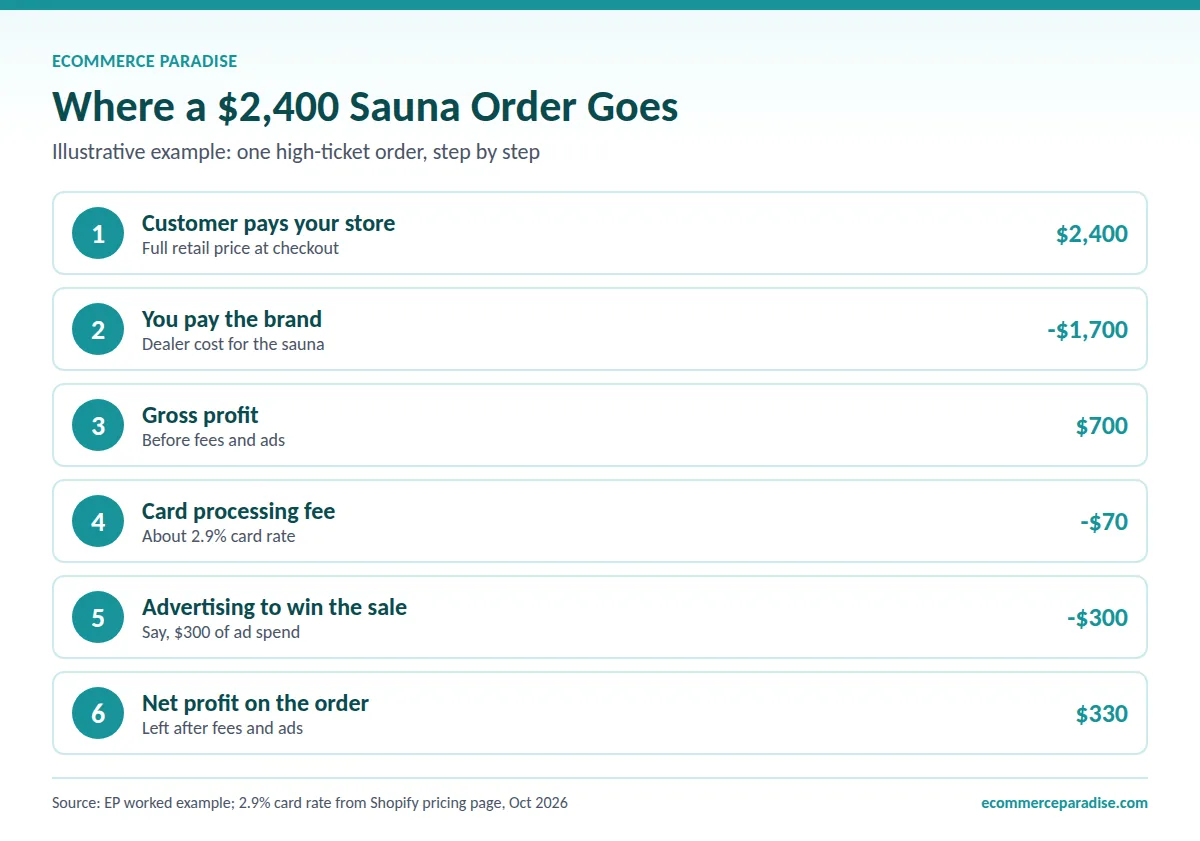
Here’s what actually happens on a typical order. I’ll use a real-world style example: a $2,400 infrared sauna.
- A shopper finds you. They search Google for “2 person infrared sauna,” see your product in Google Shopping, and click through to your store.
- They research and buy. High-ticket buyers compare specs, read reviews, check your policies and often call or chat before buying. Then they check out on your store for $2,400.
- You collect the full payment. The money lands in your Shopify Payments or payment processor account, minus a processing fee of roughly 2.9%.
- You place the order with the supplier. You send the order to the brand at your dealer cost, say $1,700, usually by email, a dealer portal or an automated integration.
- The supplier ships to your customer. The brand ships from its US warehouse, often by freight carrier for large items, and sends you tracking.
- You handle the customer. You send tracking, answer questions, and handle any issue with the supplier behind the scenes. The customer only ever deals with your brand.
On that order your gross profit is $700 before processing fees and ad spend. After about $70 in fees and, say, $300 in advertising to win the sale, you net around $330 from one order. Compare that to low-ticket dropshipping, where you’d need to sell dozens of $30 gadgets to make the same money.
High-Ticket vs. Low-Ticket Dropshipping
Most people discover dropshipping through the low-ticket model: a cheap product, a Facebook ad and a supplier in China. It can work, but the margins are razor thin and you’re always one ad account ban away from zero. Here’s how the two models compare.
| Factor | Low-Ticket Dropshipping | High-Ticket Dropshipping |
|---|---|---|
| Typical product price | $10 to $100 | $500 to $10,000+ |
| Profit per sale | $5 to $20 | $100 to $1,500+ |
| Suppliers | AliExpress, Chinese factories, generic products | US manufacturers and distributors, branded products |
| Shipping time | 1 to 4 weeks | 2 to 10 business days |
| Main traffic source | Facebook and TikTok impulse ads | Google Shopping, search and SEO |
| Buyer behavior | Impulse purchase | Researched purchase, often with a phone call |
| Orders needed for $10,000/month profit | 500 to 2,000 | 15 to 50 |
| Customer service load | High volume, low value tickets | Low volume, high value conversations |
| Barrier to entry | Very low, very saturated | Higher (supplier approval), less saturated |
| Business resale value | Lower, hard to transfer | Higher, with supplier accounts and SEO that transfer to a buyer |
There’s also a middle ground. Products in the $100 to $500 range behave a bit like both models, and I wrote a separate guide on mid-ticket dropshipping if that range interests you.
Is High-Ticket Dropshipping Worth It in 2026? Pros and Cons
Yes, if you treat it like a real business. Online sales keep taking share from physical stores: according to the US Census Bureau’s quarterly ecommerce report, US retail ecommerce hit $340.2 billion in the second quarter of 2026, 17.1% of all retail sales, up 12.2% from a year earlier. Expensive products are a growing slice of that, because buyers who used to drive to a showroom now research and buy online.
That said, I’m not going to pretend it’s easy. Here’s the honest list.
| Pros | Cons |
|---|---|
| $100 to $1,500+ profit per order, so you need far fewer sales | Supplier approval takes work, and many brands say no at first |
| No inventory to buy, store or insure | Higher startup budget than low-ticket, realistically $3,000 to $10,000 |
| Branded US products with real warranties and fast shipping | Bigger orders mean bigger risk from fraud, freight damage and chargebacks |
| Buyers are researched and deliberate, so fewer refunds | Longer sales cycles, plus phone calls and pre-sale questions |
| Google Shopping and SEO bring buyer-ready traffic | Margins are thinner as a percentage than private label, often 15% to 35% gross |
| Less ad-platform risk than impulse dropshipping | You don’t control the product, the price floor (MAP) or stock levels |
| A real asset you can sell for a multiple of profit | It takes 6 to 18 months to build to a meaningful income |
If you want the long version of my take, read is high-ticket dropshipping still profitable, where I break down what I’ve seen change over the years. And if you want the uncomfortable parts nobody puts in their sales pitch, read the brutal truth about high-ticket dropshipping.
How Much Money Can You Make With High-Ticket Dropshipping?
Real talk first: results vary a lot, and anyone promising you a number is selling something. What I can give you is how the math works and what I’ve seen across my own stores and hundreds of students and clients.
Across my stores, net margins have landed between 7% and 20% after ad spend. Gross margins from suppliers usually run 20% to 30%, sometimes higher on smaller brands. Here’s what that looks like on a store averaging $2,000 per order.
| Monthly revenue | Orders (at $2,000 AOV) | Gross profit (25%) | Ad spend (about 10% of revenue) | Fees, apps and tools | Net profit (about 12%) |
|---|---|---|---|---|---|
| $20,000 | 10 | $5,000 | $2,000 | $600 | $2,400 |
| $50,000 | 25 | $12,500 | $5,000 | $1,500 | $6,000 |
| $100,000 | 50 | $25,000 | $10,000 | $3,000 | $12,000 |
| $250,000 | 125 | $62,500 | $25,000 | $7,500 | $30,000 |
These are illustrative numbers, not a promise, but they’re realistic for a well-run store. One good store can generate $3,000 to $10,000+ in net profit per month, and it only takes one store to replace a full-time income. Plug your own numbers into my dropshipping profit calculator to see how margin and ad spend change the picture.
Typical timeline from what I’ve seen:
- Months 0 to 3: niche research, business setup, store build and supplier approvals. Little or no revenue.
- Months 3 to 6: first sales from Google Shopping, lots of testing, roughly $0 to $20,000 per month in revenue.
- Months 6 to 18: more suppliers, better ads and growing SEO, often $20,000 to $100,000 per month for stores that keep going.
- 18 months and beyond: the top stores pass $100,000 per month, and some of my students have gone past $1 million a year.
How Much Does It Cost to Start High-Ticket Dropshipping?
You don’t buy inventory, which is the biggest cost in normal retail. But you do need enough money to set things up properly and to fund ads while Google learns your store. Here’s a realistic budget for a DIY build.
| Expense | Typical cost | Notes |
|---|---|---|
| LLC formation (state fee plus service) | $100 to $500 one time | Wyoming charges a $100 state filing fee |
| Registered agent | $0 to $125 per year | Often free for year 1 with a formation service |
| Domain name | $10 to $20 per year | Short, brandable .com |
| Shopify plan | $29 to $39 per month (Basic) | $29 billed yearly, $39 billed monthly |
| Premium theme | $0 to $400 one time | Or build on the free Dawn theme with Claude |
| Apps (reviews, email, chat, inventory sync) | $50 to $300 per month | Start lean, add as you grow |
| Business phone number | $15 to $30 per month | Non-negotiable for high-ticket |
| Starting ad budget | $2,000 to $5,000 | Google Shopping first, over 2 to 3 months |
| Bookkeeping and legal templates | $20 to $100 per month | Policies, terms and clean books from day one |
| Total to launch properly | About $3,000 to $10,000 | The ad budget is the biggest variable |
Can you start with less? Yes, people do it with $1,000 to $2,000, but you’ll grow slower because you can’t afford to let Google Shopping collect data. If you want to plan it out properly, my dropshipping business plan template walks through the full budget.
Skip Weeks of Niche Research
Get my free list of 1,000+ high-ticket dropshipping niches, the same list I use to brainstorm new stores.
How to Start a High-Ticket Dropshipping Business in 8 Steps
Here’s the full roadmap. Each step has its own detailed section below, so use this as your checklist and come back to it as you go.
- Pick and validate your niche using the criteria and research process above.
- Form your business: LLC, EIN, bank account, sales tax permit and a business phone number.
- Build your store on Shopify with a professional theme, trust signals and policies.
- Find and get approved by suppliers as an authorized dealer.
- List products and set prices with clean product data, MAP compliance and automated inventory updates.
- Drive traffic with Google Shopping first, then SEO, email and retargeting.
- Run operations: order processing, customer service, freight issues, returns and fraud prevention.
- Scale and eventually sell by adding suppliers, building systems, hiring help and preparing for an exit.
If you’d like this whole process as a guided course with templates, my free mini course on high-ticket dropshipping is the best place to start. I also put together a full launch checklist in everything you need to launch a high-ticket dropshipping business.
Step 1: Pick Your Niche (Best High-Ticket Dropshipping Products for 2026)
Picking the niche is the single most important decision you’ll make, so let’s spend some time here. The best high-ticket niches share a handful of traits:
- Average order value of $500+, ideally $1,000 to $5,000.
- Lots of US brands (at least 10 to 20), so you’re never dependent on one supplier.
- Buyers who are willing and able to pay, usually homeowners, baby boomers and Gen X with disposable income, or businesses.
- Products people research before buying, where content, specs and trust actually change the decision.
- Hard to buy at big-box stores, because they’re large, specialized, or need expert advice.
- MAP pricing enforced by the brands, so you’re not in a race to the bottom on price.
- Evergreen or multi-season demand, not a one-time fad.
Here are the niches I like for 2026, based on my own stores, client stores and what I’m seeing in Google Shopping right now.
| Niche | Typical order value | Why it works | Watch out for |
|---|---|---|---|
| Saunas and cold plunges | $2,000 to $10,000 | Wellness boom, passionate buyers, many US brands | Freight logistics and electrical questions |
| Home gym equipment | $800 to $5,000 | Huge search volume, evergreen demand | Big-box competition on entry-level gear |
| Outdoor furniture and patio sets | $1,500 to $8,000 | Homeowner buyers, strong MAP brands | Seasonality in northern states |
| Fire pits, outdoor kitchens and grills | $1,000 to $10,000 | Lifestyle purchase, great for content | Gas line and installation questions |
| Electric bikes and scooters | $1,200 to $6,000 | Growing category, enthusiastic community | Battery shipping rules and warranty claims |
| Mobility scooters and medical equipment | $800 to $5,000 | Older buyers with real need, repeat category | Insurance and regulatory questions |
| Generators and backup power | $1,000 to $15,000 | Demand spikes around storm season, high AOV | Stock swings during hurricanes and outages |
| HVAC and mini-split systems | $1,000 to $10,000 | Essential purchase, contractor and DIY buyers | Installation and licensing questions |
| Commercial kitchen and restaurant equipment | $1,000 to $20,000 | B2B buyers, repeat orders, quote requests | Freight, liftgate and dock delivery details |
| Laser engravers and maker equipment | $1,000 to $10,000 | Small business buyers, technical content wins | Pre-sale support takes product knowledge |
| Flight and racing simulators | $1,000 to $15,000 | Passionate hobby buyers who spend big | Smaller pool of suppliers |
| Hot tubs and swim spas | $4,000 to $15,000 | Very high AOV, local delivery is a moat | Dealer territory restrictions |
| Industrial and warehouse equipment | $1,000 to $25,000 | Boring B2B niches with little competition | Net terms and purchase orders |
| Pool tables, game room and arcade | $1,500 to $10,000 | Home entertainment buyers, giftable | White-glove delivery expectations |
| Trade show displays and signage | $800 to $8,000 | Business buyers with budgets and deadlines | Custom print proofs and rush orders |
Notice how many of those are “boring.” That’s on purpose. Boring B2B and home niches tend to have less competition and more serious buyers, which is why I wrote a whole post on why boring B2B niches are the best opportunity in 2026. On the flip side, some niches are crowded now, and I cover those in the most oversaturated high-ticket niches.
For a much bigger list with specific product ideas, go through my high-ticket niches list. If you want product-level examples, read high-ticket products to sell online in 2026.
How I validate a niche in about an hour
This is my go-to research process, the same one I show on YouTube. You can do all of it for free.
- Search Google Shopping for the main product and sort by price high to low. If you see lots of products over $1,000 from many different stores, that’s a good sign.
- Count the brands. Write down every brand you see. You want at least 10 to 20 US brands, not 2 or 3.
- Look at the competitors. Are they small specialized stores or only giant retailers and marketplaces? Small stores ranking is a green light, because it means you can compete.
- Check search demand with a keyword tool. Hundreds or thousands of monthly searches for the core product terms is plenty.
- Check prices across stores. If everyone sells at the same price, the brands enforce MAP, which protects your margin.
- Ask yourself if you’d enjoy it. Profitability comes first, but you’ll be living in this niche for years. Being interested in it helps you push through the hard months.
For the full version with examples, read my guide on how to validate a high-ticket dropshipping niche. Real experience in an industry also counts for a lot, which I explain in why experience beats passion when picking a niche.
Step 2: Form Your Business the Right Way
Suppliers want to work with real businesses. Before most brands approve you as a dealer, they’ll ask for your business name, EIN, resale certificate and sometimes a credit application. So do this before you start supplier outreach, not after. My complete business formation guide for high-ticket dropshipping goes deep on every piece, but here’s the checklist.
1. Form an LLC
An LLC separates your personal assets from the business and makes you look legitimate to suppliers and payment processors. Most of my students start with a single-member LLC. The SBA’s guide to choosing a business structure explains how an LLC compares with a sole proprietorship or corporation.
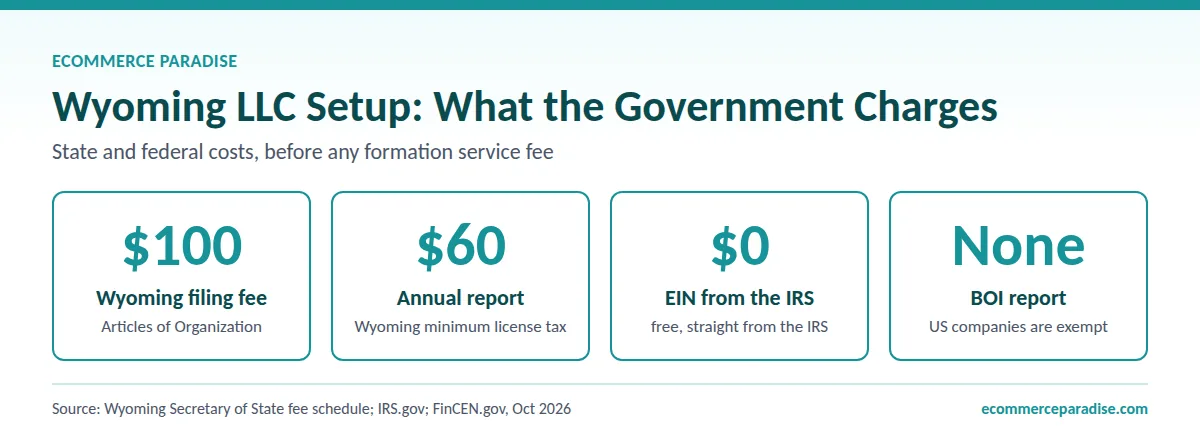
Which state? If you live in the US, forming in your home state is usually simplest, because you’ll likely have to register there anyway. If you’re a digital nomad like me, or you value privacy, Wyoming is popular: it has a $100 filing fee, a $60 minimum annual report, no state income tax and strong privacy. I walk through the full process in how to form an LLC for a high-ticket dropshipping store.
2. Get your EIN
Your Employer Identification Number is your business’s tax ID. Suppliers, banks and Shopify Payments all ask for it. It’s free directly from the IRS, so never pay someone just for an EIN, and you can apply for an EIN online at IRS.gov in about 10 minutes.
3. Register for a sales tax permit and resale certificate
This one trips up a lot of beginners. You’ll need a sales tax permit (also called a seller’s permit) in your home state, and a resale certificate so suppliers don’t charge you sales tax on your wholesale orders. Since the Supreme Court’s South Dakota v. Wayfair decision, states can also require you to collect sales tax once you pass their economic nexus threshold, so watch your sales by state as you grow.
Shopify can calculate and collect sales tax automatically, which makes this much easier. Talk to a CPA once you start selling in volume.
4. Open a business bank account
Keep business and personal money completely separate from day one. I like Mercury for online businesses because it’s built for ecommerce founders, has no monthly fees and works great with Shopify payouts. I compare it with the other options in my guide to the best bank for dropshipping.
Add a business credit card early, too. Your ad spend and supplier payments are big, so the right card turns them into real rewards, and I share my exact card stack in my guide to the best credit cards for dropshipping.
5. Get a business phone number and address
High-ticket customers call before they buy, and a lot of your sales will happen on the phone. I use Quo for a business line that rings on my phone and laptop, with shared inboxes and call recording for VAs. If you work from home or travel, a virtual address from Traveling Mailbox keeps your home address off your website and filings.
6. Set up bookkeeping and business credit
Clean books make tax time painless and they’re essential when you sell your store. Finaloop is my pick for ecommerce bookkeeping because it connects to Shopify and handles cost of goods automatically. Then get a business credit card to float ad spend and supplier payments, and earn points while you do it. My guide to the best credit cards for ecommerce businesses compares the options.
One update for 2026: US companies no longer have to file a Beneficial Ownership Information report. The FinCEN BOI page confirms that domestic companies are now exempt, so you can skip that step that a lot of older guides still mention.
Best LLC formation services to get started
You can file your LLC yourself with the state, but a formation service handles the paperwork, includes a registered agent and keeps your name and address off public records. These are the four I recommend most.
- Northwest Registered Agent: my top pick for privacy. They use their own address on your public filings and include a year of registered agent service, which is perfect for nomads and home-based founders.
- Bizee: the best budget option, with a free first year of registered agent service and a simple online process.
- LegalZoom: a good choice if you want attorney access and a big brand name behind your filing.
- ZenBusiness: easy to use, with handy compliance reminders so you never miss an annual report.
Need help deciding the structure, state or tax setup for your situation? Business formation is one of the most common topics in my private high-ticket dropshipping coaching sessions.
Step 3: Build Your High-Ticket Ecommerce Store
Your store does three jobs at once. It has to convince suppliers you’re a legit dealer, convince Google you’re a trustworthy merchant, and convince a shopper to hand over $2,000 to a brand they just discovered. A cheap-looking store fails all three.
Use Shopify
I’ve built on almost every platform over the years, and for high-ticket dropshipping I recommend Shopify because it’s reliable, fast, secure and has the best app ecosystem for inventory sync, reviews and Google Shopping. The Basic plan is $29 per month billed yearly, and it’s all you need to launch. If you want the full comparison with BigCommerce, WooCommerce and others, read my guide to the best ecommerce platform for high-ticket products.
Pick a clean, professional theme
Skip the flashy one-product themes made for impulse buys. High-ticket stores need big catalogs, mega menus, detailed spec tables and strong search. Superstore by Pixel Union is built for exactly that kind of catalog. These days I also build fully custom themes on Shopify’s free Dawn theme with Claude, which is what we do on our done-for-you builds.
The pages every high-ticket store needs
- A homepage that says exactly what you sell, who it’s for and why you’re the expert, with your phone number visible.
- Collection pages with filters for the specs buyers care about (size, power, material, price).
- Product pages with full specs, 6+ images, video, FAQs, shipping details, warranty info and reviews.
- An About page with your story, photos and why you started the store.
- Contact page with phone, email, chat and a business address.
- Shipping, returns, warranty, privacy and terms pages written clearly for big, freight-shipped items.
- A quote request form for bulk, B2B and custom orders.
- Buying guides and blog content that answer the questions buyers ask before spending thousands.
Two of those pages deserve extra attention. Your returns policy has to protect you from expensive freight returns while still building trust, so read how to write a returns policy for high-ticket items. And if you sell to businesses at all, add a quote form using my guide on building a quote request form for a high-ticket store.
For the legal pages, Termly generates compliant privacy policies, terms and cookie banners so you’re not copying someone else’s policies and hoping for the best.
Trust signals that close high-ticket sales
When someone is about to spend $3,000, trust is everything. Here’s what I put on every store we build:
- Phone number in the header, on every product page and at checkout
- Live chat (Shopify Inbox is free and works well)
- Product reviews and store reviews from real customers
- “Authorized dealer” badges for brands that provide them
- Clear shipping timelines and freight delivery details
- Secure checkout badges and financing options like Shop Pay Installments
- A real About page with your face on it
For reviews, I use Judge.me on most stores because it’s affordable, pulls reviews into Google Shopping and looks clean. I cover the rest of the app stack in the best Shopify apps for high-ticket dropshipping.
Product pages that convert
High-ticket shoppers read. They want dimensions, weight, power requirements, materials, warranty terms, delivery method and what’s in the box. They want to see the product from every angle and ideally in a real setting. If your product page has two sentences copied from the manufacturer, you’ll lose to the store that answers every question.
My guide on how to optimize Shopify product pages for high-ticket sales shows what to include. If you want help with the writing itself, read how to write product descriptions that sell.
For the bigger picture, my Shopify conversion rate optimization guide covers everything from site speed to checkout.
Build email capture in from day one
According to the Baymard Institute’s cart abandonment research, about 70% of online shopping carts get abandoned, based on 50 different studies. For high-ticket products, I see people come back days or weeks later. That’s why email is critical.
I use Klaviyo on my stores for welcome flows, abandoned cart, browse abandonment and post-purchase review requests. Set those 4 flows up before you launch and they’ll recover sales on autopilot.
Want the Whole Store Built for You?
Our turnkey service covers niche selection, business formation guidance, a custom Shopify store, US supplier recruiting, product catalog setup, Klaviyo email and Google Shopping ads. Packages start from $4,999.
Step 4: Find and Get Approved by High-Ticket Dropshipping Suppliers
This is the step that scares people off, and honestly, that’s a good thing. Supplier approval is the moat that keeps high-ticket dropshipping from being as saturated as low-ticket. If it were easy, everyone would do it.
What a good high-ticket supplier looks like
- US-based warehouse with fast shipping, usually 2 to 10 business days
- A dealer or dropship program with a written authorized dealer agreement
- Enforced MAP pricing (minimum advertised price) so competitors can’t undercut you
- Healthy margins, ideally 20% to 40% off retail
- Clear warranty, returns and freight damage policies
- Product data you can use: images, specs and ideally a data feed for inventory and pricing
- A real person to talk to, because you’ll need them when something goes wrong
Mid-tier brands are often better partners than the biggest names. They have less competition, they’re more willing to approve new dealers, and they actually return your calls. I list the brands and distributors I’d look at first in my roundup of the best high-ticket dropshipping suppliers.
Where to find high-ticket suppliers
- Your competitors’ websites. This is my favorite method. Find 10 stores in your niche, list every brand they carry, and you have your supplier target list. If a small store carries a brand, that brand works with online dealers.
- Google Shopping. Search your products, sort by price, and note every brand that shows up from multiple retailers.
- The manufacturer’s website. Look for “become a dealer,” “dealer application” or “wholesale” links in the footer.
- Trade shows. Industry expos are the best place to meet brands in person, and a handshake gets you approved faster than any email.
- Supplier directories. They save time on the research side, as long as you remember a listing isn’t an approval.
On directories: I built Supplier Paradise, which is Ecommerce Paradise’s own directory of 11,096 brand, manufacturer and distributor leads across 889 product niches (as of October 2026), with access from $9 per month or $49 per year. Full disclosure, I own it, and I’ll be straight with you: it’s a research starting point, not a guarantee. A listing doesn’t mean a company dropships or will approve your store, so you still have to do the outreach. If you’d rather use a third-party directory with built-in market research, SaleHoo is the one I’d look at, with plans starting at $9 per month billed annually.
How to get approved: my outreach process
- Launch your store first. Have your branding, policies, About page and contact info live before you reach out. Suppliers will look at your site.
- Have your paperwork ready: LLC documents, EIN, resale certificate and a business address and phone number.
- Call first, then email. Ask for the dealer or ecommerce sales manager. A 5 minute phone call beats 10 unanswered emails.
- Pitch them like a retailer. Explain your niche focus, how you’ll market their products (Google Shopping, SEO, email), and that you’ll respect their MAP policy.
- Fill out the dealer application and credit application if they have one.
- Follow up. Most approvals come on the second or third follow-up, not the first email.
- Keep going. Expect plenty of no’s early on. Each approval makes the next one easier, because you can tell new brands who else you carry.
For the full walkthrough, including scripts, what to say when they ask about your sales volume and how to handle “we don’t dropship,” read my step-by-step guide to finding high-ticket dropshipping suppliers.
Typical supplier terms you’ll see
| Term | What’s typical | What to ask for |
|---|---|---|
| Dealer margin | 20% to 40% off MSRP | Volume tiers that improve as you sell more |
| Payment terms | Credit card at order to start | Net 30 terms after a few months of good history |
| Dropship fee | $0 to $25 per order | Waived fees once you hit a monthly volume |
| Shipping | Free parcel shipping or a freight charge | Free freight on orders over a set amount |
| MAP policy | Advertised price can’t go below MAP | A copy in writing so you know the rules |
| Returns | Restocking fee of 15% to 30% | Clear process for damaged and defective items |
| Product data | Images and spec sheets | A CSV, FTP or API feed for inventory and pricing |
If you don’t have the time to recruit suppliers yourself, my team does it for you. Our supplier recruiting and catalog management service handles the research, outreach, dealer applications and follow-up until brands approve your account.
Step 5: List Your Products and Price Them Right
Once a supplier approves you, you need their products on your store with accurate stock and pricing. This sounds simple, and it’s where a lot of stores quietly lose money.
Import products cleanly
Most suppliers give you a spreadsheet or data feed. Import it into Shopify, then rewrite titles and descriptions so they’re unique and genuinely helpful. Titles should include the brand, model number and key specs, because high-ticket buyers search for exact model numbers.
Automate inventory and price updates
Nothing kills a high-ticket store faster than selling a $4,000 item that’s out of stock. If your supplier provides a feed, use an inventory sync app like Stock Sync to update stock levels and prices automatically. If they don’t, set a weekly reminder to check stock on your top sellers manually.
Price for profit and MAP
Most high-ticket brands set a MAP price, and many stores simply sell at MAP. That’s fine. You compete on trust, content, service and shipping instead of price. Where you have room above MAP, test it, because high-ticket buyers care more about confidence than a $20 difference. My full guide on how to price high-ticket products covers pricing strategy. My guide to monitoring MAP, stock and competitors shows how to keep an eye on the market.
Product images and video
You can’t photograph products you never hold, so start with supplier images and add lifestyle shots, comparison graphics and spec infographics. AI tools have changed the game here, and I show exactly how in using AI for product images and UGC videos.
Step 6: Drive Traffic and Make Sales
High-ticket buyers don’t buy from impulse ads on social media. They search. That’s why my marketing order is always the same: Google Shopping first, then SEO and content, then email and retargeting. Get the first one working before you spread yourself thin.
Google Shopping: your #1 revenue driver
When someone types “infrared sauna for 2 people” into Google, they’re ready to buy, and Google Shopping puts your product, price and store right in front of them with a photo. On almost every high-ticket store I’ve run or managed, Google Shopping has been the biggest source of revenue.
Here’s how I set it up in 2026:
- Create a Google Merchant Center account and connect it to Shopify with the Google and YouTube app.
- Clean up your product feed. Accurate titles, GTINs or MPNs, brand, price, availability and high-quality images. Google’s Merchant Center product data specification lists every attribute it expects.
- Launch a feed-only Performance Max campaign. For multi-brand high-ticket stores, I start with feed-only PMax (no creative assets) from day one, and use Standard Shopping as the fallback.
- Set up conversion tracking properly so Google learns which clicks turn into sales.
- Give it time and budget. Plan on $1,000 to $2,000 per month for the first 2 to 3 months while Google learns.
- Mirror it on Microsoft Ads (Bing Shopping), which often has cheaper clicks and an older audience that fits high-ticket products well.
Getting the click is only half of it. Read how to turn Google Shopping clicks into sales for the on-site side. Then read why high-ticket Google Ads need a complete conversion system to see how ads, phone, chat and email work together.
If you’d rather hand ads off completely, my team runs Google and Bing Shopping ad management for high-ticket stores.
SEO and content: the long game that pays the most
SEO is slow, and it’s also the best traffic you’ll ever get, because it’s free and it compounds. High-ticket buyers search things like “best home sauna for small spaces” or “Brand A vs Brand B treadmill,” and the store that answers those questions earns the sale.
- Optimize collection pages for category keywords (“outdoor fire pit tables”).
- Optimize product pages for model numbers and brand plus product terms.
- Publish buying guides, comparisons and how-to posts every week.
- Build links from industry blogs, suppliers’ dealer locators and partner sites.
For keyword research, Semrush is the tool I’d pick if you’re only going to pay for one, since it shows your competitors’ best keywords and pages. If you want content and SEO done for you, check out our done-for-you SEO content service.
Email marketing
Most high-ticket buyers don’t buy on the first visit, so capture the email and follow up. A popup with a small discount, a buying guide or a giveaway entry works well. Then let your Klaviyo flows nurture them. I break down the sequences that work in my guide to email marketing for high-ticket products.
Phone sales
This is the most underrated part of high-ticket. A big chunk of my sales over the years started with a phone call or ended with one. Put your number everywhere, answer it, and know your products. When someone calls about a $5,000 order, they’re basically telling you they want to buy from you if you can answer their questions.
Retargeting and other channels
Once Google is profitable, add retargeting on Facebook, Instagram and YouTube to stay in front of people who visited but didn’t buy. Pinterest works great for home and outdoor niches. I compare the options in the best ad platforms for high-ticket dropshipping.
Step 7: Run the Business Day to Day
Once orders start coming in, your job shifts from building to operating. Here’s what that looks like, and where things go wrong.
Order processing
When an order comes in, verify it looks legitimate, place it with the supplier the same day, and send the customer a confirmation with a realistic delivery estimate. Then forward tracking as soon as you have it. My Shopify order fulfillment guide for high-ticket dropshipping walks through the full workflow.
Freight, delivery and damage
Big items ship by LTL freight, which means delivery appointments, liftgates and curbside drop-offs. Tell customers exactly what to expect, and tell them to inspect the shipment and note any damage on the delivery receipt before signing. That one instruction saves you a lot of headaches with freight claims. Set your shipping rules up correctly with my guide to Shopify shipping zones and rates for high-ticket products.
Also know the rules on shipping promises. The FTC’s Mail, Internet, or Telephone Order Merchandise Rule requires you to ship within the time you state (or 30 days if you don’t state one) and to notify customers about delays.
Fraud and chargebacks
Fraudsters love expensive products. Watch for mismatched billing and shipping addresses, rush shipping to freight forwarders and multiple failed cards. For extra protection, ClearSale reviews risky orders and guarantees approved ones against fraud chargebacks. Read my guide on chargeback prevention for high-ticket stores before you scale your ad spend.
Customer service
Your customers deal only with you. When something goes wrong, you work it out with the supplier behind the scenes. Respond fast, be honest about timelines and over-communicate. Great service is how a small store beats the giant marketplaces.
Hiring help
Once you’re doing a few orders a day, hire a virtual assistant for order processing, tracking updates and product uploads. I’ve hired VAs from the Philippines for years through OnlineJobs.ph, where you can find a great full-time assistant at an affordable rate. Write SOPs for every task first, because systems are what let you step back from the day-to-day.
Step 8: Scale and Sell Your Store
Go deep before you go wide
The fastest way to grow is not launching a second store. It’s adding more brands and products to the store that’s already working. Every new supplier adds catalog, keywords and Google Shopping listings to a store that already has trust and traffic. Add suppliers, add content and improve conversion before you think about store number 2.
Watch out for seasonality too. A lot of high-ticket niches swing hard between summer and winter, so plan your catalog around it with my guide on how to beat seasonality in high-ticket dropshipping.
Build systems and a team
SOPs, checklists, automations and VAs turn a job into a business. The goal is a store that runs without you working in it every day, which is also exactly what buyers pay for when you sell.
Selling your store
This is the part most dropshipping courses never mention. A high-ticket store with real supplier accounts, clean books, SEO traffic and documented processes is an asset that buyers will pay a multiple of annual profit for. I’ve sold 4 high-ticket stores myself, plus the portfolio sale in 2022, and planning the exit from day one changed how I built every store.
If you’re thinking about an exit, read how to prepare a high-ticket dropshipping store for an exit. And if you’re ready to buy or sell, our high-ticket dropshipping store brokerage connects buyers and sellers in our network.
The 12 Most Common High-Ticket Dropshipping Mistakes
- Picking a niche with only 2 or 3 brands. One supplier changes their policy and your store is dead.
- Reaching out to suppliers before the store is ready. You get one first impression. Make it a good one.
- Skipping the business setup. No LLC, no EIN and no resale certificate means no approvals.
- Hiding the phone number. High-ticket buyers want to talk to a human.
- Using manufacturer copy on every product page. Duplicate content won’t rank and doesn’t sell.
- Selling out-of-stock products. Automate inventory or check it constantly.
- Running Facebook ads first. Start with search intent on Google Shopping.
- Quitting Google Ads after 2 weeks. The algorithm needs data, so budget for 2 to 3 months.
- Breaking MAP. It’s the fastest way to lose a supplier for good.
- Ignoring freight damage instructions. Teach customers to inspect before signing.
- Launching store number 2 too early. Go deep before you go wide.
- Doing everything alone forever. Hire help, write SOPs and get a mentor who has done it.
DIY, Coaching or Done for You: Which Path Fits You?
There’s no single right way to start. It comes down to how much time you have, how much you want to learn and your budget. Here’s how the options compare at Ecommerce Paradise.
| Path | Best for | Investment |
|---|---|---|
| DIY with the Masterclass | Learners who want to build it themselves with a proven system and community | $9 per month or $49 per year after a 7 day free trial |
| Private coaching | Builders who want expert eyes on their store and decisions | $97 per hour, or done-with-you packages from $997 for 12 calls |
| Done-for-you turnkey build | Busy professionals and investors who want a store built and launched for them | From $4,999 |
| Scaling services | Store owners already making sales who want to grow faster | From $997 per month |
Still comparing courses and programs? I put together an honest ranking of the best high-ticket dropshipping courses, including how mine stacks up.
My Recommended High-Ticket Dropshipping Tool Stack
You don’t need 40 apps. Here’s a lean stack that covers everything a high-ticket store needs, with the tool I’d pick in each category.
| Job | Tool I recommend | Why |
|---|---|---|
| Ecommerce platform | Shopify | Reliable, fast and the best app ecosystem |
| Theme | Superstore by Pixel Union | Built for big multi-brand catalogs |
| LLC formation | Northwest Registered Agent | Privacy-first filings and registered agent included |
| Business banking | Mercury | Built for online businesses, easy Shopify payouts |
| Business phone | Quo | Shared business line for you and your VAs |
| Email marketing | Klaviyo | The best ecommerce flows and segmentation |
| Product reviews | Judge.me | Affordable and feeds reviews into Google Shopping |
| Inventory sync | Stock Sync | Automates stock and price updates from supplier feeds |
| Fraud protection | ClearSale | Reviews risky high-value orders |
| Bookkeeping | Finaloop | Ecommerce-specific books connected to Shopify |
| Legal policies | Termly | Compliant privacy policy, terms and cookie banner |
| SEO research | Semrush | Competitor keywords and content gaps |
| Virtual assistants | OnlineJobs.ph | Affordable, skilled full-time VAs |
| Supplier research | Supplier Paradise (my own directory) | 11,096 brand and distributor leads to research |
High-Ticket Dropshipping FAQs
Is high-ticket dropshipping legit?
Yes. High-ticket dropshipping is a legal, established retail model. Many well-known online retailers have products shipped directly from manufacturers and distributors. You’re an authorized dealer selling real branded products, and the supplier ships to your customer. The scams are in the overhyped courses, not the business model itself.
Is high-ticket dropshipping still profitable in 2026?
Yes, for people who treat it like a real retail business. Across my stores, net margins have landed between 7% and 20% after ad spend, and a single good store can make $3,000 to $10,000+ in net profit per month. Results depend on your niche, suppliers, store quality and marketing.
How much money do I need to start high-ticket dropshipping?
Plan on about $3,000 to $10,000 to launch properly. That covers your LLC, Shopify, apps, a business phone and, most importantly, $2,000 to $5,000 for Google Shopping ads over the first few months. People start with less, but they grow slower.
What counts as a high-ticket product?
Most people define high-ticket as products that sell for $500 or more. On my own stores, the sweet spot has been $1,000 to $5,000 per order, with gross margins of roughly 20% to 30% from US brands.
Do I need an LLC to start high-ticket dropshipping?
Practically, yes. Most US brands won’t approve you as a dealer without a registered business, an EIN and a resale certificate. An LLC also protects your personal assets and makes it easier to open business bank accounts and payment processing.
How do I find high-ticket dropshipping suppliers?
Start with competitors: list the brands that small online stores in your niche carry, because those brands already work with online dealers. Then check manufacturer websites for dealer applications, go to trade shows, and use supplier directories for research. Call before you email, and follow up several times.
Is high-ticket dropshipping saturated?
Low-ticket dropshipping is very saturated. High-ticket is much less so, because supplier approval, the startup budget and the work of building a real brand filter out most of the competition. Some popular niches are crowded, but new niches and brands keep appearing every year.
How long does it take to make money with high-ticket dropshipping?
Expect 3 to 6 months to get set up, approved and making your first consistent sales, and 6 to 18 months to build to a meaningful income. It’s a real business, not a get-rich-quick scheme.
Can I do high-ticket dropshipping from outside the US?
Yes. I’ve run my stores as a digital nomad for years. Non-US residents can form a US LLC and sell to US customers, but there’s more paperwork for the EIN, banking and payment processing, so use a formation service and talk to a CPA who works with foreign-owned US companies.
Can I run a high-ticket dropshipping store part-time?
Yes, especially in the early stages. Many of my students built their first store while working full-time jobs. Because high-ticket stores need fewer orders, you can handle the early volume around a job and hire a VA as you grow.
What happens if a high-ticket product arrives damaged?
Your customer contacts you, and you handle the claim with the supplier, who usually replaces the item or the damaged part and files the freight claim. Tell customers to inspect freight deliveries and note any damage on the delivery receipt before signing, because that makes claims much easier.
Is Shopify the best platform for high-ticket dropshipping?
For most people, yes. Shopify is reliable, secure, easy to use and has the best apps for inventory sync, reviews, email and Google Shopping. The Basic plan is $29 per month billed yearly, which is all you need to launch.
What is the best traffic source for high-ticket dropshipping?
Google Shopping. High-ticket buyers search for specific products and compare prices, and Google Shopping shows your product photo, price and store right in the search results. Add SEO, email and retargeting once Google Shopping is profitable.
Is high-ticket dropshipping better than Amazon FBA?
They’re different models. Amazon FBA means buying inventory upfront and building on Amazon’s platform under its rules and fees. High-ticket dropshipping needs no inventory, you own your store, customer list and brand, and you can sell the business as a standalone asset. I prefer owning the store.
What is high-ticket ecommerce?
High-ticket ecommerce means selling expensive products online, usually $500 or more per order. High-ticket dropshipping is the version where authorized US brands ship each order straight to your customer, so you run your own branded store without buying or holding inventory.
Final Thoughts: Build It Like a Real Business
High-ticket dropshipping isn’t a shortcut. It’s a real retail business where you skip the hardest and most expensive part, inventory, and focus on what actually makes money: picking the right niche, getting great suppliers, building trust and driving buyers who are ready to spend.
If you take one thing from this guide, make it this: pick a niche with lots of US brands, build a store that looks like a business, get approved by as many suppliers as you can, and put your first ad dollars into Google Shopping. Then go deep before you go wide. That’s the same playbook I’ve used since October 2010.
Here’s what to do next, depending on where you are:
- Just exploring? Grab the free 1,000+ high-ticket niches list and start researching.
- Ready to build it yourself? Join the High-Ticket Dropshipping Masterclass with a 7 day free trial.
- Want it done for you? Book a call about our turnkey high-ticket store build.
- Already making sales? Talk to us about our scaling services.
You can also reach me directly at +1 206-504-6099, and WhatsApp works best if you can. I’m always happy to talk about your niche and goals.
Build Your High-Ticket Store With a Proven System
18 modules, 20+ hours of video, real store case studies and a community of builders. Try it free for 7 days, then $9 per month or $49 per year.
Trevor Fenner is the founder of Ecommerce Paradise. He has been building, growing and selling high-ticket dropshipping stores since October 2010, and he teaches entrepreneurs worldwide how to build premium ecommerce businesses with US suppliers, high-margin products and Google Shopping.
Related Articles
If you found this useful, these guides go deeper on related topics:
- High-Ticket Ecommerce: Why Selling Expensive Products Online Is the Smartest Business Model
- 9 Best Industrial Equipment Dropshipping Suppliers for High-Ticket Stores
- Shopify Store Design Tips That Actually Convert High-Ticket Buyers
- Best CRM Software for High-Ticket Ecommerce Businesses
- How to Protect a High-Ticket Dropshipping Store From Fraud and Chargebacks

Trevor Fenner is an ecommerce entrepreneur and the founder of Ecommerce Paradise, a platform focused on helping entrepreneurs build and scale profitable high-ticket ecommerce and dropshipping businesses. With over a decade of hands-on experience, Trevor specializes in high-ticket dropshipping strategy, niche and product selection, supplier recruiting and onboarding, Google & Bing Shopping ads, ecommerce SEO, and systems-driven automation and scaling. Through Ecommerce Paradise, he provides free education via in-depth guides like How to Start High-Ticket Dropshipping, advanced training through the High-Ticket Dropshipping Masterclass, and fully done-for-you turnkey ecommerce services for entrepreneurs who want a faster, more hands-off path to growth. Trevor is known for emphasizing sustainable, real-world ecommerce models over hype-driven tactics, helping store owners build scalable, sellable, and location-independent brands.

Still deciding what to sell?
Grab the free list of 1,000+ niches that work for high-ticket dropshipping, sorted by category.
Free. Unsubscribe any time.


