

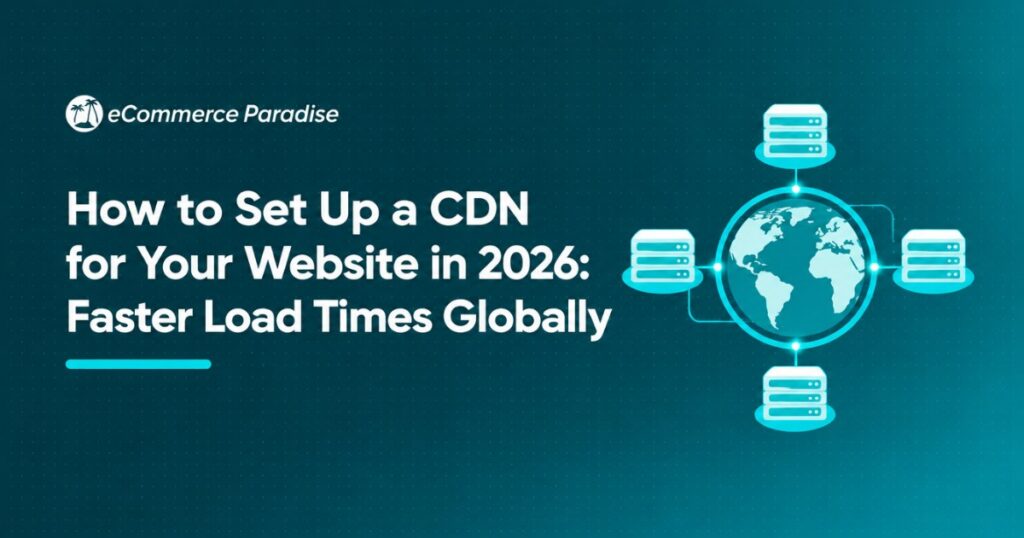
A Content Delivery Network (CDN) is one of the most effective ways to speed up your website, and setting one up is way easier than most people think. If your website serves visitors from multiple geographic locations, a CDN can reduce page load times by 40% to 60% for visitors who are far from your origin server. That’s a massive improvement for a setup that takes about 15 minutes.
At E-Commerce Paradise, I set up CDNs on every client website because the performance gains are too significant to skip. In this guide, I’ll walk you through how CDNs work, which CDN service to choose, and the step-by-step setup process for the most popular CDN providers. Whether you’re running a blog, a business site, or a high-ticket dropshipping store with customers across the country, a CDN makes your site faster for everyone.
How a CDN Actually Works
Without a CDN, every visitor to your website downloads all content (images, CSS, JavaScript, fonts) directly from your origin server. If your server is in New York and a visitor is in Los Angeles, the data has to travel across the country. If a visitor is in London, the data crosses the Atlantic Ocean. The physical distance creates latency that slows down page loads.
A CDN solves this by caching copies of your website’s static content on servers (called edge servers or Points of Presence) located around the world. When a visitor in Los Angeles requests your page, they download static content from a CDN edge server in Los Angeles instead of your origin server in New York. The result is dramatically reduced latency and faster load times.
According to Cloudflare’s CDN documentation, CDNs handle a significant percentage of all internet traffic globally. Major websites and services rely on CDNs to deliver content quickly to their worldwide audiences.
What a CDN Caches
A CDN caches static content, which includes images (JPEG, PNG, WebP, GIF, SVG), CSS stylesheets, JavaScript files, web fonts, PDF documents and downloadable files, and video content (on CDNs that support media delivery). Dynamic content like database-driven pages (your WordPress post content, WooCommerce product pages, cart and checkout) is typically not cached by a CDN and still comes from your origin server. However, some advanced CDNs offer full-page caching for dynamic content as well.
Choosing the Right CDN
There are several CDN options available, from free to enterprise-level. Here are the most popular choices.
Cloudflare (Best Free Option)
Cloudflare offers a generous free plan that includes CDN, DDoS protection, SSL, and basic security features. Their network spans 300+ cities in over 100 countries. The free plan is sufficient for most small to medium websites. Paid plans start at $20 per month for additional features like image optimization and advanced caching rules.
Hosting Provider CDNs
Many hosting providers include CDN functionality. WPX Hosting includes a free high-speed CDN with 26 global endpoints on every plan. Cloudways offers their own CDN add-on starting at $1 per 25 GB of bandwidth. SiteGround includes their own CDN with paid plans. Using your host’s CDN is often the simplest setup since it’s pre-integrated.
Premium CDN Providers
For high-traffic sites that need maximum performance, premium CDN providers like KeyCDN, StackPath, or BunnyCDN offer more control, better analytics, and potentially faster delivery. These typically charge based on bandwidth usage, starting at $0.01 to $0.04 per GB.
Setting Up Cloudflare CDN (Free)
Cloudflare is the most popular free CDN and the one I recommend for most websites. Here’s the step-by-step setup.
Step 1: Create a Cloudflare Account
Go to cloudflare.com and sign up for a free account. Click “Add a Site” and enter your domain name. Select the “Free” plan.
Step 2: Import DNS Records
Cloudflare will automatically scan your domain’s existing DNS records and import them. Review the imported records to make sure everything is correct. Pay special attention to your A records (pointing to your hosting server), MX records (for email), CNAME records, and TXT records (for SPF, DKIM, and domain verification).
Each DNS record has a proxy status (orange cloud icon). Records with the orange cloud enabled will be routed through Cloudflare’s CDN. Records with the gray cloud are DNS-only and bypass Cloudflare. Enable the orange cloud on your A records and CNAME records. Keep MX records (email) as DNS-only (gray cloud).
Step 3: Update Nameservers
Cloudflare will provide two nameserver addresses. Log into your domain registrar (where you purchased your domain) and replace the existing nameservers with Cloudflare’s nameservers. Nameserver changes can take up to 48 hours to propagate, but usually happen within a few hours.
Step 4: Configure Cloudflare Settings
Once your domain is active on Cloudflare, configure these important settings. Under SSL/TLS, set the encryption mode to “Full (strict)” for end-to-end encryption. Under Speed > Optimization, enable Auto Minify for JavaScript, CSS, and HTML. Enable Brotli compression for better file compression. Under Caching > Configuration, set the Browser Cache TTL to “Respect Existing Headers” or set it to 1 month for static assets. Under Security, set the Security Level to “Medium” for a balance of protection and accessibility.
Step 5: Install the Cloudflare WordPress Plugin (Optional)
If you’re running WordPress, install the Cloudflare plugin from the WordPress plugin directory. This plugin integrates Cloudflare settings with your WordPress dashboard, automatically purges cache when you update content, and optimizes Cloudflare settings for WordPress.
Setting Up a WordPress Caching Plugin CDN
If you’re using a premium CDN service (not Cloudflare), you’ll typically integrate it through your WordPress caching plugin.
WP Rocket CDN Setup
In WP Rocket settings, go to the CDN tab. Enable the CDN option. Enter your CDN URL (provided by your CDN service). Save changes. WP Rocket will automatically rewrite your static asset URLs to serve them from the CDN.
LiteSpeed Cache CDN Setup
If your host uses LiteSpeed servers (like Namecheap), the LiteSpeed Cache plugin includes CDN integration. Go to LiteSpeed Cache > CDN in your WordPress dashboard. Enable CDN and configure your CDN URL. The plugin handles URL rewriting for static assets.
Testing Your CDN Setup
After setting up your CDN, verify it’s working correctly.
Check Response Headers
Open your website in Chrome and use Developer Tools (F12). Go to the Network tab and click on any static asset (image, CSS, JavaScript). Look for response headers that indicate the CDN is serving the file. For Cloudflare, look for “cf-cache-status: HIT” in the headers. A “HIT” means the file was served from the CDN cache. A “MISS” means it was fetched from your origin server (subsequent requests should be HITs).
Speed Test Comparison
Run speed tests before and after CDN setup to measure the improvement. Use GTmetrix to test from multiple locations. Use WebPageTest to test from specific cities around the world. Compare page load times, TTFB, and waterfall analysis.
According to performance research from KeyCDN, CDN implementation typically reduces page load times by 30% to 60% for geographically distributed audiences.
CDN for E-Commerce Sites
E-commerce sites benefit enormously from CDN implementation because product images are typically the heaviest content on your pages.
For WooCommerce stores, make sure your CDN is configured to cache product images at multiple sizes (thumbnails, medium, and full size). Configure cache invalidation so that when you update a product image, the CDN serves the new version. Test your checkout process to ensure the CDN isn’t interfering with dynamic cart and checkout functionality.
If you’re selling products across a wide range of niches with extensive product catalogs, CDN caching of product images makes a noticeable difference in browsing speed. Faster product pages mean better conversion rates.
Advanced CDN Configuration
Page Rules (Cloudflare)
Cloudflare’s page rules let you customize CDN behavior for specific URLs. Cache everything on static pages for maximum CDN benefit. Bypass cache on dynamic pages like cart, checkout, and account pages. Set security levels differently for admin pages versus public pages.
Image Optimization
Some CDNs offer on-the-fly image optimization. Cloudflare’s paid plans include Polish (image optimization) and Mirage (responsive image delivery). These features automatically compress and resize images based on the visitor’s device and connection speed.
Cache Purging
When you update your website, you may need to purge the CDN cache so visitors see the latest content. Cloudflare lets you purge individual URLs or the entire cache from their dashboard. Most WordPress CDN plugins include a “purge cache” button that clears both your local cache and CDN cache simultaneously.
Common CDN Issues and Solutions
Mixed Content Warnings
If you see mixed content warnings after enabling a CDN, some assets are being loaded over HTTP instead of HTTPS. Fix this by ensuring your CDN is configured for HTTPS and updating any hardcoded HTTP URLs in your content.
Stale Content
If visitors see outdated content after you make changes, the CDN cache hasn’t been purged. Purge the cache manually or set up automatic purging when content is updated.
Admin Panel Issues
If your WordPress admin panel behaves strangely after enabling a CDN, make sure the CDN is configured to bypass cache on wp-admin URLs. Most CDN plugins handle this automatically, but verify the settings.
Getting Expert Help
If you want CDN setup and performance optimization handled for you, check out the management service at E-Commerce Paradise. We configure CDN, caching, and server optimization as part of our complete store management package.
For anyone building a dropshipping store from scratch, our turnkey service includes CDN setup along with everything else you need to launch. Make sure your business foundation is solid, and grab the free niches list to explore profitable product categories.
Join the E-Commerce Paradise community for more performance tips. A CDN is one of those optimizations where the setup effort is minimal but the impact on your visitors’ experience is really really significant. I wish you guys the best of luck, and I’ll see you in the next one.

Trevor Fenner is an ecommerce entrepreneur and the founder of Ecommerce Paradise, a platform focused on helping entrepreneurs build and scale profitable high-ticket ecommerce and dropshipping businesses. With over a decade of hands-on experience, Trevor specializes in high-ticket dropshipping strategy, niche and product selection, supplier recruiting and onboarding, Google & Bing Shopping ads, ecommerce SEO, and systems-driven automation and scaling. Through Ecommerce Paradise, he provides free education via in-depth guides like How to Start High-Ticket Dropshipping, advanced training through the High-Ticket Dropshipping Masterclass, and fully done-for-you turnkey ecommerce services for entrepreneurs who want a faster, more hands-off path to growth. Trevor is known for emphasizing sustainable, real-world ecommerce models over hype-driven tactics, helping store owners build scalable, sellable, and location-independent brands.


