

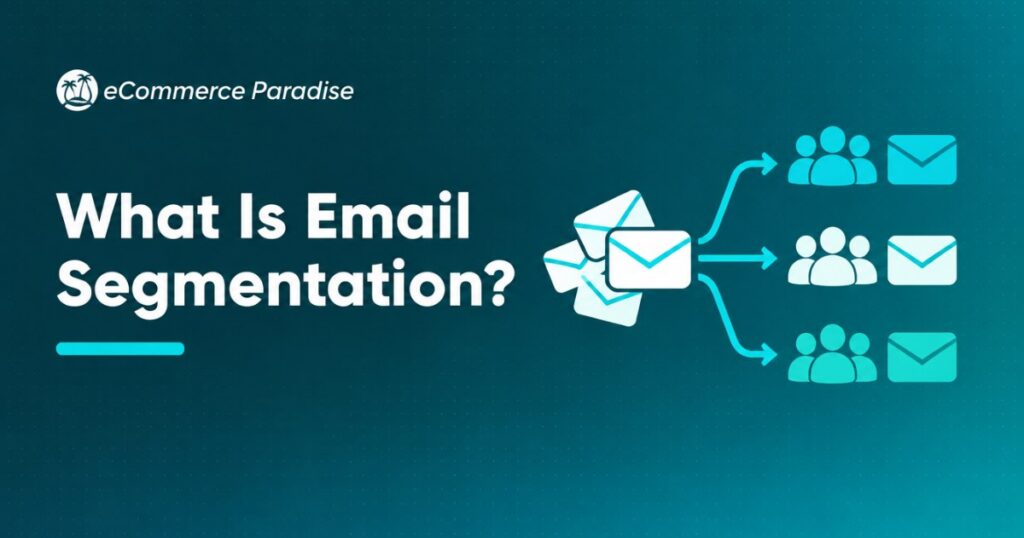
Email Segmentation Defined in Simple Terms
Email segmentation is the practice of dividing your email subscriber list into smaller groups based on shared characteristics, behaviors, or preferences so you can send more targeted and relevant emails to each group. Instead of blasting the same generic email to everyone on your list, segmentation lets you tailor your messages to specific audiences who are more likely to engage and buy.
Think of it like this. If you walked into a store looking for a standing desk and the salesperson immediately started talking about outdoor grills, you’d walk right out. But if they asked what you were looking for and then showed you their best standing desks based on your budget and needs, you’d be much more likely to buy. Email segmentation does the same thing, but at scale. It matches the right message to the right person automatically.
I’ve been running e-commerce businesses for over 15 years, and segmentation is one of the things that separates stores that make money from email from stores that just annoy their subscribers. At E-Commerce Paradise, we implement segmentation for every high-ticket dropshipping store we manage because the revenue difference is dramatic. Segmented campaigns generate 760% more revenue than non-segmented campaigns according to Campaign Monitor’s research. That’s not a typo. Seven hundred and sixty percent more.
Why Segmentation Matters for E-Commerce Stores
Sending the same email to your entire list is like using a megaphone in a crowded room. Sure, everyone hears you, but most people don’t care about what you’re saying because it’s not relevant to them. Here’s why segmentation changes everything.
Higher Open and Click Rates
When your email subject line and content match what a subscriber actually cares about, they’re much more likely to open it and click through. A subscriber who recently browsed standing desks on your site is far more likely to open an email titled “The Standing Desk You Were Looking At Is Now 15% Off” than a generic “Spring Sale on All Products” email. Relevant emails get attention. Generic emails get ignored.
More Sales Per Email
Because segmented emails are more relevant, they convert at higher rates. Instead of a 1% conversion rate on a blast to your entire list, you might see 3% to 5% conversion rates on well-segmented campaigns. For a high-ticket store with $1,500 average order values, the difference between 1% and 3% conversion on a 5,000-person list is the difference between $75,000 and $225,000 in email revenue. Those numbers are not exaggerated.
Lower Unsubscribe Rates
People unsubscribe when they receive too many irrelevant emails. If you’re sending three emails a week to your entire list about product categories half of them don’t care about, they’ll eventually hit unsubscribe. Segmentation reduces unsubscribes because subscribers only receive emails that are relevant to their interests and behavior. They stay on your list longer, which gives you more opportunities to convert them over time.
Better Deliverability
Inbox providers track how subscribers interact with your emails. High engagement (opens, clicks) tells Gmail and others that your emails are wanted, which helps them land in the inbox. Low engagement signals spam. Segmentation improves overall engagement because you’re only sending to people who are likely to interact with each specific email, which strengthens your sender reputation and email deliverability.
The Main Types of Email Segmentation for E-Commerce
There are several ways to segment your email list, and the best strategies use multiple segmentation types together. Here are the most important ones for online stores.
Demographic Segmentation
Dividing subscribers by demographic data like location, age, or gender. For e-commerce, location segmentation is particularly useful because it lets you send region-specific promotions, adjust for time zones, and account for seasonal differences. A store selling outdoor furniture would send spring collection emails to subscribers in warm climates earlier than those in cold climates.
Behavioral Segmentation
This is the most powerful type of segmentation for e-commerce because it’s based on what subscribers actually do, not just who they are. Common behavioral segments include products viewed (browsing behavior), products added to cart, purchase history, email engagement (opens, clicks), and website activity. Behavioral segmentation lets you send highly relevant emails based on demonstrated interest.
Purchase History Segmentation
Dividing your list based on what people have bought (or haven’t bought) is incredibly effective. Key segments include never purchased (subscribers who haven’t bought yet), one-time buyers (converted once but haven’t returned), repeat customers (bought multiple times), VIP customers (top spenders or most frequent buyers), and lapsed customers (haven’t purchased in a defined period). Each of these segments deserves different messaging. Your VIP customers should receive exclusive offers and early access. Your never-purchased subscribers need more education and trust-building. Your lapsed customers need re-engagement campaigns.
Engagement-Based Segmentation
Segmenting based on how subscribers interact with your emails. Highly engaged subscribers (open and click regularly) can receive more frequent emails and first access to promotions. Moderately engaged subscribers get your standard cadence. Inactive subscribers get re-engagement campaigns or get moved to a sunset flow. This protects your deliverability while maximizing revenue from your most interested subscribers.
Acquisition Source Segmentation
Tracking how subscribers joined your list and segmenting accordingly. Someone who subscribed through a buying guide lead magnet has different interests and intent than someone who signed up for a 10% discount popup. Tailor your welcome series and early communications based on the acquisition source to match the subscriber’s original intent.
How to Set Up Segmentation in Your Email Platform
Most modern email platforms make segmentation relatively straightforward. Here’s how it works in the most popular platforms for e-commerce.
Segmentation in Klaviyo
Klaviyo has one of the most powerful segmentation engines available for e-commerce. You can create segments based on virtually any data point: email activity, website behavior, purchase history, customer properties, and custom events. Klaviyo segments update in real time, so subscribers automatically move between segments as their behavior changes. For example, a “first-time visitor” automatically moves to “customer” the moment they make a purchase.
Segmentation in Omnisend
Omnisend offers similar segmentation capabilities with a slightly more visual interface. You can combine multiple conditions to create precise segments, and Omnisend provides pre-built segments for common e-commerce use cases like “high-value customers” and “at risk of churning” that save you time in setup.
Segmentation in Other Platforms
ActiveCampaign offers advanced segmentation with its tagging and scoring system. Mailchimp has basic segmentation that works for smaller stores. Drip specializes in behavioral segmentation for e-commerce. The platform you choose should support the segmentation complexity your strategy requires.
Essential Segments Every E-Commerce Store Should Create
If you’re new to segmentation, start with these foundational segments. They cover the most impactful groupings and will immediately improve your email marketing results.
Active Subscribers
Subscribers who have opened or clicked an email in the last 90 days. This is your primary sending list for campaigns. Sending to this segment instead of your full list immediately improves your open rates, click rates, and deliverability. It’s such a simple change but it makes a huge difference.
Non-Buyers
Subscribers who have been on your list for at least 30 days but haven’t made a purchase. These people need more trust-building content, social proof, and potentially a stronger incentive to convert. Send them buying guides, customer testimonials, and first-order discounts.
One-Time Buyers
Customers who have purchased exactly once. Your goal with this segment is to get them to buy again, because a customer who buys twice is significantly more likely to buy a third time and beyond. Send cross-sell recommendations, complementary product suggestions, and loyalty incentives.
VIP Customers
Your top 10% to 20% of customers by total spending or purchase frequency. These are your most valuable subscribers and they deserve special treatment. Send them exclusive early access to sales, VIP-only discounts, new product previews, and personalized recommendations. These customers generate disproportionate revenue and are worth the extra effort.
At-Risk Customers
Customers who haven’t purchased in 60 to 90 days but were previously active. These subscribers are starting to drift and need a re-engagement nudge. Send winback offers, “we miss you” campaigns, or highlight what’s new since their last visit.
Cart Abandoners
People with items currently in their cart who haven’t completed checkout. This segment should be tied to your abandoned cart automation, but you can also use it for campaign targeting. If you’re running a site-wide sale, sending a “your cart items are now on sale” email to this segment can drive immediate conversions.
Segmentation Best Practices for E-Commerce
Segmentation is powerful, but it can also get overcomplicated quickly. Here are the best practices I follow when setting up segmentation for my clients.
Start Simple and Expand
Don’t try to create 50 segments on day one. Start with the essential segments listed above and get comfortable using them in your campaigns. As you learn what works and what data is available, add more specific segments over time. Two or three well-used segments are better than twenty segments you never actually target.
Let Data Drive Your Segments
Create segments based on actual customer data, not assumptions. If you think customers in Texas buy differently than customers in New York, verify it with data before creating geographic segments. Platforms like Klaviyo make it easy to analyze purchase patterns across different customer attributes so you can make data-driven segmentation decisions.
Keep Segments Updated
Make sure your segments update dynamically. A subscriber who was “inactive” three months ago might have re-engaged last week. Your segments should reflect current behavior, not historical snapshots. Most email platforms handle this automatically, but verify that your segments are set to dynamic mode rather than static lists.
Don’t Over-Segment
There’s a point of diminishing returns. Sending 20 different versions of the same campaign to 20 micro-segments takes 10x the work for marginal improvement over 4 or 5 well-defined segments. Focus your segmentation efforts where the biggest revenue differences exist. According to HubSpot’s marketing data, even basic segmentation (active vs inactive, buyers vs non-buyers) can improve campaign performance by 50% or more.
How Segmentation Connects to Your Broader Email Strategy
Segmentation isn’t a standalone tactic. It’s a foundational element that improves everything else in your email marketing.
Your automated flows become more effective when they’re segmented. A welcome series for discount-seekers looks different from one for buying-guide readers. An abandoned cart email for a $500 item should have different messaging than one for a $5,000 item.
Your campaign emails perform better when you send to targeted segments instead of your full list. Product launches go to subscribers who’ve browsed that category. Flash sales go to your most engaged segment. Re-engagement offers go to your at-risk segment.
Even your list hygiene improves with segmentation. By identifying and isolating your inactive segment, you can clean your list more effectively and protect your sender reputation.
For the complete how-to implementation guide, including step-by-step setup instructions, check out our detailed article on how to segment your email list for maximum revenue.
Getting Started with Segmentation Today
If you’re currently sending every email to your entire list, making just one change will improve your results immediately: create an “active subscribers” segment of people who have opened or clicked in the last 90 days, and send your next campaign only to that segment. Watch your open rates and click rates jump. That single change will show you the power of segmentation and motivate you to build more segments.
Make sure you’re set up with the right niche and suppliers before investing heavily in email marketing optimization. And ensure your business formation is complete so your email compliance is covered.
For store owners who want expert help with segmentation and the entire email marketing system, our management service includes advanced segmentation strategy and implementation. Our team builds and maintains your segments, creates targeted campaigns, and optimizes based on data.
Or if you prefer to learn and implement yourself, our coaching program includes personalized guidance on building your segmentation strategy. Join our community to connect with other store owners who are working on their email marketing segmentation.
I wish you guys the best of luck with segmentation. It’s one of those things that seems technical but is really just common sense: send the right emails to the right people. Once you start doing it, you’ll never go back to blasting your whole list. It makes that big of a difference. I’ll see you in the next one.

Trevor Fenner is an ecommerce entrepreneur and the founder of Ecommerce Paradise, a platform focused on helping entrepreneurs build and scale profitable high-ticket ecommerce and dropshipping businesses. With over a decade of hands-on experience, Trevor specializes in high-ticket dropshipping strategy, niche and product selection, supplier recruiting and onboarding, Google & Bing Shopping ads, ecommerce SEO, and systems-driven automation and scaling. Through Ecommerce Paradise, he provides free education via in-depth guides like How to Start High-Ticket Dropshipping, advanced training through the High-Ticket Dropshipping Masterclass, and fully done-for-you turnkey ecommerce services for entrepreneurs who want a faster, more hands-off path to growth. Trevor is known for emphasizing sustainable, real-world ecommerce models over hype-driven tactics, helping store owners build scalable, sellable, and location-independent brands.


