



A solar generator is the only backup power you can legally and safely run inside a house, which is the entire reason this category exists. It is not a way to lower a power bill, and any article that tells you otherwise has not done the arithmetic. This guide is part of the portable power cluster on E-Commerce Paradise, and every specification below was read off the manufacturer’s own product page on 5 September 2026.
Where a figure could not be retrieved from a primary source this session, I have written “Not published” rather than repeating a number from the earlier version of this article. A number of claims in that version did not survive the check, including one in a call to action, and I list them explicitly.
The decision comes down to three things: how many usable watt hours you need, whether you require 240V for a well pump or a dryer, and how fast the system switches over when the grid drops. Everything else is detail.
Keep The House Running When The Grid Drops
Bluetti’s AC500 with B300S starts at US$2,099 for 5,000W of output and 2,764.8Wh, expandable to 16,588.8Wh, and reaches 80 percent charge in 1.5 hours on 3,000W of input. Silent, no fumes, safe to run indoors.
Size It On Usable Watt Hours, Not Nameplate
A battery rated at 2,000Wh does not deliver 2,000Wh to an appliance. Converting DC battery output into AC mains costs energy, and the unit spends some of its own charge running its inverter, display and fans. Plan on no more than 85 percent of nameplate reaching the socket. I use 85 percent across this cluster and I state it every time, and 85 percent is already the generous end rather than a safety margin.
Bluetti publishes its own version of the same correction. In the AC180 product FAQ the company states a depth of discharge of 90 percent, an inverter efficiency of 85 percent, and self consumption of about 15W, and works its runtime examples from those numbers rather than from the nameplate.
Correcting the earlier version of this article. It said that “a 2,000Wh battery running a 200W refrigerator provides approximately 10 hours of runtime”. That is nameplate arithmetic. At 85 percent efficiency a 2,000Wh battery delivers about 1,700Wh, so a continuous 200 W draw gives about 8 hours 30 minutes, not 10. In practice a domestic fridge cycles rather than running flat out, so if yours averages 150 W over the day you would get closer to 11 hours 20 minutes. Either way, the number to work from is usable watt hours divided by average draw, and you should know which of the two you are being quoted.
| System | Nameplate | Usable at 85 percent | Hours at a 300 W essentials load |
|---|---|---|---|
| Jackery Explorer 1000 v2 | 1070Wh | About 910Wh | About 3 hours 2 minutes |
| Jackery Explorer 2000 v2 | 2042Wh | About 1,736Wh | About 5 hours 47 minutes |
| Bluetti Apex 300 | 2,764.8Wh | About 2,350Wh | About 7 hours 50 minutes |
| Bluetti AC500 with B300S | From 2,764.8Wh | About 2,350Wh | About 7 hours 50 minutes |
| Jackery HomePower 3600 Plus | 3584Wh | About 3,046Wh | About 10 hours 9 minutes |
| EcoFlow DELTA Pro | 3.6kWh | About 3,060Wh | About 10 hours 12 minutes |
A 300 W essentials load is a fridge averaging 150 W, a router, a laptop, a few LED lights and phone charging. Scale it to your own house before you buy, because the difference between 300 W and 600 W of essentials halves every number in that column.
The Systems Worth Considering
Bluetti AC500 with B300S
This is the closest thing here to a whole home system, and it was absent from the earlier version of this article entirely. Bluetti’s page states a 5,000W pure sine wave inverter with expandable capacity “from 2,764.8Wh to 16,588.8Wh”, and efficient solar input reaching 80 percent of capacity in 1.5 hours on 3,000W of input. Listed price starts at US$2,099.00 against a compare at price of US$2,999.00.
Read the warranty line carefully. Bluetti’s page for this system states a four year warranty, not the five years the brand quotes on units like the AC180. That is a genuine difference within one brand and it is the sort of thing that gets flattened in roundups. Bluetti’s own warranty policy page is the authority: for portable power stations the period “varies from 24 months to 72 months”, for home backup systems it “varies from 48 months to 60 months”, and cover “will be invalid on the items once they are taken or shipped to other countries”.
The expansion battery specification also needs correcting against a lot of published material. Bluetti lists the B300K expansion battery at 2,764.8Wh, not the 3,072Wh figure that circulates widely. Cycle life is Not published in the specification area of the system page I could retrieve.
Bluetti Apex 300
Bluetti lists the Apex 300 at 2,764.8Wh and 3,840W, scaling “From 2.7kWh to 58kWh and 3.8kW to 11.5kW, from basics to whole-home backup”, at a listed US$1,699.00. The specification that matters most for a home office is the switchover: Bluetti quotes 0ms UPS switchover on this unit, against 20 ms on the AC180 and 10 ms on the Elite 300. If you have equipment that cannot tolerate an interruption at all, this is the one to look at first. Cycle life is Not published on the page.
Jackery HomePower 3600 Plus
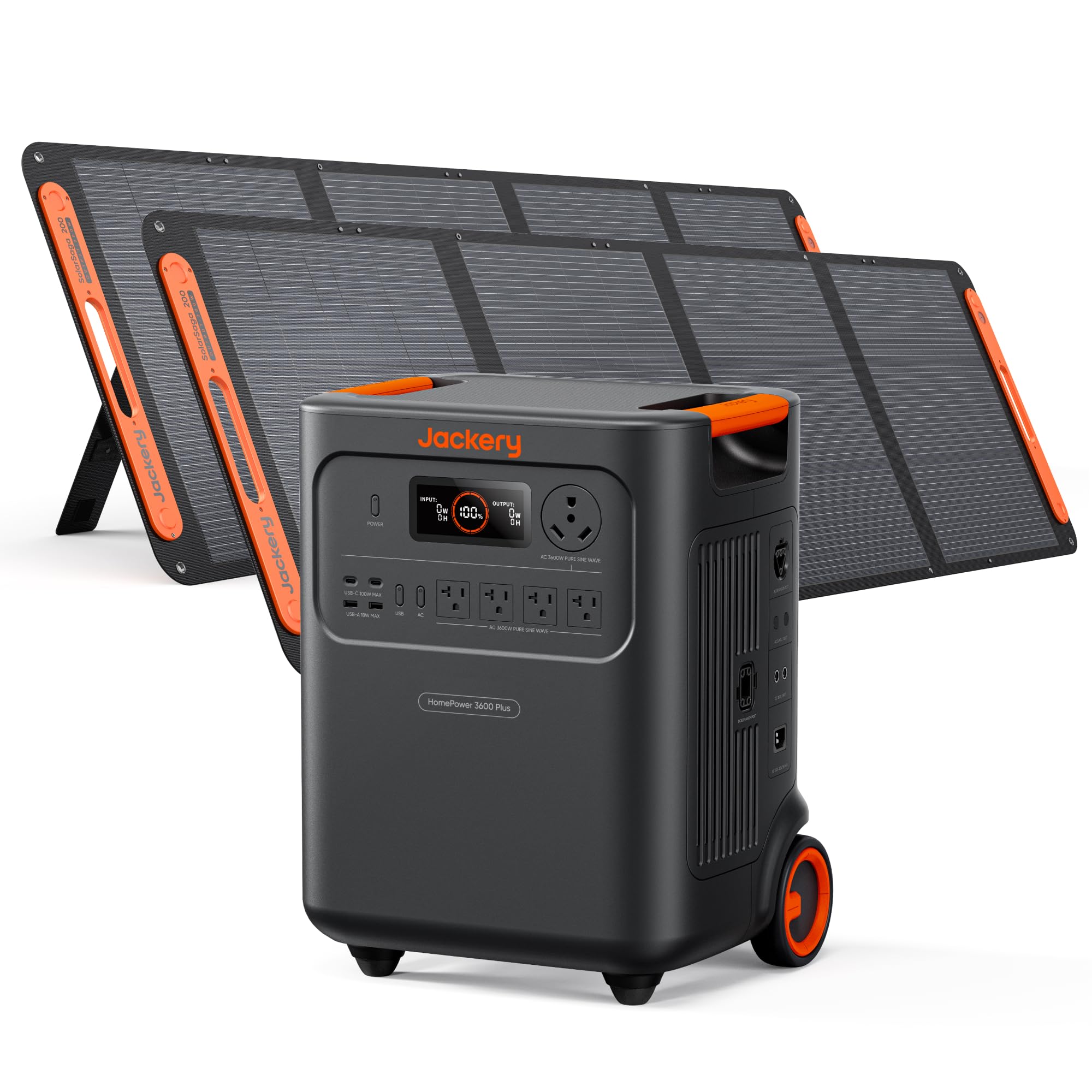
Jackery’s listing states 3584Wh of capacity expandable to 21kWh, delivering “15hrs to 9days of backup power” with 3600W output, and it runs 120V appliances on a single unit with 240V available by connecting two units for well pumps and dryers. On longevity it quotes an EV grade LiFePO4 pack at 6,000 cycles, to the 70 percent floor Jackery applies across its LiFePO4 range, and up to 16 years, backed by a five year warranty, and noise at about 30dB. Listed price was US$1,709.00 for the unit, US$2,289.00 bundled with two SolarSaga 200W panels and US$2,459.00 with the SolarSaga 500 X.
What it actually runs. About 3,046 usable watt hours at 85 percent efficiency, so roughly 10 hours 9 minutes of a 300 W essentials load or about 20 hours of a fridge averaging 150 W.
On cost. At US$1,709 across 3584Wh and 6,000 rated cycles to 70 percent it delivers about 18,278 kWh over its rated life at 85 percent efficiency, which is 9.4 cents per delivered kilowatt hour of hardware and about 30 cents all in once the electricity goes on top. That is the best figure in this guide.
Not published. Jackery does not state a weight on that listing, so the 77 pound figure the earlier version of this article used is unverified here.
Jackery Explorer 2000 v2 Solar Generator
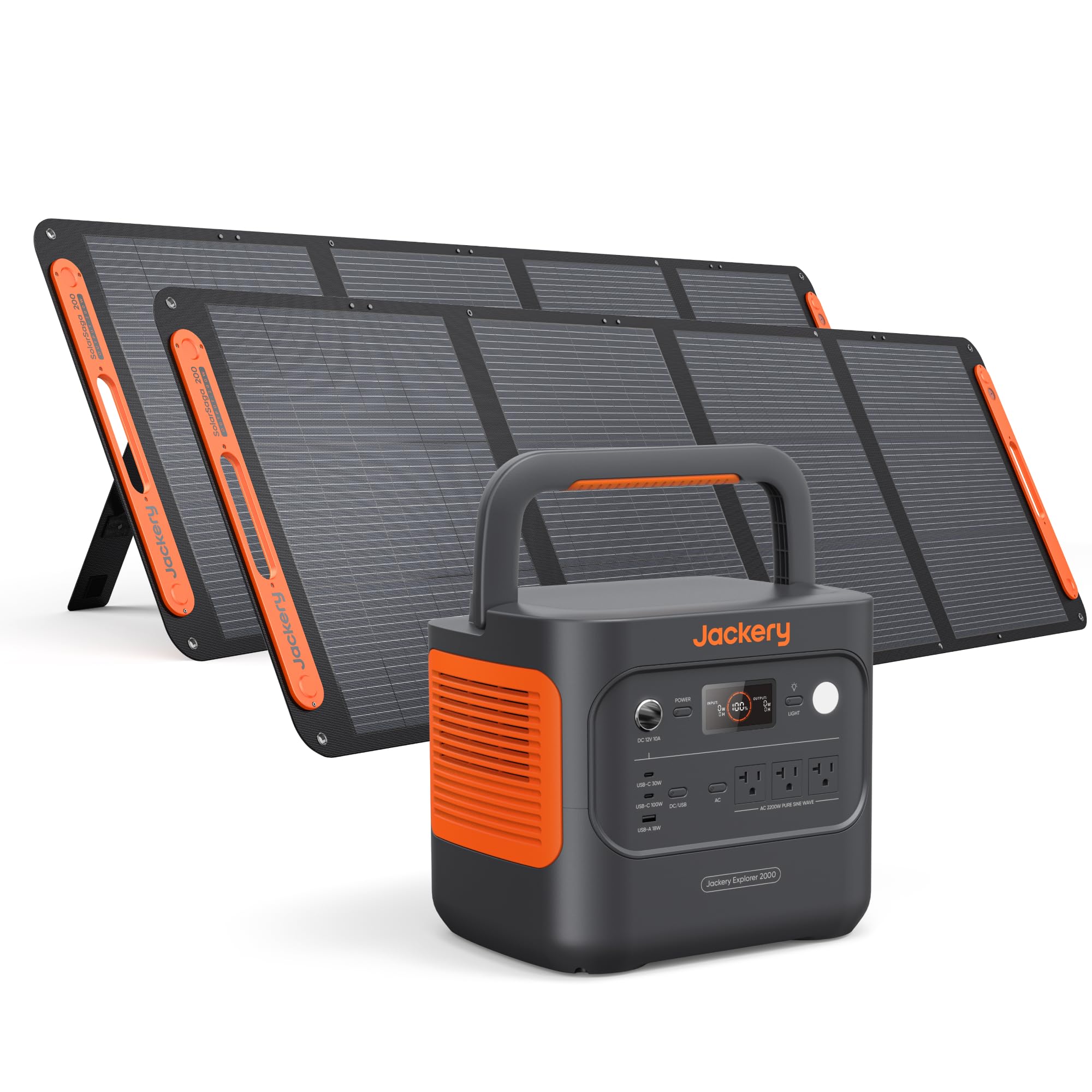
Jackery’s page states 2042Wh of LiFePO4 capacity with “2200W continuous output (4000W surge)”, switchover happening in under 20ms so a router, computer or network storage stays online, and a high speed AC recharge that restores the unit from empty to full in about 1.7 hours. Listed price was US$899.00 for the unit and US$1,399.00 bundled with two SolarSaga 200W panels.
Corrections. The earlier version of this article credited this unit with an 80 percent charge in 66 minutes, a weight of 39.5 lbs, a system weight of 66.8 lbs with panels, and three AC outlets. None of those four figures appears on Jackery’s own product page, so all four are Not published here. The recharge claim I can verify is the roughly 1.7 hour figure to a full charge, and the switchover claim of under 20ms holds up.
What it actually runs. About 1,736 usable watt hours at 85 percent efficiency, so roughly 5 hours 47 minutes of a 300 W essentials load. Cycle life is Not published on the model page, so I have not computed a cost per delivered kilowatt hour for it.
Jackery Solar Generator 1000 v2

Jackery’s page for the underlying Explorer 1000 v2 states 1070Wh of capacity and 1500W output, dual 100W USB-C ports, an emergency super charge taking it from empty to full in one hour, and LiFePO4 cells lasting more than ten years at 4,000 charge cycles, to the 70 percent floor Jackery applies across its LiFePO4 range, with a five year warranty when bought at jackery.com that Jackery’s own warranty policy page contradicts by listing the 1000 Series at two years plus one. Listed price was US$499.00 for the unit and US$789.00 bundled with a SolarSaga 200W panel.
This is the smallest system here that I would still call a backup rather than a battery. About 910 usable watt hours at 85 percent efficiency runs a fridge averaging 150 W for about 6 hours, or a 75 W home office for about 12 hours. It will not carry a whole house and it does not pretend to.
On cost it delivers about 3,638 kWh over its rated life, which is 13.7 cents per delivered kilowatt hour of hardware and 34.1 cents all in once the electricity goes on top.
EcoFlow DELTA Pro with 400W Solar Panel

EcoFlow’s page states a 3.6kWh base capacity expanding to 25kWh by adding another unit, extra batteries and smart generators, 3600W of AC output, a full charge in as fast as 1.8 hours from the wall, and enough ports to run 15 devices at once. It rolls on a luggage style handle, which matters at this weight.
This is where the earlier version of this article went wrong, and it went wrong in a call to action. That article’s closing block described the DELTA Pro as having “7200W surge output”. EcoFlow’s own page is explicit that a single unit powers up to 4500W of appliances using X-Boost, and that the 7200W figure at 240V requires chaining two units together. Presenting a two unit number as a single unit specification in a buying prompt is the kind of error that gets someone’s well pump not starting during an outage. It has been removed.
Read the cycle claim carefully too. EcoFlow states “6500+ cycles” for the LiFePO4 pack, with a footnote reading “Approx. 6500+ cycles at 50% capacity”. That is a 50 percent retention floor, where Bluetti quotes the AC180 at 3,500 cycles to 80 percent retention and Anker quotes 4,000 cycles to at least 80 percent. Those are not comparable numbers and nobody should present them side by side without the qualifier.
Price. Not published. EcoFlow renders its pricing in JavaScript that a plain fetch does not return, so I will not quote a figure I cannot verify. Check it directly.
EcoFlow DELTA Pro 3 with Solar Panels
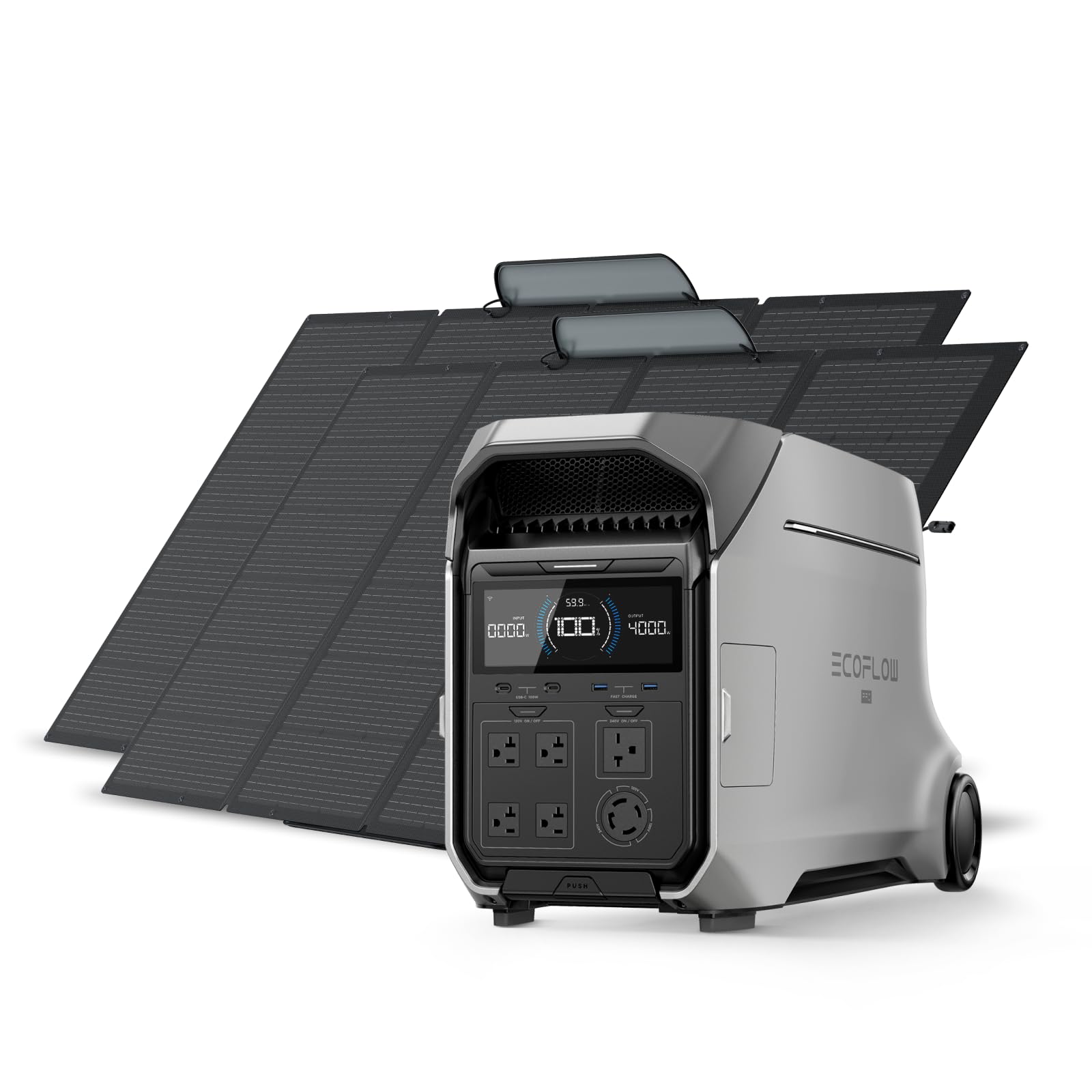
I have to be straight about this one. EcoFlow’s DELTA Pro 3 product page returned nothing readable to a plain fetch this session, so the capacity, output, expandable ceiling, weight, switchover time, ingress rating, noise level and warranty are all Not published here. The earlier version of this article quoted 4096Wh, 4000W, expansion to 48kWh, 115 pounds, a 10 millisecond switchover, an IP65 rated pack, 30 dB and a five year warranty, and I could verify none of them from EcoFlow directly.
That does not mean those numbers are wrong. It means I will not republish them as verified. If this unit is on your shortlist, read the specification tab on EcoFlow’s own site before you commit, particularly the 240V capability, because that is the feature people buy this class of product for.
Days Of Backup, Not Hours
Jackery HomePower 3600 Plus at US$1,709: 3584Wh expandable to 21kWh, 3600W output, 6,000 cycles to 70 percent on an EV grade LiFePO4 pack, five year warranty, about 30dB. About 30 cents per delivered kilowatt hour all in, of which 9.4 cents is hardware.
What Backup Power Actually Costs
Price per watt hour prices the box and ignores how many times the box will fill and empty before it is finished. The metric that means something is cost per kilowatt hour delivered across the rated cycle life: price divided by nameplate watt hours times efficiency times rated cycles divided by one thousand.
| System | Listed price | Cycle life on the maker’s page | Hardware per delivered kWh | All in, hardware plus 20.4 cents of electricity |
|---|---|---|---|---|
| Jackery HomePower 3600 Plus | US$1,709.00 | 6,000 cycles to 70% | 9.4 cents | 29.8 cents |
| Jackery Explorer 1000 v2 | US$499.00 | 4,000 charge cycles to 70% | 13.7 cents | 34.1 cents |
| Bluetti Apex 300 | US$1,699.00 | Not published | Not published | Not published |
| Bluetti AC500 with B300S | From US$2,099.00 | Not published | Not published | Not published |
| EcoFlow DELTA Pro | Not published | 6500+ cycles at 50% capacity | Not published | Not published |
Now the number nobody prints. That 9.4 cents is hardware amortisation only, the first of two terms. You still buy the electricity you put into the system. United States residential electricity averaged 17.30 cents per kilowatt hour across 2025, according to the Energy Information Administration’s Electric Power Monthly, Table 5.3, and the same table shows 18.16 cents year to date through June 2026.
So delivering one kilowatt hour out of a HomePower 3600 Plus means buying about 1.18 kWh from the wall, which is 17.30 cents divided by 0.85, an energy term of 20.4 cents, plus the 9.4 cents of hardware. Call it about 30 cents per delivered kilowatt hour against 17.30 cents straight from the socket. On the smaller Explorer 1000 v2 it is 34.1 cents.
None of these saves money on electricity. Every one of them buys availability, which is power in a house that has none. During a multi day outage in winter that is worth far more than the price difference, and during a normal month it is worth nothing at all. Buy accordingly.
Buying Guide
Continuous Watts And Surge Watts
Continuous output decides what you can run at all; surge output decides whether motors will start. Refrigerator compressors, well pumps and sump pumps draw several times their running wattage for a fraction of a second at start up, which is why a system that comfortably runs a fridge can still fail to start one.
The earlier version of this article asserted that most refrigerators need 1,500 to 2,000 surge watts to start, along with a long list of appliance wattages, whole house system prices and installation costs. None of those had a named source and I could not verify any of them this session, so they have been removed rather than reworded. Measure your own loads with a plug in meter, or read the nameplate on the appliance, and size from that.
240V Or Not
This is the fork in the road. If you need a well pump, an electric dryer or a central air conditioner, you need 240V, and that generally means either a system built for it or two units chained. Jackery’s HomePower 3600 Plus offers 240V by connecting two units. EcoFlow’s DELTA Pro reaches 7200W at 240V only with two units. If you only need a fridge, lights, internet and a laptop, a single 120V unit is far cheaper and far simpler.
Switchover Time
If the system is going to act as an uninterruptible supply for a home office, the switchover time is the specification that matters most. Verified numbers from the manufacturers this session: 0ms on the Bluetti Apex 300, under 20ms on the Jackery Explorer 2000 v2, 20 ms on the Bluetti AC180, and 10 ms on the Bluetti Elite 300. Anything in that range keeps a computer alive.
Solar Input
Solar input caps decide whether a battery becomes a system you can live off or a bucket you empty once. Bluetti quotes the AC500 system reaching 80 percent in 1.5 hours on 3,000W of input. Jackery sells its HomePower and Explorer units in bundles with SolarSaga panels. Check the maximum input voltage and current as well as the wattage, because panels that exceed the voltage window will not charge at all.
Cycle Life, With Its Qualifier
A cycle rating without a retention floor is meaningless. Compare only like with like. Jackery quotes 6,000 cycles on the HomePower 3600 Plus and 4,000 on the Explorer 1000 v2, both to a 70 percent floor. EcoFlow quotes 6500 or more cycles for the DELTA Pro at 50 percent capacity. Bluetti quotes 3,500 or more cycles to 80 percent original capacity on the AC180. The EcoFlow figure looks the largest and is measured to the loosest floor.
Running This As A Business
Home backup is one of the better high ticket categories to sell into, because order values run well into four figures, the products ship on pallets rather than in envelopes, and buyers research hard before committing. That last part rewards anyone willing to publish real arithmetic instead of marketing figures.
Start with the category rather than the product. Our list of proven high ticket dropshipping niches covers where the margin actually sits. If the model is new to you, read our explanation of what high ticket dropshipping is and how the economics work before spending anything.
Supply is where most people stall. Our step by step guide to finding suppliers for high ticket products walks the whole approach process. On the legal and financial side, our business formation guide for high ticket dropshipping covers entity choice and tax registration in the right order.
On tooling I keep it deliberately dull. I run stores on Shopify because the app ecosystem removes problems I do not want to solve. For entity formation I use Bizee, which files without the upsell theatre.
Two things people skip and regret. Get general liability cover through Hiscox before you sell anything containing several kilowatt hours of lithium. And put the books on QuickBooks from the first order rather than reconstructing a year of transactions in April.
Frequently Asked Questions
What size solar generator do I need for essential home backup?
Work from usable watt hours. A typical essentials load of a fridge averaging 150 W, a router, a laptop, LED lighting and phone charging comes to roughly 300 W. At 85 percent efficiency a 2,042Wh unit delivers about 1,736Wh, which carries that load for about 5 hours 47 minutes. A 3584Wh unit delivers about 3,046Wh and carries it for about 10 hours 9 minutes. If you want to ride out an overnight outage without solar input, aim for at least 2,000Wh nameplate. If you want days rather than hours, you are shopping in the 3,500Wh and up class with expansion batteries.
Can a solar generator power a whole house?
Only with careful load management and, usually, 240V capability. Jackery’s HomePower 3600 Plus reaches 240V by connecting two units, which is what lets it run a well pump or a dryer. EcoFlow’s DELTA Pro reaches 7200W at 240V by chaining two units, and a single unit tops out at 4500W using its X-Boost mode. Bluetti’s Apex 300 scales from 2.7kWh to 58kWh and from 3.8kW to 11.5kW according to its own page. Whatever you buy, running an air conditioner, a dryer and an oven at the same time is not on the menu.
How long will a solar generator run a refrigerator?
Divide usable watt hours by the fridge’s average draw, not its rated draw, because a compressor cycles. A fridge that averages 150 W over a day runs about 20 hours off a 3584Wh unit at 85 percent efficiency, about 11 hours 34 minutes off a 2042Wh unit, and about 6 hours 4 minutes off a 1070Wh unit. If the fridge really does draw a continuous 200 W, cut each of those by about a quarter.
Does a solar generator save money on my electricity bill?
No. At US$1,709 across 3584Wh and 6,000 rated cycles to 70 percent, the HomePower 3600 Plus delivers about 18,278 kWh over its rated life at 85 percent efficiency, so the hardware term is 9.4 cents per delivered kilowatt hour. You still buy the electricity to fill it, at a 2025 United States residential average of 17.30 cents per kilowatt hour according to the Energy Information Administration, which at 85 percent efficiency is an energy term of 20.4 cents. All in, about 30 cents per delivered kilowatt hour against 17.30 cents straight from the wall. It buys availability, not cheaper power.
Is a solar generator safe to run indoors?
Yes, and that is the whole point of the category. Battery systems produce no exhaust, so unlike a petrol or diesel generator there is no carbon monoxide risk and no need to run them outside in bad weather. They are also quiet: Jackery quotes about 30dB for the HomePower 3600 Plus. For preparation guidance beyond the hardware, the federal Ready.gov guidance on power outages is a sensible starting point.
How fast do these recharge?
All figures from the manufacturers. EcoFlow quotes a full charge for the DELTA Pro in as fast as 1.8 hours from the wall, and 1.7 hours when integrated with its Smart Home Panel. Jackery quotes the Explorer 2000 v2 from empty to full in about 1.7 hours, and the Explorer 1000 v2 in one hour using emergency super charge. Bluetti quotes the AC500 system reaching 80 percent in 1.5 hours on 3,000W of input. Solar recharge times depend entirely on panel wattage, orientation and weather, so treat any solar figure as a best case.
The Bottom Line
For most households the honest answer is the Jackery HomePower 3600 Plus at US$1,709. It gives you 3584Wh, expansion to 21kWh, 3600W of output, 240V by pairing two units, and a 6,000 cycle rating to 70 percent on a five year warranty, and at 9.4 cents per delivered kilowatt hour of hardware, or about 30 cents all in, it is the cheapest stored energy in this guide.
If you want the largest headroom and the fastest expansion path, look at Bluetti’s AC500 with B300S from US$2,099, remembering that its page states a four year warranty rather than the five years Bluetti quotes elsewhere, and that Bluetti’s warranty policy page puts the range at 24 months to 72 months and voids cover once a unit is shipped abroad. If your priority is a home office that never blinks, the Bluetti Apex 300 at US$1,699 with a 0ms switchover is the strongest specification here. If your outages are short and you only need the fridge, the internet and a laptop, the Jackery Explorer 2000 v2 at US$899 is enough and costs half as much.
What I would not do is buy on a marketing number. The previous version of this article told readers a single DELTA Pro delivers 7200W of surge, which required two units, and computed a refrigerator runtime straight off the nameplate. Both are the kind of error you only discover during the outage. Size the system on usable watt hours, check the switchover time, check whether you actually need 240V, and buy for availability rather than for savings, because savings are not on offer.
Buy Availability, Not A Cheaper Power Bill
Bluetti Apex 300 at US$1,699: 2,764.8Wh and 3,840W, scaling from 2.7kWh to 58kWh, with a 0ms UPS switchover so a home office never drops. Zero emissions and safe to run indoors, unlike any fuel generator.
If you would rather sell in this category than shop in it, we build the business for you. Our done for you high ticket dropshipping business build and launch service covers niche selection, supplier approvals, the store itself and the first traffic, so you start with something that already works.
Related Articles
Bluetti Review 2026, with verified specs and cost per delivered kilowatt hour
Jackery Review 2026, with corrected pricing across the Explorer line
The best portable power stations for camping, sized on usable watt hours
How long a power station will actually run a refrigerator
How to size a solar generator for your own house

Trevor Fenner is an ecommerce entrepreneur and the founder of Ecommerce Paradise, a platform focused on helping entrepreneurs build and scale profitable high-ticket ecommerce and dropshipping businesses. With over a decade of hands-on experience, Trevor specializes in high-ticket dropshipping strategy, niche and product selection, supplier recruiting and onboarding, Google & Bing Shopping ads, ecommerce SEO, and systems-driven automation and scaling. Through Ecommerce Paradise, he provides free education via in-depth guides like How to Start High-Ticket Dropshipping, advanced training through the High-Ticket Dropshipping Masterclass, and fully done-for-you turnkey ecommerce services for entrepreneurs who want a faster, more hands-off path to growth. Trevor is known for emphasizing sustainable, real-world ecommerce models over hype-driven tactics, helping store owners build scalable, sellable, and location-independent brands.

Still deciding what to sell?
Grab the free list of 1,000+ niches that work for high-ticket dropshipping, sorted by category.
Free. Unsubscribe any time.


