

Quick answer: Most beginner dropshippers make $0 to $2,000 a month, and experienced sellers can reach $10,000 or more, according to TrueProfit’s study of 1,200+ stores. That study does not say whether those figures are revenue or profit. My own high-ticket planning range is $0 to $3,000 a month in gross profit for months 1 to 6, rising for stores that keep going. Every number below is labeled as my experience, outside data or a math scenario.
If you have been researching dropshipping, you have seen wildly different income claims. YouTube gurus post screenshots of $100,000 months, and Reddit threads are full of people who never made a sale. So what is the truth? I have been building online stores for over fifteen years, and through Ecommerce Paradise I teach the higher-priced model. I explain it in my guide to what high-ticket dropshipping is.
This page gives you the honest breakdown, and it is built differently from most income articles. Most of them quote a range with no source and no definition of the word “earn.” I have separated three kinds of numbers: my own experience, outside data I could read on the source page, and arithmetic scenarios that are math, not claims.
Everything here is current as of October 2026. Income depends on what you sell, how you sell it and how long you stay at it, and nothing on this page is a promise of results. This is general information, not tax, legal or financial advice, and I am not a CPA or an attorney.
Start here: get my free high-ticket niches list. The product category you choose sets your order size and margin more than any ad or app does, so look at the options before you spend a dollar. Get the Free Niches List →
Prefer to watch? Here is my video on high-ticket vs low-ticket dropshipping and which one to start with.
What’s in This Guide
- How to read the numbers on this page
- What outside data says dropshippers make
- Why “the average dropshipper” is a weak number
- What beginners actually make (months 1 to 6)
- What intermediate sellers make (months 6 to 12)
- What experienced operators make (year 2 and beyond)
- Per-order math: low-ticket vs high-ticket
- Revenue is not income
- What affects your income the most
- A realistic three-year timeline
- What most income claims get wrong
- When to move from low-ticket to high-ticket
- How to maximize your dropshipping income
- Frequently asked questions
How to Read the Numbers on This Page
An income number is only useful if you know who produced it and what it counts. So every figure below carries one of three labels.
- Trevor’s experience: ranges from my own stores and the stores of people I have worked with. They are planning ranges, not audited statistics, and they describe stores that kept going, which leaves out people who quit.
- Outside data: a figure I read on the source page, with a link so you can check it. I say when a source does not define its terms.
- Math scenario: arithmetic with stated assumptions, such as a card fee or an ad cost per sale. A scenario shows how the pieces fit together. It is not a prediction of what you will earn.
What Outside Data Says Dropshippers Make
There is no government survey of dropshipper income, so the public numbers come from software companies and blogs. They are useful as a rough guide and weak as proof. Here is what I could read on each page in October 2026, and what each figure leaves out.
| Label | Source and figure | What it does not tell you |
|---|---|---|
| Outside data | TrueProfit’s analysis of 1,200+ stores: beginners $0 to $2,000 a month, intermediate $2,000 to $10,000, advanced $10,000 to $50,000+ | It does not say whether those are revenue or profit, how stores were chosen, or what period it covers |
| Outside data | The same page: net profit margin of 15% to 25%+ as a benchmark, and about 1% to 5% of dropshippers reaching consistent profitability | Its own table shows beginner net of $450 to $1,200 a month, which does not match its text range, so treat the figures as loose |
| Outside data | ZIK Analytics: only 10% of stores turn a profit in year one and 1.5% reach $50,000 a month in revenue | The page does not tell you where the data came from, and it does not define “turn a profit” |
| Outside data | Bureau of Labor Statistics: of private establishments opened in the year ended March 2015, 79.6% survived one year and 50.2% survived five years | It covers all private businesses, not dropshipping, and it measures survival, not income |
| Outside data | FTC action against Automators AI: the FTC alleged the vast majority of the defendants’ clients did not make the promised earnings or recoup their investment | It is one case about one paid program, not a measure of all dropshipping |
| Outside data | Census Bureau: US e-commerce sales of $340.2 billion in Q2 2026, 17.1% of total retail sales | It shows that online buying is normal, not that dropshippers earn a share of it |
Other articles that rank for this question list beginner, intermediate and advanced ranges too. Some cite no source at all, and one vendor’s page labels its own earner profiles “hypothetical case studies.” When a range comes with no source and no definition, I treat it as an opinion.
The pattern across the sources I could read is consistent, though. Most people earn little or nothing at first, a minority reach several thousand dollars a month, and a small number reach five figures. Where my experience differs is what happens when you change the price of what you sell, which I cover below.
Why “the Average Dropshipper” Is a Weak Number
When someone quotes an average, ask four questions. These are my own checklist, not an industry standard.
- Revenue or profit? A store with $10,000 in sales and a 15% net margin keeps $1,500. Many articles quote the $10,000.
- Which model? A $25 product and a $2,500 product have completely different economics, and most statistics blend them into one number.
- Who is counted? Stores that closed after two months rarely appear in a study of active stores, so the surviving averages look better than the reality.
- Before or after tax? Self-employment tax is real, and I show it in the revenue section below.
That is why I give you stage-by-stage ranges and per-order math instead of one average. You can plug your own price and margin into the math and see where you land.
What Beginners Actually Make (Months 1 to 6)
Trevor’s experience, high-ticket model. I am not going to lie to you: most people make very little in their first few months. This is the foundation-building phase, and a lot of the unglamorous work happens here. You form your LLC, build your store, reach out to suppliers, get authorized, list products and launch your first Google Shopping campaigns. Your income might be zero for the first month or two, and that is normal.
For high-ticket dropshipping specifically, most of my clients start seeing their first sales around months 2 to 4 after launching their marketing. Those first sales are exciting because the profit per sale is significant. When your first $2,000 order comes in and you net $400 to $500 in gross profit, you realize the model is real. It is still sporadic at this stage, maybe 2 to 5 sales a month while you optimize campaigns and build out your catalog.
My realistic income range for months 1 to 6 of a high-ticket store is $0 to $3,000 a month in gross profit. Some months will be better than others. Every supplier you get authorized with, every product you list and every piece of SEO content you publish is building an asset, which is why I keep saying that setting up your business properly from the start matters so much.
Outside data. TrueProfit’s beginner range of $0 to $2,000 a month sits inside the same area, and it says reaching $5,000 to $10,000 a month takes about 6 to 12 months. It does not define whether that is revenue or profit, so use it as a sanity check, not a target.
What Intermediate Sellers Make (Months 6 to 12)
Trevor’s experience, high-ticket model. This is where things get interesting. By month 6, you should have a solid store with 100+ products from 10 to 15 authorized suppliers. Your Google Shopping campaigns have data, and you have started optimizing toward the products and keywords that convert best. You may also be getting organic traffic from the content you have been publishing.
At this stage, high-ticket stores typically do $15,000 to $40,000 a month in revenue. At a 20% to 25% gross margin, that is $3,000 to $10,000 a month in gross profit. After ad spend, the Shopify subscription, apps and other expenses, net take-home is typically $2,000 to $7,000 a month. That is real money, and for a lot of people it approaches or exceeds their day job.
The business starts to feel sustainable at this point. You are getting consistent sales, you understand your customers and you know which products sell best. Phone calls come in from customers who want to place orders, and if you have a business phone system like Dialpad set up, you can convert those calls at 30% to 50% in my stores. Organic traffic starts to compound as your content ages.
What Experienced Operators Make (Year 2 and Beyond)
Trevor’s experience, high-ticket model. Year two is typically when a high-ticket store hits its stride. Supplier relationships are strong, ad campaigns are optimized, organic traffic is growing, and reviews and trust signals improve your conversion rate. Some of my clients launch a second store in a different niche during year two, which diversifies their income.
My realistic revenue range for an established high-ticket store is $40,000 to $100,000+ a month. At a 20% to 25% gross margin, that is $8,000 to $25,000 a month in gross profit. After ad spend, team members, software and accounting, net take-home is typically $5,000 to $15,000 a month from a single store, and if you run two stores, double those numbers.
I have clients doing $60,000 a month in outdoor furniture, $80,000+ a month in commercial kitchen equipment and $40,000 a month in electric fireplaces. Those are my own statements about their monthly revenue, not audited figures, and revenue is not profit. They are people who followed the process, stuck with it through the early months and built real businesses over 12 to 24 months. They run their stores in 2 to 4 hours a day because they built systems and hired help through services like OnlineJobs.ph.
Notice what is missing from every range above: the people who stopped. These ranges describe stores that kept going, and the BLS survival numbers earlier are a reminder that a large share of new businesses do not.
Per-Order Math: Low-Ticket vs High-Ticket
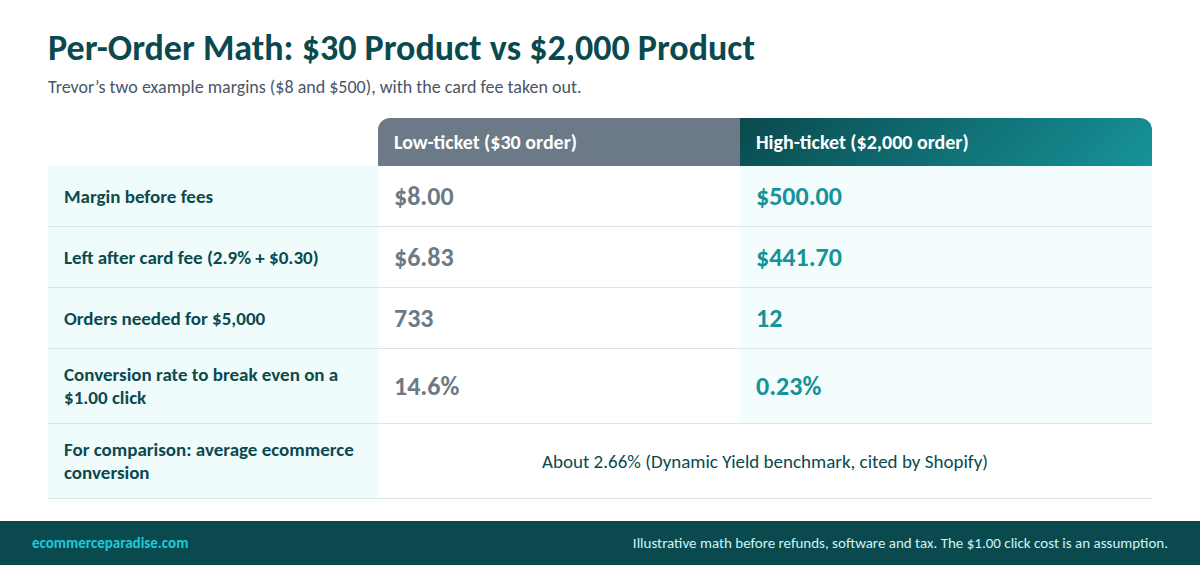
Math scenario. This is the part of my answer that does not depend on whose data you trust. Here is why high-ticket income looks so different from the typical dropshipping income statistics you see online, using the two examples I always use: a $30 product with an $8 margin, and a $2,000 product with a $500 margin.
A low-ticket dropshipper selling $30 products with an $8 margin needs 625 sales a month to make $5,000 in gross profit. A high-ticket dropshipper selling $2,000 products with a $500 margin needs 10. That is the whole difference in traffic, ad spend and customer service volume, and it is why I have focused on high-ticket for 15+ years.
Now take out the card fee. Using the 2.9% plus 30 cents rate that Shopify’s pricing page lists for its Basic plan, the $30 order leaves $6.83 and the $2,000 order leaves $441.70. To reach $5,000 you then need 733 low-ticket orders or 12 high-ticket orders, before ads, refunds and software.
The break-even click math
The number that decides whether paid traffic can work is the conversion rate you need to break even on a click. The formula is the cost of a click divided by what you keep per order. I will assume a $1.00 click, which is my assumption for illustration and not a market average.
On the low-ticket order you keep $6.83, so you need 14.6% of clicks to buy just to break even ($1.00 divided by $6.83). On the high-ticket order you keep $441.70, so you need about 0.23% ($1.00 divided by $441.70), or roughly one buyer in 440 clicks. For context, Shopify’s conversion rate guide cites an average of 2.66% from a Dynamic Yield benchmark of more than 400 brands. Most ecommerce stores are nowhere near a 14.6% conversion rate, and that gap is the heart of the low-ticket squeeze.
What different order volumes leave you with
Here is the same math at different volumes. The ad cost per sale is an assumption for illustration. Your real number comes from your own campaigns, and it will vary by niche and by month.
| Scenario (math, not results) | Orders a month | Left before ads | After assumed ad cost per sale |
|---|---|---|---|
| Low-ticket, $30 order | 100 | $683 | $183 at $5 per sale |
| Low-ticket, $30 order | 100 | $683 | -$17 at $7 per sale |
| High-ticket, $2,000 order | 5 | $2,208.50 | $1,708.50 at $100 per sale |
| High-ticket, $2,000 order | 10 | $4,417 | $3,417 at $100 per sale |
| High-ticket, $2,000 order | 20 | $8,834 | $6,834 at $100 per sale |
| High-ticket, $2,000 order | 40 | $17,668 | $13,668 at $100 per sale |
High-ticket is not a free pass. Large items ship by freight, suppliers approve you before you sell, buyers research a $2,000 purchase for longer and each click costs more. My comparison of dropshipping vs traditional ecommerce covers the trade-offs.
If your own numbers look thin, my guide to raising dropshipping profit margins shows what to change first.
Revenue Is Not Income
Math scenario. When someone posts a Shopify screenshot with $100,000 in monthly sales, that is revenue, not profit. After product costs (60% to 80% of the price for low-ticket and 70% to 80% for high-ticket, in my experience), ad spend, payment processing, refunds and operating expenses, the take-home is a fraction of the headline.
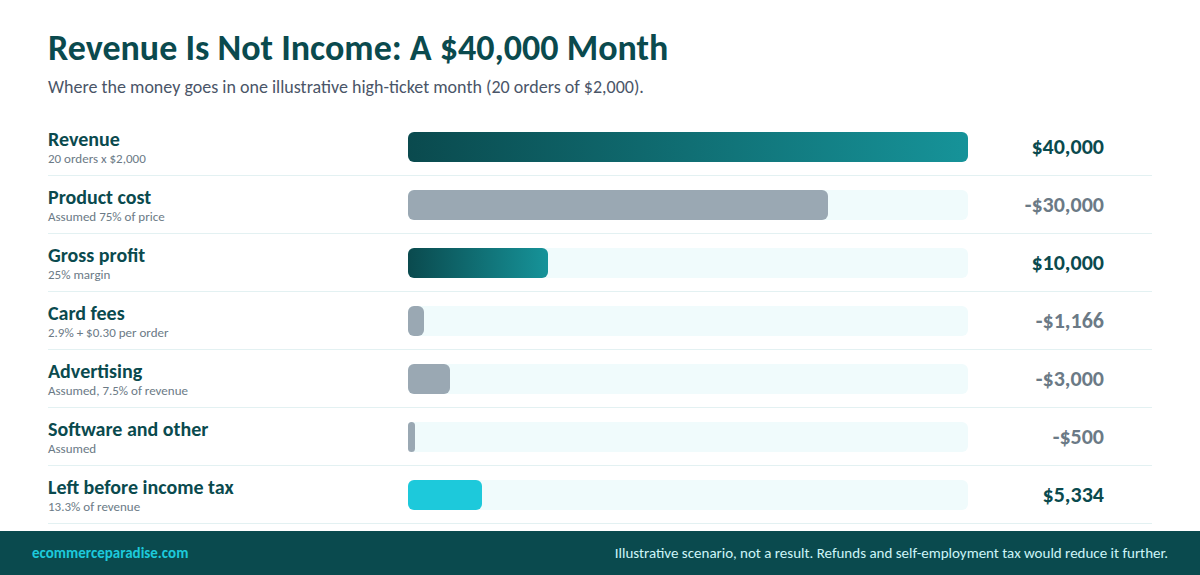
Here is one illustrative month. Take 20 orders of $2,000, which is $40,000 in revenue, at an assumed 25% margin. Gross profit is $10,000. Card fees come to $1,166 (2.9% of $40,000 plus 30 cents on each of 20 orders), I assume $3,000 for ads and $500 for software and other costs, and that leaves $5,334 before income tax. That sits inside my $2,000 to $7,000 range for the middle stage, and it is only 13.3% of the revenue.
Then there is tax. The IRS says the self-employment tax rate is 15.3%, made up of 12.4% for Social Security and 2.9% for Medicare, and that is before income tax. On a simple $5,000 of net profit that would be up to about $765 by my arithmetic, though a CPA will calculate it exactly for your situation. Talk to one before you decide how much you can really take home.
What Affects Your Income the Most
Now that you know the ranges, here are the specific levers that decide where you land. These come from my experience across hundreds of stores.
Niche Selection
Your niche determines your average order value, your margins and your customer demographics. Niches with a higher average order ($1,500 to $5,000) and stronger margins (25% to 35%) produce more income per sale. Outdoor furniture, electric fireplaces and commercial equipment are examples where the math works well, and you can explore over 1,000 categories in my high-ticket niches list.
Number of Suppliers and Products
More products mean more chances to make sales. A store with 50 products from 5 suppliers has a much lower revenue ceiling than a store with 300 products from 15 suppliers, because every product is another chance to appear in Google Shopping or organic search. Getting authorized with more suppliers should be an ongoing priority, and my guide on how to find suppliers for high-ticket products shows how.
Marketing Investment and Optimization
Your ad budget correlates with your revenue. A store spending $500 a month on Google Shopping will make less than one spending $3,000 a month, assuming both are optimized, but the skill that separates a $5,000 a month store from a $50,000 a month store is spending smarter. That means finding your highest-converting products, scaling what works and cutting what does not.
SEO is the other side, and it is what creates lasting income. Stores that invest in SEO with tools like Semrush and publish consistently build organic traffic that sells with no ad cost. I have seen stores where 40% to 50% of revenue comes from organic search.
Phone Sales Capability
This is the multiplier most dropshippers ignore. For high-ticket stores, phone sales can represent 30% to 50% of revenue in my stores. When a customer calls about a $3,000 product and you help them choose, the close rate is far higher than a website-only sale, so being available to take calls can dramatically lift your income.
Time Invested
This business rewards consistent effort. The stores that make the most are the ones where the owner kept working on suppliers, listings, content and marketing for 12+ months, because each month builds on the last. Your content ages and ranks higher, reviews accumulate and supplier terms improve.
Want Help Getting to Your First Real Sales Faster?
One-on-one coaching covers your niche, your dealer applications and your first campaigns, so you spend less time guessing.
A Realistic Three-Year Timeline
Trevor’s experience, a planning projection. Here is what an income trajectory looks like for someone starting a high-ticket store today who follows the process and puts in consistent effort. It describes a store that keeps going, not an average of everyone who starts.
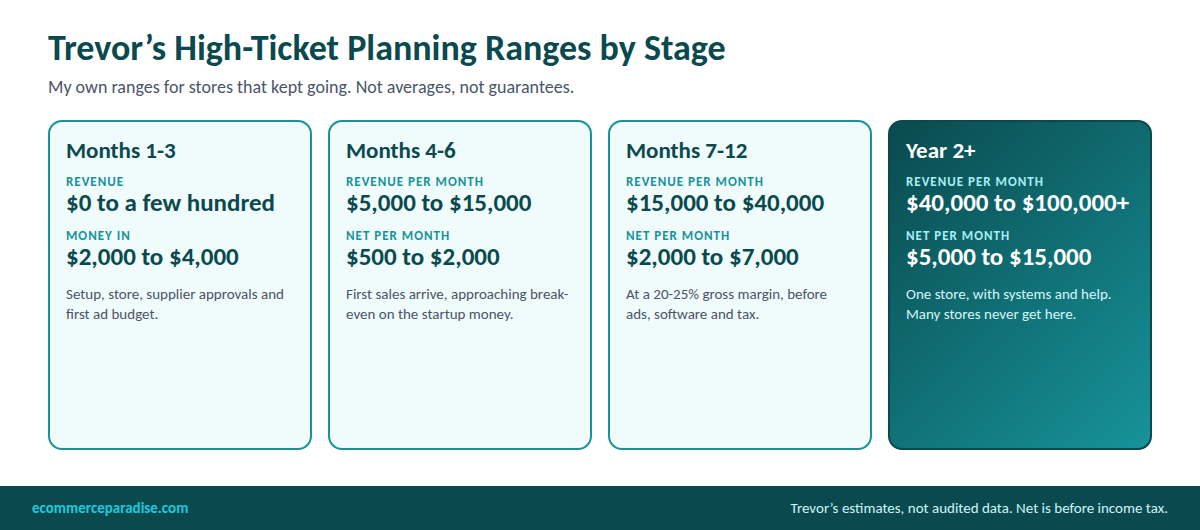
Months 1 to 3 are the investment phase. You spend money on the LLC, your Shopify store and an initial ad budget, and you earn $0 to a few hundred dollars. Total investment so far is $2,000 to $4,000.
Months 4 to 6 are the first sales phase. Revenue starts coming in, maybe $5,000 to $15,000 a month, and net income is $500 to $2,000 a month, which approaches break-even on your initial investment.
Months 7 to 12 are the growth phase. Revenue climbs to $20,000 to $40,000 a month as you add products and optimize, and net income is $2,000 to $7,000 a month, so the business has recouped its startup money.
Year 2 is the optimization phase. Revenue reaches $40,000 to $80,000 a month, you hire a VA for daily operations, and net income is $5,000 to $15,000 a month. You might start a second store.
Year 3 and beyond is the scale phase. Combined revenue across 2 to 3 stores is $80,000 to $200,000+ a month, with net income of $15,000 to $40,000+ a month, and the business runs 3 to 4 hours a day thanks to systems and team members.
Is this guaranteed? No. Nothing in business is. The Year 3 range in particular describes operators running two or three stores, so treat it as an upper scenario and not an expectation. The people who follow the process and do not quit are the ones who get close to these numbers, and setting up email marketing with Omnisend early helps every other channel pay off faster.
What Most Income Claims Get Wrong
I want to call out three misconceptions because they send people in the wrong direction.
Passive income is a myth at the start. Dropshipping is often marketed as passive. It is not, especially in the first 12 months, because you are actively building, optimizing and managing. It can become semi-passive in years 2 to 3 once you have systems and a team, but that takes real work up front. I still spend time on my stores every day after 15+ years, and now I spend 2 to 3 hours a day because I choose to.
One month does not define your income. Seasonality affects most niches, economic conditions change and a supplier may have stock issues. Judge your income over quarters. The stores that last are built on multiple suppliers, multiple traffic sources and a growing base of repeat customers.
Guaranteed-income pitches are a warning sign. The FTC’s action against Automators AI is worth reading, because it shows how an automated-store pitch can promise earnings that most buyers never see. Be careful with anyone selling a finished store or a secret supplier list with an income guarantee, and read my ranked guide to the best dropshipping courses for beginners before you pay for training.
I sell coaching and a done-for-you store build, so I have an obvious interest here. That is exactly why I label which numbers are mine and which are not.
When to Move From Low-Ticket to High-Ticket
If you already run a cheap-product store, you do not have to start over. The Shopify account, the business entity and the ad-testing skills carry across. What changes is the price of the product and the supplier relationship, because you move from marketplace catalogs to approved dealer accounts with established US brands. My video above covers the decision, and the guide to AliExpress dropshipping and when to move on shows what the low-ticket end looks like in 2026.
Signs it may be time to move up: your cost per sale is close to what you keep per order, refunds and support eat your week, or you cannot raise prices without losing sales. Here is how I point people depending on where they are.
| Where you are | Go here |
|---|---|
| Still choosing a niche | Free niches list |
| Want to learn it yourself, free | Free mini course or the beginner guide |
| Want the full training | High-Ticket Dropshipping Masterclass |
| Want help while you build | Coaching |
| Want a store built for you | Done-for-you build |
| Already selling and want to scale | Store management and ad management |
Prefer to learn the whole model yourself? The High-Ticket Dropshipping Masterclass has 18 modules, over 20 hours of training and 10 bonuses, and you choose how to join on the sales page. See the Masterclass →
How to Maximize Your Dropshipping Income
If you want the highest possible income, here is what I would focus on based on 15+ years of experience.
Go high-ticket. This is the most impactful decision. Selling products in the $1,000 to $5,000 range with 20% to 30% margins changes the economics, because you need fewer sales, less traffic and less customer service for the same income.
Pick the right niche and go deep before you go wide. Choose a specific niche with strong supplier availability, MAP pricing and affluent customers, and become the best store in it before you expand.
Build more than one traffic channel. Google Shopping for immediate sales, SEO for long-term traffic, email for repeat customers and abandoned carts, and phone sales for high-converting conversations. Each channel raises your ceiling and lowers your dependence on any single source.
Invest in systems and a team. Use Stock Sync for inventory automation. Use Finaloop for bookkeeping, and hire a VA to handle customer service and order processing.
Protect the money you make. My guide to protecting a high-ticket store from fraud and chargebacks covers the risks that eat into profit.
Disclosure: I may earn a commission if you sign up through my Shopify, Omnisend, Semrush, Dialpad, OnlineJobs.ph, Stock Sync or Finaloop links on this page, at no extra cost to you.
Frequently Asked Questions
How much do dropshippers make a month?
It varies enormously. TrueProfit’s study of 1,200+ stores puts beginners at $0 to $2,000 a month, intermediate sellers at $2,000 to $10,000 and advanced sellers at $10,000 to $50,000+, without saying whether that is revenue or profit. My own high-ticket planning range is $0 to $3,000 a month in gross profit for months 1 to 6, and $5,000 to $15,000 a month net for an established single store.
Can you make $5,000 a month dropshipping?
Yes, but the order count differs a lot by model. On my example margins and after the card fee, it takes about 733 low-ticket orders or 12 high-ticket orders, before ads, refunds and software. It is arithmetic, not a promise, and ad costs can erase the low-ticket total.
How long does it take to start making money?
In my experience, high-ticket clients see first sales around months 2 to 4 after launching their marketing, and consistent profit usually takes longer. TrueProfit says reaching $5,000 to $10,000 a month takes about 6 to 12 months. Anyone promising money in days is selling something.
Is dropshipping profitable in 2026?
It can be, but the cheap end is difficult. The Bureau of Labor Statistics found that 50.2% of private establishments opened in the year ended March 2015 survived five years, which covers all industries, and TrueProfit says only about 1% to 5% of dropshippers reach consistent profitability. Margins, order size and ad cost per sale decide the outcome, not the label “dropshipping.”
Do dropshippers pay taxes on what they make?
Yes. Net profit is taxable income, and the IRS lists a 15.3% self-employment tax rate on top of income tax for most self-employed people. Ask a CPA how it applies to you, and keep your business and personal money separate from day one.
Want a Working Store Instead of a Blank Dashboard?
My team builds a high-ticket dropshipping store and lines up suppliers, so you start with a working store and spend your time learning the business. Prefer to learn it yourself? Ask about coaching instead.
Related Articles
If you found this useful, these guides go deeper on related topics:
- How to Start Dropshipping: 9 Steps for Beginners in 2026
- Is $500 Enough to Start Dropshipping?
- Best Dropshipping Products: What Sells and Why
- Amazon FBA vs Dropshipping: Complete Comparison for 2026
- Dropshipping Tools: 34 Best Tools by Job for 2026
Trevor Fenner
Email: trevor@ecommerceparadise.com
Phone: (307) 429-0021
5830 E 2nd St, Ste. 7000 #715, Casper, WY 82609
About | Contact | Resources

Trevor Fenner is an ecommerce entrepreneur and the founder of Ecommerce Paradise, a platform focused on helping entrepreneurs build and scale profitable high-ticket ecommerce and dropshipping businesses. With over a decade of hands-on experience, Trevor specializes in high-ticket dropshipping strategy, niche and product selection, supplier recruiting and onboarding, Google & Bing Shopping ads, ecommerce SEO, and systems-driven automation and scaling. Through Ecommerce Paradise, he provides free education via in-depth guides like How to Start High-Ticket Dropshipping, advanced training through the High-Ticket Dropshipping Masterclass, and fully done-for-you turnkey ecommerce services for entrepreneurs who want a faster, more hands-off path to growth. Trevor is known for emphasizing sustainable, real-world ecommerce models over hype-driven tactics, helping store owners build scalable, sellable, and location-independent brands.


