

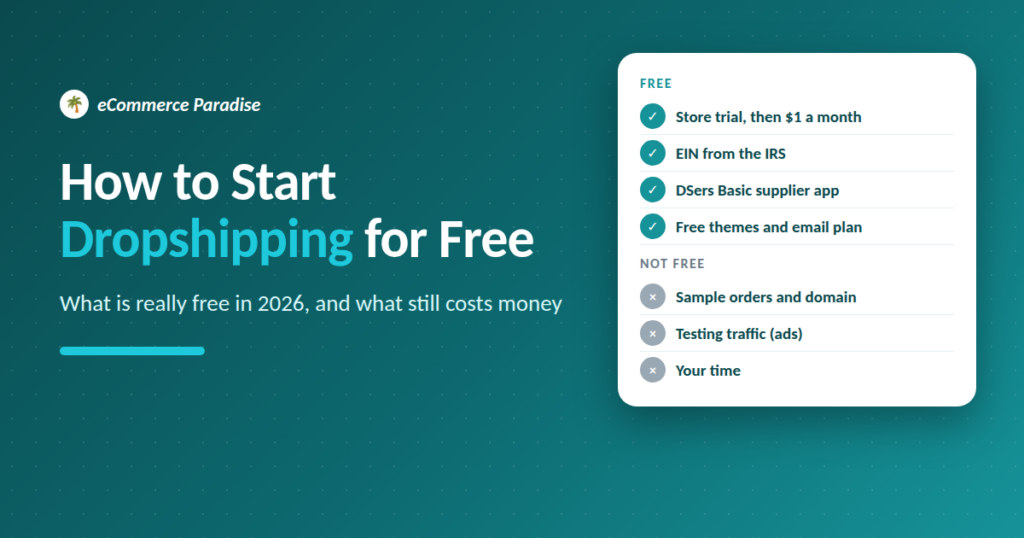
Quick answer: You can set up a dropshipping store for close to $0: a Shopify trial that costs $1 a month for the first three months, a free EIN, free supplier plans such as DSers Basic and CJdropshipping, and a free theme. What you cannot do for free is test traffic. $500 is tight, and for a high-ticket launch I suggest saving $2,500 to $3,000.
Search for how to start dropshipping for free and you will find lists of free apps, free themes and “no money needed” promises. Some of it is true, and the true part is useful. A store really can cost almost nothing to open, and I will show you each piece with the price and the limit as I read it on the company’s own page in October 2026.
But I have been building online stores for over fifteen years, and through Ecommerce Paradise I teach the higher-priced version of this model. The honest answer is that free covers the setup and does not cover the part that makes sales, which is testing traffic and getting suppliers to approve you. I explain the higher-priced model in my guide to what high-ticket dropshipping is.
This guide gives you the zero-cost path step by step, the free alternatives to an LLC, what each free plan really limits, and what it takes to run a store that can learn from real customers. Everything is current as of October 2026. When a number is my own estimate, I say so. This is general information, not legal, tax or financial advice, and I am not an attorney or CPA.
Start here: get my free high-ticket niches list. It costs nothing, and the category you choose decides your margins more than any app or ad does, so look at the options before you spend a dollar. Get the Free Niches List →
Prefer to watch? Here is my free beginner crash course on how high-ticket dropshipping works.
What’s in This Guide
- Free to open is not free to run
- The $0 starter stack: what is really free
- The zero-cost path, step by step
- Free alternatives to paying for an LLC
- Free low-ticket route vs zero-cost high-ticket route
- When free runs out
- The real cost breakdown
- How to start if you only have $500
- The budget I actually recommend
- Ways to fund your startup without debt
- What you should not spend money on
- Warning signs in “free” offers
- Where to go next
- Frequently asked questions
Free to Open Is Not Free to Run
Can you start dropshipping with $500, or with nothing? Technically yes. Can you build a profitable business that way? That is a much harder question, and the answer depends on which dropshipping model you follow. Most “start for free” advice online describes the low-ticket AliExpress model, where you sell cheap products with thin margins. You can open that kind of store for almost nothing, but running it profitably is a different story.
Here is the distinction I want you to keep in mind. Opening costs are the platform, a business ID and a supplier connection, and they can be near zero. Running costs are sample orders, a domain, the business entity, testing traffic and refunds, and they are not zero. The first group gets you a store. The second group gets you customers.
If you want the full beginner sequence rather than the budget angle, my guide on how to start dropshipping in nine steps covers the process from choosing a model to your first 90 days.
The $0 Starter Stack: What Is Really Free
I went to each company’s own pricing page in October 2026 and wrote down what the free option includes and where it stops. Confirm every price before you sign up, because plans change.
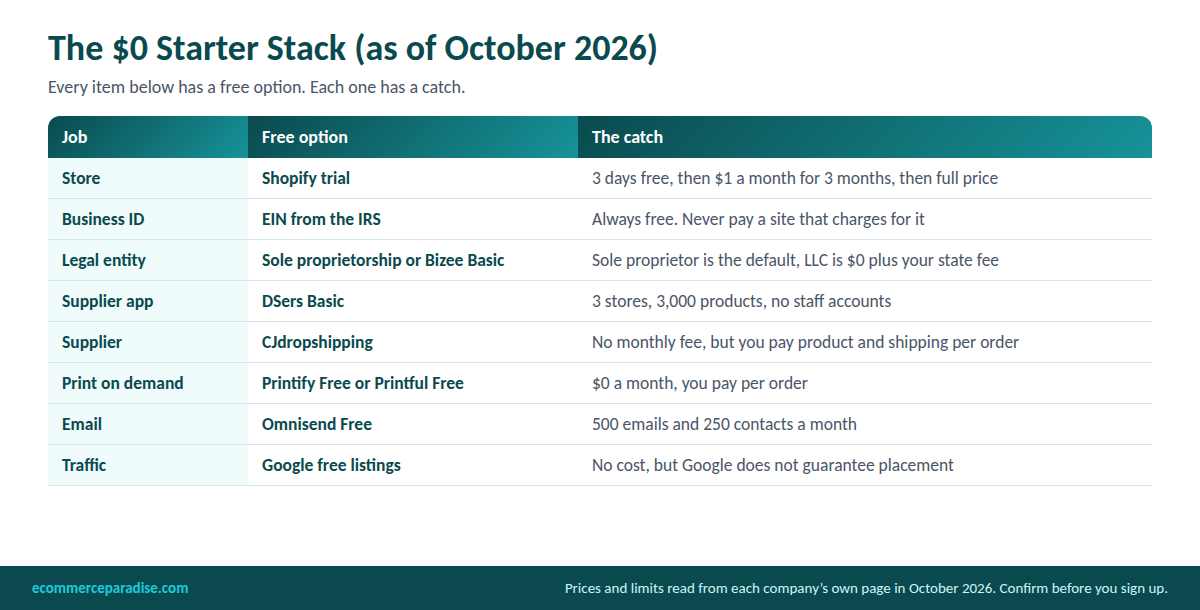
| Job | Free option | What it limits (October 2026) |
|---|---|---|
| Store platform | Shopify trial | 3 days free, then $1 a month for 3 months, then Basic at $39 a month or $29 a month billed yearly |
| Federal tax ID | EIN from the IRS | Always free, and the IRS says you never have to pay a fee for one |
| Business entity | Sole proprietorship, or Bizee Basic | A sole proprietorship is the default with no registration. Bizee Basic is $0 plus your state fee |
| Supplier app | DSers Basic | Free. 3 stores, 3,000 products, 1 sales channel, 1 supplier account, no staff accounts. Advanced is $19.90 a month |
| Supplier platform | CJdropshipping | No monthly platform fee, per CJ’s own help post (2020) and a September 2026 supplier roundup, but you pay for product, shipping and any services on each order. I could not load CJ’s pricing page |
| Supplier platform | Zendrop Free | $0 with “limited access.” Automated fulfillment is listed on the $49 Pro and $79 Plus plans, not on Free |
| Print on demand | Printify Free, Printful Free | $0 a month for each. Printify Premium starts at $39 a month, and Printful Growth is $24.99 a month |
| Omnisend Free | Up to 500 emails and 250 contacts a month | |
| Live chat | Tidio Free | 50 billable conversations a month, up to 10 agents |
| Theme | Dawn (Shopify) | Listed as free on Shopify’s theme store |
| Traffic | Google free listings | No cost to be eligible, but Google says it does not guarantee your products will be shown |
A few things that are no longer free, because older articles still say they are. Spocket has no free plan, only a 7-day free trial, and its Starter plan is $39.99 a month. Ecwid’s pricing page now lists a $5 a month Starter plan as its lowest tier and shows no free plan. And WooCommerce itself is free software, but you still pay for hosting, which I cover in my guide to WooCommerce dropshipping plugins and costs.
Disclosure: I may earn a commission if you sign up through my Shopify, DSers, CJdropshipping, Zendrop, Printify, Printful, Spocket, Bizee, Omnisend or Tidio links in this guide, at no extra cost to you.
If you want to compare the tools by job, my list of the best dropshipping tools by job prices a bare-bones stack alongside larger ones.
The Zero-Cost Path, Step by Step
This is the sequence I would follow if I wanted to spend as close to nothing as possible while still learning how a real store works. It is my own ordering, not an industry standard.
Step 1: Learn first, for free
Do not buy a course before you have used the free material. My free mini course walks through niche selection, store building, supplier outreach and marketing setup.
My beginner guide is a second free resource. Then pick your category from the free niches list, and if you are deciding between ideas, my guide to the best dropshipping niches for beginners narrows the field.
Step 2: Get the business basics at $0
Get an EIN from the IRS, which it describes as free and available online in minutes. Open a separate business bank account, and compare monthly fees before you choose one. Choose between a sole proprietorship and an LLC using the section on free LLC alternatives below.
Step 3: Open a trial store with a free theme
Start the Shopify trial and use the free Dawn theme. Build one product page and look at the admin and checkout before you pay for anything. The trial gives you 3 days, and then the $1 a month offer covers your first three months, so you can build slowly without paying full price.
Step 4: Connect free suppliers, or apply for dealer accounts
If you are going the low-ticket route, install the free DSers Basic plan or connect CJdropshipping and import a handful of products. My guide to AliExpress dropshipping in 2026 covers what has changed on delivery and duties.
If you are going the high-ticket route, there is no app to install. You apply directly to US brands and distributors to become an authorized dealer, and the applications cost nothing but time. My guide on how to find suppliers for high-ticket products walks through the process.
Step 5: Place a sample order, which is not free
This is the first line item that costs real money, and I would not skip it. Buy one product, follow it through the supplier and see the packaging, the speed and the packing slip. My CJdropshipping review explains how I would test that platform.
I did the same for another free-plan supplier in my Zendrop review, including shipping times and branding limits.
Step 6: Use free traffic while you learn
Google Merchant Center lets eligible products appear in Google Search and the Shopping tab through free listings, according to Google’s own help page. Pinterest and YouTube can send visitors too. Free traffic is slow and not guaranteed, so treat it as a way to learn, not a replacement for a testing budget.
Step 7: Let early profit fund your ads
The bootstrap method is to reinvest. Your first $2,000 sale might net $400 to $500 in gross profit, in my experience. Put that into ads, and let the second and third sales fund the next round. It is slower, and it works only if you are patient and disciplined.
Free Alternatives to Paying for an LLC
You do not have to form an LLC on day one, and you do not have to pay a formation service. These are the options, from cheapest up. Talk to a CPA or attorney about which one fits your state and situation.
| Option | Cost | The catch |
|---|---|---|
| Sole proprietorship | $0 to start | The SBA says you are automatically a sole proprietorship if you do business without registering as anything else, and you can be held personally liable for the business’s debts |
| Sole proprietorship plus EIN | $0 | The EIN is free from the IRS. It does not create a separate legal entity, so it does not limit your personal liability |
| LLC through Bizee Basic | $0 plus state fee | Bizee’s homepage lists Basic at $0 plus the state fee, Standard at $199 plus the state fee and Premium at $299 plus the state fee. State fees in my experience range from about $50 to $500 |
| LLC filed directly with your state | State fee only | You do the paperwork yourself, and you may need a registered agent |
Two honest notes. First, a $0 formation package is not free, because you still pay the state fee. Second, the SBA says most small businesses need a combination of licenses and permits, so check your state and city before you take your first order. For the order of operations on the higher-priced model, see my guide to business formation for high-ticket dropshipping.
In my experience, established US suppliers want to see a registered business, an EIN and a professional website before they approve a dealer account, so a sole proprietorship may be enough to learn but not always enough to get approved.
Free Low-Ticket Route vs Zero-Cost High-Ticket Route
The two models use the free stack differently, and the math is why I teach the second one. Here is the comparison, with arithmetic where I can show it.
| Low-ticket route | High-ticket route | |
|---|---|---|
| What is free | Store trial, DSers Basic or CJ, free theme | Store trial, EIN, dealer applications, free theme, Google free listings |
| Supplier approval | Install an app and import products | Apply as a dealer and show a real business |
| What you keep on a typical order | An $8 margin on a $30 order leaves $6.83 after a 2.9% plus 30 cent card fee (my arithmetic) | A $500 margin on a $2,000 order leaves $441.70 after the same fee (my arithmetic) |
| Where free runs out first | Ads. A $5 cost per sale leaves $1.83 per order | Time to first sale and the testing budget |
| Honest downside | Thin margins, overseas shipping and import rule changes | Slower start, freight shipping and more research per buyer |
The low-ticket route is easier to open for free, and it is also the one where free tends to run out fastest, because a $6.83 profit cannot pay for much testing. The high-ticket route is harder to open and cheaper to test, because one sale can fund a lot of clicks. If you are torn, my video above and my guide to dropshipping vs traditional ecommerce go deeper, and I am openly biased toward the higher-ticket version.
When Free Runs Out
The free plans are designed to be outgrown, so plan for the moment they stop being enough. Here is the Shopify price path as I read it from the pricing page in October 2026, plus the next costs that usually appear.
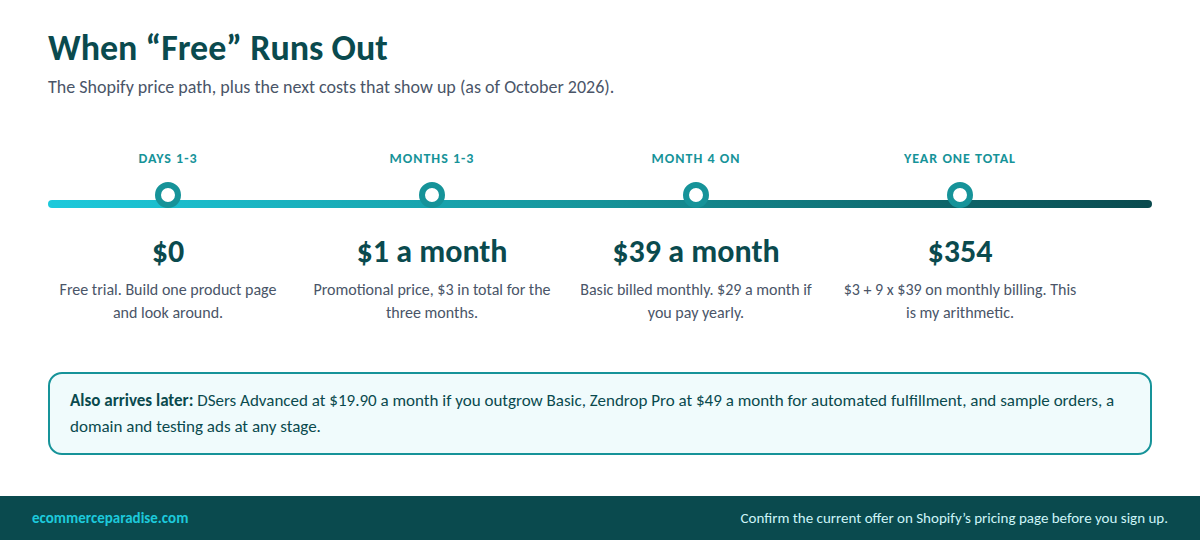
On monthly billing that is $3 for the first three months and $39 a month after, or $354 over the first year by my arithmetic (3 + 9 x 39). The $1 offer is described on Shopify’s page as applying to “most plans,” so check that it applies to the plan you pick. Beyond Shopify, you may outgrow DSers Basic and move to Advanced at $19.90 a month, or choose Zendrop Pro at $49 a month for automated fulfillment. Printful Growth is $24.99 a month, though Printful says it is free once you reach $12,000 a year in sales.
The other costs that never show up as a plan are the ones that matter most: samples, a domain and testing traffic.
The Real Cost Breakdown
If you want to run a real test and not just open a store, here are the cost categories. The figures below are my own estimates from building stores, except where I name a source. Use them to set a budget, and confirm current prices before you pay.
Business formation: $100 to $500
Before you build a store, I like to set up a real business with an EIN, any state permit you need and a business bank account. In my estimate, the whole process runs $100 to $500 depending on your state. Skip it and you may spend months getting suppliers to respond, because established manufacturers want to see a legitimate business before they consider a dealer agreement.
E-commerce platform: $29 to $39 a month after the trial
Shopify Basic is $29 a month billed yearly or $39 a month month to month, per the pricing page. It includes unlimited products, built-in payment processing and access to the Shopify App Store. I recommend starting with Basic and upgrading only when revenue justifies it. A custom domain is a yearly fee that varies by registrar, and my past estimate has been roughly $14 to $25 a year, so check the current price at Namecheap or your registrar.
Store design: $0 to $350
You can start with the free Dawn theme, which is clean and fast. If you are serious about a professional store, a premium theme is a real upgrade, and in my experience themes built for large catalogs run about $300 to $350. Start free and upgrade once you have made sales.
Marketing and advertising: $500 to $2,000 for initial testing
This is where $500 total becomes really tight. For high-ticket dropshipping, my main channel is Google Shopping, and you need enough budget to test and optimize before it becomes profitable. I recommend setting aside $500 to $1,000 specifically for initial ad testing, and $500 a month is the minimum I would plan on for Google Shopping on high-ticket products.
The reason is data. Google Shopping campaigns need clicks to learn which products get interest and what a sale costs. With a $100 budget, you might get only 20 to 30 clicks in a high-ticket niche, which is not enough to draw conclusions. With $500 to $1,000 over two to four weeks, patterns start to emerge. My guide to setting up Google Shopping and Performance Max covers the campaign side.
Tools and apps: $0 to $150 a month
Start with the free plans in the stack above, and add paid tools only when you need them. A free Omnisend plan covers early email, and my ecommerce email marketing flows guide shows which emails to set up first. Inventory sync tools such as Stock Sync help once you have supplier feeds. For SEO, paid research tools cost real money, so start with free ones and upgrade after you have revenue.
Business phone system: $15 to $30 a month
For high-ticket stores, a phone number on your site is non-negotiable in my experience. When someone is about to spend $2,000, they want to talk to a person, and a virtual phone system gives you a professional number that forwards to your cell. My estimate is $15 to $30 a month, so confirm the current price with a provider such as Grasshopper.
So what is the real number?
Here is my estimate for a properly funded three-month launch of a high-ticket store. Business formation, permit and domain: $150 to $500. Shopify for three months: $90 to $240. Store theme and basic design: $0 to $350. Google Shopping ad testing for three months: $1,500 to $3,000. Tools and apps for three months: $50 to $450. Business phone for three months: $45 to $90. Total: approximately $1,835 to $4,630.
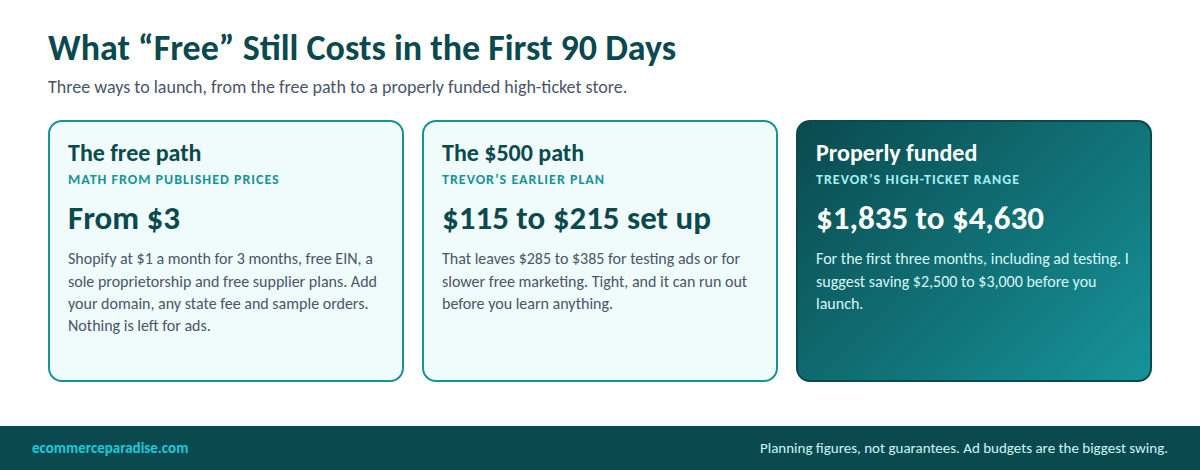
That is why $500 is really tight. It is not impossible, but you end up cutting corners in the area that matters most, which is marketing. Starting with too little ad budget means you cannot test, so you cannot optimize, so you do not get sales, so you quit and conclude that dropshipping does not work. I have seen that pattern many times.
How to Start If You Only Have $500
I am not going to tell you it is impossible, because resourceful people find a way. If $500 is truly all you have right now, here is the strategy I would use to give yourself the best chance.
First, handle business formation. Form an LLC through Bizee’s $0 package if you can pay the state fee, or begin as a sole proprietorship with a free EIN. Budget about $100 to $200 for this step depending on your state, and apply for any permit your state requires.
Next, build your store on the Shopify trial with a free theme and load it with products from the suppliers you have been approved with. In my plan, that brings total spend to roughly $115 to $215 including a domain.
With the remaining $285 to $385, you have two options. Option one is to put it into a tight, focused Google Shopping campaign on your best products, which gives you two to three weeks of testing at a modest daily budget. Option two is to invest in SEO and content instead, writing detailed product descriptions, buying guides and comparison articles, and focusing on organic traffic that costs nothing per click. It is slower, and it does not need a large ad budget.
If you go organic, add free channels too. Set up a Google Business Profile, share products on Pinterest, which acts like a visual search engine, and make YouTube videos reviewing and comparing products in your niche. These take time to build, but they cost only effort.
The Budget I Actually Recommend
If you ask for my honest recommendation, it is to save at least $2,500 to $3,000 before you launch. That covers proper business formation, a professional-looking store, three months of ad testing at a reasonable budget and the tools you need to run it efficiently.
With $3,000, you can launch with confidence instead of watching every dollar. You can test Google Shopping properly, which helps you find winning products faster. You can invest in a premium theme and the essential apps from day one, and you have a buffer for the unexpected costs that always come up in business.
The people who start with adequate capital and a patient, methodical approach are the ones who last. The ones who rush in with $200, throw it at ads for a week, get no sales and declare dropshipping a scam are the ones who feed the failure statistics. The Bureau of Labor Statistics shows that 50.2% of private establishments opened in the year ended March 2015 survived five years, across all industries, so planning for the long run matters.
Ways to Fund Your Startup Without Debt
If you do not have $2,500 to $3,000 saved, that is okay. Here are practical ways to fund a startup without credit card debt or personal loans.
Run a side hustle for startup capital. Pick up freelance work, sell things you do not need, drive for a rideshare service or take extra shifts. Put every dollar of that income into your startup fund. Most people can save $2,500 in two to three months if they are intentional, and while you save, you can research niches and study the model using my high-ticket niches list.
Start lower and reinvest profits. If you launch with $500 using the organic strategy above, reinvest whatever you earn. Your first sale on a $2,000 product might net $400 to $500 in gross profit, in my experience, and you reinvest that in ads. This bootstrap approach is slower, but it works if you are patient and disciplined.
Take the free education first. Work through the free mini course while you are saving, so that when your capital is ready you know exactly what to do with it. Most people waste money because they jump in before they understand the process.
What You Should Not Spend Money On
Knowing what not to buy matters as much as knowing what to invest in. These are the money pits I see beginners fall into.
Expensive courses before you try the free material. There are plenty of free guides, videos and posts that teach the fundamentals, and my free niches list and mini course give you a lot to act on. When you are ready to compare paid programs, my ranked guide to the best dropshipping courses for beginners shows what each costs.
Custom website design before you validate a niche. A free or low-cost theme is fine for launch. I have seen people spend $3,000 on a custom site before making a sale, which is backwards.
Every app at once. Start with the basics, which are a store, a free email plan and your ad account. Every unnecessary $20 a month subscription eats into your ad budget, and early on every dollar of that budget matters.
Hiring before you are profitable. Handle things yourself at first, because you will learn every part of the business. When you are consistently profitable, bring on a VA through OnlineJobs.ph to take over daily operations.
Finished stores, secret supplier lists and guaranteed-income programs. The FTC’s action against Automators AI shows how those pitches work. The FTC alleged that the vast majority of that company’s clients did not make the promised earnings or recoup their investment.
Warning Signs in “Free” Offers
“Free” is also a sales tactic, so read the terms. These are the patterns I would watch for, and they are my own checklist.
- Free training that exists to sell a high-priced program. That is fine if you know it, and it is a problem if the training hides the price.
- “No money needed” with no mention of ads. If the guide never says what a sale costs to acquire, it is skipping the main expense.
- Free supplier lists with no approvals. A list is not a relationship, and suppliers decide who they will sell to.
- Trials that need a card and renew quietly. Set a calendar reminder for the day your trial or promotional price ends.
- Delivery and duty promises you did not test. A presidential order suspended the $800 de minimis exemption effective August 29, 2025, according to CBS News, and the rules have kept changing, so ask a supplier in writing whether the price includes duties and delivery.
Want Help Starting Without Wasting the Budget?
One-on-one coaching covers your niche, your dealer applications and your first campaigns, so a small starting budget goes further.
Where to Go Next
The investment that pays for itself is treating this as a real business. A well-built store with strong margins can pay back a $2,500 to $3,000 startup over time, but I cannot promise that, and you should compare it with what other business models need to start. If you want a deeper look at the model before spending, my comparison of Amazon FBA vs dropshipping is a good place to start.
Here is how I point people depending on where they are after reading this guide. Start at the first row that fits you.
| Where you are | Go here |
|---|---|
| Still choosing a niche | Free niches list |
| Want to learn it yourself, free | Free mini course or the beginner guide |
| Want the full training | High-Ticket Dropshipping Masterclass |
| Want help while you build | Coaching |
| Want a store built for you | Done-for-you build |
| Already selling and want to scale | Store management and ad management |
Prefer to learn the whole model yourself? The High-Ticket Dropshipping Masterclass has 18 modules, over 20 hours of training and 10 bonuses, and you choose how to join on the sales page. See the Masterclass →
Frequently Asked Questions
Can you start dropshipping for free?
You can open a store for close to $0 using a Shopify trial, a free EIN, a free supplier plan such as DSers Basic and a free theme. You cannot test paid traffic or order samples for free, so the real cost shows up the moment you want a first sale. Decide on an amount you can afford to lose and keep it separate from living costs.
Is $500 enough to start dropshipping?
It is enough to open a store and cover the basics, but it is tight for testing. In my plan, $115 to $215 goes to setup and $285 to $385 is left for ads or slower free marketing. My recommended budget for a high-ticket launch is $2,500 to $3,000.
What is the cheapest way to start dropshipping?
The cheapest route is the low-ticket one, using the Shopify trial, DSers Basic or CJdropshipping, and a free theme. It is also the route where the profit per order is smallest, so the ads you need later can wipe it out. My guide to dropshipping suppliers for beginners compares the starter options.
Do I need an LLC to start dropshipping?
Not always, and rules vary by state, so confirm with a CPA or attorney. A sole proprietorship with a free EIN is the cheapest way to begin. In my experience, established suppliers want a registered business before they approve a dealer account.
Can I really dropship with no money and no ads?
You can try free traffic such as Google free listings, Pinterest and YouTube, but Google does not guarantee that free listings show your products, and free channels take months. In my experience, a small tested ad budget gets you data much faster than waiting for organic traffic.
Want a Working Store Instead of a Blank Dashboard?
My team builds a high-ticket dropshipping store and lines up suppliers, so you start with a working store and spend your time learning the business. Prefer to learn it yourself? Ask about coaching instead.
Related Articles
If you found this useful, these guides go deeper on related topics:
- How to Start Dropshipping: 9 Steps for Beginners in 2026
- Dropshipping Tools: 34 Best Tools by Job for 2026
- AliExpress Dropshipping in 2026: How It Works, Real Costs, and When to Move On
- Spocket Review 2026: Pricing, Shipping Times, Pros and Cons
- Dropshipping Checklist for Beginners
Trevor Fenner
Email: trevor@ecommerceparadise.com
Phone: (307) 429-0021
5830 E 2nd St, Ste. 7000 #715, Casper, WY 82609
About | Contact | Resources

Trevor Fenner is an ecommerce entrepreneur and the founder of Ecommerce Paradise, a platform focused on helping entrepreneurs build and scale profitable high-ticket ecommerce and dropshipping businesses. With over a decade of hands-on experience, Trevor specializes in high-ticket dropshipping strategy, niche and product selection, supplier recruiting and onboarding, Google & Bing Shopping ads, ecommerce SEO, and systems-driven automation and scaling. Through Ecommerce Paradise, he provides free education via in-depth guides like How to Start High-Ticket Dropshipping, advanced training through the High-Ticket Dropshipping Masterclass, and fully done-for-you turnkey ecommerce services for entrepreneurs who want a faster, more hands-off path to growth. Trevor is known for emphasizing sustainable, real-world ecommerce models over hype-driven tactics, helping store owners build scalable, sellable, and location-independent brands.


