


High Ticket vs Low Ticket: The Fundamental Difference
If you are trying to decide between selling $20 gadgets from AliExpress or $2,000 products from US manufacturers, let me save you a lot of time and headache. After building stores on both sides of the spectrum over 10+ years, I can tell you that high ticket dropshipping wins in almost every category that matters for building a real, sustainable business. But I want to walk you through the actual numbers so you can make this decision based on data, not hype. For the complete breakdown of how this model works, check out our comprehensive guide to high ticket dropshipping.
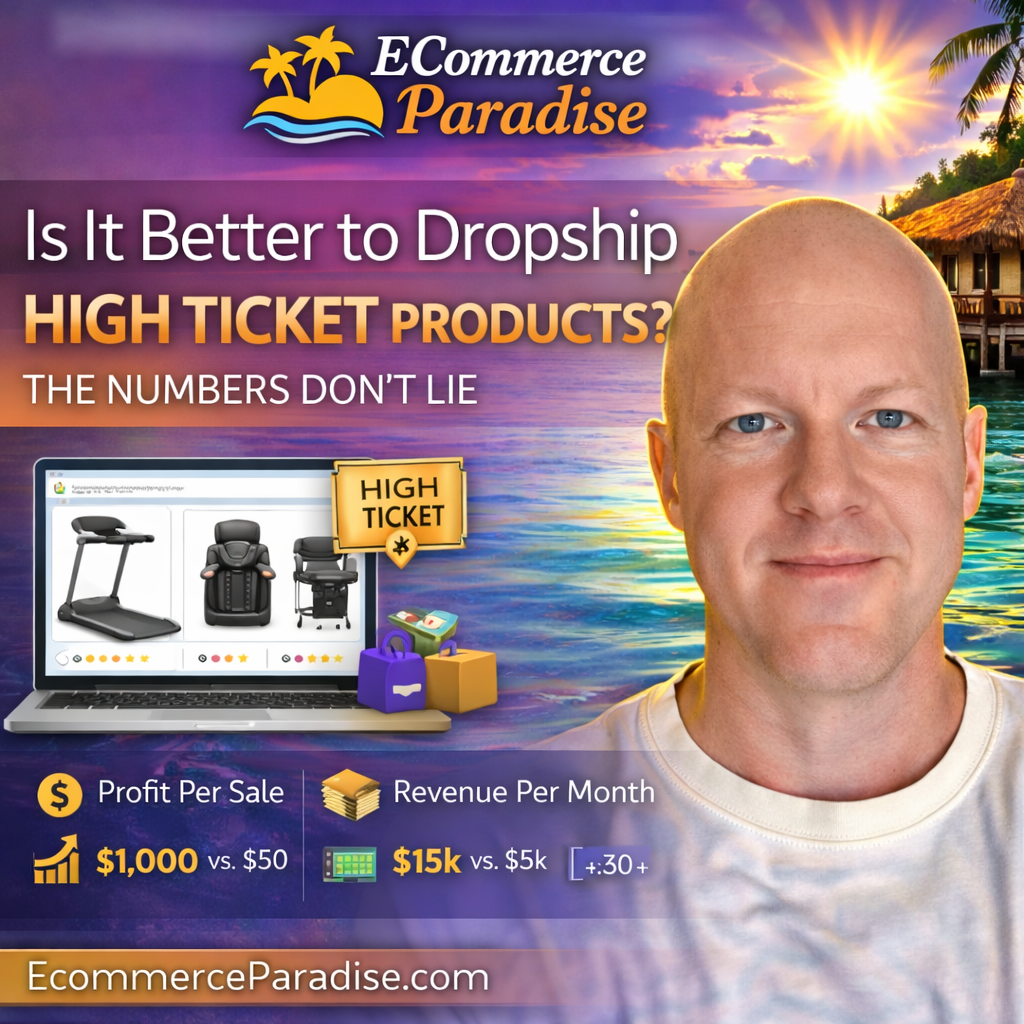
The core difference comes down to profit per transaction. When you sell a low ticket item for $25 with a 20% margin, you make $5 per sale. To generate $5,000 per month in gross profit, you need 1,000 sales. That means 1,000 customers to acquire, 1,000 orders to process, 1,000 potential customer service inquiries, and 1,000 chances for something to go wrong. With high ticket products priced at $1,500 and a 30% margin, you make $450 per sale. You only need about 11 sales to hit that same $5,000. That is a completely different workload and stress level. If you want to start exploring what high ticket niches are available, grab our free niches list with over 1,000 options.
Keep that in mind because it changes everything about how you run your business. Fewer sales means less customer service, fewer returns, fewer shipping issues, and more time to focus on growth instead of putting out fires all day. When I had low ticket stores years ago, I spent most of my time dealing with complaints, chargebacks, and shipping delays. With high ticket stores, I spend my time building supplier relationships and optimizing my marketing. It is a completely different lifestyle. Our resources page has all the tools and guides you need to get started with this model.
The Profit Margin Breakdown: Real Numbers Compared
Let me put some concrete numbers side by side so you can see exactly why high ticket makes more sense for most people. A typical low ticket dropshipping store selling products in the $15 to $50 range operates on margins between 15% and 25%. After you factor in advertising costs, which tend to be high relative to the product price, platform fees, and refunds, your net margin often drops to 3% to 7%. On $10,000 in monthly revenue, that is $300 to $700 in actual profit. And getting to $10,000 in revenue selling $20 items requires a ton of traffic and a lot of ad spend. If you are thinking about forming your business to do this right, start with our business formation checklist.
A high ticket dropshipping store selling products in the $500 to $5,000 range operates on gross margins between 25% and 50%. Net margins after ads and expenses typically land between 7% and 15%. On $50,000 in monthly revenue, which is very achievable with high ticket, that is $3,500 to $7,500 in net profit. And you are generating that revenue from maybe 20 to 40 orders instead of hundreds or thousands. The math just works better. If you want hands-on help building a store with these margins, our private coaching program walks you through every step.
The advertising economics are also dramatically different. With low ticket products, your cost per acquisition often eats up most of your margin. If it costs $8 in ads to acquire a customer who buys a $25 product with $5 in margin, you are losing money on every sale. You have to rely on repeat purchases and upsells to become profitable, which is really hard when you are selling commodity products with no brand loyalty. With high ticket products, a $30 to $80 cost per acquisition on a $1,500 sale with $400 in margin leaves plenty of room for profit. That is why I always recommend high ticket to anyone who is serious about building a real business. Our turnkey store service builds you a fully stocked high ticket store ready to generate these margins.
Supplier Quality and Reliability
One of the biggest advantages of high ticket dropshipping that does not get talked about enough is supplier quality. When you work with US-based manufacturers selling premium products, you are dealing with professional companies that have real warehouses, real customer support teams, and established shipping processes. Orders get fulfilled in 1 to 5 business days, tracking numbers are provided automatically, and products arrive in professional packaging. Browse our high ticket niches list to find categories with strong US-based manufacturers.
Compare that to low ticket dropshipping where you are often sourcing from overseas suppliers through AliExpress or CJ Dropshipping. Shipping times can be 2 to 4 weeks, quality control is inconsistent, and communication with suppliers often involves language barriers and time zone differences. When a customer complains about a late shipment or a defective product, you are stuck playing middleman between an unhappy buyer and a supplier who may or may not respond. The complete process for finding reliable high ticket suppliers is laid out in our supplier sourcing guide.
MAP pricing is another huge factor. Most high ticket US manufacturers enforce Minimum Advertised Price policies, which means every authorized dealer sells at the same price. You are not constantly getting undercut by competitors willing to sell at a loss just to grab market share. The playing field is level, and you compete on trust, customer service, and store quality rather than price. This is a massive advantage that low ticket dropshipping simply does not have. I use Shopify for all my stores because it handles high ticket transactions seamlessly with secure checkout and fraud protection built in.
Customer Service: Less Volume, Higher Quality
This is something a lot of people do not think about until they are drowning in customer support tickets. With low ticket dropshipping, high volume means high customer service demands. Hundreds of emails, live chats, and phone calls about shipping delays, wrong items, and refund requests. It becomes a full-time job just managing customer inquiries, and if you do not handle them well, you get negative reviews that tank your store. Set up a professional business phone from day one with Grasshopper so customers can actually reach you.
With high ticket dropshipping, you deal with far fewer customers, but each interaction matters more. A customer spending $2,000 expects to be able to call you, ask detailed questions about the product, and get a real human who knows what they are talking about. That might sound intimidating, but it is actually way more manageable than fielding hundreds of low-value complaints. You can give each customer genuine attention, which builds loyalty and generates referrals. Set up a professional email through Google Workspace so your communications look legitimate and trustworthy.
Phone sales are a major part of high ticket dropshipping, and this is actually one of the most fun parts of the business. When someone calls about a $3,000 product, they are usually ready to buy and just need reassurance that they are making a good choice. A five-minute phone call can close a sale worth $500 to $1,000 in profit. Try doing that with $20 products. Having a dedicated business phone through Dialpad makes this process smooth and professional.
Advertising and Traffic: Quality Over Quantity
Google Shopping is the bread and butter of high ticket dropshipping, and it works incredibly well for expensive products. When someone searches for a specific model number or product name on Google, they have very high purchase intent. They know what they want and they are looking for the right place to buy it. Your job is to show up in that search with a professional-looking listing and a trustworthy store. Use SEMRush to research which product keywords have the most commercial intent in your niche.
The conversion rates on Google Shopping for high ticket products are surprisingly good because of that intent. A well-optimized campaign can convert at 1% to 3%, and when your average order value is $1,500 or more, even a 1% conversion rate is extremely profitable. Compare that to low ticket products where you need Facebook or TikTok ads to create demand for products people did not know they wanted. Those platforms are great for impulse purchases, but the targeting and creative requirements are much more demanding. I find the best keywords for my stores using KWFinder which shows search volume and competition at a glance.
SEO is another massive advantage for high ticket stores. Product-specific keywords in high ticket niches tend to have low competition because not many websites target them. A blog post reviewing a specific outdoor kitchen model or comparing two brands of infrared saunas can rank on page one of Google within a few months, driving free organic traffic that converts at high rates. Over time, this organic traffic compounds and reduces your dependence on paid ads. Tools like Ahrefs help you track your rankings and find new keyword opportunities.
Email marketing works differently with high ticket too. Your list might be smaller, but the value per subscriber is much higher. A well-crafted email sequence through Klaviyo can recover abandoned carts worth hundreds or thousands of dollars. One recovered cart email that saves a $2,500 sale pays for your entire email marketing software cost for the year. That kind of ROI is just not possible with low ticket products.
Startup Costs and Investment Comparison
I want to be honest about one area where low ticket has an advantage, which is startup costs. You can technically start a low ticket dropshipping store for a few hundred dollars. AliExpress does not require minimum orders, and you can run cheap Facebook ads to test products. The barrier to entry is very low, which is part of the appeal. But that low barrier is also why the market is so saturated and margins are so thin. Our beginner’s guide covers everything you need to know about getting started the right way.
High ticket dropshipping requires more upfront investment, typically $2,000 to $5,000 to get started properly. That includes your Shopify subscription, a premium theme like Superstore, LLC formation, and an initial advertising budget. It is more money, but the return on that investment is significantly higher. Think of it as the difference between opening a lemonade stand and opening a real business. The lemonade stand costs less but has a much lower ceiling.
LLC formation is pretty straightforward and affordable. Services like LegalZoom can handle it for you, or you can go with a more budget-friendly option like Bizee which offers free formation where you just pay the state filing fee. Either way, having a proper business entity protects your personal assets and makes you look more professional to suppliers and customers.
You will also need a registered agent for your LLC, which runs about $100 to $200 per year. Northwest Registered Agent is my go-to recommendation because they protect your privacy and never sell your data. Once your business is set up properly, the ongoing costs are manageable and scale with your revenue.
Scalability and Long-Term Growth
High ticket dropshipping scales in a way that low ticket simply cannot match. To double revenue with low ticket, you need to double your order volume, which means double the customer service, double the fulfillment complexity, and double the potential problems. To double revenue with high ticket, you can add more suppliers and products to your existing store, expand into related niches, or improve your conversion rate. The operational complexity stays manageable. If you are ready for someone to build your store while you focus on growth, check out our turnkey service.
A lot of my clients start with one niche and one store, get it profitable, then expand. Some add complementary product categories to the same store. Others launch entirely new stores in different niches. One client went from zero to three profitable stores within 18 months, each doing $20,000 to $40,000 per month. The systems and processes you build for one store transfer directly to the next. I teach this exact scaling strategy in our coaching program.
The hiring side is also much simpler with high ticket. Because order volume is lower, you can hire one or two virtual assistants through OnlineJobs.ph to handle customer service and order processing for your entire operation. With low ticket, you might need a whole team just to keep up with the volume. Less complexity means higher net margins and less management headache.
Your bookkeeping stays cleaner too. Fewer transactions means easier reconciliation and less room for errors. I use Finaloop for automated ecommerce accounting, and with a high ticket store doing 30 to 50 orders per month, the books practically keep themselves.
The Lifestyle Factor
This one is personal, but I think it matters. High ticket dropshipping gives you a business you can run from anywhere without being chained to your computer all day. I have run my stores from Bali, Thailand, Los Angeles, and Montana. Because the order volume is manageable, I can check in for a few hours a day and handle everything. Try doing that with a low ticket store processing 50 orders a day. Protect your business address no matter where you are with a virtual mailbox from Traveling Mailbox.
The stress level is completely different too. With low ticket, you are constantly chasing the next viral product, worrying about ad account bans, and dealing with supplier issues. It feels like a hamster wheel. With high ticket, you build relationships with established manufacturers, sell evergreen products that people need year-round, and grow steadily over time. It is a business you can actually enjoy running. I use Surfshark VPN to keep my connections secure when working from coffee shops and coworking spaces around the world.
If the location-independent lifestyle appeals to you, high ticket dropshipping is pretty much the perfect business model. The margins support a comfortable income, the workload is manageable, and the products are not going away. People will always need furniture, outdoor equipment, kitchen appliances, and specialty items that they cannot just grab at the local store. Stay connected internationally with a phone plan like Google Fi that works in over 200 countries.
When Low Ticket Might Make Sense (But Probably Does Not)
I want to be fair here. There are a few scenarios where low ticket dropshipping could work. If you have a massive social media following and can drive free organic traffic, low ticket impulse purchases can work because your customer acquisition cost is near zero. If you are purely testing the waters of ecommerce and want to spend as little as possible to learn, low ticket is cheaper to start. And if you find a truly viral product with a limited window of demand, riding that wave with cheap ads can generate short-term profit. But none of these are sustainable long-term business strategies. Our free mini course shows you how to build a business that lasts.
For anyone serious about building a real business that generates consistent income for years, high ticket is the clear winner. The margins are better, the operations are simpler, the customer relationships are stronger, and the long-term growth potential is much higher. It is not the easier path in terms of startup effort, but it is absolutely the smarter path. Get started with our beginner’s guide for a step-by-step roadmap.
Ready to Make the Switch to High Ticket?
If you have been going back and forth on whether to go high ticket, I hope this breakdown makes the decision clearer. The numbers speak for themselves. Our done-for-you turnkey store service can have you set up and ready to sell within weeks, with suppliers onboarded and products loaded.
For personalized guidance on choosing the right niche and building your store the right way, our private coaching gives you direct access to me and my team. We have helped hundreds of people transition from low ticket to high ticket successfully.
Join our Skool community where you can connect with other store owners, ask questions, and get real-time support as you build your business. It is the best place to learn alongside people who are actually doing this.
Check out our podcast for more in-depth discussions on high ticket vs low ticket, niche selection, and building a profitable ecommerce business. I wish you guys the best of luck out there. Let’s get into it.

Trevor Fenner is an ecommerce entrepreneur and the founder of Ecommerce Paradise, a platform focused on helping entrepreneurs build and scale profitable high-ticket ecommerce and dropshipping businesses. With over a decade of hands-on experience, Trevor specializes in high-ticket dropshipping strategy, niche and product selection, supplier recruiting and onboarding, Google & Bing Shopping ads, ecommerce SEO, and systems-driven automation and scaling. Through Ecommerce Paradise, he provides free education via in-depth guides like How to Start High-Ticket Dropshipping, advanced training through the High-Ticket Dropshipping Masterclass, and fully done-for-you turnkey ecommerce services for entrepreneurs who want a faster, more hands-off path to growth. Trevor is known for emphasizing sustainable, real-world ecommerce models over hype-driven tactics, helping store owners build scalable, sellable, and location-independent brands.

Still deciding what to sell?
Grab the free list of 1,000+ niches that work for high-ticket dropshipping, sorted by category.
Free. Unsubscribe any time.


