

One of the most common points of confusion for people building their first website is the difference between web hosting and a domain name. They sound similar, they’re often sold together, and some providers bundle them in ways that make it even harder to tell them apart. But they’re two completely different things, and understanding the distinction is important for making smart decisions about your website.
I’m Trevor with E-Commerce Paradise, and I’ve been building websites for over 15 years. This is one of the first things I explain to new clients and students because getting confused about hosting vs domains leads to overpaying, choosing the wrong services, and making setup mistakes that cost time and money.
In this guide, I’ll break down the difference between web hosting and domain names in the simplest way possible, explain how they work together, and help you understand what you need to buy and where to get the best deals. Let’s get into it.
What Is a Domain Name
A domain name is your website’s address on the internet. It’s what people type into their browser to find your site. For example, ecommerceparadise.com is a domain name. Google.com is a domain name. Amazon.com is a domain name. It’s the human-readable name that maps to a numerical IP address where your website actually lives.
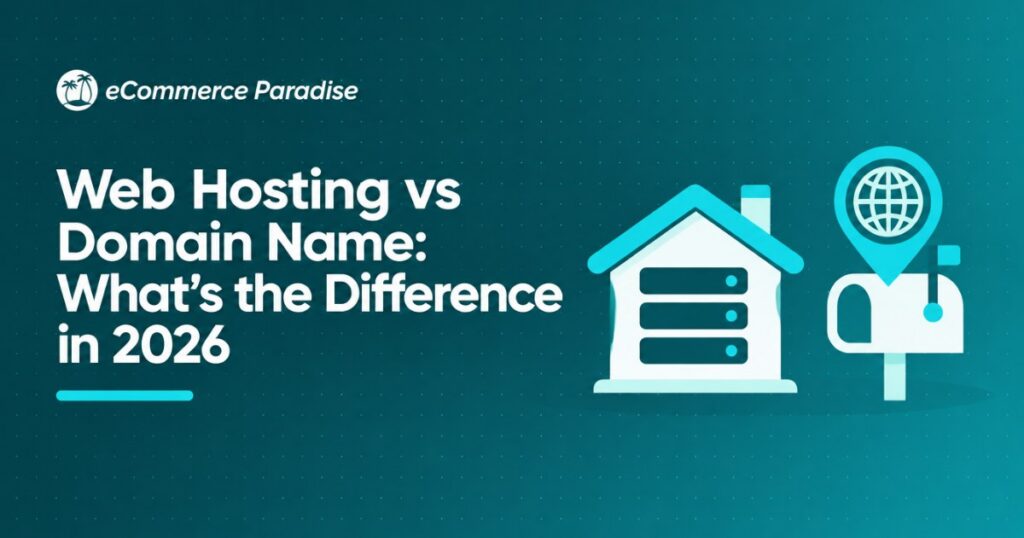
Think of a domain name like your home address. When someone wants to visit your house, they use your street address to find it. Your domain name works the same way for your website. Without a domain name, visitors would have to type in a string of numbers (like 192.168.1.1) to find your website, which nobody would remember.
Domain names are registered through domain registrars, which are companies authorized by ICANN (Internet Corporation for Assigned Names and Numbers) to sell domain names. Popular registrars include Namecheap, GoDaddy, Google Domains, and Cloudflare Registrar. When you register a domain, you’re essentially leasing the rights to use that name for a set period, typically one year, with the option to renew.
Domain names consist of two parts: the name itself (like “ecommerceparadise”) and the extension (like “.com”). Extensions are also called TLDs (Top-Level Domains). The most common is .com, but there are hundreds of options including .net, .org, .io, .store, .shop, and many more. For most businesses, .com is still the best choice because it’s the most recognized and trusted by consumers.
What Is Web Hosting
Web hosting is the service that stores your website’s files and makes them accessible to visitors on the internet. When someone types your domain name into their browser, the hosting server delivers your website’s files to their browser so the site appears on their screen.
If a domain name is your address, web hosting is the actual house that sits at that address. The hosting server stores everything that makes up your website: the HTML files, images, videos, databases, scripts, stylesheets, and all other content. Without hosting, there’s nothing for visitors to see when they visit your domain.
Web hosting comes in several types depending on your needs and budget. Shared hosting is the most affordable at $2-10/month, where your site shares a server with other websites. VPS hosting ($20-80/month) gives you dedicated resources in a virtual environment. Cloud hosting distributes your site across multiple servers for better reliability. And dedicated hosting ($100-500+/month) gives you an entire physical server. For a complete breakdown, read our guide on types of web hosting explained.
Hosting providers include companies like SiteGround, Bluehost, Cloudways, and Liquid Web. They own and operate the servers in data centers, provide the technology to keep your site running, and offer support when you need help.
The Key Differences
Let me lay out the fundamental differences between domain names and web hosting clearly so there’s no confusion.
A domain name is an address. Web hosting is the physical space. A domain name tells browsers where to find your website. Web hosting is where your website’s files actually live.
You register a domain name. You subscribe to web hosting. Domain names are typically registered for one year at a time and renewed annually. Hosting is a service you pay for monthly or annually.
Domain names are relatively cheap. Hosting costs vary widely. A .com domain costs around $10-15 per year. Hosting can range from $3/month for shared hosting to $500+/month for dedicated servers.
Domain names are portable. Hosting is less portable. You can point your domain to any hosting provider at any time by changing your DNS settings. Moving your actual website files between hosts requires a migration process. Our guide on how to migrate your website to a new host walks through that process.
You need both to have a website. A domain name without hosting has nothing to display. Hosting without a domain name has no address for visitors to reach. They work together, but they’re separate services that can be purchased from different companies.
Should You Buy Them Together or Separately
This is a question I get all the time, and my answer has changed over the years. Here’s my current recommendation.
When to Buy Together
Buying your domain and hosting from the same provider is the simplest approach. There’s no DNS configuration needed, everything is managed in one account, and many hosting providers include a free domain name for the first year. If you’re a complete beginner and want the easiest possible setup experience, getting both from the same provider like Bluehost or HostGator is a perfectly fine choice.
When to Buy Separately
I generally recommend keeping your domain name and hosting with separate providers. Here’s why. If you ever want to switch hosting providers (which happens more often than you’d think), having your domain registered separately means you simply update the DNS settings to point to your new host. You don’t have to deal with transferring your domain away from your old host while also migrating your website.
Also, domain registrars often offer better pricing and more domain management features than hosting providers. Namecheap is my go-to recommendation for domain registration. Their pricing is transparent, renewal rates are fair, and they include free privacy protection (WHOIS guard) which hides your personal information from public domain records.
How Domain Names and Hosting Work Together
Here’s the technical process that happens when someone visits your website, explained simply.
A visitor types your domain name (like ecommerceparadise.com) into their browser. The browser asks the DNS (Domain Name System) servers where that domain points. The DNS servers return the IP address of your hosting server. The browser connects to your hosting server using that IP address. Your hosting server sends the website files back to the browser. The browser displays your website.
The DNS system is like the internet’s phone book. It translates human-readable domain names into machine-readable IP addresses. According to ICANN’s explanation of the domain name system, DNS is a fundamental part of how the internet functions, processing billions of queries every day.
When you buy a domain and hosting separately, you need to connect them by updating your domain’s nameserver settings at your domain registrar. Nameservers tell the DNS system which hosting server to point to. Your hosting provider will give you nameserver addresses (usually something like ns1.hostingprovider.com and ns2.hostingprovider.com), and you enter those into your domain registrar’s settings. It takes up to 48 hours for DNS changes to propagate fully, though most changes take effect within a few hours.
Domain Name Costs in 2026
Domain name pricing depends on the extension you choose and the registrar you use. Here’s what to expect.
.com domains cost $8-15 per year for registration. Renewal pricing is typically $12-18 per year. Namecheap and Cloudflare Registrar offer some of the best pricing at near-wholesale rates.
.net, .org, and other common extensions cost $10-20 per year for registration. Some specialty extensions like .io, .ai, and .store can cost $25-60 per year.
Premium domains, which are short, memorable, or contain popular keywords, can cost hundreds, thousands, or even millions of dollars. For most businesses, a standard .com domain at the regular price is the way to go.
Domain privacy (WHOIS protection) hides your personal contact information from public records. Some registrars include it free (like Namecheap), while others charge $5-15 per year for it. Always enable domain privacy to protect your personal information.
Web Hosting Costs in 2026
Hosting costs vary significantly based on the type of hosting and provider. Here’s a realistic overview.
Shared hosting runs $2-10 per month at promotional rates, with renewal prices of $8-15 per month. This is suitable for new websites and small blogs. Providers like Bluehost and HostGator are popular shared hosting options.
VPS hosting costs $20-80 per month for managed plans. This is the step up for growing websites that need more resources and reliability.
Cloud hosting ranges from $14-200+ per month depending on resources and provider. Cloudways offers great entry-level cloud hosting starting at $14/month.
Dedicated hosting starts at $100-500+ per month for businesses that need maximum performance. Liquid Web is the top choice for managed dedicated hosting.
For a complete cost breakdown across all hosting types, check out our guide to choosing web hosting that includes pricing comparisons and recommendations.
Common Mistakes to Avoid
Registering Your Domain Through Your Web Designer
Always register your domain in your own account with a domain registrar. I’ve seen too many cases where business owners had their web designer register the domain, then couldn’t access it when the relationship ended. Your domain is your digital real estate. Own it directly.
Ignoring Domain Renewal
Domains expire if not renewed. If your domain expires and someone else registers it, getting it back can be expensive or impossible. Set up auto-renewal and keep your payment information current. According to Verisign’s domain industry report, millions of domains change hands each year, some because owners forgot to renew.
Overpaying for Free Bundled Services
Some hosting providers charge extra for services that should be free, like SSL certificates, domain privacy, and email forwarding. Know what should be included and don’t pay extra for standard features.
Buying Multiple Years of Hosting Up Front
While longer hosting terms get lower monthly rates, committing to 3 years of hosting before you know if the provider is any good is risky. Start with one year, evaluate the service, and then commit to a longer term at renewal if you’re satisfied.
Setting Up Your Online Business Foundation
Your domain and hosting are the technical foundation of your online business, but they’re just the starting point. To build a successful business, you also need the right business structure, products, and suppliers.
Our business formation checklist walks through everything from LLC setup to business banking. If you’re exploring high-ticket dropshipping as a business model, check out our niches list for profitable product ideas.
Once you’ve chosen a niche, our guide on finding the best suppliers shows you how to source products from authorized manufacturers.
If you want everything set up professionally from the start, our done-for-you turnkey service handles domain registration, hosting setup, store design, and product loading. For personalized guidance, our coaching program gives you direct mentorship.
Final Thoughts
Web hosting and domain names are two separate services that work together to make your website accessible on the internet. A domain name is your website’s address, and hosting is where your website’s files live. You need both, but they can (and often should) be purchased from different providers.
For domains, I recommend Namecheap for the best combination of pricing, features, and free privacy protection. For hosting, the right choice depends on your needs. Check out our guides on what is web hosting and how to choose web hosting for detailed recommendations.
Join the E-Commerce Paradise community to learn from other entrepreneurs building their online presence. I wish you guys the best of luck, and I’ll see you in the next one.

Trevor Fenner is an ecommerce entrepreneur and the founder of Ecommerce Paradise, a platform focused on helping entrepreneurs build and scale profitable high-ticket ecommerce and dropshipping businesses. With over a decade of hands-on experience, Trevor specializes in high-ticket dropshipping strategy, niche and product selection, supplier recruiting and onboarding, Google & Bing Shopping ads, ecommerce SEO, and systems-driven automation and scaling. Through Ecommerce Paradise, he provides free education via in-depth guides like How to Start High-Ticket Dropshipping, advanced training through the High-Ticket Dropshipping Masterclass, and fully done-for-you turnkey ecommerce services for entrepreneurs who want a faster, more hands-off path to growth. Trevor is known for emphasizing sustainable, real-world ecommerce models over hype-driven tactics, helping store owners build scalable, sellable, and location-independent brands.


