

I get this question all the time from entrepreneurs I work with at Ecommerce Paradise: “Should I set up a holding company?” It’s one of those topics that sounds fancy and complicated, but the reality is simpler than you might think. If you’re running an ecommerce business making solid money, a holding company could be a game-changer for your asset protection, tax planning, and long-term wealth building. Let me walk you through what this actually is and whether it makes sense for your situation.
Understanding What a Holding Company Really Is
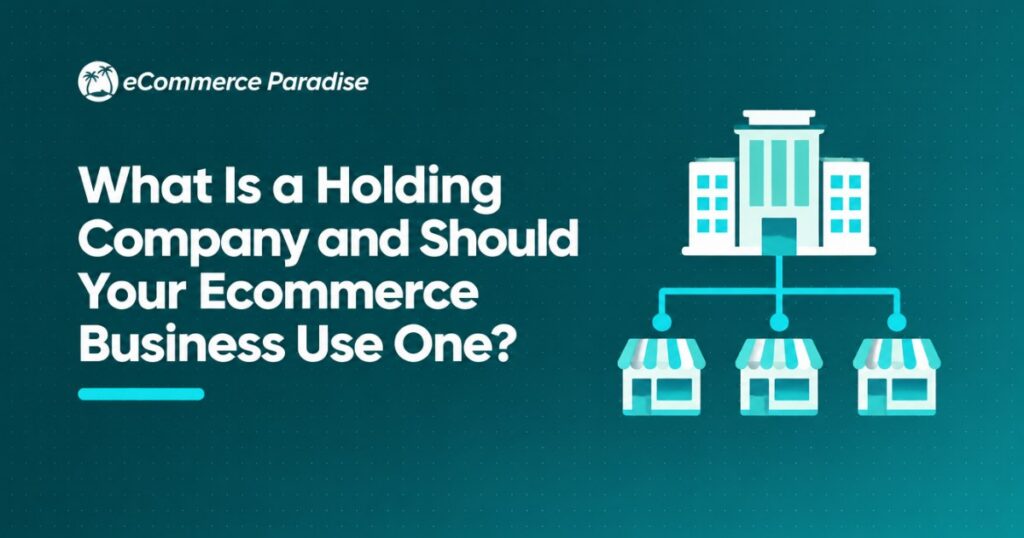
A holding company is basically a corporation or LLC that owns other businesses or assets instead of operating them directly. Think of it like an investment vehicle that holds ownership stakes in operating companies. What I’ve seen with my clients is that they use holding companies to separate the management side of the business from the actual money-making side, which creates some serious advantages.
Here’s the straightforward version: your holding company doesn’t make products, doesn’t sell anything, and doesn’t take customer calls. Instead, it owns the operating company that does all that work. The operating company pays dividends or distributes profits to the holding company, which then owns the assets. This structure creates a protective layer between your personal assets and business liabilities.
The most common setup I see is a single-member LLC holding company that owns one or more operating LLCs or corporations. The operating company runs your dropshipping stores or product sales, handles inventory (if applicable), manages customer relationships, and takes on the day-to-day operational risk. The holding company sits above it and owns the equity, real estate, intellectual property, and other valuable assets.
The Asset Protection Benefits That Actually Matter
Let’s talk about why people actually set up these structures. Asset protection is huge. On my stores, I’ve always been concerned about what happens if a customer sues, if there’s a data breach, or if something goes wrong operationally. A holding company creates a wall between the operating company’s liabilities and the valuable assets held at the parent level.
When you have a proper holding company structure, creditors of the operating company can’t easily reach the assets held by the parent. If your ecommerce store gets hit with a lawsuit and loses, the judgment is against the operating company only. The holding company’s assets, which might include real estate, intellectual property, cash reserves, or other business interests, are protected because they’re held separately.
I’ve had clients where this exact structure saved them hundreds of thousands of dollars. One client had a legitimate liability claim against his operating company, but because his commercial real estate and equipment were held in the parent holding company, those assets couldn’t be touched. The operating company insurance covered the claim, and the personal assets stayed safe.
This isn’t foolproof, though. You need to maintain proper documentation, keep separate bank accounts, respect the corporate veil, and follow all the legal requirements. If a court decides you’re just using the structure to commit fraud, they can pierce that veil. But with legitimate business purposes and proper administration, the separation works incredibly well.
Tax Planning Advantages You Should Know About
The tax benefits are one of the biggest reasons I recommend this structure to my clients, but they’re also more nuanced than people think. A holding company doesn’t magically reduce your taxes, but it gives you flexibility in how you structure your profits and distributions, which can result in real tax savings.
One major advantage is the ability to retain earnings in the holding company at potentially lower tax rates in some situations, or to distribute profits in the most tax-efficient way possible. If you’re in a state with high income taxes and own real estate or other assets generating income, moving that income to a holding company structure can sometimes offer advantages depending on your overall tax picture.
Another benefit I’ve used with my clients is the ability to conduct tax-deferred reorganizations or acquisitions more easily with a holding company structure. If you’re planning to scale your ecommerce business into a multi-brand operation, a holding company makes acquisitions and integration smoother from a tax perspective. You can move entities under the parent without triggering massive tax events.
That said, this isn’t about getting away with anything shady. I always tell my clients to work with a good CPA or tax attorney, which I write about extensively in our business formation guide. The IRS is pretty sophisticated about this stuff. If you’re just trying to hide income or avoid legitimate taxes, you’ll get caught and face penalties that make the whole thing a disaster.
How Holding Companies Work With High-Ticket Ecommerce
If you’re in the high-ticket space, a holding company becomes even more valuable. When you’re selling items worth $500, $1,000, or even $5,000 and up per order, the operational risk is higher because the transactions are larger and customers are more likely to pursue legal action if something goes wrong. That’s exactly where this structure shines.
I’ve worked with dozens of high-ticket dropshipping entrepreneurs, and the ones who set up proper entity structures early are the ones who sleep better at night. You’re already dealing with supplier relationships, payment processing, and customer expectations around high-value items. A holding company lets you layer on asset protection without adding much operational complexity.
The key is that the holding company can own intellectual property related to your brand, which is crucial in high-ticket niches. Your brand name, website, customer lists, and proprietary processes all have real value. By holding these assets in a parent company, you protect them from claims against the operating company. If a lawsuit happens, those valuable intangible assets stay safe.
Check out my complete guide on high-ticket niches to see where this structure works best. The niches with higher liability potential benefit most from this layered approach.
The Operating Company: Where the Money Actually Gets Made
The operating company is where all the action happens. This is your actual ecommerce business. It handles orders, manages customer service, interfaces with suppliers, handles returns and refunds, and generates the revenue. The operating company pays taxes on its profits and distributes money up to the holding company.
The beauty of this structure is that the operating company can be pretty simple. It doesn’t need to own valuable long-term assets. It can be structured for efficiency and operational simplicity. Many of my clients use an LLC for the operating company because the pass-through taxation makes sense, and you get liability protection without the complexity of corporate taxation.
What I’ve learned from years of helping clients is that the operating company should be the one carrying business insurance, handling the customer-facing risk, and taking the potential liability hits. That’s why you want the operating company to be lean and focused on operations, not holding valuable long-term assets.
The operating company pays dividends or distributions to the holding company based on performance. If the operating company generates $500,000 in annual profit after all expenses and taxes, it might distribute $300,000 to the holding company annually. That cash flow goes up to the parent, where it can be managed, reinvested, or used to fund other ventures.
Setting Up Your Holding Company Structure the Right Way
Getting the structure right is critical. You can’t just set up two LLCs and call it a holding company. You need to do it properly with the right documentation, separate bank accounts, and clear operational procedures. I’ve seen people try to do this on the cheap and end up with a structure that doesn’t actually protect them.
The first step is working with a business formation service that understands holding company structures. I’m a fan of Bizee for basic LLC formation, but for a holding company structure, I’d recommend going with LegalZoom because they can set up the parent-subsidiary relationship correctly from day one.
Alternatively, LegalNature is another solid option that specializes in proper entity structuring for business owners.
You’ll also want to consider which state to form in. I write in detail about the best states for LLC formation, and many of those considerations apply to holding companies too. Delaware and Nevada have advantages for asset protection and privacy, though the benefits are often overstated.
Once formed, you need operating agreements that clearly delineate the relationship between the holding company and the operating company. You need separate bank accounts, separate accounting, and separate business records. You need to actually operate them as separate entities, not just on paper. According to the National Conference of State Legislatures, proper documentation and separation is critical for liability protection.
The Liability Protection Limits You Need to Understand
I need to be honest about what holding companies can’t do. They’re not a get-out-of-jail-free card. They don’t protect you from personal liability for your own actions. If you personally guarantee a business debt, you’re liable regardless of the structure. If you personally commit fraud or negligence, you can still be sued personally.
The structure protects you from liability that arises from the business operations, not from your personal actions. This distinction matters enormously. A customer sues your ecommerce company because a product caused them harm? The holding company protects your personal assets. You personally make a fraudulent representation to a supplier? The holding company won’t protect you.
Also, piercing the corporate veil is a real risk if you don’t maintain proper formalities. If you’re mixing personal and business finances, making loans from the holding company to yourself without documentation, or not maintaining separate accounting and records, a court could decide that the structure isn’t legitimate and go after both entities.
Single-member LLCs, which are commonly used as holding companies, have a specific weakness in some states. Some creditors argue that the lack of an ownership agreement between members (since there’s only one) means there’s no veil to pierce. This is pretty much a dead argument legally, but it’s worth discussing with a good business attorney.
Tax Complexity: It’s Real and It Costs Money
Here’s the reality: a holding company structure increases your tax complexity. You’re now filing tax returns for the holding company and the operating company, keeping separate accounting records, and managing distributions between them. That costs money in accounting and CPA fees.
The increased complexity could run you $2,000 to $5,000 per year in additional accounting costs, depending on how sophisticated your structure is. You need to factor that into your decision. For a business making $200,000 to $300,000 annually, that’s a meaningful expense. For a business making $500,000 or more, it becomes a rounding error.
That’s why I generally recommend a holding company structure for ecommerce businesses hitting $300,000+ in annual profit. Below that, the tax and administrative costs might outweigh the benefits unless you’re in a particularly risky business or sitting on valuable assets you want to protect.
Work with a CPA to understand the full tax implications before you implement this structure. Different states have different rules, and your personal tax situation might make one structure more advantageous than another. Don’t make this decision in a vacuum.
Multi-Entity Scaling: Where Holding Companies Really Shine
The place where holding companies become absolutely necessary is when you’re scaling into multiple ecommerce brands or business ventures. If you want to own a high-ticket dropshipping store, a digital course business, and maybe rental real estate, a holding company gives you an elegant way to organize all of that.
Each operating entity sits under the holding company umbrella. The holding company owns equity in each one, collects distributions from each one, and holds shared assets like corporate brand IP, technology infrastructure, or real estate. This is how serious business owners structure their wealth.
I’ve had clients expand from one ecommerce store to three different brands within a couple of years, and the holding company structure let them do that smoothly. Each operating company had its own liability, its own accounting, and its own focus. The holding company provided the oversight and asset protection across the portfolio.
If you’re thinking about expanding into high-ticket dropshipping or other verticals in addition to your current business, a holding company structure becomes critical. You’re not just protecting one business anymore. You’re building a real operating company portfolio.
When You Might Not Need a Holding Company
Not every ecommerce business needs this structure, and I’m not going to pretend otherwise. If you’re just starting out with under $100,000 in annual revenue, the complexity and cost aren’t worth it yet. Keep it simple with a basic LLC for your operating business.
If you’re not accumulating significant assets, if your business is low-liability (like digital products with no physical goods), or if you have no plans to scale beyond one brand, a simple operating LLC might be all you need. You still get liability protection. You just don’t need the extra layer.
Also, if your business structure and tax situation are straightforward, your accountant might not recommend it. Get professional advice specific to your situation. What works for one business owner might not work for another.
What I’ve learned is that timing matters. It’s easier to implement a holding company structure when you’re building it from scratch than to reorganize an existing business later. If you think you might want this eventually, it’s worth planning for it early.
Deciding Between an LLC and a C-Corporation Holding Company
You can structure your holding company as either an LLC or a corporation. Both have advantages and disadvantages. I write extensively about the differences between LLC, S-Corp, and C-Corp structures, and much of that analysis applies here.
An LLC holding company is simpler administratively. It’s pass-through taxation, fewer formalities, and easier to maintain. You still get liability protection. This is what most of my clients choose for straightforward situations.
A corporate holding company (C-Corp or S-Corp) might make sense if you’re running something really complex, if you need to bring in investors, or if your tax situation is sophisticated. The tax treatment can be advantageous in some scenarios, but the administrative burden is higher. You need a board of directors, more formal meetings and documentation, and more complex accounting.
For most ecommerce entrepreneurs, an LLC holding company is the sweet spot. It gives you the protection and structure you need without the corporate complexity. But this is exactly where you need good professional advice from a business attorney or CPA.
Real-World Example: How This Works in Practice
Let me give you a concrete example from my experience. I worked with a client running a high-ticket home office furniture dropshipping business. He was doing about $400,000 in annual revenue and $120,000 in annual profit. His biggest concern was liability, since he was selling items people would use in their homes every day.
We set up a holding company structure. The parent was Paradise Holdings LLC, which owned the equity in Office Furniture Pro, LLC (the operating company). Office Furniture Pro handled all customer sales, supplier relationships, payment processing, and customer service. Paradise Holdings collected profits and held valuable IP assets.
Within eighteen months, he wanted to launch a second brand in the outdoor furniture niche. Instead of creating a whole new separate business, he could launch Outdoor Furniture Co, LLC as another operating company under the same holding company umbrella. Both operating companies generated their own profit, had their own liability isolation, but shared certain corporate assets and oversight at the parent level.
Three years later, he sold the outdoor furniture brand for a six-figure number. Because it was a separate operating company under the holding company, the transaction was clean. The buyer bought the operating company, and he retained the holding company and the original furniture business. That kind of clean structuring is only possible if you’ve set it up right from the beginning.
The Legal Documentation You Need to Get Right
You absolutely cannot skip the paperwork on this. I see people try to operate a holding company structure without proper documentation, and it falls apart in seconds if there’s ever a legal challenge. You need operating agreements for both the holding company and the operating company, and they need to clearly spell out the relationship.
The holding company operating agreement should clearly state that it owns equity in the operating company and describe how distributions work. The operating company operating agreement should clearly state that it’s owned by the holding company and describe the operating relationship. Both need separate bylaws or operating procedures.
You also need documentation showing that any loans, asset transfers, or other transactions between the entities happened for real business reasons and at fair market value. If you transfer something from the operating company to the holding company, there needs to be documentation showing that transaction happened intentionally and at a legitimate value.
This is another place where using a professional service like LegalShield can be valuable. You want someone checking your documentation regularly to make sure everything is maintained properly. It’s not glamorous, but it’s what actually protects you.
How Supplier Relationships Change With a Holding Company
One thing that sometimes surprises my clients is that supplier relationships don’t really change with a holding company. Your suppliers contract with the operating company, not the holding company. They don’t care about your parent structure. They’re dealing with the entity making orders and generating revenue.
This is actually good news because it means you can implement a holding company structure without renegotiating all your supplier agreements. Your suppliers keep working with the operating company exactly as before. The holding company is transparent to them.
You do need to be careful about personal guarantees on supplier agreements though. If you’ve personally guaranteed a supplier line of credit, that personal liability still exists regardless of your corporate structure. Try to get those personal guarantees released or at least not required on new agreements as you scale.
When you’re looking at finding the best suppliers for high-ticket dropshipping, you’re evaluating the operating company’s ability to work with them. The holding company doesn’t change that evaluation at all.
Getting Professional Help: It’s Worth the Investment
I’m going to be direct: this is not a DIY project if you’re planning to operate the structure seriously. Yes, you can form basic entities through online services. You need a business attorney to review your operating agreements, help you set up the structure properly, and make sure you’re doing everything correctly.
A good business attorney will cost you $1,000 to $3,000 to set up a holding company structure properly. That sounds expensive until you realize that one lawsuit where the structure fails could cost you $100,000 or more. That’s a worthwhile investment in protection.
Beyond the initial setup, you need ongoing compliance help. If you work with someone like Northwest Registered Agent, they can help you maintain registered agent status in multiple states if you operate in several jurisdictions. They don’t do legal advice, but they can handle compliance filing deadlines and keep your entities in good standing.
I also recommend MyCompanyWorks for ongoing compliance management. They’ll help you track deadlines, file annual reports, and keep your corporate records organized. It’s one of those services that seems unnecessary until you’re managing multiple entities.
Implementing a Holding Company When You Already Have a Business
If you’re already running an ecommerce business without a holding company structure, can you implement one now? Yes, but it’s more complex than starting fresh. You’ll need to reorganize your existing business, which might trigger tax events depending on how you do it.
The general approach is to form a new holding company, then transfer the operating business (or assets) into it. Depending on how you structure the transfer, you might trigger capital gains taxes or other tax consequences. This is definitely work with a CPA territory.
Some reorganizations can be done as tax-deferred exchanges, which is what you want. A “Section 368 reorganization” is the IRS term for certain business reorganizations that don’t trigger immediate tax consequences. According to IRS Publication 542, your CPA needs to structure the transition to qualify.
The timeline for reorganizing an existing business is usually a few months from initial planning to completion. It’s definitely doable, but plan ahead and get professional help. Don’t try to rush this or do it on the cheap.
Protecting Your Assets Through Proper Capitalization
Here’s something I see people miss: you need to actually capitalize your operating company properly. If you set up a holding company and then underfund the operating company, courts will look at that unfavorably. The operating company needs enough capital to meet its obligations and operate legitimately.
You also need to make sure the operating company maintains adequate insurance. This protects the operating company itself, but it also shows that you’re treating it as a real, separate business. Insurance is a credibility factor if your structure ever gets challenged.
Keep significant valuable assets in the holding company, not the operating company. If you own real estate that your ecommerce business uses, the holding company should own it and lease it to the operating company. This keeps the valuable assets separate from day-to-day operational risk.
That’s the whole point of the structure: meaningful assets at the parent level, operational risk at the subsidiary level. If you flip that around, you defeat much of the purpose.
Integration With Your eCommerce Platform and Tools
Your ecommerce platform like Shopify doesn’t care about your corporate structure. Your website is owned by the operating company, and that’s fine. The holding company doesn’t directly interface with your sales systems, accounting software, or payment processors.
The operating company handles all customer-facing operations. The holding company is behind the scenes, owning equity and holding assets. Your accounting software (like QuickBooks) will track both entities separately with different accounts and reporting, but the day-to-day ecommerce operations don’t change.
What does matter is that you keep clear accounting separation between the entities. You need separate bank accounts, separate credit cards ideally, and separate bookkeeping. Mixing finances between the holding company and the operating company is one of the fastest ways to undermine your liability protection.
Scaling Your Team: Employee Relationships and Holding Companies
If you’re scaling your ecommerce business and hiring team members, a holding company structure doesn’t change much from an employment perspective. Employees work for the operating company and are paid by the operating company. The holding company doesn’t directly employ anyone.
If you’re considering outsourced support, like OnlineJobsPH for virtual assistants, those contractors work with the operating company. Again, the holding company is invisible to them.
You do want to make sure your employee agreements, independent contractor agreements, and non-compete clauses are clear about which entity they work for. Having proper agreements with employees is part of maintaining the integrity of your corporate structure anyway.
As you think about scaling, check out my management services to help you build operational systems.
Our coaching programs work whether you’re running a single business or multiple entities under a holding company.
Technology Infrastructure and IP Ownership
Here’s a clever application of holding company structure: own your technology and intellectual property at the parent level. If you’ve developed custom software, proprietary processes, unique brand elements, or other valuable IP, the holding company should own these assets.
The holding company then licenses this IP to the operating companies at a fair market rate. This protects the valuable IP from operating company liability, creates a tax-deductible expense for the operating company, and moves profit to the holding company in a clean way.
If you’re in the high-ticket dropshipping space and you’ve developed specialized sourcing systems or customer acquisition strategies, these represent real IP value. Getting ownership structured correctly from the beginning protects this value long-term.
Exit Planning and Acquisition Scenarios
One of the biggest advantages I’ve seen with holding company structures is how they simplify exit planning. If you want to sell your ecommerce business someday, having a clean operating company that you can spin off is much more attractive to buyers than trying to untangle a complicated personal structure.
A buyer wants to buy the operating company, not your personal real estate or other assets. With a proper holding company structure, you can separate the operating asset cleanly. The buyer gets the operating company. You keep the holding company, any real estate, IP assets, or other valuables you want to keep.
This is huge for deal structuring flexibility. Some deals work better if the buyer acquires the operating company. Others work better as asset sales. With a holding company structure, you have maximum flexibility to structure the deal advantageously.
I’ve also seen clients use holding company structures to set up their businesses for family succession. If you plan to transfer your ecommerce business to family members eventually, the holding company makes that cleaner and more tax-efficient.
State Laws and Multi-State Considerations
If you operate in multiple states (which most online ecommerce businesses do), you need to understand multi-state taxation and registration requirements. Your holding company might be registered in Delaware, but you might need to register the operating company in states where it has “nexus,” meaning real business activity.
Nexus for ecommerce is getting stricter with sales tax registration requirements according to research from the Tax Foundation. The holding company structure doesn’t change this, but it’s worth understanding. Your operating company needs to be registered and tax-compliant wherever you do business.
This is another area where you really need professional guidance. Multi-state tax implications can be complex, and getting it wrong can cost you money. Work with a tax attorney or CPA who understands ecommerce specifically.
Maintaining Your Structure: Ongoing Obligations
Once you’ve set up a holding company structure, you have ongoing responsibilities to maintain it properly. Annual meetings, minutes, documentation of decisions, updated operating agreements if things change. These aren’t optional if you want the liability protection to hold up.
You need to file annual reports in each state where your entities are registered. You need to maintain business licenses. You need to keep your registered agent updated. For multi-state operations, this can add up to real administrative overhead.
Some services help with this compliance burden. Your accountant should be tracking annual reporting deadlines. Your registered agent should send you reminders about filings. You might also want to use a compliance service to help manage all of this across multiple entities.
The cost of maintaining your structure properly is part of the ongoing cost-benefit analysis. If you’re running a lean operation and this overhead is significant relative to your profits, it might not be worthwhile. If you’re making real money and have real assets to protect, it’s a no-brainer.
Common Mistakes People Make With Holding Companies
I’ve seen so many people set up holding company structures and then immediately start undoing all the protection through careless mistakes. The biggest one is mixing finances. Using the operating company bank account for personal expenses, or vice versa, is a fast way to have a court decide the structure isn’t legitimate.
Another common mistake is failing to document inter-company transactions. According to SBA guidance on entity compliance, if money moves from one entity to another, there needs to be documentation. A memo, an invoice, something showing it was intentional. Don’t just move money and assume documentation isn’t necessary.
People also sometimes set up the structure and then never maintain it. They don’t hold annual meetings, don’t update operating agreements, don’t keep current minutes. That looks really bad in court. You set it up, you maintain it. That’s the deal.
I also see people try to use the holding company structure to hide assets in divorce, bankruptcy, or from creditors illegally. Don’t do this. It’s fraud, it’s illegal, and you’ll get caught. Use the structure for legitimate business purposes, not as a judgment-proofing scheme.
Integration With Bookkeeping and Accounting Systems
Your bookkeeping needs to be separate for each entity. Ideally, you have separate QuickBooks files or separate sections in whatever accounting software you use. You’re tracking income, expenses, and assets separately for the holding company versus the operating company.
The operating company books are straightforward: sales revenue, cost of goods sold, operating expenses. The holding company books track income from distributions, expenses related to holding assets, maybe interest on loans to operating companies.
Your CPA needs to see clear separation in your bookkeeping. Commingled accounting is a red flag that undermines your liability protection. This is another reason to invest in good accounting practices from the beginning.
The Future of Your Ecommerce Business and Holding Companies
As you think about building an ecommerce empire, a holding company structure is how professional business owners organize their ventures. It’s not just about the tax benefits, though those matter. It’s about operating with sophistication, protecting your assets, and maintaining clean separation between your businesses and your personal life.
If you’re serious about building wealth through ecommerce, take advantage of the resources available to you. Explore our turnkey services to get professional setup help. Join our community to connect with other entrepreneurs who’ve been through this process.
If you want ongoing guidance and support in structuring your business, our coaching program walks you through all these decisions with personalized advice.
If you’re just getting started in high-ticket ecommerce, my comprehensive guide on high-ticket dropshipping fundamentals will give you the foundation you need.
You should also review my detailed guide on finding the best suppliers before coming back to the business structure decision. Validate your concept first, then structure for growth.
Decide If a Holding Company Is Right for Your Ecommerce Future
Here’s my honest assessment: if you’re making serious money from ecommerce, if you have valuable assets to protect, if you’re planning to scale into multiple brands or keep growing, a holding company structure is one of the smartest moves you can make. It’s not perfect, but it’s proven effective for asset protection and tax planning.
If you’re just starting out or running a small side business, keep it simple with a basic operating LLC. You can always upgrade to a holding company structure later if needed. The important thing is that you have some corporate structure separating your personal assets from business liability.
Work with professionals on this decision. Get advice from a business attorney, a CPA, and maybe a business formation service. The money you invest in proper setup now prevents expensive problems later. Don’t try to save a thousand dollars on setup and risk losing hundreds of thousands if something goes wrong.
The ecommerce entrepreneurs who thrive long-term are the ones who think like business owners, not just salespeople. They structure their operations properly, they document everything, they maintain their entities, and they scale with intention. A holding company is a tool that serious entrepreneurs use to build sustainable wealth.
Ready to take your business to the next level? Check out our Patreon community where you get weekly insights and training on scaling ecommerce businesses. Join the people who are building real wealth in this space. Your future self will thank you for taking this seriously today.

Trevor Fenner is an ecommerce entrepreneur and the founder of Ecommerce Paradise, a platform focused on helping entrepreneurs build and scale profitable high-ticket ecommerce and dropshipping businesses. With over a decade of hands-on experience, Trevor specializes in high-ticket dropshipping strategy, niche and product selection, supplier recruiting and onboarding, Google & Bing Shopping ads, ecommerce SEO, and systems-driven automation and scaling. Through Ecommerce Paradise, he provides free education via in-depth guides like How to Start High-Ticket Dropshipping, advanced training through the High-Ticket Dropshipping Masterclass, and fully done-for-you turnkey ecommerce services for entrepreneurs who want a faster, more hands-off path to growth. Trevor is known for emphasizing sustainable, real-world ecommerce models over hype-driven tactics, helping store owners build scalable, sellable, and location-independent brands.


