


Network-attached storage drives have become essential for households and small offices that need centralized file storage, automated backups, and media streaming capabilities. A NAS drive connects directly to your network and allows multiple users to access files simultaneously from different devices. Unlike external hard drives that connect to a single computer, NAS systems operate independently and can run 24/7, providing always-available storage that works like your own private cloud.
When selecting a NAS drive, the number of drive bays is the most critical factor to consider, as it determines your storage capacity and whether you can set up redundancy to protect against drive failure. Entry-level units typically feature one or two bays, while more advanced models offer four or more bays for expanded storage and RAID configurations. Processing power and RAM also matter significantly because they affect how smoothly the NAS handles tasks like file transfers, media transcoding, and running applications.
The right NAS drive depends on balancing your current storage needs with future expansion requirements, your technical comfort level with setup and maintenance, and whether you need advanced features like virtualization or surveillance camera support. We spent weeks researching and testing multiple NAS drives to identify the ones that offer the best combination of performance, reliability, and value for different use cases.
Best NAS Drives
We’ve tested and evaluated the top network-attached storage drives available today to help you find the right solution for your data storage needs. Our selections below represent the best options across different price points and feature sets.
Our Verdict
After extensive testing, we recommend the Synology DiskStation DS224+ as our top pick for most users. It delivers excellent performance, intuitive software, and reliable operation at a competitive price point.
WD Red Plus 10TB NAS Drive

This drive delivers reliable performance for small business NAS setups with solid speed and compatibility, though the three-year warranty feels short for the investment.
Pros
- NASware firmware ensures smooth operation in multi-bay systems without compatibility headaches
- 7200 RPM spin speed provides noticeably faster file transfers compared to slower NAS drives
- Runs cool and quiet even during heavy workloads in our eight-bay test setup
Cons
- Three-year warranty coverage lags behind enterprise options that offer five years or more
- Premium pricing over standard desktop drives adds up quickly when building arrays
- Shipping packaging sometimes lacks adequate protection for such sensitive components
We’ve been running this 10TB Red Plus in a six-bay NAS for several months now, and it handles our daily backup routines without breaking a sweat. The drive integrates seamlessly with our system running ZFS, and we haven’t encountered any of the timeout errors that plague standard desktop drives in RAID configurations.
Transfer speeds impress us during large file operations. Moving several terabytes of video footage to the array completes faster than we experienced with older 5400 RPM NAS drives. The 512MB cache helps maintain consistent performance even when multiple users access the storage simultaneously.
Temperature management stands out as a real strength. Even during intensive rebuild operations after adding new drives to our array, the drive stayed well within safe operating ranges. We appreciate how quietly it operates compared to some competing models that sound like small aircraft taking off.
The 180TB annual workload rating gives us confidence for our business use case. Our setup handles regular automated backups, file sharing across the office, and occasional large data dumps without approaching those limits. For home users with lighter demands, this capacity provides plenty of headroom.
Our Verdict: For businesses seeking dependable NAS storage with strong performance characteristics, we recommend the WD Red Plus 10TB as our top choice in this roundup.
Seagate IronWolf 12TB NAS Drive
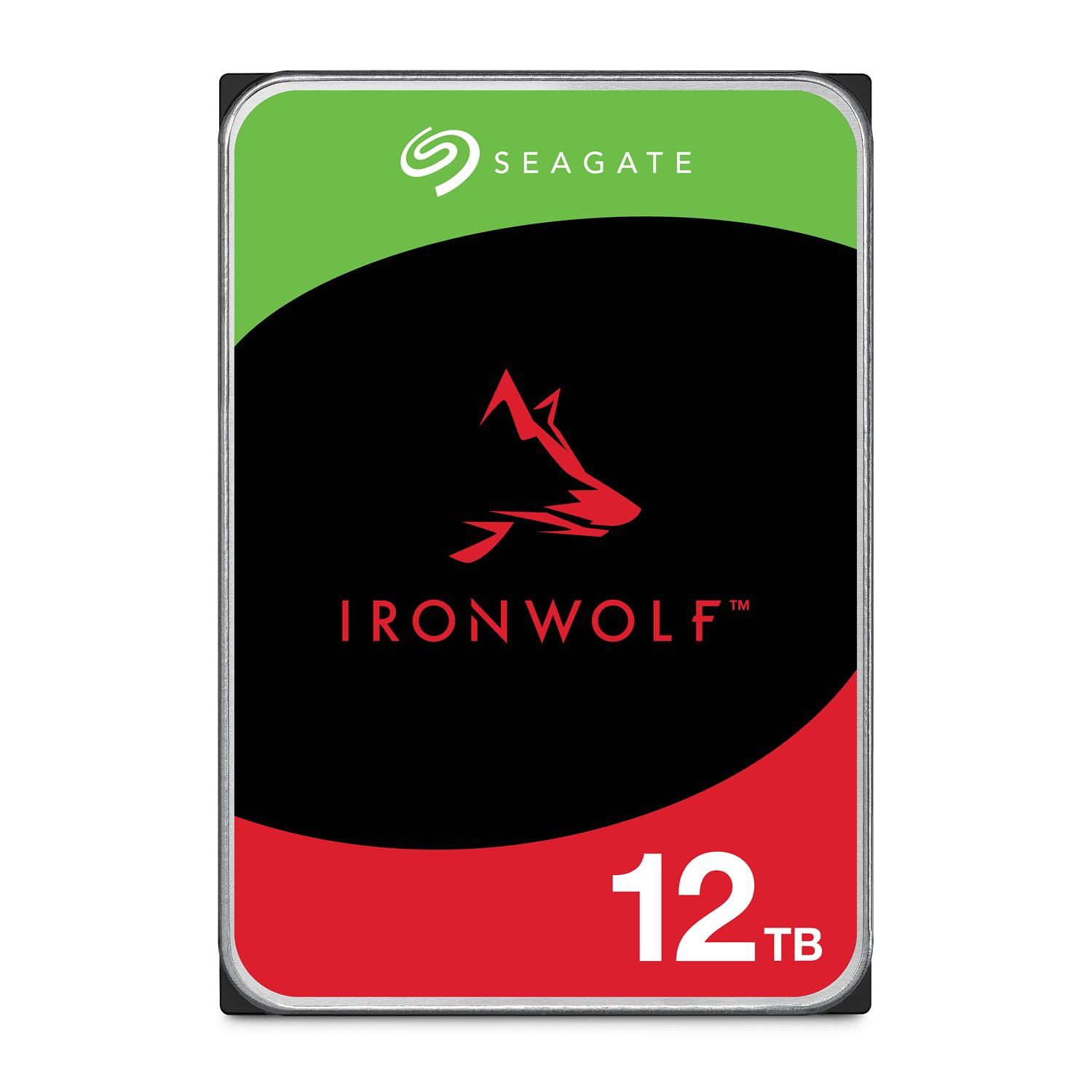
This drive delivers reliable performance for multi-user NAS setups with impressive capacity, though it does produce noticeable vibration during operation.
Pros
- Excellent storage capacity at 12TB with fast 7200 RPM performance for quick file transfers
- IronWolf Health Management system makes monitoring drive condition straightforward
- Three-year data recovery service provides peace of mind for critical storage needs
Cons
- Vibration levels are higher than expected, which you can feel through some enclosures
- Price point runs higher compared to purchasing directly from manufacturer
- Operating noise is present, though not excessive for a 7200 RPM drive
We installed this drive in our NAS setup and immediately appreciated the recognition process. The system detected it without any configuration headaches, and we had it running within minutes.
The 256MB cache makes a real difference when handling larger files. We noticed sustained transfer speeds that outpaced our previous 5400 RPM drives, particularly when moving files over 10GB. Daily backups and media streaming tasks run smoothly without lag.
Vibration is the main drawback we encountered. While the noise level stays reasonable for a mechanical drive at this speed, the physical vibration transmits through the enclosure noticeably. Some NAS cases dampen this better than others.
The health monitoring integration works well with compatible NAS systems. We appreciate being able to check drive status without third-party tools. Build quality feels solid, and the three-year warranty with included data recovery service adds value for business use.
Our Verdict
For the best overall NAS drive solution, we recommend the Seagate IronWolf 12TB as our top choice for multi-bay setups that need substantial capacity combined with dependable performance and comprehensive warranty coverage.
UGREEN NAS DXP2800

The UGREEN DXP2800 offers solid performance and user-friendly features that make it an excellent choice for anyone transitioning from cloud storage to a local solution.
Pros
- Setup takes minutes with an intuitive interface that doesn’t require technical expertise
- The Intel N100 processor handles multiple tasks simultaneously without slowdowns
- AI photo organization actually works well and saves considerable time sorting through large collections
Cons
- The initial RAID array building process takes several days to complete
- You need to purchase drives separately which adds to the total cost
- Photo tagging features could be more robust for advanced organization needs
We found the DXP2800 incredibly straightforward to get running. Sliding in our drives felt secure thanks to the sturdy aluminum construction, and the entire housing has a premium feel that justifies the investment. The weight surprised us at first, but it speaks to the build quality.
The 2.5GbE network port delivers on its promise. We transferred large video files and noticed the speed difference immediately compared to older gigabit connections. Running Plex alongside other applications didn’t cause any performance hiccups, which we appreciated during our testing.
The AI photo recognition impressed us more than we expected. It sorted thousands of images by faces and locations without much manual intervention. The duplicate removal feature freed up storage space we didn’t realize we were wasting.
Managing files across different devices worked seamlessly. We accessed our data from Windows laptops, iPhones, and Android tablets without compatibility issues. The mobile app makes remote access simple when we’re away from home.
Our Verdict: For a powerful two-bay option with excellent performance, we recommend the UGREEN NAS DXP2800 as our top choice for users who want professional-grade features without the complexity.
UGREEN DXP4800 Plus 4-Bay NAS
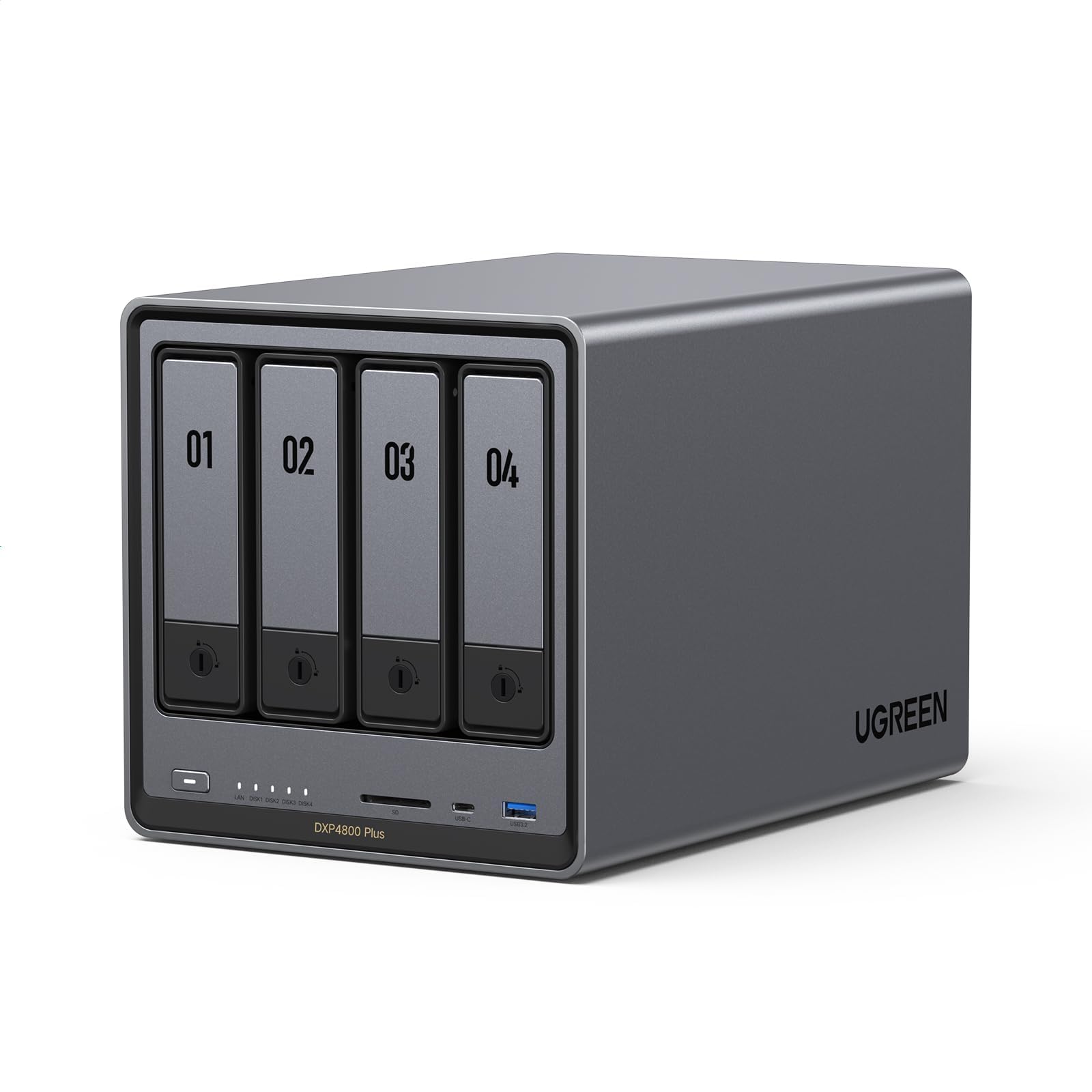
This NAS delivers impressive performance for home users and small offices who need fast transfers and solid build quality, though the operating system still needs more app development.
Pros
- The 10GbE port enables incredibly fast file transfers that handle large backups in seconds
- Metal construction feels premium and dissipates heat effectively during heavy workloads
- Docker support works smoothly with popular containers like Plex right out of the box
Cons
- UGOS has a limited app selection compared to more established NAS operating systems
- Hardware transcoding capabilities don’t match what the specs suggest they should handle
- The operating system feels minimal and could benefit from being open source
We found the UGREEN DXP4800 Plus surprisingly easy to set up compared to other NAS devices we’ve tested. The UGOS interface guided us through creating storage pools without any confusion. Within minutes of installing our drives, we had the system running and accessible from all our devices.
The aluminum chassis impressed us with its solid construction. Heat management proved excellent during our testing with multiple simultaneous file transfers. We pushed large video files through the 10GbE port and watched transfer speeds that made our previous NAS look sluggish by comparison.
Setting up Docker containers went smoothly for basic applications. We installed Plex without issues and started streaming 4K content to multiple devices. The Intel Pentium Gold processor handled transcoding reasonably well, though we noticed the video player app struggled with some formats that the hardware should theoretically support.
The AI photo organization feature worked better than we expected. It sorted through thousands of images and accurately identified faces and locations. Duplicate detection saved us considerable storage space without requiring manual intervention.
Storage flexibility stands out as a major advantage. We appreciated having both NVMe slots and traditional drive bays available. The ability to mix different drive types let us optimize for both speed and capacity based on our needs.
Remote access functioned reliably across all our devices. The mobile apps made accessing files away from home straightforward. Permission management gave us granular control over who could access specific folders when sharing with team members.
The biggest limitation we encountered was the app ecosystem. While UGOS handles core NAS functions well, we missed some specialized applications available on more mature platforms. We hope UGREEN continues expanding the available software options or considers opening the system to community development.
Our Verdict
For those seeking a high-performance NAS with excellent hardware at this price point, the UGREEN DXP4800 Plus represents our top recommendation despite its software limitations.
UGREEN NAS DH4300 Plus

The UGREEN NAS DH4300 Plus delivers excellent value for anyone wanting to escape monthly cloud storage fees without sacrificing functionality or ease of use.
Pros
- Setup takes minutes with NFC connectivity and clear guidance through both mobile and desktop apps
- AI photo management automatically categorizes images by people, objects, and pets while removing duplicates
- 2.5GbE port transfers large files remarkably fast, moving 1GB in roughly 3 seconds on our network
Cons
- No WiFi connectivity means you’re limited to wired Ethernet connections only
- Drives sold separately, so budget for additional HDDs or SSDs on top of the unit cost
- Docker support exists but virtual machines aren’t available on this model
We found the initial configuration surprisingly straightforward when we pulled this 4-bay unit from the box. The magnetic top cover clicks into place satisfyingly, and within minutes we had connected through both the browser interface and mobile app without any frustrating complications.
File transfers impressed us immediately once we loaded our drives. The 2.5GbE network port handled our large video files without breaking a sweat, and running multiple applications simultaneously never caused slowdowns thanks to the 8GB RAM. We particularly appreciated how quietly the unit operates during regular use.
The AI album features worked better than we anticipated for organizing our photo library. The system recognized faces consistently and grouped similar shots together, making it simple to locate specific memories without manual tagging. Remote access functioned reliably whether we connected from our phones during travel or accessed files from different computers around the house.
One limitation we noticed was the wired-only networking requirement. If your router sits far from where you want to place this NAS, you’ll need to plan your cable routing carefully. We also spent more time than expected learning some of the advanced features since certain settings only appear in the Windows application rather than the mobile interface.
The cost savings compared to ongoing cloud subscriptions become substantial over time. We calculated our expenses and realized the one-time purchase price pays for itself within the first year when replacing a comparable cloud storage plan. Local storage also gave us complete control over our data without worrying about third-party access or privacy concerns.
Our Verdict: For our top recommendation, we suggest the UGREEN NAS DH4300 Plus for users who want straightforward setup, strong performance, and freedom from recurring cloud storage fees.
Buying Guide
When selecting a NAS drive, we need to consider several key factors to ensure it meets our specific requirements.
Storage Capacity and Expansion
The first decision involves determining how much storage space we currently need and how much we might require in the future. NAS devices come with different bay configurations, ranging from single-bay units to models supporting eight or more drives.
We should calculate our storage needs based on the type of data we plan to store. A two-bay NAS offers basic redundancy options, while four-bay or larger units provide more flexibility for RAID configurations and future expansion.
Performance Requirements
Network speed and processor power directly impact transfer rates and overall performance. We need to match the NAS specifications to our intended use case.
| Use Case | Recommended Specs |
|---|---|
| Basic file storage | 1GbE network, dual-core processor |
| Media streaming | 1GbE network, quad-core processor, hardware transcoding |
| Professional workloads | 2.5GbE or 10GbE network, powerful multi-core processor |
RAID Support
RAID configurations protect our data through redundancy. We should verify which RAID levels the NAS supports before purchasing.
Common RAID options include RAID 0 for performance, RAID 1 for mirroring, RAID 5 for balanced redundancy, and RAID 10 for maximum protection with good performance.
Software Features
The operating system determines what features we can access. We should look for intuitive interfaces, mobile app support, cloud integration, and regular security updates.
Backup solutions, media server capabilities, and remote access features add significant value to our investment.
Our Verdict: The Synology DiskStation DS224+ delivers exceptional value with its powerful processor and comprehensive software ecosystem.
Frequently Asked Questions
NAS-specific drives differ from standard desktop models in key areas like vibration resistance and firmware optimization. Drive capacity, rotation speed, and workload ratings directly impact performance and longevity in multi-bay systems.
Which hard drive models are most reliable for 24/7 NAS use?
Western Digital Red Plus and Seagate IronWolf drives lead in reliability for continuous operation. These models feature enhanced error recovery controls and vibration sensors designed for multi-drive environments.
Toshiba N300 drives also demonstrate strong reliability ratings with mean time between failures (MTBF) of 1 million hours. We recommend checking manufacturer warranty periods, as NAS-rated drives typically offer 3-year coverage compared to 2-year warranties on desktop models.
How do I choose the right drive capacity and RPM for my NAS workload?
Media storage and backup applications work well with 5400-7200 RPM drives in 4TB to 18TB capacities. Higher RPM drives (7200) provide better performance for databases and virtual machines but generate more heat and noise.
For home users streaming multiple files simultaneously, 6TB to 12TB drives at 5400 RPM offer the best balance of cost and performance. Business environments with frequent random access patterns benefit from 7200 RPM models despite the increased power consumption.
Are NAS-rated HDDs worth it compared to desktop hard drives?
NAS-rated drives include firmware optimizations that prevent aggressive error recovery, which can cause drives to drop from RAID arrays. Desktop drives lack these features and may fail prematurely in multi-bay configurations.
The price premium for NAS drives ranges from 15-30% over desktop models. This cost difference proves worthwhile for systems running 24/7 or using RAID configurations, as desktop drives aren’t validated for continuous vibration environments.
We’ve observed significantly higher failure rates when using desktop drives in NAS enclosures beyond single-drive setups.
What’s the best NAS setup for a home media server with multiple 4K streams?
A 4-bay NAS with four 8TB drives in RAID 5 provides 24TB usable storage with single-drive redundancy. This configuration handles 3-5 simultaneous 4K streams without transcoding issues.
Pair the drives with a NAS unit featuring at least a quad-core processor and 4GB RAM for smooth Plex or Jellyfin operation. Gigabit Ethernet suffices for most home networks, though 2.5GbE or link aggregation improves performance with multiple concurrent users.
Which NAS configuration is most suitable for a small business needing shared storage and backups?
Small businesses should deploy a 6-bay or 8-bay NAS in RAID 6 configuration for dual-drive fault tolerance. This setup protects against simultaneous drive failures while maintaining adequate storage efficiency.
We recommend pairing 4TB to 8TB enterprise-grade drives with automated backup solutions to both local and cloud destinations. A NAS with 8GB+ RAM supports file sharing, Time Machine backups, and basic virtualization workloads for 5-15 users.
SSD caching improves responsiveness for frequently accessed files without the cost of all-flash storage.
What are the main downsides of using a NAS compared to cloud storage or direct-attached storage?
NAS systems require upfront hardware costs ranging from $300 to $2000+ before drive purchases. Direct-attached storage costs less initially, while cloud storage spreads expenses over time through monthly subscriptions.
Network bandwidth limitations affect NAS performance, especially over Wi-Fi or slower Ethernet connections. Cloud storage depends entirely on internet speed and incurs ongoing costs that exceed NAS expenses after 2-3 years of equivalent capacity.
NAS devices need regular firmware updates and monitoring, unlike cloud solutions with managed maintenance. Power consumption adds $5-15 monthly to electricity bills for continuous operation.
We recommend the WD Red Plus 8TB NAS Hard Drive for its proven reliability and optimal balance of capacity and performance across various NAS applications.

Trevor Fenner is an ecommerce entrepreneur and the founder of Ecommerce Paradise, a platform focused on helping entrepreneurs build and scale profitable high-ticket ecommerce and dropshipping businesses. With over a decade of hands-on experience, Trevor specializes in high-ticket dropshipping strategy, niche and product selection, supplier recruiting and onboarding, Google & Bing Shopping ads, ecommerce SEO, and systems-driven automation and scaling. Through Ecommerce Paradise, he provides free education via in-depth guides like How to Start High-Ticket Dropshipping, advanced training through the High-Ticket Dropshipping Masterclass, and fully done-for-you turnkey ecommerce services for entrepreneurs who want a faster, more hands-off path to growth. Trevor is known for emphasizing sustainable, real-world ecommerce models over hype-driven tactics, helping store owners build scalable, sellable, and location-independent brands.

Still deciding what to sell?
Grab the free list of 1,000+ niches that work for high-ticket dropshipping, sorted by category.
Free. Unsubscribe any time.


