

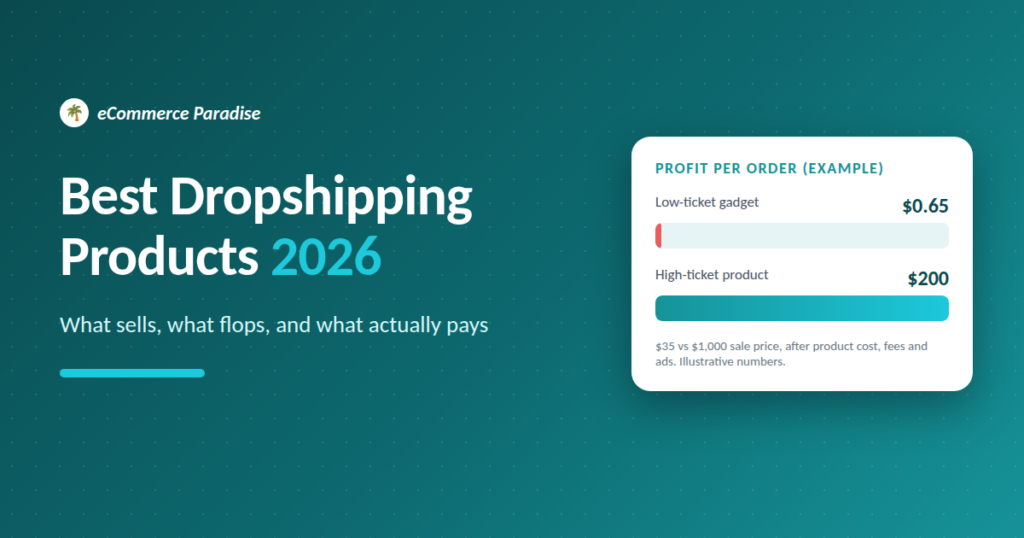
Search for the best dropshipping products and you will find a hundred lists of fifteen dollar gadgets and a lot of “winning product” hype. I have been in ecommerce for over fifteen years, and the product is still the biggest decision you will make in this business. Pick wrong and you burn months and ad budget with nothing to show for it. Pick right and a single sale can cover a week of marketing.
Here is the problem with most of those lists: they are written for low-ticket stores, where you might keep a few dollars per order after ads, refunds, and fees. This guide covers both sides. I will show you what is trending in 2026, why most of it struggles to turn a profit, and the high-ticket categories ($500 to $5,000) where I build stores for myself and for clients through Ecommerce Paradise.
People are comfortable buying online, and that includes big purchases. The U.S. Census Bureau reported $340.2 billion in retail e-commerce sales for the second quarter of 2026, or 17.1 percent of all retail sales (seasonally adjusted, August 2026 release). That is exactly why a premium grill, a rowing machine, or a standing desk can sell through a niche store when you earn the trust.
Start here: get my free high-ticket niches list. Not sure which category fits you? The list shows you which niches are worth your time before you spend a dollar on a store. Get the Free Niches List →
Prefer to watch? Here is my video breaking down high-ticket vs low-ticket dropshipping, and which one to start with.
Low-Ticket vs High-Ticket Dropshipping Products at a Glance
Before we get into specific products, this table shows the real difference between the two models. The numbers in the last two rows come from the worked example later in this post, so treat them as an illustration of how the math behaves, not a promise.
| Factor | Low-Ticket ($15 to $60) | High-Ticket ($500 to $5,000) |
|---|---|---|
| Typical buyer | Impulse shopper, often from social ads | Researcher who compares brands and reads reviews |
| Supplier type | Marketplace sellers, overseas warehouses | US manufacturers and authorized distributors |
| Price competition | Anyone can source the same item in an afternoon | MAP pricing protects your margin |
| Main traffic source | Paid social, trend-driven | Google Shopping, search, email |
| Customer service load | High volume of small tickets | Fewer orders, more phone and email time per order |
| Profit per order (example) | Under $1 after ads | About $200 |
| Orders for $5,000 profit (example) | Thousands | About 25 |
What Low-Ticket Products Are Trending in 2026 (and Why Most Don’t Make Money)
Almost every list you will find covers the same handful of categories: kitchen and home organization gadgets, pet accessories, beauty and wellness tools, phone and tech accessories, fitness accessories like resistance bands, and car and desk accessories. They are popular because they are cheap to test, easy to find on AliExpress or CJ Dropshipping, and simple to show in a short video. There is nothing wrong with that as a way to learn how ecommerce works.
The trouble starts when you try to turn one of these into a real income. The same product is listed by hundreds of other stores within days, so the only lever left is price, and that is a race to the bottom you will lose. Ad costs keep climbing, shipping from overseas warehouses is slow, and refunds and chargebacks eat the little margin that is left.
Shipping speed is a bigger deal than most beginners realize. Under the FTC’s Mail, Internet, or Telephone Order Merchandise Rule, you need a reasonable basis to ship within the time you advertise, or within 30 days if you do not state one. If you cannot meet that window, you have to get the customer’s consent to a delay or refund the order. A store that depends on a three-week supplier is walking into that problem every day.
Can you make money with low-ticket products? Yes, some people do, usually with strong ad skills and a product that catches a trend early. I just do not recommend it as a first business, and I have watched a lot of people burn out chasing the next winning product. If you want to research trends anyway, tools like SEMRush and Google Trends will show you demand before you spend on inventory or ads.
The High-Ticket Upgrade for Every Trending Category
If you are already selling cheap products, you do not need to abandon what you know about your customers. You can move up within the same interest. The table below pairs each popular low-ticket category with the high-ticket version of the same buyer’s interest, using the price ranges from the category sections further down.
| Low-Ticket Category | Typical Price | High-Ticket Upgrade | Typical Price |
|---|---|---|---|
| Kitchen gadgets | $15 to $40 | Espresso machines, stand mixers, specialty appliances | $400 to $3,000+ |
| Pet accessories | $10 to $35 | Premium kennels, smart feeders, pet furniture | $500 to $2,000 |
| Phone and tech accessories | $10 to $30 | Studio and audio gear, instruments | $500 to $5,000+ |
| Fitness accessories | $10 to $30 | Treadmills, rowers, home gym packages | $1,500 to $5,000 |
| Car accessories | $10 to $40 | Roof racks, truck bed systems, performance parts | $100 to $2,000 |
| Home decor and organization | $15 to $50 | Patio furniture, fire pits, gazebos, grills | $1,500 to $5,000 |
| Desk and office gadgets | $10 to $40 | Standing desks, ergonomic chairs | $500 to $3,000 |
| Baby gadgets | $10 to $40 | Premium cribs, strollers, car seats | $500 to $2,000 |
Notice the pattern. The buyer for the premium version is older, has more money, and does real research before buying. That is the customer who will trust a niche store with a phone number on it, and it is the whole idea behind high-ticket dropshipping.
Already running a low-ticket store? Watch my free mini course first. It shows you exactly how the high-ticket model differs, so you can decide whether to switch before you change anything. Start the Free Mini Course →
The Math That Decides Which Products Win
Product lists never show you the math, so let me do it. These are illustrative numbers, not averages, and your actual costs will differ, but the shape of the result is what matters.
| Per Order | Low-Ticket Example | High-Ticket Example |
|---|---|---|
| Sale price | $35.00 | $1,000.00 |
| Product cost including shipping | $15.00 | $650.00 |
| Payment processing (about 3%) | $1.35 | $30.00 |
| Ad cost to win one order (assumed) | $18.00 | $120.00 |
| Profit before refunds and apps | $0.65 | $200.00 |
| Orders needed for $5,000 profit | About 7,700 | 25 |
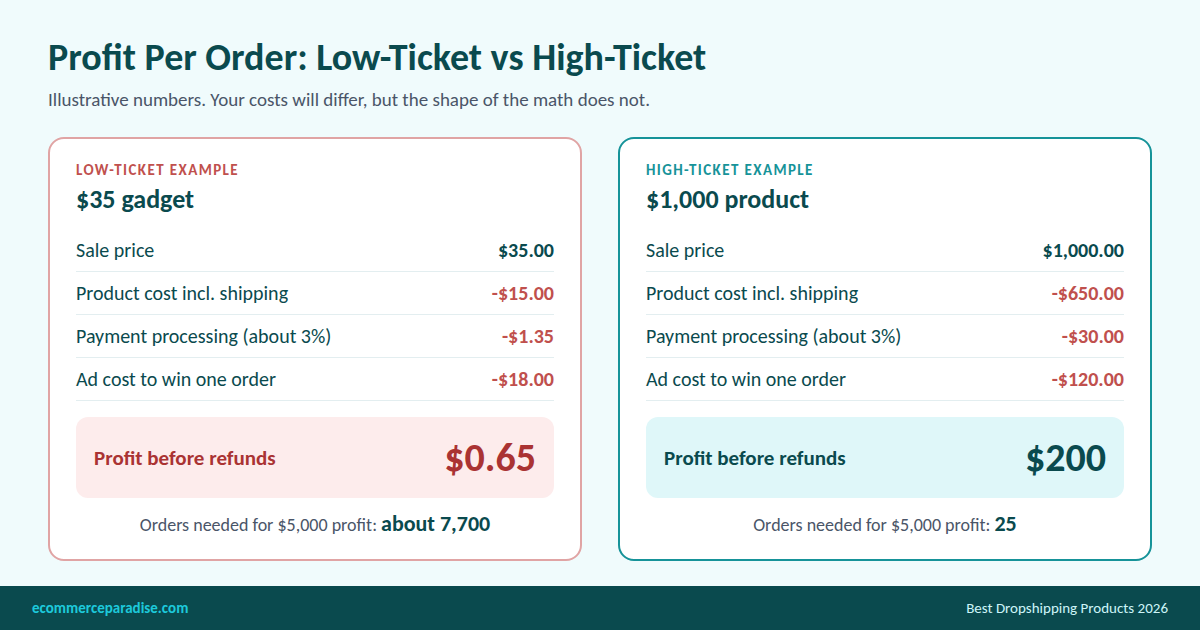
Now say you get really good at ads and you keep $6 per order on the cheap product. You still need about 830 orders to make $5,000, which means 830 shipments, 830 chances for a late package, and 830 potential refund requests. On the high-ticket side, 25 orders is a manageable week or two of work, and you can pick up the phone and talk to every buyer.
High-ticket has its own costs, and I do not want to hide them. You need to respond fast, you will deal with freight on bulky items, and a mistake on a $2,000 order hurts more than a mistake on a $20 order. That is a trade-off I am happy to take, because you can run a real business on 25 orders a month and you cannot run one on a dollar of profit per sale.
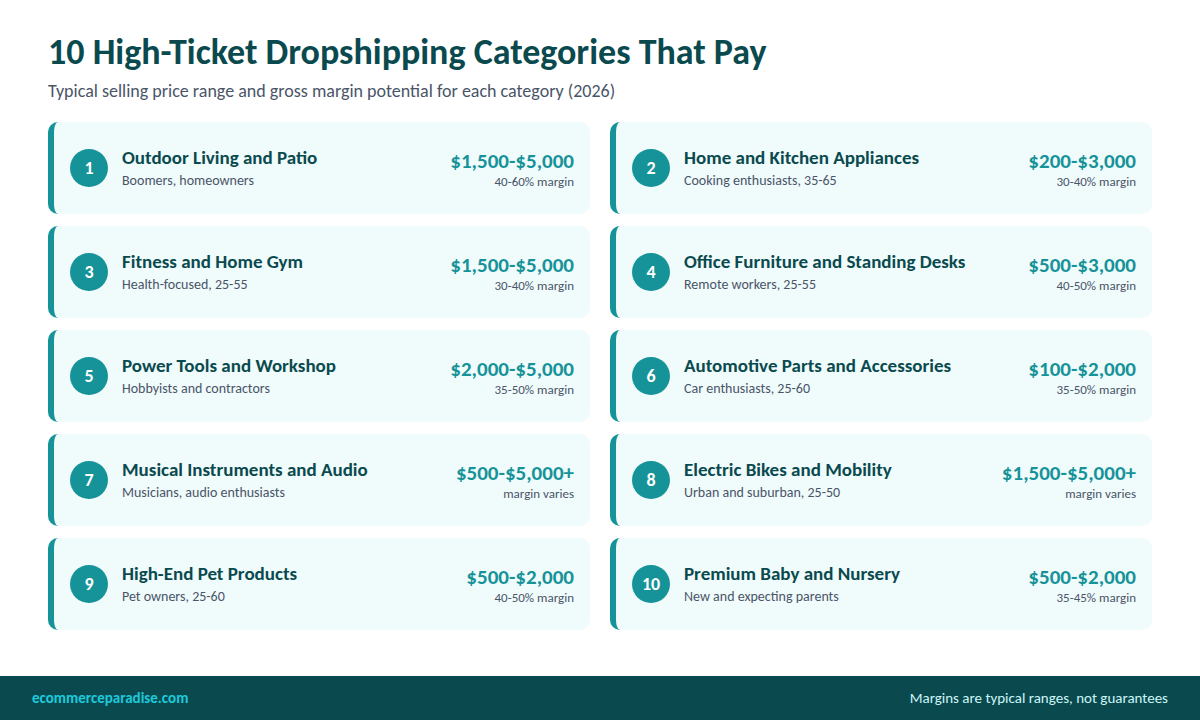
Quick Comparison of the 10 High-Ticket Product Categories
Here is the cheat sheet for the ten categories I cover below. The margin ranges are what I see on MAP-protected products from authorized suppliers, so your numbers will move with the brand, the freight, and your ad costs.
| Product Category | Price Range | Target Customer | Margin Potential | Seasonality |
|---|---|---|---|---|
| Outdoor Living & Patio Furniture | $1,500-$5,000 | Baby boomers, homeowners | 40-60% | Spring/summer peak |
| Home & Kitchen Appliances | $200-$3,000 | Cooking enthusiasts age 35-65 | 30-40% | Year-round |
| Fitness & Home Gym Equipment | $1,500-$5,000 | Health-focused, age 25-55 | 30-40% | Consistent year-round |
| Office Furniture & Standing Desks | $500-$3,000 | Remote workers, age 25-55 | 40-50% | Year-round with summer dips |
| Power Tools & Workshop Equipment | $2,000-$5,000 | Hobbyists & contractors, age 30-65 | 35-50% | Year-round, steady |
| Automotive Parts & Accessories | $100-$2,000 | Car enthusiasts, age 25-60 | 35-50% | Consistent with seasonal peaks |
| Musical Instruments & Audio | $500-$5,000+ | Musicians & audio enthusiasts | Varies by product | Year-round, holiday peaks |
| Electric Bikes & Mobility | $1,500-$5,000+ | Urban/suburban, age 25-50 | Varies | Spring/summer peak |
| Pet Products (High-End) | $500-$2,000 | Pet owners, age 25-60 | 40-50% | Year-round with holiday peaks |
| Baby & Nursery (Premium) | $500-$2,000 | New & expecting parents, 25-45 | 35-45% | Year-round with seasonal spikes |
Outdoor Living and Patio Furniture
This is the category I point people to first if they want big margins. We are talking grills at fifteen hundred to four thousand dollars, fire pits, full outdoor furniture sets, and gazebos that run two thousand to five thousand dollars. On the right items the margins sit between forty and sixty percent.
Baby boomers and homeowners are the core buyer. They have the money, they are investing in their houses, and they do not price-shop like younger shoppers. Harvard’s Joint Center for Housing Studies projects homeowner improvement and repair spending of about $518 billion by the end of 2026, although growth is easing from 2.1 percent to 1.6 percent. So the pot is huge, but it is not a rocket ship, which is one more reason to pick products and suppliers carefully.
Seasonality is the wild card. Spring and early summer explode, August cools off, and by November it is quiet. Plan inventory and ad budgets months ahead, and use the slow season to build content and line up suppliers for next spring.
The best products here are the ones nobody can pick up at Home Depot: high-end fire tables, custom outdoor kitchens, premium gazebos with lighting and heating, and specialty grills. Look for manufacturers with strong MAP protection, because price wars in this category are a race to the bottom. If you want the framework behind that, read my breakdown of high-margin, low-competition products.
Pros
- 40-60% margins on outdoor entertaining gear
- Baby boomer buyers with deep disposable income
- MAP-protected premium brands stop price wars
- Spring/summer demand explosions move serious volume
Cons
- Dead zone November through February
- Bulky freight shipping eats into margins
- Inventory and ad spend must be planned months ahead
- Wrong timing on seasonal launches can cost a quarter
Home and Kitchen Appliances
Kitchen appliances are a pain in the butt to ship, but people pay for them because they are expensive and they want real warranty coverage from an authorized dealer. Think stand mixers at four hundred to eight hundred dollars, espresso machines at two thousand and up, premium blenders, and specialty cooking equipment. Demand runs year-round, so you are not riding the seasonal rollercoaster that patio furniture puts you on.
The buyer is usually thirty-five to sixty-five with a real interest in cooking or coffee. These people watch YouTube reviews, read specs, and care about brand reputation. Use a keyword tool like KWFinder to see exactly what appliance terms they search, because they are not impulse buyers, but when they are ready they spend serious money.
Margins here run thirty to forty percent since you are often selling established brands through authorized distributors. That is still excellent profit. The key is consistency: steady month-to-month sales as long as your marketing keeps running.
Focus on specialty rather than basic. A premium stand mixer, not a food processor anyone can grab at Target. An espresso machine, not a drip coffee maker. If you are coming from cheap kitchen gadgets, this is the natural step up, and the same buyer who impulse-orders a $19 milk frother will research a $2,000 machine for weeks.
Pros
- Year-round consistent demand, no seasonal cliff
- 35-65 age buyers who research and trust authorized dealers
- Strong brand loyalty once a customer finds you
- Specialty equipment commands premium pricing
Cons
- Shipping kitchen appliances is a pain in the butt
- 30-40% margins are solid but tighter than outdoor
- Established brands mean less pricing flexibility
- Customer service questions are highly technical
Fitness and Home Gym Equipment
When people commit to fitness at home, they drop serious money on quality equipment. Treadmills run two thousand to five thousand dollars, rowing machines fifteen hundred to four thousand, and full home gym packages go higher. Home fitness did not collapse when gyms reopened, because people still value the convenience and privacy of working out at home.
Your customer is fitness-focused, twenty-five to fifty-five, and has usually tried gyms and decided home is better. These buyers compare brands and specs, and they look for equipment that matches a specific goal like marathon training or strength work. That research habit is exactly what a niche store with real product knowledge can win.
Stick with premium, durable equipment from established brands. Cheap treadmills and flimsy weight sets destroy your reputation fast, and returns on heavy gear are brutal. This is where the right high-ticket suppliers make all the difference, since you need reliable inventory, freight terms you understand, and a warranty process that works.
Pros
- Home fitness demand stayed strong after gyms reopened
- Customers research specs and pay for quality
- Single sales of $2,000-$5,000+ are routine
- Natural step up for stores selling resistance bands and accessories
Cons
- Treadmills and weight sets are massive to ship
- Returns on heavy equipment are nightmares
- Cheap brands will tank your reputation fast
- Competition from established fitness retailers is real
Office Furniture and Standing Desks
Remote and hybrid work stuck around, and the home office keeps getting upgraded. Desks run five hundred to three thousand dollars, ergonomic chairs three hundred to two thousand, and full office setups can reach five thousand and up. Margins usually land between forty and fifty percent, with a slight dip during summer vacation season.
The buyer is a professional between twenty-five and fifty-five who sits at a desk eight hours a day and takes it seriously. They will spend two thousand dollars on a desk if they believe it will help their back and their productivity. That makes them far more research-driven than someone buying a $25 desk organizer.
Pick products that cannot be bought locally: a premium standing desk instead of a basic table, an ergonomic chair from a specialty brand, plus lighting, converters, and acoustic panels that you can bundle into a complete setup. Bundles raise your average order value, which is what pays for ads.
Look for suppliers who sell B2B and are still figuring out direct-to-consumer. Those are your openings. A tool like Inventory Source can connect you with furniture manufacturers that already support dropshipping integrations.
Pros
- 40-50% margins on premium ergonomic gear
- Remote work makes this a long-term tailwind
- Year-round demand with minor summer dips
- Combining items into full setups boosts AOV
Cons
- Many manufacturers still do not understand D2C dropshipping
- Heavier furniture means freight complexity
- Competing against IKEA-tier basics is pointless
- B2B suppliers can be hard to convert to retail
Power Tools and Workshop Equipment
Hobbyists and contractors love their tools and pay premium prices for quality. Table saws run two thousand to five thousand dollars, and the category also covers drill presses, air compressors, specialty woodworking machines, and complete shop setups. Demand comes from weekend woodworkers and working contractors alike.
These buyers are passionate about their craft. They spend weekends in the shop, take pride in their work, and understand that better tools mean better results. A woodworker who gets the right table saw from you comes back for dust collection, blades, and jigs, and tells his buddies.
Focus on specialty and professional-grade equipment rather than basic models. Precision tools, specialty jigs, and workshop gear that serious craftspeople respect. YouTube channels about woodworking and metalworking are goldmines for seeing what the community actually trusts, and SEMRush will show you which keywords drive organic traffic to competitor stores.
Pros
- Hobbyists and contractors pay premium for the right tool
- Loyal repeat buyers once you earn their trust
- Community-driven referrals from YouTube and forums
- Specialty tools have less price competition
Cons
- $2,000-$5,000 price points need real trust signals
- Niche knowledge required to position correctly
- Heavy machinery shipping is a freight game
- Buyers research extensively before committing
Automotive Parts and Accessories
Car and truck enthusiasts are some of the most passionate buyers you can target. Roof racks, truck bed accessories, performance parts, specialty lighting, and vehicle protection products range from one hundred dollars to two thousand for complete systems. Margins run thirty-five to fifty percent, with steady demand year-round and peaks around the big driving seasons.
These buyers see their vehicle as an extension of themselves. They share builds on social media, hang out in forums, and influence other buyers. If you have been selling $15 phone mounts and seat covers, the jump to roof racks and truck bed systems keeps you in front of the same audience at ten times the order value.
The best products enhance function or looks in a way people notice: a premium roof rack system, specialty truck bed organizers, interior kits, and protective gear. Word of mouth and social proof drive this niche, so look for products that show off well in the enthusiast community.
Niche selection matters more here than almost anywhere. Are you targeting truck owners, off-roaders, or tuners? Each has different products and budgets, and my high-ticket niches list helps you pick one. Go deep in one before you go wide across all of automotive.
Pros
- Passionate buyers identify with their vehicle
- Strong community word-of-mouth drives sales
- Year-round demand with seasonal driving peaks
- Sub-niches (truck, off-road, tuning) are deep enough to dominate
Cons
- Each sub-niche has totally different products and customers
- Fitment data and product knowledge are critical
- Heavy parts can spike shipping costs
- Going wide instead of deep kills positioning
Musical Instruments and Audio
Musicians and audio engineers will spend serious money on gear. Guitars run five hundred to three thousand dollars, keyboards one thousand to five thousand, and PA systems, studio recording equipment, and high-end audio sit in the same range. Buyers range from hobbyists to working sound engineers.
This buyer is defined by passion more than demographics. They spend thousands of hours with their equipment, hang out in communities around their instruments, and understand the link between gear quality and output. They also research heavily and trust expert recommendations, so if your store is the knowledgeable one, people will come to you for guidance.
Content is the lever in this niche. YouTube demos, honest comparisons, and real engagement with the music community drive sales better than ads alone. I use AI tools like Claude to draft demo scripts and product descriptions, then I edit them so they sound like a real person who actually plays.
Stick with professional-grade and specialty gear rather than beginner starter kits. A quality guitar from a recognized brand, studio microphones, recording interfaces, and monitors that working musicians recommend.
Pros
- Buyers will spend thousands once they find their sound
- Content marketing converts in this niche better than almost anywhere
- Brand recognition makes online buying easier
- Professional-grade gear sustains premium pricing
Cons
- Wide price ranges from hobbyist to pro confuse positioning
- Buyers expect deep product knowledge from the store
- Authorized dealer relationships are tough to get
- Competing with Sweetwater and Guitar Center directly is hard
Electric Bikes and Mobility
Electric bikes are one of the fastest-growing high-ticket categories. Prices run fifteen hundred to five thousand dollars and beyond, with electric scooters and mobility devices filling out the category. Urban congestion and the pure convenience of electric riding keep pushing it.
The buyer is typically twenty-five to fifty, urban or suburban, and wants an alternative to driving. They care about reliability, warranty coverage, and who answers the phone when something goes wrong, so support is part of the product.
The challenge is logistics. E-bikes are heavy and awkward to ship, and battery rules add complexity. Look for suppliers who have already solved fulfillment for bulky items, and a platform like Spocket can help you find US-based suppliers. The margins and order values justify the hassle, because one e-bike sale can out-earn a hundred small ones.
This category shows why high-ticket wins. You could sell a thousand five-dollar items on impossible margins, or sell a fifteen-hundred-dollar e-bike with a few hundred dollars of profit. Which one sounds like the better use of your time and ad budget?
Pros
- One of the fastest-growing high-ticket categories
- Single e-bike sales can generate several hundred dollars in profit
- Urban demand driven by long-term lifestyle shifts
- Premium brands give you positioning protection
Cons
- Heavy, awkward shipping logistics are a real challenge
- Battery and motor warranties require strong supplier support
- Returns are expensive and complicated
- Regulations vary by state
Pet Products (High-End)
Pet owners treat their animals like family and spend accordingly. Premium dog kennels run five hundred to two thousand dollars, and the category also covers smart automatic feeders, designer pet furniture, grooming equipment, and high-end accessories. Margins are usually forty to fifty percent, with demand steady year-round and a lift around the holidays.
The buyer is twenty-five to sixty, emotionally attached, and willing to invest in comfort and safety. They read reviews, care about quality, and stay loyal when you deliver good products with good service. If you currently sell $12 chew toys, this is how you move up with the same customer.
The winning products meaningfully improve a pet’s life: a premium kennel instead of a basic crate, a feeder with health tracking instead of a bowl, quality furniture and bedding. Pet owners also share photos, trade tips in forums, and follow pet accounts, so authentic community engagement pays off.
Build the store on BigCommerce or Shopify, and create a dedicated landing page for each product line.
Pros
- 40-50% margins on premium pet gear
- Pet owners treat pets like family and spend accordingly
- Year-round demand with holiday upticks
- Brand-loyal repeat buyers once you earn trust
Cons
- Community-driven niche needs authentic engagement
- Specialty products require deeper product knowledge
- Cheaper marketplace alternatives can undercut basic items
- Crowded category with many established players
Baby and Nursery (Premium)
Parents building a nursery are among the most emotionally driven buyers online. Premium cribs run five hundred to two thousand dollars, and the category includes high-end strollers, car seats, nursery furniture, and monitoring equipment. Margins are thirty-five to forty-five percent, with demand spiking around pregnancy announcements and new-parent milestones.
The buyer is twenty-five to forty-five and worried about safety first. They read safety ratings, compare brands, and want products recommended by pediatricians and other parents. They will pay a premium for peace of mind.
This category demands total confidence in product safety. A recall or a bad review can sink a store, so only work with established brands that have strong safety records. Use SaleHoo to verify supplier legitimacy, and look for certifications and transparent quality assurance.
Do not try to compete with no-name knockoffs, because parents will not trust them with a baby. Compete on service, knowledge, and honest recommendations instead.
Pros
- Emotionally driven buyers willing to invest in safety
- Strong demand from new and expecting parents
- Premium brands trusted on safety alone
- Recurring purchases as babies grow through stages
Cons
- Safety recalls or quality issues will destroy your store
- Only established brands work, no knockoffs
- Heavy regulatory scrutiny across multiple agencies
- Customer service must be flawless for parents
Free High-Ticket Niches List
Picking the right category is half the battle. Grab my free high-ticket niches list with margin notes, supplier tips, and demand signals so you can skip the guessing game.
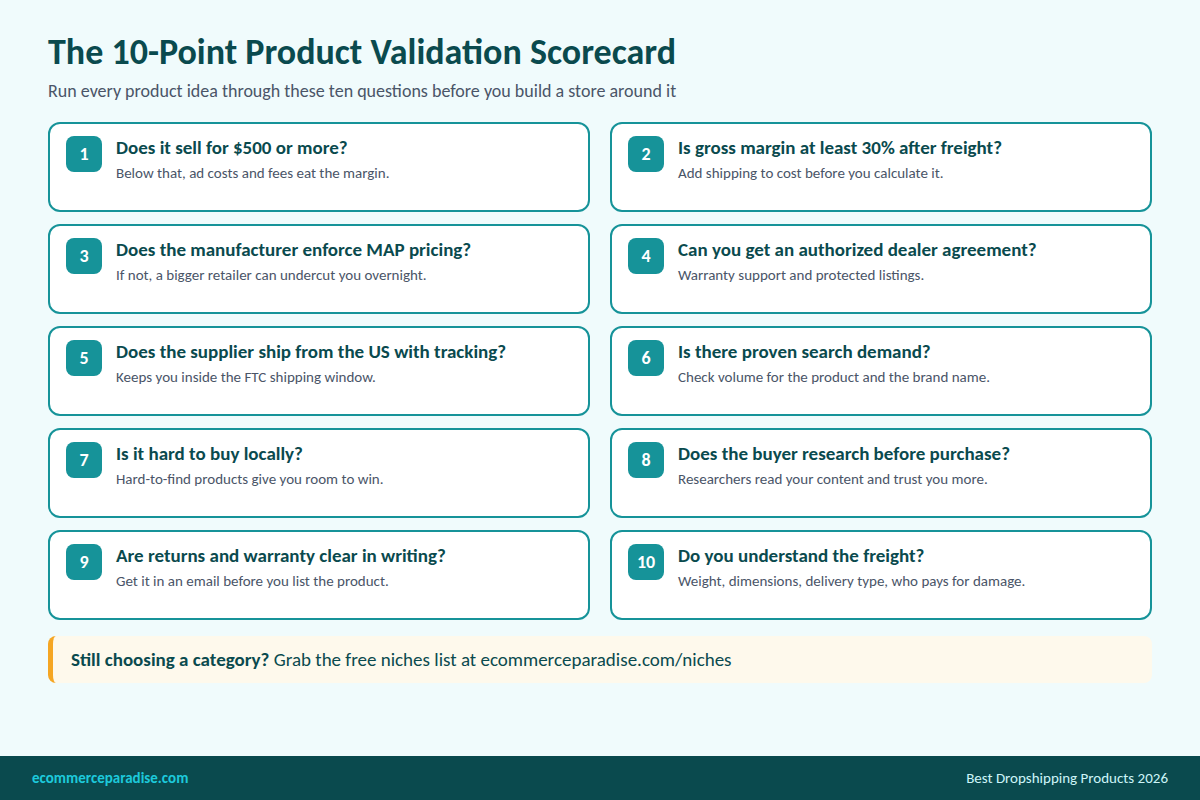
The 10-Point Product Validation Scorecard
Most product lists stop at “here are some ideas.” Here is the scorecard I run every product through before I spend a dollar. Give each question a yes or a no, and if you cannot get at least eight yeses, I move on. One thing to keep in mind: a product can look great on paper and still fail on question seven, so do not skip any of them.
- Does it sell for $500 or more? Below that, ad costs and processing fees eat too much of the margin.
- Is the gross margin at least 30 percent after freight? Add shipping to the cost before you calculate it.
- Does the manufacturer enforce MAP pricing? If not, a bigger retailer can undercut you overnight.
- Can you get an authorized dealer agreement? This gets you warranty support and protects your listings.
- Does the supplier ship from the US with a tracking number? Domestic shipping keeps you inside the FTC shipping window.
- Is there proven search demand? Check keyword volume for the product and the brand name.
- Is it hard to buy locally? Online-only or hard-to-find products give you room.
- Does the buyer research before purchase? Researchers read your content, which helps your SEO and your trust.
- Is the return and warranty process clear in writing? Get it in an email before you list the product.
- Do you understand the freight? Know the weight, dimensions, delivery type, and who pays when it arrives damaged.
Products to Avoid in 2026
Knowing what to skip saves you more money than knowing what to pick. I steer clear of three groups, and the first one trips up almost every beginner I talk to.
The first is anything that can be bought at a big-box store the same day. If a customer can drive to Walmart and pick it up in an hour, you are fighting convenience and price at the same time. The second is products with no MAP protection, where the lowest price always wins and your margin disappears. The third is fragile, regulated, or recall-prone items sold without a strong brand behind them, such as unbranded baby gear, supplements, and cheap electronics with lithium batteries.
I also pass on trend-driven viral gadgets with a three-month lifespan, because you have to rebuild the whole funnel each time the trend dies. If you want to see how brutal the numbers are for people who skip this step, read my breakdown of how many dropshippers fail and how to beat the odds.
How to Validate Demand in 10 Minutes
Here is the quick research routine I use on camera and with clients. It takes about ten minutes per product and it kills most bad ideas before you waste a week on them.
Start with Google Shopping and search for the product category. Sort the results by price from high to low, because that is my signature move: it shows you right away whether people are actually selling and buying at premium prices. Then look at who is on the page. If you see mostly big retailers and manufacturers with no small niche stores, the category may be too tough, and if you see a mix of specialty stores, there is room.
Next, plug the product and its brand into KWFinder and check the monthly search volume and keyword difficulty. After that, open SEMRush and look at a competitor store to see which pages bring in organic traffic. If a product has real search demand and a few small stores ranking for it, it is usually worth a deeper look.
Finally, call the supplier. Ask about MAP, dealer requirements, lead times, and warranty handling. A supplier who picks up the phone and answers clearly is worth more than any keyword tool, which is why I wrote a full walkthrough on choosing dropshipping suppliers for Shopify.
How to Switch From Low-Ticket to High-Ticket Dropshipping
If you are running a low-ticket store right now, you do not have to start over. You already know how to build a store, run ads, and handle customers. What changes is the product, the supplier, and the way you build trust. Here is the path I walk people through.
- Pick the high-ticket version of what you already sell. Use the upgrade table above and stay in the same interest area.
- Rebuild around one tight niche. A store that sells everything does not earn trust at $1,500.
- Source US suppliers with MAP and dealer agreements. This is the part that takes the most work, so budget real time for it.
- Add trust signals. Put your phone number, a physical address, clear warranty and return pages, and real reviews on the site.
- Switch your traffic to Google Shopping and search. High-ticket buyers search before they buy, which is a very different audience from social scrollers.
- Answer every call and email fast. Phone sales close a surprising share of high-ticket orders.
Before you launch the new store, get the legal side right with my guide to business formation for high-ticket dropshipping. A proper LLC and a business bank account matter more when you are processing orders in the thousands. Once the basics are in place, my dropshipping checklist for beginners keeps you from missing launch-day details.
Your Path From Free Resources to a Done-For-You Store
Everything I publish is meant to move you one step closer to a working high-ticket business, and you choose how much help you want. Use this table to find your starting point.
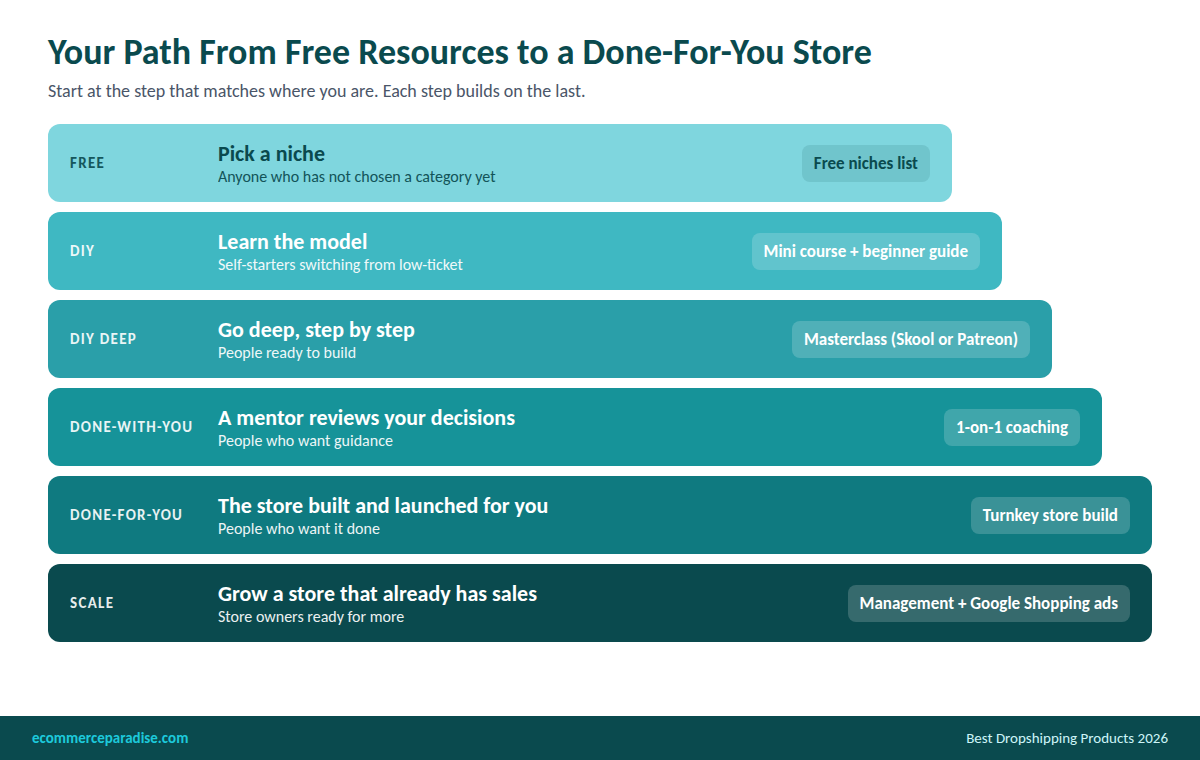
| Stage | Best For | Where to Start |
|---|---|---|
| Free: pick a niche | Anyone who has not chosen a category yet | Free niches list |
| DIY: learn the model | Self-starters switching from low-ticket | Free mini course and the beginner guide |
| DIY: go deep | People ready to build step by step | Masterclass, on Skool or Patreon |
| Done-with-you | People who want a mentor reviewing their decisions | 1-on-1 coaching |
| Done-for-you | People who want the store built and launched for them | Turnkey store build |
| Scale | Store owners with sales who want growth | Store management and Google Shopping ads |
Want us to build it for you? My team handles niche research, supplier sourcing, and the full store build so you can launch with real products from real suppliers. See the Done-For-You Store Build →
If you are still sorting out suppliers, my free supplier directory is a good place to look. And if you want a realistic look at income before you commit, I broke down what you can realistically make dropshipping using real numbers from fifteen years of doing this.
Frequently Asked Questions
What are the best dropshipping products to sell in 2026?
For beginners who want real profit, I recommend high-ticket categories in the $500 to $5,000 range, such as outdoor living, fitness equipment, office furniture, power tools, and premium pet or baby gear. Low-ticket gadgets are easy to test, but the margins rarely survive ad costs and refunds. Start with my free niches list to narrow it down.
Is low-ticket dropshipping still worth it?
It can be, but it takes strong ad skills and a product that catches a trend early. Most beginners get stuck on thin margins, long shipping times, and refund requests. If you are starting from zero, I would learn on a small budget with cheap products and then move up, using my budget breakdown for starting with $500 as a reality check.
How much profit should I make per order?
I want at least thirty percent gross margin after freight on high-ticket products, and I look for a few hundred dollars of profit per order. In the example earlier in this post, a $1,000 sale left about $200 after product cost, fees, and ads. Your real numbers will vary, so run the math on every product before you list it.
Where do I find suppliers for high-ticket products?
Look for US manufacturers and authorized distributors that offer MAP pricing and dealer agreements. I walk through the exact process in my guide to finding high-ticket suppliers. Tools like Inventory Source also help you find suppliers with existing dropshipping integrations.
Can I convert my existing store to high-ticket?
Usually yes, but I recommend building a new, focused niche store instead of stuffing expensive products into a general store. Trust is the whole game at $1,500, so you need a tight brand, a phone number, and clear policies. If you want help, my coaching program walks you through the switch.
Final Verdict
The best dropshipping product is the one that leaves you real profit after ads, fees, shipping, and refunds. For most people in 2026, that means moving away from fifteen dollar gadgets and toward products in the $500 to $5,000 range, where a handful of orders a week can add up to a real income.
Pick one category, go deep, and build a store that earns trust. Run every product through the scorecard, call your suppliers, and do the math before you commit.
If you want help, you have options. I can build the store for you through the Turnkey Done-for-You Store Service.
If you would rather learn it yourself, the masterclass teaches the whole model. If you want a mentor in your corner, the private coaching program is built for that.
Once you are making sales, my team can run your Google Shopping ads. The Resources page lists every tool I use.
Product selection is everything in this business, so take your time, do the research, and go deep before you go wide. I am rooting for you.
Related Articles
If you found this useful, these guides go deeper on related topics:
- High-Ticket Niches: The Complete List
- Best High-Ticket Dropshipping Products: High Margin, Low Competition
- Trending Dropshipping Products 2026: What’s Growing, Not Fading
- Best Dropshipping Niches for Beginners
- High-Ticket Products to Sell Online in 2026
Trevor Fenner
Email: trevor@ecommerceparadise.com
Phone: (307) 429-0021
5830 E 2nd St, Ste. 7000 #715, Casper, WY 82609
About | Contact | Resources

Trevor Fenner is an ecommerce entrepreneur and the founder of Ecommerce Paradise, a platform focused on helping entrepreneurs build and scale profitable high-ticket ecommerce and dropshipping businesses. With over a decade of hands-on experience, Trevor specializes in high-ticket dropshipping strategy, niche and product selection, supplier recruiting and onboarding, Google & Bing Shopping ads, ecommerce SEO, and systems-driven automation and scaling. Through Ecommerce Paradise, he provides free education via in-depth guides like How to Start High-Ticket Dropshipping, advanced training through the High-Ticket Dropshipping Masterclass, and fully done-for-you turnkey ecommerce services for entrepreneurs who want a faster, more hands-off path to growth. Trevor is known for emphasizing sustainable, real-world ecommerce models over hype-driven tactics, helping store owners build scalable, sellable, and location-independent brands.


