

If you’ve spent time grinding through low-commission sales roles, hitting 50 cold calls a day to close $200 deals, you already understand why high-ticket sales feels like a completely different profession. So what are high-ticket sales jobs? They are roles where a single deal is typically worth $3,000 or more, so one close can out-earn weeks of volume selling. The mechanics are the same: find a buyer, solve a problem, close a deal. But the economics are different in a way that changes everything else downstream, including how you spend your time, what your days look like, and what you can actually earn.
I’ve been selling online since 2005, running my own stores since 2010, and running Ecommerce Paradise since 2015, and the professionals I see transition most successfully from sales careers to ecommerce entrepreneurship are almost always people who’ve already done the work of learning consultative selling in high-ticket environments. The skills transfer directly. But whether your goal is to stay in sales, build a career that funds your business aspirations, or use sales expertise as a launchpad into something you own entirely, understanding which high-ticket roles are worth pursuing changes the calculation significantly.
This guide covers the best high-ticket sales jobs in 2026, ranked by income potential, market demand, and long-term career value, along with how to break in if you’re starting from scratch and why these skills matter whether you stay in sales or eventually go out on your own.
Affiliate disclosure: some links in this article are affiliate links and I may earn a commission at no cost to you. It does not change which tools I recommend or what the research found.
Already know how to sell? The fastest way to put that skill into your own business is to pick the right products. Grab the free High-Ticket Niches List →: 250+ profitable product categories with strong margins and real supplier access, built for people who already understand how buyers think.
High-Ticket Sales Jobs: Quick Comparison
| Role | Income Range | Typical Deal Size | Sales Cycle | Remote-Friendly | Entry Difficulty |
|---|---|---|---|---|---|
| Enterprise SaaS Sales | $120K-$350K+ OTE | $50K-$2M+ | 3-18 months | High | Medium |
| High-Ticket Closer | $5K-$30K+/month | $5K-$50K | 1 call-2 weeks | Very High | Low |
| Commercial Real Estate | $60K-$1M+ | $1M-$100M+ | 6-24 months | Low | Medium |
| Medical Device Sales | $120K-$250K+ | $10K-$500K+ | 3-12 months | Low | High |
| Industrial & Equipment | $80K-$200K+ | $50K-$2M+ | 3-18 months | Low | Medium |
| Financial Services | $80K-$1M+ | $500K-$50M+ AUM | 6-24 months | Medium | High |
| Luxury Sales | $80K-$500K+ | $300K-$100M+ | 3-24 months | Low | High |
| B2B Agency Sales | $70K-$180K+ | $24K-$500K+ | 1-6 months | High | Low |
| Cybersecurity Sales | $150K-$350K+ OTE | $50K-$5M+ | 3-12 months | High | Medium |
| Executive Education | $70K-$180K+ | $5K-$500K+ | 1-12 months | Medium | Low |
Why High-Ticket Sales Outperforms Volume-Based Selling
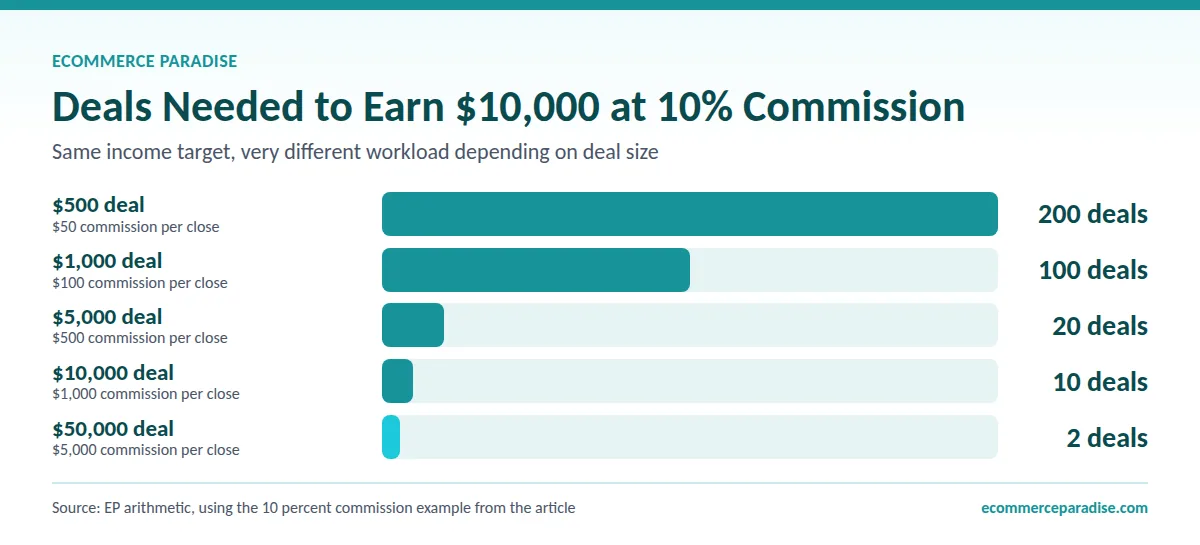
The core argument for high-ticket sales is arithmetic. If your commission rate is 10 percent, closing a $500 deal earns you $50. Closing a $50,000 deal earns you $5,000. To earn $10,000 in a month from $500 deals, you need to close 200 of them. From $50,000 deals, you need two. That compression in deal volume changes every other variable in your professional life: the time you can invest per prospect, the quality of your client relationships, the depth of product knowledge you can develop, and ultimately your income ceiling.
According to Zippia’s sales compensation research, enterprise account executives in SaaS earn median total compensation of $150,000 to $200,000 annually, with top performers reaching $300,000 and above. That income level is structurally difficult to reach in volume-based sales regardless of effort. The ceiling just isn’t there.
High-ticket sales also develops skills that compound. The ability to run a thorough discovery process, diagnose business problems, map solutions to specific buyer outcomes, and manage objections in a complex decision cycle are valuable across industries and transfer cleanly into adjacent roles like sales leadership, consulting, and business development. Reps who develop these skills in one high-ticket context routinely move into higher-paying roles with strong market leverage because what they’ve built is expertise, not just a track record of dials.
The current labor market rewards specialized sales talent disproportionately. According to the U.S. Bureau of Labor Statistics, wholesale and manufacturing sales representatives who sell technical and scientific products earned a median of $104,920 in May 2025, compared with $72,080 for reps selling other products. BLS projects little or no change in total employment for these roles from 2025 to 2035, so the opportunity is in specialized, consultative selling rather than in headcount growth. In B2B technology, healthcare, and financial services specifically, qualified enterprise sales professionals face minimal competition from automation because the consultative complexity of these deals requires human judgment and relationship management that can’t be systematized.
And the career trajectories are steeper. An enterprise software rep can progress to senior AE, then sales manager, then VP of Sales within 8 to 12 years, a trajectory with total compensation packages at the senior end that frequently exceed $500,000. Commercial real estate brokers who build strong market positions often achieve financial independence through a combination of recurring commissions and investment in the assets they sell. The ceiling in these fields is substantially higher than in most professional categories.
The same math is what drew me to high-ticket dropshipping in the first place. Selling a $4,000 product to 15 people a month is a real business. Selling a $30 product to 2,000 people a month is a customer service department that happens to make a little money.
The 10 Best High-Ticket Sales Jobs in 2026
1. Enterprise Software (SaaS) Sales
Enterprise SaaS sales is arguably the highest-ceiling sales career available in 2026. Account executives at companies like Salesforce, Workday, ServiceNow, and Palo Alto Networks sell software contracts worth tens or hundreds of thousands of dollars annually. These deals often involve 6 to 18 month sales cycles, multiple stakeholders, complex procurement processes, and contract values that can exceed $1 million for large enterprise deployments.
The compensation reflects the complexity. Base salaries for enterprise AEs at major SaaS companies typically run $80,000 to $130,000, with on-target earnings of $150,000 to $300,000 and above when commission is factored in. Top performers who consistently hit or exceed quota can earn substantially more through accelerators and SPIFFs. What makes this field particularly attractive is the recurring revenue model: SaaS contracts renew annually or multi-year, meaning a strong book of business compounds over time rather than resetting with each quarter.
If you’re pursuing this path, tools like HubSpot are worth learning deeply before you interview. Understanding CRM operations, pipeline management, and sales automation from the inside makes you a more credible candidate and a faster ramp once you’re in the role.
The other habit that separates good enterprise reps from great ones is call documentation. Multi-stakeholder deals run for months and the rep who can recall exactly what the CFO said in month two wins the deal in month nine. I run every important call through Otter.ai so the transcript and summary are searchable later, and it costs a fraction of what a blown deal costs.
Income range: $120,000 to $350,000+ OTE. Typical deal size: $50,000 to $2M+ annually. Sales cycle: 3 to 18 months. Growth path: Senior AE, Sales Manager, VP Sales, CRO.
Pros
- OTE of $200K-$500K+ at top SaaS companies
- Tech industry demand keeps growing year over year
- Skills transfer to any B2B sales role
- Generous benefits, stock options, and remote work options
Cons
- Long sales cycles (6-18 months) test your patience
- High quota pressure with monthly/quarterly cliffs
- Layoffs hit sales teams first in downturns
- Technical product knowledge required for credibility
2. High-Ticket Coaching and Consulting Sales (Closers)
High-ticket closers are commission-based sales specialists who close premium coaching, mastermind, and consulting offers on behalf of coaches, consultants, and course creators. Products are typically priced from $5,000 to $50,000 and above, and closers earn 8 to 15 percent commission per closed sale, meaning a single close can pay $500 to $7,500 or more.
The appeal of this role is its accessibility and leverage. Most high-ticket closer positions don’t require a degree, prior sales experience, or any overhead investment. Remote work is standard. The best closers earn $10,000 to $30,000 per month working from anywhere with a phone and laptop, running pre-booked calls with pre-qualified prospects who’ve already opted in to learning more about the offer.
If you’re taking calls from outside the US, get your phone setup right before your first shift. A VoIP line through Dialpad gives you a US number that rings anywhere, records calls, and doesn’t drop mid-close the way a consumer app will. That reliability matters more than people expect when a $15,000 offer is on the table.
If you want to compare options before you commit, Grasshopper is a virtual business phone number service with call forwarding. Quo is another one, and it adds texting and AI call summaries.
The trade-off is variability. Income depends entirely on close rate and call volume, and the quality of the offer and lead pipeline varies significantly between employers. Closers who build strong reputations earn consistent income; those in poorly run programs experience high variance. The role works best for people who are skilled at discovery, build rapport quickly, and handle objections without pressure tactics. What I’ve observed from people in my community who’ve done this: the ones who treat it like a consultative role rather than a persuasion exercise are the ones who last.
The natural end point of this career is owning the offer instead of closing someone else’s. Once you’ve run a few hundred calls you know the objections, the buyer, and the price point better than most of the coaches paying you commission. Plenty of closers make that jump and launch a paid community on Skool, which is the same platform I run my own academy on.
Commission-only income is lumpy, so run it like a business from day one. If you are paid as an independent contractor, FreshBooks keeps your invoices and expenses in one place. If your payouts arrive in another currency, a Wise account is worth setting up.
Income range: $5,000 to $30,000+ per month on commission. Typical deal size: $5,000 to $50,000. Sales cycle: 1 call to 1 to 2 weeks. Growth path: Closer, Lead Closer, Sales Director, launching your own offer.
Pros
- $3K-$20K+ commissions on each closed deal
- Work-from-anywhere with remote-friendly setups
- Performance-only pay rewards top closers
- Direct path from sales calls to commission checks
Cons
- 100% commission means $0 if you don’t close
- Inbound leads are competitive, fast response required
- Coaches and gurus get bad press, harder to trust
- Income is feast-or-famine month to month
Closing for someone else is a job. Owning the offer is a business. Inside the Ecommerce Paradise Academy → you get the full course library on launching, scaling, and selling a high-ticket store, plus direct access to me and the members actually running these businesses. Start with a 7 day free trial. Membership is $9/month or $49/year on Skool.
3. Commercial Real Estate Sales
Commercial real estate brokers represent buyers, sellers, and tenants in transactions involving office buildings, retail centers, industrial warehouses, apartment complexes, and land. Deal sizes are routinely $1 million to $100 million and above, and commission rates of 2 to 6 percent on those transactions produce substantial per-deal income. A single mid-sized industrial transaction can generate $60,000 to $180,000 in commission.
The path to large income takes time. The first two to three years are typically lean as brokers build relationships, learn their markets, and establish a reputation. But those who persist build client networks and market expertise that compound significantly. Established brokers often earn $200,000 to $500,000 annually, and top producers in major markets earn seven figures. Unlike most sales roles, commercial real estate income is not capped by employer structures: brokers at independent or boutique firms keep the majority of their commission and many eventually build teams that multiply their production capacity.
Income range: $60,000 early, $200,000 to $1M+ established. Typical deal size: $1M to $100M+. Sales cycle: 6 to 24 months. Growth path: Associate Broker, Senior Broker, Partner, Team Lead.
Pros
- $100K-$1M+ commissions on major deals
- Tangible asset class with real wealth-building potential
- Network effects compound your business over time
- High autonomy and entrepreneurial freedom
Cons
- Multi-year deal cycles delay paydays
- Market cycles can wipe out a year of pipeline
- Licensing requirements vary by state and complicate moves
- Requires significant upfront investment in education
4. Medical Device Sales
Medical device sales representatives sell surgical instruments, diagnostic equipment, implantable devices, and medical technology to hospitals, surgery centers, clinics, and physicians. Products are technically complex, regulatory approval is required, and buyers (surgeons and department heads) are among the most demanding customers in any sales field. That difficulty is precisely why compensation is strong.
According to MedReps’ annual medical sales salary report, medical device sales reps earn median total compensation around $160,000, with top performers in specialty surgical devices earning $250,000 to $400,000 and above. Most roles include a base salary of $70,000 to $120,000 plus commission, car allowance, and expense account. The long-term career argument is strong: high barriers to entry create real market protection, and experienced reps with strong clinical relationships are difficult to replace.
The credibility bar in the operating room is higher than in any other sales category on this list. Surgeons can tell within one conversation whether you understand the anatomy and the procedure. Working through the clinical and biomedical courses on Coursera before you interview is the cheapest way to close that gap, and it shows initiative that hiring managers in this field specifically look for.
Income range: $120,000 to $250,000+ total compensation. Typical deal size: $10,000 to $500,000+. Sales cycle: 3 to 12 months. Growth path: Territory Rep, Regional Manager, National Accounts, Director of Sales.
Pros
- $150K-$400K+ OTE with strong base + commissions
- High average order values mean fewer deals needed
- Recession-resistant due to ongoing medical demand
- Strong career progression into management
Cons
- Long credentialing and ride-along process to start
- Hospital politics and procurement red tape
- Travel-heavy with frequent surgical attendance
- Heavily regulated, compliance burden is real
5. B2B Industrial and Equipment Sales
Industrial and equipment sales reps sell heavy machinery, manufacturing equipment, construction systems, and industrial tools to businesses. Caterpillar, Komatsu, John Deere, and hundreds of regional distributors employ reps who manage six- and seven-figure accounts with repeat and contract-based purchase patterns. This category is less glamorous than SaaS or financial services but consistently lucrative.
Buyers in this space are rational and motivated: they purchase equipment because they need it, not because they’ve been convinced they want it. That dynamic rewards product expertise and reliability over salesmanship, which tends to produce more sustainable client relationships and lower churn. Reps often develop quasi-exclusive relationships with their accounts over years. A manufacturer who buys their first piece of equipment through a trusted rep is likely to buy their next several from the same person. That kind of account loyalty is where the real income is built in this category.
Pay attention to this category if you ever want to run your own store, because it is the same buyer I sell to. Most of the best high-ticket niches are industrial or semi-industrial equipment categories where the customer is a business with a budget and a problem, not a consumer browsing for fun.
Income range: $80,000 to $200,000+. Typical deal size: $50,000 to $2M+. Sales cycle: 3 to 18 months. Growth path: Territory Rep, Regional Manager, National Accounts, VP Sales.
Pros
- Long-term contracts mean predictable income
- Lower competition than tech sales
- Strong manufacturer support and ride-along training
- Career stability in industries that don’t evaporate
Cons
- Travel to customer sites is constant
- Sales cycles drag 6-18 months on large equipment
- Industry-specific knowledge takes years to build
- Less prestige than tech or finance
Want the full playbook instead of the overview? The High-Ticket Dropshipping Masterclass → walks through niche selection, supplier approval, store build, and Google Shopping ads step by step, using the same process I’ve used to build and sell stores since 2010.
6. Financial Services and Wealth Management Sales
Wealth advisors, investment consultants, and financial sales professionals serve high-net-worth individuals and institutions. Products include investment portfolios, private equity access, alternative assets, insurance products, and comprehensive financial planning services. Minimum investable assets for many advisory relationships start at $500,000 to $1 million and above.
The income model in this field is predominantly AUM-based, where advisors earn 0.5 to 1.5 percent annually on client portfolios. An advisor with $50 million under management earns $250,000 to $750,000 in recurring annual revenue before new business development. Building to that level takes years of prospecting, networking, and client development, but unlike commission-based roles, AUM income is highly predictable and grows through market appreciation and continued asset gathering simultaneously. It’s one of the most financially durable long-term careers in sales.
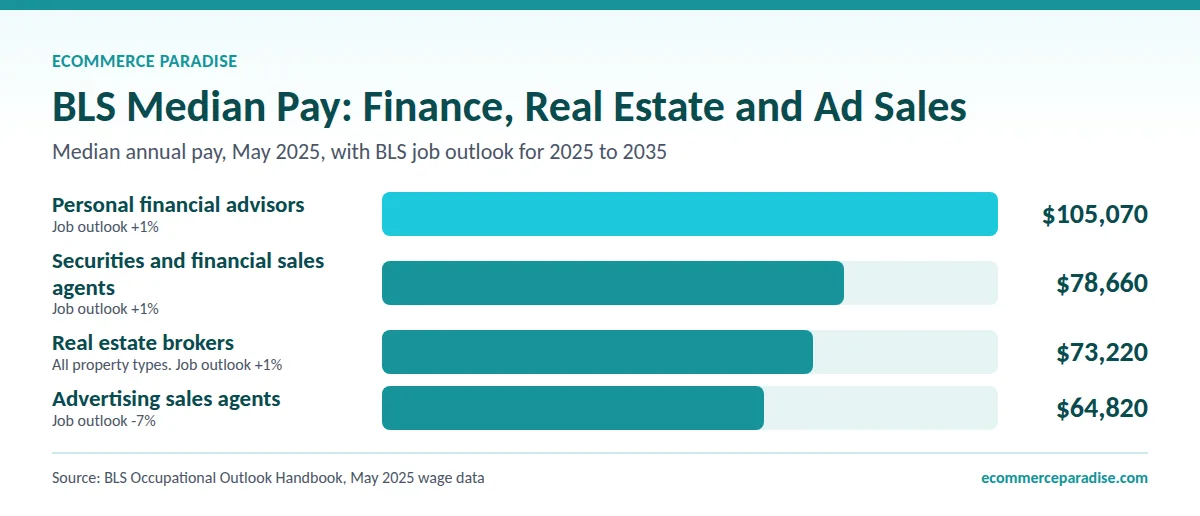
Income range: $80,000 early, $300,000 to $1M+ established. Typical deal size: $500,000 to $50M+ AUM. Sales cycle: 6 to 24 months. Growth path: Junior Advisor, Associate, Senior Advisor, Partner or RIA Principal.
Pros
- $200K-$2M+ on $10M+ assets under management
- Recurring revenue from AUM keeps compounding
- High-status career with influence and impact
- Long-term relationships compound your book
Cons
- Heavy licensing (Series 7, 65, 66, CFP) required
- Strict regulatory and compliance environment
- Long ramp before consistent income arrives
- Older clientele can mean attrition risk over time
7. Luxury Sales (Automotive, Yachts, Private Aviation)
Luxury sales professionals sell ultra-premium products: Rolls-Royce and Bentley vehicles ($300,000 to $600,000+), superyachts ($2 million to $500 million+), private aircraft ($3 million to $90 million+), and luxury real estate to a small market of high-net-worth buyers. Commission per deal is substantial, and the selling environment is unlike anything in mainstream retail.
This field rewards different skills than most other sales categories. Product knowledge, personal presentation, discretion, and genuine rapport with affluent buyers matter more than formal sales process. Buyers at this level are often relationship-driven: they buy from people they trust, enjoy spending time with, and respect, not from the most technically proficient closer in the room. Income is less predictable than SaaS or financial services due to low deal frequency, but individual transactions can generate $30,000 to $200,000 or more in commission. Top yacht and aviation brokers are among the highest-paid salespeople in the world.
Income range: $80,000 to $500,000+ (highly variable). Typical deal size: $300,000 to $100M+. Sales cycle: 3 to 24 months. Growth path: Sales Associate, Senior Consultant, Principal Broker.
Pros
- $10K-$500K+ commissions on a single sale
- Affluent clientele who know what they want
- Lifestyle perks (test drives, yacht demos) come with the job
- Repeat buyers and referrals build your book
Cons
- Foot traffic is fickle and depends on the economy
- Inventory and dealership politics limit flexibility
- Long courting cycles before each big sale
- Competitive market with limited inventory
8. B2B Marketing and Agency Services Sales
Business development representatives and account executives at marketing agencies, SEO firms, and B2B service companies sell retainer engagements, project contracts, and long-term service agreements to businesses. Deal sizes range from $2,000 per month retainers to $500,000 and above for enterprise-level accounts. This category is worth highlighting as one of the more accessible on-ramps to high-ticket selling, with many firms willing to hire and train strong communicators without deep technical backgrounds.
The skills this role develops, including consultative selling, diagnosing business problems, and presenting ROI-based solutions, are highly transferable. Experienced B2B services salespeople who build strong networks often transition into independent consulting, launching their own agencies, or business development leadership roles at larger firms. Tools like HubSpot CRM are standard infrastructure in this space and worth knowing well.
If you plan to sell SEO or marketing retainers, you will be taken more seriously when you can read a keyword report, so spend a weekend inside Semrush. KWFinder is a lighter option if all you need is keyword research.
Income range: $70,000 to $180,000+ base plus commission. Typical deal size: $24,000 to $500,000+ annual contract value. Sales cycle: 1 to 6 months. Growth path: BDR, Account Executive, Sales Director, VP Business Development.
Pros
- Recurring revenue from retainer agreements
- High margins on $5K-$50K+ monthly contracts
- Agency owners hire commission-only closers
- Skills transfer to building your own agency
Cons
- Client churn risk on month-to-month retainers
- Performance pressure with quick “fire” cycles
- Agency reputation impacts your closing ability
- Often requires generating your own leads
Curious what the ecommerce version of this looks like? The free High-Ticket Dropshipping Mini Course → walks you through the whole business model in under an hour. It’s the fastest way to see whether this is the right next step for someone with your sales background.
9. Cybersecurity and IT Solutions Sales
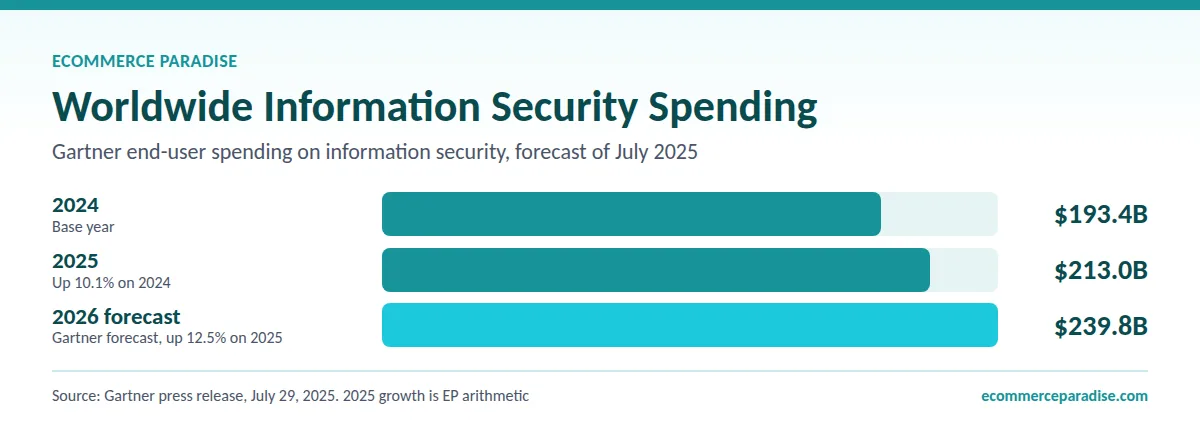
Cybersecurity sales is one of the fastest-growing areas in enterprise selling. According to Gartner’s July 2025 security forecast, worldwide end-user spending on information security is projected to reach about $240 billion in 2026, up from about $213 billion in 2025. Reps who sell endpoint security, threat intelligence platforms, identity management, and enterprise security infrastructure operate in a market characterized by large budgets and high urgency, a powerful combination for commission-based sellers.
Buyers in this space purchase because the cost of not buying is existential: a single breach can cost tens of millions of dollars and permanently damage brand trust. That urgency shortens sales cycles and reduces price sensitivity in a way that’s unusual even among high-ticket categories. Security AEs at companies like Palo Alto Networks, CrowdStrike, and Fortinet routinely earn $200,000 to $350,000 OTE and above.
You do not need to be an engineer, but you cannot fake the vocabulary either. A Security+ prep course or a threat-landscape fundamentals track on Udemy costs less than a tank of gas and gets you far enough to hold your own in a discovery call with a CISO. That is genuinely the difference between getting a callback and getting screened out.
Income range: $150,000 to $350,000+ OTE. Typical deal size: $50,000 to $5M+. Sales cycle: 3 to 12 months. Growth path: SDR, AE, Senior AE, Enterprise AE, Sales Leadership.
Pros
- $200K-$1M+ OTE on Fortune 500 enterprise deals
- Recession-proof category, cyber spending only grows
- Technical product knowledge commands respect
- Lucrative bonuses for hitting quota
Cons
- Highly technical, requires real understanding of threats
- Long enterprise sales cycles (9-18 months)
- Heavy quota pressure with cliff timing
- Constant learning to keep up with the landscape
10. Private Education and Executive Training Sales
Executive education programs at business schools, professional training organizations, and premium online education companies sell learning experiences to individuals and corporations. Products include MBA-equivalent certifications ($10,000 to $50,000), executive leadership programs ($5,000 to $30,000), and corporate training contracts ($50,000 to $500,000+). The corporate sales angle is particularly strong: companies with training budgets purchase seats and cohort programs in bulk, and relationships with L&D departments can produce recurring six-figure contracts annually.
This role is also a natural fit for people who want to stay close to the learning and development world. If you’re someone who believes in investing in skills and professional growth, platforms like Coursera are worth exploring both as a learning resource for your own career development and as a category that employs strong consultative sales professionals.
Income range: $70,000 to $180,000+. Typical deal size: $5,000 to $500,000+. Sales cycle: 1 to 12 months. Growth path: Program Advisor, Senior Advisor, Corporate Sales Manager, Director.
Pros
- $5K-$50K+ commissions on a single program enrollment
- Corporate budgets fund executive coaching and training
- Repeat clients drive 60%+ of revenue once established
- High prestige working with C-suite buyers
Cons
- Slower than transactional sales, relationship-driven
- Often requires significant pre-sales relationship building
- Smaller market means fewer total prospects
- Cycles depend on corporate L&D budget approval
How to Break Into High-Ticket Sales
Getting your first high-ticket sales role is the hardest step, not because the skills required are out of reach, but because hiring managers in these fields lean heavily on track records and everyone entering the field is competing without one. Here’s how to build toward one strategically.
Start adjacent, not at the top. Most successful enterprise and high-ticket sales reps didn’t start there. They started as SDRs (Sales Development Representatives), BDRs (Business Development Representatives), or inside sales reps at mid-market companies, built their skills and metrics, and moved up. One to two years in a role where you’re developing pipeline, running discovery calls, and learning to handle objections is the fastest legitimate path to an AE or closer position. Don’t skip the ramp; use it.
Invest seriously in sales education. The fundamentals of consultative selling are documented and learnable. SPIN Selling by Neil Rackham, The Challenger Sale by Dixon and Adamson, and Never Split the Difference by Chris Voss for negotiation are the canonical texts. Check Kindle Unlimited for these and similar titles (the catalog rotates, so confirm a book is included before you count on it), which is how I’d approach building your sales library without spending $400 on books upfront. If you are comparing structured programs, use my guide to the best high-ticket sales courses before you commit. Certifications from HubSpot Academy, Sandler, and similar organizations are also valued by employers and demonstrate initiative in a competitive applicant pool.
Develop genuine expertise in your target industry. The best high-ticket sales reps are not generalists. They understand their buyer’s world: the terminology, the pain points, the organizational dynamics, the competitive landscape. If you’re pursuing medical device sales, learn the clinical environment. If you’re pursuing enterprise SaaS, learn how companies evaluate and procure technology. Formal courses on Coursera can accelerate this significantly, particularly for technical categories like cybersecurity, healthcare technology, and financial products.
Record and review your own calls. This is the single highest-leverage habit I can give you and almost nobody does it. Run your calls through Otter.ai, then go back and read the transcript looking for the moments you talked over the prospect, skipped a discovery question, or jumped to pitching too early. Two weeks of that will teach you more than any course, because you are studying your own actual failures instead of somebody else’s theory. Paste the transcript into Claude and ask where you skipped a discovery question.
Build your professional presence deliberately. High-ticket buyers and hiring managers both research the people they work with. A LinkedIn profile that positions you as a knowledgeable professional in your target industry, with thoughtful posts, documented results, and endorsements from colleagues, significantly improves inbound opportunities and recruiter response rates. This is especially true in financial services, where personal brand and network are disproportionately important.
Target your first role strategically. Some categories are more accessible than others for first-time high-ticket reps. B2B marketing agency sales, high-ticket closer roles, and inside sales positions at SaaS companies are generally the most accessible on-ramps because they hire for potential and train for skills. Commercial real estate, medical device sales, and financial services all have longer ramp times and higher upfront expectations.
Track and document your metrics obsessively. Once you’re in a sales role, track your performance: close rate, pipeline generated, average deal size, quota attainment, ramp time. These numbers are your credibility for your next move. A rep who can say “I closed 110 percent of quota for six consecutive quarters and grew my book of business by 40 percent” has a completely different job search than one who can only say “I worked in sales for two years.”
Not sure whether to chase the next sales role or build your own thing? That’s exactly the conversation I have on private coaching calls →, where we map the shortest path from your specific sales background to a business you actually own.
From Sales Professional to Ecommerce Entrepreneur
One of the more interesting patterns I’ve observed over the years is how naturally experienced high-ticket sales professionals transition into ecommerce entrepreneurship. The skills transfer in ways that aren’t immediately obvious until you’ve seen it happen repeatedly.
The consultative selling skills that make you effective in enterprise SaaS or commercial real estate are exactly what high-ticket dropshipping requires on the customer side. High-ticket products ($500 to $10,000+ items like outdoor equipment, furniture, specialty machinery, and home improvement products) require customers to feel understood and served rather than sold to. The phone and email support dynamics of a high-ticket ecommerce store are closer to what a commercial real estate broker does than what a consumer retail associate does. My complete guide to high-ticket dropshipping covers the model in detail if you’re curious about what that transition looks like in practice.
The product and niche selection side of ecommerce also benefits from sales experience. Understanding how buyers think, what motivates purchase decisions, and how to evaluate market demand is exactly what a high-ticket sales background develops. The high-ticket niches list covers the product categories where I’ve seen the best margins and supplier relationships, and the pattern recognition from sales experience helps enormously in evaluating which ones are worth pursuing.
The operational lift is smaller than most people assume. You need a store, and Shopify handles that for around $39 a month on a free theme like Dawn. You do not need inventory, a warehouse, or staff on day one. What you need is the ability to get a supplier to approve you and the ability to talk a $4,000 buyer through a purchase decision, and you already have the second one. If you want to upgrade the design later, Empire is the paid theme I recommend.
If you’re at the point where you’re considering building your own operation, the business formation checklist covers every legal and financial foundation step before you take your first order. For the LLC itself I use and recommend Northwest Registered Agent, because they put their own address on your public filings instead of your home address, which matters a lot once suppliers and customers start looking you up.
Supplier approval is the one genuinely hard part, and it is also where sales professionals have an unfair advantage. Getting a brand-name manufacturer to authorize you as a dealer is a B2B sale, not a form submission. The supplier sourcing guide covers exactly how to run that process, and if you have spent two years closing enterprise deals you will find it easier than most people do.
Supplier outreach is cold email, and it is the part of this business where a sales background pays off fastest. A tool like GMass lets you send those emails from Gmail, set up follow-ups, and watch for replies.
My Starter Stack for Sales Pros Going Ecommerce
This is the stack I set up for clients and recommend to beginners, in roughly the order you will need it. You do not need every row on day one.
| Job | Tool | Why it matters |
|---|---|---|
| LLC and registered agent | Northwest Registered Agent | My top pick for forming the business |
| Business mailing address | Anytime Mailbox | A virtual mailbox so supplier paperwork does not go to your house |
| Business banking | Mercury | Keeps store money separate from your personal account |
| Domain name | Namecheap | Register your store domain |
| Professional email | Google Workspace | Supplier reps take you more seriously from a branded address |
| Store platform | Shopify | The store itself, as covered above |
| AI help | Claude | Drafting supplier emails and product copy |
| Supplier outreach emails | GMass | Cold email from Gmail with follow-ups, which is the same skill you already have |
| Email marketing | Klaviyo | My core pick for flows and campaigns. Omnisend is the alternative |
| Live chat | Tidio | Answer a $4,000 buyer fast, with a chatbot as backup |
| Product reviews | Judge.me | Social proof on product pages |
| Keyword research | KWFinder | Find what buyers search before you pick a niche |
| SEO research | Semrush | Competitor and search research as you grow |
| Bookkeeping | Finaloop | Books done for you once orders start |
| Hiring help | OnlineJobs.ph | Find virtual assistants for listings and support |
Want the store built for you so you can go straight to selling? The done-for-you turnkey store service → delivers a complete high-ticket dropshipping operation in 60 days: niche research, supplier approvals, store build, and product catalog, ready for you to run.
Frequently Asked Questions
What are high-ticket sales jobs?
Most definitions center on deal size rather than product type. Sales roles where individual transactions are worth $3,000 or more are broadly considered high-ticket. Some practitioners set the threshold higher at $10,000 or $25,000 per deal to emphasize the consultative nature of the selling process and the magnitude of the commission opportunity. What matters more than a specific number is whether the role rewards consultative expertise, involves sophisticated buyers, and generates substantial per-close income.
Do I need a degree to get into high-ticket sales?
Degrees are not universally required, but some categories do expect them. Medical device sales and financial services almost always require a bachelor’s degree as a baseline credential. Enterprise SaaS hiring varies: many companies prioritize demonstrated sales performance and relevant experience over educational background. High-ticket closer roles and B2B agency sales are the most accessible without degrees, hiring primarily based on communication skills, work ethic, and trainability.
How long does it take to earn six figures in high-ticket sales?
In SaaS and B2B services, motivated reps who join the right company and perform well can reach $100,000 and above in total compensation within 1 to 3 years. In commercial real estate and financial services, where income builds on accumulated relationships and assets under management, the timeline is typically 3 to 7 years before consistently earning six figures. High-ticket closer roles are the fastest path: top closers with strong skills can reach that income level within 12 to 18 months in the right program.
Is high-ticket sales stressful?
Yes, but differently from high-volume sales. The primary stressors are deal uncertainty (large deals can take months to close and can fall apart late in the process), performance pressure around quota, and the emotional weight of complex negotiations. The absence of 50 cold calls a day is a significant quality-of-life improvement for many reps coming from volume-based environments. The stress profile is different, fewer but higher-stakes interactions, rather than simply more or less stressful overall.
Can high-ticket sales be done remotely?
Increasingly yes. Enterprise SaaS roles went predominantly remote or hybrid after 2020 and have largely stayed that way, and high-ticket coaching closers almost always work remotely. If you plan to take calls from outside the US, run your connection through a VPN like Surfshark so your CRM and dialer logins don’t get flagged for logging in from a new country every week. Financial services, medical device sales, commercial real estate, and luxury sales all still involve significant in-person client contact, so the category you’re in determines remote viability substantially. If you will be abroad for months at a time, price out travel health insurance like SafetyWing before you go.
What’s the difference between high-ticket sales and high-ticket dropshipping?
High-ticket sales refers to working as a sales professional earning commission to sell products or services for an employer or client. High-ticket dropshipping refers to running your own ecommerce business that sells expensive products, typically $500 to $10,000 and above, through direct brand partnerships without holding inventory. Both involve large deal values and consultative customer interaction, but one is a career and one is a business. The High-Ticket Dropshipping Masterclass covers the business side end to end if you want to see what running your own operation actually involves. If you want the overview first, read my free guide to how high-ticket dropshipping works.
What sales skills matter most in high-ticket roles?
Discovery is the most important skill by a significant margin. The ability to ask the right questions, listen genuinely, and understand what a buyer actually needs before presenting a solution separates trusted advisors from transactional reps. After discovery, objection handling (not overcoming objections by force, but genuinely addressing the underlying concern) and the ability to manage complex multi-stakeholder decision processes are what define high-ticket performance at the senior level. These skills are all learnable through deliberate practice, and resources on Kindle Unlimited cover the frameworks in depth.
Should I stay in sales or start my own high-ticket store?
You do not have to choose immediately, and most people I work with don’t. A high-ticket sales job pays the bills and sharpens the exact skills a store requires, which makes it a reasonable place to build from while you get a store off the ground on the side. The honest trade-off is that a job pays you today and caps what you own, while a store pays you nothing for the first few months and then keeps paying after you stop working on it daily. Joining the Ecommerce Paradise Academy is the cheapest way to watch how other people are running that transition before you commit to it yourself.
What is the typical high-ticket sales salary?
It depends on the category. Enterprise SaaS roles run about $120K to $350K+ in on-target earnings, cybersecurity sales $150K to $350K+, medical device sales $120K to $250K+, and B2B agency or executive education sales $70K to $180K+. Top high-ticket closers can earn $5K to $30K+ per month.
High-Ticket Selling Rewards the Same Things Whether You’re an Employee or an Entrepreneur
High-ticket sales is one of the most financially rewarding career paths available, but it isn’t one path. It’s a set of parallel tracks with different skill requirements, ramp times, income trajectories, and lifestyle implications. Enterprise SaaS offers the highest income ceiling with the most structured career progression. Commercial real estate and financial services build slowly but create compounding wealth. Medical device sales combines stability with strong compensation. High-ticket closer roles offer the fastest income potential with the most variability.
The common thread is that all of them reward the same core skills: genuine curiosity about your buyer’s world, patience with complex processes, the ability to build trust quickly, and the discipline to follow through when deals go quiet. Those skills are learnable and transferable, and once developed, they create career optionality across virtually every high-ticket category and into business ownership as well.
If you’re at the intersection of sales expertise and curiosity about building something of your own, that’s exactly the profile that tends to do well in high-ticket dropshipping. The customer relationships, the supplier negotiations, the brand positioning: all of it runs on the same consultative instincts that make great salespeople great. High-ticket selling rewards expertise and trust, whether you’re an employee closing deals or an entrepreneur building a business around products worth owning.
The people making this move are already inside. Join the Ecommerce Paradise Academy → for the full course library, niche and supplier research from members actually building stores, and direct access to me. Free for 7 days, then $9/month or $49/year.
If you want additional support, we offer services and community to help you succeed.
Ecommerce Paradise Academy: Our Skool community with the full course library covering launching, scaling, and selling a high-ticket store, plus live discussions and real feedback. Free for 7 days. Membership is $9/month or $49/year on Skool.
High-Ticket Dropshipping Masterclass: The complete step-by-step training on niche selection, supplier approval, store build, and paid traffic.
Turnkey Dropshipping Stores: We build your complete high-ticket store from scratch so you can skip the technical setup and focus on operations.
Private Coaching: One-on-one guidance tailored to your business goals and challenges.
Google Shopping Ads Management: We run and optimize your Google Shopping campaigns so you get real traffic from buyers ready to purchase.
Scaling Services: Already have a store? We help you scale operations, optimize conversions, and grow revenue to the next level.
Free High-Ticket Niches List: 250+ profitable product categories with strong margins and real supplier access, free to download.
Related Articles
If you found this useful, these guides go deeper on related topics:
- Highest Paying B2B Sales Jobs: Top 10 Roles and Real OTE Ranges
- Best High-Ticket Sales Courses: Top Programs to Close Bigger Deals
- Best High-Ticket Sales Books: Close Bigger Deals With Confidence
- Best High-Ticket Affiliate Programs: Top Programs With Real Commissions
- High-Ticket Niches List: 250+ Profitable Product Categories
This article was written by Trevor Fenner, founder of Ecommerce Paradise. Trevor has been selling online since 2005 (20+ years), has run his own stores since 2010, and started Ecommerce Paradise in 2015, helping entrepreneurs build profitable online businesses. For questions, reach out at trevor@ecommerceparadise.com.

Trevor Fenner is an ecommerce entrepreneur and the founder of Ecommerce Paradise, a platform focused on helping entrepreneurs build and scale profitable high-ticket ecommerce and dropshipping businesses. With over a decade of hands-on experience, Trevor specializes in high-ticket dropshipping strategy, niche and product selection, supplier recruiting and onboarding, Google & Bing Shopping ads, ecommerce SEO, and systems-driven automation and scaling. Through Ecommerce Paradise, he provides free education via in-depth guides like How to Start High-Ticket Dropshipping, advanced training through the High-Ticket Dropshipping Masterclass, and fully done-for-you turnkey ecommerce services for entrepreneurs who want a faster, more hands-off path to growth. Trevor is known for emphasizing sustainable, real-world ecommerce models over hype-driven tactics, helping store owners build scalable, sellable, and location-independent brands.


