

If you have built a Shopify store worth real money, deciding where to sell a Shopify store like that is one of the most important financial decisions you will ever make. I have built, scaled, and sold multiple ecommerce businesses over the last 15 years, including a three-store package that did $7 million a year in gross revenue, and I can tell you the platform you choose changes your final number more than almost anything else you do in the sale process. Pick wrong and you leave six figures on the table. Pick right and the same business sells for dramatically more with far less stress.
This guide breaks down exactly where to sell your Shopify store in 2026, ranked by your store size, revenue, and how much support you want. It is written from the perspective of someone who has actually been on both sides of these deals, not a generic affiliate roundup. At Ecommerce Paradise I teach people the high-ticket dropshipping model specifically because it builds businesses that sell at premium multiples, so the exit is something I think about constantly when I help people build.
By the end you will know which marketplace or broker fits your situation, what your store is realistically worth, and the specific steps to take before you list so you maximize your payout.
List Your Store In Front of 1.9 Million+ Registered Buyers
Flippa describes itself as the world’s largest platform for online businesses, with optional broker and M&A support and published fees. Its broker-led service covers businesses from $100K to $50M+.
Quick Comparison: Where to Sell Your Shopify Store in 2026
Here is the fast version. The detailed breakdown of each platform follows below, but this table gives you the lay of the land before we get into it.
| Platform | Best Deal Size | Fee Structure | Support Level | Best For |
|---|---|---|---|---|
| Empire Flippers | From $24K net profit | Blended, 15% down to 2.5% | Full service | Established, profitable stores wanting curation |
| Flippa | $100K-$50M+ (broker-led) | Upfront fee + 5-10% | Marketplace + optional broker/M&A | Serious sellers and investors wanting reach plus expert support |
| Quiet Light | $500K-$20M | Not published | Full service | Founder-operated DTC brands |
| Website Closers | $5M-$50M+ | Success-based, not published | White glove | Large exits, institutional buyers |
| Ecomswap | $500K-$20M | Success fee, rate not published | Dedicated M&A team | Fast, confidential DTC sales |
| BizBuySell | Any size | Listing fee, no commission | Self-service | Hybrid online plus physical businesses |
| Acquire.com | Varies | 6-8% closing fee + monthly listing fee | Advisory for SaaS with $100K+ revenue | Tech-forward ecommerce and SaaS hybrids |
What Happened to the Shopify Exchange Marketplace?
If you have been researching this for a while, you have probably run into references to the Shopify Exchange Marketplace. Here is what you need to know: Shopify Exchange shut down on November 1, 2022. It is gone, so do not waste time looking for it.
For about five years it was Shopify’s official platform for buying and selling stores, and it pulled data straight from Shopify so listings had verified metrics. The problem, according to critics such as Empire Flippers, was overvalued listings and misleading profit figures. Quiet Light reports that Shopify said at the time it was recommending merchants use other marketplaces for buying or selling their commerce brands, and you can follow Shopify’s own announcements on the official Shopify blog.
The silver lining is that the established brokers and marketplaces that absorbed that demand are honestly far better than Exchange ever was. You have more buyers, better vetting, and real deal support now. So losing Exchange was a net win for sellers.
The 7 Best Places to Sell Your Shopify Store in 2026
I have ranked these by overall quality and fit, not just by who pays the biggest affiliate commission. Each one serves a different type of seller, so read the “best for” line carefully because matching your store to the right platform is the single biggest lever you control. For an even deeper breakdown of the full-service broker landscape specifically, I went into more detail in my guide to the best ecommerce business brokers in 2026.
1. Empire Flippers, Best for Established Profitable Stores (From $24K Net Profit)
Empire Flippers is the gold standard for selling profitable, established ecommerce businesses. They are a curated marketplace with strict vetting, verified buyers, and comprehensive seller support, and their public scoreboard shows over $606 million in sales across 2,679 listings sold as of October 2026. That page also shows $15.98 billion in total verified liquidity and 325K buyers and sellers combined, which is the kind of demand that helps deals get done.
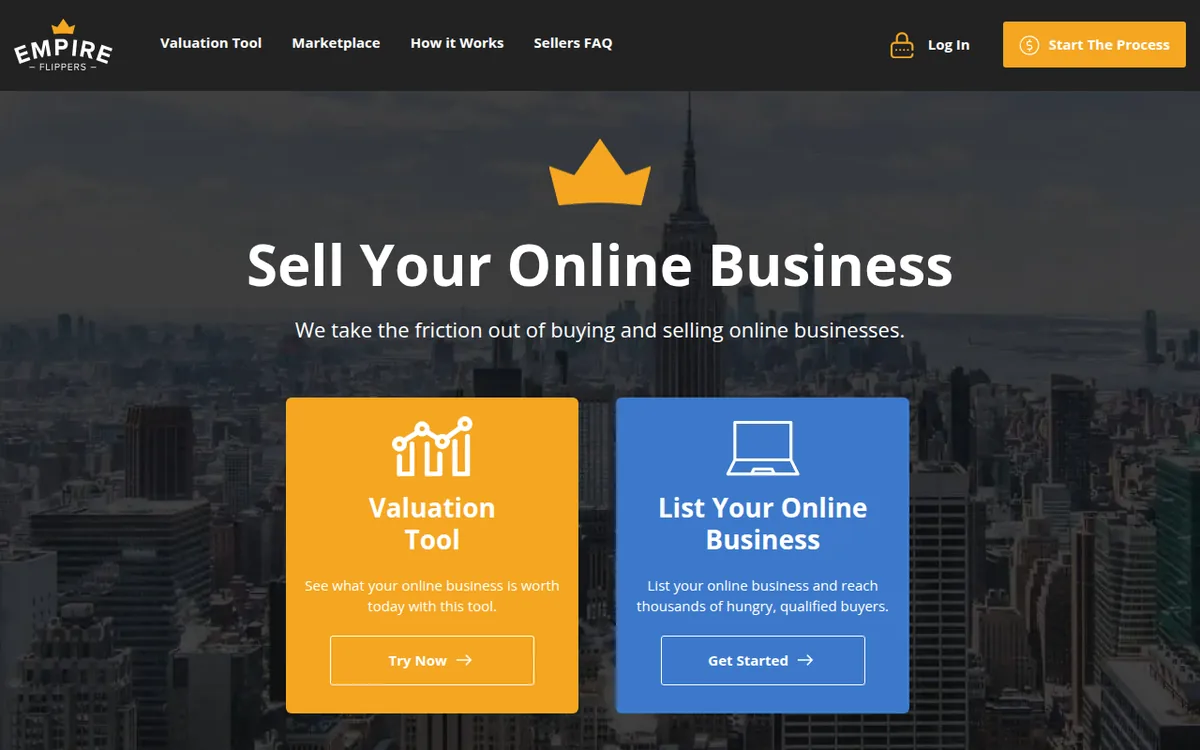
Their commission is blended, so the rates stack: a flat $10,000 up to a $66,666 sale price, 15 percent of the sale price from there to $700K, 8 percent on the portion between $700K and $5 million, and 2.5 percent on the portion above $5 million. On a $1 million sale that works out to $129,000, or 12.9 percent. The trade-off is that strict vetting means not every store qualifies: you need at least $24,000 a year in net profit and a 12-month track record, listings are exclusive for 2 months, and their page shows an average time to sale of 130 days. But if you pass their review, you are presenting to some of the most serious, well-capitalized buyers in the market, and their migration support through closing is genuinely comprehensive. For a first-time seller, that hand-holding is worth real money.
Try the Empire Flippers Valuation Tool
Over $606 million sold across 2,679 listings, with $15.98 billion in verified liquidity on their scoreboard. See what your online business is worth today with their valuation tool.
2. Flippa, Best Marketplace for Serious Sellers and Investors ($100K-$50M+)
Flippa describes itself as the world’s largest platform for online businesses, connecting founders with a global network of qualified buyers, investors, brokers, and M&A professionals. A lot of people still think of Flippa as the place for tiny starter sites, but that reputation is out of date. The platform has evolved into a leading destination for serious deals, with a broker-led service for businesses from $100K to $50M-plus and a deep bench of acquirers actively hunting for established Shopify and DTC brands. I went deep on exactly how it works in my full Flippa review for 2026 if you want the complete breakdown.
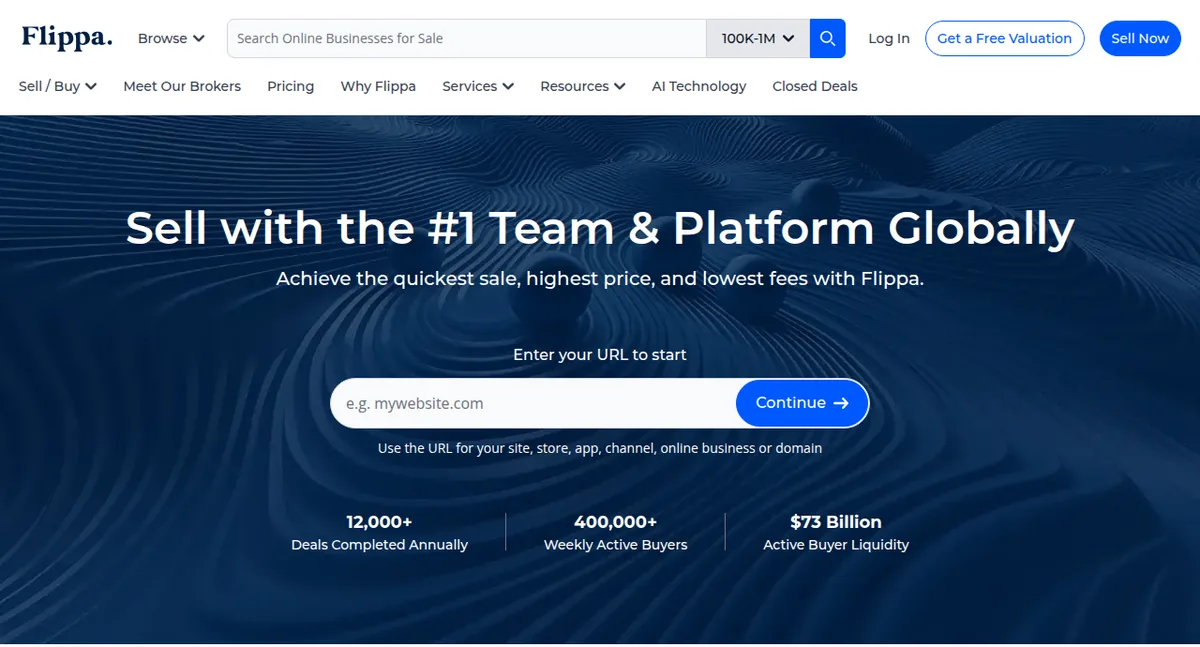
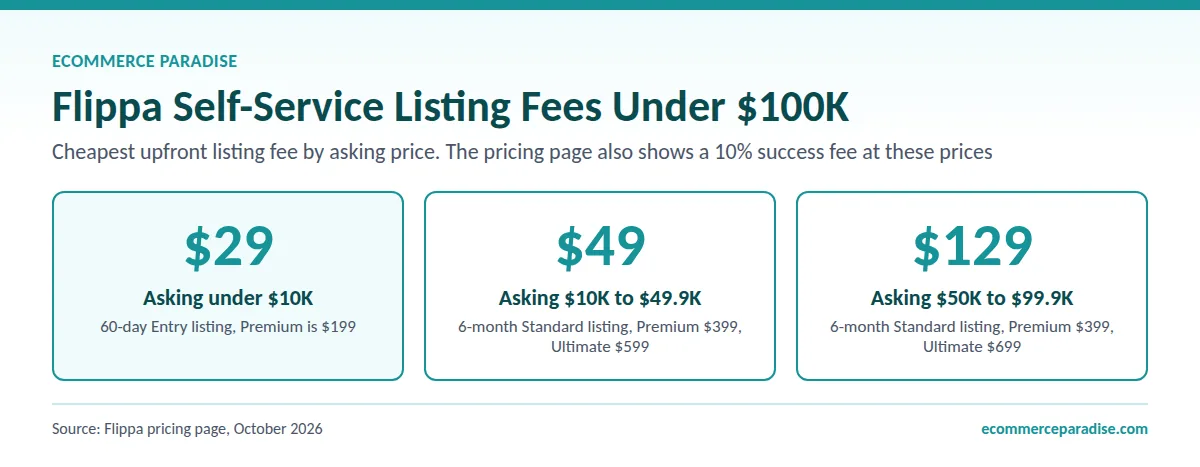
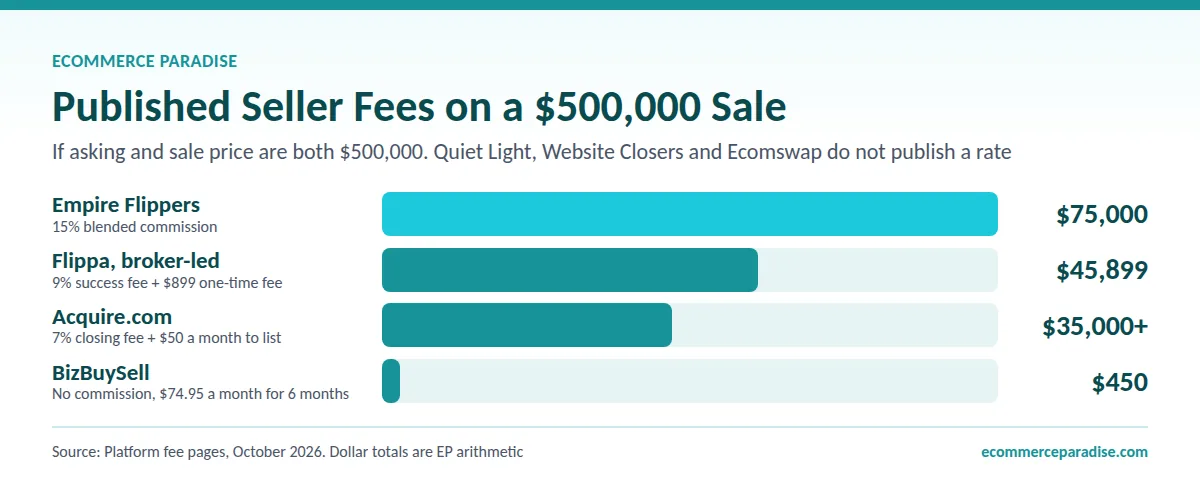
What makes Flippa stand out now is the combination of marketplace scale and expert support. You get exposure to over 1.9 million registered buyers worldwide, according to its pricing page, including private equity, aggregators, and portfolio investors, and you also get access to experienced brokers and M&A advisors who guide valuation, buyer negotiations, due diligence, and deal structuring. The fee structure is published as of October 2026: an upfront fee plus a success fee that runs from 10 percent at lower asking prices down to 5 percent at $50 million and above, which is 9 percent on a $500K sale. Compare that with the 15 percent blended commission Empire Flippers lists at the same price, and the gap can be tens of thousands of dollars on a mid-six-figure exit, though the services you get are not identical.
The honest trade-off is that with a marketplace this large, a strong, well-prepared listing is what stands out, and sellers choose their own level of support from self-directed all the way to fully broker-assisted. For sellers and investors targeting serious deals, that flexibility is the whole point: you get massive buyer demand plus optional expert help at published fees. Self-service listings start at $29 for asking prices under $10K.
Reach More Buyers, Keep More of Your Sale Price
Flippa pairs a large buyer pool with optional broker and M&A advisory, with an upfront fee plus a 5% to 10% success fee depending on asking price.
3. Quiet Light, Best for Mid-Market Founder-Operated Businesses ($500K-$20M)
What makes Quiet Light different is that every advisor has personally bought, sold, or built their own online businesses. They are not salespeople reading off a script. They understand the emotional side of exiting something you built, the operational details buyers dig into during due diligence, and how to tell a founder-operated brand’s story in a way that commands a premium. Their site says they have sold over 750 online businesses for more than $500 million in total transaction value since 2006, with 47 percent of listings selling at or above asking and 85 percent selling within 90 days, which is fast for full service.
Quiet Light does not publish its commission rates, so ask for the fee schedule up front. Their sell page describes a 90-day agreement that you can end at any time, and they are selective about what they take, but that selectivity works in your favor because their listings do not get buried in a sea of mediocre businesses. For a founder-built Shopify or DTC brand in the $1 to $5 million range, this is often the best fit available.
4. Website Closers, Best for Large Exits ($5M-$50M+)
Website Closers operates at the high end. With a team that has been doing M&A since 1998 and $2.23 billion in transactions represented per their own site, they have the institutional buyer relationships and complex deal experience that large ecommerce exits require. At this level your buyers are aggregators, private equity firms, family offices, and strategic acquirers writing eight-figure checks, and the due diligence can run 6 to 12 months. They have in-house attorneys and accountants to manage that complexity without outsourcing the critical pieces. They say their fees are 100 percent success-based and paid only when they close, with no percentage published.
If your store does $5 million or more in revenue and you are thinking about an exit, this is the tier of brokerage you need. They are less suited to smaller deals where boutique brokers give more personal attention, so be honest about where your business actually sits.
5. Ecomswap, Best for Fast, Confidential DTC Brand Sales ($500K+)
Ecomswap is a newer M&A advisory focused on Shopify, Amazon and DTC brands, connecting sellers with a private network of buyers (its site is ecomswap.io). The pitch is a confidential, advisor-led process with several buyers bidding at once, and it says there are no upfront deal fees or retainers, just a success fee agreed before it starts. The trade-off is that it is newer with less public track record than the established players, it does not publish its fee percentage, and its FAQ says it works with businesses making at least $500K a year in net profit, so check the fit first. For a DTC brand owner who values a quiet, quick process, it is worth a conversation.
6. BizBuySell, Best for Hybrid Online Plus Brick-and-Mortar
BizBuySell is the largest business-for-sale marketplace overall, traditionally focused on brick-and-mortar but increasingly featuring online stores. If your Shopify business has a physical component, a retail location, a warehouse you own, offline POS revenue, BizBuySell attracts buyers who understand and want hybrid models. It is self-service with minimal seller support and it assumes you bring your own broker or attorney, so go in knowing you are driving the process. Per its listing FAQ as of October 2026, listings run $74.95 a month for Basic, $99.95 for Showcase and $199.95 for Diamond on a 6-month term, and BizBuySell says it charges advertising fees only, with no commission on a sale.
7. Acquire.com, Best for Tech-Forward Ecommerce and SaaS Hybrids
Acquire.com: Acquire focuses on startups and tech-enabled businesses, including Shopify stores with software components or subscription models. If your business has a tech angle, a Shopify app you built, proprietary software, a subscription engine, this is where the right buyer demographic hangs out. They say they reach 500K+ buyers, charge a 6 to 8 percent closing fee plus a $25 to $100 monthly listing fee depending on asking price, and offer an M&A advisory program for SaaS startups with at least $100K in trailing revenue. It is less ideal for a pure traditional ecommerce store with no tech element. If you are weighing this against an Amazon-based exit, my breakdown of how Amazon FBA works is a useful companion read on how those businesses get valued differently.
How to Choose the Right Platform for Your Situation
Platform selection starts with deal size because that determines who will take your business seriously. For stores under $100K, Flippa and BizBuySell are the realistic options, with cost-effective fee structures and the flexibility to manage as much or as little of the process as you want. In the $100K to $500K range, Flippa and Empire Flippers both make sense, Empire if you have strong margins and want curation, Flippa for maximum buyer exposure plus optional broker support.
For stores in the $500K to $5M range, this is where expert deal support really moves the final number. Flippa, Empire Flippers, Quiet Light, and Ecomswap all deliver strong outcomes here. Flippa describes itself as pairing the world’s largest buyer pool with broker and M&A advisory, and its published fees fall as the asking price rises. On a $500K sale, the published fees I could find range from $75,000 at Empire Flippers to $45,899 on Flippa’s broker-led plan, and Quiet Light, Website Closers and Ecomswap do not publish rates. Above $5 million you want institutional buyer access and experienced advisors: Flippa broker-assisted, Website Closers, or upper-tier Quiet Light deals.
Beyond size, think about how much support you want. If you want the broadest possible reach with flexible support levels, the large marketplaces win. If you want someone holding your hand through every step, full-service brokers or Flippa’s broker-assisted track are the move, and that is especially true for first-time sellers or busy operators who do not have 200-plus hours to run a sale process themselves.
How to Value Your Shopify Store Before Listing
Pricing is where most sellers get it wrong in both directions. Too high and serious buyers never even inquire. Too low and you are literally giving away money you earned. Most Shopify stores sell on a multiple of Seller’s Discretionary Earnings, which is your net profit plus owner compensation plus discretionary and one-time expenses added back in.
Typical multiples vary by business type. Dropshipping stores tend to sell at 1.5 to 2.5 times SDE. Inventory-based stores run 2 to 3 times. Branded DTC stores command 2.5 to 4 times. Subscription businesses and stores with proprietary products can hit 3 to 5 times. So a store with $205,000 in SDE at a 3x multiple is worth around $615,000, but that same store at a 2x multiple is only $410,000. The multiple is everything, and the multiple is something you can actually influence.
What pushes your multiple up: strong brand recognition, proprietary or exclusive products, recurring revenue, diversified traffic instead of 90 percent paid ads, an engaged email list, documented systems, a stable or growing revenue trend, and clean books. What drags it down: a pure commodity dropshipping model, single-channel traffic dependence, declining revenue, no brand equity, and disorganized financials. For broader market context on where ecommerce valuations sit, the U.S. Census Bureau ecommerce data is a solid reference for the macro trends buyers price in.
Want to understand which niches and models command the highest exit multiples? Check the Ecommerce Paradise high-ticket niches list →
Preparing Your Store for Sale: What Actually Moves the Number
The highest-leverage work happens 6 to 12 months before you list, not during the sale. The first thing is clean financials. Buyers will scrutinize every number, so you need profit and loss statements going back 12 to 24 months minimum, a balance sheet, bank statements that match your claimed revenue, your Shopify and Google Analytics exports, and ad spend records by platform. I tell people to hire an ecommerce accountant for this, because clean books alone can add 10 to 20 percent to your valuation by removing the ambiguity that makes buyers discount aggressively. For bookkeeping I point clients toward FreshBooks since it keeps the financials organized in a way buyers and brokers can actually verify quickly.
The second thing is documented operations. Standard operating procedures for fulfillment, customer service, supplier communication, inventory, and marketing are not busywork. They are the difference between a buyer thinking they are acquiring a system versus buying themselves a job, and that perception is worth 20 to 30 percent on the multiple. If you do not have a team documenting this, a virtual assistant from OnlineJobs.ph can build out your SOP library affordably before you go to market.
The third thing is diversifying traffic and strengthening weak points. A store where 80 percent of revenue comes from one ad channel is a risk that buyers price down hard. Building organic, email, and content channels in the year before a sale can add 15 to 25 percent to your multiple. On the email side specifically, I recommend readers build their list with Omnisend because an engaged, transferable email asset is something acquirers genuinely pay extra for. And if your store theme looks dated, upgrading to a conversion-focused theme like Superstore before listing improves both your trailing conversion numbers and the buyer’s first impression.
The Selling Process: What to Actually Expect
A broker-facilitated sale typically runs 4 to 8 months across a predictable set of phases. Weeks 1 to 4 are valuation, platform selection, and documentation prep, which is the most time-consuming part and the part most sellers underestimate. Weeks 5 onward you list and start fielding inquiries, and you will get a mix of serious buyers asking detailed operational questions and time-wasters making lowball offers or pushing for contact outside the platform.
Due diligence is the intense stretch, usually weeks 8 to 16, where the buyer verifies every financial claim, reviews your analytics, and checks supplier relationships. Be completely transparent here, because hidden problems always surface and they kill deals and your reputation at the same time. Negotiation and deal structuring follow, where you settle final price and terms, whether that is all cash, an earn-out where part of the payment is tied to future performance, or seller financing. Then funds go into escrow through a service like Escrow.com, assets transfer, and you provide 2 to 4 weeks of transition support. For a deeper grounding in deal terms and what to watch for legally, the U.S. Small Business Administration guide to selling a business is a genuinely useful neutral reference.
Common Mistakes That Cost Sellers Real Money
The most common mistake is overvaluing the business out of emotional attachment. The market sets the price, not the effort you put in, and if you get zero offers in 60 days you are simply overpriced. The second is poor documentation, which makes buyers distrust numbers they cannot verify and either walk or discount hard. The third is hiding problems, which never works because everything comes out in due diligence anyway, so disclose issues upfront and frame the solution.
Selling too early is another one. Buyers want proof of concept, which means at least 12 months of stable operations, ideally 24. Choosing the wrong platform for your size and support needs wastes months. And engaging with unqualified buyers drains the time you should be spending on real ones, which is exactly why platforms with broker support that vet buyers for you are worth it, they filter the noise so you talk to people who can actually close. The deeper foundational work, like proper entity structure and clean compliance, matters too, and the business formation checklist covers the legal and financial groundwork that prevents due diligence surprises from blowing up a deal at closing. If something does go sideways mid-process, my guide to crisis management for high-ticket ecommerce businesses walks through how to keep a deal alive when problems surface.
Why High-Ticket Dropshipping Stores Sell at Premium Multiples
This is the part most people building a store never think about until it is too late. High-ticket dropshipping businesses consistently sell at higher multiples than traditional dropshipping stores, and the reasons are structural, not luck. Higher average order values in the $1,000 to $5,000-plus range, better margins in the 25 to 40 percent territory, more qualified buyers with serious intent, less competition from mass-market sellers, and a relationship-driven phone-sales model that is genuinely harder to replicate. All of that shows up in the multiple a buyer is willing to pay.
Run the numbers. A traditional dropshipping business doing $800K in revenue at a 15 percent margin is $120K profit, and at a 2x multiple that sells for $240K. A high-ticket store doing the same $800K at a 30 percent margin is $240K profit, and at a 3.5x multiple that sells for $840K. Same top-line revenue, $600K more at exit. That gap is the entire reason I teach this specific model. Sourcing the right suppliers is a core part of building that kind of defensible, premium business, and the complete supplier sourcing guide walks through exactly how to build the authorized-dealer relationships that buyers pay up for.
If you are starting from scratch or want to build something engineered for a premium exit from day one rather than cleaning it up right before listing, that is exactly what the done-for-you turnkey store service is built for, and personalized coaching is there if you want guidance applying this to a store you already run.
If you specifically have a high-ticket dropshipping store to sell or want to buy one, I also run a specialized brokerage service built just for this model, since general marketplaces do not always position the supplier relationships and margins that make these stores worth more.
Frequently Asked Questions
How long does it take to sell a Shopify store?
Empire Flippers’ page shows an average of 130 days to sale, and Quiet Light says 85 percent of its listings sell within 90 days. Marketplace platforms can move faster, sometimes 4 to 8 weeks, while traditional full-service broker sales take longer at 4 to 8 months. Platforms like Flippa combine marketplace speed with optional broker support to get strong outcomes efficiently.
What percentage of Shopify stores actually sell?
Success rates are self-reported and each firm defines them differently. Website Closers advertises a 92 percent close rate, and I have not found an independent figure for the whole market. Preparation quality and expert support are the biggest drivers, far more than the platform alone.
Can I sell a store that is not profitable yet?
Yes. Marketplace platforms like Flippa have buyers and investors actively acquiring pre-profit and early-stage stores for their growth potential, audience, or assets. You will generally get stronger valuations with 6-plus months of revenue data, but a well-prepared listing with a clear growth story can still attract serious interest.
Do I need a lawyer to sell my store?
Not always required, but strongly recommended for sales over $500K or any deal with earn-outs or intellectual property. For smaller straightforward deals, broker templates often cover it, but get legal review on anything complex regardless of size.
What is the minimum revenue to work with the top platforms?
Empire Flippers requires at least $24,000 a year in net profit and a 12-month track record, and Quiet Light does not publish a minimum on its sell page. Flippa accepts businesses across the full size range, from starter sites to multi-million dollar exits, which is part of why it works for so many sellers. If you are still learning the fundamentals, the free mini course is a good place to start.
Making the Right Decision for Your Business
Selling your Shopify store is one of the biggest financial events of your entrepreneurial life, so do not rush it. For stores under $100K, start with Flippa or BizBuySell and keep expectations realistic. For $100K to $500K, Empire Flippers or Flippa give you the right balance of reach, support, and cost. For $500K to $5M, Flippa, Quiet Light, Empire Flippers, and Ecomswap all deliver, with Flippa describing itself as pairing the world’s largest buyer pool with broker and M&A advisory. For $5M-plus, work with experienced advisors who handle major transactions regularly.
The single most important thing is preparation. Spend the 4 to 8 weeks getting your financials, operations, and assets in order before you list, because the difference between a well-prepared listing and a rushed one is routinely $50K to $200K-plus in final sale price. That is real money that comes down to work you control.
And if you are reading this while still building rather than selling, the smartest move you can make right now is to build the kind of business that commands a premium when the time comes. That means the high-ticket model, clean systems, real supplier relationships, and a brand buyers want. If you want help getting there, explore the free beginner’s guide to high-ticket dropshipping to learn the fundamentals, or jump straight to the done-for-you store build if you would rather have it built right from day one.
Ready to See What Your Store Is Worth?
Whether you are selling now or building toward an exit, start with a real valuation. Flippa offers a large buyer pool plus optional broker support, and Empire Flippers has an online valuation tool.
I wish you the best of luck with your sale. Prepare properly, pick the platform that matches your situation, and the exit will take care of itself.
Related Articles
If you found this useful, these guides go deeper on related topics:
- Best Ecommerce Business Brokers in 2026: Complete Guide to Selling Your Online Store
- Flippa Review 2026: The Marketplace for Buying and Selling Online Businesses
- What Is High-Ticket Dropshipping: A Comprehensive Guide for Ecommerce Entrepreneurs
- High-Ticket Niches List: Profitable Product Categories
- How to Find the Best Suppliers for High-Ticket Dropshipping
- Business Formation: The Complete Legal and Financial Foundation Checklist

Trevor Fenner is an ecommerce entrepreneur and the founder of Ecommerce Paradise, a platform focused on helping entrepreneurs build and scale profitable high-ticket ecommerce and dropshipping businesses. With over a decade of hands-on experience, Trevor specializes in high-ticket dropshipping strategy, niche and product selection, supplier recruiting and onboarding, Google & Bing Shopping ads, ecommerce SEO, and systems-driven automation and scaling. Through Ecommerce Paradise, he provides free education via in-depth guides like How to Start High-Ticket Dropshipping, advanced training through the High-Ticket Dropshipping Masterclass, and fully done-for-you turnkey ecommerce services for entrepreneurs who want a faster, more hands-off path to growth. Trevor is known for emphasizing sustainable, real-world ecommerce models over hype-driven tactics, helping store owners build scalable, sellable, and location-independent brands.


