

If you’ve built an ecommerce business worth selling, the ecommerce business broker you choose to represent it matters as much as the business itself. I’ve been in this space long enough through Ecommerce Paradise to know that the difference between a mediocre exit and a life-changing one often comes down to who’s negotiating on your behalf, which buyers they have access to, and how well they understand ecommerce specifically. A broker who usually sells restaurants or gas stations will not serve you as well as one who lives in the same digital world you do.
This guide covers the best ecommerce business brokers operating in 2026, what makes each one right for a specific type of seller and deal size, how the sale process works from start to finish, and what you should be doing right now to maximize what your business is worth when you’re ready to sell. Whether you’re actively planning an exit or just building with one eye on what the business will eventually be worth, this is the information you need.
If you’re currently in the building phase rather than the exit phase, my complete guide to high-ticket dropshipping covers the business model I’ve seen consistently command the highest exit multiples, and understanding why will inform how you build from here.
Broker Comparison Table
| Broker | Deal Size | Commission | Success Rate | Avg. Timeline | Best For |
|---|---|---|---|---|---|
| Ecommerce Paradise | Any size | Contact for details | High | 1-3 months | High-ticket dropshipping stores specifically |
| Empire Flippers | From $24K net profit a year | 2.5-15% (blended) | ~85% (not verified) | About 4 months (130 days) | Best overall; largest buyer pool |
| Flippa | $100K to $50M+ (broker-led) | Upfront fee + 5-10% success fee | Higher with broker support | 1-3 months | Marketplace scale plus broker & M&A support |
| Quiet Light | $500K-$20M | 8-10% (not verified) | 47% sell at or above asking | 85% sell within 90 days | Founder-operated DTC brands |
| Website Closers | $1M-$1B | Success-based, no percentage published (5-10% not verified) | 92% close rate | 6-12+ months | Large exits; institutional buyers |
| FE International | $1M-$100M (not verified) | 10-15% (not verified) | 94.1% | 3-5 months | Complex high-quality businesses |
| Ecommerce Brokers | Not published | Not published | N/A | 3-5 months | International sellers; boutique |
| Acquisitions Direct | $250K-$30M+ | Success-based, no percentage published | N/A | 3-5 months | Complex/hybrid businesses |
| Website Properties | $500K-$50M revenue (ecommerce) | Success-based, no percentage published | 85% of listings closed | 4-6 months | Diverse business models |
| Peterson Acquisitions | Varies | N/A | N/A | 4-8 months | Hybrid digital + physical |
| Archstone | $1M-$50M revenue | 2-10% | N/A | 4-6 months | Larger multi-channel ecommerce |
How these figures were checked, 9 October 2026. The Empire Flippers numbers come from its public scoreboard and its seller page, and the Flippa numbers from Flippa’s own sell page and its pricing page, where the success fee runs from 10% down to 5% depending on asking price (the sell page itself quotes packages from $29 and success fees starting at 5% in one place and sell-side fees starting at 3% in another). FE International’s 94.1 percent success rate, 1,500-plus transactions and 80,000-plus investor network are published on its site. Website Closers’ volume, Website Properties’ buyer network and Acquisitions Direct’s deal range were read on their own sites. Quiet Light’s pages publish its volume and sell-through figures but no commission schedule, so every Quiet Light commission figure here is unverified, as is any commission rate a broker does not publish publicly. Cells marked not verified are figures I could not read on the vendor’s own pages in this pass.
What an Ecommerce Business Broker Actually Does
An ecommerce business broker is a specialized M&A advisor who facilitates the sale of online businesses. The specialization matters: generic business brokers who also sell restaurants, car washes, and dental practices don’t understand the metrics that drive ecommerce valuations. They won’t know what a healthy customer acquisition cost looks like, how to evaluate traffic source diversification, what a concerning platform dependency looks like on an Amazon FBA business, or how to position a Shopify store’s email list as an asset rather than just a footnote.
What a good ecommerce broker does in practice: they establish an accurate market value for your business based on current multiples and comparable sales, help you prepare your financials and operations documentation to present the business at its best, market it actively to their network of qualified buyers (not just list it and wait), vet interested parties to filter out tire-kickers who waste your time and potentially expose confidential information, negotiate price and deal structure on your behalf, and manage the legal, escrow, and asset transfer process through to closing. The broker’s commission, which typically runs 8 to 15 percent depending on deal size, is earned by achieving a significantly higher sale price than you’d get going it alone and handling the 200-plus hours of process work that a business sale typically requires.
The Best Ecommerce Business Brokers in 2026
Our #1 Pick: Ecommerce Paradise High-Ticket Dropshipping Business Brokerage
Before I get into the general-purpose ecommerce brokers below, I want to highlight something we offer directly through Ecommerce Paradise that no other broker on this list can match: a brokerage service built specifically for high-ticket dropshipping businesses.
Here is the thing about selling a high-ticket dropshipping store. The general brokers listed below are great at what they do, but none of them specialize in the high-ticket dropshipping model. They lump your store in with Amazon FBA sellers, print-on-demand operations, and low-ticket commodity dropshippers. That means your store’s real advantages, like authorized dealer agreements with premium suppliers, 25 to 40 percent margins, and a customer base that spends $1,000 to $10,000 per order, don’t get positioned correctly to buyers. The result is a lower valuation than your business actually deserves.
Through the Ecommerce Paradise brokerage service, I work directly with sellers and buyers to match high-ticket dropshipping stores with qualified acquirers who understand exactly what they are buying. I have 15+ years of experience building and selling these businesses, a network of buyers specifically looking for high-ticket stores, and the operational knowledge to properly value supplier relationships, MAP pricing agreements, and the other assets that make high-ticket stores worth significantly more than general ecommerce operations.
Whether you are looking to sell a store you have built or buy an established high-ticket dropshipping business that is already generating revenue, this service connects you with the right opportunity. The process starts with a conversation. Reach out directly and I will walk you through what your store is worth and how we can find the right buyer, or if you are on the buying side, what is currently available and what to look for.
Looking to buy or sell a high-ticket dropshipping store? Learn more about the Ecommerce Paradise brokerage service →
For general ecommerce businesses outside the high-ticket dropshipping model, the brokers below are the best in the industry. Here are my picks ranked by overall quality and fit.
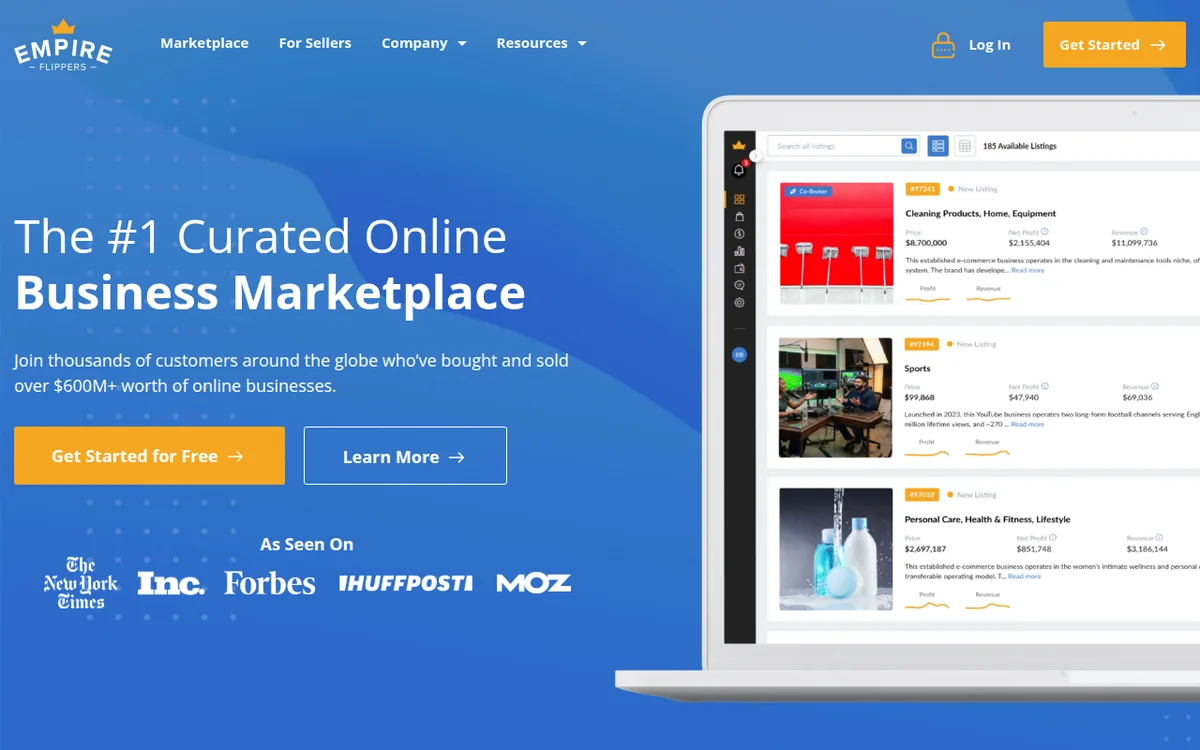
1. Empire Flippers: Best Overall for Established Ecommerce (From $24K Net Profit)
Empire Flippers has become the standard recommendation for selling profitable online businesses, and the track record justifies the reputation. Their public scoreboard, which I read on 9 October 2026, puts lifetime sold volume at $606,343,148.01 across 2,678 listings sold, with total verified liquidity of $15,973,117,064 and a combined buyer and seller base of 325K. The roughly 85 percent success rate on vetted listings that gets quoted for them is not published on that scoreboard, so treat it as not verified. That means if your business passes their vetting process, there’s a strong probability it sells.
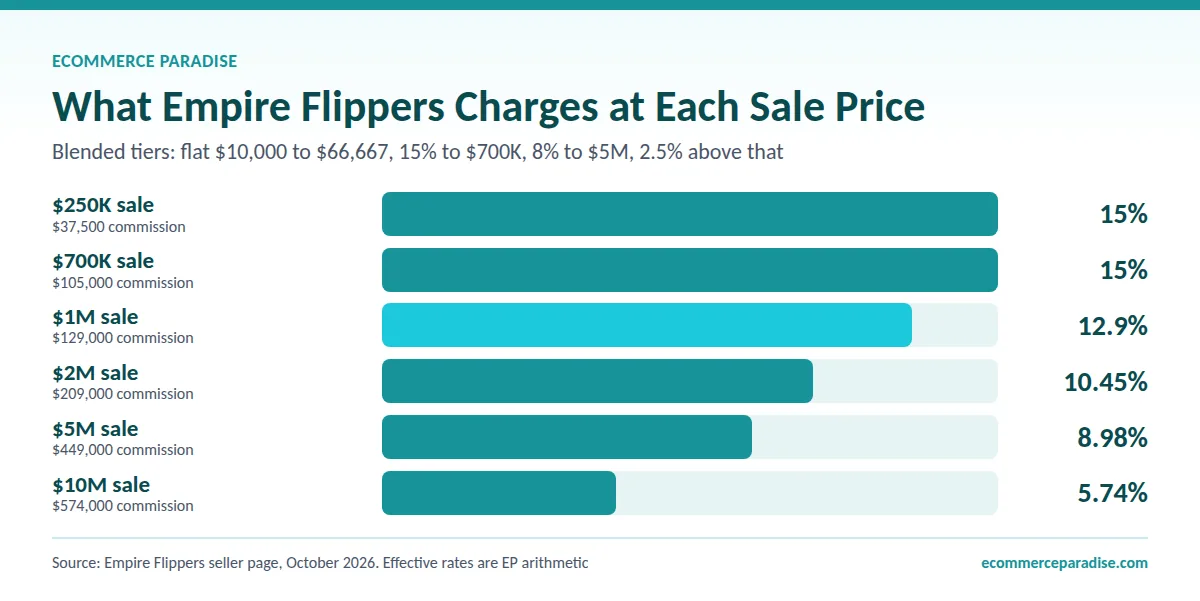
Their commission is blended, so the rates stack. As of October 2026, their seller page lists a flat $10,000 up to a $66,666.66 sale, then 15 percent of the sale price up to $700K, 8 percent on the portion between $700K and $5 million, and 2.5 percent on the portion above $5 million. On my arithmetic, a $1 million sale works out to $129,000, or 12.9 percent, and a $10 million sale to $574,000, or 5.74 percent. The sweet spot where Empire Flippers delivers the most consistent value is the $250K to $3 million range, where their buyer network depth is largest relative to deal size. The vetting process is strict, which filters out businesses that aren’t ready, but if you pass, you’re presenting to some of the most serious and well-capitalized buyers in the market.
They cover ecommerce, Amazon FBA, SaaS, and content sites. The migration support through closing is comprehensive. For first-time sellers especially, the hand-holding through a complex process is worth significant commission dollars. Their seller page puts the average time to sale at 130 days, so plan on about four months, and it asks for at least $24,000 a year in net profit and a 12-month track record before it will list a business.
Best for: Profitable ecommerce stores with 12-plus months of history, sellers wanting maximum buyer exposure, first-time sellers who need process support. Website: empireflippers.com
2. Flippa: Best Marketplace-Driven Platform With Broker and M&A Support ($100K to $50M+)
Flippa is the world’s largest marketplace for buying and selling online businesses, connecting entrepreneurs with a global network of buyers, investors, brokers, and M&A professionals. While historically recognized for smaller online business transactions, the platform has evolved into a leading destination for deals ranging from starter sites to businesses valued at $1M+, with increasing activity in the $250K+ acquisition space.

What sets Flippa apart is its combination of marketplace scale and expert support. Sellers gain exposure to a large pool of qualified buyers while also having access to experienced brokers and M&A advisors who can guide them through valuation, buyer negotiations, due diligence, legal processes, and deal structuring. This creates a more flexible and cost-effective alternative to traditional brokerage models, while still delivering the strategic support founders need to achieve successful outcomes.
Flippa is well suited for a broad range of businesses, including SaaS, eCommerce, content, apps, agencies, and digital services. Whether a founder is exploring an exit for the first time or running a larger transaction process, the platform’s ecosystem of brokers, advisors, and integrated deal tools helps streamline the path from listing to close.
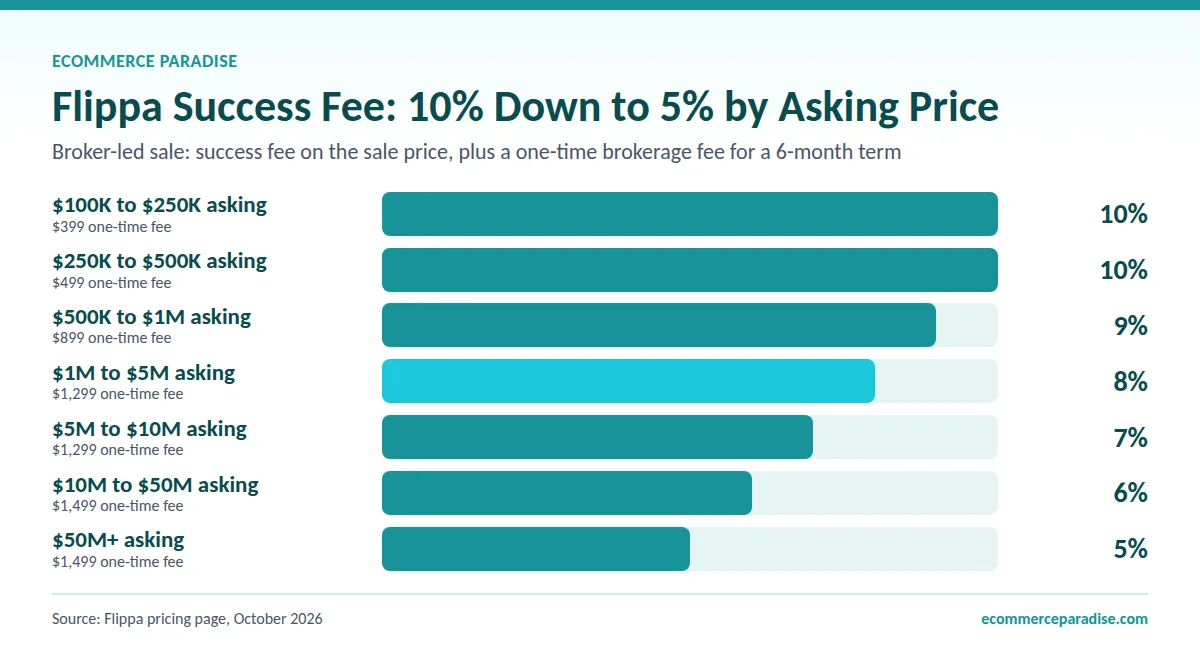
The platform works particularly well for founders seeking both reach and expertise: the scale of a global marketplace combined with access to trusted professionals who can help maximize valuation and improve transaction success rates. As of October 2026, its pricing page shows self-service listing packages from $29 and broker-led sales with a one-time fee of $399 to $1,499 depending on asking price, plus a success fee that falls from 10 percent to 5 percent as the asking price rises.
Best for: Businesses ranging from $100K to $50M+, founders seeking access to global buyers alongside broker and M&A support, and sellers looking for a modern marketplace-driven approach to buying and selling businesses. Website: flippa.com
3. Quiet Light Brokerage: Best for Mid-Market Founder-Operated Businesses ($500K-$20M)
What makes Quiet Light genuinely different from most brokers is that every advisor has personally bought, sold, or built their own online businesses. They’re not salespeople with an ecommerce script. They’re entrepreneurs who understand the emotional complexity of exiting a business you built, the operational realities that buyers will dig into during due diligence, and how to position a founder-operated business’s story in a way that commands premium valuations.
Their own pages, which I read on 9 October 2026, state over $500 million in transactions across 750-plus businesses sold since 2006, with 47 percent of listings selling at or above asking price and 85 percent of listings selling within 90 days (smaller deals typically take 30 to 60 days and larger ones 90 to 150). Commission is usually quoted at 10 percent under $1 million, 9 percent for $1 to $2 million and 8 percent for $2 to $3 million, but I could not find a fee schedule on their pages, so treat those percentages as unverified.
Quiet Light is selective about which businesses they take on and requires an exclusive listing agreement, but that selectivity works in sellers’ favor: their listings don’t get lost in a sea of mediocre businesses, and the buyer pool they attract is appropriately sophisticated for the deal sizes they handle. For founder-built ecommerce brands in the $1 to $5 million range, this is often the best fit available.
Best for: Founder-operated Shopify and DTC brands, sellers who value personal advisor relationships, entrepreneurs seeking strategic exit advice. Website: quietlight.com
4. Website Closers: Best for Large Exits ($1M-$1B)
Website Closers occupies the high end of the ecommerce brokerage market. Their homepage, read on 9 October 2026, publishes 2,345 businesses sold, $2.23 billion of transactions represented, a 1.3 million buyer network and a 92 percent close rate, and states the company runs transactions from $1 million up to $1 billion. With that volume behind them they have the institutional buyer relationships and complex deal experience that large ecommerce exits require. Their deals have ranged from $1 million to $500 million-plus, including some of the largest ecommerce exits in the digital business space.
At this level, buyers aren’t individual entrepreneurs; they’re aggregators, private equity firms, family offices, and strategic acquirers who write eight-figure checks and conduct sophisticated due diligence processes that can take 6 to 12 months. Website Closers has the in-house attorneys and accountants to manage that complexity without needing to outsource critical deal components, and they describe themselves as 100 percent success-based, with fees paid only when a deal closes and structured as a flat fee, a Lehman-style formula or a variation depending on deal size. They do not publish a percentage, so the 5 to 10 percent usually quoted for large deals is unverified.
If your ecommerce operation does $5 million or more in revenue and you’re thinking about an exit, this is the level of brokerage you need. They’re less suited for smaller deals, where the personal attention may not match what boutique brokers provide.
Best for: Multi-million dollar ecommerce operations, businesses seeking institutional or private equity buyers, complex deal structures. Website: websiteclosers.com
5. FE International: Best for High-Quality Complex Businesses ($1M-$100M)
FE International positions itself as the premium M&A advisor for sophisticated digital businesses and backs that positioning with a 94.1 percent deal success rate, which is the highest published success rate I’ve seen in this category. Both that figure and the 1,500-plus completed transactions are published on their own site, which I read on 9 October 2026, alongside a stated combined transaction value of over $50 billion and an 80,000-plus pre-qualified investor network. Their process is data-driven in a way that distinguishes them from relationship-focused boutiques.
The rigor is said to cut both ways, with FE International turning down over 90 percent of businesses that apply to list with them, though I could not find that figure published on their site and it is not verified here. If your business passes their pre-listing due diligence (which they conduct upfront rather than leaving it for the buyer), you enter the market with a comprehensive information package that is said to shorten the buyer’s due diligence timeline by about 28 percent against the industry average, another figure I could not find published on their site. That speed matters because shorter deal timelines mean less time your business is in limbo and fewer opportunities for something to go wrong.
Their commission rates, usually quoted at 10 to 15 percent for mid-market but not published on their site, are premium, but the exceptional success rate and deal speed largely justify the cost for businesses that qualify. They describe themselves as a technology M&A advisor, with ecommerce and consumer products as one of their listed industries, so they are a fit for ecommerce businesses with the metrics to meet their threshold.
Best for: High-quality ecommerce businesses with strong metrics, sellers wanting comprehensive due diligence upfront, complex business models, international sellers. Website: feinternational.com
6. Ecommerce Brokers: Best for International Sellers and Boutique Service
Ecommerce Brokers was founded by George Moulos, who has spent 13 years in ecommerce, built and sold several of his own businesses, and started the firm in Sydney, Australia. That brings a level of operational authenticity that you don’t always find in brokerage firms, because he understands the business from the inside rather than just knowing how to facilitate its sale. He says he focuses on a small number of qualified buyers and sellers he knows personally.
Their international expertise is a genuine differentiator. For UK, European, and Australian ecommerce businesses particularly, the US-centric buyer networks of larger brokers can be a limitation. Ecommerce Brokers has a genuinely global buyer relationship network and direct experience navigating the cross-border complexities that international sellers face during due diligence and asset transfer. The firm does not publish its commission rates, so ask for them up front. A personal, no-nonsense approach makes them a strong choice for sellers who value working directly with people who have done what they’ve done.
Best for: International businesses (especially UK, EU, Australia), sellers wanting boutique attention, entrepreneurs who value transparency. Website: ecommerce-brokers.com
7. Acquisitions Direct: Best for Personalized M&A Advisory ($250K-$30M+)
Acquisitions Direct has operated for over 20 years and says it has sold hundreds of online businesses, with transaction sizes from $250K to $30 million-plus. They limit their active listing inventory to 12 to 18 businesses at a time, which is a deliberate constraint that allows each seller to receive dedicated advisor attention throughout the process rather than being handed off to junior team members once the listing is active.
Their advisors have built and sold their own businesses, which informs how they approach the complexity of businesses that don’t fit a simple category. Hybrid operations, businesses with unusual revenue structures, or founder-operated companies where the seller’s role is deeply embedded in operations are exactly the kind of complexity that benefits from a broker who has navigated similar situations personally rather than academically. The boutique limitation means they may have a waiting list, but the personalized approach pays dividends in deal quality. According to their FAQ, they are paid only when a sale closes, but they require a minimum six-month listing agreement and do not take businesses priced under $250,000.
Best for: Complex businesses requiring a customized approach, sellers wanting a dedicated advisor relationship throughout. Website: acquisitionsdirect.com
8. Website Properties: Best for Diverse Business Models ($500K-$50M Revenue)
Website Properties has been going since 2002 and its site publishes 600-plus deals closed and a 50,000-buyer network, read on 9 October 2026, across the full range of online business models, with ecommerce revenue from $500K up to $50M. The breadth is both the strength and the potential limitation: if your business doesn’t fit neatly into the ecommerce, SaaS, or Amazon FBA categories that the most specialized brokers focus on, Website Properties’ versatility may be exactly what you need. They handle content sites, affiliate businesses, digital agencies, and other models that pure ecommerce brokers may not have strong buyer relationships for.
For sellers with straightforward ecommerce operations, the depth of specialization at Empire Flippers or Quiet Light may serve them better. For sellers with mixed or harder-to-categorize business models, Website Properties’ track record across diverse deal types makes them a strong option. Their valuation process is accurate and fast, and they report $650M-plus in transferred enterprise value since 2002.
Best for: Businesses with diverse or unusual revenue models, sellers wanting broad buyer network exposure across multiple categories. Website: websiteproperties.com
9. Peterson Acquisitions: Best for Hybrid Digital and Physical Businesses
Most ecommerce brokers are uncomfortable with businesses that have significant physical components: warehouse operations, retail locations, large physical inventory, or manufacturing relationships that require in-person oversight. Peterson Acquisitions is one of the few brokers equally capable of representing pure digital businesses and traditional businesses with physical assets, making them the right choice for omnichannel operations and DTC brands that have expanded beyond pure online selling.
Founder Chad Peterson’s strong online presence drives a meaningful percentage of inbound buyer interest, which is useful for hybrid businesses that straddle the line between the digital buyer community and the traditional business acquisition market. If your ecommerce business has warehousing, retail locations, or other physical infrastructure that a pure digital buyer may not know how to value, Peterson’s dual expertise prevents that complexity from becoming a discount.
Best for: Ecommerce businesses with physical retail locations, warehouses, or significant physical infrastructure. Website: petersonacquisitions.com
10. Archstone Business Brokers: Best for Larger Multi-Channel Ecommerce Operations ($1M-$50M Revenue)
Multi-platform ecommerce operations, those selling simultaneously on Shopify, Amazon, wholesale, and retail channels, present complexity that confuses brokers who are used to single-channel businesses. Archstone is a general lower-middle-market M&A firm rather than an ecommerce specialist: it lists eCommerce among many sectors, works with profitable companies doing $1M to $50M in revenue, and says it has closed 100-plus transactions worth over $600 million. Its FAQ puts its sell-side fee at generally 2 to 10 percent, with no upfront fees or retainers. That makes it worth a call for DTC brands that have expanded into wholesale, or Amazon sellers who have also built a direct Shopify presence, as long as you ask how many pure ecommerce deals it has closed.
Best for: Larger multi-channel ecommerce operations selling across platforms, omnichannel DTC brands with $1M or more in revenue. Website: archstonebrokers.com
How to Choose the Right Broker for Your Situation
Broker selection should start with deal size, because it determines which brokers will take your business seriously. For businesses with revenue under $500K, Empire Flippers and Flippa are the realistic options. Full-service brokers at this level aren’t always economical on their end, which means you won’t get the focus you need. For businesses in the $500K to $2 million range, Empire Flippers, Flippa, Quiet Light, and Ecommerce Brokers all make sense and are worth interviewing. For $2 to $10 million, Quiet Light, FE International, Website Closers, Flippa, and Acquisitions Direct all compete well and have differentiated approaches worth comparing. Above $10 million, Website Closers and FE International have the institutional buyer networks that large deals require.
Beyond size, business type matters. Amazon FBA businesses sell best through brokers with deep Amazon-specific buyer relationships (Empire Flippers, Quiet Light, FE International). Shopify and DTC brands with strong brand equity and email lists tend to do well at Quiet Light and Ecommerce Brokers where the advisors understand brand-building. Multi-platform operations and hybrid businesses need Archstone or Peterson Acquisitions. International sellers, particularly in the UK, EU, and Australia, should prioritize Ecommerce Brokers and FE International over US-centric brokers.
Your priority also matters. If maximum sale price is the goal, Quiet Light (which publishes that 47 percent of its listings sell at or above asking) and FE International (with its own published 94.1 percent success rate) are the two I would interview first. If broad buyer reach combined with expert support is the priority, Empire Flippers and Flippa have the largest buyer pools and access to brokers and M&A advisors who help guide deals to close. If personalized service throughout the process is what you need, any of the boutique brokers (Ecommerce Brokers, Acquisitions Direct, Quiet Light) will outperform the marketplace-style operations.
Interview at least two or three brokers before deciding. The right advisor relationship is worth tens or hundreds of thousands of dollars in additional sale proceeds, so the selection process deserves time proportional to those stakes.
What Good Brokers Do and Red Flags to Watch For
Good ecommerce brokers specialize in digital businesses rather than selling everything that walks through their door. They have a published track record of completed transactions, not just claimed experience. Their buyer network is actively maintained with verified qualification, not a static email list of anyone who ever expressed interest. They publish their commission structure openly and don’t charge upfront fees with no guarantee. Their advisors have operated online businesses personally, not just read about them. And they communicate consistently, with a dedicated advisor throughout the process rather than a rotating cast of team members.
The red flags are equally important. Any broker who guarantees a specific sale price is lying: no ethical advisor can control what buyers will pay. Significant upfront fees with no performance guarantee misalign incentives. Pressure to list immediately before you’re prepared is a sign the broker prioritizes their pipeline over your outcome. Vague or evasive answers about commission structure are unacceptable. And if a broker can’t articulate why their buyer network is specifically qualified for ecommerce deals, they probably aren’t.
Trust your instincts on rapport as well. You’ll work with this person closely for 4 to 8 months during one of the most consequential financial transactions of your life. An advisor you don’t trust, don’t communicate well with, or don’t believe has your interests at heart will not serve you as well as one you do.
Understanding Broker Commission Structures
Commission rates decline as deal size increases because the fixed cost of the work doesn’t scale proportionally with deal value. For small deals ($100K to $500K), expect commissions of 12 to 15 percent. Mid-market deals ($500K to $3 million) typically run 8 to 12 percent, often tiered. Large deals ($3 to $10 million) run 5 to 10 percent. Major exits above $10 million are typically 3 to 8 percent, negotiated based on deal complexity. Published schedules fit that pattern: Empire Flippers’ blended schedule works out to 15 percent on a $500K sale and under 6 percent on a $10 million sale, and Flippa’s success fee runs from 10 percent down to 5 percent by asking price, with a one-time brokerage fee on top.
The commission math can work out well for sellers who use a quality broker. A DIY seller might achieve $1.8 million for their business after 200-plus hours of work. A broker who takes 10 percent but negotiates the sale to $2.2 million (a 22 percent premium, which brokers commonly claim to achieve) nets the seller $1.98 million: $180,000 more despite the commission, plus 180-plus fewer hours of work. Brokers commonly say they achieve 15 to 30 percent higher sale prices than unrepresented sellers, though I have not found independent data that confirms it, so run your own numbers before you rely on it.
The Business Sale Process: What to Expect
A standard broker-facilitated ecommerce business sale runs 4 to 8 months across seven distinct phases. The initial consultation and valuation (weeks 1 to 2) establishes whether the broker is a good fit, what your business is worth at current market multiples, and what preparation is needed before listing. Business preparation (weeks 3 to 6) involves organizing 12 to 24 months of clean financial records, documenting processes and operations, building marketing materials, and setting the list price. Most sellers underestimate how much preparation work this phase requires.
Marketing and buyer outreach (weeks 7 to 12) begins once the listing goes live, with the broker doing active outreach to their buyer network rather than just waiting for inbound interest. Serious buyers then request calls and submit letters of intent (weeks 13 to 18), which the broker negotiates on your behalf. Due diligence (weeks 19 to 24) is the most intensive phase for sellers: the buyer verifies every claim in the listing, examines financials in detail, reviews traffic and customer analytics, and checks supplier and vendor relationships. Maintaining complete transparency during this phase is essential.
Final negotiations and purchase agreement (weeks 25 to 28) address any due diligence findings and finalize deal terms. Asset transfer and transition (weeks 29 to 32) moves all business assets to the new owner, with funds held in escrow and released once the buyer confirms receipt. A period of seller support typically follows where you answer questions and introduce the buyer to key relationships.
Alternatives to Using a Full-Service Broker
For businesses generating under $200K, a DIY sale or a marketplace platform are realistic options. Flippa is the largest marketplace for online businesses and is active across the full range from starter sites to $1M+ deals. You can list directly while also tapping the platform’s brokers and M&A advisors for support with valuation, negotiation, and the legal and escrow process. The cost structure (a listing fee from $29 plus a 5 to 10 percent success fee, per its pricing page as of October 2026) is lower than a traditional full-service broker, and the access to expert support helps sellers achieve stronger outcomes than going fully solo.
Cheaper still are the flat-fee listing platforms that charge a one-off fee and little or no commission, but they sell advertising rather than representation, so it is worth reading what a low-commission listing platform actually publishes about its results before you treat one as a substitute for a broker.
A hybrid approach works for some mid-size sellers: list on a marketplace yourself, hire a transaction coordinator for the legal and escrow work, and engage an attorney for document review. This costs 3 to 5 percent of deal value rather than the 10 to 15 percent a full-service broker charges, and it works well for sellers who have sold businesses before, have good professional networks, or have business structures that are genuinely simple to transfer. For most first-time ecommerce business sellers with businesses above $300K, having dedicated expert representation pays for itself.
How to Maximize Your Sale Price Before You List
The highest-leverage things you can do to increase your business’s sale price happen 6 to 12 months before you engage a broker, not during the listing process. Clean, professionally prepared financials are the foundation. An ecommerce accountant who produces clean P&L statements, separates personal from business expenses completely, and documents all revenue streams can add 10 to 20 percent to your valuation by eliminating the ambiguity that causes buyers to discount aggressively.
Traffic source diversification is equally important. A business where 80 percent of revenue comes from a single advertising channel is inherently riskier than one with diversified organic, email, paid, and referral traffic. Building organic and email channels in the 12 months before a sale can add 15 to 25 percent to the valuation multiple buyers are willing to pay. Similarly, documented standard operating procedures that allow the business to run without you add 20 to 30 percent to valuation by demonstrating to buyers that they’re acquiring a system rather than buying themselves a job.
Legal and compliance housekeeping eliminates deal-killers: current business licenses, registered trademarks where applicable, written supplier agreements, and clean tax compliance all prevent the kinds of due diligence surprises that derail deals at closing. A repeat customer rate above 30 percent, achievable through email nurture sequences, loyalty programs, and subscription options, adds another 10 to 20 percent by demonstrating the kind of recurring revenue that buyers pay premium multiples for. My supplier sourcing guide is relevant here: well-documented supplier relationships with clear terms are a significant due diligence asset that many sellers overlook.
High-Ticket Dropshipping: The Exit-Optimized Business Model
One of the consistent patterns I’ve observed across ecommerce exits is that high-ticket dropshipping businesses command meaningfully higher valuation multiples than traditional dropshipping operations. Traditional dropshipping stores typically sell at 1.5 to 2.5 times annual profit. High-ticket dropshipping businesses, built the way I teach through Ecommerce Paradise coaching, consistently achieve 2.5 to 4 times multiples. The reasons are structural.
Margins of 25 to 40 percent on high-ticket products versus 10 to 20 percent on standard dropshipping mean significantly more profit on the same revenue. Premium positioning in categories like outdoor equipment, furniture, specialty machinery, or home improvement creates defensible moats that are harder to replicate than commodity dropshipping. Customer quality at the $1,000 to $5,000 ticket level is inherently stronger, which shows in lower refund rates, higher lifetime value, and more durable supplier relationships. Buyers who understand ecommerce recognize all of this in a valuation, and the multiple reflects it.
The practical impact is significant. A traditional dropshipping business doing $800K in revenue at a 15 percent margin ($120K profit) at a 2x multiple sells for $240K. A high-ticket dropshipping business doing the same $800K in revenue at a 30 percent margin ($240K profit) at a 3.5x multiple sells for $840K. Same revenue, but $600K more at exit. The high-ticket niches list covers the product categories where this dynamic is strongest.
If you’re building an ecommerce business with an eventual exit in mind, the done-for-you turnkey store service builds high-ticket dropshipping operations from the ground up with proper systems, documentation, and supplier relationships designed for maximum valuation at exit. And the complete business formation checklist covers the legal and financial foundation that makes a business sellable from day one rather than requiring cleanup right before listing.
When Is the Right Time to Sell?
The best time to sell is during a strong growth trajectory, not at peak performance. Buyers pay premium prices for growth stories, not for businesses at their ceiling. If revenue is increasing 20-plus percent year over year and the trend is intact, that growth narrative commands a premium multiple. Selling immediately after a major milestone (hitting $1 million in revenue, successfully expanding to a new platform, launching a product line that’s clearly working) captures momentum that buyers will pay for.
Market timing matters too. When acquisition capital is abundant, aggregators and private equity are actively buying, and interest rates are favorable for leveraged acquisitions, seller multiples rise. The ecommerce acquisition market has matured significantly since the aggregator boom of 2020 to 2022, but quality businesses with strong metrics continue to sell well. Selling before a major platform algorithm shift, regulatory change, or market saturation point you can see coming is always better than waiting through the disruption.
The worst time to sell is when revenue is declining: buyers negotiate hard on downward trends and the multiple compresses significantly. During seasonal slumps, when recent months look weak relative to the business’s real performance, valuation suffers even if the trailing twelve months look strong. And selling a business that’s owner-dependent, where the operation would struggle meaningfully without you personally involved, is simply very hard regardless of timing.
Frequently Asked Questions
How long does it take to sell an ecommerce business?
Four to eight months is the typical range for a broker-facilitated sale. Marketplace platforms like Flippa can move faster (1 to 3 months), with broker and M&A support available to help guide the deal. Large deals above $5 million routinely take 8 to 12-plus months due to the complexity of institutional buyer due diligence.
What documents do I need to sell my ecommerce business?
The core documentation package includes 12 to 24 months of profit and loss statements, a current balance sheet, traffic analytics from Google Analytics or your platform, customer acquisition and lifetime value metrics, supplier agreements and key contracts, a full asset inventory (domains, social accounts, email lists, inventory), tax returns for 2 to 3 years, and business bank statements. Brokers will give you a specific checklist once you engage.
Do I need an attorney to sell my business?
For deals above $500K, yes. A business sale attorney reviewing the purchase agreement and asset transfer documents is worth the cost. For smaller deals, brokers often provide standard templates that work for straightforward transactions, but any significant complexity (IP licensing, earn-out provisions, non-compete negotiations) warrants legal review regardless of deal size.
Can I sell a business that isn’t profitable?
It’s very difficult with a quality broker and not impossible on marketplace platforms, but expect a very low valuation, limited buyer interest, and significant time investment for uncertain results. If your business isn’t yet profitable, the better path is usually to delay the sale, work on margins and cost structure, and list 12 months later with a profitability track record.
What percentage of listings actually sell?
Published figures vary: Website Closers states a 92 percent close rate, FE International a 94.1 percent success rate and Website Properties 85 percent of listings closed, and each firm uses its own definition. On marketplace platforms, sell-through rates vary by listing tier and preparation quality, and deals supported by brokers or M&A advisors close at meaningfully higher rates than unsupported self-listed ones. The vetting and advisory process filters out businesses that aren’t actually sellable at the price the seller wants, which is why supported success rates look high relative to raw inquiry volume.
Should I use multiple brokers simultaneously?
No. Most quality broker agreements are exclusive, and even where they aren’t, running multiple broker relationships simultaneously creates confusion about who’s representing the deal, signals desperation to buyers, and typically damages credibility with the most serious buyer prospects. Interview several brokers before signing, then commit to one.
What’s the minimum revenue to work with a full-service broker?
Empire Flippers asks for at least $24,000 a year in net profit and a 12-month track record. Quiet Light focuses on businesses valued at $500K-plus (I could not confirm that on its site). Website Closers says it runs transactions from $1 million, and FE International does not publish a minimum. Across the full range, Flippa serves everything from starter sites up to $50M-plus asking prices, with broker-led sales available from $100K.
How do I stay anonymous during the sale process?
Brokers use non-disclosure agreements (NDAs) to protect your identity in initial marketing materials, and serious buyers sign NDAs before receiving detailed business information or learning your identity. Complete anonymity is possible through the early stages but becomes impractical as deals move toward due diligence and closing, where buyers need to know who they’re transacting with.
How much do ecommerce business brokers charge?
Most ecommerce business brokers charge a commission that drops as deal size grows. Expect 12 to 15 percent on deals from $100K to $500K, 8 to 12 percent from $500K to $3 million, 5 to 10 percent from $3 to $10 million, and 3 to 8 percent above $10 million. Brokers say they earn that back through 15 to 30 percent higher sale prices than unrepresented sellers, though I have not found independent data that confirms it.
Our Top Recommendations
If you are buying or selling a high-ticket dropshipping business specifically, the Ecommerce Paradise brokerage service is my number one recommendation, period. No general broker understands this business model the way we do, and that understanding translates directly into better valuations for sellers and better acquisitions for buyers. Contact me directly to get started.
For general ecommerce businesses, Empire Flippers is my top recommendation for the vast majority of sellers. The combination of the largest vetted buyer pool in the industry, a transparent tiered commission structure, comprehensive migration support, and more than 2,600 listings sold makes them the strongest all-around choice whether you’re selling a $200K Shopify store or a $5 million Amazon FBA brand.
What sets Empire Flippers apart from the rest of the field is the quality of their buyer network. The scoreboard’s $15,973,117,064 of total verified liquidity across a 325K buyer and seller base means your listing isn’t sitting in front of curious browsers, it’s in front of serious people with capital ready to deploy. That depth of demand is what supports their sell-through record, and it’s what justifies their commission for any seller who wants the broadest possible exposure to the best possible buyers.
If you’re ready to find out what your business is worth, Empire Flippers offers a free valuation tool that gives you an instant estimate based on your revenue, profit, and business model. It takes about two minutes and costs nothing. Even if you’re 12 to 18 months away from actually listing, getting a current valuation gives you a concrete target to build toward and helps you understand which levers move the number most before you go to market.
High-ticket dropshipping store? Contact Ecommerce Paradise to buy or sell →
General ecommerce business? Get your free business valuation from Empire Flippers →
And if you’re still in the building phase rather than the exit phase, the best thing you can do right now is build the kind of business that commands a premium multiple when the time comes. The done-for-you store service and coaching program at Ecommerce Paradise are both built around exactly that: high-ticket dropshipping operations with the margins, systems, and supplier relationships that make exit valuations significantly higher than standard ecommerce stores. Build it right from the start, and the exit takes care of itself.
If you want additional support, we offer services and community to help you succeed.
Turnkey Dropshipping Stores: We build your complete high-ticket store from scratch so you can skip the technical setup and focus on operations.
Private Coaching: One-on-one guidance tailored to your business goals and challenges.
Google Shopping Ads Management: We run and optimize your Google Shopping campaigns so you get real traffic from buyers ready to purchase.
Scaling Services: Already have a store? We help you scale operations, optimize conversions, and grow revenue to the next level.
Patreon Membership: Get full access to the High-Ticket Dropshipping Masterclass plus additional courses, scripts, templates, books, and our private Discord community.
Ecommerce Paradise Academy: Join operators discussing what is working right now. Start with a 7 day free trial, then $9/month or $49/year.
Related Articles
If you found this useful, these guides go deeper on related topics:
- What Is High-Ticket Dropshipping: A Comprehensive Guide for Ecommerce Entrepreneurs
- High-Ticket Niches List: 250+ Profitable Product Categories
- Best High-Ticket Affiliate Programs: Top Programs With Real Commissions
- Business Formation: The Complete Legal and Financial Foundation Checklist
- How to Find the Best Suppliers for High-Ticket Dropshipping
This article was written by Trevor Fenner, founder of Ecommerce Paradise. Trevor has 15+ years of experience in ecommerce and high-ticket dropshipping, helping entrepreneurs build profitable online businesses. For questions, reach out at trevor@ecommerceparadise.com.

Trevor Fenner is an ecommerce entrepreneur and the founder of Ecommerce Paradise, a platform focused on helping entrepreneurs build and scale profitable high-ticket ecommerce and dropshipping businesses. With over a decade of hands-on experience, Trevor specializes in high-ticket dropshipping strategy, niche and product selection, supplier recruiting and onboarding, Google & Bing Shopping ads, ecommerce SEO, and systems-driven automation and scaling. Through Ecommerce Paradise, he provides free education via in-depth guides like How to Start High-Ticket Dropshipping, advanced training through the High-Ticket Dropshipping Masterclass, and fully done-for-you turnkey ecommerce services for entrepreneurs who want a faster, more hands-off path to growth. Trevor is known for emphasizing sustainable, real-world ecommerce models over hype-driven tactics, helping store owners build scalable, sellable, and location-independent brands.


