

The problem with stock market news in 2026 is not scarcity. It is the opposite. Financial headlines arrive through dozens of channels simultaneously, social feeds blend credible institutional reporting with anonymous speculation, and free news aggregators surface the same stories hours after professional traders have already acted on them. The investors who consistently make better decisions are not the ones consuming the most news. They are the ones consuming the right news from the right sources at the right time.
The market for financial news has stratified sharply in recent years. At the professional end, platforms like Benzinga Pro and Bloomberg deliver real-time, market-moving information seconds after it breaks. In the middle tier, publications like The Wall Street Journal, Financial Times, and Seeking Alpha provide analysis and context that helps investors build investment theses rather than just react to headlines. At the free end, sources like CNBC, Yahoo Finance, MarketWatch, and Reuters (limited free articles) give casual investors solid general coverage without a subscription, though with meaningful trade-offs in speed and depth. Getting this stack right is the same kind of systematic decision making I write about across every topic at Ecommerce Paradise, from sourcing suppliers to structuring the business that generates the capital you are now trying to protect.
The critical mistake most investors make is using the wrong type of source for their strategy. A day trader relying on The Wall Street Journal for time-sensitive market signals will always be behind. A long-term value investor monitoring Benzinga Pro’s real-time news squawk is paying for features they will never benefit from. Matching your news consumption to your actual investing behavior is the most efficient upgrade most investors can make without spending a dollar more.
This guide covers ten of the best stock market news sources available in 2026. Selections were made based on speed, editorial quality, coverage depth, pricing, and real-world fit for different investor types. Here is a quick look at every source covered:
- Benzinga Pro: Best for real-time breaking news and active traders
- Bloomberg: Best for institutional-depth global financial journalism
- The Wall Street Journal: Best for in-depth business and market analysis
- Reuters: Best for unbiased global news coverage
- Seeking Alpha: Best for crowdsourced analysis and research depth
- CNBC: Best free broadcast and digital financial news
- MarketWatch: Best free Dow Jones-backed market coverage
- Financial Times: Best for global macroeconomic and international market context
- Barron’s: Best for weekly long-form investment analysis
- Investing.com: Best free all-in-one data and news platform
What Is a Stock Market News Source and Why Does It Matter?
What Is a Stock Market News Source?
A stock market news source is any publication, platform, or feed that delivers information about publicly traded companies, economic events, central bank decisions, earnings reports, analyst ratings, and macroeconomic developments that affect asset prices. These sources range from wire services delivering raw data as soon as it is published, to long-form investment publications providing weeks of editorial analysis behind a single investment thesis.
For ecommerce entrepreneurs and dropshippers investing the profits from their high-ticket dropshipping business, the quality of the financial news they consume directly influences the quality of the investment decisions they make. Markets move on information, and the investors who receive accurate, relevant information faster than the crowd have a structural advantage. That advantage compounds over time into meaningfully better outcomes, particularly in volatile markets where misinformation and noise can trigger costly emotional reactions.
The cost of poor news consumption is not always visible. Reacting to a misleading headline, missing a market-moving earnings report, or building an investment thesis on incomplete information all carry real financial consequences. Understanding which news sources are credible, which are fast, and which are designed for your specific investing style is foundational to building a sustainable investment process.
What to Look For in a Stock Market News Source
Speed and Real-Time Delivery
For active traders and anyone who makes decisions based on market catalysts, the speed of news delivery is the single most important variable. By the time a story appears on a general news feed or mainstream financial website, professional traders with access to real-time wire feeds have already positioned themselves around the information. Platforms designed for speed, including real-time newsfeeds, audio squawk alerts, and push notifications tied to watchlist events, give retail investors a fighting chance at acting on news before the full market absorbs it.
Editorial Quality and Credibility
Not all financial news is produced with the same rigor. Wire services like Reuters and Bloomberg operate newsrooms with hundreds of journalists and strict editorial standards, producing original reporting you can trust. Commentary platforms and crowd-sourced analysis services like Seeking Alpha mix institutional contributors with amateur retail investors, and the quality varies accordingly. Free aggregators often republish stories from credible outlets alongside low-quality content from ad-driven blogs. Learning to distinguish original reporting from recycled commentary is one of the most valuable editorial skills an investor can develop.
Coverage Breadth and Specialization
Some news sources are generalists, covering US equities, international markets, macro economics, currencies, commodities, and geopolitics all under one roof. Others specialize: Barron’s focuses on long-form investment analysis, the Financial Times emphasizes European and global macro coverage, and Investor’s Business Daily is built entirely around a specific growth investing methodology. Matching your primary news source to your investment focus avoids paying for coverage you never use.
Cost and Value Relative to Usage
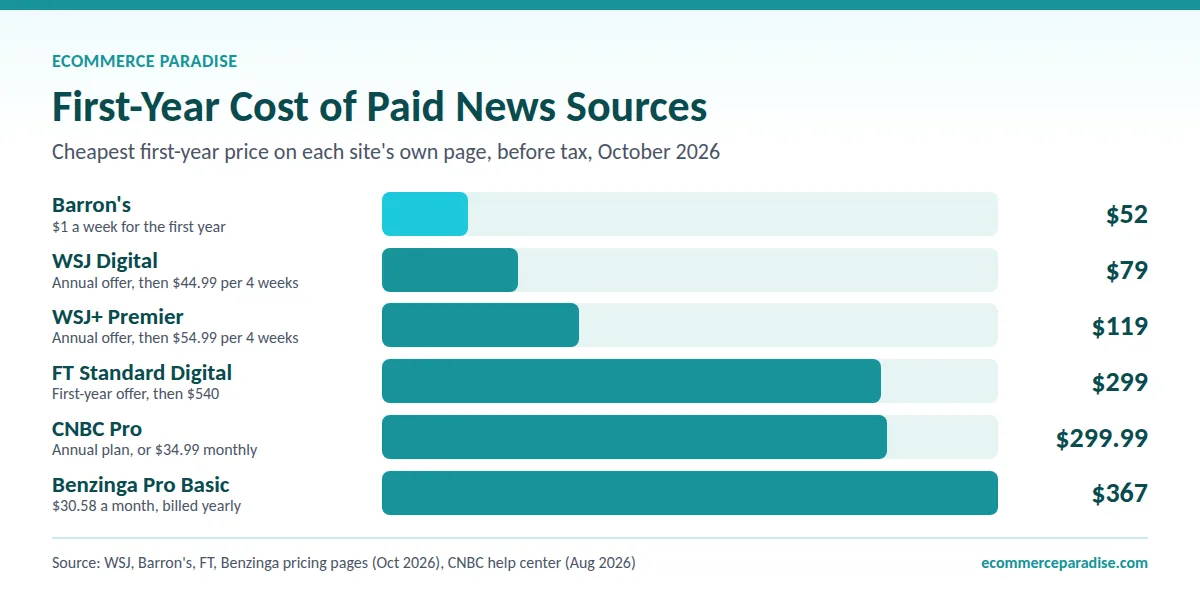
Financial news subscriptions range from free to several hundred dollars per year for premium digital access, to thousands of dollars for professional terminal access. The right pricing tier depends entirely on how you use the source. An investor who reads deeply and makes decisions quarterly does not need a real-time trading feed at $197 per month. A trader making daily decisions based on pre-market catalysts may find that cost easily justified by a single well-timed trade. Evaluating cost against your actual usage patterns rather than theoretical access is the rational framework for subscription decisions.
Mobile and Multi-Device Experience
Most investors today consume financial news across multiple devices, including desktop during research sessions, mobile during the trading day, and tablets for long-form reading. The best news platforms deliver a consistent experience across all three, with mobile apps that mirror the full feature set of the web platform rather than stripping it down to a feed of headlines.
The Best Stock Market News Sources in 2026
1. Benzinga Pro: Best for Real-Time Breaking News and Active Traders
Benzinga Pro is the fastest real-time financial news platform available to retail investors, and it has been the preferred information tool for active traders for over a decade. Its core product is a constantly updated newsfeed that delivers earnings reports, SEC filings, analyst upgrades and downgrades, FDA approvals, merger announcements, and macroeconomic data releases as they happen, before mainstream outlets publish their summaries. For a retail trader it is the closest thing to an institutional wire feed, at a fraction of the cost.
Real-Time Newsfeed and Audio Squawk
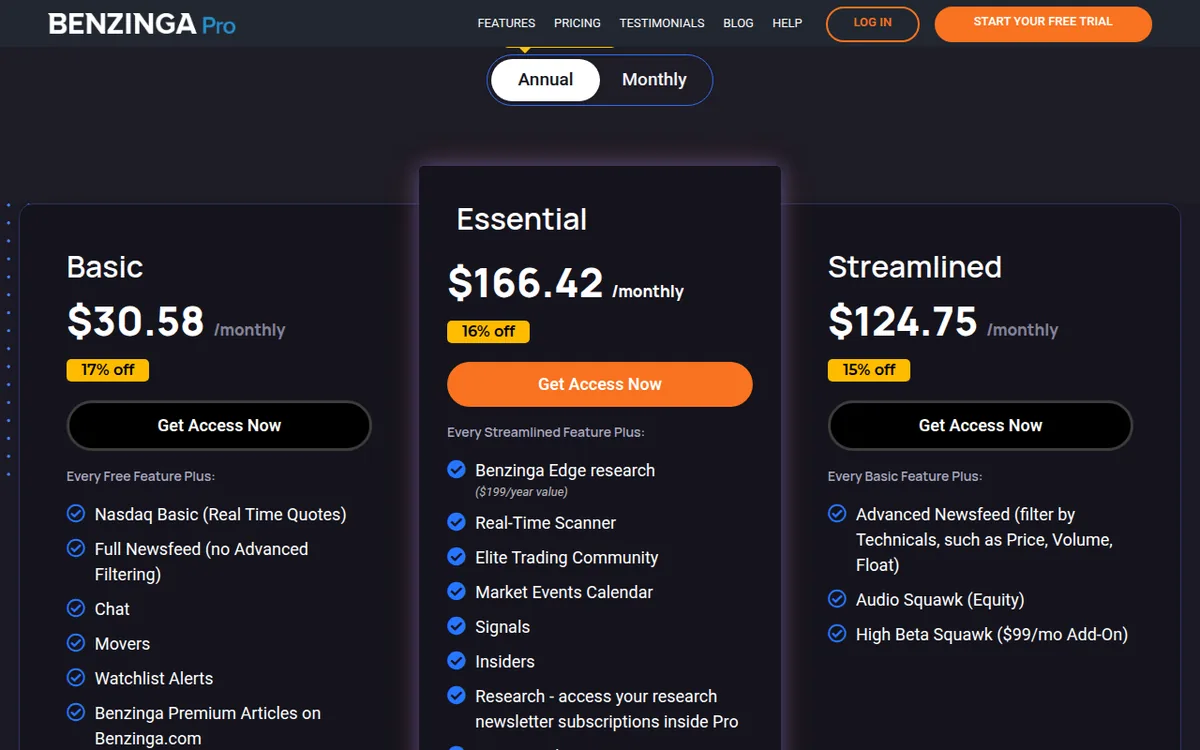
The newsfeed can be customized across 20 different news categories and color-coded by event type, allowing traders to filter for the signals most relevant to their positions. The Audio Squawk feature delivers live breaking news via an audio stream, so traders monitoring active positions in a different window still catch market-moving headlines the moment they break. This combination of visual and audio delivery is particularly valuable during high-volatility sessions when multiple catalysts are unfolding simultaneously.
Analyst Ratings, Earnings, and Pre-Market Movers
Beyond breaking news, Benzinga Pro aggregates analyst rating changes, upgrades and downgrades, earnings announcements, and pre-market movers into structured, timestamped feeds. The pre-market movers section surfaces stocks most likely to see significant activity at open, giving traders time to prepare their positioning before the market opens. Options activity scanners, unusual trade alerts, and insider block trade monitoring are available at higher tiers.
Pricing Tiers
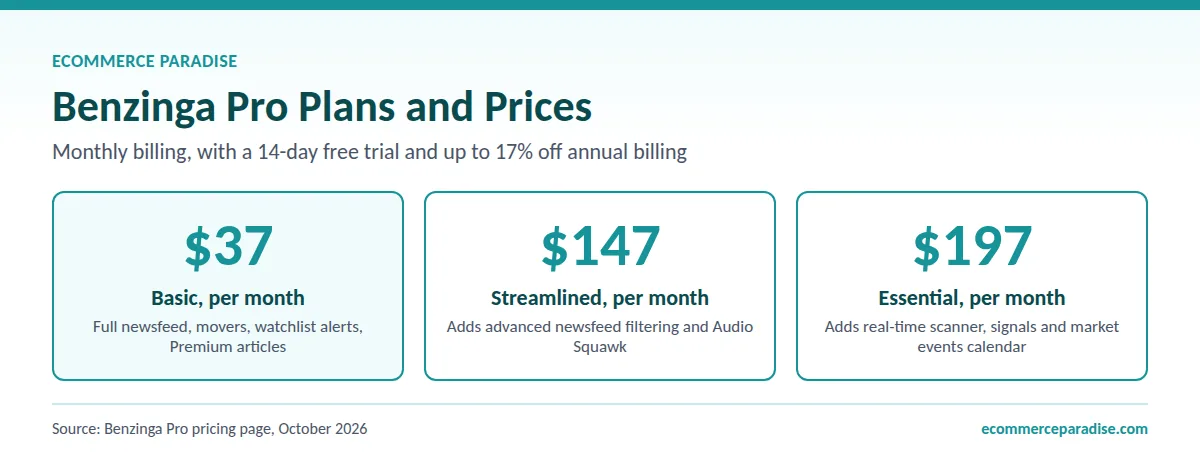
As of October 2026, Benzinga lists the Basic plan at $37 per month, which includes the real-time newsfeed, premium articles, basic alerts, and the pre-market movers list. The Streamlined plan at $147 per month adds advanced newsfeed filtering and Audio Squawk. The Essential plan at $197 per month includes full scanner access, signals, and calendar alerts. Annual billing saves up to 17%, and Benzinga offers a 14-day free trial. For most active retail traders, the Basic tier at $37 per month delivers the core value proposition at a defensible price point.
Pros:
- Fastest real-time news delivery in the retail investor category
- Audio Squawk keeps traders informed hands-free during market hours
- Highly customizable newsfeed across 20 categories
- Pre-market movers and unusual options activity alerts
- News sentiment indicators and impact ratings
Cons:
- Basic tier is meaningfully more expensive than most competitors
- Primarily US-focused, weaker on international market coverage
- Best value for active traders only, limited utility for long-term investors
- Needs to be paired with a separate charting platform for full research workflow
Quick Specs:
- Free Tier: Very limited, plus a 14-day free trial of Pro
- Paid Plans: $37/month (Basic), $147/month (Streamlined), $197/month (Essential), as of October 2026
- Coverage: US equities, earnings, analyst ratings, macro events
- Mobile App: iOS and Android
- Best For: Active traders and catalyst-driven investors
2. Bloomberg: Best for Institutional-Depth Global Financial Journalism
Bloomberg is the gold standard for professional financial journalism, and its digital subscription provides access to reporting, analysis, and market data that professional traders and institutional investors rely on daily. The Bloomberg newsroom operates globally with reporters stationed in every major financial center, covering equities, fixed income, currencies, commodities, geopolitics, and economics with a depth and accuracy that no competitor matches at scale.
Editorial Quality and Global Coverage
Bloomberg’s reporting on institutional market developments, central bank policy, corporate strategy, and international economics consistently sets the standard other publications follow. CEO interviews, live market commentary, and Bloomberg Businessweek’s long-form analysis add layers of context that go well beyond headline coverage. For investors with international exposure or those who want to understand the macro forces driving market movements, Bloomberg’s global reach is unmatched.
Digital Subscription and Pricing
Price trackers I checked in October 2026 list Bloomberg’s annual digital subscription at $399 per year, a significant increase from prior years (Bloomberg’s own pricing page blocked my check, so confirm the live price there). A monthly option is also available, which those trackers put between roughly $35 and $40 per month. The digital subscription provides access to the Bloomberg website, app, live TV streams, and Businessweek. The Bloomberg Terminal, used by professional traders and institutional desks, is commonly estimated at $25,000 or more per user per year and is a separate product entirely. For retail investors, the $399 annual digital subscription is the relevant tier.
Limitations
Bloomberg’s digital subscription is primarily editorial access, not a trading tool. It does not include the screeners, alerts, or real-time data feeds that active traders need. For the depth of reporting it provides, the $399 annual price is fair, but casual investors who primarily want market summaries will find better value in free sources like CNBC or MarketWatch.
Pros:
- Unmatched global newsroom depth and editorial quality
- CEO interviews and institutional market perspective unavailable elsewhere
- Bloomberg Businessweek adds long-form strategic analysis
- Trusted as the most credible financial news source across global markets
Cons:
- Annual digital subscription is the highest of any source on this list
- Not a trading tool, lacks screeners and real-time alerts
- Introductory pricing differs significantly from renewal pricing
- Bloomberg Terminal is an entirely separate and much more expensive product
Quick Specs:
- Free Tier: Limited (some articles before paywall)
- Paid Plan: ~$399/year or ~$35 to $40/month (digital), per third-party price trackers
- Coverage: Global, all asset classes
- Mobile App: iOS and Android
- Best For: Serious investors and professionals who need global institutional-grade reporting
Explore Bloomberg digital subscriptions
3. The Wall Street Journal: Best for In-Depth Business and Market Analysis
The Wall Street Journal has been the most respected source for business and financial journalism since its founding in 1889, and its 2026 digital edition remains one of the most comprehensive single-source platforms available to investors. Unlike Bloomberg, which leads with market data and speed, the WSJ’s strength is in the depth, breadth, and editorial rigor of its business reporting. Corporate strategy, executive profiles, policy analysis, and industry investigations are covered with a level of sourcing and context that distinguishes WSJ journalism from most alternatives.
WSJ Plus Bundle Value
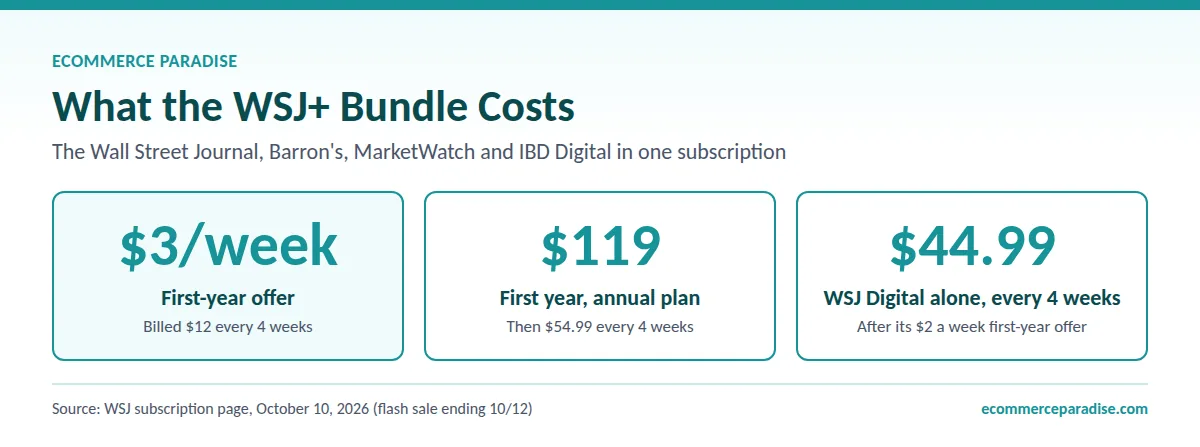
As of October 2026, WSJ lists its WSJ+ bundle (now called WSJ+ Premier) at $3 per week for the first year, billed $12 every 4 weeks, or $119 for the first year on the annual plan, then $54.99 every 4 weeks. It includes unlimited access to The Wall Street Journal, Barron’s, MarketWatch, and Investor’s Business Daily in a single subscription. For investors who read across multiple investment timeframes, from daily market news through MarketWatch to weekly investment analysis through Barron’s, this bundle delivers exceptional value relative to individual subscription pricing.
Earnings, Policy, and Corporate Reporting
WSJ reporters have deep relationships with corporate management, regulatory agencies, and government officials, producing exclusive reporting on earnings events, M&A activity, antitrust investigations, Federal Reserve policy, and macroeconomic trends before smaller outlets pick up the story. For investors who make decisions based on company fundamentals and policy environment, the WSJ is a foundational reading source.
Limitations
The WSJ’s news cycle is oriented around the business day and longer analytical pieces, not real-time market catalysts. For traders who need to act on information in seconds, the WSJ is too slow. Its mobile experience is functional but the iOS app interface has drawn criticism for usability in recent updates. The standard renewal rate is meaningfully higher than the introductory price.
Pros:
- Deep, credible corporate and policy reporting with exclusive sourcing
- WSJ+ bundle includes Barron’s, MarketWatch, and IBD at strong value
- Decades of institutional trust and editorial independence
- Strong coverage of M&A, regulatory, and macroeconomic developments
Cons:
- Not a real-time news tool for active traders
- Standard renewal rate is higher than most alternatives
- iOS app usability has declined in recent updates
- Paywalled content means most articles require a subscription to read in full
Quick Specs:
- Free Tier: Limited (some articles before paywall)
- Paid Plan: $3/week intro for the WSJ+ Premier bundle, then $54.99 per 4 weeks; WSJ Digital alone $2/week intro, then $44.99 per 4 weeks (October 2026)
- Coverage: US and global equities, macro, business, policy
- Mobile App: iOS and Android
- Best For: Long-term investors focused on business fundamentals and policy context
Subscribe to The Wall Street Journal
4. Reuters: Best for Unbiased Global News Coverage
Reuters is the world’s largest international news agency, operating with more than 2,600 journalists across 200 locations worldwide. What distinguishes Reuters from most financial news competitors is its organizational mandate to produce neutral, fact-based reporting without editorial opinion or investment recommendation layered on top. For investors who want objective event coverage of global markets, corporate actions, economic data releases, and geopolitical developments without spin, Reuters is the most trusted source available.
Wire Service Speed and Breadth
Reuters operates as a wire service, meaning its stories are typically the first to reach news desks at financial institutions, portfolio managers, and other publications. Many financial platforms and publications carry Reuters content. Reuters began charging for full website access in October 2024, at about $1 per week according to Press Gazette, and it lets readers open a limited number of articles first, so it is still a low-cost way to get wire-service reporting.
Global and Emerging Market Coverage
While US financial media focuses heavily on domestic markets, Reuters maintains reporters in every major market globally, including coverage of Asian, European, African, Latin American, and Middle Eastern markets that most domestic outlets either ignore or aggregate from secondary sources. For investors with international exposure, Reuters provides ground-level reporting unavailable through US-centric alternatives.
Limitations
Reuters does not produce investment analysis, stock recommendations, or portfolio guidance. It is a news organization, not a financial advisory service. Its website interface is functional but not optimized as a trading or research platform. For investors who want data tools, watchlists, or screening alongside their news consumption, Reuters needs to be paired with a dedicated platform.
Pros:
- World’s largest news agency with 2,600+ journalists in 200 locations
- Neutral, fact-based reporting without investment bias
- Unmatched emerging market and international coverage
- Limited number of free articles on Reuters.com, then about $1 per week
Cons:
- No investment analysis, recommendations, or portfolio tools
- Website not optimized as a trading or research environment
- Lacks real-time alert customization for watchlist stocks
- Less useful for investors focused exclusively on US domestic markets
Quick Specs:
- Free Tier: Limited number of free articles
- Paid Plan: About $1/week for full website access (per Press Gazette, October 2024)
- Coverage: Global, all asset classes
- Mobile App: iOS and Android
- Best For: Global investors and those who value factual, unbiased reporting
5. Seeking Alpha: Best for Crowdsourced Analysis and Research Depth
Seeking Alpha is a financial research and news platform built around a community of more than 18,000 analysts, professional contributors, and institutional researchers who publish detailed, opinion-driven analysis daily. The platform produces over 400 unique articles and news updates per day, covering bull and bear cases for individual securities across every sector and market cap. For investors who want multiple perspectives on a stock rather than a single editorial view, Seeking Alpha provides a depth of coverage that no traditional newsroom can match.
Premium Features and Quant Ratings
As of October 2026, third-party reviews put the Premium subscription at $299 per year ($269 for the first year), and it unlocks unlimited access to contributor analysis, exclusive earnings coverage, earnings transcripts, proprietary Quant Ratings based on 125-plus factors, portfolio alerts, and the stock screener. Quant Ratings algorithmically score every stock across momentum, valuation, earnings revisions, profitability, and growth, providing a data-driven layer alongside the qualitative contributor articles. For investors who want to stress-test their investment thesis against both bullish and bearish analysis from experienced contributors, Seeking Alpha is the most comprehensive qualitative research environment available.
News Speed and Market Coverage
Seeking Alpha’s news team publishes real-time earnings results, analyst rating changes, and market-moving corporate announcements, with the same content synced to the mobile app. The speed is not at the level of Benzinga Pro’s real-time wire feed, but for investors who do not need millisecond reaction times, the Seeking Alpha news feed combined with its research depth creates a strong all-in-one environment.
Limitations
Much of Seeking Alpha’s contributor content reflects the opinions of retail investors rather than professional analysts, and quality varies widely across contributors. International stock coverage is weaker than US and Canadian equities. The free tier has become increasingly limited, with most valuable features now behind the Premium paywall.
Pros:
- 18,000+ contributors providing diverse bull and bear perspectives daily
- Quant Ratings across 125+ factors for data-driven investment screening
- Earnings transcripts and exclusive analysis not available on free platforms
- Premium plan combines news, research, and portfolio tools in one subscription
Cons:
- Contributor quality varies widely, not all analysis is institutional grade
- Free tier is heavily restricted
- International coverage weaker than US and Canadian equities
- Mobile app experience is less rich than the web platform
Quick Specs:
- Free Tier: Yes, very limited
- Paid Plans: $299/year list, $269 first year (Premium); $2,400/year list (Pro), per third-party reviews, October 2026
- Coverage: US and Canadian equities primarily
- Mobile App: iOS and Android
- Best For: Research-oriented investors who want crowdsourced analysis depth
6. CNBC: Best Free Broadcast and Digital Financial News
CNBC is NBC’s flagship financial news brand and one of the most widely followed free financial media sources in the world. The CNBC app and website provide real-time stock quotes, live market updates, breaking business news, CNBC TV streams, and investor commentary at no cost. For investors who want continuous awareness of market developments throughout the trading day without a subscription, CNBC covers the major domestic and international stories as they unfold.
Broadcast Advantage
CNBC’s television broadcast provides a live running commentary on market movements, Fed announcements, earnings calls, and geopolitical developments throughout the trading day. The live audio feature in the app gives investors access to this stream on mobile without needing a cable subscription. For investors who want ambient market awareness while working, this hands-free monitoring is a practical free resource.
CNBC Pro
As of August 2026, CNBC’s help center lists CNBC Pro at $34.99 per month or $299.99 per year, and it adds exclusive analyst research, stock screener tools, portfolio analysis, expert commentary from institutional investors, and enhanced market data. For most retail investors the free tier covers the majority of practical news consumption needs, with the Pro tier best suited to those who already follow CNBC closely and want to deepen their research workflow.
Limitations
CNBC’s programming and editorial framing can amplify market noise and encourage reactive decision-making. The personalities and commentary style, particularly around market volatility, are not calibrated for long-term buy-and-hold investors. The platform is strongest as a current events feed rather than a research source.
Pros:
- Comprehensive free tier with real-time quotes, live updates, and TV access
- Broad consumer familiarity makes it easy to use without learning a new platform
- Live audio feature enables ambient market monitoring
- Strong coverage of Fed policy, earnings season, and major corporate events
Cons:
- Commentary style can amplify market noise and encourage reactive trading
- Not a deep research platform, best for current events awareness
- CNBC Pro pricing is high relative to comparable alternatives
- Quality of analysis varies significantly across personalities and shows
Quick Specs:
- Free Tier: Yes, comprehensive
- Paid Plan: $34.99/month or $299.99/year (CNBC Pro, per CNBC, August 2026)
- Coverage: US and international markets, broad financial news
- Mobile App: iOS and Android
- Best For: Casual investors and anyone wanting free continuous market awareness
7. MarketWatch: Best Free Dow Jones-Backed Market Coverage
MarketWatch is a Dow Jones publication that attracts more than 20 million monthly visitors and provides some of the most complete free market coverage available. As part of the same media group as The Wall Street Journal and Barron’s, MarketWatch benefits from institutional editorial infrastructure while maintaining a free access model for the majority of its content. Real-time stock quotes, market data, personal finance coverage, earnings analysis, and a well-organized news feed are all available without a subscription.
Dow Jones Editorial Quality
The quality of MarketWatch reporting benefits from its Dow Jones parentage. Staff journalists produce original reporting on market events, economic releases, and corporate developments at a level of credibility that distinguishes it from aggregator-heavy free competitors. The editorial team covers earnings season, Fed announcements, and sector-level developments with genuine depth for a free platform.
Bundle Value with WSJ
MarketWatch is included in the Wall Street Journal digital bundle alongside Barron’s and IBD at $3 per week for the first year as of October 2026, making it effectively free for WSJ subscribers. For investors who want the combination of real-time market coverage through MarketWatch and longer-form analysis through Barron’s and the WSJ, the bundle provides excellent value relative to individual subscriptions.
Limitations
MarketWatch is primarily a news and data platform, not a research or trading tool. It does not provide analyst ratings, stock screeners, earnings transcripts, or portfolio tracking features. For investors who need those capabilities alongside their news consumption, MarketWatch requires pairing with a dedicated research platform.
Pros:
- Comprehensive free market coverage backed by Dow Jones editorial standards
- Real-time stock quotes and market data at no cost
- Included in WSJ+ bundle for existing WSJ subscribers
- 20 million monthly visitors signals high consumer trust
Cons:
- No stock screener, analyst ratings, or portfolio tools
- Best as a news source rather than a research platform
- Some premium content requires WSJ subscription
- Less specialized than financial-only platforms
Quick Specs:
- Free Tier: Yes, majority of content
- Paid Plan: Included in WSJ+ bundle ($3/week intro, October 2026)
- Coverage: US and international markets, personal finance
- Mobile App: iOS and Android
- Best For: Casual investors wanting free, credible daily market coverage
8. Financial Times: Best for Global Macroeconomic and International Market Context
The Financial Times is the definitive English-language source for European financial markets, global macroeconomics, and international business strategy. Its salmon-colored pages and rigorous editorial standards have made it the go-to publication for institutional investors, policymakers, and business executives who need to understand the global forces shaping markets. For US-based investors with international portfolio exposure or anyone trying to understand the broader macroeconomic environment driving equity and fixed income markets, the FT provides context that domestically focused alternatives cannot.
International and Macro Coverage
The FT’s coverage of European Central Bank policy, UK economic developments, Asian market dynamics, emerging market sovereign debt, and global trade dynamics is the deepest available in English. At a time when geopolitics, supply chain realignment, and central bank coordination are among the most important market drivers, the FT’s global perspective provides material analytical advantages for investors looking beyond domestic indices.
Digital Subscription
As of October 2026, FT’s own page lists Standard Digital at $540 per year ($299 for the first year) and Premium Digital at $75 per month, with a $1 trial for the first 4 weeks. FT Weekend provides extended coverage of culture, markets, and long-form business journalism. Yahoo Finance’s paid plans (Bronze, Silver, and Gold) list Financial Times premium articles among their premium news features, so check Yahoo’s plan page for which tier includes it.
Limitations
The FT’s US domestic equity coverage is less comprehensive than WSJ or Bloomberg for day-to-day stock market monitoring. Its editorial voice is analytical and long-form, which suits strategic investors but can feel unhelpfully abstract for traders looking for actionable signals.
Pros:
- Best English-language coverage of European markets and global macro
- Rigorous editorial standards with strong international sourcing
- FT Weekend provides long-form strategic and markets journalism
- Available as an add-on through some Yahoo Finance premium tiers
Cons:
- Standard subscription pricing is relatively high
- Less useful for US domestic equity traders
- Long-form editorial voice is more analytical than actionable
- Limited real-time trading signals or alert tools
Quick Specs:
- Free Tier: Limited (some articles before paywall)
- Paid Plan: $540/year for Standard Digital ($299 first year); $75/month for Premium Digital (October 2026)
- Coverage: Global, emphasis on European and macro markets
- Mobile App: iOS and Android
- Best For: International investors and macro-focused long-term strategists
Subscribe to the Financial Times
9. Barron’s: Best for Weekly Long-Form Investment Analysis
Barron’s is the oldest and most respected weekly investment publication in the United States, with more than a century of track record providing institutional-quality analysis on individual securities, sectors, and market strategy. Unlike daily news sources that follow the short-term noise of market movements, Barron’s produces deliberate, researched weekly analysis on earnings, valuation, corporate strategy, and portfolio construction that investors use to inform longer-horizon decisions.
Weekly Investment Coverage
Each issue of Barron’s features deep-dive analysis of specific equities and sectors, cover stories on market themes, interviews with fund managers and executives, and ranking reports like the annual Barron’s 400 that highlight well-positioned companies across industries. The quality of analysis is consistently institutional grade, and Barron’s track record of identifying undervalued or overvalued securities is well-documented.
Bundle with WSJ
Barron’s is included in the WSJ+ Digital Bundle, making it effectively free for Wall Street Journal subscribers. Purchased independently, Barron’s lists a digital subscription at $1 per week for the first year as of October 2026, then its standard $5 per week. For investors who already subscribe to the WSJ, adding Barron’s through the bundle is among the highest-value per-dollar upgrades available.
Limitations
Barron’s is a weekly publication, which means it is not useful for monitoring daily market developments or reacting to breaking news. It is a strategic analysis tool for investors who make decisions on a weekly to monthly basis, not a real-time information platform. The publication’s investment recommendations should be evaluated critically, as Barron’s has historically had mixed accuracy on specific stock calls.
Pros:
- Century-plus track record as the most respected weekly investment publication
- Institutional-quality analysis of individual stocks and sectors
- Included in WSJ+ bundle at no additional cost for WSJ subscribers
- Balanced editorial voice with long-form coverage not available elsewhere
Cons:
- Weekly publication, not suitable for real-time market monitoring
- Mixed historical accuracy on specific investment recommendations
- Standard subscription pricing is higher than most digital-only competitors
- Best as a complement to daily news sources, not a standalone solution
Quick Specs:
- Free Tier: Limited
- Paid Plan: Included in WSJ+ bundle; standalone pricing available
- Coverage: US equities and markets, weekly
- Mobile App: iOS and Android (via Barron’s and WSJ apps)
- Best For: Long-term investors making deliberate weekly research decisions
10. Investing.com: Best Free All-in-One Data and News Platform
Investing.com is one of the most comprehensive free financial data and news platforms globally, offering real-time quotes, an economic calendar, earnings calendar, market screeners, portfolio tracker, and a news feed across equities, forex, commodities, crypto, and ETFs at no cost. The economic calendar is among the strongest available anywhere, providing scheduled release times, consensus estimates, and prior readings for economic data releases that directly affect market prices.
Economic Calendar and Data Coverage
The Investing.com economic calendar is the go-to free resource for tracking scheduled macro events, including Fed decisions, CPI releases, GDP reports, jobs data, and international central bank announcements. Filtering the calendar by expected market impact, country, and event type lets investors prepare for volatility windows in advance rather than reacting to surprises. This functionality alone makes Investing.com a valuable complement to any investor’s toolkit at zero cost.
Multi-Asset News Coverage
The news feed covers US and global equities, commodities, currency markets, cryptocurrency, and fixed income, making it one of the most geographically and asset-class diverse free news platforms available. The community forum and contributor analysis sections provide additional perspective, though quality varies and should be evaluated critically.
Limitations
Investing.com is not a professional-grade news source. Data on the platform may not be provided by exchanges directly and can differ from actual market prices, which the platform explicitly discloses. The interface is ad-heavy on the free tier. For professional-grade real-time pricing and news, it needs to be supplemented by a paid platform.
Pros:
- Comprehensive free economic calendar with global macro event coverage
- Multi-asset coverage across stocks, forex, commodities, and crypto
- Portfolio tracker, screeners, and market data at no cost
- Community analysis provides alternative perspectives on securities
Cons:
- Data may not be exchange-sourced and can differ from actual prices
- Interface is ad-heavy on the free tier
- Not a professional-grade real-time platform
- Community content quality varies significantly
Quick Specs:
- Free Tier: Yes, comprehensive
- Paid Plan: Premium tier available for ad-free experience and enhanced data
- Coverage: Global, multi-asset
- Mobile App: iOS and Android
- Best For: Free multi-asset market data and economic calendar monitoring
Stock Market News Sources Compared: Feature Breakdown
| Source | Free Tier | Paid Cost | Real-Time Speed | Coverage Scope | Analysis Depth | Mobile App |
|---|---|---|---|---|---|---|
| Benzinga Pro | Very limited | $37–$197/mo | Best-in-class | US focused | Strong | Yes |
| Bloomberg | Limited | ~$399/yr | Fast | Global | Best-in-class | Yes |
| WSJ | Limited | $44.99/4wks | Good | US + global | Strong | Yes |
| Reuters | Limited (some free articles) | ~$4/mo | Wire speed | Global | Neutral/factual | Yes |
| Seeking Alpha | Very limited | $299/yr | Good | US + Canada | Crowdsourced | Yes |
| CNBC | Strong | ~$299.99/yr Pro | Good | US + global | Moderate | Yes |
| MarketWatch | Strong | In WSJ bundle | Good | US + global | Moderate | Yes |
| Financial Times | Limited | $540/yr ($299 first year) | Good | Global/macro | Strong | Yes |
| Barron’s | Limited | In WSJ bundle | Weekly | US equities | Excellent | Yes |
| Investing.com | Comprehensive | Low | Moderate | Global, multi-asset | Moderate | Yes |
How to Choose the Right Stock Market News Source for Your Situation
Use Case Decision Table
| Use Case | Recommended Source |
|---|---|
| Real-time catalyst trading and active positions | Benzinga Pro |
| Institutional-depth global journalism | Bloomberg |
| In-depth US corporate and policy analysis | Wall Street Journal |
| Unbiased global factual reporting | Reuters |
| Crowdsourced bull and bear investment analysis | Seeking Alpha |
| Free daily US market monitoring | CNBC or MarketWatch |
| European and international macro context | Financial Times |
| Weekly deep-dive investment analysis | Barron’s |
| Free economic calendar and multi-asset data | Investing.com |
| Best value news bundle | WSJ+ (WSJ + Barron’s + MarketWatch + IBD) |
Step-by-Step Selection Process
Step 1: How active is your trading style?
  - Daily/intraday decisions: Benzinga Pro is non-negotiable for speed
  - Weekly/monthly decisions: WSJ, Bloomberg, or Seeking Alpha Premium
  - Quarterly/annual decisions: Barron's, FT, or Reuters (limited free articles) + CNBC

Step 2: What is your geographic focus?
  - US equities only: Benzinga Pro, WSJ, or Seeking Alpha
  - Global equities: Bloomberg, Reuters, or Financial Times
  - Macro and international: Financial Times + Reuters combination

Step 3: Do you want original reporting or analysis?
  - Breaking original reporting: Reuters, Bloomberg, or WSJ
  - Investment analysis and thesis: Seeking Alpha or Barron's
  - Both: Bloomberg or the WSJ+ bundle

Step 4: What is your budget?
  - $0: CNBC + MarketWatch + Investing.com covers most needs, with Reuters' limited free articles on top
  - Under $25/month: Seeking Alpha Premium (annual) or WSJ+ bundle
  - Under $40/month: Benzinga Pro Basic or Bloomberg Digital (annual)
  - $40+/month: Bloomberg Digital monthly or Benzinga Pro higher tiers

Step 5: Do you read for background context or real-time signals?
  - Background context: WSJ, FT, Barron's, or Bloomberg
  - Real-time signals: Benzinga Pro with Audio Squawk
  - Both: Benzinga Pro for trading hours, WSJ or Bloomberg for strategic reading
Cost and Tradeoff Comparison
| Source | Monthly (Renewal) | Annual Est. | Best For |
|---|---|---|---|
| Reuters | ~$4 (after limited free articles) | ~$48 | Unbiased global news |
| CNBC | Free | $0 | Free broadcast and digital |
| MarketWatch | Free | $0 | Free Dow Jones market coverage |
| Investing.com | Free | $0 | Free economic calendar and data |
| Seeking Alpha Premium | ~$24.92 | $299 | Crowdsourced research depth |
| Barron’s (bundle) | In WSJ bundle | In WSJ bundle | Weekly investment analysis |
| WSJ+ Bundle | $12 per 4 weeks intro | $119 first year | Best value news bundle |
| Financial Times | $75 (Premium) or $45 (Standard, annualised) | $540 ($299 first year) | Global macro and international |
| Bloomberg Digital | ~$33.25 | $399 | Institutional-depth journalism |
| Benzinga Pro Basic | $37 | $444 | Real-time trading news |
| CNBC Pro | $34.99 | $299.99 | Upgraded CNBC research tools |
FAQ: Stock Market News Sources
Q1: Do you actually need a paid financial news subscription?
For most long-term investors, the combination of CNBC, MarketWatch, Investing.com, and the limited free articles on Reuters provides sufficient free coverage to stay informed without paying for a subscription. The case for a paid source is strongest when you are making active investment decisions based on catalysts and timing, when you need analysis depth beyond what free aggregators provide, or when the cost of missing a market-moving story exceeds the subscription fee. For active traders, Benzinga Pro at $37 per month for real-time news delivery is a straightforward business expense. For long-term fundamental investors, the WSJ or Seeking Alpha Premium offer the most defensible paid tiers.
Q2: What is the difference between a news aggregator and an original reporting outlet?
An original reporting outlet employs journalists who develop sources, conduct interviews, and break stories from primary information. Reuters, Bloomberg, the WSJ, and the FT are original reporters. A news aggregator republishes stories from original outlets, often adding headline summaries and link collections without original research. Most free financial websites, including many that appear prominently in search results, are primarily aggregators. Original reporting moves markets; aggregated coverage follows the move. The practical implication for investors is that original reporting outlets break stories faster and produce more reliable information than secondary aggregators.
Q3: What is the best free stock market news source in 2026?
For investors who want zero cost and broad US market coverage, CNBC and MarketWatch together cover the majority of daily market news needs effectively. For global coverage and unbiased factual reporting, Reuters.com provides wire-service quality for about $1 per week after a limited number of free articles. For economic calendar monitoring and multi-asset data, Investing.com’s free tier is the strongest available. For investors who want depth of analysis on specific stocks, Seeking Alpha’s free tier provides limited access to its contributor base, though the most valuable content requires a Premium subscription.
Q4: How does the speed of news affect investment returns?
Research on market microstructure consistently shows that the investors who receive market-moving information first capture a larger share of the price adjustment. In a market with high-frequency participants, the first few seconds after a catalyst breaks represent the largest potential return window. For retail traders, Benzinga Pro’s real-time newsfeed and Audio Squawk compress the reaction time gap between professional and retail investors in a way that no free platform replicates. For long-term investors, news speed matters less than news quality: understanding whether a story represents a genuine change in business fundamentals or a temporary noise event is a more valuable skill than receiving the headline two seconds faster.
Q5: How do financial news sources connect to building and scaling an ecommerce business?
Understanding market conditions is directly relevant to ecommerce operators who invest their store profits, manage cash holdings, or use market signals to time major business decisions like inventory expansion or capital deployment. Macro awareness of consumer spending trends, inflation data, and sector performance feeds directly into product selection, and I keep an updated high-ticket niches list for exactly that reason. The same awareness shapes supplier negotiation strategy, which I cover in my guide to finding suppliers for high-ticket products. If you are new to the model, start with the beginner’s guide to high-ticket dropshipping before anything else. Once you are building toward the point where your ecommerce income generates investable capital, the High-Ticket Dropshipping Masterclass provides the foundation for getting there systematically. Setting up the right business entity from the start keeps those profits protected as they grow. For operators already generating revenue who want structured scaling support, private coaching with Trevor Fenner offers direct guidance. Or let the done-for-you store service handle execution while you stay focused on the bigger picture.
The Bottom Line on Stock Market News Sources
Benzinga Pro is the best stock market news source for active investors who make decisions based on real-time catalysts. Its news delivery speed, Audio Squawk, and pre-market movers coverage are unmatched at its price point, and it is the closest thing to an institutional wire feed a retail trader can get at this price. For the $37 per month Basic tier, it is the clearest value proposition in the paid news category for traders who treat news as a trading tool rather than a reading habit.
For investors who do not need real-time trading signals, the most value is found in the WSJ+ Digital Bundle, which combines The Wall Street Journal, Barron’s, MarketWatch, and Investor’s Business Daily into a single subscription that covers daily market coverage, weekly investment analysis, and personal finance content across multiple time horizons. Bloomberg is the premium choice for investors who want institutional-depth global journalism and are willing to pay for the best editorial product available. Seeking Alpha provides the most analysis volume for researchers who want multiple perspectives on specific securities, while CNBC, MarketWatch, and Investing.com together cover most practical monitoring needs at zero cost, and Reuters adds wire-service reporting for about $1 per week.
The right stack for most serious investors combines one real-time source for trading hours and one analytical source for strategic reading. Start with the free tier of your top candidates, evaluate your actual usage over 30 days, and pay only for sources that consistently deliver information you act on.
For entrepreneurs building ecommerce businesses, the same discipline that makes a great investor, systematic research, clearly defined criteria, and decisions driven by data rather than emotion, translates directly into better business outcomes. Build the business foundation through the High-Ticket Dropshipping Masterclass, and let the done-for-you store service accelerate your path to the cash flow that makes investing possible.
Choose the right sources. Stay informed with intention. Invest with discipline.
Disclaimer
This article is for informational purposes only and does not constitute financial or investment advice. Pricing and features in this category change frequently. Always verify current details directly with the provider before committing. Ecommerce Paradise uses affiliate links for some providers listed; this does not affect recommendations. Consult a licensed financial advisor before making investment decisions.
Further Reading
- Reuters Institute: Journalism, Media, and Technology Trends 2026
- Securities and Exchange Commission: Investor Information Resources
- CFA Institute: Standards for Financial Journalism and Investment Reporting
Ecommerce Paradise: Lean. Profitable. Freedom-First. 5830 E 2nd St, Ste. 7000 #715 | Casper, WY 82609 | trevor@ecommerceparadise.com | +1 307-429-0021

Trevor Fenner is an ecommerce entrepreneur and the founder of Ecommerce Paradise, a platform focused on helping entrepreneurs build and scale profitable high-ticket ecommerce and dropshipping businesses. With over a decade of hands-on experience, Trevor specializes in high-ticket dropshipping strategy, niche and product selection, supplier recruiting and onboarding, Google & Bing Shopping ads, ecommerce SEO, and systems-driven automation and scaling. Through Ecommerce Paradise, he provides free education via in-depth guides like How to Start High-Ticket Dropshipping, advanced training through the High-Ticket Dropshipping Masterclass, and fully done-for-you turnkey ecommerce services for entrepreneurs who want a faster, more hands-off path to growth. Trevor is known for emphasizing sustainable, real-world ecommerce models over hype-driven tactics, helping store owners build scalable, sellable, and location-independent brands.


