

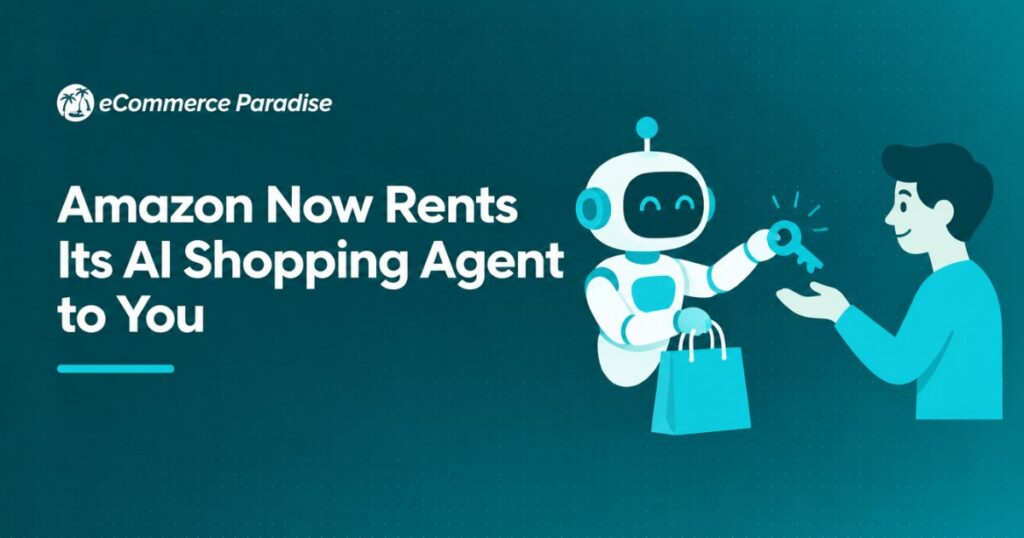
Amazon just turned the AI shopping agent it spent years building into a product it will sell to the same retailers it competes with. On June 2, Amazon Web Services launched the Agentic Shopping Assistant, a packaged version of the conversational agent tech that powers Alexa for Shopping. Any retailer can now stand up its own AI shopping agent in weeks instead of building one from scratch. The first customer out the gate was the parent company of Kate Spade, which used the tool to build the Kate Spade AI Gift Concierge.
Read that again, because it tells you exactly where this is going. The company that wants your customers is now also the arms dealer selling AI shopping tech to everyone who sells online. If you run a niche Shopify store, this is not a headline to skim past. It is a signal about how product discovery, conversion, and the customer relationship itself are being rewired in real time. I have been tracking every move in this race on Ecommerce Paradise, and this one matters more than the flashier announcements.
Below I will break down what Amazon actually shipped, how the agentic commerce race got here, what it means for a high-ticket store doing real revenue, and the specific moves to make this week.
When AI platforms sit between you and your buyer, the one record you still fully control is your business filing. The registered agent on that filing decides whether your home address gets sold and scraped. Northwest uses their own address on your public docs and does not sell your data. See why I use Northwest as my registered agent →
What Amazon Actually Shipped
The AWS Agentic Shopping Assistant lets a retailer launch a branded conversational shopping agent built on Amazon’s Bedrock AgentCore infrastructure. According to Amazon’s own announcement, the agent can be customized to a retailer’s catalog, brand voice, and customer base, then deployed in weeks rather than the months it takes to build the same thing in-house.
The pitch rests on one number. Amazon says conversational shopping sessions convert at 3.5 times the rate of traditional keyword product searches. For a high-ticket store where a single sale can be worth thousands of dollars, a conversion multiple like that is not a rounding error. It is the difference between a profitable ad spend and a losing one.
Kate Spade was the proof of concept. Per the company blog post, its AI Gift Concierge guides shoppers to the right gift for a specific recipient, and the brand tested the tool for roughly two and a half months before turning it on for customers. The agent draws on the same well of data that Amazon’s Alexa for Shopping collects, specifically the questions shoppers ask and the answers that actually lead to a sale, as Retail Dive reported.
That data point is the whole game. Amazon is not just selling software. It is selling software trained on the largest pool of real shopping intent on the planet, and it is renting that intelligence to retailers who will feed it even more behavior in return. The AWS announcement frames this as a way for retailers to preserve their customer relationships while moving fast. The quieter reality is that every query routed through the assistant teaches Amazon’s models a little more about how your category buys.
This landed only weeks after Amazon pointed Alexa for Shopping at the broader market, replacing the Rufus assistant it launched in 2024. I covered that shift when it happened in my breakdown of how Amazon retired Rufus and aimed Alexa at your store. The retailer-facing version is the logical next step: get consumers comfortable talking to an AI to shop, then sell the same conversational layer to every store that wants it.
How We Got Here
This did not come out of nowhere. The agentic commerce race has been running hard since the winter. In February, OpenAI launched “Buy it in ChatGPT,” an Instant Checkout feature built on the Agentic Commerce Protocol it co-developed with Stripe, letting users buy products without leaving the chat. You can still read the original OpenAI announcement laying out the vision.
Then reality hit. OpenAI quietly pulled Instant Checkout in March. Fewer than 30 of Shopify’s millions of merchants had gone live with it, and CNBC reported the feature did not offer the flexibility OpenAI wanted. The lesson buried in that retreat is the one most operators miss: in-chat checkout is hard, but AI-driven discovery is already here. Buyers are using these tools to find and compare products long before any cart exists.
Google and Shopify answered with the Universal Commerce Protocol, a more complete standard covering discovery through post-purchase support. Its March update added multi-item carts, live catalog queries, and loyalty integration. I walked through what that means for store owners in my piece on how Google’s universal cart made your store optional.
Shopify’s own move was the smartest defensive play of the bunch. Its Agentic Storefronts give merchants out-of-the-box access to ChatGPT, Microsoft Copilot, AI Mode in Google Search, and Gemini, all managed from the Shopify admin. The key detail, per Shopify’s announcement, is that the merchant stays the merchant of record and keeps ownership of the customer relationship and the data. Amazon’s AWS tool now competes directly with that promise, and the two companies are pulling merchants in opposite directions: Shopify wants you to keep the relationship, Amazon is happy to mediate it.
Why This Matters for Your Store
Here is the part that should change how you spend your time this quarter. For fifteen years, the high-ticket dropshipping model has run on one engine: Google Shopping ads put your product in front of a buyer, your site closes the sale. That engine still works. But a growing slice of product discovery is moving from a search results page to a conversation with an AI agent, and agents do not browse the way humans do. They read structured data, compare specs, and surface a short list. If your product feed is messy or your specs are thin, you do not make the short list, and you never even see the lost sale.
This is why owning your own channels matters more now, not less. When Amazon, Google, and OpenAI all want to sit between you and your customer, the assets you fully control become your moat. The biggest one is your email list. If a buyer found you through an AI agent and you captured nothing, you rented that customer. If you got them onto your list, you own the relationship. This is the case I have made for years for running real email flows through a tool like Omnisend instead of treating email as an afterthought.
The second controllable asset is your own on-site experience. If conversational shopping converts at 3.5 times keyword search, the answer is not to hand that conversion lift to Amazon. It is to put a real AI chat experience on your own store, under your brand, capturing your own data. I have had good results pairing a niche store with an on-site assistant like Tidio, which handles product questions and pre-sale objections without sending the shopper into someone else’s funnel. The whole point is to keep the conversation on property you own.
The Wharton perspective backs this up. Kartik Hosanagar, a marketing professor at the University of Pennsylvania, warned that leaning on external AI tools inserts distance between a retailer and its prospective customers, and that collapsing the shopping journey inside a tech platform can shift the power balance away from retailers. He is right. The stores that win the next two years will be the ones that adopt AI on their own terms instead of outsourcing their customer to a platform that also sells to that customer directly.
Run the math on a single high-ticket order to see why this is worth your attention. If you sell a 2,400 dollar product at a 22 percent gross margin, that is roughly 528 dollars of gross profit per sale. A conversion lift of even half the 3.5x Amazon is claiming, captured on your own site instead of a marketplace, can turn a flat ad month into a clear winner. The same lift handed to a platform that also competes with you builds their data moat and not yours. That is the entire decision in one sentence: same technology, opposite owner.
None of this changes the fundamentals of picking a good business. You still want a niche with real margin, real suppliers, and buyers who are willing and able to spend. If you are still choosing a direction, my high-ticket niches list is the place to start, because a strong niche with defensible product data is exactly what survives an agent-driven discovery shift. The AI layer is new. The need for a real store on a real platform like Shopify is not.
If reading all of this makes you want to skip the learning curve entirely, that is a fair reaction. Standing up a high-ticket store, wiring the suppliers, structuring the product feed for AI discovery, and building the email and chat layer is a lot of moving parts. That is exactly what my team does inside the turnkey done-for-you store build, where we hand you a launched business built for how people actually shop now, not how they shopped five years ago.
New to high-ticket dropshipping and trying to make sense of all this AI noise? Start with the fundamentals before you touch a single agent. Grab my free beginner guide →
What To Do This Week
You do not need to overhaul your business over one announcement. You do need to make a handful of specific moves so an agent-driven shift does not catch you flat. Here is the short list.
- Clean your product feed. AI agents read structured data, so missing specs, vague titles, and empty attribute fields get you skipped. Go through your top 20 revenue products and fill in every brand, model, dimension, and material field. This is the single highest-leverage hour you can spend right now.
- Decide on your Shopify Agentic Storefronts setting. Open your Shopify admin and check whether your store is exposed to ChatGPT, Copilot, Google AI Mode, and Gemini. Decide deliberately whether you want that exposure for each channel rather than letting a default choose for you.
- Lock down your email capture. Make sure every visitor has a clear reason to join your list, and that your welcome flow actually runs. If an agent sends you a buyer, your list is how you keep them. Build the flows in Omnisend if you have not already.
- Put AI chat on your own store. Add an on-site assistant that answers product questions and captures intent under your brand, so you get the conversion lift instead of handing it to a marketplace.
- Audit how you show up in AI answers. Ask ChatGPT and Google AI Mode a few buying questions in your niche and see whether your store gets named. If it does not, that is your content and feed roadmap for the next month, and it is the cheapest competitive research you will do all quarter.
Frequently Asked Questions
Does this mean Google Shopping ads are dead for high-ticket stores?
No. Shopping ads are still the primary revenue engine for most high-ticket stores, and they will be for a while. Agent-driven discovery is additive right now, not a replacement, so the move is to protect your search performance while preparing your store for AI traffic.
Should I use Amazon’s AWS agent on my own store?
Probably not as your first move. Handing your customer conversations to Amazon’s tooling feeds data back to a company that competes with you. Start with an on-site assistant you control, then evaluate bigger platforms once you understand your own numbers.
What actually makes a product show up in an AI shopping agent?
Clean, complete, structured product data and clear content that answers real buying questions. Agents reward stores that publish specs and comparisons, which is the same discipline that wins organic search.
Is in-chat checkout something I need to worry about yet?
Not urgently. OpenAI pulled Instant Checkout in March after almost no merchants adopted it, so the checkout side is still immature. Discovery is the part moving fast, so focus there first.
I am just starting out. Is now a bad time to launch a high-ticket store?
It is a good time, as long as you build for how people shop now. Pick a niche with strong margins, set up clean product data from day one, and own your email and chat from the start.
How do I keep the customer relationship when platforms keep inserting themselves?
Capture the email, run the flows, and keep the conversation on your own site. Every owned touchpoint is one a platform cannot take from you later.
Want my private weekly breakdowns and store teardowns as this agentic commerce shift plays out? Join the Patreon → Prefer Skool? Start the Academy with a 7 day free trial →
The platforms are going to keep fighting over who owns the moment a buyer decides to purchase. Your job is simpler: build a real store, own your channels, and adopt AI on your own terms. Subscribe to the YouTube channel for daily breakdowns. More breaking news later today.
Related Articles
If this was useful, these go deeper:
- Best Shopify Chatbot Apps in 2026: Top AI Chat Tools for Ecommerce Stores
- Northwest Registered Agent Review 2026: Best for Privacy-Conscious Sellers
- Ecommerce SEO Strategies: How to Drive Free Organic Traffic to Your Store

Trevor Fenner is an ecommerce entrepreneur and the founder of Ecommerce Paradise, a platform focused on helping entrepreneurs build and scale profitable high-ticket ecommerce and dropshipping businesses. With over a decade of hands-on experience, Trevor specializes in high-ticket dropshipping strategy, niche and product selection, supplier recruiting and onboarding, Google & Bing Shopping ads, ecommerce SEO, and systems-driven automation and scaling. Through Ecommerce Paradise, he provides free education via in-depth guides like How to Start High-Ticket Dropshipping, advanced training through the High-Ticket Dropshipping Masterclass, and fully done-for-you turnkey ecommerce services for entrepreneurs who want a faster, more hands-off path to growth. Trevor is known for emphasizing sustainable, real-world ecommerce models over hype-driven tactics, helping store owners build scalable, sellable, and location-independent brands.


