

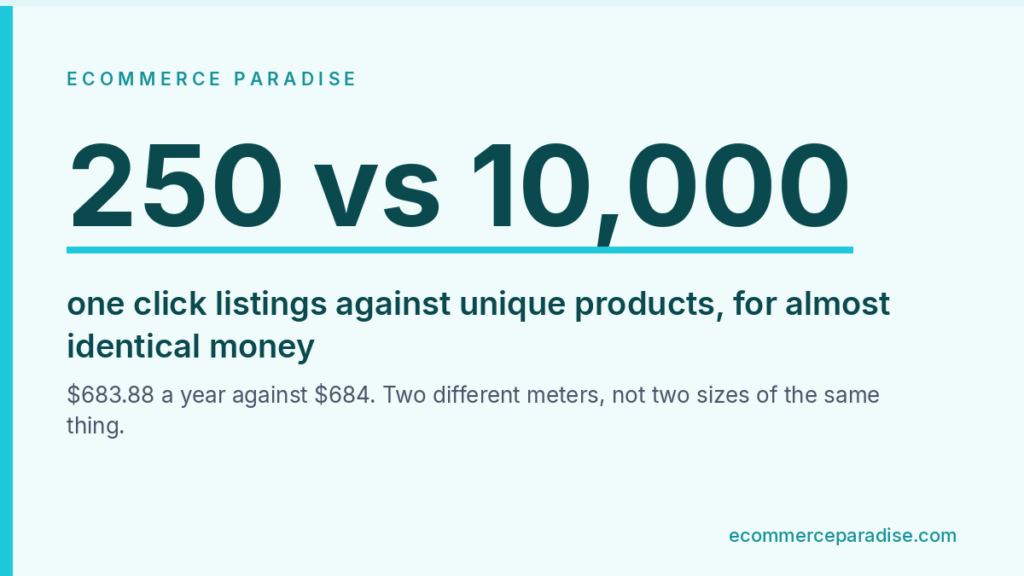

Two supplier platforms, two annual prices, six cents apart. Doba Basic computes to $683.88 a year at the rate Doba displays. Spocket Empire is $684 a year at the rate Spocket displays. If price were the whole comparison, this would be a coin flip.
It is not a coin flip, and it is also not the landslide the raw allowances suggest. For that money Doba Basic gives you two hundred and fifty one click listings. Spocket Empire gives you ten thousand unique products. Those numbers are forty times apart, which looks decisive until you notice that a one click listing and a unique product are not the same thing, are not counted the same way, and do not run out under the same conditions. This post is about what that difference actually means when you are the one paying.
Every figure below came off the two vendors’ own pricing pages on 8 September 2026. Nobody here holds a paid account on either platform. The arithmetic is mine and you can redo it in a minute.
The Two Price Lists, Side By Side But Not Divided
Doba displays quarterly billing. Every price on its page is a per month figure that only applies inside a three month commitment, and a true monthly price is not published for Basic, Standard or Enterprise. Spocket displays both a monthly price and an annual price expressed as a per month figure, except on its Starter tier, which is not offered annually at all.
That is a real difference in how the two companies present money, and it matters before you get anywhere near features. With Spocket you can see exactly what the monthly and annual options cost. With Doba, on the tier most people buy, you cannot see a monthly option at all.
| Doba plan | Displayed price | Annual, computed from the display price | Doba’s meter |
|---|---|---|---|
| Limited | $28.66 USD/mo billed quarterly | $343.92 | 30 one click listings, inventory capacity 20, 1 store |
| Basic | $56.99 USD/mo billed quarterly | $683.88 | 250 one click listings, inventory capacity 600, 2 stores |
| Standard | $142.66 USD/mo billed quarterly | $1,711.92 | 1000 one click listings, inventory capacity 3000, 5 stores |
| Enterprise | “Only Monthly / Annual Available” | not published | 2500 one click listings, inventory capacity 15000, 15 stores |
| Spocket plan | Monthly | Annual, per month | Annual total | Spocket’s meter |
|---|---|---|---|---|
| Starter | $39.99 | not offered annually | $479.88 at the monthly rate | 25 unique products |
| Professional | $59.99 | $24, “Save $432” | $288 | 250 unique products, 25 premium products |
| Empire | $99.99 | $57, “Save $516” | $684 | 10,000 unique products, 10,000 premium products |
| Unicorn | $299.99 | $79, “Save $2563” | $948 | 25,000 unique products, 25,000 premium products |
The Doba annual column is my calculation from the displayed quarterly rate, not a price Doba advertises as an annual plan. The Spocket annual column is that vendor’s own annual rate multiplied by twelve. Both vendors also run trials, and I will come back to those.
Why You Cannot Just Divide
Here is the temptation. Doba Basic works out to $2.74 per one click listing per year. Spocket Empire works out to about seven cents per unique product per year. Spocket wins by roughly forty to one, headline written, everybody goes home.
That conclusion is wrong, and it is wrong for a reason worth understanding, because the same mistake is made across this entire category. The two numbers are not measuring the same thing.
A one click listing on Doba is an action. It is the act of pushing a catalogue item into your connected store, and Doba counts each one against your allowance. It is a throughput number: how much publishing you are permitted to do.
A unique product on Spocket is an entitlement. It is a slot in your catalogue, the right to carry that item and sell it through the platform. It is a capacity number: how big your catalogue is allowed to be.
Those are related but they are not interchangeable. Doba also publishes a separate capacity figure, which it calls inventory capacity, and on Basic that number is six hundred rather than two hundred and fifty. So the honest capacity comparison at this price point is six hundred against ten thousand, not two hundred and fifty against ten thousand. It is still a large gap. It is not a forty times gap.
See What Doba Charges Today
Doba Basic displays $56.99 USD per month billed quarterly, which computes to $683.88 a year for 2 stores, 250 one click listings and inventory capacity of 600. Both vendors change prices without notice, so check before you buy.
What The Unit Difference Does Mean
Strip out the false precision and there are three real consequences.
The first is catalogue ceiling. If your business model is a wide catalogue with thin traffic across many products, Spocket Empire’s ten thousand unique products is genuinely a different scale of permission from Doba Basic’s six hundred units of inventory capacity. A store built on breadth will hit the Doba wall long before it hits the Spocket wall at the same annual spend.
The second is relisting cost. Because Doba’s listing count measures actions, churn matters. If you list, delist and relist products regularly as you test, you are consuming a finite resource that Spocket’s model does not charge you for in the same way. A store that publishes and forgets uses Doba’s allowance efficiently. A store that constantly rotates its catalogue does not.
The third is what the allowance is attached to. Spocket’s headline is unique products and premium products, and its plans are built around a supplier base weighted toward United States and European Union sellers with short shipping windows. Doba’s headline is listings, capacity and stores, and its plans are built around pushing volume into multiple storefronts. You are not buying a bigger version of the same product. You are buying a different product.
Where Doba Wins At This Price
Doba Basic gives you two store connections. Spocket’s plan pages describe product allowances rather than a store count that scales the same way, so if your constraint is running two storefronts off one subscription, Doba is answering a question Spocket’s pricing is not organised around.
Basic also includes the AI Auto Lister with thirty auto listings, an Advanced Product Research Tool, four hundred and fifty monthly downloads and three hundred AI credits. If your bottleneck is the labour of getting products live rather than the size of the catalogue you are allowed to carry, that tooling is where the money goes. The full tier by tier costing lives in the Doba pricing breakdown.
And Doba scales further on stores. Standard takes you to five storefronts and Enterprise to fifteen, though Enterprise pricing is not published so you cannot cost that path in advance.
Where Spocket Wins At This Price
Spocket’s advantage at $684 a year is not subtle. Ten thousand unique products and ten thousand premium products is an enormous entitlement compared with anything Doba offers below Standard, and Spocket includes it on a plan you can see the price of without contacting sales.
Spocket also states 0% transaction fee and unlimited orders across its plans, and advertises a catalogue described as over one hundred million products. If your model depends on carrying a lot of items and letting search do the work, that is the shape of plan you want.
Then there is the price ladder underneath. Spocket Professional at $288 a year for two hundred and fifty unique products has no equivalent on Doba’s price list. Doba’s nearest tier by allowance is Basic at a computed $683.88, and its nearest tier by price is Limited at a computed $343.92 with only thirty one click listings. If you want a modest catalogue cheaply, Spocket has a rung on the ladder that Doba does not. The tier detail is in the existing Spocket pricing guide.
The Trials Are Not Equivalent Either
Doba lists a seven day trial of Basic for US$0.99 and a five day trial of Standard for US$0.99. Spocket advertises a seven day trial across its plans. Neither costs enough to matter and both are worth using, but the way you should use them differs.
On Doba, the question a trial answers is whether the catalogue carries products you can sell at a margin, because you are buying access to an aggregated supplier base. On Spocket, the question is whether the supplier base has the shipping origins you need, because the whole pitch is faster delivery from closer warehouses. Same seven days, different test.
Whichever you trial, book the cancellation date immediately. A Doba trial that rolls over becomes a computed $170.97 quarterly charge on Basic.
Trial Doba For Ninety Nine Cents First
Doba lists a seven day Basic trial and a five day Standard trial, both at US$0.99. Search your own products, not the demo catalogue. Diary the cancellation date, because Basic rolls into a computed $170.97 quarterly charge.
Three Stores, Three Different Answers
Abstractions are easy to argue with, so here are three concrete situations and what the numbers say about each.
A store selling forty high ticket items in one category, averaging well over a thousand dollars an order. Neither platform’s allowance is remotely binding. Both annual prices vanish against a single sale. The deciding factors are supplier quality and shipping origin, not the meter, and this operator should ignore the allowance columns entirely and trial both.
A store running two storefronts across a general catalogue of three or four hundred items. Doba Basic covers the two stores explicitly and the inventory capacity of six hundred is comfortable. Spocket Empire covers the catalogue with room to spare but is not organised around a store count in the same way. At almost identical annual cost this one leans Doba, and it leans further that way if the operator is publishing to marketplaces as well as a storefront.
A store building breadth deliberately, listing thousands of low consideration items and letting search find the buyers. Doba Basic’s inventory capacity of six hundred is the wall, and Standard at a computed $1,711.92 is the next stop. Spocket Empire’s ten thousand at $684 does the job for less than half of Doba Standard. This one leans Spocket and it is not close.
Notice that the same pair of prices produced three different answers. That is the point. The money is a tie, so the money is not the decision.
The Comparison Table Nobody Should Build
Somewhere on the internet there is a table listing Doba, Spocket, SaleHoo and Inventory Source with a cost per product column, and it is fiction. Doba meters one click listings and inventory capacity. Spocket meters unique products. SaleHoo meters monthly product imports, which reset every month and are therefore a completely different kind of number again. Inventory Source meters SKUs and integrations.
You can compare annual prices honestly. You can compare what each vendor says you get, in that vendor’s own words, honestly. What you cannot do is divide one by the other across vendors and present the result as value, because the denominators are incompatible. The category wide version of this argument, with every vendor’s meter printed beside its price, is in the supplier directory ranking.
It is also worth saying what is missing from the two column view entirely. Inventory Source publishes a Supplier Directory Search tier at $0 a month covering supplier browsing, feed previews, supplier contact information and advanced filters. If your real question is whether suppliers exist for your niche, neither Doba nor Spocket is the cheapest way to find out, and that comparison gets its own treatment in the Doba against Inventory Source piece.
What Neither Price List Tells You
Both pages are silent on the two costs that decide whether a supplier platform pays for itself. The first is landed cost, meaning what an item actually costs you once shipping is on it, and no allowance figure on either page tells you anything about that. The second is how often a listed item goes out of stock, which is the difference between a catalogue and a liability, and again neither vendor quantifies it where a buyer can see it.
This is why the ninety nine cent Doba trial and the Spocket trial are worth more than the price comparison you just read. Search both catalogues for the exact items you intend to sell, write down the wholesale price, add shipping, and put that against the price those items actually clear at on the channels you compete on. If the margin is not there, the annual subscription cost is irrelevant, because you were never going to make money either way.
How To Actually Choose
Ask three questions in this order and the decision usually makes itself.
How many products will you carry at once? If the honest answer is under a few hundred, the ten thousand product entitlement is headroom you will never touch and you should be shopping on features and shipping origin instead of allowance. If it is thousands, Spocket Empire is offering something Doba does not sell at that price.
How many storefronts? If you need two or more on one subscription, Doba’s store counts are explicit and its ladder is built around them.
Where do your customers expect the parcel to come from? This is the question people leave until last and it is the one that most often decides. Spocket’s proposition is built on nearby supplier origins. Doba’s is built on catalogue aggregation and listing throughput. Neither is better in the abstract.
If none of the three answers point cleanly at one platform, the wider sort by meter in the Doba alternatives guide covers the rest of the field, including options that charge nothing and options that charge far more.
The Honest Verdict
At the price point where these two collide, Spocket Empire offers a much larger catalogue entitlement and Doba Basic offers multi store publishing with listing automation. Six cents separates the annual cost. Everything else about the two products is different.
What I will not tell you is that Spocket is forty times better value. That claim comes from dividing two numbers that are not the same unit, and anyone who prints it either has not read the pricing pages or is hoping you will not. What I will tell you is that if catalogue size is your binding constraint, Spocket wins clearly at $684 a year, and if store count and listing speed are your constraints, Doba Basic is a defensible $683.88.
Readers who want the platform verdict rather than the head to head should read the Doba platform review. Anyone weighing Doba against a hand vetted contact directory instead of a catalogue marketplace will find that argument in the existing SaleHoo against Doba comparison.
Same Money, Different Meter
Doba Basic computes to $683.88 a year for 250 one click listings, inventory capacity of 600 and 2 stores. Spocket Empire is $684 a year for 10,000 unique products. Pick the meter that matches your constraint, not the bigger number.
Running The Business Behind The Store
Choosing between two supplier subscriptions is a small decision inside a much larger one, and the larger decision is what you sell. Work through the list of high ticket niches worth entering before you commit to either platform, because the answer changes which meter matters.
Order value decides whether a subscription in this price band is background noise or a real cost, and the case is laid out in the primer on what high ticket dropshipping actually involves. One good sale covers either platform for a year.
There is also a third route that neither of these companies will mention, which is going direct to manufacturers, and the full method is in the walkthrough on how to find suppliers for high ticket products. It costs time instead of money.
Whichever route you take, get the entity filed before you apply for wholesale accounts, and the guide to business formation for high ticket dropshipping covers what suppliers will ask you for.
On the operating stack, both platforms in this comparison integrate with Shopify first, which is why most stores in this category end up there. Getting the paperwork filed is a job for Bizee if you would rather not deal with the state forms yourself.
Liability cover is the line item that gets skipped until a distributor asks for a certificate, so budget for Hiscox at the same time as the supplier subscription rather than after.
If you would rather skip the assembly entirely, there is a done for you high ticket store build and launch service that handles the whole build.
Frequently Asked Questions
Is Doba or Spocket cheaper?
At the tiers that collide they are within six cents a year of each other. Doba Basic computes to $683.88 from its displayed quarterly rate and Spocket Empire is $684 at its annual rate. Lower down the ladder Spocket Professional at $288 a year has no Doba equivalent.
Does Spocket really give forty times more than Doba for the same price?
No, and that framing comes from dividing incompatible units. Spocket Empire’s ten thousand unique products is a catalogue entitlement. Doba Basic’s two hundred and fifty one click listings is a publishing allowance, and Doba separately allows inventory capacity of six hundred. The gap is real and large. It is not forty to one.
What is Doba’s monthly price?
Not published for Basic, Standard or Enterprise. The pricing page shows USD per month rates billed quarterly, which is a different thing from a monthly plan.
Which one is better for United States suppliers?
Spocket’s proposition is built around suppliers in the United States and European Union with shorter shipping windows, and its plans are priced around that. Doba is a broader aggregation marketplace. If shipping origin is your deciding factor, that points at Spocket.
Which one is better for running several stores?
Doba, because it publishes explicit store counts on every tier: one on Limited, two on Basic, five on Standard and fifteen on Enterprise. If you need two storefronts on one subscription, Basic covers it.
Do either of them offer a free plan?
Neither does. Doba lists trials at US$0.99 and Spocket lists a seven day trial. The only genuinely free option in this category is Inventory Source’s Supplier Directory Search tier at $0 a month, which offers directory access and supplier contact information but no automation.
What happens if I go over the allowance?
Neither pricing page spells out an overage charge for these tiers, which in practice usually means the platform stops you rather than billing you, but I am not going to state that as fact when the page does not. Ask before you subscribe if you expect to run close to a limit.
Can I use both at once?
Nothing stops you, and some stores do exactly that, using one platform for catalogue breadth and the other for faster shipping origins. Just cost it honestly, because a computed $683.88 plus $684 is a real annual line item that needs a margin behind it.
Related Articles
Doba Pricing 2026: Every Plan Costed Against What It Meters
Doba Review 2026: What the Quarterly Price Actually Buys
Doba Alternatives 2026: Ranked by What Each Platform Actually Meters
Spocket Pricing in 2026: A Complete Guide to All Plans and Features
SaleHoo vs Doba: Hand Vetted Directory Against Automated Marketplace

Trevor Fenner is an ecommerce entrepreneur and the founder of Ecommerce Paradise, a platform focused on helping entrepreneurs build and scale profitable high-ticket ecommerce and dropshipping businesses. With over a decade of hands-on experience, Trevor specializes in high-ticket dropshipping strategy, niche and product selection, supplier recruiting and onboarding, Google & Bing Shopping ads, ecommerce SEO, and systems-driven automation and scaling. Through Ecommerce Paradise, he provides free education via in-depth guides like How to Start High-Ticket Dropshipping, advanced training through the High-Ticket Dropshipping Masterclass, and fully done-for-you turnkey ecommerce services for entrepreneurs who want a faster, more hands-off path to growth. Trevor is known for emphasizing sustainable, real-world ecommerce models over hype-driven tactics, helping store owners build scalable, sellable, and location-independent brands.

Still deciding what to sell?
Grab the free list of 1,000+ niches that work for high-ticket dropshipping, sorted by category.
Free. Unsubscribe any time.


