


If you run an online store, you already know the moment. You find the car, you fill in the finance form, and it asks for your employer. You don’t have one. You are the employer. Your income shows up as Shopify payouts, Stripe transfers and a tax return that your accountant worked very hard to make look small.
So which auto loans actually work for self-employed borrowers in 2026? I went through what each of the big names publishes about 1099 income, bank statement income, business income and buying a car in an LLC’s name. The short version is a bit uncomfortable, and I’m going to give it to you straight, because that is the whole point of this post.
Quick note before we get into it: this is general information, not financial advice. Rates and terms change all the time, so check each lender’s current terms before you apply. I’m not a lender and I’m not a financial adviser. I’m a guy who has sold physical products online for fifteen years and reads the fine print for a living.
Affiliate disclosure: the myAutoloan links in this post are monetised affiliate links. myAutoloan pays us per lead, which means we get paid when you submit its form, whether or not you ever take a loan. Every other lender and marketplace in this post (LendingTree, Autopay, RateGenius, Caribou, LightStream and PenFed) pays us nothing, and I link to their own sites directly. The Shopify, Bizee and Hiscox links in the business section near the end are affiliate links too.
The short answer for self-employed store owners
Here is what I found, and I’ll back every line of it up below.
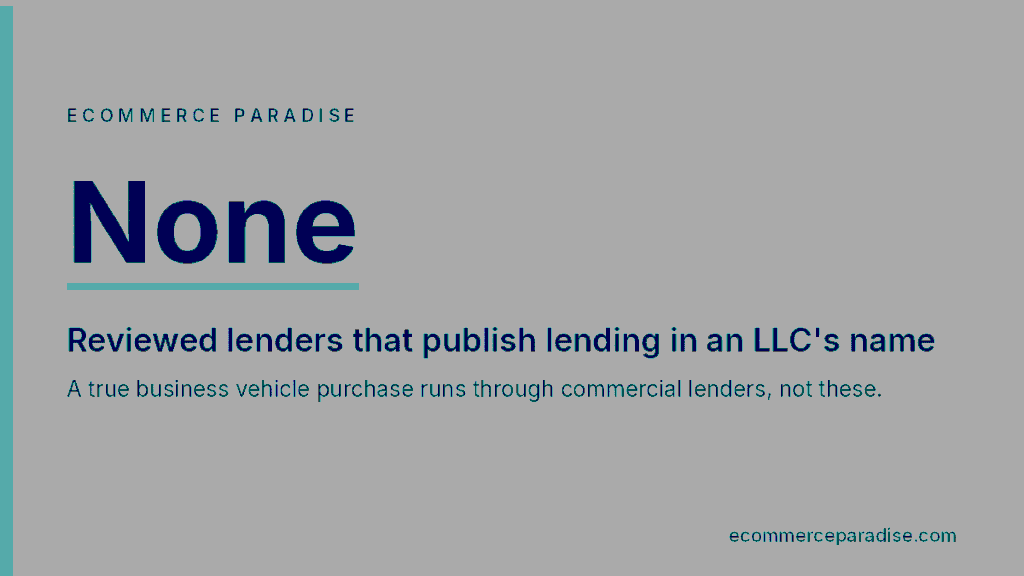
- None of the lenders or marketplaces reviewed here publishes a way to borrow in an LLC’s name. Not one. Every product in this post is a personal loan in your own name. If you want the car titled and financed in the business’s name, you need a commercial lender or your business bank, and that is a different process.
- Almost nobody publishes a self-employed income policy. myAutoloan says nothing about 1099 or bank statement income on its policy pages. The one exception I found is RateGenius, which says self-employed applicants need to give their net monthly income.
- Expats are mostly out. myAutoloan requires you to live in one of 48 US states. LendingTree only serves loans that originate in the United States.
- Your write-offs can work against you. If a lender looks at net income, every deduction that lowers your tax bill also lowers the income you can show.
That is not the answer most “best auto loans” lists give you. But it’s the honest one, and it will save you a lot of wasted applications.
What each lender publishes on self-employed and business income
This is the table I wish I’d had. It only shows what each company actually says on its own public pages. Where a company is silent, I say so rather than guess.
| Lender or marketplace | What it is | Self-employed, 1099 or bank statement income | Loan in an LLC’s name | Where you must live |
|---|---|---|---|---|
| myAutoloan | Marketplace run by Horizon Digital Finance, LLC. Not a lender. | Nothing on policy pages. FAQ: “Income requirements will vary by lender.” | No stated policy | One of 48 states (not Alaska or Hawaii) |
| LendingTree | Marketplace and lead generator. Not a lender. | Silent on the pages I read | Silent | Loans that originate in the continental US, Alaska and Hawaii |
| Autopay | Arranger in The Savings Group network (same parent as RateGenius) | Asks for “Proof of Income (paystubs, tax returns)”. No self-employed policy. | Silent | Not stated on the pages I read |
| RateGenius | Refinance platform, The Savings Group | Self-employed applicants give net monthly income | “We cannot refinance the vehicle under a company’s name.” | Not stated on the pages I read |
| Caribou | Refinance marketplace | Income documents given as “a pay stub or W-2”. No self-employed policy. | No commercial vehicles | Offers not available in MD, NE, NV, WV |
| LightStream | Direct lender (Truist Bank), unsecured | Silent on the pages I read | “Loans are made to individuals for personal use, not to businesses.” | Not checked |
| PenFed Credit Union | Direct lender, membership required | Silent on the pages I read | Silent | Up to 125% financing “in the U.S., Puerto Rico and Virgin Islands” |
Look at that middle column. That is the problem in one picture. Self-employed borrowers are a huge chunk of the market, and the lenders mostly don’t tell you how they will treat your income until you apply.
The LLC question: can you buy the car in your business’s name?
This is the question I get most from store owners, so let me be really, really plain about it.
None of the lenders or marketplaces in this post publishes a way to finance a vehicle in an LLC’s name. Here is what each one says:
- RateGenius: “RateGenius can refinance a vehicle purchased under a company name into a personal vehicle loan as long as the individual has company authorization. We cannot refinance the vehicle under a company’s name.” It also says commercial vehicles and heavy equipment are not eligible.
- LightStream: “Loans are made to individuals for personal use, not to businesses. You may not use your loan proceeds for business purposes.” Funding and payments also have to go to and from a personal bank account.
- Caribou: “we are unable to offer refinancing for motorcycles and any commercial vehicles.”
- myAutoloan: no stated policy on business, LLC or commercial loans anywhere I looked. Its product pages describe personal consumer borrowing: your income, your age, your state of residence.
- LendingTree, Autopay and PenFed: silent on the pages I read. Silence is not a yes.
So if you want a true business vehicle purchase, with the LLC as the borrower and the business on the title, you’re looking at a commercial auto loan. That usually means your business bank, a credit union that does business lending, or a dedicated commercial vehicle lender. Those lenders will typically want to see the business itself: how long it has existed, its bank statements, its tax returns and its credit file. Many will also ask you to personally guarantee the loan, so ask about that up front.
That is why business credit matters here. If your LLC has no credit history, a commercial lender has nothing to go on except you. I wrote a full walkthrough on how to build business credit for an ecommerce store, and it’s the first thing I’d read if a business vehicle is on your roadmap.
If you haven’t set up the entity yet, start with my guide on how to form an LLC step by step. And if you want to watch your business credit file while you build it, here is my comparison of the best business credit monitoring platforms for ecommerce.
One more thing. Financing the car personally and then using it partly for the business is common, and the tax side of that is its own topic. I’m not going to give tax advice here. Point your accountant at IRS Publication 463 (Travel, Gift, and Car Expenses) and IRS Publication 946 (How To Depreciate Property), and let them tell you what applies to you.
myAutoloan for self-employed borrowers: what it does and doesn’t say
myAutoloan is the one company in this post that pays us, so I want to be extra careful here.
First, what it is. myAutoloan is an auto loan marketplace operated by Horizon Digital Finance, LLC. It is not a lender. Its own process page says Horizon Digital Finance “is not acting as a lender or loan broker and does not make extensions of credit to consumers.” You fill in one form, and it says you can get “up to 4 offers” from participating lenders. It covers new, used, refinance, private party and lease buyout loans, which is broader than most marketplaces.
On self-employed income, myAutoloan’s policy pages say nothing. No mention of 1099 income, bank statement income or business owners. Its FAQ says “Income requirements will vary by lender” and that “employment requirements will vary depending on the lender.” The same FAQ says lenders “will look at the length of time you’ve been at your current place of employment, as well as the year-to-date earnings on your pay stub.” That wording is written for W-2 employees. It doesn’t mean self-employed people are rejected. It means you’re relying on whichever lenders see your form.
The published minimum income is $1,800 a month ($21,600 a year) for new, used and private party loans, and $1,500 a month ($18,000 a year) for refinance. The new car page also shows a line saying “Minimum monthly income of $2,000 required”, so the site contradicts itself there. myAutoloan also says you “may still submit a loan application even if you do not meet all of the criteria”, though it may not find a lender.
The site does have a blog post from May 2023 called “How to Get an Auto Loan When You Are Self-Employed”. It’s general advice, not a policy. It says “Most auto loan lenders will require at least six months of bank statements” and “most lending institutions will ask you to provide at least two years of tax returns.” Treat that as the site’s general guidance, not a promise from myAutoloan or its lenders.
The rates. myAutoloan advertises floor rates, and they are exactly that. As of August 18, 2026, it showed as low as 4.99% APR for new car loans, 5.24% for used, 7.24% for private party, 4.24% for refinance and 3.90% for lease buyout. Those are the lowest rates participating lenders recently offered. Its own rate FAQ says “most borrowers will qualify for rates above the lowest advertised figures.” As a self-employed borrower with no stated income policy, I would plan on landing above the floor.
The credit pull. The homepage says myAutoloan “acquires a “soft” credit inquiry, which does not affect your credit score.” The same homepage also says “Submitting an Offer Form may result in soft credit and/or hard credit inquiries from the Lenders.” Both are true. The marketplace itself does a soft pull. The lenders may do a hard one.
Your data and your phone. When you submit, you authorise Horizon Digital Finance to share your information with lenders and their networks, and with what it calls “Credit Sources”, which it says are “not within our network.” Its privacy policy also lists sharing with auto dealers. Those companies “may contact you directly by: Phone / Email / Text message.” If you want them to stop, you have to contact each company directly. Go in expecting calls.
Cost. myAutoloan says it “does not charge consumers a fee to use its service”, and that it “may receive compensation from Lenders or Credit Sources”. Lender fees like origination or title fees depend on the lender. So it’s free to use, but it isn’t a charity: the lenders pay the marketplace, and the loan itself can still carry fees.
Compare up to 4 lender offers with one form
myAutoloan advertised as low as 4.99% APR for new and 5.24% for used car loans as of August 18, 2026, the lowest rates participating lenders recently offered. Most borrowers see higher rates, lenders may run a hard inquiry, and it publishes no self-employed income policy.
If you want my full take on the marketplace itself, read my myAutoloan review. For the complete rate chart by term, see my breakdown of myAutoloan rates.
The other options, lender by lender
LendingTree
LendingTree is also a marketplace. Its disclosures say it “is not a lender in any transaction and does not make loans”. It says you can get offers “from up to five trusted lenders.” It advertised purchase offer rates as low as 5.19% APR as of 21 September 2026, on a $55,000 loan over 48 months, based on offers to consumers with the same self-identified credit rating. That’s a floor, not an offer.
LendingTree does a soft pull itself and says each lender has its own policy, with some pulling your credit before an offer and some after you accept. It’s silent on self-employed income on the pages I read. And it only serves loans that originate in the United States. I compare the two marketplaces head to head in myAutoloan vs LendingTree.
Autopay and RateGenius
These two are sister brands. Both belong to The Savings Group, so don’t treat them as two independent opinions.
Autopay handles refinance, purchase, lease buyout and cash out refinance. Its FAQ says it offers loan amounts from $2,500 to $100,000 and terms from 24 months to 96 months for qualified applicants. Its documentation list includes “Proof of Income (paystubs, tax returns)”. It doesn’t publish an APR floor, and its legal page says title and lien transfer fees apply and an origination fee may apply depending on your state. More in myAutoloan vs Autopay.
RateGenius is refinance only, and it is the only company here that says anything useful about self-employment. Its FAQ says “Individuals who are considered self-employed will need to provide their net monthly income (income after taxes and deductions as opposed to gross monthly income).” It also says applicants who don’t meet income requirements can add a co-applicant. Its hard limits: a vehicle under 10 years old with under 120,000 miles, a personal use vehicle, and a balance between $10,000 and $55,000.
Caribou
Caribou is refinance only too. It’s clear about the credit pull: a soft pull to check rates, then a hard pull if you continue your application. Its APR range is 4.18% to 28.55%, valid as of 8/13/26, with the lowest rate for a 36 month term and excellent credit. Its income example is “a pay stub or W-2”, so self-employed borrowers should expect to document things differently. No commercial vehicles.
LightStream
LightStream, from Truist Bank, is a direct lender with an unsecured auto loan from $5,000 to $100,000. It places no restrictions on the vehicle’s year, make, model or mileage, and it lets you buy from a dealer or a private seller. It says “LightStream loans do not have any fees.”
The trade offs: the application “pulls a hard inquiry from TransUnion or Equifax”, there’s no prequalification, and the advertised new car range is 7.74% to 17.74% APR with AutoPay (rates without AutoPay are 0.50 points higher, and the lowest rates require excellent credit). And again, it’s personal use only. You can’t use the proceeds for business purposes.
PenFed Credit Union
PenFed publishes dated rate tables, which I really like. As of September 1, 2026, new auto purchase rates started at 4.19% APR for 36 months, and used at 4.79% for 36 months. It says “Rates quoted assume excellent borrower credit history. Not all applicants will qualify for the lowest rate.” You have to join to borrow, and a $5 savings deposit opens membership. The initial rate check is a soft pull, and a full application is a hard pull. It’s silent on self-employed income on the pages I read.
Rate snapshot, with the fine print attached
Every rate below is an advertised floor or range, with the vendor’s own date. None of them is an offer to you.
| Lender or marketplace | Advertised rate | Date and condition |
|---|---|---|
| myAutoloan | As low as 4.99% new, 5.24% used, 7.24% private party, 4.24% refinance, 3.90% lease buyout | As of August 18, 2026. Lowest rates participating lenders recently offered; most borrowers will see higher rates. |
| LendingTree | As low as 5.19% purchase, 5.00% refinance | As of 21 September 2026, on a $55,000 and an $88,000 loan over 48 months |
| PenFed Credit Union | New from 4.19%, used from 4.79% (36 months) | As of September 1, 2026. Assumes excellent credit. |
| LightStream | New car 7.74% to 17.74% | Undated (no rate date published); with AutoPay discount; lowest rates require excellent credit |
| Caribou | Refinance 4.18% to 28.55% | Valid as of 8/13/26; lowest APR at 36 months with excellent credit |
| Autopay | Not published | n/a |
| RateGenius | Undated average table by credit tier | Averages, not offers; “do not bind any lender” |
How to document self-employed income before you apply
Because the lenders don’t publish self-employed policies, the smartest move is to over-prepare. What follows is general, practical advice. It isn’t any specific lender’s policy, and each lender will decide what it wants to see.
- Pull your last two years of personal tax returns, including every schedule. Ask your accountant which one shows your business income.
- Download bank statements. Have several months ready for both your personal and business accounts, showing regular deposits.
- Keep your 1099s together. Payment processors and marketplaces may send them. They back up the income on your return.
- Print a year-to-date profit and loss statement. If your books are in accounting software, this takes two minutes. A clean P&L helps explain a year that doesn’t look like last year.
- Know your net number. If a lender like RateGenius wants net monthly income, figure out what that looks like before you type anything into a form.
- Have your ID, insurance and proof of address ready. Autopay, for example, lists a driver’s license, insurance, proof of income and proof of residence.
If your books are a mess, fix that first. My guide on how to file taxes as an ecommerce seller in 2026 walks through getting your records straight, which helps at tax time and at loan time.
The write-off trap
This one catches a lot of store owners. When you run everything you legally can through the business, your taxable income goes down. That’s the goal at tax time. But when a lender looks at net income, as RateGenius says it does for self-employed applicants, that lower number is the one you qualify on.
I’m not telling you to change how you file. That’s a conversation for your accountant. I’m telling you to know the number a lender will see before you apply, so you’re not surprised. A co-applicant with W-2 income, a bigger down payment or a cheaper car are all levers you control.
What a longer term really costs
When income is harder to prove, it’s tempting to stretch the term to get the payment down. Here’s an illustration. It uses the standard loan payment formula, M = P × r / (1 − (1 + r)^−n), where r is the APR divided by 12 and n is the number of months. It leaves out fees, taxes and add-ons, and it is not an offer from any lender.
| $30,000 at 7.00% APR | Monthly payment | Total interest | Total paid |
|---|---|---|---|
| 60 months | $594.04 | $5,642.12 | $35,642.12 |
| 72 months | $511.47 | $6,825.87 | $36,825.87 |
The 72 month term cuts the payment by $82.57 a month and costs $1,183.75 more in interest. The CFPB makes the same point: “While the longer loan term gives you a lower monthly payment, consider the total cost you’ll pay over the full term of your loan.”
Buying from a private seller or buying out a lease?
myAutoloan covers private party (as low as 7.24% APR) and lease buyout (as low as 3.90% APR), as of August 18, 2026. Those are the lowest rates participating lenders recently offered; most borrowers qualify above them. US residents in 48 states, personal name only.
Living abroad? Read this first
A lot of my readers run their stores from Thailand, Mexico, Portugal or wherever. I’ve lived as a digital nomad since 2019 myself. So here’s the honest bit: myAutoloan is not for you if you live outside the US. Every product page says you “must reside in a state where myAutoloan currently does business (we do business in 48 states, but not in Alaska or Hawaii).”
LendingTree says it only services requests for loans that originate in the continental United States, Alaska and Hawaii. PenFed’s 125% financing applies in the U.S., Puerto Rico and the Virgin Islands. If you’re abroad and need a car in the US, you’ll generally need a US address you actually live at, or you’ll need to deal with a bank you already have a relationship with.
Which option fits which self-employed buyer
- You live in the US, borrow in your own name, and want several offers from one form: myAutoloan is worth a look, especially for private party or lease buyout, as long as you’re fine with lender calls and a possible hard inquiry.
- You have strong credit and don’t mind joining a credit union: PenFed publishes dated rates and does a soft pull to check them. Its published floors sit at or below myAutoloan’s advertised floors for new and used purchases.
- You’re buying an older or high mileage car from a private seller with good credit: LightStream has no vehicle age or mileage limits and no fees, but expect a hard inquiry up front and personal use only.
- You’re refinancing and want a straight answer on self-employment: RateGenius is the only one that publishes how it treats self-employed income. Caribou is the clearest on its credit pull. My best auto refinance companies post goes deeper.
- You want the LLC to own and finance the vehicle: none of these. Go to your business bank or a commercial lender.
Already have a car loan you’re unhappy with? My step by step guide on how to refinance a car loan covers the credit pull window, add-ons and when a longer term costs you more. And for every other marketplace and lender I looked at, see myAutoloan alternatives.
Keep your personal and business credit separate
Every loan in this post lands on your personal credit file. That’s one more reason to build separate business credit for the store. When the business has its own cards and its own history, your personal file stays cleaner for the day you need a car, a lease or a mortgage.
If you’re still paying inventory on a personal card, read business credit card vs personal credit card. Then use my guide on how to get a business credit card to set one up properly.
Running the business behind the store
A car loan is a personal decision, but the income that qualifies you for it comes from the store. The stronger and cleaner that income is, the easier every loan conversation gets. If you’re still choosing what to sell, start with my high-ticket niches list.
If you’re new to the model, here’s what high-ticket dropshipping actually is and why it produces fewer, bigger orders.
Suppliers make or break the business. My complete guide on how to find suppliers for high-ticket dropshipping walks through it step by step.
And get the structure right early. My post on business formation for high-ticket dropshipping covers entity setup for store owners.
The stack I recommend: build the store on Shopify. Form your LLC with Bizee.
Then cover the business with liability insurance from Hiscox, because a store selling high-ticket products needs real coverage.
If you’d rather have it built for you, check out my done-for-you high-ticket dropshipping store build.
Self-employed and buying in your own name?
myAutoloan is free to use, and lenders pay it. Refinance income minimum is $1,500 a month; other loans list $1,800. Submitting shares your data with lenders and Credit Sources, and lenders may run a hard inquiry. It is a personal-name product and publishes no business or LLC loan policy.
FAQ
Can I get a car loan if I’m self-employed?
Yes, self-employed people get car loans all the time. The catch is that most lenders don’t publish how they’ll treat your income. Of the companies in this post, only RateGenius says what it wants: net monthly income. Expect to show tax returns and bank statements, and apply through a lender or marketplace that lets you compare several offers.
Does myAutoloan accept 1099 or bank statement income?
myAutoloan’s policy pages say nothing about 1099 or bank statement income. Its FAQ says income requirements “will vary by lender.” Its 2023 blog post on self-employed loans is general advice that mentions bank statements and tax returns, but it isn’t a policy. You’re relying on the individual lenders who see your form.
Can my LLC get an auto loan through myAutoloan, LightStream or RateGenius?
Not on anything they publish. None of the lenders or marketplaces reviewed here publishes a way to borrow in an LLC’s name. RateGenius says it cannot refinance a vehicle under a company’s name. LightStream lends to individuals for personal use, not to businesses. myAutoloan has no stated business loan policy. For a true business vehicle purchase, talk to your business bank or a commercial auto lender.
Will checking rates hurt my credit?
It depends on the step. myAutoloan does a soft inquiry itself, but says submitting the form “may result in soft credit and/or hard credit inquiries from the Lenders.” PenFed and Caribou do a soft pull to check rates and a hard pull if you apply. LightStream’s application is a hard inquiry. The CFPB says multiple auto loan inquiries generally count as one if they’re made within 14 to 45 days of each other, depending on the scoring model, so the safe practice is to finish your shopping within 14 days.
Can I use myAutoloan if I live abroad?
No. myAutoloan requires you to live in one of the 48 US states it serves. Alaska and Hawaii are excluded, and so is anywhere outside the US.
Can I deduct my car if I use it for the business?
I don’t give tax advice. The IRS covers business car use in Publication 463 and depreciation in Publication 946. Take those to your accountant and let them work out what applies to you.
Is myAutoloan a lender?
No. It’s a marketplace run by Horizon Digital Finance, LLC, which says it “is not acting as a lender or loan broker.” The loans come from participating lenders, and myAutoloan gets paid by those lenders.
Related Articles
How to Refinance a Car Loan in 2026
How to Build Business Credit for Ecommerce
How to Form an LLC: The Complete Step-by-Step Guide

Trevor Fenner is an ecommerce entrepreneur and the founder of Ecommerce Paradise, a platform focused on helping entrepreneurs build and scale profitable high-ticket ecommerce and dropshipping businesses. With over a decade of hands-on experience, Trevor specializes in high-ticket dropshipping strategy, niche and product selection, supplier recruiting and onboarding, Google & Bing Shopping ads, ecommerce SEO, and systems-driven automation and scaling. Through Ecommerce Paradise, he provides free education via in-depth guides like How to Start High-Ticket Dropshipping, advanced training through the High-Ticket Dropshipping Masterclass, and fully done-for-you turnkey ecommerce services for entrepreneurs who want a faster, more hands-off path to growth. Trevor is known for emphasizing sustainable, real-world ecommerce models over hype-driven tactics, helping store owners build scalable, sellable, and location-independent brands.

Still deciding what to sell?
Grab the free list of 1,000+ niches that work for high-ticket dropshipping, sorted by category.
Free. Unsubscribe any time.


