

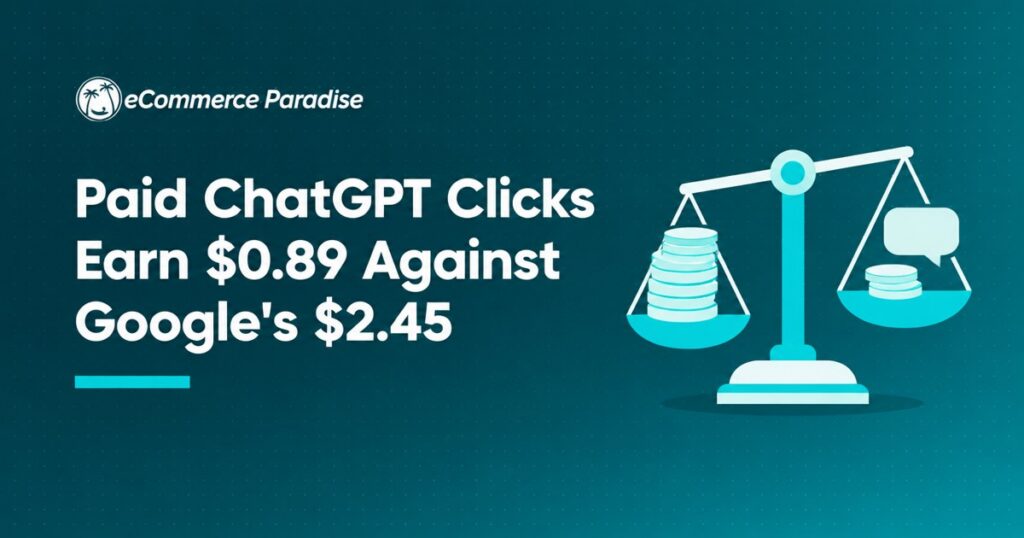
Paid ChatGPT visits earned online stores $0.89 each, against $2.45 for paid Google search, according to an October 2026 working paper covering about 10 billion sessions.
If you run a high-ticket store, that gap lands on your ad budget first. OpenAI recommends starting bids of $3 to $5 per click, while the paper puts a ChatGPT click at roughly $0.26 if you want the same return per dollar that search gives you. This is the kind of number we track at Ecommerce Paradise, because it decides which channel deserves your next $1,000.
Three things matter here: what the researchers measured, what the one big winning account looks like, and what a store with a four-figure average order should test before spending anything. The study is early and unreviewed, and its paid sample leans toward services, software, education and finance rather than furniture or mobility, so treat it as a warning label and not a verdict.
Every new ad channel sends you strangers you pay for once. Capture their email on the first visit and a weak channel stops being a total loss. Set up email capture and flows with Klaviyo →
ChatGPT Paid Visits Earn $0.89 Against Google’s $2.45
The paper is titled “Can Advertising Fund Free AI? Evidence from ChatGPT’s International Advertising Rollout.” Its authors are Maximilian Kaiser of the Vienna University of Economics and Business and Christian Schulze of the Frankfurt School of Finance & Management. It is a version-one working paper dated October 2026 and has not completed peer review, according to PPC Land, which published its breakdown on November 2.
The authors tracked 60 weeks of Google Analytics 4 ecommerce data, from June 29, 2025 to August 22, 2026, per the paper’s page. The organic panel holds 1,898 websites with about $16 billion in annual sales. The paid panel holds 387 sites that received at least one paid ChatGPT click, and 102 of those have complete financial data. Grips Intelligence supplied the data free of charge. Kaiser is a scientific adviser to Grips, and the paper says the company had no right to review or delay publication.
Paid ChatGPT traffic versus paid Google search
In US traffic, a paid ChatGPT visit returned $0.89 in revenue against $2.45 for a paid Google search visit, a 64% shortfall. Conversion was 0.37% against 1.17%. Within the same websites, paid ChatGPT orders ran $74 smaller. Of 87 advertisers buying both channels in the US, 84 earned less per paid ChatGPT visit, and 73 recorded no paid ChatGPT transaction at all.
The results are concentrated. One advertiser accounts for 66% of paid ChatGPT purchases in the financial sample, according to PPC Land’s summary of the paper, and removing it widens the gap. The median paid ChatGPT account in the panel converted at 0.00%.
The authors also calculate a parity price. About $0.26 per click is the price at which a ChatGPT click would return as much per dollar as a search click, with a resampled range of $0.05 to $0.57. The median account on Google’s search network paid $1.01 per click across 40,183 accounts. The largest publicly known ChatGPT account paid $1.72 per click, about 6.6 times parity, a figure the paper took from a public report and did not verify.
Organic ChatGPT traffic held up
The organic findings are kinder. Organic ChatGPT referrals fell 5.9% over the first 13 weeks after ads launched in a market, with a 95% interval of -12.6% to +1.2%, which includes zero. Adjusting for faster ChatGPT growth in North America puts the drop between 7.2% and 8.4%. Conversion barely moved, down 0.02 percentage points from a 2.21% baseline.
Organic ChatGPT sessions generated $3.27 each in US traffic, the highest of the five channels the paper measured. That is the number to keep in your head while everyone argues about ad prices.
How ChatGPT Ads Went From $250K Minimums to Self-Serve
The price of entry collapsed in three months. At the February pilot launch, the minimum spend commitment ran as high as $250,000, according to Techwyse. On April 22, ChatGPT ads moved to cost-per-click bidding with bids of $3 to $5 and a $50,000 minimum, with ads shown only to Free and Go tier users and contextual targeting, per a report citing The Next Web.
On May 5, OpenAI opened a beta self-serve Ads Manager at ads.openai.com to US advertisers, rolling out gradually. Benji Shomair, an OpenAI vice president, said “the minimum spend commitment will be removed altogether,” per Techwyse. The launch categories included household and consumer goods, local services, travel and entertainment, and digital products and education. OpenAI also announced a Conversions API and said it retains ownership of the pixel, so advertisers cannot create it independently. For CPC campaigns, OpenAI recommends a starting maximum bid of “$3 to $5 USD per click.”
The study’s design explains why it can speak to the rollout. The authors compared nine countries with ads (the US, Australia, Canada, New Zealand, the UK, Japan, Korea, Brazil and Mexico) against the 27 EU member states, which had no ads during the window, using a staggered-rollout method that tracks each site, country and device week by week.
The counterpoint: one account that made money
Not everyone lost. Opascope published figures on June 15 from one live account running scaled campaigns. Across 15 complete days it spent about $60,000, booked about $89,000 in revenue, and posted a blended return on ad spend of 1.49x, with daily swings from about 0.2x to 2.9x. CPC was about $1.72 and conversion was 2.35%. Opascope tied revenue to spend with its own first-party tracking, because the platform dashboard reports CPC and CPA but not ROAS.
The paper calls that account “the exception, not the rule,” per PPC Land. The authors also list their own limits. The measurement is last-click only. The paid evidence covers the first 28 weeks and rests on about 0.45 million paid sessions. Conversion-optimized campaigns, available since June 5, 2026, fall in the last 11 weeks and are not analyzed separately. The method can only detect lifts of roughly 50% or more, and ads in the EU launched after the window closed.
I covered the traffic side of this earlier, when a study found ChatGPT sends 0.62% of Google’s organic traffic. Earlier in October, Shopify said AI-referred sessions convert 80% better. Neither claim conflicts with this paper, which finds organic ChatGPT traffic converts like organic search and paid traffic does not.
There is also a funding story behind the pricing. Per PPC Land’s summary, the paper estimates ads bring in about $1 per free user per year while inference costs about $5. The authors argue value per click has to rise, and that moving ads inside answers could raise it at the cost of user trust. If OpenAI is under that pressure, expect auction rules and prices to keep changing, which is another reason not to anchor a budget to today’s numbers. And if your attribution looks off, remember the tracking bug that hid AI referrals for a week in October.
What $0.26 Parity Means for a High-Ticket Store’s Budget
My read is that the early data says ChatGPT ads are priced like search and behave like a lower-intent channel. People in a chat are often researching, not shopping, and the 0.37% conversion rate fits that. That is a read, not a finding, and the paper does not test intent directly.
Here is the math that matters for high-ticket, and every figure below is hypothetical, not reported. Take a store with a $1,800 average order and a 25% gross margin, which is $450 of gross profit per order. Break-even conversion equals the cost per click divided by $450. At $1.72 per click, you need 0.38%. At $3, you need 0.67%. At $5, you need 1.11%.
The paper’s paid ChatGPT average was 0.37%, in a sample with a much lower basket, about $240 unadjusted. So a high-ticket store could sit right at break-even at a $1.72 click and well underwater at OpenAI’s suggested $3 to $5 starting bid. Now scale it to your own numbers. If your paid Google conversion rate is 0.9% and ChatGPT converts at the paper’s ratio of about 32% of search (0.37 divided by 1.17), you would see roughly 0.28%. Break-even CPC at that rate is about $1.28. Anything above that loses money on the first order.
The high-ticket twist cuts both ways. Buyers spending four figures often research in one place and call or search your brand later, so last-click tracking undercounts any top-of-funnel channel, and it undercounts Google too. That is why the test has to include call tracking and first-party attribution, not just platform clicks.
Scenarios with thresholds, using the same hypothetical store:
If your test converts below 0.4%, even the $1.72 price paid by the Opascope account loses money, and you stop. If it converts between 0.7% and 1.1%, a $3 bid starts to pencil out, and you keep a capped budget running. If it converts above 1.1%, even a $5 bid breaks even on the first order, and you can scale carefully while watching refunds and chargebacks. Nothing in the paper’s reported findings points to an early-mover edge, so waiting a quarter costs you little.
The cheaper lever is the organic one. At $3.27 per session, organic ChatGPT traffic outearned every channel the paper measured. That makes preparing your site for AI-powered search a better first move than buying clicks. Meanwhile Google keeps rearranging where paid shopping lives, as in the AI Mode test grouping Shopping ads under one label, so your Google baseline can shift under you too.
Before you decide anything, use Semrush to see which competitors already bid on your terms.
Small budgets also have a statistical problem. Meta’s own guidance is that ad sets under 50 weekly conversions cost 28% more. A high-ticket store will not hit 50 conversions a week on a $500 test, so you are buying signal, not optimization. Size the test to learn one thing: whether your conversion rate clears the break-even line above.
If the store itself is the bottleneck and channel testing feels premature, that is exactly where my team’s turnkey done-for-you store build fits, because a store with solid product pages, quotes and follow-up converts better on every channel you try later.
Not sure which channel deserves your ad budget? Let my team run the numbers on the store you already have. See the scaling service →
Test ChatGPT Ads Before You Move Real Budget
Five moves, in order:
- Calculate break-even before you open an account. Divide your gross profit per order into any CPC you are quoted to get the conversion rate you need, then compare it with your last 90 days of paid Google conversion data. If the gap is bigger than 3 to 1, skip the test.
- Cap the test and separate it. Use a dedicated campaign, a fixed budget you can lose, and tagged landing pages so every order from the channel shows up in your own Shopify reports. OpenAI owns the pixel, so your own attribution is the check, which is how Opascope measured its account.
- Put a tracked phone number on the landing page. High-ticket buyers call, and a platform that only sees clicks will miss them. A business line like Quo logs the calls. A CRM built for high-ticket stores tells you which source closed.
- Capture every visitor you pay for. A first-visit email offer and a browse-abandon flow in Klaviyo turn a $1.72 click into an owned contact. Omnisend does the same job if you prefer it.
- Put the real effort into organic. Clean product data, specific pages and content AI assistants can cite beat paying for clicks at parity prices of $0.26. Check how your keywords look in AI answers with Semrush’s AI Overviews data. Track your own rankings with Mangools.
If you want a second opinion on your channel mix, start with Turnkey service details.
Frequently Asked Questions
Are ChatGPT ads worth it for a Shopify store right now?
On average, no, based on the first 28 weeks of paid data in this paper. One reported account turned a profit, so a small capped test is reasonable if your break-even math works. My dropshipping marketing strategy playbook shows where the proven channels sit. The email flows every high-ticket store needs turn any paid click into an owned contact.
How much does a ChatGPT ad click cost?
OpenAI recommends a starting maximum bid of $3 to $5 per click, per Techwyse. The largest publicly known account paid about $1.72 per click, and the median Google search network account paid $1.01 across 40,183 accounts, per the paper.
Can I buy ChatGPT ads without an agency?
OpenAI opened a beta self-serve Ads Manager to US advertisers on May 5, rolling out gradually, with eligibility limited to certain categories at launch. Check your own account for current eligibility, since that list may have changed.
Do ChatGPT ads hurt organic ChatGPT referrals?
The paper’s raw estimate is a 5.9% drop in organic referrals, but the interval includes zero, and conversion held at its 2.21% baseline. The authors conclude ads have not substantially diminished the product’s value. For context on where search is heading, see Google Search Growth Slows to 12% as AI Mode Earns Less.
How reliable is this study?
It is a working paper that has not completed peer review. It uses last-click data from Grips Intelligence, where co-author Kaiser is a scientific adviser, and the paid sample covers a small slice of the first months. Treat the direction as credible and the exact figures as provisional.
Should I add live chat for visitors from AI channels?
The paper has no data on chat, so this is my judgment. High-ticket buyers ask pre-sale questions, and a tool like Tidio catches them while they are on the page. Pair it with the checks in my high-ticket store audit.
I am still picking a niche. Where do I start?
Grab my free high-ticket niches list. Then read the tech stack I would use today. Pick a niche with real margin first, because no ad channel fixes thin margins.
Want 1-on-1 coaching to build a high-ticket store where any ad channel can pay off? Get the coaching details →
Subscribe to the YouTube channel for daily breakdowns. More breaking news coming through the day.
Related Articles
If this was useful, these go deeper:
- Study: ChatGPT Sends 0.62% of Google’s Organic Traffic
- Shopify Says AI-Referred Sessions Convert 80% Better
- AI Mode Test Groups Google Shopping Ads Under One Label
- My Google Merchant Center Optimization Checklist
- Why Most Ecommerce Stores Get Stuck at the Same Revenue Level

Trevor Fenner is an ecommerce entrepreneur and world traveler from Seattle, Washington, and the founder of Ecommerce Paradise, a platform focused on helping entrepreneurs build and scale profitable high-ticket ecommerce and dropshipping businesses. With over a decade of hands-on experience, Trevor specializes in high-ticket dropshipping strategy, niche and product selection, supplier recruiting and onboarding, Google & Bing Shopping ads, ecommerce SEO, and systems-driven automation and scaling. Through Ecommerce Paradise, he provides free education via in-depth guides like How to Start High-Ticket Dropshipping, advanced training through the High-Ticket Dropshipping Masterclass, and fully done-for-you turnkey ecommerce services for entrepreneurs who want a faster, more hands-off path to growth. Trevor is known for emphasizing sustainable, real-world ecommerce models over hype-driven tactics, helping store owners build scalable, sellable, and location-independent brands.
He maintains homes in Seattle and Bali, spends most of the year overseas, and usually returns to Seattle for about a month each summer.


