

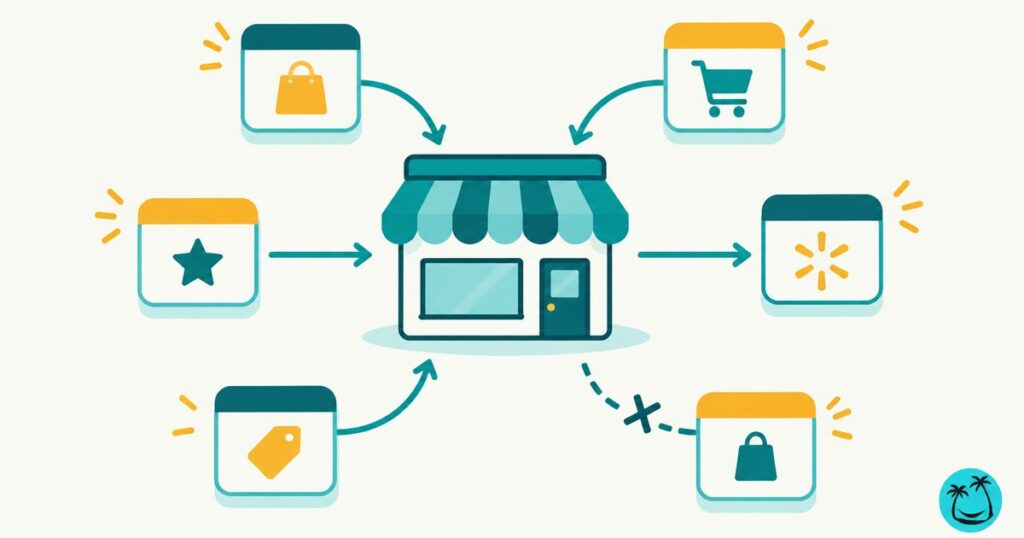
CarParts.com told the SEC that a large marketplace partner plans to end its seller relationship when the company launches its own marketplace in December.
According to the company’s third-quarter 10-Q, the partner sent a letter in October calling the planned CarParts Connect launch a conflict of interest. If you sell high-ticket products through Amazon, eBay or any other marketplace, this is a live example of a rented channel deciding you compete with it. For readers of Ecommerce Paradise, the filing is a warning about channel concentration.
The model I teach, which I lay out in my guide to what high-ticket dropshipping is, runs on margin, phone sales and customers you can actually reach. A marketplace account gives you none of those on your terms. Below you get the facts from the filing, the context around it, my read on what it means for your store, and five moves for this week.
Own the storefront nobody else can switch off. A store on your own domain keeps your product pages, your customer list and your ad traffic even when a marketplace changes its mind about you. Build your own store on Shopify →
Affiliate disclosure: some links in this article are affiliate links and I may earn a commission at no cost to you. It does not change which tools I recommend or what the filings say.
CarParts.com 10-Q: A Marketplace Partner Plans to Cut It Off
CarParts.com signed its third-quarter 10-Q on Oct. 29, 2026. The filing says the company received a letter in October from one of its large third-party marketplace partners. The letter states that “our planned launch of CarParts Connect creates a conflict of interest,” and the partner intends to terminate the seller relationship when the launch occurs.
The partner is not named. The filing also does not say which contract or policy the partner cited, according to Value Added Resource, which reported the disclosure on Nov. 10. Value Added Resource said CarParts.com had not answered its questions about the letter at publication. The company says it expects discussions with the partner over the coming weeks and months.
The risk factor language is blunt. Per the CarParts.com Form 10-Q, “If the partner terminates our seller relationship, sales through this channel, could decline or cease.” The filing adds that a cutoff could hurt the company’s business, financial condition and results of operations.
Marketplace exposure is large. Sales on third-party marketplaces, including eBay and Amazon, made up a combined 30.3% of total sales for the 39 weeks ended Oct. 3, 2026, per the filing. Value Added Resource put that at about $120.3 million and said the share was 33.9% a year earlier. The filing does not say which marketplace sent the letter, so 30.3% is the outer limit of the exposure, not the size of the one channel at risk.
The rest of the quarter was mixed. Net sales for the 13 weeks ended Oct. 3 came in at $129.3 million against $127.8 million in the prior-year quarter, a gain of about 1.2% by my arithmetic. The net loss narrowed to $4.1 million from $10.9 million. Over nine months, net sales fell to $396.9 million from $427.1 million, down 7.1%, and the net loss was $9.3 million against $38.9 million.
CarParts Connect itself is no secret. CarParts.com announced it on Oct. 22 at 9:10 a.m. EDT in a company press release. The release describes a marketplace and retail media network powered by Mirakl, with launch expected in December 2026 and seller recruitment starting immediately. The company says its customer base exceeds 100 million unique customers annually.
Why CarParts.com Built CarParts Connect on Mirakl
The press release says CarParts Connect will broaden the catalog beyond parts into vehicle accessories, travel and road-trip gear, pet and passenger products, and outdoor and recreational items. CEO David Meniane framed it as a step in the company’s long-term growth strategy. Mirakl, the software vendor behind the build, published its own CarParts Connect announcement on Oct. 22.
Value Added Resource reported that the marketplace charges a general 15% commission that may vary by category, with no upfront or subscription fees. It also reported that CarParts.com advertises “no exclusivity” and limits the marketplace to U.S.-based sellers of new, authentic products. Those terms come from Value Added Resource’s reporting, not from the press release, which does not mention a commission rate.
The motive is easy to read in the numbers. Nine-month sales are down 7.1%, and Q3 marked a return to year-over-year growth. A marketplace adds catalog breadth without buying inventory, and a retail media network adds a second revenue line on top of it.
A marketplace operator earns a commission on sellers’ sales and can sell advertising against those listings. That is the same business Amazon and eBay run, which is why a partner could view CarParts Connect as a competitor and not a customer. Per the press release, CarParts.com wants qualified sellers with automotive parts, accessories and related products such as electronics and car care supplies. Those are categories where established marketplaces already sell.
On the Oct. 29 earnings call, Meniane said JC Whitney exited the quarter with 7,000 SKUs live on Amazon and added more than 8,000 in early October, for a total of 15,000, according to the call transcript. He also said the company is working to bring JC Whitney products to its own site. So CarParts.com is expanding on a marketplace channel at the same moment it prepares a rival one. The filing does not say whether Amazon is the partner that sent the letter.
Retailer-run marketplaces have a mixed record. Retail TouchPoints reported that Best Buy’s Mirakl-powered U.S. marketplace went live Aug. 19, 2025, about eight months after the announcement. The same report said Best Buy’s first marketplace, launched around 2011, shut down five years later after reaching 1% of domestic revenue, with 70% of its third-party inventory overlapping Best Buy’s own merchandise.
Counterpoint: the cutoff is not certain. The 10-Q gives no deadline, the launch is expected and not complete, and the company says talks are coming. A partner that sends a letter is also negotiating, and a letter is not a termination notice. I would not read this as proof that marketplaces drop every seller who builds a competing storefront.
This thread connects to coverage I have already run. I broke down the fee side in my post on Amazon’s Q3 seller services and ads growth. I covered the other big channel in my post on eBay’s Q3 GMV and take rate.
What a Marketplace Cutoff Means for High-Ticket Store Owners
My read: this story is not about auto parts. It is about what a platform does when it decides a seller has become a competitor. The platform holds the account, the buyer data and the ranking. You hold the inventory commitments and the bad day.
Run the rough math on a hypothetical store. Say it does $100,000 a month and 30% of that comes through marketplaces. Losing that channel removes $30,000 of monthly revenue. If you replaced a third of it with new traffic in the first month, you would still be $20,000 short. At a hypothetical 4x return on ad spend, replacing that $20,000 takes $5,000 of new ad spend, before you count margin or the weeks it takes to tune campaigns. These figures are illustrative only and are not from CarParts.com.
The letter is one trigger. Marketplaces also change the terms you live under without a conflict of interest in sight. Amazon raised FBA fees by $0.19 a unit effective Jan. 15. eBay is widening AI monitoring of seller listings starting Nov. 26.
Support can erode too. Amazon cut seller support staff in a new round of layoffs. A smaller support team is the last thing you want to meet when a listing gets pulled during peak season.
Here is the rule of thumb I would use, and it is my own, not a data-backed standard. If marketplaces carry under 15% of your revenue, a cutoff hurts but you survive it. Between 15% and 35%, you need a written 90-day replacement plan today. Above 35%, you are running someone else’s store, and the first lever to pull is your own traffic.
Owned channels fix that, and each one is a skill you can build. An email list that you capture on your own site compounds, which is why I wrote up the email flows every high-ticket store needs. Search and shopping traffic that lands on your own domain builds equity, and my piece on high-ticket search marketing strategy shows where to start.
If you plan to add outside sellers to your own store, take the opposite lesson. CarParts.com is a public company with more than 100 million annual customers by its own count, and it still drew a written objection. A small store that adds a multi-vendor layer on top of a marketplace-dependent business invites the same question from the platforms that feed it. Sequence matters. Build the owned traffic first and add the layers after.
Cash flow matters just as much. A channel disappearing changes your payout schedule, and a payout is not profit, as I explained in my cash flow system for store owners. I made the same argument about processors in my post on single points of failure. Every account you cannot replace in a week is a single point of failure.
Supplier relationships travel with you and marketplace accounts do not. If an authorized dealer agreement sits in your name, you can sell that product on your own site tomorrow. My paid supplier directory exists to shorten that search. For the basics, my dropshipping suppliers vetting checklist is a good place to begin.
Think about what you would show a supplier if a marketplace cut you off tomorrow. A supplier wants to see a live store, a clear brand, real traffic and a plan to hold MAP pricing. A marketplace account page proves none of that. A store on your own domain proves all of it, and it makes you a better dealer prospect even when the marketplaces are behaving.
If you want the owned store built and running before the next marketplace changes its mind, that is what my team does through the turnkey done-for-you service. You keep the domain, the customer list and the supplier relationships.
CarParts.com’s letter shows what renting a channel can cost. Want my team to build and run a high-ticket store you own? See the turnkey done-for-you service →
Watch three things next. First, whether CarParts.com names the partner or reports a signed termination notice. Second, whether CarParts Connect launches on the December timeline the company gave. Third, whether other marketplace sellers with retail ambitions disclose similar letters in their own filings. I found none of those as of Nov. 11.
5 Moves to Cut Marketplace Risk Before Black Friday
Black Friday lands Nov. 27, so you have about two weeks before the heaviest sales days of the year. Do these five in order.
- Pull 90 days of sales by channel and calculate the marketplace share of revenue and of gross profit. Compare it with the 15% and 35% marks above, then run my high-ticket Black Friday stress test on the store side.
- Read every marketplace seller agreement for termination, competing-service and account-suspension clauses. Write down the notice periods. I am not a lawyer, so take anything unclear to one.
- Capture email on your own site and send it through Omnisend flows. Do not pull marketplace buyer data into your list unless the marketplace’s rules allow it.
- Find the keywords you can rank for on your own domain using Semrush, then build Shopping campaigns around the winners with my guide to turning Google Shopping clicks into sales. If you already run a store and want ads and SEO handled, see my scaling service.
- Add a business phone line with Quo and hire a virtual assistant through OnlineJobs.ph to answer it. High-ticket buyers call before they spend, and a marketplace never gives you their number.
Frequently Asked Questions
Which marketplace sent CarParts.com the letter?
The 10-Q does not say. Value Added Resource asked the company and had no response at publication. Combined eBay and Amazon sales were 30.3% of CarParts.com’s total for the nine months ended Oct. 3, but that does not identify the sender.
Has CarParts.com actually been cut off?
No. The filing says the partner intends to terminate the relationship when CarParts Connect launches, which the company expects in December 2026. The company also expects discussions with the partner.
Can a marketplace really drop a seller for building a competing marketplace?
The 10-Q says one partner intends to. Whether the contract allows it is not public. Check your own agreement, and see my breakdown of scaling a high-ticket store without cutting prices if you are rebuilding margin on your own site.
Does this mean I should stop selling on marketplaces?
No. Marketplaces send real demand, and I would keep using them where the margin works. Treat them as rented space and keep your own store, list and ads growing beside them.
How much of a store’s revenue should come from marketplaces?
There is no official number. My own rule of thumb is to keep it under 15% and to have a written plan if it passes 35%. Your product margins and supplier terms may move those marks.
What if I do not have a store of my own yet?
Start with the niche. My free high-ticket niches list gives you product categories to research. Then my 150+ niche breakdown shows how to filter them.
Want to work through a channel plan with other store owners and me inside the community? Start the 7-day free trial. Join the Skool community →
Subscribe to the YouTube channel for daily breakdowns. More breaking news coming through the day.
Related Articles
If this was useful, these go deeper:
- Shopify Q3: GMV Up 29%, Growth Slows From 32%
- Why High Ticket Google Ads Need a Complete Conversion System
- TikTok Shop Plus Launches at $9.99 for 1M Shoppers
- Dropshipping Wholesalers vs Manufacturers: Who Should You Work With?
- The Brutal Truth About High-Ticket Dropshipping Nobody Tells You

Trevor Fenner is an ecommerce entrepreneur and world traveler from Seattle, Washington, and the founder of Ecommerce Paradise, a platform focused on helping entrepreneurs build and scale profitable high-ticket ecommerce and dropshipping businesses. With over a decade of hands-on experience, Trevor specializes in high-ticket dropshipping strategy, niche and product selection, supplier recruiting and onboarding, Google & Bing Shopping ads, ecommerce SEO, and systems-driven automation and scaling. Through Ecommerce Paradise, he provides free education via in-depth guides like How to Start High-Ticket Dropshipping, advanced training through the High-Ticket Dropshipping Masterclass, and fully done-for-you turnkey ecommerce services for entrepreneurs who want a faster, more hands-off path to growth. Trevor is known for emphasizing sustainable, real-world ecommerce models over hype-driven tactics, helping store owners build scalable, sellable, and location-independent brands.
He maintains homes in Seattle and Bali, spends most of the year overseas, and usually returns to Seattle for about a month each summer.


