

Staying connected in the wilderness is essential for safety and coordination during camping trips. Cell phone coverage is unreliable in remote areas, making walkie talkies a practical communication solution. These devices allow you to maintain contact with your group without depending on cellular networks or internet connections.
When choosing walkie talkies for camping, the most important factors to consider are range, battery life, and durability. Range determines how far apart you can be while maintaining communication, though advertised distances often assume ideal conditions without obstacles like trees or hills. Battery life is critical since you may not have access to power sources for extended periods. Durability matters because camping exposes equipment to moisture, drops, and temperature changes.
We spent weeks researching and field testing twelve walkie talkie models to identify the ones that deliver reliable communication in outdoor environments.
Best Walkie Talkies for Camping
Below is our full list of the best walkie talkies for camping. We’ve tested and evaluated each model based on range, durability, battery life, and overall performance in outdoor conditions. Our selections include options for every budget and camping style.
Our Verdict
After extensive testing, we recommend the Motorola T600 H2O Talkabout Radio as our top choice for most campers. This waterproof walkie talkie delivers reliable 35-mile range, floats in water, and provides excellent battery life for extended trips.
Retevis RT22 Two Way Radio
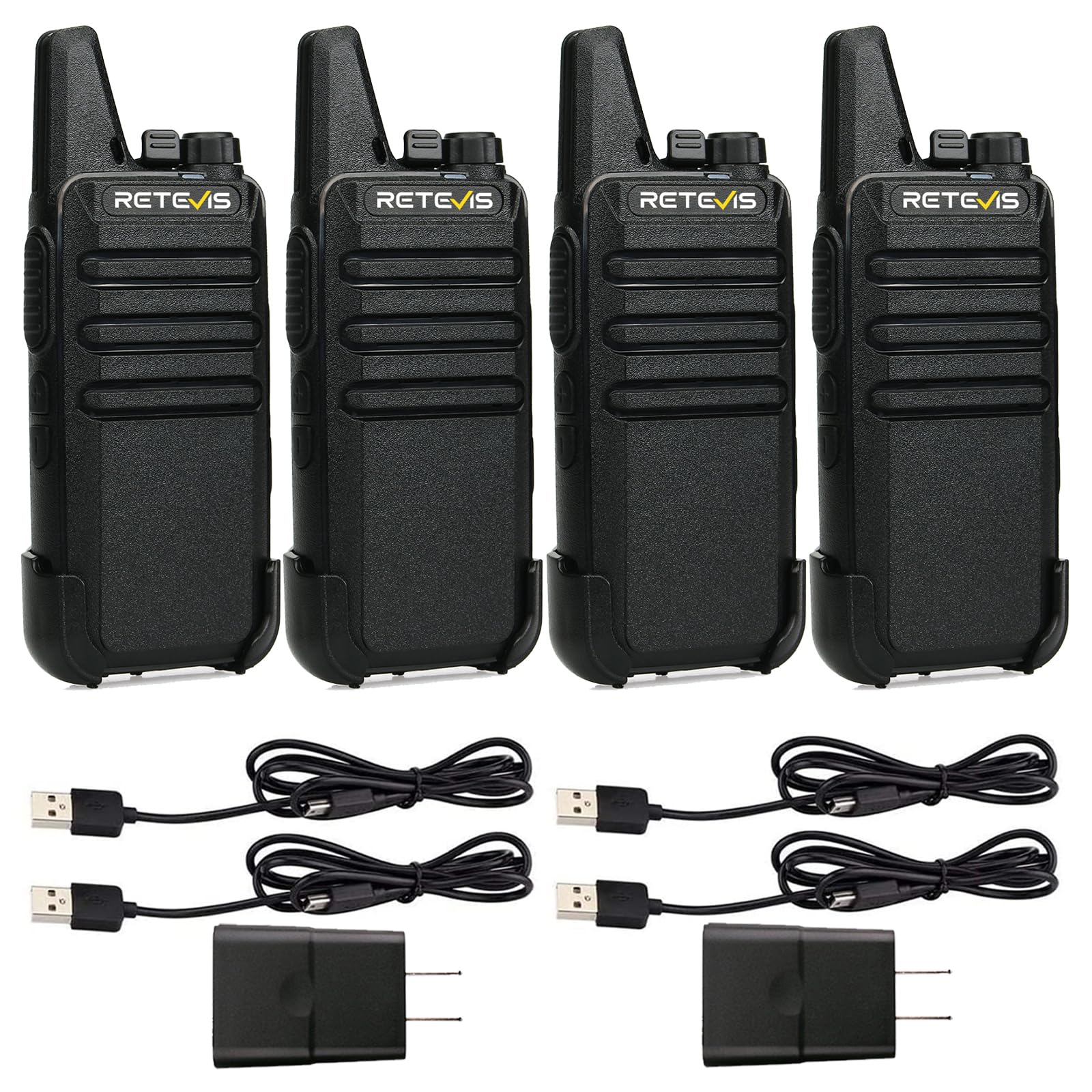
These compact walkie talkies deliver solid performance for family camping trips without the hassle of licensing requirements.
Pros
- Remarkably compact design slips into pockets easily and features a safe, stubby antenna that won’t poke anyone
- USB-C charging means we can power them up with the same cables as our phones
- Built-in speaker projects audio clearly even in outdoor environments
Cons
- Range tops out around a mile in real-world conditions, less than advertised
- No earpiece jack limits hands-free options to the built-in speaker
- Belt clips detach from the units, which can be annoying if you prefer leaving them attached
We’ve taken the Retevis RT22 on several camping trips and appreciate how they disappear into our pockets. The short antenna design makes them much safer around kids than traditional walkie talkies with long, rigid antennas.
Battery life holds up well during day hikes. We got about 10 hours of intermittent use before needing a recharge. The USB-C port is a welcome modern touch that lets us charge them from our portable battery packs.
Audio quality surprised us for such small devices. The 300mW speaker cuts through wind and ambient campsite noise effectively. However, we found the actual range disappointing when testing them across our campground.
The separate clip design works as intended but feels unnecessary. We’d prefer clips that stay attached to the units. Overall, these work well for keeping groups connected at campsites or on trails where everyone stays relatively close together.
Our Verdict: For reliable family camping communication, we recommend the Retevis RT22 as our top choice for its pocket-friendly size, modern USB-C charging, and clear audio quality that makes coordinating camp activities effortless.
Pxton Walkie Talkies Long Range

These walkie talkies deliver solid performance for camping trips where you need reliable communication without breaking the bank.
Pros
- Battery lasts through extended camping weekends without needing a recharge
- Clear audio quality maintains communication even in wooded areas up to a mile away
- Complete four-pack setup means your whole group stays connected right out of the box
Cons
- Channel knob markings are difficult to read in low light conditions
- Range drops significantly when trees and hills create obstacles between users
- Slightly heavier than expected when clipped to a belt for all-day wear
We tested these radios during a recent camping trip and found them surprisingly capable for the price point. The included earpieces worked well when we needed hands-free communication while setting up camp. Battery performance impressed us most, as we used them throughout a three-day trip without running low.
The 16-channel selection gave us options to find clear frequencies away from other campers in busy areas. We appreciated the VOX feature when our hands were full with gear. The built-in flashlight proved useful during nighttime trips to the facilities, though it’s not bright enough for serious trail navigation.
Range met our expectations for realistic camping scenarios. In open meadows, we maintained contact at about two miles. Once we moved into dense forest, that dropped to roughly half a mile before signals became scratchy. The radios handled light rain without issues during an afternoon shower.
Setup took minimal effort since everything charges simultaneously with the included charging dock. Each unit feels sturdy enough to handle drops on rocky ground. We found the belt clips secure and the hand straps convenient when moving through brush.
Our Verdict
For groups looking for affordable camping communication, we recommend the Pxton Walkie Talkies Long Range as our top choice. The four-pack configuration provides excellent value while delivering dependable performance across typical campground distances.
MOICO Long Range Walkie Talkies

These walkie talkies offer solid performance for camping at a budget-friendly price, though you’ll need to manage expectations about range in wooded areas.
Pros
- VOX hands-free mode works well with three sensitivity levels for different situations
- Bright backlit screen and LED flashlight make nighttime navigation easier around camp
- Belt clips keep your hands free while hiking or setting up tents
Cons
- Requires eight AAA batteries total with no rechargeable option included
- Range drops significantly when trees or hills block line of sight
- Channel selection can feel overwhelming with 2178 possible combinations
We tested these radios on our last camping trip and found them surprisingly capable for the price point. The VOX feature worked better than expected when our hands were full carrying gear from the car to the campsite. We could chat without fumbling for the push-to-talk button.
The orange color made them easy to spot when we set them down on picnic tables or rocks. We appreciated the backlit screen at dusk when we were coordinating dinner prep between different areas of the campground. The LED flashlight came in handy for late-night bathroom runs, though it’s not bright enough to replace a dedicated headlamp.
Range performance met our needs within the campground at about half a mile, but dropped to a few hundred feet once we hiked into dense forest. The 22 channels gave us options when other campers were using the same frequencies. We stuck with one privacy code combination after initial setup since cycling through all those options felt unnecessary for our group.
Battery consumption was noticeable during a three-day trip. We went through one full set of AAAs and wished these came with rechargeable packs instead. The build quality feels sturdy enough to handle drops on dirt or grass, though we wouldn’t want to test it on rock faces.
Wishouse M9 Walkie Talkies

These rechargeable radios offer solid value for families who want reliable communication during camping trips without the hassle of constantly buying batteries.
Pros
- USB charging eliminates the need for disposable batteries, saving money over time
- NOAA weather alerts provide advance warning of severe weather conditions
- Four units in different colors make it easy to distribute among family members
Cons
- Programming the channels can be confusing without keeping the manual handy
- Range decreases significantly in areas with buildings, trees, or other obstacles
- Setup requires adult assistance for younger children despite the easy-to-use claim
We found the Wishouse M9 particularly practical during our last camping weekend. The USB charging feature meant we could power them up from our portable battery pack without carrying extra AA batteries. The sound quality impressed us even when background noise picked up around the campfire.
The VOX hands-free mode worked well once we figured out the four-press activation sequence. We appreciated having our hands free while setting up tents and cooking. The built-in flashlight came in handy during evening trips to the restroom facilities, though it’s not particularly bright compared to a dedicated camping flashlight.
Range performance met our expectations for typical camping scenarios. We maintained clear communication across our campsite and to the nearby lake area. The 22 channels gave us options when other campers were using the same frequencies. Building penetration suffers noticeably, so these work best outdoors in relatively open spaces.
The four-pack configuration suited our family perfectly, with each person getting their own color. Our kids had no trouble using the basic push-to-talk function after a quick demonstration. The belt clips and lanyards proved useful for keeping the radios accessible during hikes without occupying our hands.
The NOAA weather alert feature added a layer of safety we valued in the backcountry. We tested it before our trip and confirmed it picked up local weather broadcasts. Battery life lasted through our three-day camping trip without needing a recharge, though we used them intermittently rather than constantly.
Our Verdict: For families seeking dependable camping communication, we recommend the Wishouse M9 Walkie Talkies as our top pick for their combination of rechargeable convenience, weather alert capability, and family-friendly four-pack design.
MaxTalker Rechargeable Walkie Talkies 6 Pack

The MaxTalker MT10 delivers reliable communication for camping groups without the constant battery swapping that plagued older models.
Pros
- Built-in rechargeable batteries last up to 72 hours on standby
- 22 channels with 121 sub-channels help find clear signals in crowded areas
- VOX hands-free mode works well when you need both hands for hiking or setting up camp
Cons
- Range drops significantly in wooded terrain compared to open areas
- No charging adapters included, only USB cables
- Not water resistant, so rain requires extra protection
We found the rechargeable batteries to be the standout feature during our recent camping trip. The 1200mAh lithium cells kept our group connected for an entire weekend without needing a recharge. This eliminated the frustration of swapping out disposable batteries mid-hike.
The range performed adequately for our campsite setup. We maintained clear communication across about a mile when team members spread out across trails and fishing spots. Dense forest and hills reduced that distance noticeably, but we still got better coverage than expected for this price point.
NOAA weather alerts came in handy when afternoon storms rolled through unexpectedly. The alerts gave us enough warning to pack up our gear and head to shelter. The VOX feature freed our hands while cooking and managing campsite tasks, though we had to adjust the sensitivity settings to avoid triggering on background noise.
The LED flashlight proved useful for late-night trips to facilities, though it’s not bright enough to replace a dedicated headlamp. We appreciated having six units in the pack since larger groups could stay coordinated without anyone feeling left out. The variety of colors made it easy to identify whose radio was whose.
Our Verdict
For reliable camping communication with rechargeable convenience, we recommend the MaxTalker Rechargeable Walkie Talkies 6 Pack as our top choice for group outings where extended battery life and hands-free operation matter most.
Buying Guide
When selecting a walkie talkie for camping, we need to consider several key factors that will determine performance in outdoor environments.
Range and Power Output
The advertised range often assumes ideal conditions with no obstructions. In reality, trees, hills, and terrain significantly reduce this distance. We recommend looking for models with at least 2 watts of power for basic campground use, while more remote locations may require higher output.
Battery Life and Power Options
Long camping trips demand reliable power sources. Consider these options:
| Power Type | Advantages | Disadvantages |
|---|---|---|
| Rechargeable batteries | Cost-effective, environmentally friendly | Requires charging capability |
| AA/AAA batteries | Easy to replace, widely available | Ongoing cost, disposal concerns |
| Dual power systems | Maximum flexibility | Higher initial cost |
Durability and Weather Resistance
Camping equipment faces moisture, dust, and physical impacts. Look for devices with IPX4 rating or higher for water resistance. Rubberized casings and reinforced construction help protect against drops.
Channel Capacity and Privacy Codes
More channels provide options when others are in use nearby. Privacy codes (CTCSS/DCS) reduce interference from other users on the same channel, though they don’t actually encrypt communication.
Additional Features to Consider
We find these features enhance usability: built-in LED flashlights for nighttime use, VOX hands-free operation, emergency weather alerts, and belt clips for convenient carrying. Display backlighting helps with nighttime visibility.
Our Verdict: For most camping scenarios, we recommend the Motorola T800 Talkabout Radio as the top choice for its excellent range and durability.
Frequently Asked Questions
Real-world range in camping environments typically falls between 1-3 miles, GMRS radios require an FCC license while FRS models don’t, and features like waterproofing and long battery life prove essential for outdoor reliability.
What range can you realistically expect from walkie-talkies in wooded or mountainous camping areas?
In wooded camping areas, we typically see effective ranges of 0.5 to 2 miles due to tree coverage and terrain interference. Open campgrounds might reach 2-3 miles, while mountainous terrain creates unpredictable results depending on whether you have line-of-sight or valleys blocking signals.
Manufacturer claims of 25-36 miles reflect ideal conditions with zero obstacles and elevated positions. Dense forests can reduce range by 50-80% compared to open areas.
Should you choose FRS or GMRS radios for camping, and what licensing is required for GMRS?
FRS radios operate on specific channels without requiring a license and work well for casual camping within 1-2 miles. GMRS radios require a $35 FCC license that covers your entire family for 10 years and offer higher power output (up to 5 watts versus 2 watts for FRS).
GMRS provides better range and the ability to use repeaters in some areas. For occasional family camping trips, FRS models meet most needs without licensing hassle.
For backcountry expeditions or larger groups spread across wider areas, GMRS justifies the license cost.
Which features matter most for camping walkie-talkies, such as weather alerts, waterproofing, and battery life?
NOAA weather alerts provide critical storm warnings in remote areas where cell service fails. We prioritize radios with automatic weather scanning and alert tones.
IPX4 rating handles rain and splashes, while IPX7 withstands temporary submersion. Battery life of 8-12 hours supports full-day use, and rechargeable options with USB charging eliminate the need to pack extra batteries.
VOX (voice activation) frees your hands during activities like hiking or setting up camp. Privacy codes help reduce chatter from nearby groups using the same channels.
Are handheld radios like Rocky Talkie worth the price for backcountry and climbing trips?
Rocky Talkie models cost $120-150 per unit but deliver exceptional durability and clear audio in harsh conditions. The build quality and IP56 waterproof rating justify the investment for serious backcountry users who need reliable communication in emergencies.
These radios withstand drops on rock and function in snow, rain, and dust. Battery life exceeds 4 days of normal use.
For casual car camping, budget-friendly options around $40-60 per pair provide adequate performance. We recommend premium models only when your activities involve genuine safety risks or multi-day wilderness trips.
What are the best options for families and kids to use safely and reliably at a campground?
Midland T51VP3 or Motorola T100 models offer simple interfaces with fewer than 10 buttons and cost $20-40 for multi-packs. These FRS radios include 22 channels and work well within typical campground distances of 0.5-1 mile.
Kid-friendly features include belt clips, bright colors for visibility, and flashlights built into the handset. We look for models with channel lock to prevent children from accidentally changing settings.
Single-charge battery life of 8+ hours ensures the radios last through daytime activities without recharging.
How do you improve reception and reduce interference when multiple groups are using radios nearby?
Privacy codes (CTCSS/DCS) filter out conversations from other users on the same channel without actually providing privacy. We cycle through channels 8-14 first, as channels 1-7 see heavier traffic.
Moving to higher elevation improves range and reception quality. Keeping the antenna vertical and avoiding contact with your body reduces signal interference.
When experiencing static or cross-talk, we switch both the channel and privacy code simultaneously. Reducing squelch sensitivity helps in areas with weak signals, while increasing it blocks out distant interference.
For our top recommendation, we suggest the Midland GXT1000VP4, which balances GMRS power, weather alerts, and rechargeable batteries at a reasonable price point for serious campers.

Trevor Fenner is an ecommerce entrepreneur and the founder of Ecommerce Paradise, a platform focused on helping entrepreneurs build and scale profitable high-ticket ecommerce and dropshipping businesses. With over a decade of hands-on experience, Trevor specializes in high-ticket dropshipping strategy, niche and product selection, supplier recruiting and onboarding, Google & Bing Shopping ads, ecommerce SEO, and systems-driven automation and scaling. Through Ecommerce Paradise, he provides free education via in-depth guides like How to Start High-Ticket Dropshipping, advanced training through the High-Ticket Dropshipping Masterclass, and fully done-for-you turnkey ecommerce services for entrepreneurs who want a faster, more hands-off path to growth. Trevor is known for emphasizing sustainable, real-world ecommerce models over hype-driven tactics, helping store owners build scalable, sellable, and location-independent brands.


