


Camping with electricity is no longer exotic, but the way these products get sold still is. Almost every roundup you will read, including the earlier version of this one, sizes a power station by dividing its nameplate watt hours by the load. That number is wrong by roughly an eighth before you plug anything in. Everything below is computed from usable watt hours instead, and I state the efficiency I assumed every time. This is part of the portable power cluster on E-Commerce Paradise, and every spec here was read off the manufacturer’s own product page on 5 September 2026.
Where a manufacturer does not publish a figure, I have written “Not published” rather than carrying an old number forward. Several claims in the previous version of this article did not survive that test, and I say which ones near the end.
The two things that actually decide this purchase are capacity in usable watt hours and weight. Everything else, including port counts and app features, is a tiebreak. If you drive to the site, buy capacity. If you carry the thing any distance, buy light and accept that you are paying a lot per watt hour for the privilege.
The Camping Pick Most People Should Buy
Jackery Explorer 1000 v2, US$499 for 1070Wh nameplate and about 910Wh usable at 85 percent efficiency. Roughly 30 hours of a 12V fridge or 22 hours of a CPAP, and a full recharge in about an hour.
How I Sized These
A power station does not deliver its nameplate capacity to an AC device. Converting DC battery output into AC mains costs energy, and the unit spends some of its own charge running its screen, board and fans. Plan on no more than 85 percent of nameplate reaching the socket. Across this cluster I use 85 percent as the single planning assumption, and 85 percent is already the generous end rather than a safety margin.
Bluetti publishes its own version of the same correction. In the AC180 product FAQ the company states that for that unit the depth of discharge is 90 percent, the inverter efficiency is 85 percent, and self consumption is about 15W, and it works an example accordingly. Different brands, same physics.
| Model | Nameplate | Usable at 85 percent | Weight |
|---|---|---|---|
| Jackery Explorer 300 | 293Wh | About 249Wh | About 7.1 lb |
| GRECELL 300W | 288Wh | About 245Wh | 7.3 pounds |
| Anker SOLIX C1000 Gen 2 | 1,024Wh | About 870Wh | 24.9 lb |
| Bluetti Elite 100 V2 | 1,024Wh | About 870Wh | 25 lbs |
| Jackery Explorer 1000 v2 | 1070Wh | About 910Wh | Not published on the product page |
Divide the usable column by your load in watts and you have your runtime. A 12V compressor fridge drawing 60 W but cycling at roughly half duty averages about 30 W, so a 910Wh unit carries it for about 30 hours and a 249Wh unit for about 8 hours 18 minutes. A CPAP at 40 W without heated humidification runs about 22 hours off the larger one and about 6 hours 12 minutes off the smaller. Those are the numbers that decide whether you can leave the panels folded on a cloudy day.
My Top Pick For Camping
The Jackery Explorer 1000 v2 is the unit I would buy for most car camping, and it is the only unit here I would trust for a multi day trip with a fridge running. The earlier version of this article named the Explorer 1000 Pro at 1002Wh as the top pick in one place and then recommended a different product in every section below it, which was incoherent. There is one recommendation now.
Jackery Explorer 1000 v2

Jackery’s own listing states that it “Delivers 1070Wh Capacity and 1500W Output”, carries dual 100W USB-C ports, and can be taken from empty to full in one hour using the emergency super charge mode in the app. On chemistry the page says the LiFePO4 cells last more than ten years at 4,000 charge cycles, to the 70 percent floor Jackery applies across its LiFePO4 range, backed by a five year warranty when bought at jackery.com. The listed price at the time I checked was US$499.00 in black, with the Dune White colourway at US$519.00.
What it actually runs. About 910 usable watt hours at 85 percent efficiency. That is roughly 30 hours of a 12V fridge averaging 30 W, about 22 hours of a 40 W CPAP, about 14 full charges of a 65Wh laptop battery, or about 12 hours of a laptop and router together.
What I would flag. Jackery does not publish a weight on that product listing, so the roughly 24 pound figure that circulates in reviews is Not published as far as its own page goes. Solar charging is designed around Jackery’s own SolarSaga panels, which is convenient if you buy into the ecosystem and irritating if you already own panels from somebody else.
Verdict. The best balance of capacity, recharge speed and price in this group, and the one I would take on a trip where the food matters.
The Rest Of The Field
Bluetti Elite 100 V2
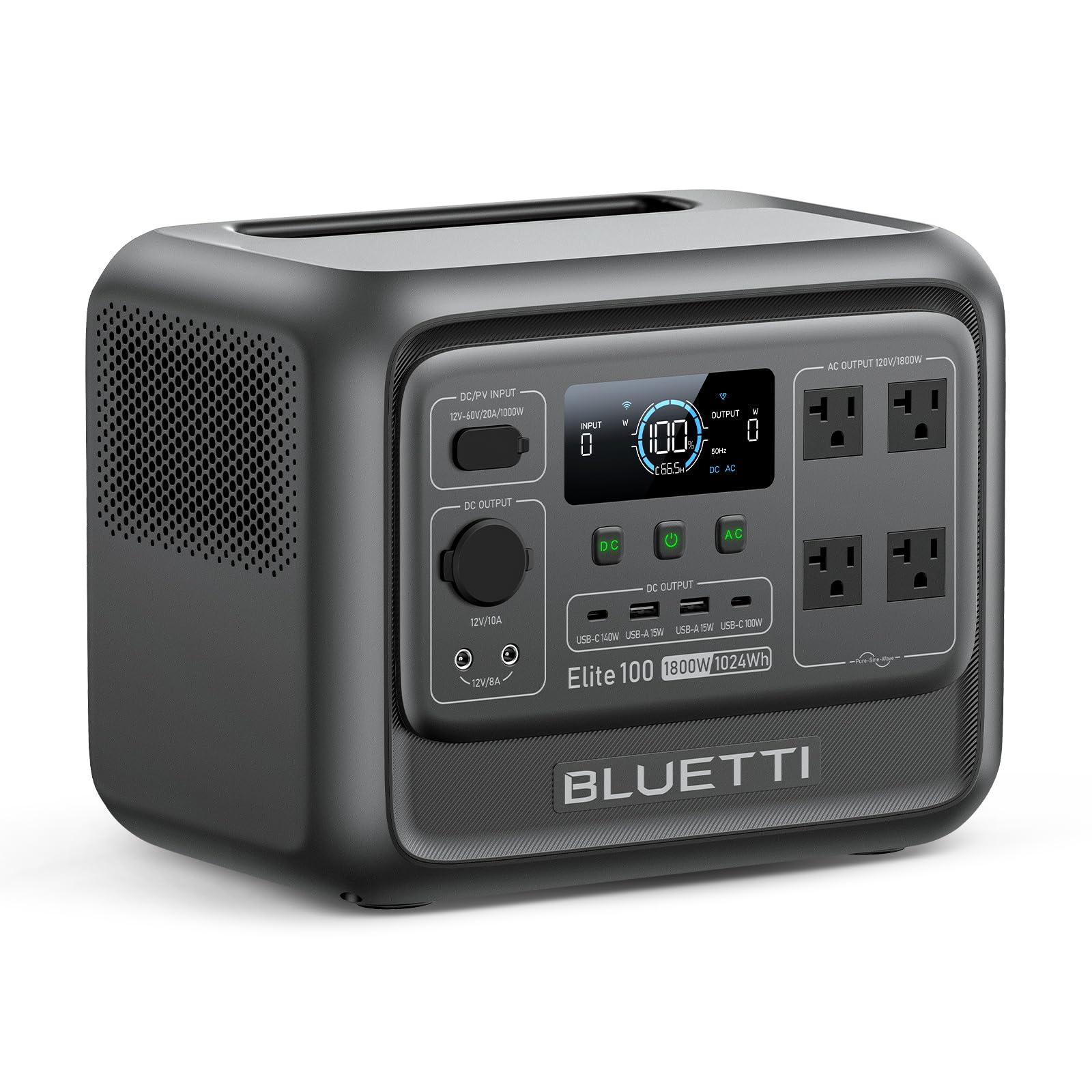
Bluetti’s page lists 1,024Wh of capacity, 1,800W output with 2,700W lifting power across 11 ports, a weight of only 25lbs with a 17L body and hidden handle, and LiFePO4 cells with over 4,000 cycles to 80 percent of original capacity. Two specs stand out for camping. Noise is quoted at 30dB under light loads, which is quieter than the fan in most tents. And the UPS switchover is quoted at 10 ms, faster than Bluetti’s own AC180 at 20 ms, which matters if you are running anything medical.
Correcting the earlier version. That article said this unit charges from empty to full in 70 minutes. Bluetti’s page attributes the 70 minute full charge to 1,000W of solar input with built in MPPT, and separately quotes 45 minutes to 80 percent on AC using 1,200W TurboBoost. Those are different claims and the article merged them. It also stated the unit is limited to four AC outlets. Bluetti’s specification area gives the AC outlets as 1,800W in total at 120V and 15A without stating a count, so the number of AC sockets is Not published on the manufacturer’s own page.
What it actually runs. About 870 usable watt hours at 85 percent efficiency, so about 29 hours of a 12V fridge averaging 30 W or about 21 hours of a 40 W CPAP.
Price. Bluetti’s own store showed US$899.00 with a final price of US$499.00 at the time I checked. Compare that against the Amazon listing before buying, because the direct price and the marketplace price move independently.
Anker SOLIX C1000 Gen 2
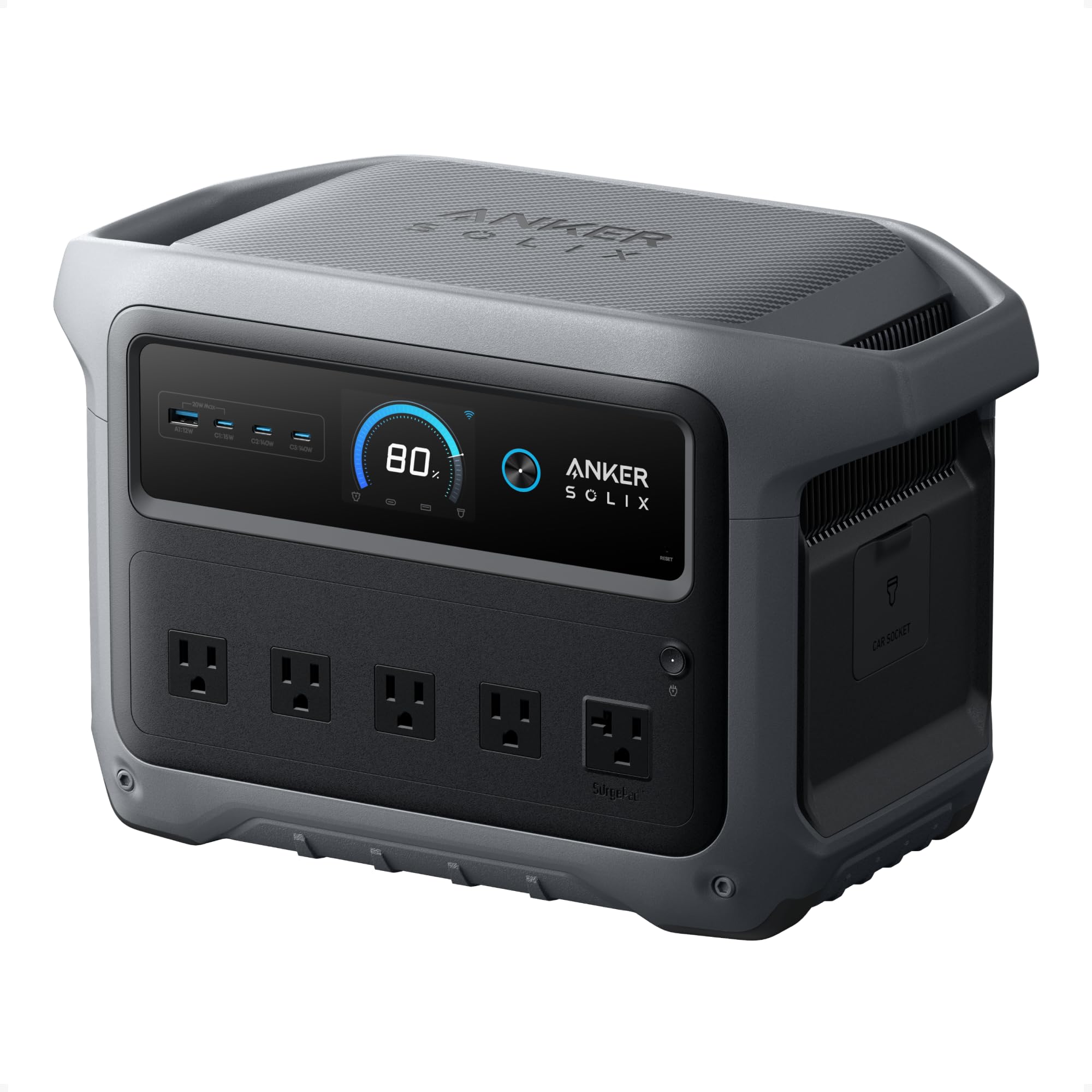
Anker’s page states 1,024Wh capacity, 2,000W output with a 3,000W peak across 10 ports, a net weight of 24.9 lb, and UPS switchover in under 10 ms. On longevity it says that after 4,000 cycles the battery still has at least 80 percent capacity, which is the strict way to quote a cycle rating and I appreciate it.
The charging claims are the reason to look at this one. Anker quotes a full recharge in 49 minutes at 1,600W using its HyperFlash mode, with a footnote saying that is the fastest charging time among all portable power stations as of April 2025. Solar is quoted at 600W maximum input and a full recharge in 1.8 hours. It also warns in its own FAQ that ultrafast charging only engages above 20 degrees Celsius, so expect slower results on a cold morning.
What it actually runs. About 870 usable watt hours at 85 percent efficiency, the same as the Elite 100 V2, so about 29 hours of a fridge averaging 30 W.
What I would flag. Anker’s page does not state a warranty term in its specification area, and it does not render a price to a plain fetch, so both are Not published here. Anker also confirms in its own FAQ that this generation dropped expandability to save weight, so if you might want an extra battery later, look at the original C1000 instead.
Jackery Explorer 300
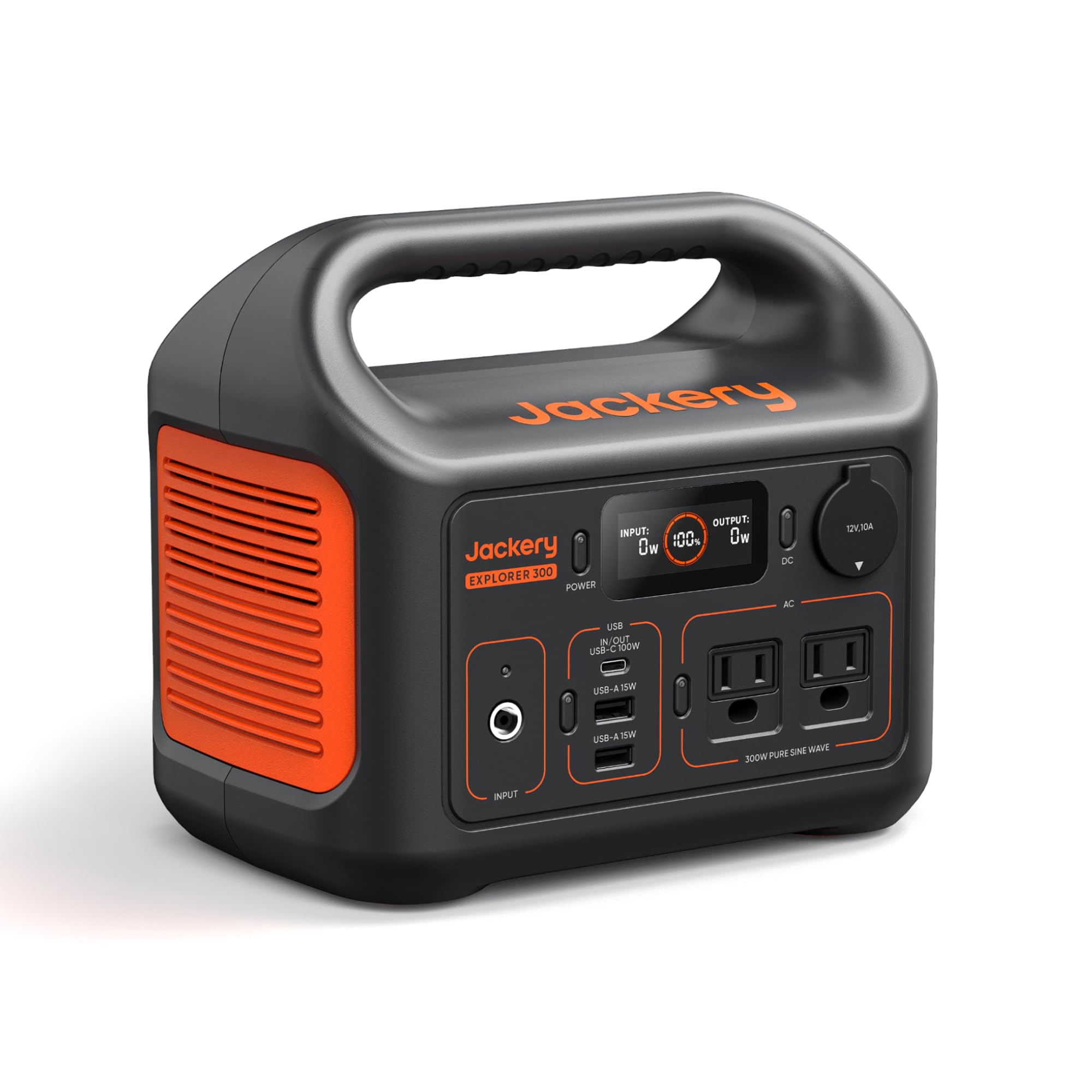
Jackery’s page states 293Wh capacity with a 300W inverter and a 500W surge, quick AC charging in just 2.5 hours using a 90W wall charger together with a 60W USB-C power delivery charger, support for six smart devices at once, and 36.4dB of noise. Listed price was US$259.00 and its shipping weight of 3,221 grams works out at about 7.1 pounds.
Three corrections. The previous version of this article priced this unit at roughly $179 to $199; it is $259. It claimed 80 percent charge in two hours from dual charging; Jackery’s own page claims a full charge in 2.5 hours from that same dual arrangement, which is a different and slightly better claim. And it implied a five year warranty across Jackery’s range. This model’s page states a two year warranty with a one year extension applied automatically when bought from Jackery’s official site, so three years, not five.
Chemistry matters here. The plain Explorer 300 does not appear on Jackery’s own list of nineteen models running LiFePO4, and its product page does not name LiFePO4 anywhere. Assume older lithium chemistry with a shorter cycle life. Jackery does not publish a cycle rating for it, so that number is Not published.
What it actually runs. About 249 usable watt hours at 85 percent efficiency. That is roughly 16 phone charges at 15Wh each, about 24 hours of a 10 W lantern, or about 8 hours 18 minutes of a 12V fridge averaging 30 W. It will not run a kettle, a coffee maker or a toaster, and the overload protection will tell you so immediately.
Verdict. Buy it because you carry it, not because it is cheap. At 88 cents per nameplate watt hour it is the most expensive storage in this roundup by a wide margin.
GRECELL 300W Portable Power Station
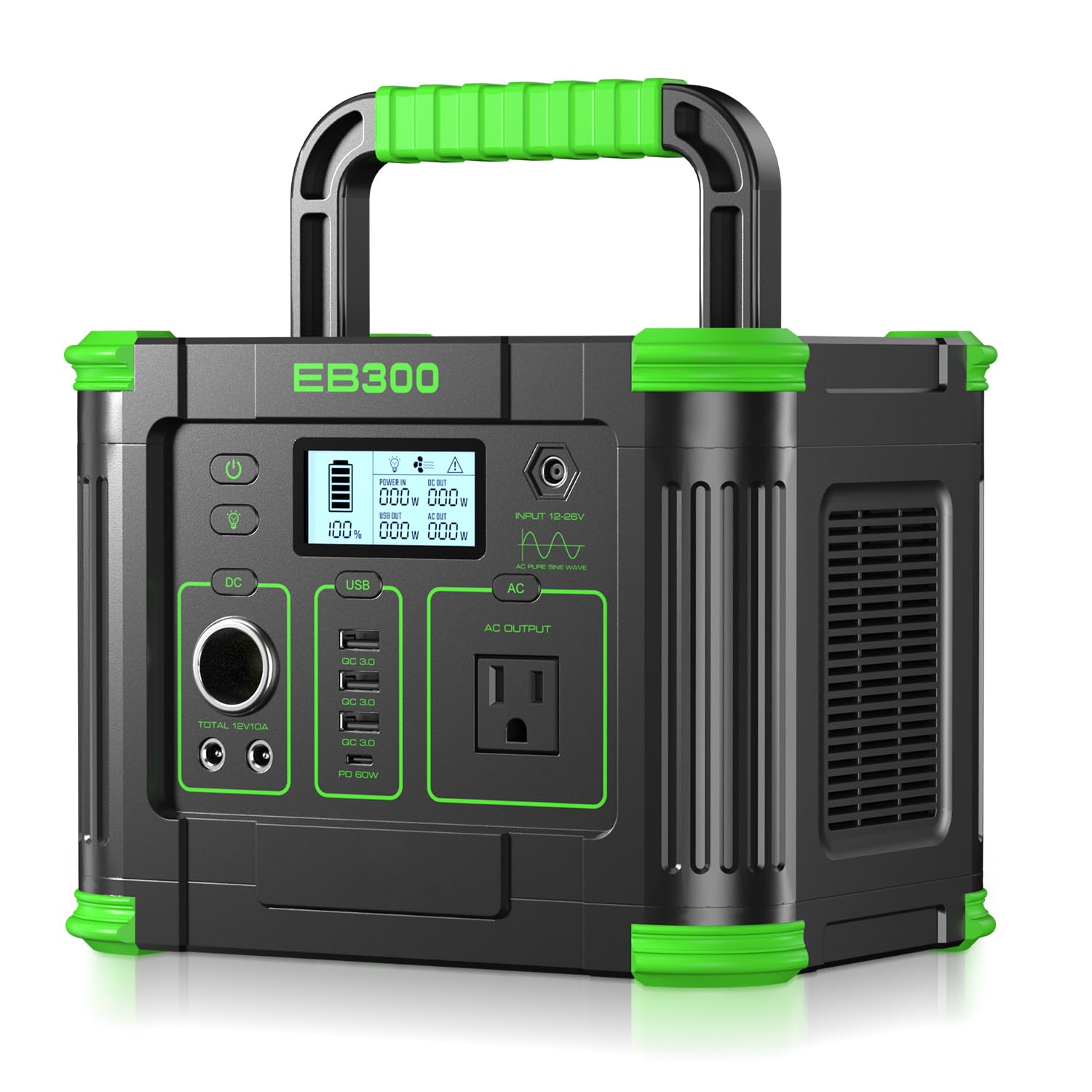
GRECELL’s own listing gives 288Wh of capacity, an output wattage of 300, an item weight of 7.3 pounds and 110 volts, at a listed price of US$159.99 for the bare unit. Bundles with a 100W or 200W panel were listed higher.
Correction. The previous version of this article credited this unit with a 330W maximum output. GRECELL’s own product data says 300 watts. I have used the manufacturer’s figure. The eight port count and the 60W USB-C power delivery rating quoted in that article are not stated in the product data I could retrieve, so both are Not published. Battery chemistry and cycle life are also Not published, which for a unit at this price is worth knowing before you rely on it.
What it actually runs. About 245 usable watt hours at 85 percent efficiency, so roughly the same working capacity as the Explorer 300 for less money, with less transparency about what is inside it.
Quiet Enough For A Campsite, Safe Enough For A Tent
Bluetti Elite 100 V2: 1,024Wh, 1,800W output with 2,700W lifting, 11 ports, over 4,000 cycles to 80 percent, 30dB under light load and 10 ms UPS switchover, at 25lbs. Zero emissions, so it runs where a petrol generator cannot.
What A Camping Power Station Costs To Run
Price per watt hour is the number everybody quotes and it is a weak one, because it prices the box and ignores how many times the box will fill and empty. The metric that means something is cost per kilowatt hour delivered across the rated cycle life: price, divided by nameplate watt hours times efficiency times rated cycles divided by one thousand.
| Model | Listed price | Cycle life on the maker’s page | Hardware per delivered kWh | All in, hardware plus 20.4 cents of electricity |
|---|---|---|---|---|
| Jackery Explorer 1000 v2 | US$499.00 | 4,000 charge cycles to 70% | 13.7 cents | 34.1 cents |
| Bluetti Elite 100 V2 | US$499.00 final price | 4,000+ cycles to 80% | 14.3 cents | 34.7 cents |
| Anker SOLIX C1000 Gen 2 | Not published | 4,000 cycles to at least 80% | Not published | Not published |
| Jackery Explorer 300 | US$259.00 | Not published | Not published | Not published |
| GRECELL 300W | US$159.99 | Not published | Not published | Not published |
Now the part that gets left out of every roundup. That 13.7 cents is only the hardware term. You still buy the electricity you put into the machine. United States residential electricity averaged 17.30 cents per kilowatt hour across 2025, according to the Energy Information Administration’s Electric Power Monthly, Table 5.3. Delivering one kilowatt hour out of an Explorer 1000 v2 means buying about 1.18 kWh from the wall, so 17.30 cents divided by 0.85 is an energy term of 20.4 cents, on top of the 13.7 cents of hardware. Call it 34.1 cents against 17.30 cents straight from the socket.
So none of these saves you money on electricity. What they buy is availability, meaning power at a campsite, in a van or during an outage where the grid is not offering any. That is worth a great deal, and it is the only honest reason to buy one.
Buying Guide
Capacity, In Usable Watt Hours
Work out your daily consumption first. A 12V compressor fridge averaging 30 W over a day uses about 720Wh. LED camp lights draw about 5 W to 15 W each. Phone charging costs about 15Wh per phone. A laptop is roughly 60Wh per full charge. Add it up, then divide by 0.85 to get the nameplate capacity you actually need to buy.
On that arithmetic a fridge alone consumes more in a day than any 300Wh unit holds, which is why the small stations in this roundup are for lights and devices, not for food.
Output, In Continuous And Surge Watts
Continuous output decides what you can run at all. Kettles and single serve coffee makers typically want well over 1,000 W, which rules out both 300W units here and is comfortably inside the 1,500W to 2,000W class. Surge headroom matters for anything with a motor or a compressor, which draws several times its running wattage for a moment at start up.
Recharging
Verify all three paths before you buy: wall, car and solar. Solar input caps vary enormously across this group, from 600W on the Anker to 1,000W on the Bluetti Elite 100 V2. A higher cap is what turns a battery into a system you can live off for a week rather than a bucket you empty once.
Weight
Roughly 7 pounds is genuinely portable. Roughly 25 pounds is a two handed carry from the car and no further. There is nothing in between in this group, and that gap is the real decision.
Warranty
The earlier version of this article said most quality units carry warranties of 12 to 24 months. That is wrong for every unit on this list. Jackery offers three years plus two extra free at jackery.com on the Explorer 1000 v2, and two years plus one on the Explorer 300. Bluetti quotes five years on the AC180. Anker does not state a term in its specification area, so that one is Not published. Check the term on the exact model you are buying, because it moves within a single brand. Two caveats worth knowing. Jackery’s own warranty policy page lists the 1000 Series at two years plus one, against the three plus two its Explorer 1000 v2 product page promises, so get the term in writing. And Bluetti’s warranty policy page states that for portable power stations the period “varies from 24 months to 72 months”, and that cover “will be invalid on the items once they are taken or shipped to other countries”.
Running This As A Business
Some of you are here to sell this category rather than camp with it. Outdoor power is good territory, because order values are high, the products ship well, and buyers research hard, which rewards anyone willing to publish real arithmetic instead of nameplate figures.
Start with the category, not the product. Our list of proven high ticket dropshipping niches covers where the margin actually sits. If the model is new to you, read our explanation of what high ticket dropshipping is and how the economics work first.
Supply is where most people stall. Our step by step guide to finding suppliers for high ticket products walks the approach process. On the legal side, our business formation guide for high ticket dropshipping covers entity choice and tax registration in the right order.
On tooling I keep it dull. I run stores on Shopify because the app ecosystem removes problems I do not want to solve. For entity formation I use Bizee, which files without the upsell theatre.
Two things people skip and regret. Get general liability cover through Hiscox before selling anything with a large lithium cell in it. And put the books on QuickBooks from the first order rather than rebuilding a year of transactions in April.
Frequently Asked Questions
How big a power station do I need for a weekend camping trip?
For phones, lights and a speaker, about 250 usable watt hours is enough for two or three days, which means a nameplate capacity of about 300Wh. Add a 12V fridge and the arithmetic changes completely, because a fridge averaging 30 W uses about 720Wh a day on its own. For a fridge plus devices over a weekend, plan on about 1,000Wh nameplate, which is roughly 850 usable watt hours at 85 percent efficiency.
How long will a power station run a camping fridge?
Take usable watt hours and divide by the fridge’s average draw, not its rated draw. A 12V compressor fridge rated at 60 W typically cycles at about half duty in mild weather, so it averages near 30 W. On that basis the Jackery Explorer 1000 v2 at about 910 usable watt hours runs it for roughly 30 hours, and the Bluetti Elite 100 V2 or Anker C1000 Gen 2 at about 870 usable watt hours run it for roughly 29 hours. Hot weather raises the duty cycle and shortens all of those.
Can a camping power station run a kettle or a coffee maker?
Only the larger ones. Electric kettles and single serve coffee makers typically draw well over 1,000 W, which the 300W units in this roundup cannot supply at all. The Jackery Explorer 1000 v2 at 1500W and the Anker C1000 Gen 2 at 2,000W with a 3,000W peak both handle them, but a single brew cycle can take a noticeable bite out of the battery, so budget for it rather than assuming it is free.
How long do these take to recharge?
All figures are from the manufacturers. Anker quotes a full recharge for the C1000 Gen 2 in 49 minutes at 1,600W with HyperFlash enabled, and 1.8 hours from 600W of solar. Jackery quotes the Explorer 1000 v2 from empty to full in one hour using emergency super charge in its app, and the Explorer 300 at 2.5 hours using a 90W wall charger plus a 60W USB-C charger together. Bluetti quotes the Elite 100 V2 at 45 minutes to 80 percent on AC using 1,200W TurboBoost, and a full charge in 70 minutes from 1,000W of solar.
What should I look for in a lightweight unit for tent camping?
Weight first, then usable watt hours, then port mix. Under about 8 pounds is the threshold where a unit stops being a thing you carry from the car and starts being a thing you carry to a site. Accept that you are paying a large premium per watt hour for that, because you are. Also check battery chemistry: LiFePO4 units last far longer, and a manufacturer that does not name the chemistry on the product page is telling you something.
Is a 2000W station worth it for camping?
Only if you cook with electricity or run several high draw items at once. A 2,000W class unit will run a fridge continuously, charge everyone’s devices, and handle a kettle or a coffee maker one at a time. Below that use case the extra weight and cost buy you nothing at a campsite, and the money is better spent on solar panels so you can stay out longer.
The Bottom Line
Buy the Jackery Explorer 1000 v2 at US$499 if you drive to your campsite and want one unit that covers a fridge, devices and a laptop for a long weekend. About 910 usable watt hours, a full recharge in roughly an hour, and 13.7 cents per delivered kilowatt hour of hardware, or 34.1 cents all in once the electricity goes on top, make it the strongest all round value in this group.
Take the Bluetti Elite 100 V2 instead if quiet and switchover speed matter more than capacity, because 30dB under light load and a 10 ms UPS switchover are the best numbers here for medical loads and light sleepers. Take the Anker SOLIX C1000 Gen 2 if recharge speed is the constraint, because 49 minutes to full is genuinely different from everything else on the list, and check its price yourself since Anker does not publish one a plain fetch can read.
Buy the Jackery Explorer 300 only if you are carrying it on your back, and treat the GRECELL as the budget option it is, with unpublished chemistry and cycle life to match the price. Neither will run a fridge for a night.
And go in knowing what you are buying. None of these makes electricity cheaper. They make electricity available where there is none, which at a campsite is the entire point.
Power Where The Grid Is Not
Explorer 1000 v2 at US$499: 1070Wh nameplate, about 910Wh usable at 85 percent efficiency, 1500W output, 4,000 charge cycles to 70 percent, and five years of cover on this model when bought direct. Silent, no fumes, safe next to a tent.
If you would rather build a store in this category than shop in it, we do the whole build for you. Our done for you high ticket dropshipping business build and launch service covers niche selection, supplier approvals, the store itself and the first traffic.
Related Articles
Bluetti Review 2026, with verified specs and cost per delivered kilowatt hour
Jackery Review 2026, with corrected pricing across the Explorer line
The best solar generator for home backup when the grid goes down
How long a power station will actually run a refrigerator
How to choose a portable power station without overbuying

Trevor Fenner is an ecommerce entrepreneur and the founder of Ecommerce Paradise, a platform focused on helping entrepreneurs build and scale profitable high-ticket ecommerce and dropshipping businesses. With over a decade of hands-on experience, Trevor specializes in high-ticket dropshipping strategy, niche and product selection, supplier recruiting and onboarding, Google & Bing Shopping ads, ecommerce SEO, and systems-driven automation and scaling. Through Ecommerce Paradise, he provides free education via in-depth guides like How to Start High-Ticket Dropshipping, advanced training through the High-Ticket Dropshipping Masterclass, and fully done-for-you turnkey ecommerce services for entrepreneurs who want a faster, more hands-off path to growth. Trevor is known for emphasizing sustainable, real-world ecommerce models over hype-driven tactics, helping store owners build scalable, sellable, and location-independent brands.

Still deciding what to sell?
Grab the free list of 1,000+ niches that work for high-ticket dropshipping, sorted by category.
Free. Unsubscribe any time.


