


Jackery is the brand most people meet first in this category, which means it is also the brand most people overpay for or dismiss for the wrong reasons. I have been buying and specifying portable power for years, mostly because I spent a decade running a physical products business from Bali where the grid is a suggestion rather than a service. This review, like everything in the power station cluster on E-Commerce Paradise, is built on numbers I pulled from the manufacturer’s own product pages, not from a press release.
Every figure below was read off jackery.com on 5 September 2026. Where Jackery does not publish something, I have written “Not published” rather than repeating a number from an older version of this article. Several prices in the previous version were badly out of date, one warranty claim was wrong for the entry model, and a set of price per watt hour comparisons had no source behind them at all. All of that is corrected and I say exactly what changed.
The short version: Jackery’s mid range is now priced at parity with the cheapest credible competition rather than at a premium, the cycle ratings are genuinely good, and the customer experience is more mixed than the brand’s reputation suggests. Here is the arithmetic.
Power That Works When The Grid Does Not
The Explorer 1000 v2 lists at US$499 for 1070Wh and 1500W output, with LiFePO4 cells rated at 4,000 charge cycles to a 70 percent floor and a full recharge in about one hour. That is roughly 22 hours of a 40 W CPAP or 12 hours of a laptop and router.
What Jackery Is In 2026
Jackery designs and sells portable power stations and folding solar panels for camping, van life, home backup and off grid work. Manufacturing is in China, which is true of every serious brand in this category, so it separates nobody from anybody.
The previous version of this article claimed three million units sold globally and a Frost and Sullivan certification for smallest and lightest units in class. I could not source either claim to Jackery or to a named third party this session, so both have been removed. Not published.
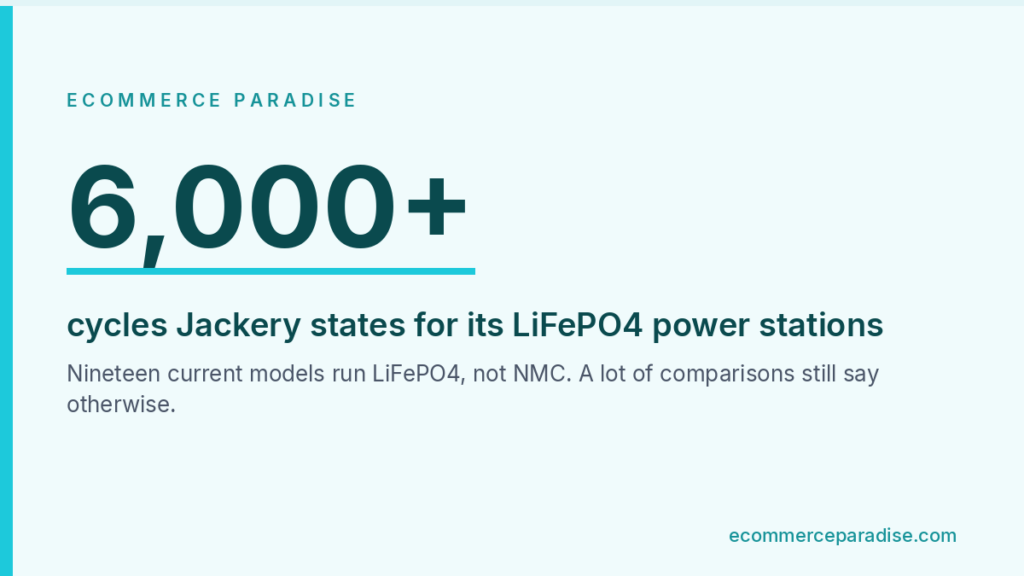
What Jackery does publish, and what actually matters, is battery chemistry. Their buying advice page on which products use LFP lists nineteen current models running lithium iron phosphate: the Explorer 100 Plus, 240 v2, 300D, 300 v2, 300 Plus, 600 v2, 600 Plus, 1000 v2, 1000 Plus, 1500 v2, 1500 Ultra, 2000 v2, 2000 Plus, 5000 Plus, and the HomePower 1000 v2, 2000 Plus v2, 3000, 3600 Plus and 3600 Pro Max. The same page states that “Jackery Portable Power Stations with LiFePO4 batteries can last over 6000 cycles” and that “Once the cycles are completed, the batteries will operate at a capacity of 70% or higher”.
Read that second sentence carefully, because it is the qualifier almost every review drops. Six thousand cycles to 70 percent retention is not the same promise as a competitor’s 3,500 cycles to 80 percent retention. A higher cycle count measured to a lower retention floor is a different product claim, not automatically a better one. I will use the qualifier every time it appears in this article.
One model does not appear on that LFP list. The plain Explorer 300 is not among the nineteen, and its product page describes a 293Wh capacity with a 300W inverter and a 500W surge without naming LiFePO4 anywhere. Assume older lithium chemistry there and check the page yourself before you buy it.
The Two Numbers Everybody Quotes Wrong
Nameplate Watt Hours Are Not Usable Watt Hours
A 1070Wh station does not put 1070Wh into an AC device. Converting DC battery output to AC mains costs you energy, and the unit spends some of its own charge running its screen, board and fans. Plan on no more than 85 percent of nameplate reaching the socket. Across this cluster I use 85 percent as the single planning assumption, and I state it every time. That is not a conservative figure: 85 percent is Bluetti’s own published inverter efficiency, and its own runtime tables imply less again once self consumption is counted.
On that basis, here is what Jackery’s published capacities actually amount to at the outlet:
| Model | Nameplate | Usable at 85 percent |
|---|---|---|
| Explorer 300 | 293Wh | About 249Wh |
| Explorer 1000 v2 | 1070Wh | About 910Wh |
| Explorer 2000 v2 | 2042Wh | About 1,736Wh |
| HomePower 3600 Plus | 3584Wh | About 3,046Wh |
Worked runtimes for the Explorer 1000 v2 from that 910Wh usable figure, rounding down and ignoring the unit’s own standby draw:
- A 40 W CPAP without heated humidification runs about 22 hours, so two nights.
- A 75 W desk of laptop plus router runs about 12 hours.
- A 60 W compressor fridge cycling at roughly half duty, so about 30 W averaged, runs about 30 hours.
- A 65Wh laptop battery takes about 14 full charges.
- A 150 W setup of laptop, two monitors and router runs about 6 hours.
Every one of those is computed from usable watt hours at 85 percent efficiency. A runtime that divides the nameplate figure straight by the load overstates the answer by about 18 percent.
Dollars Per Watt Hour Is Meaningless Without Cycle Life
Price per watt hour prices the box and ignores how many times the box will fill and empty before it is finished. The metric that means something is cost per kilowatt hour delivered across the rated cycle life: price divided by nameplate watt hours, times efficiency, times rated cycles, divided by one thousand.
Run it on the Explorer 1000 v2 at its listed US$499, 1070Wh, 85 percent efficiency and the 4,000 charge cycles to a 70 percent floor Jackery states on that product page. It delivers about 3,638 kWh across its rated life, which is 13.7 cents per delivered kilowatt hour of hardware. The HomePower 3600 Plus at US$1,709, 3584Wh and the 6,000 cycles to 70 percent its own page states delivers about 18,278 kWh, or 9.4 cents of hardware.
Those are strong numbers. They are also only half the picture, and this is the part every affiliate review skips.
That 13.7 cents is hardware amortisation, and it is only the first of two terms. You still have to buy the electricity you put into the machine. United States residential electricity averaged 17.30 cents per kilowatt hour across 2025, according to the Energy Information Administration’s Electric Power Monthly, Table 5.3. Year to date through June 2026 that same table shows 18.16 cents.
So delivering one kilowatt hour out of an Explorer 1000 v2 means buying about 1.18 kWh from the wall, which is 17.30 cents divided by 0.85, an energy term of 20.4 cents. Add the 13.7 cents of hardware and the all in figure is 34.1 cents per delivered kilowatt hour, against 17.30 cents straight from the socket. Storing electricity and taking it back out costs almost exactly twice what the grid charges.
That is the honest conclusion and it does not damage the case for buying one. It just moves the case. A power station is not a device that saves money on electricity. It is a device that buys availability, meaning power at a time and in a place where the grid is not offering any. That is worth real money to the right buyer and nothing at all to the wrong one.
The 2026 Jackery Lineup With Verified Prices
Prices in the previous version of this article were wrong across the board, mostly because they were quoted as promotional ranges rather than as listed prices. Everything below was read off jackery.com on 5 September 2026.
| Model | Capacity | Output | Cycle life stated on the page | Listed price | Per nameplate Wh |
|---|---|---|---|---|---|
| Jackery Explorer 300 | 293Wh | 300W, 500W surge | Not published | US$259.00 | $0.88 |
| Jackery Explorer 1000 v2 | 1070Wh | 1500W | 4,000 charge cycles to 70% | US$499.00 | $0.47 |
| Jackery Explorer 2000 v2 | 2042Wh | 2200W, 4000W surge | Not published | US$899.00 | $0.44 |
| Jackery HomePower 3600 Plus | 3584Wh, to 21kWh | 3600W, 120V and 240V | 6,000 cycles to 70% | US$1,709.00 | $0.48 |
What changed from the previous version of this article. The Explorer 300 was listed at roughly $179 to $199; it is $259. The Explorer 1000 v2 was listed at roughly $429 to $699; it is $499, with the Dune White colourway at $519. The Explorer 2000 v2 was listed at roughly $699 to $999; it is $899. Prices for the Explorer 500, Explorer 1000 Plus, Explorer 1500 Ultra, HomePower 3000 and Explorer 5000 Plus could not be retrieved from jackery.com this session, so those models have been removed from the pricing table rather than carried forward on old numbers.
The warranty claim needs correcting too. The previous article said the standard warranty is three years and registration extends it to five across the line. Jackery’s Explorer 1000 v2, 2000 v2 and HomePower 3600 Plus listings all carry the same banner offering a three year warranty plus two extra years free when bought at jackery.com, which supports the five year figure for those models. The Explorer 300 does not. Its page states a two year warranty plus a one year extension applied automatically when purchased from Jackery’s official website, so three years total. Buying the entry model does not buy you the flagship warranty. There is also a conflict inside Jackery’s own documentation. Jackery’s warranty policy page lists “2+1 years warranty” against the “Jackery 1500 Series/1000 Series/500 Series/300 Series/240 Series/160 Series”, and reserves “3+2 years warranty” for the “3000 Pro Series/2000 Pro Series/2000 Plus Series/1500 Pro Series/1000 Pro Series/1000 Plus Series/300 Plus Series”. The Explorer 1000 v2 is neither a Pro nor a Plus, so on that taxonomy it reads as a 1000 Series unit at three years total, while its own product page promises five. Both statements are Jackery’s. Get the term for your exact model in writing before you rely on five years.
Cost Per Delivered Kilowatt Hour
This is the table that reorders the lineup. All rows use 85 percent efficiency and the listed price above, and every row carries the same energy term: 17.30 cents divided by 0.85, which is 20.4 cents of electricity per delivered kilowatt hour.
| Model | Delivered over rated life | Hardware per delivered kWh | All in, hardware plus 20.4 cents of electricity |
|---|---|---|---|
| Explorer 1000 v2, 4,000 cycles to 70% | About 3,638 kWh | 13.7 cents | 34.1 cents |
| Explorer 2000 v2, 4,000 cycles to 70%, brand standard rating | About 6,943 kWh | 13.0 cents | 33.4 cents |
| HomePower 3600 Plus, 6,000 cycles to 70% | About 18,278 kWh | 9.4 cents | 29.8 cents |
| Explorer 300 | Cycle rating not published | Not published | Not published |
The Explorer 2000 v2 needs a note. Its own model page states no cycle rating, so the table uses the 4,000 cycles to 70 percent that Jackery’s other product pages state, which is the conservative choice. Jackery’s blog claims over 6,000 cycles to that same 70 percent floor across the LiFePO4 range, and on that basis the 2000 v2 would deliver about 10,414 kWh at 8.6 cents of hardware, but no model page supports it, so that is not the number in the table. Ask Jackery support for the rating on the unit you are actually buying.
Notice the pattern anyway. The Explorer 300 is the cheapest thing on the list and, at 88 cents per nameplate watt hour with no published cycle life, it is by a wide margin the worst value per unit of stored energy. Small stations are the expensive way to buy electricity storage. Buy one only when weight or size is the genuine constraint, not to save money.
For Outages, Vans, Campsites And Medical Loads
Explorer 2000 v2: 2042Wh nameplate, about 1,736Wh usable at 85 percent efficiency, 2200W continuous with a 4000W surge, switchover under 20ms, and a full recharge in about 1.7 hours. Silent and safe indoors where a petrol generator is not.
The Models Worth Your Attention
Explorer 1000 v2, The One Most People Should Buy
Jackery’s own listing states that it “Delivers 1070Wh Capacity and 1500W Output”, carries dual 100W USB-C ports, and can be brought from empty to full in one hour using an emergency super charge mode in the app. On chemistry the page says the long lasting LiFePO4 cells ensure more than ten years at 4,000 charge cycles, to the 70 percent floor Jackery applies across its LiFePO4 range, backed by a five year warranty that its own policy page contradicts. Their ChargeShield 2.0 charging system is described as using 62 layers of protection, which is marketing language wrapped around real battery management.
At US$499 for about 910 usable watt hours, this is the model the rest of the lineup should be judged against, and it is competitively priced rather than a premium buy.
Explorer 2000 v2, The Outage Machine
The page states 2042Wh of LiFePO4 capacity and “2200W continuous output (4000W surge)”, which it says handles a refrigerator, microwave and coffee maker without tripping. Two figures matter more than those. Switchover is stated as happening in under 20ms, which is fast enough that a router, computer or network attached storage will not drop. And a full recharge is quoted at about 1.7 hours from empty, which is the difference between one usable outage per day and one per week.
At the time I checked, this unit was listed as available to pre-order with a stated ship date, so confirm stock before ordering.
HomePower 3600 Plus, The Whole House Attempt
Jackery describes this one as 3584Wh expandable to 21kWh, delivering “15hrs to 9days of backup power” with 3600W output, and running both 120V and 240V appliances, with two units chained for the larger 240V loads like well pumps and dryers. Cycle life is stated as 6,000 cycles, to the 70 percent floor Jackery applies across its LiFePO4 range, on an EV grade pack with a five year warranty, and noise at about 30dB.
At US$1,709 that is 9.4 cents per delivered kilowatt hour of hardware, and 29.8 cents all in once the 20.4 cents of electricity goes on top, which is the best value per unit of stored energy in the range. It is also a large purchase for a use case most people do not have. Buy it if you genuinely lose power for days, not hours.
Jackery Against Bluetti, EcoFlow And Anker SOLIX
The previous version of this article claimed Jackery averages 89 cents per watt hour against EcoFlow at 71 cents and Bluetti at 75 to 95 cents, and that Jackery charges in 2.5 hours on average against EcoFlow’s 1.1 hours. None of those averages had a source anywhere in the article and I could not reconstruct any of them. They are gone. Not published.
Here is what I could verify, comparing like for like at roughly one kilowatt hour of capacity.
| Brand and model | Capacity | Chemistry and cycles | Warranty | Listed price |
|---|---|---|---|---|
| Jackery Explorer 1000 v2 | 1070Wh | LiFePO4, 4,000 charge cycles to 70% | 3 years plus 2 free at jackery.com | US$499.00 |
| Bluetti AC180 | 1,152Wh | LiFePO4, 3,500+ cycles to 80% | 5 Years | US$499.00 |
| EcoFlow DELTA 2 | 1kWh, expandable to 3kWh | LiFePO4, 3000+ cycles to 80% | 5 years | Not published |
| Anker SOLIX C1000 Gen 2 | 1,024Wh | LiFePO4, 4,000 cycles to at least 80% | Not published | Not published |
The two missing prices are missing because EcoFlow and Anker render pricing in JavaScript that a plain fetch does not return, and I will not copy a stale price out of an old article and present it as current. Anker’s C1000 Gen 2 page also does not state a warranty term in its specification area.
The headline finding is that the brand premium narrative no longer holds. Jackery and Bluetti are both at US$499 for roughly a kilowatt hour. That is 47 cents per nameplate watt hour for the Explorer 1000 v2 against 43 cents for the AC180, a difference of about four cents per watt hour, not a category. Bluetti gives you 82 more watt hours and five years of cover on the AC180 with no registration step, though Bluetti’s own warranty policy page runs “from 24 months to 72 months” depending on the product and voids cover once a unit is shipped to another country. Jackery gives you a lighter unit, a one hour emergency recharge, retail presence at Costco, Home Depot and Best Buy that makes service materially easier, and a higher stated cycle count.
On cycle life, be careful with the comparison. Jackery’s Explorer 1000 v2 states 4,000 charge cycles without naming a retention floor on that page, but the brand level LFP page puts the whole LiFePO4 range on a 70 percent floor, so 70 percent is the floor to assume for it. Bluetti’s AC180 states 3,500 or more cycles specifically to 80 percent of original capacity. The Bluetti figure is the more conservative measurement, which makes the gap smaller than it looks.
Anker’s C1000 Gen 2 quotes a 10 ms switchover and a 24.9 lb weight, which beats both on paper. Without a verifiable price I cannot tell you whether it beats them on value.
What Buyers Actually Report
Jackery’s Trustpilot page showed a TrustScore of 4.3 out of 5 across 914 reviews when I checked on 5 September 2026, with 64 percent of reviewers at five stars and 24 percent at one star. The previous version of this article quoted 393 reviews, which was simply out of date.
That 24 percent at one star deserves attention, and it is the single most interesting thing I found in this audit. For comparison, Bluetti US on the same platform on the same day showed 4.6 out of 5 across 742 reviews with 7 percent at one star. Jackery has a higher review volume, a lower score and more than triple the proportion of one star reviews.
I am not going to over interpret self selected review data, and Trustpilot skews toward people with a grievance. But the comfortable assumption that Jackery is the safe, boring, reliable choice because it has been around longest does not survive contact with the current numbers. Whatever their support operation is doing, a quarter of the people who bother to post are unhappy enough to give it one star.
The criticisms the previous version of this article listed, including slow service at peak periods, documentation heavy warranty claims, a refurbished replacement sent against a new unit failure, a countdown timer used in a sale, and a large hazardous materials fee on a return, were all attributed to unnamed verified reviews. I could not attach a named source to any individual one of them this session, so I have not repeated the specifics. The Trustpilot distribution above is the sourced version of the same signal.
Where A Jackery Genuinely Earns Its Money
Given that stored electricity costs roughly twice grid electricity, the case has to rest on availability. It does, and it is a good case.
Grid outages. The Explorer 2000 v2’s sub 20ms switchover keeps a computer and a router from rebooting. For anyone whose income depends on being reachable, that pays for itself the first time.
Van life and RV. Jackery’s folding SolarSaga panels pair with the Explorer line, which turns a battery into a small generating system. If you are recharging away from mains, that ecosystem is the real reason to choose the brand.
Camping and travel. The Explorer 300 at about 7 pounds is the only unit here that genuinely goes in a pack. Its economics are poor per watt hour and that is fine, because you are paying for portability, not for storage.
CPAP and medical loads. A 40 W CPAP runs about 22 hours off an Explorer 1000 v2 at 85 percent efficiency. Switch on the heated humidifier and the draw can roughly double, so plan on one night rather than two if you use heat.
Anywhere a combustion generator is impossible. Indoors, in an apartment, at a campsite with noise rules, or anywhere emissions matter. There is no substitute for this at any price, which is exactly why it justifies the cost.
If none of those describes you, and you are buying to lower a power bill, do not buy. Keep the money.
Running This As A Business
A good share of readers here are weighing whether to sell this category rather than buy from it. Outdoor power, solar and emergency preparedness are strong territory, because order values are high, the products ship well, and buyers research hard before committing, which rewards anyone willing to publish real arithmetic.
Start with the category rather than the product. Our list of proven high ticket dropshipping niches covers where the margin actually sits. If the model is new to you, read our explanation of what high ticket dropshipping is and how the economics work before spending anything.
Supply is where most people stall. Our step by step guide to finding suppliers for high ticket products walks the whole approach. On the legal and financial side, our business formation guide for high ticket dropshipping covers entity choice, tax registration and the order to do things in.
On tooling I keep it dull on purpose. I run stores on Shopify because its app ecosystem removes problems I do not want to solve. For entity formation I use Bizee, because the filing gets done without the upsell theatre.
Two things people skip and regret. Get general liability cover through Hiscox before you sell anything with a large lithium cell in it. And put the books on QuickBooks from the first order instead of rebuilding a year of transactions in April.
Frequently Asked Questions
Does Jackery use LiFePO4 batteries?
Yes, across most of the current range. Jackery’s own buying advice page lists nineteen models on LiFePO4, from the Explorer 100 Plus up to the Explorer 5000 Plus and the whole HomePower line, and states those stations “can last over 6000 cycles” with capacity of 70 percent or higher afterwards. The plain Explorer 300 is not on that list and its product page does not name LiFePO4, so check the specific model page before you buy an entry unit.
Which Jackery should I buy?
The Explorer 1000 v2 at US$499 for most people. It is 1070Wh, 1500W output, 4,000 charge cycles to 70 percent per Jackery’s page, roughly 910 usable watt hours at 85 percent efficiency, and it recharges fully in about an hour. Step up to the Explorer 2000 v2 at US$899 if you need to run a fridge and a microwave through a long outage, and to the HomePower 3600 Plus at US$1,709 if you lose power for days rather than hours.
How long will an Explorer 1000 v2 run my equipment?
Divide about 910 usable watt hours by your load in watts. That figure is the 1070Wh nameplate multiplied by 85 percent for AC conversion losses. So a 40 W CPAP gives about 22 hours, a 75 W laptop and router gives about 12 hours, and a 60 W fridge cycling at about half duty gives about 30 hours. Never plan from the nameplate number alone.
What is Jackery’s warranty and does it differ by model?
It differs, and this matters. The Explorer 1000 v2, Explorer 2000 v2 and HomePower 3600 Plus listings all offer a three year warranty plus two extra years free when the unit is bought at jackery.com, so five years total. The Explorer 300 page instead states a two year warranty with a one year extension applied automatically on official website purchases, so three years total. Register the unit as soon as it arrives either way. Jackery’s own warranty policy page complicates it further, listing the 1000 Series at two years plus one against the product page’s three plus two, so confirm the term for your exact model in writing.
Does a Jackery save money on my electricity bill?
No. At US$499, 1070Wh and 4,000 rated cycles to 70 percent, the Explorer 1000 v2 delivers about 3,638 kWh across its life at 85 percent efficiency, so the hardware term is 13.7 cents per delivered kilowatt hour. You still buy the electricity to fill it, at a 2025 United States residential average of 17.30 cents per kilowatt hour according to the Energy Information Administration, which at 85 percent efficiency is an energy term of 20.4 cents. All in, 34.1 cents per delivered kilowatt hour against 17.30 cents straight from the wall. It buys availability, not cheaper power.
Is Jackery better than Bluetti?
Not on price any more, which is the change from the last version of this article. Both sit at US$499 for roughly a kilowatt hour, at 47 cents per nameplate watt hour for the Explorer 1000 v2 and 43 cents for the Bluetti AC180. Jackery is lighter, recharges faster and is easier to service through physical retail. Bluetti gives more capacity, a five year warranty with no registration step, and a cycle rating measured to the stricter 80 percent retention floor. Pick on service access and weight, not on price.
The Bottom Line
My rating on Jackery is unchanged at 8.5 out of 10, but the reasoning behind it has changed materially and I want to be explicit about that rather than quietly editing the numbers underneath the same score.
The previous version marked Jackery down for a brand premium. The verified prices do not support that criticism. At US$499 for 1070Wh the Explorer 1000 v2 is within four cents per watt hour of the cheapest credible competitor, and on cost per delivered kilowatt hour it is 13.7 cents of hardware, or 34.1 cents all in once the electricity goes on top. That criticism has been withdrawn.
In its place sits a different concern. Jackery’s Trustpilot distribution, at 4.3 out of 5 with 24 percent of reviewers at one star, is noticeably worse than the main competitor’s on the same platform on the same day. The hardware story is strong and the service story is not as settled as the brand’s reputation implies.
Buy the Explorer 1000 v2 if you want the safest mid range unit with the best physical retail support in the category. Buy the HomePower 3600 Plus if you lose power for days. Skip the Explorer 300 unless portability is the entire point, because at 88 cents per nameplate watt hour with no published cycle life it is the weakest value in the range. And buy any of them because you need power where the grid is not offering any, not because you expect to save on a bill, because you will not.
Buy Availability, Not A Cheaper Power Bill
Explorer 1000 v2 at US$499: 1070Wh nameplate, about 910Wh usable at 85 percent, 1500W output, 4,000 charge cycles to 70 percent, and a full recharge in about an hour.
If you would rather not spend eighteen months learning the store side of this by trial and error, we build it for you. Our done for you high ticket dropshipping business build and launch service covers niche selection, supplier approvals, the store itself and the first traffic, so you begin with a working business rather than an empty dashboard.
Related Articles
Bluetti Review 2026, with verified specs and cost per delivered kilowatt hour
Bluetti versus Jackery, the head to head on price, cycles and service
The best portable power stations for camping, sized on usable watt hours
The best solar generator for home backup when the grid goes down
How to choose a portable power station without overbuying

Trevor Fenner is an ecommerce entrepreneur and the founder of Ecommerce Paradise, a platform focused on helping entrepreneurs build and scale profitable high-ticket ecommerce and dropshipping businesses. With over a decade of hands-on experience, Trevor specializes in high-ticket dropshipping strategy, niche and product selection, supplier recruiting and onboarding, Google & Bing Shopping ads, ecommerce SEO, and systems-driven automation and scaling. Through Ecommerce Paradise, he provides free education via in-depth guides like How to Start High-Ticket Dropshipping, advanced training through the High-Ticket Dropshipping Masterclass, and fully done-for-you turnkey ecommerce services for entrepreneurs who want a faster, more hands-off path to growth. Trevor is known for emphasizing sustainable, real-world ecommerce models over hype-driven tactics, helping store owners build scalable, sellable, and location-independent brands.

Still deciding what to sell?
Grab the free list of 1,000+ niches that work for high-ticket dropshipping, sorted by category.
Free. Unsubscribe any time.


