

Staying connected abroad used to mean either paying eye-watering roaming fees or hunting for a local SIM card at every new destination. In 2026, the options are dramatically better, but choosing the wrong plan still means surprise charges, dead zones, or the constant friction of juggling multiple SIMs across countries. This guide breaks down the cell phone plans and eSIMs I actually recommend for international travel in 2026, based on running my ecommerce business from Bali for years and traveling through Southeast Asia, Europe, and Latin America with the same setup.
I get this question constantly inside the Ecommerce Paradise community: what’s the best cell phone setup for digital nomads and frequent international travelers? The honest answer in 2026 has two parts. For your primary plan, Google Fi is still the cleanest single-bill solution if you need a real US number. For travel data, the eSIM market has matured to the point where buying a Holafly eSIM the night before a trip is faster, cheaper, and more reliable than buying a local SIM at the airport. This guide covers both layers of the decision, plus the major carrier alternatives so you can pick what actually fits your situation.
If you haven’t picked your business model yet, my pillar guide on what high-ticket dropshipping actually is is the place to start before you worry about phone plans. And if you’re researching the broader nomad business stack, my business formation checklist walks through LLC, banking, and the legal foundation you need before you go remote.
My Top Recommendations
Holafly for Travel eSIMs, Google Fi for Your Primary US Plan
For travel data abroad, Holafly is the #1 eSIM provider in 2026. Unlimited data plans in 200+ destinations, 5-minute setup, monthly Plans starting at $49.90. For your primary US number that handles 2FA on banking and Stripe, Google Fi Unlimited Premium at $65/month is still the cleanest single-bill option. Most serious nomads run both.
Get a Holafly eSIM → Sign Up for Google Fi →
Quick Comparison: Best Phone Plans and eSIMs for International Travel
Here’s the side-by-side I built so you can scan it on your phone in a minute and figure out which option fits your trip. Full review of each is below.
| Provider | Type | Starting Price | Best For |
|---|---|---|---|
| Holafly (Top eSIM) | Data-only eSIM | ~$3.90 to $4.10/day country plans $49.90/mo (25GB Plans) |
Travel data, long stays, multi-country trips, China VPN bypass |
| Google Fi (Top Primary Plan) | Full carrier (US number + data) | $35/mo (Unlimited Essentials, US only) $65/mo (Unlimited Premium) |
US-based digital nomads needing 2FA on US number, frequent travelers |
| T-Mobile Experience More | Full carrier (postpaid) | ~$85 to $90/mo | US travelers wanting strong international coverage with major carrier |
| Verizon TravelPass | Day-pass add-on | $12/day per device | Verizon customers who travel a few times per year |
| AT&T International Day Pass | Day-pass add-on | $12/day per device | AT&T customers on infrequent trips |
| Airalo | Data-only eSIM (GB and unlimited packages) | ~$4 (1GB) to $36.50 (20GB) | Light data users on short trips |
The 60-second take: For travel data abroad, get a Holafly eSIM. Unlimited data, 5-minute setup, works in 200+ destinations, no GB anxiety. For your primary US plan with a real number that handles 2FA, get Google Fi Unlimited Premium. For most serious digital nomads in 2026, you run both. The major carrier day-pass options (Verizon TravelPass, AT&T Day Pass) make sense only if you’re already locked into those carriers and travel rarely.
Why Your Connectivity Setup Matters More Than You Think
Let me back up here, because most travel-phone-plan articles treat this as a personal decision. For an ecommerce store owner running a business while traveling, it isn’t. Your connectivity is part of your operational infrastructure, the same way your hosting, your payment processor, and your registered agent are. If you don’t have a reliable US number while abroad, you can’t get the SMS codes for your Shopify two-factor authentication, your Stripe login, your business banking, or your supplier portals. If you don’t have predictable data, you can’t respond to customer service escalations, monitor your store, or take a meeting from a coworking space without panicking about whether the Wi-Fi will hold.
I run my stores from Bali, and I take trips every few months to Thailand, Vietnam, and other parts of Indonesia with my wife. I’ve been doing this since 2016, and the thing I learned the hard way is that the cheapest connectivity setup is almost always the most expensive in business cost. A missed 2FA code that locks you out of your Stripe account during a chargeback dispute. A dropped supplier call because the local SIM you bought at the airport had spotty coverage. A customer service email that didn’t get answered for three hours because you were in a tunnel between countries with no data. These things cost real money, and the right setup eliminates almost all of them.
According to the FCC’s guidance on cell phone fraud, SIM-swap attacks and roaming fraud are still meaningful risks for travelers, which is why a stable primary plan with a major carrier-network MVNO matters more than just buying the cheapest local SIM. The CISA cybersecurity advisory on mobile devices and public Wi-Fi reinforces why having your own data plan abroad (vs depending on coffee shop and hotel Wi-Fi for sensitive logins) matters for any business owner. According to GSMA’s mobile industry data, eSIM adoption among international travelers has climbed fast since 2023, which is exactly why a dedicated eSIM provider like Holafly has become the default for serious nomads in 2026.
Want me to handle the entire ecommerce setup so you can focus on running it remotely? Check out my done-for-you turnkey service →
Holafly: My Top eSIM Pick for International Travel
Holafly is the eSIM provider I recommend by default for international travel data in 2026. Headquartered in Dublin (originally founded in Spain in 2017), Holafly offers unlimited data eSIM plans for over 200 destinations with simple per-day pricing or monthly subscriptions. For a traveler who wants connectivity to just work the moment you land, without buying a local SIM at the airport, hunting for a kiosk that takes foreign cards, or watching a GB counter drain during work hours, Holafly is the cleanest option in the category.
Plans and Pricing
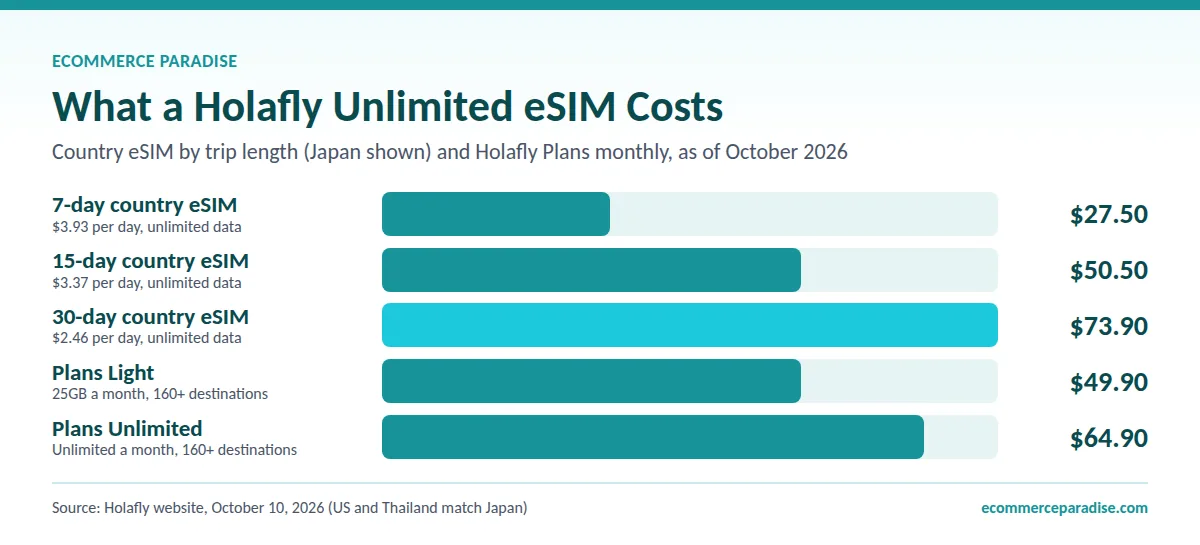
Holafly has two main pricing models. Country-specific or regional plans with per-day pricing run roughly $3.90 to $4.10 per day for 1 to 7 day trips, dropping to $2.46 to $3.15 per day on longer 20 to 30 day plans (as of October 2026, for popular destinations like Japan, Thailand, the US, the UK, and Europe). Plans start at 1 day and go up to 30 days, and the daily rate gets cheaper the longer you commit. For a 30-day trip to those destinations, expect to pay about $74 to $77 for unlimited data.
The bigger story for nomads in 2026 is Holafly Plans, the monthly subscription product. As of October 2026, $49.90 per month gets you 25GB of data globally across 160+ destinations on a Netflix-style monthly billing cycle. $64.90 per month gets you unlimited data globally on the same global eSIM. No annual commitment, hotspot tethering supported on the unlimited tier, and one eSIM that works wherever you go. For a digital nomad bouncing between Bali, Thailand, and Vietnam over 6 months, the monthly Plans option is the cleanest way to handle travel data without buying a new eSIM every border crossing.
What Holafly Does Well
The setup is the smoothest in the eSIM space. You buy a plan on the website or app, get a QR code by email, scan it on your phone, and you’re connected within 5 minutes. No physical SIM swap, no airport line, no passport scan at a kiosk. For a nomad landing in a new country, this matters. You can install the eSIM on your last day in your previous country, then activate data the moment you land at the new airport.
The unlimited data model is genuinely useful for ecommerce work. There’s no GB counter to watch, no anxiety about running out mid-call with a supplier, no overage charges. Even with the fair-use throttling that kicks in around 3 to 5GB per day, that’s still more daily data than most nomads use unless they’re heavily streaming. For typical store monitoring, customer service, video calls with the team, and general work browsing, you’ll never hit the threshold.
The 24/7 support is the third real strength. Holafly has live chat, email, and WhatsApp support in multiple languages with response times typically in the 5 to 15 minute range. That’s faster than most local carrier support in foreign countries, and fast enough to actually help when something breaks during a work call.
One genuinely useful feature for travel in Asia: Holafly’s China plans route through a network that bypasses the Great Firewall, so WhatsApp, Google services, and Instagram all work without a separate VPN. If you’re a nomad with sourcing trips to Yiwu or Guangzhou for product research, this matters more than the marketing implies.
Where Holafly Falls Short
The biggest limitation is what Holafly is, fundamentally. It’s a data-only eSIM. There’s no voice, no SMS, no phone number. You can’t receive a 2FA text from your bank on Holafly. You can’t take a phone call without using WhatsApp or a similar messaging app. This is why Holafly works best paired with a primary plan that handles your phone number functions, not as a complete replacement for a real cell plan.
The fair-use throttling is the second thing to know. Holafly markets unlimited data, but in practice if you hit roughly 3 to 5GB in a single day, your speeds drop until the next billing day resets. For most nomads doing email, store monitoring, video calls, and moderate browsing, you won’t hit this. For heavy 4K video streaming or constant uploads, you will.
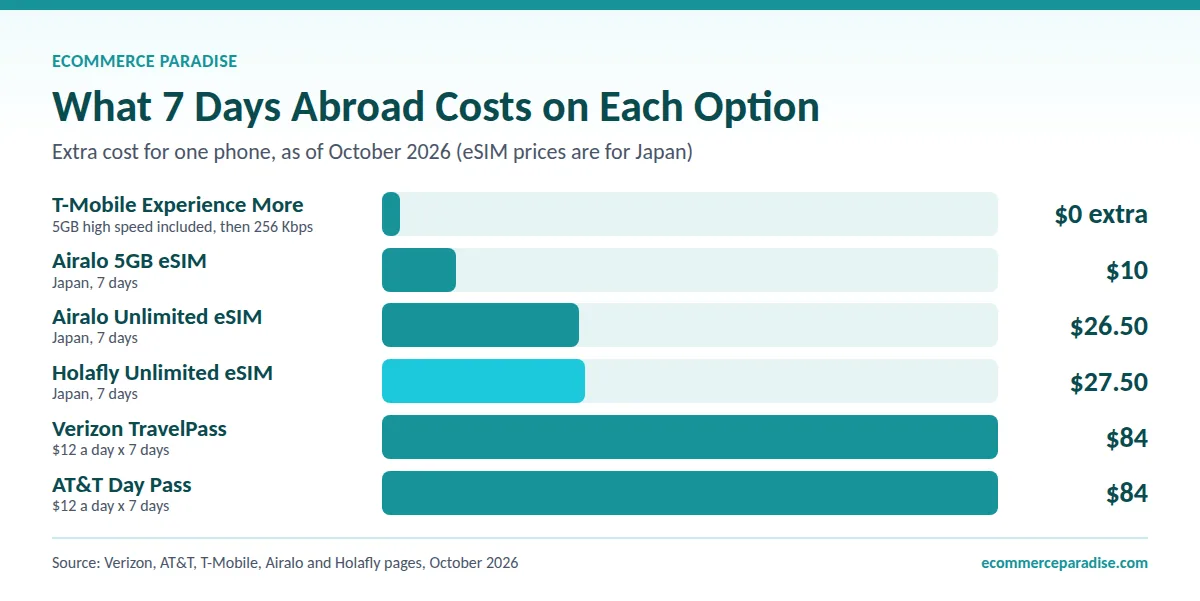
Pricing is the third consideration. For a 7-day trip with light data use, a 5GB plan from Airalo runs about $10 to $12.50 (Japan and the US, as of October 2026), vs Holafly’s $27.50 for unlimited. If you’re a light data user on short trips, cheaper alternatives exist. Holafly’s value is in the simplicity (no GB calculations) and the fair-use ceiling that’s high enough for almost all real-world business use.
Google Fi: My Top Primary Plan for US-Based Travelers
Google Fi is the cell phone plan I’ve been recommending to nomads in my coaching calls for years, and it’s still the right primary plan in 2026 for the same reasons. It gives you a real US phone number that works for 2FA and banking. It includes data in 200+ countries on Unlimited Premium and Flexible, with no daily roaming fees. It runs on T-Mobile’s network in the US (one of the strongest nationwide networks). And it bills as a flat monthly fee with no surprise charges, even when you’re hopping between countries.
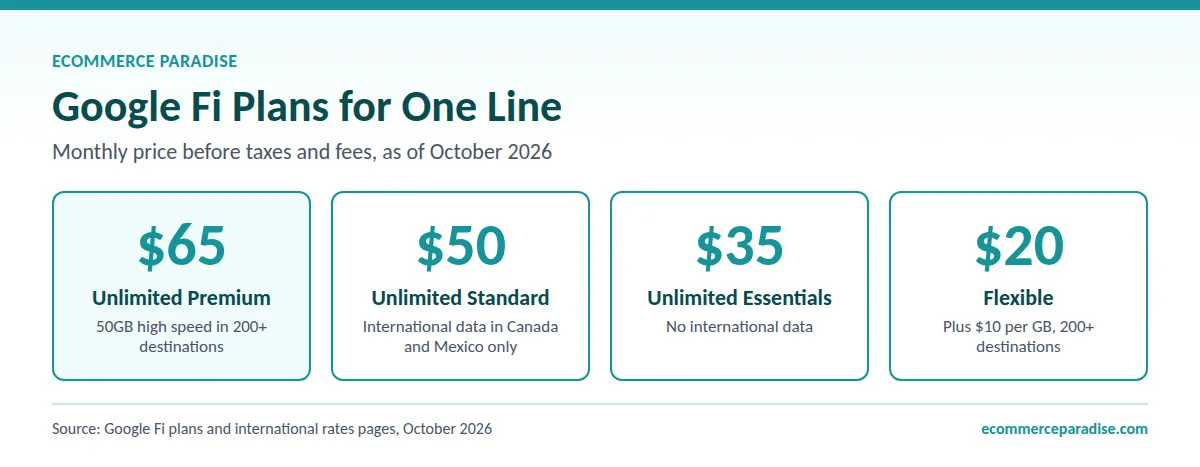
The Unlimited Premium plan at $65/month is the standout option for serious travelers. You get 50GB of high-speed international data in 200+ countries (with 5G in 110+ destinations), 100GB of domestic high-speed data, 50GB of hotspot tethering, free international calls to 50+ countries from the US, and voice calls while abroad at $0.20 per minute. Where traditional carriers charge $10 to $15 per day for international roaming, Fi includes data abroad at no additional fee. A single 7-day international trip already pays for the upgrade compared to Verizon TravelPass or AT&T Day Pass.
The big limitation to know: Google Fi is intended for primary US use, and an extended stretch outside the US, typically around 50 days, triggers a warning by email and in the app. Your account stays active, but Google suspends your international data 30 days after that email (calls and texts still work), per Google Fi’s help page as of October 2026. For a true long-term expat planning to be abroad for months at a stretch without returning to the US, this is a real limitation worth planning around. The fix is either a quick US trip (which most nomads do anyway for visa runs) or layering a Holafly eSIM on top so your data needs are met regardless. I’ve covered the full Google Fi review including all three plan tiers, the iPhone hotspot quirks, and how I personally have my phone set up from Bali in my dedicated Google Fi review.
Best for: frequent international travelers making multiple trips per year, US-based digital nomads who regularly return to the US, ecommerce entrepreneurs and remote workers who need reliable data across many countries, and anyone who wants international coverage without the friction of day passes or eSIM purchases for short trips.
Want the full Google Fi breakdown? Read my full Google Fi review →
T-Mobile: The Best Major Carrier for International Travel
T-Mobile’s Experience More plan is the top major carrier plan for international travel in 2026, with unlimited text and 15GB of high-speed data in Canada and Mexico, plus unlimited text and up to 5GB of high-speed data in 215+ countries and destinations (per T-Mobile’s plans page, October 2026). Calls abroad run $0.50 per minute. For US travelers who want to stay with a major carrier rather than a Google product, T-Mobile is the cleanest option.
The tradeoffs are price (about $85 to $90 per month for one line on Experience More 2.0, depending on AutoPay) and the fact that the included international data stops at 5GB of high-speed data, then drops to 256 Kbps. For light travelers who use messaging apps, maps, and email, this is enough. For heavy data users hotspotting laptops or doing video calls, you’d want to add a Holafly eSIM on top to get high-speed data abroad while keeping T-Mobile as your US number.
Best for: T-Mobile customers who want to stay with their existing carrier, families and multi-line households where the per-line cost works out, and travelers who specifically want a major US carrier as their primary plan rather than an MVNO like Google Fi.
Verizon TravelPass and AT&T International Day Pass
Verizon TravelPass and AT&T International Day Pass are essentially the same product from the two largest US carriers. You pay $12 per day per device when you use your phone abroad, and you get to use your domestic data, talk, and text allowances in 210+ countries. There’s no setup, no separate eSIM to install, no hunting for a local SIM. Your phone just works abroad and your bill goes up by $12 for each day you actually use it.
The math works out for short, infrequent trips. A 4-day weekend in Mexico costs just $24 on Verizon’s $6-a-day Canada and Mexico rate, and a 4-day weekend in Europe costs $48 at the standard $12 rate, which is reasonable. A 14-day trip to Europe costs $168 on Verizon, which is starting to push the limit of reasonable (AT&T caps International Day Pass at 10 daily fees per line per bill period, or $120). A 30-day trip would be $360 on Verizon, at which point Google Fi at $65/month or a Holafly eSIM at about $74 to $77 would be dramatically cheaper.
Best for: Verizon or AT&T loyalists on infrequent international trips (1-2 trips per year, mostly under 7 days each), travelers who want zero setup and don’t mind paying a premium for convenience, and people who specifically need to keep their existing carrier for other reasons (corporate plan, family bundle, etc.).
Worst for: Digital nomads, frequent travelers, anyone abroad more than 10 days per month, and ecommerce business owners running operations from outside the US. The math gets brutal fast for any serious travel.
Just getting started with high-ticket dropshipping? Grab my free beginner’s guide first →
Airalo: The Budget eSIM Alternative
Airalo is the largest eSIM marketplace and the main alternative to Holafly. Where Holafly bets on unlimited data with simple pricing, Airalo mainly sells capped GB plans (typically 1GB, 3GB, 5GB, 10GB, 20GB) that are cheaper than Holafly’s unlimited tiers for light data users. It also sells unlimited packages now, at about $26.50 for 7 days in Japan versus Holafly’s $27.50. A 5GB Airalo plan runs about $10 for 7 days in Japan and $12.50 in the US (as of October 2026), which beats Holafly on price if you genuinely won’t use much data.
The tradeoffs are GB anxiety (you’re watching the counter the whole trip), top-up friction if you run out mid-trip, and the fact that Airalo’s customer support is noticeably slower than Holafly’s during peak travel season. For light travelers (email, messaging, maps, occasional photo uploads), Airalo’s capped plans work fine and save money. For ecommerce nomads doing video calls, hotspotting laptops, or anyone who’d rather not think about data limits at all, Holafly is the cleaner option despite costing more.
Best for: budget-conscious light travelers, vacation tourists who only need maps and messaging, and people taking short trips where GB calculations are easy to predict.
How to Choose: A Decision Tree
Here’s how I’d think about your specific situation.
If you’re a US-based digital nomad or frequent international traveler: Get Google Fi Unlimited Premium as your primary plan plus a Holafly eSIM as your travel data backup for long stays or countries where Fi’s partner network is weak. This is what I run from Bali. Total monthly cost is roughly $115 when running both, which is a fraction of what most nomads pay for worse setups.
If you’re a non-US traveler: Skip Google Fi entirely and use Holafly Plans monthly subscription as your travel data solution layered on top of your existing home country plan. The $49.90 to $64.90 per month covers the data needs of most international trips cleanly.
If you take infrequent short trips (1-2 trips per year, mostly under 7 days each): Either stay with Verizon TravelPass or AT&T Day Pass at $12/day, or buy a country-specific Holafly eSIM for the duration of each trip. The TravelPass route is fine for trips under 5 days. The Holafly route is better for trips over 5 days.
If you’re a true long-term expat (6+ months continuous abroad without US visits): Skip Google Fi (the 50-day warning leads to suspended international data about 30 days later). Use a non-US primary plan in your destination country plus Holafly Plans monthly subscription for travel data when you’re moving around. My guide on LLC formation for digital nomads covers the broader nomad business stack including this scenario.
If you’re a light data user on a vacation trip: Buy an Airalo eSIM with a capped GB plan for your destination. Cheapest option for genuine light use.
Want me to walk you through your full nomad business stack? Book a coaching call with me →
How I Have My Phone Set Up From Bali
For context, here’s the actual setup I run, which I’ve refined over years of running my business from Bali and traveling through Asia. Primary line is Google Fi Unlimited Premium at $65 per month, with my US number on a physical SIM. This handles all my US number functions, banking 2FA, supplier calls back to the US, and most of my international data needs in countries where Fi has strong partner networks.
For long stays past the 50-day mark, or in countries where Fi’s partner is weak, I add a Holafly eSIM as a secondary data line. My phone runs both simultaneously in dual-SIM mode. Total monthly cost when I’m running both is around $115, which is a fraction of what most nomads pay when they layer on bad solutions like daily roaming charges plus local SIM purchases plus Wi-Fi day passes.
Local SIMs almost never. The only exception is extended stays in a single country where I want to optimize cost long-term, or specific situations like a Vietnamese number for ride-hailing apps that don’t accept foreign numbers. For 95% of nomad work, the Google Fi plus Holafly combo is enough on its own.
Frequently Asked Questions
What is the best eSIM for international travel in 2026?
Holafly is my top pick for most travelers. Unlimited data plans in 200+ destinations, simple flat pricing, 5-minute setup, and 24/7 support. For light data users on short trips, Airalo’s capped plans are cheaper. For ecommerce nomads who want connectivity to just work, Holafly is the cleaner option.
Is Google Fi worth it for international travel?
Yes, especially for frequent travelers and digital nomads. Google Fi’s Unlimited Premium plan at $65/month includes 50GB of international data in 200+ countries plus 50GB of hotspot tethering. Compared to paying $12/day with Verizon TravelPass or AT&T International Day Pass, a trip of more than 6 days in a single month already makes Google Fi more cost-effective.
Can I use my US phone number abroad?
Yes, with most international plans including Google Fi, T-Mobile, Verizon TravelPass, and AT&T International Day Pass. Your existing US number works for calls, texts, and 2FA just as it does at home. Data-only eSIMs like Holafly and Airalo do NOT preserve your US number. You’ll need Wi-Fi for calls and texts through messaging apps if you only use a data eSIM.
What’s the best phone setup for Southeast Asia specifically?
For US-based travelers, Google Fi as your primary plan plus a Holafly eSIM for the time you spend abroad past Google Fi’s 50-day warning. Both work in Indonesia, Thailand, Vietnam, the Philippines, Malaysia, and Singapore. For non-US travelers, Holafly Plans monthly subscription handles the entire region with one eSIM.
Do eSIMs work on iPhone?
Yes, all iPhones from the XS (2018) onward support eSIM. Most newer Android flagships also support eSIM. Modern phones support dual-SIM mode (one physical SIM plus one eSIM, or two eSIMs), which is exactly what enables the Google Fi plus Holafly combo to run simultaneously without conflict.
Will buying an eSIM cancel my regular cell plan?
No. Adding a Holafly or Airalo eSIM does not affect your primary cell plan. You’ll have both active simultaneously. You can choose which line handles calls, which handles SMS, and which handles cellular data, all independently in your phone’s settings.
What’s the cheapest way to stay connected abroad?
Buying a local SIM card in your destination country is usually the absolute cheapest option, but it comes with friction (passport requirements in some countries, language barriers, you lose your home number). For 95% of travelers, a Holafly eSIM at about $3.90 to $4.10 per day or $49.90 per month for the global Plans is the right balance of price and convenience.
Does Holafly work in China?
Yes, and this is one of the few eSIMs that genuinely solves the Great Firewall problem. Holafly’s China plans route traffic through a network that bypasses the firewall, so Google services, WhatsApp, Instagram, and other blocked apps work without a separate VPN. For ecommerce sourcing trips to Yiwu, Guangzhou, or Shenzhen, this matters a lot.
The Bottom Line
The best cell phone setup for international travel in 2026 has two parts. For travel data, Holafly is the top eSIM provider thanks to unlimited plans in 200+ destinations, 5-minute setup, and the China VPN bypass feature most competitors lack. For your primary US plan, Google Fi Unlimited Premium at $65 per month is still the cleanest single-bill option for keeping your US number active for 2FA and banking while you’re abroad.
For most serious digital nomads in 2026, you run both. Google Fi handles your US number functions and short trips where its built-in international data is enough. Holafly handles long stays past Google Fi’s 50-day warning, countries where Fi’s partner network is weak, and any trip where you want unlimited data without watching a counter. Total monthly cost when running both is around $115, which beats almost any other setup combination once you factor in the operational reliability for an ecommerce business.
The major carrier day-pass options (Verizon TravelPass, AT&T Day Pass) only make sense for short, infrequent trips. T-Mobile is reasonable if you’re already on T-Mobile and don’t want to switch carriers. Airalo works for budget light-data travelers. For everyone else, especially ecommerce store owners running businesses while traveling, Holafly plus Google Fi is the answer.
If you want help walking through the entire nomad business stack including phone, banking, LLC, and store setup, that’s exactly what my agency does for high-ticket store owners every day.
Get Connected Before Your Next Trip
Holafly for travel data eSIMs, Google Fi for your primary US number. The same combo I use to run my ecommerce business from Bali. Total monthly cost around $115, no surprise roaming fees, no airport SIM hunts.
Get Holafly eSIM → Sign Up for Google Fi →
Want me to handle the entire ecommerce setup so you can focus on running it remotely? Check out my done-for-you turnkey service →
Related Articles
If this article was helpful, here are a few more from the Ecommerce Paradise blog that pair well with what you just read:
Google Fi Review 2026: The Best Cell Phone Plan for Digital Nomads. The full standalone review of Google Fi with all three plan tiers, the 50-day warning details, and how I personally have my phone set up from Bali.
LLC for Digital Nomads: How to Form One From Anywhere. The complete guide for nomad ecommerce store owners forming an LLC without a US tax home.
Business Address for Digital Nomads: Legal Options That Work. The companion piece on virtual mailbox services and business addresses for nomad founders.
Best Tools and Services to Run Your LLC as a Digital Nomad. The full nomad business stack including registered agents, virtual mailboxes, accounting software, and the rest of the operational setup.
Business Formation: The Complete Legal and Financial Foundation Checklist. The full pillar guide on LLC formation, EIN, business banking, and the legal foundation every ecommerce business needs.
What Is High-Ticket Dropshipping? A Comprehensive Guide for Ecommerce Entrepreneurs. The pillar article that covers what high-ticket dropshipping actually is, why it beats low-ticket, and how to get started.
High-Ticket Niches List: 1,000+ Profitable Product Categories. My constantly updated list of profitable high-ticket niches with research notes from my own stores and clients.
How to Find the Best Suppliers for High-Ticket Dropshipping. The complete step-by-step guide to landing authorized dealer agreements with USA-based manufacturers.

Trevor Fenner is an ecommerce entrepreneur and the founder of Ecommerce Paradise, a platform focused on helping entrepreneurs build and scale profitable high-ticket ecommerce and dropshipping businesses. With over a decade of hands-on experience, Trevor specializes in high-ticket dropshipping strategy, niche and product selection, supplier recruiting and onboarding, Google & Bing Shopping ads, ecommerce SEO, and systems-driven automation and scaling. Through Ecommerce Paradise, he provides free education via in-depth guides like How to Start High-Ticket Dropshipping, advanced training through the High-Ticket Dropshipping Masterclass, and fully done-for-you turnkey ecommerce services for entrepreneurs who want a faster, more hands-off path to growth. Trevor is known for emphasizing sustainable, real-world ecommerce models over hype-driven tactics, helping store owners build scalable, sellable, and location-independent brands.


