



Quick answer: The best credit card for dropshipping depends on where your money goes. For ad spend, the Amex Business Gold (4x on advertising when it is a top category) and Chase Ink Business Preferred (3x on search and social ads) lead the pack. For supplier payments, the Capital One Spark Cash Plus earns 2% on everything, and the Chase Ink Business Unlimited earns 1.5% with no annual fee. My recommended starting pair is the Ink Business Unlimited plus the Ink Business Preferred, then I add cards in stages as spend grows. My full 4-stage stack is below.
Hey guys, Trevor here. I’ve been running high-ticket dropshipping stores since October 2010, and one of the biggest hidden profit centers in this business model has nothing to do with products. It’s the credit cards you run your spend through.
When your store spends $25,000 a month on Google Shopping and $50,000 a month paying suppliers, every dollar earns something. Put that spend on a basic 1% card and you leave thousands on the table every year. Put it on the right cards and it turns into business class flights, hotel stays and real cash back.
That’s a big part of how I’ve traveled the world as a digital nomad while running my stores. This guide is the exact card strategy I teach at Ecommerce Paradise, updated for the biggest changes the banks made in 2026.
If you’re brand new, start with my guide to high-ticket dropshipping so the spending examples below make sense.
Disclosure: some links in this guide are affiliate links, and card links go to my card comparison page, which may earn me a commission at no extra cost to you. Card terms, fees and welcome offers change often. The details below were checked in October 2026, but always confirm the current terms before you apply. I’m not a financial advisor or a tax professional, and this is general education, not financial advice.
Find the Card That Pays You Back on Ad Spend
Compare business cards side by side by what you actually spend on: advertising, supplier payments, shipping and software.
What’s in This Guide
- Why credit cards matter more in high-ticket dropshipping
- What changed with business credit cards in 2026
- The best credit cards for dropshipping compared
- My 4-stage business credit card stack
- The best card for each type of spend
- What the right cards are worth: real numbers
- Paying suppliers with a credit card
- Card strategy by business size
- How to apply and get approved
- How to redeem points for the most value
- How to manage multiple cards without mistakes
- Credit card FAQs
Why Credit Cards Matter More in High-Ticket Dropshipping
In a low-ticket store, card rewards are a nice bonus. In a high-ticket store, they can add up to a meaningful slice of your profit. Here’s why.
Your ad spend is huge
Most of my high-ticket stores spend the majority of their marketing budget on Google Shopping and search ads. Established stores commonly spend $10,000 to $50,000 or more a month. On a card that earns 3x or 4x on advertising, that spend alone can generate hundreds of thousands of points a year.
Many suppliers accept cards
When a customer orders a $3,000 product, you pay the supplier for it. A lot of high-ticket brands accept credit cards for individual orders, which means your cost of goods can earn rewards too. I cover how to recruit those brands in my complete guide to finding high-ticket suppliers.
Cards smooth out cash flow
In dropshipping, you usually collect money from the customer before you pay the supplier. A credit card adds a grace period on top of that, so you have time for your Shopify payouts to land before the statement is due. Used responsibly and paid in full, it works like free short-term float.
You get purchase protection and travel benefits
Many business cards include extended warranty, purchase protection, rental car coverage and trip insurance. Premium cards add airport lounge access and hotel status, which matters if you travel to trade shows or work remotely like I do.
It all sits on top of deductible spend
Ads, cost of goods and software are normal costs of running your store. The IRS explains which costs count in its guide to business expense resources, and the right card simply layers rewards on top of money you were going to spend anyway.
What Changed With Business Credit Cards in 2026
The banks made some big changes over the last year. If you read an older card guide, some of its advice is now wrong. Here’s what matters for store owners.
- Chase cut most Hyatt transfers to 4:3. As of October 1, 2026, including for existing cardholders, only the Sapphire Reserve and Sapphire Reserve for Business still transfer to World of Hyatt at 1:1. Frequent Miler’s breakdown of the Hyatt change covers the details.
- Fixed Chase Travel values are going away. The old 1.5 cent and 1.25 cent redemptions are being replaced by Points Boost, with older points grandfathered until October 26, 2027.
- Premium fees went up. The Chase Sapphire Reserve is now $795 a year, and the Amex Business Platinum is now $895 a year, both with more credits to offset the fee.
- Capital One renamed the Spark Miles. It’s now the Capital One Venture Business card.
- The Apple Card is changing issuers. JPMorgan Chase is taking over from Goldman Sachs, with the transition expected to take up to 24 months.
I go deeper on the first change in my post on the Chase Ink Hyatt transfer cut. The short version: Chase is still my starting ecosystem, but Hyatt-focused travelers now need a Sapphire Reserve in the mix.
The Best Credit Cards for Dropshipping Compared
Here’s a quick look at the cards I recommend most, what each one is best for and how it earns. Annual fees and earning rates were checked in October 2026.
| Card | Best for | Annual fee | Key earning |
|---|---|---|---|
| Chase Ink Business Unlimited | Supplier payments and everyday spend | $0 | 1.5% (or 1.5x points) on everything |
| Chase Ink Business Preferred | Google and Meta ads | $95 | 3x on ads, shipping, internet and phone, travel (first $150k a year) |
| Chase Ink Business Cash | Software and phone bills | $0 | 5% on internet, cable, phone and office supply stores (first $25k a year) |
| Amex Business Gold | Heavy ad spend | $375 | 4x on your top 2 of 6 categories, including advertising (first $150k a year) |
| Capital One Spark Cash Plus | Big supplier payments, cash back | $150 (refunded at $150k spend) | 2% cash back on everything |
| Capital One Venture X Business | Supplier payments, travel rewards | $395 | 2x miles on everything, $300 travel credit |
| Chase Ink Business Premier | Large single purchases | $195 | 2.5% on purchases of $5,000 or more, 2% on everything else |
| Marriott Bonvoy Business Amex | US shipping costs | $125 | 4x on US shipping, restaurants, gas and wireless |
| Amex Blue Business Plus | No-fee points | $0 | 2x points on the first $50k a year |
| Chase Sapphire Reserve (personal) | Travel and 1:1 Hyatt transfers | $795 | 8x on Chase Travel, 4x flights and hotels booked direct |
Want to see current welcome offers for these cards in one place? My business credit card comparison page is updated as offers change, which is much easier than checking each bank yourself.
My 4-Stage Business Credit Card Stack
This is the exact playbook I give my coaching students. Follow the stages in order. Each stage builds on the one before it, and you don’t need every card on day one.
Stage 1: Your first 2 cards
Start here as soon as your business is set up. These 2 cards cover almost all of your early spend.
1. Chase Ink Business Unlimited (supplier payments and everything else). It earns 1.5% cash back on every purchase with no cap and no annual fee. The current public offer is $750 back after $6,000 in spend in the first 3 months. Put supplier payments and anything without a bonus category here. Note that it charges a 3% foreign transaction fee, so don’t use it abroad.
2. Chase Ink Business Preferred (ad spend). It earns 3x points on the first $150,000 a year combined in social media and search engine advertising, shipping, internet, cable and phone, and travel. The fee is $95 a year, and the current offer is 100,000 points after $8,000 in spend in the first 3 months. Put your Google Ads, Bing Ads and Meta ads here.
Both cards earn Chase Ultimate Rewards. When you hold the Ink Preferred, the “cash back” from your Ink Unlimited can be combined into points, so everything pools into one balance.
Stage 2: Diversify once spend grows
Once your Stage 1 bonuses are earned and your monthly spend is climbing, add a second and third rewards ecosystem.
3. Capital One Venture X Business (supplier payments, travel rewards). It earns 2x miles on every purchase and comes with a $300 annual travel credit, 10,000 bonus miles every anniversary and airport lounge access. The fee is $395, and the current offer is 150,000 miles after $30,000 in spend in the first 3 months. It’s a pay-in-full card, so it suits stores with steady cash flow.
4. Amex Business Gold (ad spend). It earns 4x points on the 2 categories where you spend the most each month, out of 6 options: advertising, electronics and software, restaurants, gas, transit and wireless. That 4x applies to the first $150,000 a year combined. The fee is $375. It doesn’t include shipping as a bonus category, so I split ad spend between this card and the Ink Preferred to use both $150,000 caps. It’s a charge card, so you pay the balance in full each month.
5. Amex Blue Business Plus (no-fee points). It earns 2x Membership Rewards points on the first $50,000 a year with no annual fee. I use it for software and smaller operating costs, and it pools with the Business Gold.
Stage 3: Shipping, hotels and premium travel
Once you’re spending serious money and traveling for trade shows, supplier visits or a location-independent lifestyle, this stage starts paying off.
6. Marriott Bonvoy Business Amex (US shipping). It earns 6x at Marriott and 4x on US shipping, restaurants, US gas and wireless, plus 2x on everything else. You get a free night certificate every year, which more than covers the $125 fee if you use it.
7. Hilton Honors Amex Business (everyday spend for Hilton fans). It earns 12x at Hilton and 5x on the first $100,000 a year in other purchases. It comes with up to $240 a year in Hilton credits and Gold status for $195 a year.
8. Chase Sapphire Reserve (personal). This is my personal Visa for places that don’t take Amex. It’s now $795 a year with a $300 travel credit and a long list of other credits. The big reason I keep it is that it’s one of only 2 Chase cards that still transfer points to World of Hyatt at 1:1.
9. Amex Business Platinum (frequent flyers). It earns 5x on flights and prepaid hotels through Amex Travel and 2x on purchases of $5,000 or more and on US shipping providers, up to $2 million a year. The fee is now $895, offset by a long list of credits, plus lounge access and hotel status. Only get it once you fly often enough to use the benefits.
Stage 4: Hotel status cards
Skip this stage until you travel enough that suite upgrades, free breakfast and lounge access actually matter to you.
10. IHG One Rewards Premier (personal). It earns 10x at IHG hotels, 5x on travel, dining and gas and 3x on everything else for $99 a year. You get an anniversary free night, Platinum status and a path to Diamond status at $40,000 in yearly spend.
11. Hilton Honors Aspire (personal). It comes with automatic Diamond status, a $400 Hilton resort credit, a $200 flight credit and an annual free night for $550 a year. It’s my favorite card for automatic top-tier hotel status, especially in Southeast Asia where Hilton has strong coverage.
12. World of Hyatt cards. The personal card is $95 a year with a free night every year, and the business card is $199 a year with up to 9x at Hyatt. Hyatt points are some of the most valuable hotel points out there, so these pair well with a Sapphire Reserve.
Supporting personal cards worth keeping
- Chase Freedom Unlimited: 1.5% on everything, 3% on dining and drugstores and 5% on Chase Travel, with no annual fee. Its rewards pool with your Chase business points when you hold a Sapphire or Ink Preferred card.
- Coinbase One Card: earns 2% to 4% back in Bitcoin depending on how much you hold on Coinbase, with no foreign transaction fee. It requires a Coinbase One membership, which starts at $49.99 a year.
- Apple Card: 2% back with Apple Pay, 3% at Apple and select merchants and 1% with the physical card, plus interest-free monthly installments on Apple products. Handy if you refresh your MacBook and iPhone regularly.
If you just want cash back
Prefer simple cash over points? Use the Capital One Spark Cash Plus for 2% back on every purchase. The $150 annual fee is refunded every year you spend $150,000, which most growing stores hit easily, and the current offer is $2,000 after $30,000 in spend in the first 3 months.
The Amex Blue Business Cash is the no-fee option, with 2% back on the first $50,000 a year. Both are simpler than a points stack, and for stores that rarely travel they can be the smarter choice.
Turn Your Ad Spend Into Flights and Cash Back
See current welcome offers for the Ink Preferred, Business Gold, Spark Cash Plus and more on one page.
The Best Card for Each Type of Spend
The real trick is matching each type of spending to the card that rewards it best. Here’s how I route spend in a typical high-ticket store.
Best for Google Ads and Meta ads
The Amex Business Gold earns 4x on advertising when it’s one of your top 2 categories, and in most high-ticket stores it will be. The Chase Ink Business Preferred earns 3x on search and social advertising. Splitting ad spend between the two gives you up to $300,000 a year at bonus rates, as long as ads are the main bonus spend on both cards.
I go deeper on this in my guide to the best credit cards for Google and Meta ad spend. If ads are your biggest cost, also read my breakdown of the best ad platforms for high-ticket dropshipping.
Best for supplier payments
Supplier payments are usually your biggest category by dollars. Flat-rate cards with no caps win here: the Capital One Spark Cash Plus (2% cash back), the Venture X Business (2x miles) and the Chase Ink Business Unlimited (1.5%, no fee). If you place a lot of single orders of $5,000 or more, the Chase Ink Business Premier earns 2.5% on those.
Best for shipping
Most dropshipping suppliers include shipping in your cost, but if you pay freight or return shipping yourself, the Marriott Bonvoy Business Amex earns 4x on US shipping. Check that your freight carrier codes as shipping, because some freight brokers don’t. The Ink Business Preferred earns 3x on shipping, and the Amex Business Platinum earns 2x.
Best for software and phone bills
The Chase Ink Business Cash earns 5% on internet, cable and phone services and at office supply stores, on the first $25,000 a year. That covers your internet and phone bills. Many software subscriptions code to the Amex Business Gold’s electronics and software category instead, so check how each charge posts.
Your software stack adds up fast. I run every store on Shopify, which is the core platform behind all my high-ticket builds.
For email marketing I use Klaviyo, which earns its keep on high-ticket abandoned cart flows.
Best for travel
The Chase Sapphire Reserve, Amex Business Platinum and Venture X Business are the strongest travel cards. Pick based on which ecosystem you already earn in, because pooling points in one program is worth more than spreading them thin.
What the Right Cards Are Worth: Real Numbers
Let’s run the numbers for an established high-ticket store spending about $25,000 a month on ads and $50,000 a month on supplier payments. The last column shows what the same spend earns on a basic 1% card.
| Annual spend | Card used | What it earns | On a 1% card |
|---|---|---|---|
| Google and Meta ads: $300,000 | Amex Business Gold ($150k at 4x) + Ink Preferred ($150k at 3x) | 1,050,000 points | $3,000 |
| Supplier payments: $600,000 | Spark Cash Plus (2%) | $12,000 cash back | $6,000 |
| Internet, phone and office supplies: $24,000 | Ink Business Cash (5%) | $1,200 cash back | $240 |
| Freight and returns shipping: $24,000 | Marriott Bonvoy Business (4x) | 96,000 Marriott points | $240 |
Even if you value points at a conservative 1 cent each, the ad spend alone is worth about $10,500 a year instead of $3,000. Add $12,000 in cash back on supplier payments, and the Spark Cash Plus annual fee is refunded because you spent over $150,000.
That’s more than $20,000 a year from spending the store was already doing. Use transfer partners well and the travel value can be much higher.
Two important caveats. Cards only make sense if you pay every statement in full, because interest wipes out rewards fast. And these numbers ignore annual fees, which you should subtract when you compare cards.
Paying Suppliers With a Credit Card
Paying suppliers by card is one of the biggest wins in this business, but it comes with a few rules.
- Ask on your dealer application. Many brands list accepted payment methods on their dealer forms. Some accept cards for individual orders but want ACH for larger ones.
- Watch for surcharges. If a supplier adds a 3% card fee and your card earns 2%, you lose 1% on every order. In that case, pay by ACH.
- Keep an eye on credit limits. High-ticket orders burn through limits fast. Pay your balance early in the cycle to free up room, or use a pay-in-full card with no preset spending limit.
- Keep documents organized. Save invoices and match them to card charges, because chargebacks and supplier disputes are easier to win with clean records.
For suppliers who won’t take cards at all, I cover workarounds in my guide on how to pay suppliers with a credit card they don’t accept. Those services charge their own fees, so run the math first.
When you pay by ACH instead, run it from a dedicated business bank account. I use Mercury because you can open and manage it fully online and it connects cleanly to Shopify payouts.
For international suppliers or contractors, Wise is my pick for sending money abroad at a fair exchange rate.
Card Strategy by Business Size
You don’t need 12 cards on day one. Match your stack to the size of your store.
| Business size | Cards | Typical annual fees |
|---|---|---|
| Starting out (first year) | Ink Business Unlimited + Ink Business Preferred | $95 |
| Growing ($100k to $500k a year in revenue) | Add Amex Business Gold, Venture X Business or Spark Cash Plus | $250 to $1,000 |
| Established ($500k+ a year) | Add Marriott Business, Sapphire Reserve and hotel status cards as travel grows | $1,500+, offset by credits |
Starting out
Focus on approval, a solid first welcome bonus and simple rewards. The 2 Chase Ink cards cover ads and supplier payments for $95 a year total. Before you apply, make sure your business setup is done using my business formation checklist for dropshipping.
Growing
Once ad spend passes about $12,500 a month, you’re blowing through the Ink Preferred’s $150,000 cap. That’s the time to add the Amex Business Gold for a second ad cap. If supplier payments are big, add a 2% card.
Established
At this stage, rewards become a real line item. Route every category to its best card, add travel cards you’ll actually use and review your stack once a year to cut cards whose fees you no longer earn back.
How to Apply and Get Approved
What you need before applying
- Your legal business name and entity type
- Your EIN (sole proprietors can usually use their SSN)
- A business address and phone number
- Annual revenue (honest projections are fine for a new business)
- Your personal income, Social Security number and home address
If you haven’t formed your LLC yet, I recommend Northwest Registered Agent because they keep your home address off public filings and include registered agent service. A dedicated business phone number helps too, and I use Quo for that.
For the full walkthrough, read my guide on how to get a business credit card. If you don’t have an SSN, see my post on getting a business credit card with an EIN only.
Apply in the right order
Chase is known for its unofficial 5/24 rule, which denies some applicants who opened 5 or more personal cards in the last 24 months. In 2026 it seems to be enforced inconsistently, but applying for Chase cards first is still the safest order.
After that, space applications out by a couple of months and only apply when you have enough planned spend to earn the welcome bonus naturally. Never buy things you don’t need just to hit a bonus.
Understand the personal side
Business card applications usually trigger a hard inquiry on your personal credit, and you sign a personal guarantee. NerdWallet’s breakdown of issuer reporting practices shows that most issuers only report business card activity to your personal file if something goes wrong, with a few exceptions.
If you’re denied, call the reconsideration line, ask why and offer extra information. Common reasons are too many recent applications, low reported revenue or a thin credit file.
How to Redeem Points for the Most Value
Earning points is half the game. How you redeem them decides what they’re actually worth.
Cash back
Cash back is simple and predictable. At 1 cent per point, it’s the floor value, and it’s the right choice when you need liquidity or don’t travel much.
Travel portals and Points Boost
Chase’s fixed 1.5 cent and 1.25 cent portal values are being replaced by Points Boost, which offers higher values on selected flights and hotels. Frequent Miler’s Points Boost explainer covers the grandfathering dates for older points.
Transfer partners
Transferring to airline and hotel partners is where points get most valuable, especially for business class flights. Amex Membership Rewards and Capital One miles both transfer to a long list of airlines, and Chase points transfer to partners like United and Hyatt.
For Hyatt specifically, remember the 2026 change: 1:1 transfers only come from the Sapphire Reserve cards. Check Chase’s current rules on combining points before you plan a big redemption around it.
If you want the full travel side of this, my guide on how to travel in luxury almost free with points and miles goes deep.
A note on taxes
Rewards earned from spending are generally treated as a rebate on what you bought rather than as income. For a business, though, that can reduce the deductible cost of the expense, and bonuses that don’t require spending can be treated differently. Ask your CPA how to book rewards for your store.
How to Manage Multiple Cards Without Mistakes
- Autopay the full balance. Set every card to pay the statement balance in full from your business checking account.
- Keep business and personal separate. Business cards for business spend only. It keeps your books clean and protects your LLC.
- Write a card routing cheat sheet. List which card pays for which category, and share it with your VA if they handle payments.
- Track bonus caps. Know when you’re close to the $150,000 cap on your ad cards so you can switch cards.
- Review once a year. Before each annual fee posts, check whether the card earned back its fee.
Connect every card to your bookkeeping so charges are categorized automatically. My pick is Finaloop because it’s built for ecommerce and connects to Shopify, your bank and your cards.
For your business email, Google Workspace keeps card statements, supplier invoices and receipts in one searchable inbox.
Where Credit Cards Fit in Your Store Setup
Cards are one piece of the financial foundation for a high-ticket store. Here’s the order I recommend:
- Pick your niche. Start with my high-ticket niches list to find a profitable category.
- Choose your products. See my guide to high ticket items to sell online.
- Form your business. Get your LLC, EIN and sales tax permit in place first.
- Open your bank account. Compare options in my guide to the best business bank accounts for dropshipping.
- Add your first 2 cards. Then follow the stages above as your spend grows.
Credit Card FAQs
What is the best credit card for dropshipping?
For most high-ticket dropshippers, the best starting pair is the Chase Ink Business Unlimited for supplier payments and everyday spend plus the Chase Ink Business Preferred for ad spend. If you mostly pay suppliers by card and want simple cash back, the Capital One Spark Cash Plus earns 2% on everything. The right card depends on where most of your money goes: ads, inventory, shipping or software.
What is the best credit card for Google Ads and Facebook ads?
The American Express Business Gold earns 4x points on advertising when it is one of your top 2 spending categories each month, on up to $150,000 a year combined. The Chase Ink Business Preferred earns 3x on social media and search engine advertising on up to $150,000 a year combined. Many store owners split ad spend across both cards to get 2 bonus caps.
Can I use a business credit card to pay dropshipping suppliers?
Yes, many suppliers accept credit cards, especially for individual orders and samples. Watch for card surcharges, though. If a supplier adds a 3% fee and your card earns 2%, you lose money on every order, so pay by ACH from your business bank account instead.
Do I need an LLC to get a business credit card?
No. Many issuers let sole proprietors apply using their Social Security number. For high-ticket dropshipping you will want an LLC and an EIN anyway because suppliers ask for them, and having them makes your business card application cleaner.
Can I get a business credit card with a brand new business?
Yes. Issuers mainly look at your personal credit for new businesses, and you can list honest projected revenue. Approval is never guaranteed, so start with 1 or 2 cards and build a history before adding more.
Do business credit cards affect my personal credit?
The application is usually a hard inquiry on your personal credit, and you sign a personal guarantee. Most issuers only report business card activity to your personal credit file if the account goes delinquent, but some report more, so check each issuer’s policy.
Is the Chase 5/24 rule still a thing in 2026?
Chase has never officially published it, and in 2026 it appears to be enforced inconsistently. Some applicants with 5 or more new personal cards in 24 months are still denied while others get approved. Applying for Chase cards first is still the safest order.
Can I still transfer Chase points to Hyatt at 1:1?
Only from the Chase Sapphire Reserve and the Chase Sapphire Reserve for Business. As of October 1, 2026, including for existing cardholders, points transferred from the Sapphire Preferred and Ink Business Preferred move to World of Hyatt at a 4:3 ratio. Check Chase’s current rules before you plan a big Hyatt redemption.
Are credit card rewards taxable for my business?
Rewards earned from spending are generally treated as a rebate on what you bought, not as income, but that can reduce the deductible cost of the business expense. Sign-up bonuses that do not require spending can be treated differently. Ask your CPA how to book rewards in your situation.
How many business credit cards should a dropshipper have?
Start with 1 or 2 cards in year one. Most growing stores end up with 3 to 6 cards, each matched to a spending category like ads, supplier payments, shipping and software. More cards only make sense if you can track them and pay every balance in full.
Final Thoughts: Make Every Business Dollar Work Twice
You’re going to spend the money on ads, inventory and software anyway. The only question is whether that spend earns 1% or a lot more.
Start with the 2 Chase Ink cards, pay every balance in full and add cards in stages as your store grows. Within a year or two, your card rewards can cover a lot of your travel, and that’s a pretty great perk of running a high-ticket store.
Here’s where to go next:
- Compare current card offers: see my best credit cards for ecommerce businesses page.
- Want the whole system? Join the High-Ticket Dropshipping Masterclass with a 7 day free trial.
- Want help with your setup? Book a private coaching session and we’ll build your plan together.
- Want it done for you? See our done-for-you high-ticket store build.
You can also message me directly on WhatsApp at +1 206-504-6099. I’m always happy to help.
Pick Your Next Business Card With Confidence
One page with current welcome offers, annual fees and earning rates for the cards ecommerce owners actually use.
Trevor Fenner is the founder of Ecommerce Paradise. He has been building, growing and selling high-ticket dropshipping stores since October 2010, and he runs Electric Bikes Paradise. He teaches entrepreneurs worldwide how to set up their businesses, recruit US suppliers and grow with Google Shopping.
Related Articles
If you found this useful, these guides go deeper on related topics:
- Best Credit Cards for Paying Google and Meta Ad Spend
- Best Credit Cards for Paying Suppliers and Wholesale Inventory
- How to Get a Business Credit Card
- Chase Ink Hyatt Transfer Cut: What Changed
- Business Formation for Dropshipping: LLC, EIN, Licenses and Banking

Trevor Fenner is an ecommerce entrepreneur and the founder of Ecommerce Paradise, a platform focused on helping entrepreneurs build and scale profitable high-ticket ecommerce and dropshipping businesses. With over a decade of hands-on experience, Trevor specializes in high-ticket dropshipping strategy, niche and product selection, supplier recruiting and onboarding, Google & Bing Shopping ads, ecommerce SEO, and systems-driven automation and scaling. Through Ecommerce Paradise, he provides free education via in-depth guides like How to Start High-Ticket Dropshipping, advanced training through the High-Ticket Dropshipping Masterclass, and fully done-for-you turnkey ecommerce services for entrepreneurs who want a faster, more hands-off path to growth. Trevor is known for emphasizing sustainable, real-world ecommerce models over hype-driven tactics, helping store owners build scalable, sellable, and location-independent brands.
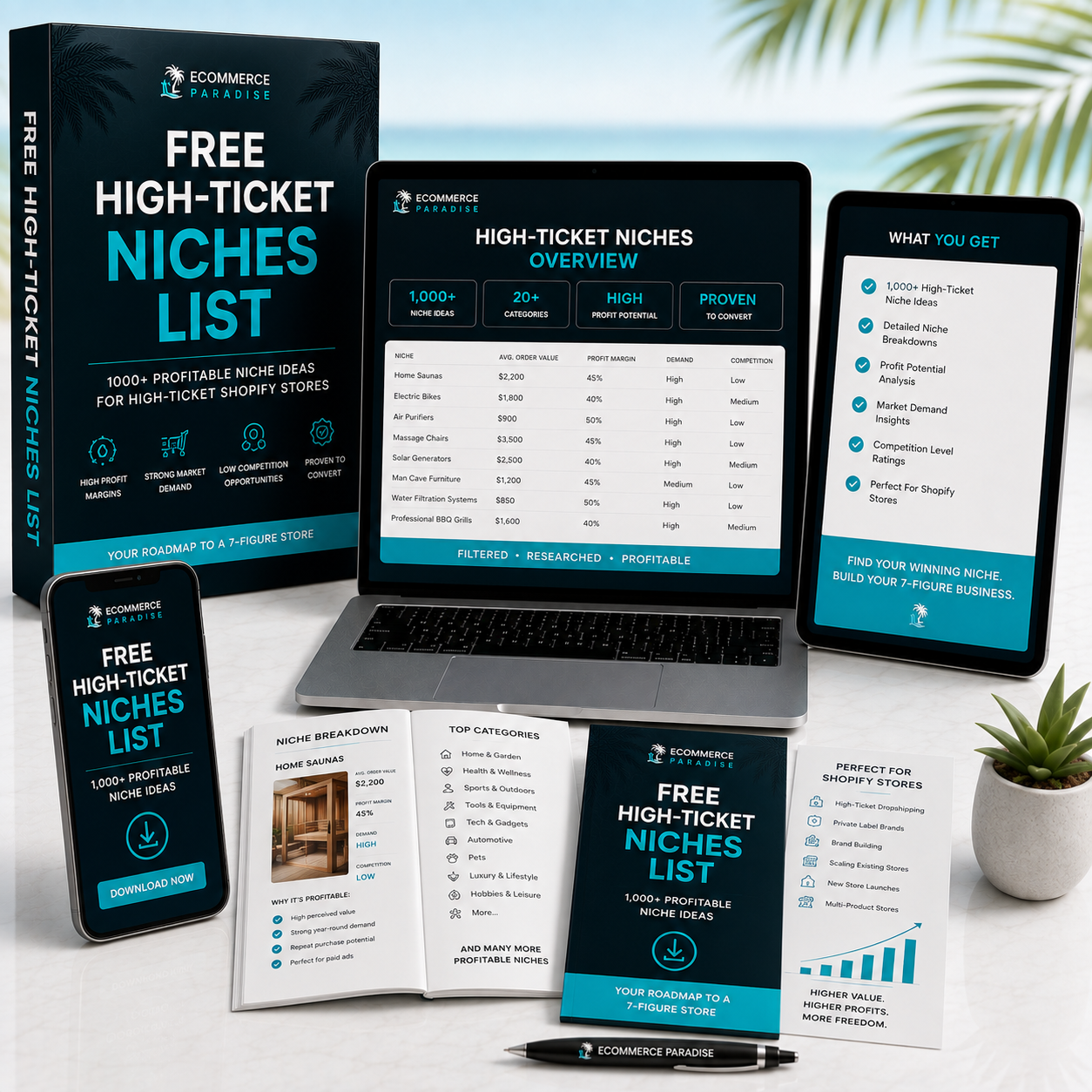
Still deciding what to sell?
Grab the free list of 1,000+ niches that work for high-ticket dropshipping, sorted by category.
Free. Unsubscribe any time.


