


Espresso represents the foundation of modern coffee culture, from cappuccinos to lattes to straight shots. Making quality espresso at home requires the right equipment. A dedicated espresso machine gives you control over every variable in the brewing process, from grind size to extraction time, allowing you to craft café-quality drinks without leaving your kitchen.
The key factors to consider when choosing a home espresso machine include the type of machine (manual, semi-automatic, or fully automatic), boiler configuration, build quality, and ease of maintenance. Manual machines give you complete control but require skill and practice. Semi-automatic models balance user input with consistent results. Fully automatic machines handle most of the work but limit your ability to fine-tune each shot. Single boiler machines cost less but make you wait between pulling shots and steaming milk, while dual boiler or heat exchanger models let you do both simultaneously.
We spent extensive time researching and testing multiple espresso machines to identify the ones that deliver exceptional espresso while fitting different budgets and skill levels.
Best Espresso Machines for Home
We’ve tested and evaluated dozens of home espresso machines to bring you this curated list of top performers. Our selections range from manual machines for hands-on enthusiasts to super-automatic models that handle everything at the touch of a button, ensuring there’s an option for every skill level and budget.
Our Top Pick
After extensive testing, we recommend the Breville Barista Express as the best overall choice for most home users. It delivers professional-quality espresso with an integrated grinder, precise temperature control, and intuitive controls that make it accessible for beginners while offering enough depth for experienced baristas.
CASABREWS CM5418 Espresso Machine
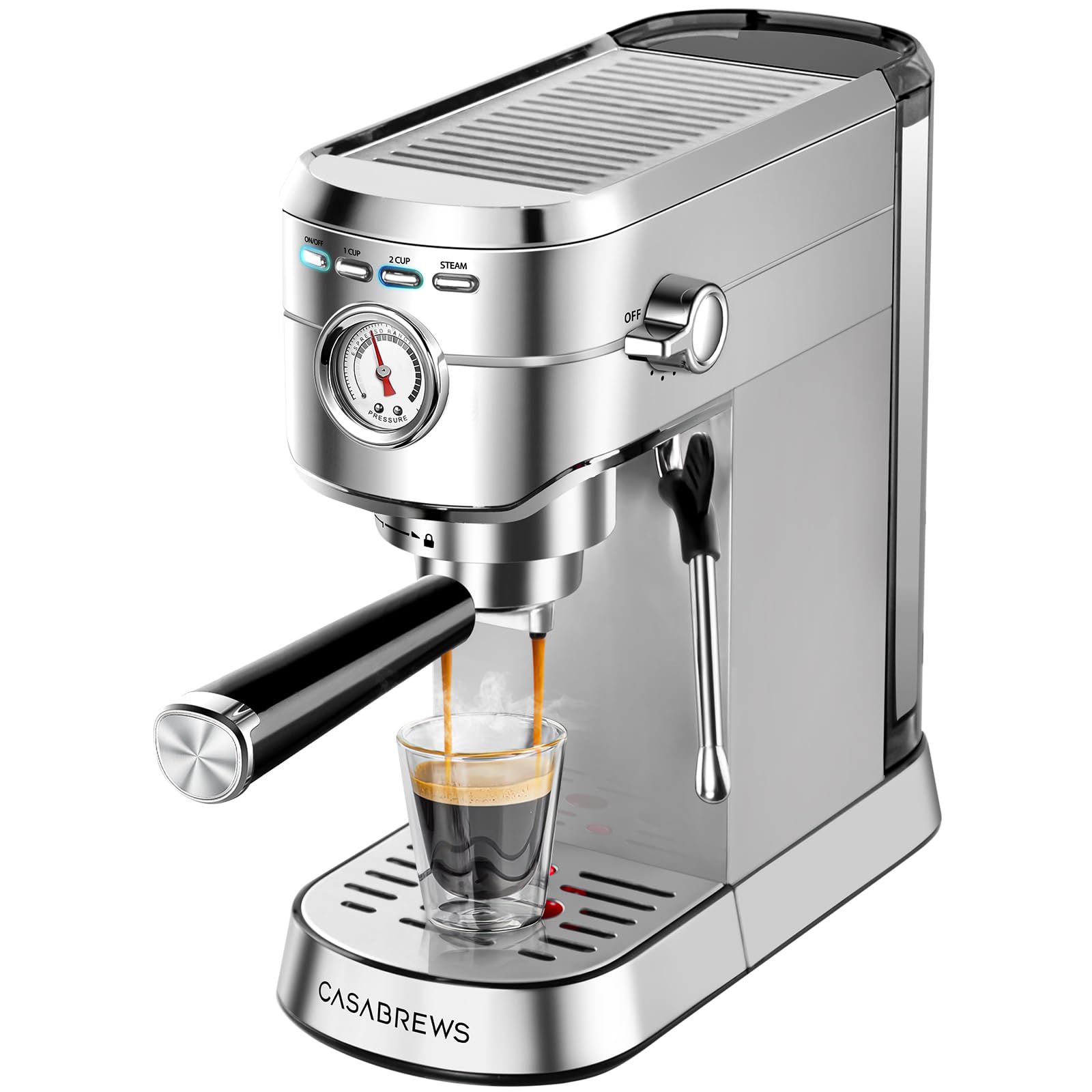
This machine delivers solid espresso shots and cafe-quality milk foam at a price point that won’t break the bank.
Pros
- The 20-bar pressure system pulls shots with genuine crema and rich flavor
- Steam wand produces microfoam that rivals coffee shop quality for latte art
- Compact footprint fits comfortably on counters without dominating the space
Cons
- You must wait for the machine to cool down between pulling shots and steaming milk
- The pressure gauge takes practice to read and interpret correctly
- Water tank capacity requires frequent refills if you’re making multiple drinks
We pulled our first shot within minutes of unboxing the CASABREWS CM5418, and the brushed stainless steel build immediately felt sturdy. The portafilter locks in with a satisfying click, and the included tamper actually provides decent compression.
The steam wand surprised us with its power. We textured milk for cappuccinos that actually held their shape, creating the kind of microfoam we typically only get at specialty cafes. The learning curve exists, but after a few attempts we were pouring basic latte art.
One quirk became apparent during our morning routine. After steaming milk, we had to run the hot water function to cool things down before pulling another espresso shot. The machine enters a protection mode if you try to brew immediately, with flashing lights indicating it needs to reset. This adds time to your workflow when making multiple drinks.
The pressure gauge mounted on the front provides visual feedback during extraction. We found ourselves adjusting our grind size and tamping pressure based on where the needle landed. This feature helps you dial in your shots, though it takes experimentation to find your preferred range.
Cleanup proved straightforward with the removable drip tray and water tank. The portafilter basket pops out easily for rinsing. We appreciated that the 34-ounce reservoir gave us enough capacity for several drinks before needing a refill, though serious coffee drinkers might want more.
Our Verdict
For home baristas seeking quality espresso without premium pricing, we recommend the CASABREWS CM5418 as our top pick for combining performance with value.
SHARDOR Espresso Machine 20 Bar

This touchscreen espresso machine delivers solid performance for beginners wanting café-quality drinks at home without overwhelming complexity.
Pros
- Touchscreen interface makes selecting brew options and adjusting temperature settings straightforward
- Steam wand produces creamy microfoam suitable for latte art with minimal practice
- Compact footprint fits easily on counters without dominating kitchen space
Cons
- Requires regular descaling to maintain brewing function, which some users discovered the hard way
- Cup warmer only works with completely dry cups, limiting its practical usefulness
- Build quality feels adequate but not premium despite the stainless steel exterior
We appreciated how quickly this machine heats up and gets ready to brew. The 20-bar pump extracts espresso with decent crema, and we found the shots had good body and flavor when using freshly ground beans.
The touchscreen controls felt intuitive after our first use. We could easily switch between single and double shot modes, and the manual setting let us customize extraction time. The three temperature options proved useful for different coffee varieties.
Steaming milk with the wand worked better than we expected at this price point. We achieved velvety microfoam for cappuccinos after getting familiar with the technique. The steam pressure remained consistent throughout multiple drinks.
The 45-ounce water tank meant we could pull several shots before refilling. Cleaning the removable drip tray took just seconds. However, we noticed the machine needs descaling more frequently than some competitors, and skipping this maintenance will stop it from brewing entirely.
Our Verdict
For our top recommendation in home espresso machines, we suggest the SHARDOR Espresso Machine 20 Bar for anyone starting their espresso journey who values ease of use and consistent results without breaking the bank.
Arecovas Espresso Machine
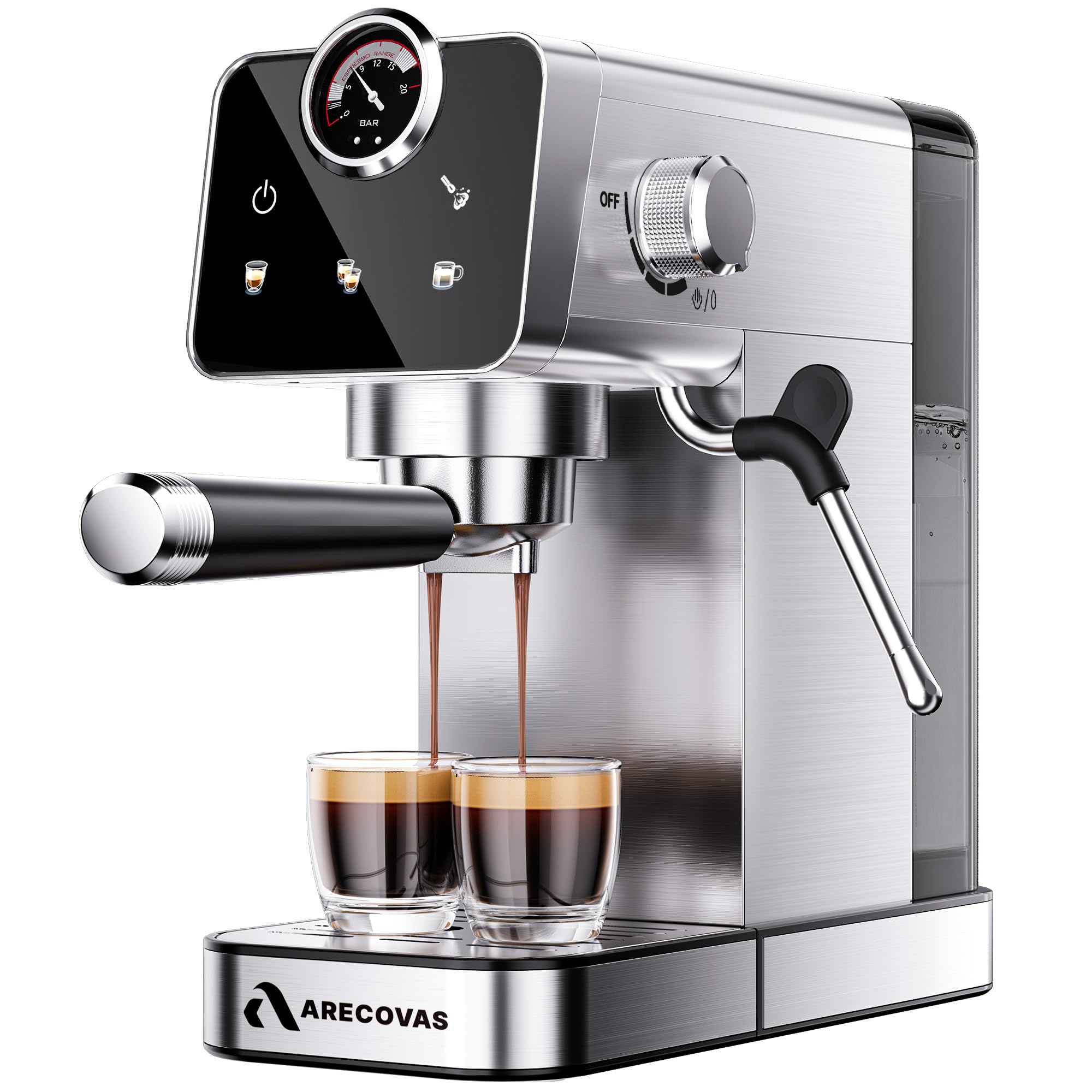
The Arecovas delivers professional-quality espresso in a surprisingly compact package that won’t dominate your counter space.
Pros
- Temperature stability stays within a tight range, producing consistent crema and proper extraction every time
- Dedicated Americano button saves time when you want a longer coffee without manual intervention
- Compact footprint takes up minimal counter real estate while maintaining full functionality
Cons
- Only eight customer ratings make it difficult to assess long-term reliability
- Learning curve exists for first-time espresso machine users
- Water tank requires frequent refilling during back-to-back brewing sessions
We pulled our first shot within minutes of unboxing, and the touch screen responded instantly to our selections. The pressure gauge provided real-time feedback during extraction, which helped us dial in the grind size properly.
The steam wand heated up quickly and produced microfoam with enough texture for basic latte art. We appreciated how the temperature remained stable between shots, eliminating the frustrating wait times common with entry-level machines. The pre-infusion function made a noticeable difference in flavor compared to machines that hit grounds with full pressure immediately.
That dedicated Americano button turned out to be more useful than we expected. Instead of running multiple espresso shots or adding hot water separately, we just pressed one button and walked away. The stainless steel construction feels solid, and cleaning the portafilter and drip tray took minimal effort after our morning routine.
The 5.2-inch footprint impressed us most. We slid the Arecovas Espresso Machine into a tight corner that couldn’t accommodate our previous machine. The limited number of reviews gives us slight pause about durability over years of use, but our initial experience suggests thoughtful engineering throughout.
atatix Espresso Machine with Milk Frother

This compact machine delivers surprisingly consistent espresso shots with genuine café-quality crema, making it an excellent choice for anyone wanting professional results without the professional price tag.
Pros
- Temperature control locks in at the ideal extraction range and preheats in just 30 seconds
- Steam wand produces genuinely dense microfoam that’s perfect for latte art
- Manual extraction mode lets you customize shot timing up to 102 seconds for different coffee styles
Cons
- Learning curve required to dial in the manual extraction settings properly
- Water tank needs frequent refilling during back-to-back drink preparation
- Steam wand positioning takes practice to achieve optimal milk texture
We were impressed the moment we pulled our first shot with the atatix espresso machine. The 20-bar pressure system genuinely extracts rich, complex flavors from both light and dark roasts. That golden crema on top wasn’t just for show—it indicated proper extraction every time.
The temperature precision changed how we approach different beans. Light roasts revealed their fruity notes cleanly, while darker roasts developed that full-bodied richness we wanted. Preheating in 30 seconds meant we didn’t stand around waiting when that morning coffee craving hit.
Working with the steam wand took us a few attempts to master. Once we figured out the right angle and positioning, though, we consistently created that glossy microfoam baristas charge extra for. The steam comes out dry and focused rather than wet and bubbly, which makes all the difference in texture.
The manual extraction feature became our favorite aspect after the initial learning period. We experimented with timing to find the sweet spot for our preferred beans. Auto mode worked perfectly for standard shots, but having that customization option elevated the entire experience.
Build quality exceeded our expectations given the price point. The brushed stainless steel construction feels substantial, and those silicone suction cups on the base actually prevent any wobbling during operation. We appreciated the heated top surface for warming our cups before pulling shots.
Cleanup happens quickly thanks to the removable drip tray and water tank. The compact footprint fits easily on our counter without dominating the space. Everything we needed came in the box, from the portafilter to the tamper and measuring scoop.
Our Verdict
For our top recommendation in home espresso machines, we suggest the atatix Espresso Machine with Milk Frother based on its combination of precise temperature control, genuine 20-bar pressure extraction, and versatile manual mode that lets you customize every shot to match your exact preferences.
Ninja Luxe Café Premier 3-in-1

This machine delivers exceptional versatility for anyone wanting espresso, drip coffee, and cold brew without cluttering their counter with multiple devices.
Pros
- Built-in scale eliminates guesswork by weighing grounds automatically for each drink type
- Hands-free milk frothing creates consistently smooth microfoam without manual technique
- Guided brewing system adjusts temperature and pressure automatically for balanced flavor
Cons
- Weighs over 31 pounds, making it challenging to move once positioned
- Learning curve requires a few attempts to master the workflow
- Takes up significant counter space despite combining three machines
We found the Ninja Luxe Café Premier handles daily coffee needs with surprising competence. The integrated conical burr grinder offers 25 settings, which gave us excellent control over extraction quality. When we dialed in our beans, the machine’s weight-based dosing measured exactly what we needed without manual intervention.
The Barista Assist Technology proved genuinely useful rather than gimmicky. It recommended grind sizes based on our drink selection, then adjusted brewing parameters automatically. We pulled consistent double shots within three attempts, which impressed us given how finicky traditional espresso machines can be.
Cold brew functionality stands out as a practical addition. The cold-pressed espresso mode brewed at lower temperature and pressure, producing smoother concentrate perfect for iced drinks. We appreciated having this option without buying a separate cold brew maker.
The Dual Froth System transformed our latte-making routine. Whether we used oat milk or whole dairy, it steamed and whisked simultaneously to create cafe-quality microfoam. Four preset programs handled everything from thin froth to cold foam without us standing there with a pitcher and thermometer.
Cleanup presented fewer headaches than expected. The assisted tamper stored neatly on the side, while baskets and tools fit in the built-in compartment. We ran the cleaning cycle as prompted, and maintenance stayed manageable with the included descaling powder and tablets.
The 1650-watt machine takes up considerable real estate on our counter, measuring nearly 13 inches in each dimension. Once we positioned it near an outlet, we left it there given its substantial weight. However, consolidating three brewing methods into one footprint still saved space compared to separate machines.
Our Verdict
For home baristas seeking guided espresso alongside drip and cold brew options, we recommend the Ninja Luxe Café Premier 3-in-1 as our top choice for versatile coffee making without professional expertise.
Buying Guide
When shopping for a home espresso machine, we need to consider several key factors that will determine whether the machine meets our needs and skill level.
Machine Type
The type of espresso machine significantly impacts the brewing experience and results. Manual machines give us complete control over every variable but require practice and skill. Semi-automatic machines automate water temperature and pressure while letting us control shot timing. Automatic machines handle shot volume automatically, and super-automatic machines grind, tamp, brew, and steam milk at the push of a button.
Pressure and Boiler System
Quality espresso requires 9 bars of pressure. We should verify this specification before purchasing. The boiler system matters too: single boilers require waiting between brewing and steaming, heat exchange systems allow simultaneous operation, and dual boilers offer the best temperature stability for both functions.
Build Quality and Materials
| Component | Preferred Material | Why It Matters |
|---|---|---|
| Group Head | Brass or Stainless Steel | Better heat retention and durability |
| Portafilter | Metal (not plastic) | Consistent temperature, professional results |
| Boiler | Stainless Steel or Copper | Longevity and thermal performance |
Size and Capacity
We must measure our counter space before buying. Water tank capacity determines how many drinks we can make before refilling. Machines range from compact single-boiler units to large dual-boiler systems.
Budget Considerations
Price typically reflects build quality, features, and longevity. Entry-level machines start around $100, mid-range options run $300-$800, and prosumer models exceed $1000.
Frequently Asked Questions
Choosing the right espresso machine involves understanding machine types, key technical features, grinder integration, and how different price points affect quality and control.
Should I choose a manual, semi-automatic, automatic, or super-automatic espresso machine for home use?
Manual machines give complete control over every variable but require significant skill and practice to pull consistent shots. Semi-automatic machines automate water pressure while letting you control shot timing, offering a good balance of control and convenience for most home users.
Automatic machines stop the shot automatically at a preset volume, which helps with consistency but removes some control. Super-automatic machines handle everything from grinding to milk frothing at the push of a button, making them ideal for convenience but limiting your ability to fine-tune extraction.
We recommend semi-automatic machines for users who want to learn espresso craft. Super-automatics work best for households prioritizing speed and simplicity over customization.
Which features matter most for making consistently good espresso at home (PID, pressure, pre-infusion, temperature stability)?
PID temperature controllers maintain brewing temperature within 1-2 degrees Fahrenheit, which is critical because even small temperature fluctuations affect extraction and flavor. Machines without PID can swing 10-15 degrees, leading to sour or bitter shots.
Proper pump pressure of 9 bars during extraction is the standard, though some machines allow pressure profiling to adjust flow throughout the shot. Pre-infusion gently saturates the coffee puck at lower pressure before full extraction begins, reducing channeling and improving flavor clarity.
Temperature stability depends on boiler size, material, and heating element quality. Larger boilers and brass or copper construction hold temperature better than aluminum thermoblocks during back-to-back shots.
Is an espresso machine with a built-in grinder better than buying a separate grinder?
Built-in grinders offer convenience and save counter space, but they typically compromise on grind quality compared to standalone grinders in the same total price range. Most integrated grinders use smaller burr sets that produce less consistent particle distribution.
A separate grinder gives you flexibility to upgrade components independently and usually delivers better grind quality for the money. Spending $300 on a dedicated grinder often outperforms a $300 machine with a built-in grinder where only $100 of value goes to the grinding mechanism.
We recommend separate grinders for anyone serious about espresso quality. Built-in options make sense primarily for super-automatic machines where convenience is the main priority.
What should beginners look for to get café-quality espresso with minimal trial and error?
Beginners should prioritize machines with PID temperature control and pressurized portafilter baskets, which are forgiving of grind and technique inconsistencies while learning. A dual-wall basket creates artificial crema and helps extract decent shots even with imperfect puck preparation.
Look for machines with clear pressure gauges to monitor extraction in real-time. A 58mm portafilter provides access to more accessories and tamping tools compared to proprietary sizes.
Single boiler machines with quick heat exchangers let you switch between brewing and steaming faster than basic models requiring cool-down periods. We find that machines offering these features reduce the learning curve from months to weeks.
What is the best value option for a home setup on a limited budget without sacrificing espresso quality?
The Gaggia Classic Pro offers the best value at around $450, featuring a commercial-style 58mm portafilter, three-way solenoid valve, and brass boiler that maintains stable temperatures. It lacks PID out of the box but accepts aftermarket PID kits for users who want that upgrade path.
Pair it with the Baratza Sedia 270 grinder at roughly $400 for a complete setup under $900 that produces genuine café-quality espresso. This combination matches the output of machines costing twice as much.
Budget super-automatic options start around $400 but sacrifice shot quality and longevity. We believe spending on a quality semi-automatic and separate grinder delivers better long-term value than cheaper all-in-one machines.
What separates prosumer-grade machines from typical consumer models for home use?
Prosumer machines use larger brass or copper boilers instead of aluminum thermoblocks, providing superior temperature stability across multiple shots. They typically feature commercial-grade E61 groupheads with integrated pre-infusion and exceptional thermal mass.
Build quality extends to components like rotary pumps instead of vibratory pumps, reducing noise and increasing longevity to 10+ years with proper maintenance. Most prosumer models include PID controllers, pressure profiling capability, and dual boilers that allow simultaneous brewing and steaming.
These machines weigh 30-50 pounds compared to 10-15 pounds for consumer models, reflecting the substantial internal components. The price difference ranges from $1,500 to $3,000+ for prosumer equipment versus $200-$800 for consumer machines, but the investment delivers commercial-level performance and durability for serious home baristas.
For those ready to invest in professional-grade performance at home, we recommend the Breville Barista Express Impress, which bridges consumer convenience with prosumer-level features at an accessible price point.

Trevor Fenner is an ecommerce entrepreneur and the founder of Ecommerce Paradise, a platform focused on helping entrepreneurs build and scale profitable high-ticket ecommerce and dropshipping businesses. With over a decade of hands-on experience, Trevor specializes in high-ticket dropshipping strategy, niche and product selection, supplier recruiting and onboarding, Google & Bing Shopping ads, ecommerce SEO, and systems-driven automation and scaling. Through Ecommerce Paradise, he provides free education via in-depth guides like How to Start High-Ticket Dropshipping, advanced training through the High-Ticket Dropshipping Masterclass, and fully done-for-you turnkey ecommerce services for entrepreneurs who want a faster, more hands-off path to growth. Trevor is known for emphasizing sustainable, real-world ecommerce models over hype-driven tactics, helping store owners build scalable, sellable, and location-independent brands.

Still deciding what to sell?
Grab the free list of 1,000+ niches that work for high-ticket dropshipping, sorted by category.
Free. Unsubscribe any time.


