

Why Shopify Store Owners Need a Virtual Mailbox (Not Their Home Address)
If you are running a Shopify store, whether it is a dropshipping operation, a private label brand, a print on demand shop, or a high-ticket store, the address on your Shopify account, your policies, and your LLC filings matters more than most store owners realize. I have been building and coaching Shopify stores at E-Commerce Paradise for over 15 years, and one of the first things I tell every new store owner is to get their home address off their public business footprint immediately. A virtual mailbox is how you do it cheaply, legally, and without slowing down your launch.
This guide walks through the best virtual mailbox services for Shopify store owners in 2026, how to plug them into your Shopify setup correctly, and exactly how I would pair one with an LLC to run a privacy first store. If you are still deciding on a niche or business model, read my comprehensive guide to high-ticket dropshipping first, because it lays out the business foundations that make the address question so important.
Where Your Address Actually Shows Up on Shopify
A lot of new store owners assume the address you put into Shopify just lives inside your admin panel. It does not. Your business address on Shopify can show up in several places that customers, payment processors, and regulators can see. The more serious you are about building a real brand, the more this matters.
Shopify Billing and Compliance
Shopify needs a valid business address for billing, tax compliance, and payment processor underwriting. This address does not always appear publicly, but it is required to match real business registration documents, and Shopify Payments sometimes asks for verification of the address matching your LLC filings. If your address on Shopify does not match your LLC and EIN paperwork, you can run into payout holds and compliance reviews.
Shipping Labels and Return Addresses
The return address Shopify prints on shipping labels is whatever you configure in your shipping settings. That address is printed on every package you ship, which means every customer sees it. If that is your home address, you have just broadcast your home address to every person who has ever bought from you. A virtual mailbox lets you print a real commercial address instead.
Store Policies and Legal Pages
Most stores have a Refund Policy, Shipping Policy, Terms of Service, and Privacy Policy. These pages often include a business address. The Federal Trade Commission has requirements for advertising and consumer protection, and the FTC guidance on online advertising and marketing is worth reading before you publish your policies. Customers also expect to see a real contact address on a legitimate store. A virtual mailbox gives you a real address to put in those policies without exposing where you live.
Best Virtual Mailbox Services for Shopify Store Owners in 2026
After testing these services across multiple Shopify stores, including my own, here are the providers I actually recommend and the specific reasons each one fits a Shopify use case.
iPostal1 (Best Value for New Shopify Store Owners)
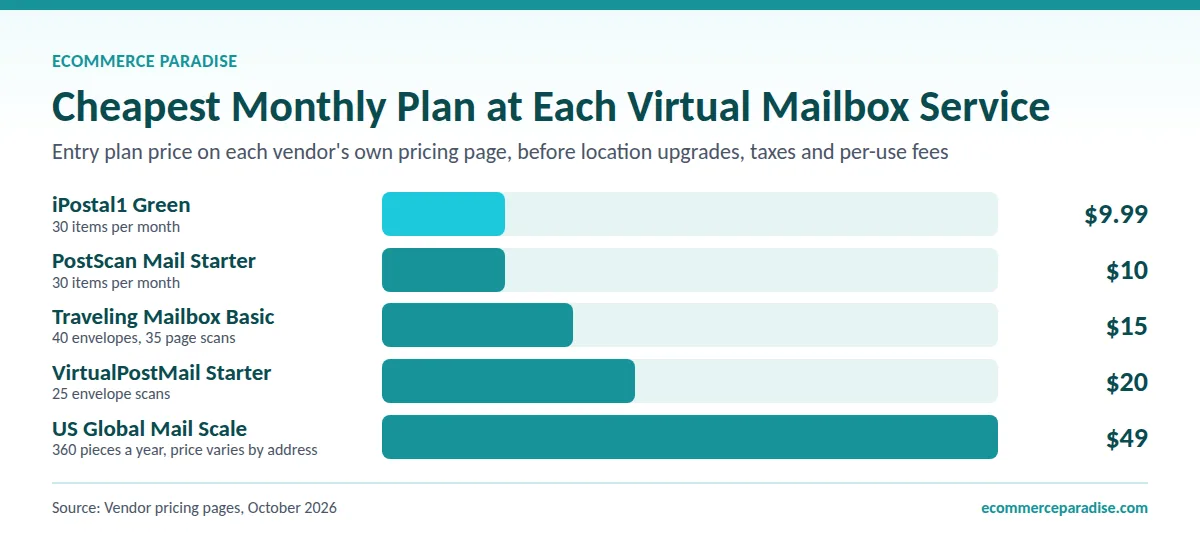
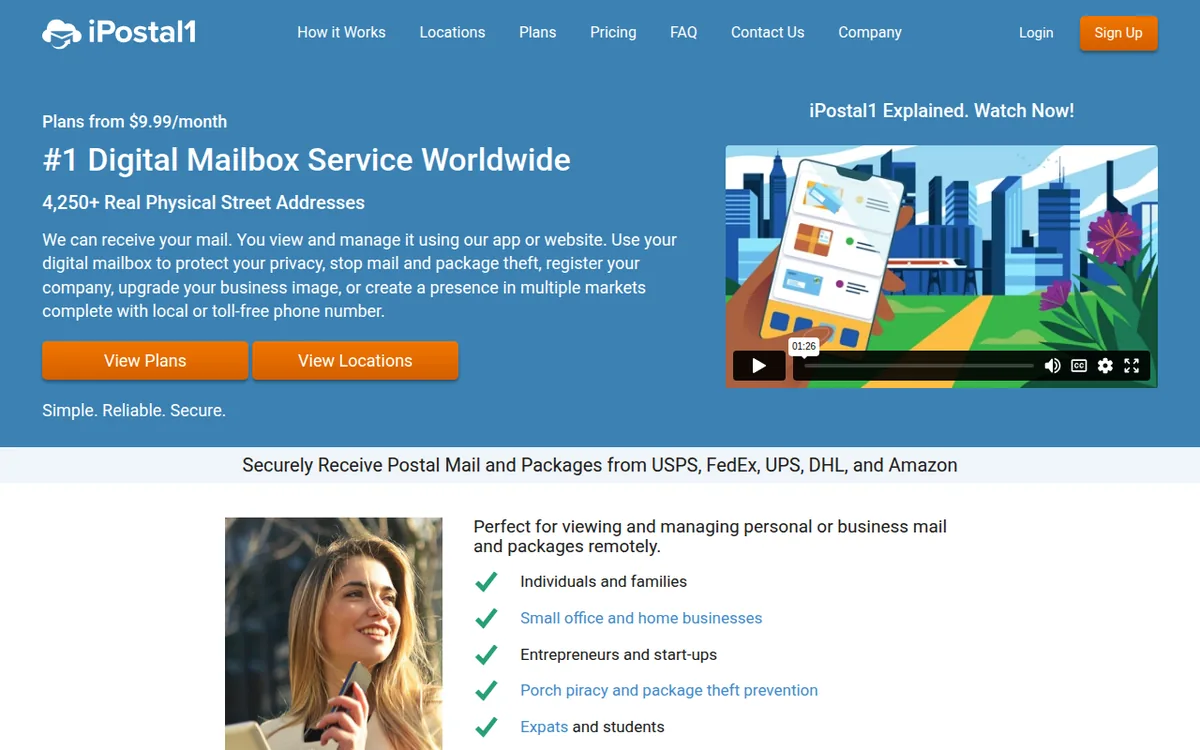
For most brand new Shopify store owners, iPostal1 is the first place I tell people to look. The reason is simple. Plans start at 9.99 dollars per month (as of October 2026), there are more than 4,250 real street addresses in the network so you can find one that matches the state where your LLC is registered, and the mobile app is clean and easy to use for store owners who are not tech obsessed. If you are launching your first Shopify store and trying to keep costs low, iPostal1 gives you the most bang for the buck, and the address format works for Shopify billing and shipping settings out of the box.
Traveling Mailbox (Best for Shopify Owners Living the Nomad Life)
A big chunk of Shopify store owners run their businesses from the road. If that is you, Traveling Mailbox is built for exactly your situation. You get a real street address, envelope and page scanning, check deposit, and package forwarding anywhere in the world. Plans start at 15 dollars per month as of October 2026, and the Basic plan covers 40 envelopes and 35 page scans. Higher plans raise those limits, but none of them are unlimited. I recommend Traveling Mailbox to store owners who plan to travel at least six months a year or who already live outside the United States and run a US store.
US Global Mail (Best for Shopify Stores With International Operations)
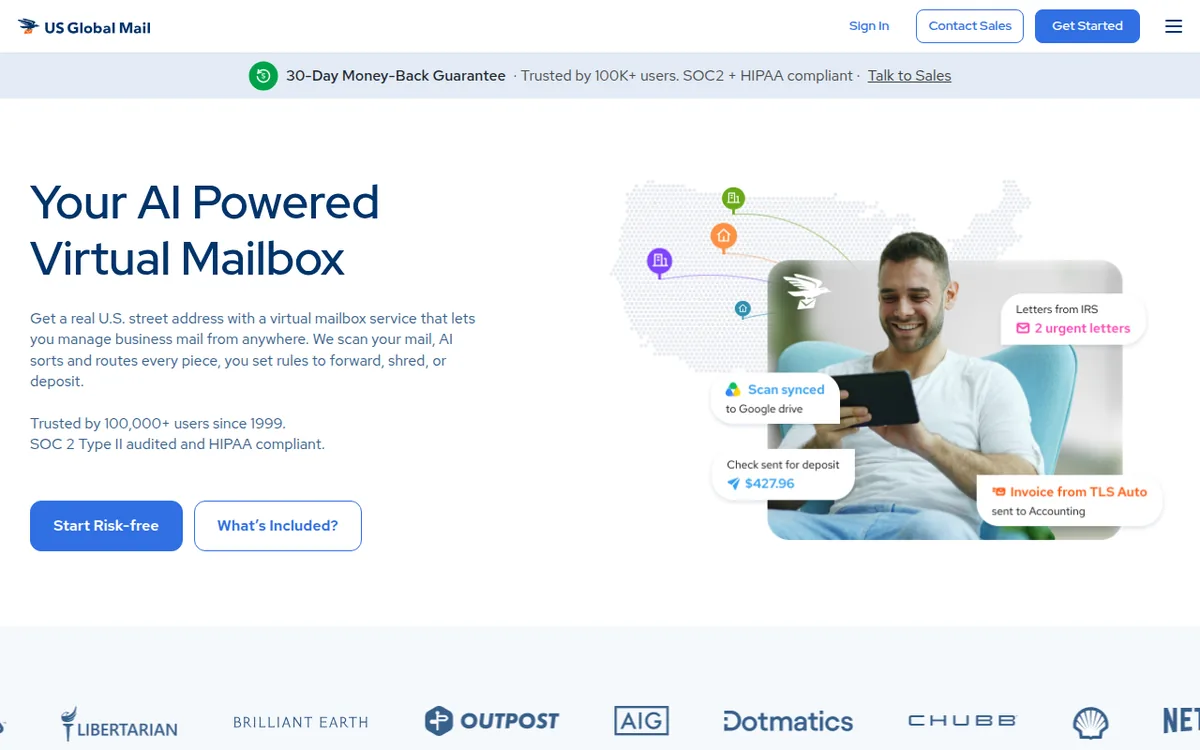
If your Shopify store sells internationally, sources product internationally, or you live outside the US and run a US store, US Global Mail is the service I would pick. Based in Houston, they have been running for more than 20 years and they offer international forwarding with discounted shipping. Plans start at 49 dollars per month as of October 2026, and the price varies by address. They are especially good if you also use your virtual mailbox address for receiving product samples or inventory from overseas suppliers.
VirtualPostMail (Best for High Volume Shopify Brands)
Once your Shopify store grows, you end up on a lot of mailing lists, you get a lot of vendor correspondence, and you receive a lot of physical legal mail. VirtualPostMail includes OCR’d PDF files in every mailbox plan and treats your mailbox like an online inbox. Plans start at 20 dollars per month for the Starter plan (25 envelope scans), as of October 2026. For Shopify brands doing serious volume, the time savings can justify the price.
PostScan Mail (Solid Mid Tier Option)
If you want something between the cheapest options and the high end enterprise services, PostScan Mail sits in a comfortable middle. Plans run from 10 dollars per month for Starter (30 items) up to 30 dollars for Premium (120 items) as of October 2026, with larger business plans above that. You can manage multiple mailing addresses from one account, and the mobile app is solid. It is a great pick for Shopify store owners who want a step up from the starter tier without overpaying.
How to Plug a Virtual Mailbox Into Your Shopify Setup
Getting a virtual mailbox is the easy part. Plugging it into your Shopify store correctly is where people mess up. Here is the exact sequence I walk coaching students through.
Step 1: Sign Up and Complete Form 1583
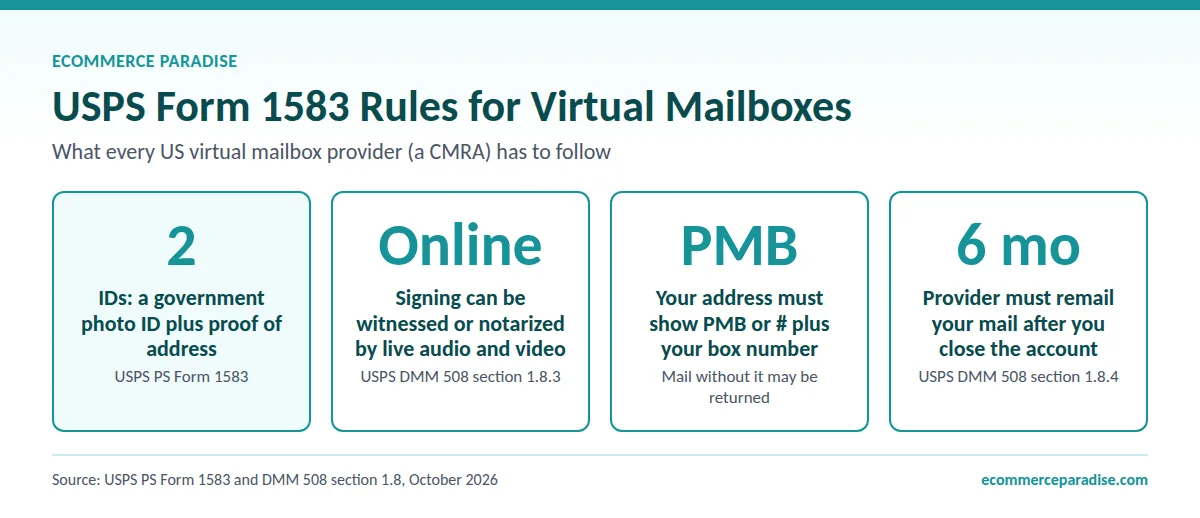
All US virtual mailbox providers require you to complete USPS Form 1583, which authorizes them to receive mail on your behalf. You will need to bring two forms of ID, typically a government photo ID and proof of your address, and you must sign the form in front of the provider or a notary public. USPS allows that to happen in person or over a live audio and video session, so you can often do it from your desk, but how long it takes depends on the provider and how fast they approve your ID.
Step 2: Update Your Shopify General Settings
Inside Shopify admin, go to Settings then General and update your store address and billing address to match the virtual mailbox exactly. Use the full street number, street name, PMB or # box number, city, state, and zip code format provided by the mailbox service. USPS requires the PMB or # on the address, and mail without it can be returned. Do not abbreviate or combine fields.
Step 3: Update Shipping Settings
Go to Settings then Shipping and Delivery and update your return address to match. This is the address that prints on every label. If you also use Shopify Shipping, make sure the origin address matches so your rates calculate correctly.
Step 4: Update Store Policies
Go to Settings then Policies and update your Refund, Shipping, Terms, and Privacy policies to reference the new business address. Shopify has policy generators but you will still want to paste in the new address manually.
Step 5: Update Payment Processor Info
This is the step people forget. Shopify Payments, Stripe, PayPal, and any other processor you use will have a business address on file. Update them all to match. Mismatches between Shopify and your processors are one of the top reasons store owners see payouts delayed.
Pairing Your Virtual Mailbox With a Proper LLC Setup
A virtual mailbox without a proper LLC is only half the privacy story. Your LLC is what shields your personal identity, and your registered agent is what keeps your public filings clean. Here is how I tell Shopify store owners to stack this.
Best LLC Formation Services for Shopify Store Owners
These are the four LLC services I recommend to Shopify store owners, each for a specific reason.
Northwest Registered Agent. My first recommendation for almost every store owner is Northwest Registered Agent. They use their own address on your public filings instead of yours, so even if somebody pulls your LLC records from the state, they see Northwest, not you. Combined with a virtual mailbox, this is a strong privacy setup. As of October 2026, formation is 39 dollars plus state fees, and registered agent service is 125 dollars per year.
Bizee. For the tightest budgets, Bizee (formerly Incfile) offers LLC formation for 0 dollars plus state filing fees, with one year of registered agent service included. If you are bootstrapping a Shopify store and trying to keep every dollar in inventory and ads, Bizee is the cheapest way I know to form your LLC.
LegalZoom. For store owners who want the most recognized brand name and the ability to add legal consultation, LegalZoom is the obvious choice. It costs more than the budget services but you get a very polished experience and optional attorney time.
MyCompanyWorks. For store owners who want white glove formation with responsive customer service, MyCompanyWorks is my under the radar pick. Smaller than the big three with better support in my experience.
Which State Should Your Shopify LLC Be In
This is the question every Shopify store owner asks, and the answer depends on where you live and what your goals are. The most common privacy states are Wyoming, Delaware, and New Mexico. Wyoming is usually my top recommendation because it has strong privacy protections, low annual fees, and no state income tax. Delaware is a strong pick for larger operations, but it is more expensive. New Mexico is cheap and private but less prestigious.
Before you file anything, read my business formation checklist for high-ticket dropshipping success. It walks through LLC state selection, EIN application, business banking, and every step of the legal foundation for an ecommerce store. The SBA guide to choosing a business structure is also worth reading if you are still deciding between LLC, sole proprietor, or S corp.
How Shopify Store Owners Actually Use Their Virtual Mailbox
A virtual mailbox is not a passive tool. Once you have it set up, you will actually use it for real business purposes. Here is what that looks like for a typical Shopify store owner.
Receiving Business Mail
Your virtual mailbox will receive state correspondence like annual report reminders, IRS mail, merchant bank statements, processor notices, and the occasional vendor correspondence. The service scans everything, you get a notification, and you read it from your phone or laptop.
Handling Refund Checks and Returns
If a supplier sends you a refund check, or a customer mails back a return to your business address, your virtual mailbox handles the receiving. Most providers offer check deposit, so you can snap a photo of a check and have it deposited to your business account without setting foot in a bank.
Receiving Product Samples
If you source from suppliers who send physical samples, especially suppliers overseas, you can have those samples shipped to your virtual mailbox address and then forwarded to wherever you actually want to inspect them. This is huge for Shopify store owners doing private label product development.
How a Virtual Mailbox Helps With Shopify Taxes and Nexus
Sales tax for ecommerce has gotten more complex since the 2018 Wayfair decision. Nearly every state that charges sales tax now has its own economic nexus rules, and your business address plays a role in where you register, where you file, and where you pay. The IRS overview of ecommerce tax obligations is a useful starting point for understanding federal filing requirements, and state level rules stack on top. A virtual mailbox with an address in the state where your LLC is registered makes it easier to keep your tax filings and your business filings aligned, which matters when you are dealing with sales tax registration, income tax filings, and annual reports.
For most new Shopify store owners, the sales tax question becomes meaningful once you cross a state’s economic nexus threshold. Many states use 100,000 dollars in sales, some also count 200 transactions, a growing number have dropped the transaction count, and California and Texas use 500,000 dollars. Check each state’s revenue department for its current number. Until you get close, the main tax concerns are getting your EIN with a real business address, filing your state annual report, and keeping your LLC in good standing. A virtual mailbox handles the mail side of every one of these tasks.
Common Mistakes Shopify Store Owners Make With Mailboxes
Using a PO Box Instead of a Real Street Address
A PO box is not a real business address for Shopify. Stripe’s support page says PO boxes are not accepted as a business address, and other processors may flag or reject them too. Use a real street address from a virtual mailbox service instead. Every provider I listed above gives you a physical street address. Stripe’s page also lists private mailboxes as not accepted, so ask your processor which address it will take before you switch.
Putting Your Home Address on Store Policies
Your Terms of Service, Privacy Policy, Refund Policy, and Shipping Policy are all public. If your home address is on those pages, it is indexed by Google and shows up in search results. Use your virtual mailbox address instead.
Forgetting to Update Every System
When you get your virtual mailbox, you must update Shopify, your LLC state registration, your EIN on file with the IRS, your bank, every payment processor, and every advertising platform. Mismatched addresses cause payout holds, ad account flags, and compliance reviews. Do it all at once and keep a simple checklist.
Building the Full Privacy Stack for a Shopify Store
Here is the full stack I recommend for a privacy focused Shopify store owner. Start with an LLC in Wyoming using Northwest Registered Agent so their address goes on your public state filings. Get your EIN from the IRS using your virtual mailbox address as the mailing address. Sign up for a virtual mailbox like iPostal1 or Traveling Mailbox. Launch your store on Shopify with the virtual mailbox as your store address.
Once you are processing orders, hire a virtual assistant through OnlineJobs.ph to handle customer service, order processing, and supplier outreach. If you want ideas for product categories that work well for high margin stores, check out my high-ticket niches list. And if you need help sourcing real suppliers, the complete guide to finding the best suppliers walks you through the exact process I use.
Frequently Asked Questions
Can I use a virtual mailbox as my business address on Shopify?
Usually, but there is no guarantee. I could not find a Shopify help page that approves or bans virtual mailbox addresses either way. Make sure it is a real street address and not a PO box, and that it matches the address on your LLC and EIN filings.
Will Shopify Payments accept a virtual mailbox address?
It can, but it is not guaranteed. Stripe’s support page says private mailboxes are not accepted as a business address, and I could not find a Shopify rule either way. If a review comes up, send your LLC and EIN documents and ask support which address they will accept. Mismatches can trigger reviews or payout holds, so keep everything consistent.
Does the virtual mailbox address need to match my LLC state?
It is not required, but I strongly recommend matching the state. Consistent paperwork reduces verification friction with processors, banks, and Shopify itself.
How much does a virtual mailbox cost for a Shopify store owner?
As of October 2026, entry plans run about 10 to 20 dollars per month at iPostal1, PostScan Mail, Traveling Mailbox, and VirtualPostMail, and 49 dollars at US Global Mail. Higher volume plans run roughly 25 to 55 dollars per month. Check deposit and package forwarding may add small per use fees.
Can I print my Shopify shipping labels from a virtual mailbox address?
Yes. Update your shipping origin and return address in Shopify settings to match the virtual mailbox. The address will print on every label you generate.
Ready to Get Your Shopify Store Off Your Home Address
A virtual mailbox is one of the cheapest and highest leverage setups you can add to a Shopify store. It protects your privacy, satisfies processor compliance, and gives your store a professional address that belongs on real business paperwork.
If you want help building the full stack from LLC to Shopify store launch, I offer one on one coaching and mentorship at E-Commerce Paradise where we walk through every step together. If you would rather skip the learning curve entirely, our turnkey done-for-you store service builds your complete Shopify business for you and hands you the keys when it is ready to run. Either way, do not launch your store with your home address on file. Get a mailbox first.

Trevor Fenner is an ecommerce entrepreneur and the founder of Ecommerce Paradise, a platform focused on helping entrepreneurs build and scale profitable high-ticket ecommerce and dropshipping businesses. With over a decade of hands-on experience, Trevor specializes in high-ticket dropshipping strategy, niche and product selection, supplier recruiting and onboarding, Google & Bing Shopping ads, ecommerce SEO, and systems-driven automation and scaling. Through Ecommerce Paradise, he provides free education via in-depth guides like How to Start High-Ticket Dropshipping, advanced training through the High-Ticket Dropshipping Masterclass, and fully done-for-you turnkey ecommerce services for entrepreneurs who want a faster, more hands-off path to growth. Trevor is known for emphasizing sustainable, real-world ecommerce models over hype-driven tactics, helping store owners build scalable, sellable, and location-independent brands.


