



When I reviewed EmailListVerify for ecommerce and high-ticket dropshipping use, the pricing model came up as the single biggest differentiator against the bigger names in email verification. This article breaks down every tier in depth, walks through the real annual cost for a small ecommerce list, and compares the numbers directly against ZeroBounce and NeverBounce so you can see exactly where the savings come from.
If you have not read Ecommerce Paradise before, my focus here is always the same: real numbers, no vague “affordable pricing” language, and an honest look at whether a tool earns its place in a store owner’s budget. Email list hygiene ties directly into the fundamentals I cover in my guide to high-ticket dropshipping, since a damaged sender reputation from a dirty list can quietly tank the email revenue that keeps a lot of stores profitable.
Affiliate disclosure: some links in this article are affiliate links and I may earn a commission at no cost to you. It does not change which tools I recommend or what the research found.
Pay for Verifications, Not a Subscription
EmailListVerify credits start at $5 for 1,000 and never expire, so you are never paying for capacity you don’t use.
The Full Pricing Breakdown
EmailListVerify runs entirely on a pay-as-you-go credit system. There is no forced monthly subscription tier, which already sets it apart from most of the competition in this space. Every new account starts with 100 free verifications, and from there you buy credits in blocks that get cheaper per credit as the volume goes up.
| Credits | Price | Cost Per Credit | Savings vs. 1K Rate |
|---|---|---|---|
| 100 (trial) | Free | $0.00 | N/A |
| 1,000 | $5.00 | $0.0050 | Baseline |
| 5,000 | $17.00 | $0.0034 | 32% |
| 10,000 | $27.00 | $0.0027 | 46% |
| 25,000 | $54.00 | $0.0022 | 57% |
| 50,000 | $98.00 | $0.0020 | 61% |
| 100,000 | $186.00 | $0.0019 | 63% |
| 1,000,000+ | Custom | Contact sales | Enterprise |
Breaking Down the 1,000 and 5,000 Credit Tiers
The entry-level 1,000 credit pack at $5 is really meant for testing, or for a very small list that only needs occasional touch-ups. A new store with a few hundred subscribers collected through a popup would burn through this tier fast if they are also using credits for the email finder feature, which consumes more per successful lookup than a standard verification.
The 5,000 credit tier at $17 is where most small ecommerce stores actually land for a first real cleanup. That covers a list built over a year or two of checkout opt-ins and lead magnet signups for most stores under 5,000 subscribers, at a per-credit cost 32% lower than buying the smallest pack.
Breaking Down the Mid-Tier and Bulk Pricing
Once you get into the 10,000 to 25,000 credit range, the per-credit savings really start compounding. At 10,000 credits for $27, you are paying $0.0027 per verification, less than half the entry-level rate. This is the tier I would point most established ecommerce stores toward if they are running a full list audit ahead of a major sale event like Black Friday.
The 50,000 and 100,000 credit tiers exist for stores with a genuinely large subscriber base or agencies managing several client lists. At 100,000 credits for $186, you are down to $0.0019 per verification, a 63% discount off the base rate. For any list larger than a million verifications a month, EmailListVerify moves to custom enterprise pricing rather than a published tier.
See Exactly How Many Bad Addresses You’re Paying to Mail
Start with 100 free verifications and get a real breakdown of your list’s health before buying a single credit.
What the Real Annual Cost Looks Like for a Small Ecommerce Store
Let’s say you run a store with 8,000 email subscribers and you clean your list twice a year, once before your biggest sale season and once mid-year to catch new signups that have gone stale. That is roughly 16,000 verifications annually. At the 25,000 credit tier, that comes out to around $54 a year, less than the cost of a single Shopify app subscription most stores are already paying for.
Compare that to the cost of not cleaning your list at all. A high bounce rate from mailing dead addresses can get your sending domain flagged by major inbox providers, which tanks deliverability across your entire list, not just the bad addresses. That kind of reputation damage can take months to fully recover from, and it directly reduces the revenue an email platform like Omnisend can generate for your store.
Annual Cost by List Size
Since most store owners think in terms of their actual list size rather than abstract credit blocks, here is a rough breakdown of what a twice-a-year cleanup schedule would cost across a few common ecommerce list sizes, assuming you buy the most efficient tier for each volume.
| List Size | Annual Verifications (2x/yr) | Recommended Tier | Approx. Annual Cost |
|---|---|---|---|
| 2,000 subscribers | 4,000 | 5,000 credit pack | ~$17 |
| 8,000 subscribers | 16,000 | 25,000 credit pack | ~$54 |
| 25,000 subscribers | 50,000 | 50,000 credit pack | ~$98 |
| 75,000 subscribers | 150,000 | Two 100,000 credit packs | ~$372 |
Even at the higher end of that range, the annual spend stays well under what most stores pay monthly for their actual email marketing platform. That context matters, because it is easy to look at a pricing page in isolation and lose sight of how small the cost actually is relative to the rest of a store’s marketing stack.
These figures also assume a twice-a-year cleanup cadence, which is a reasonable baseline for most stores but not universal. A store running aggressive lead-gen campaigns, giveaways, or influencer-driven signup spikes might want to verify quarterly instead, since those acquisition channels tend to bring in a higher share of throwaway or fake addresses than organic checkout opt-ins. Bump the frequency and the annual cost scales roughly in proportion, but it is still a small line item relative to what a damaged sender reputation would cost in lost email revenue.
Comparing EmailListVerify’s Pricing to ZeroBounce and NeverBounce
I pulled current published pricing from both major competitors to see how the numbers actually stack up rather than taking EmailListVerify’s “budget-friendly” positioning at face value.
| Tool | Entry Tier | 10,000 Credits | Credits Expire? |
|---|---|---|---|
| EmailListVerify | $5 / 1,000 credits | $27.00 | Never |
| ZeroBounce | $39 / 2,000 credits | ~$195 (extrapolated) | Only with active subscription |
| NeverBounce | $8 / 1,000 credits | $50.00 | 12 months |
At the 10,000 credit level, EmailListVerify runs roughly 45% cheaper than NeverBounce and dramatically cheaper than ZeroBounce’s pay-as-you-go rate. ZeroBounce’s better per-credit economics only kick in once you commit to their $99 a month ZeroBounce ONE subscription, which requires a minimum of 10,000 credits monthly whether you use them or not. For a store that only needs to clean its list a couple times a year, that subscription structure works against you.
Where the Pricing Compares Favorably to Alternatives
I go through a full head-to-head comparison of EmailListVerify against several other verification tools, including feature depth and not just price, in my dedicated alternatives roundup. If you are choosing between tools based on more than just the cheapest credit rate, that piece is worth reading before you commit to a plan.
Who Should Buy the Larger Credit Blocks
If you are running multiple stores, managing client lists as part of an agency, or you are far enough along that you are formalizing your business structure, the 50,000 or 100,000 credit tiers make sense to buy upfront rather than repeatedly topping up smaller packs. Since these credits never expire, there is no real downside to buying ahead of need other than the upfront cash outlay. If you have not yet handled the legal side of running a growing ecommerce operation, my business formation checklist covers what most store owners miss before they start scaling past a single-person operation.
Verifying the Numbers Directly From the Source
All of the EmailListVerify pricing figures in this article come directly from the tiers published on their own pricing page, cross-checked against third-party review sites to confirm nothing had changed recently. Pricing on SaaS tools shifts more often than people expect, so I always verify against the primary source rather than relying on older screenshots floating around review sites.
How the Pricing Holds Up Against Real User Ratings
A cheap tool that does not actually work is not a bargain. EmailListVerify holds a 4.5 out of 5 rating on G2 across 65 reviews. On Capterra it sits at 4.4 out of 5 across 155 reviews. Those ratings sit in the same range as the more expensive competitors, which is really the point of this whole comparison: you are not sacrificing quality to get the lower price.
What stands out when you read through the actual review text on both platforms is how often “value” and “price” come up specifically in the context of comparing it to a competitor the reviewer had used before. That is not something you see as often with tools priced closer to the top of the market, where reviews tend to focus more on features than cost.
Hidden Costs to Watch For
The published per-credit price is not the whole story. The email finder feature consumes more credits per successful lookup than a standard verification, so if you plan to use EmailListVerify to find missing addresses rather than just clean an existing list, budget for that separately. Every verification also consumes a credit regardless of whether the result comes back as valid, invalid, or unknown, so a messier list with more unknowns will cost slightly more per useful decision than the advertised rate suggests.
This is not unique to EmailListVerify. Every credit-based verification tool on the market charges the same way, since the platform has to run the check to find out the result before it knows whether the address was worth verifying in the first place. The practical takeaway is to run a smaller test batch first if your list has a lot of unfamiliar or older domains, so you can estimate your unknown rate before committing to a large purchase sized for a cleaner list.
Can You Change Tiers as Your List Grows
Yes. Since there is no subscription commitment, you simply buy a larger credit pack the next time you need to run a verification job. There is no plan to “upgrade” in the traditional SaaS sense, which is actually one of the more underrated parts of this pricing model. You are never locked into a tier that no longer fits your list size.
Pricing Considerations for Agencies and Multi-Store Owners
If you manage email lists across several stores, whether they are your own or client accounts, the math shifts in your favor even more than it does for a single-store owner. Buying at the 100,000 credit tier and drawing down credits across multiple lists as needed means you only pay the $0.0019 per-credit rate once, rather than each individual store paying the higher entry-level rate separately.
This is also where the non-expiring credits matter most. An agency’s verification needs are rarely evenly spread across the year. You might run a heavy batch of cleanups in Q4 ahead of the holiday season and almost nothing in the slower months. A credit-expiration policy like NeverBounce’s 12-month window can actually cost you money in that kind of usage pattern if a slow stretch causes credits to lapse unused.
How the Free Trial Changes the Math
The 100 free verifications on signup are not just a marketing gimmick. Running your actual list through that free batch tells you your real bad-address rate before you commit to a paid tier, which means you can size your first purchase accurately instead of guessing. If your free batch comes back showing a 15% bad-address rate, you know roughly what to expect across the rest of your list and can budget the right credit tier the first time rather than running out mid-cleanup and having to buy a second smaller, more expensive pack.
Paying With Annual Billing vs. One-Time Credit Purchases
Because EmailListVerify does not force a subscription, there is no “annual billing discount” in the way you would see with a typical SaaS tool. The discounting instead comes entirely from buying larger credit blocks at once. If you know you will need 50,000 verifications over the course of a year, buying that tier upfront gets you the $0.0020 per-credit rate immediately rather than making several smaller purchases at a higher blended rate throughout the year.
The trade-off is straightforward: a larger upfront purchase means more cash out the door on day one, even though the credits never expire. For a bootstrapped store still watching cash flow closely, buying in smaller increments as needed and accepting a slightly higher per-credit cost is often the more sensible approach, even if it costs a bit more in total over the course of a year.
My Take on the Pricing
For most stores in the range I cover here, whether you are just launching your first store in a high-ticket niche or you have been running one for years, EmailListVerify’s pricing model is close to ideal. You pay for exactly what you need, the credits do not expire, and the per-credit cost drops fast enough at higher volumes that even an agency-scale list cleanup stays reasonable. The only real caveat is budgeting slightly extra if you plan to lean heavily on the email finder feature rather than standard verification.
Start With the Free 100 Credits
Test EmailListVerify on a slice of your real list before you decide which credit tier makes sense for you.
Frequently Asked Questions
How much does EmailListVerify cost per email?
The per-credit cost ranges from $0.0050 at the smallest 1,000 credit tier down to $0.0019 at the 100,000 credit tier, with every account starting with 100 free verifications.
Is there a monthly subscription option?
No. EmailListVerify runs entirely on pay-as-you-go credits with no forced recurring subscription, unlike ZeroBounce’s ONE plan which requires a minimum monthly commitment.
Do EmailListVerify credits expire?
No, pay-as-you-go credits never expire, which differs from NeverBounce, where purchased credits expire 12 months after the purchase date.
Is EmailListVerify cheaper than ZeroBounce?
At comparable volumes on pay-as-you-go pricing, yes, significantly. ZeroBounce’s better rates require committing to their $99 a month subscription with a 10,000 credit minimum.
What is the cheapest way to buy EmailListVerify credits?
Buying in larger blocks lowers the per-credit cost substantially. Since credits never expire, buying ahead of an immediate need at a higher tier can make sense if you plan to use the tool regularly.
Does the email finder feature cost extra?
The email finder consumes more credits per successful result than a standard verification, so factor that into your credit budget if you plan to use it heavily.
Before you invest in any tool for your store, it is worth applying the same due diligence you would use when vetting a supplier, checking published pricing, real reviews, and a free trial before committing real money. I go deeper on frameworks like this with members inside the Ecommerce Paradise Academy on Skool, which starts with a 7 day free trial, then $9/month or $49/year.

Trevor Fenner is an ecommerce entrepreneur and the founder of Ecommerce Paradise, a platform focused on helping entrepreneurs build and scale profitable high-ticket ecommerce and dropshipping businesses. With over a decade of hands-on experience, Trevor specializes in high-ticket dropshipping strategy, niche and product selection, supplier recruiting and onboarding, Google & Bing Shopping ads, ecommerce SEO, and systems-driven automation and scaling. Through Ecommerce Paradise, he provides free education via in-depth guides like How to Start High-Ticket Dropshipping, advanced training through the High-Ticket Dropshipping Masterclass, and fully done-for-you turnkey ecommerce services for entrepreneurs who want a faster, more hands-off path to growth. Trevor is known for emphasizing sustainable, real-world ecommerce models over hype-driven tactics, helping store owners build scalable, sellable, and location-independent brands.
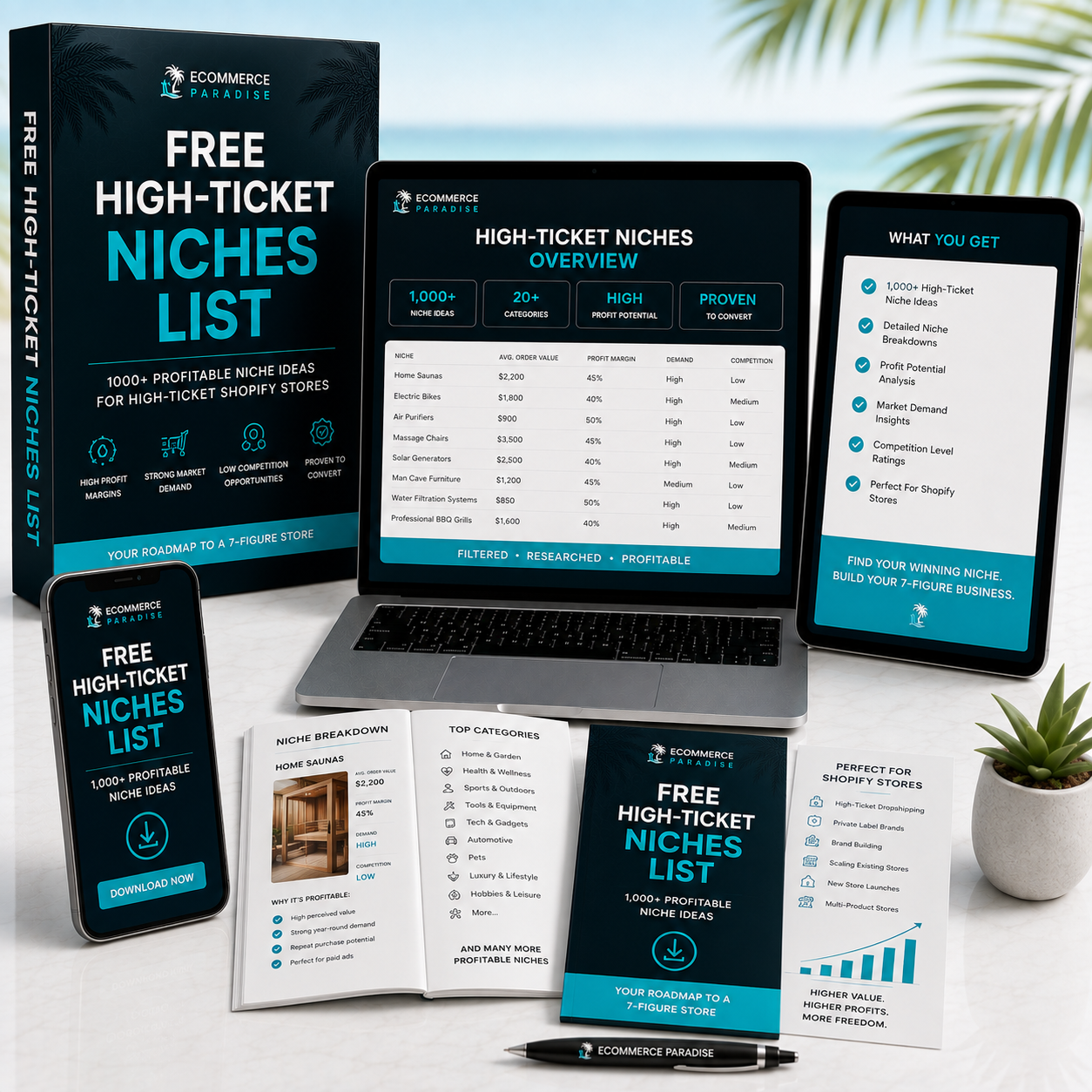
Still deciding what to sell?
Grab the free list of 1,000+ niches that work for high-ticket dropshipping, sorted by category.
Free. Unsubscribe any time.


