

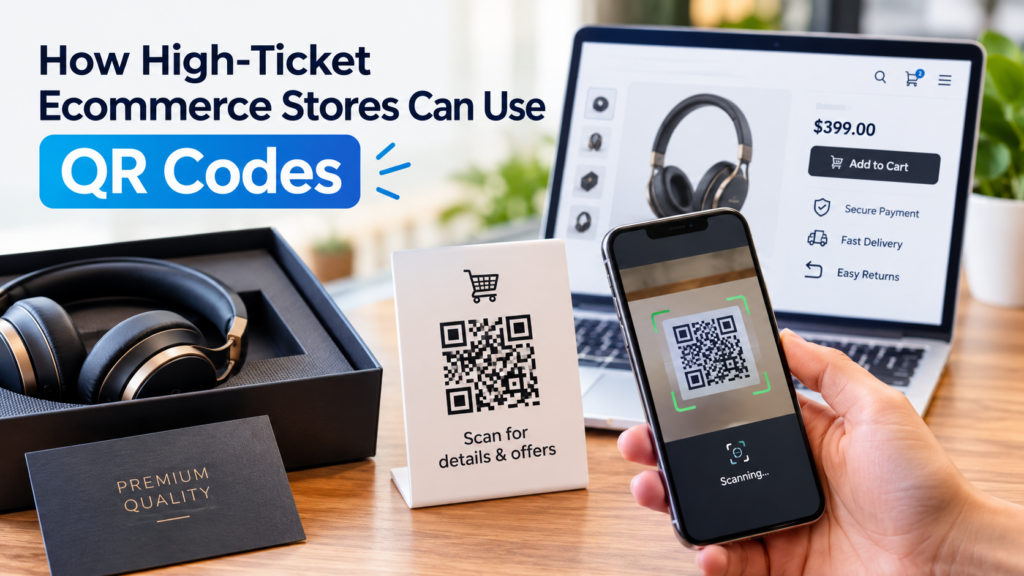

QR codes have become increasingly popular in eCommerce. Stats indicate that 45% of brands have already integrated QR codes into their marketing campaigns, while 86% of marketers are planning to increase their usage within a year.
This growing adoption rate highlights how QR codes are becoming more than just a convenient way to share and access information. For high-ticket eCommerce stores, where customers often need detailed information and strong assurance, QR codes can help in several ways.
By using QR codes strategically, high-ticket stores can give shoppers quick access to detailed product pages, video tutorials, buying guides, and much more. In this blog post, we are going to discuss all these major use cases in detail.
Updated October 2026.
Disclosure: This post contains affiliate links. If you buy through them, I may earn a commission at no extra cost to you. I only recommend tools that fit the workflow described here.
A Quick Overview of QR Codes
A QR code is the short form of “Quick Response” code. A QR code is a two-dimensional barcode that encodes information in a pattern of square modules. It can encode different types of information, such as:
- URLs (which may lead to videos, forms, product pages, etc.)
- Text
- Contact information
- Other data
And much more.
The working mechanism is very simple. eCommerce customers simply need to scan the QR code using their smartphone camera to decode the information stored in it. They can also use web-based QR scanners, such as Imagetotext.info, to scan and decode QR codes online for free.
For a store owner, the useful point is that a QR code is a compact bridge between a physical moment and a specific digital resource. GS1’s barcode overview is a helpful reference if you want to understand the broader 2D-barcode ecosystem, but you do not need to overthink the technology to put a customer-first QR journey in place.
Ways High-Ticket eCommerce Stores Can Use QR Codes
In the following section, we discuss some of the major ways in which high-ticket eCommerce stores can use QR codes.
Providing Instant Access to Detailed Product Pages
We all know that customers usually purchase expensive products from high-ticket eCommerce stores. Before making the final decision, they often evaluate every bit of detail about the product.
However, a standard product description provided alongside product photos only offers basic information. This is where QR codes come into play. High-ticket eCommerce stores can place QR codes to provide customers with instant access to detailed product pages containing information about:
- Specifications
- Features
- Size/dimensions
- Colors
- Warranty
- Return or refund policy
- Delivery
- Discounts
- Promo codes
This can reduce the need for customers to manually search or navigate through multiple pages of the store to find the product information.
Moreover, the stores can also use QR codes to immediately redirect customers to specific product variants. This can be particularly useful if the product is available in different sizes, colors, or dimensions.
Quickly Showcasing Product Demos & Tutorials
For many customers, simply reading detailed product information may not be enough to make the purchase decision. Some may want to see how the product will look and work in real time. QR codes can be used to meet this requirement. Let us explain how.
High-ticket eCommerce stores can encode links to video demonstrations, tutorials, step-by-step guides, or other visual resources in a QR code, so that customers can quickly watch the product in action with a simple scan.
For example:
If a high-ticket eCommerce store is selling advanced home equipment, then it can consider adding a link to a video that explains:
- Features
- Installation
- Operation
- Maintenance
Seeing the product in action may help customers decide whether it is worth purchasing.
Offering Personalized Buying Assistance
As mentioned earlier, high-ticket purchases often involve more considerations than lower-priced purchases. Customers may have doubts or questions about:
- Product compatibility
- Specifications
- Available options
This means simply listing written information and demo videos may not be enough to address these concerns. In this scenario, QR codes prove valuable by offering quick and easy access to personalized buying assistance.
After scanning the code, high-ticket eCommerce stores can redirect the potential customer to live chat support, a consultation form, or a dedicated customer support channel where they can receive personalized assistance.
This approach can help improve the shopping experience, as buyers don’t have to manually explore the entire store to look for personalized assistance.
Simplifying the Reviewing Process
For high-ticket products, customer reviews can play an especially important role in the purchase decision. For high-ticket eCommerce stores, customer reviews work in two ways.
First, shoppers often want to see the feedback or ratings of previous customers. Second, they may also want to leave a review after purchasing the product. QR codes can be used to simplify both processes. Let us explain how this would work.
A quick QR code scan will take shoppers to the customer review page, ratings, or testimonials section. This way, they can easily read the experiences or feedback of previous buyers who have already purchased and used that specific product.
Similarly, a simple scan will also allow existing customers to immediately leave a review on their favorite product. There is no need to search and explore the store to find the page for leaving a review, as the QR code can take them directly to the submission form.
Encouraging Repeat Purchases and Referrals
For high-ticket eCommerce stores, the relationship with satisfied customers shouldn’t end after the initial purchase. Online brands should encourage repeat purchases and referrals by maintaining consistent engagement with buyers.
QR codes again prove valuable in this aspect as well. With a quick scan, eCommerce stores can direct previous customers toward complementary products, accessories, and replacement items that are relevant to their original purchase.
For instance:
If someone has purchased a camera, then the store could use a QR code to redirect them to a lens, camera case, or any other relevant product.
Moreover, high-ticket eCommerce stores can also use QR codes to promote referral programs by ensuring maximum engagement. Existing customers can be directed to a referral page where they can learn how the program works and share their referral link with friends and family.
After going through these ways, we think you will have a good idea of how high-ticket eCommerce stores can use QR codes.
Where QR Codes Actually Earn Their Place in a High-Ticket Funnel
For a high-ticket store, a QR code should not be decoration. It earns its spot only when it removes a real point of friction. That could mean helping a shopper compare a $2,000 product at a showroom, giving a buyer a fast route to setup help after delivery, or making it easier to collect the details a hesitant prospect needs before they call. That is the same customer-first approach I recommend throughout my high-ticket dropshipping guide.
Start with a question: what does this person need at the exact moment they scan? Do not send everyone to your homepage. A buyer who scans a code on a product insert needs an installation video or support page. A prospect scanning a showroom tag may need a comparison chart, warranty details, or a way to book a call. The landing page needs to answer that next question quickly.
There is a reason this matters more for premium products. High-ticket customers tend to research before they buy. They want proof that the product fits their use case and that the store will be there if something goes wrong. A useful QR code shortens the distance between that question and a credible answer. It will not make up for a weak product page, poor service, or an unclear offer, but it can make a good buying experience easier to use.
Use a different destination for a different job
One code can point to a product page, but that is only the most basic use. I would create separate codes for product research, post-purchase setup, review collection, referral offers, and wholesale or trade inquiries. Each code should have one job, one destination, and one clear call to action. That makes the shopper experience cleaner and your reporting far more useful.
- Research code: A buying guide, product comparison, or a page that explains the real differences between models.
- Showroom or trade-show code: A product-specific landing page with specs, current pricing, delivery expectations, and a consultation option.
- In-box code: Setup instructions, warranty registration, care guidance, and support contacts.
- Post-purchase code: A review request, accessory offer, or referral page after the customer has had time to use the product.
This is also a useful discipline when you are choosing a niche. A category with complex products, real installation questions, and accessories to sell later can support a much better customer journey than a one-and-done impulse product. If you are still evaluating categories, my high-ticket niches list is a practical place to start.
Build the QR Experience Before You Print Anything
The code itself is the easy part. The work is deciding where it goes, what happens after a scan, and who owns the page if the offer changes. Before you print a single insert or countertop card, test the destination on an actual phone. Make sure the page loads quickly, the buttons are large enough to tap, the copy makes sense without extra context, and the next action is obvious.
For a Shopify store, I would usually build the destination as a focused page or a product-specific section, not as a generic campaign page with five competing calls to action. If you are building or rebuilding the storefront that supports these journeys, Shopify is the platform I normally recommend for high-ticket stores because you can keep product, content, customer, and conversion work in one place.
Use a dynamic QR code whenever you can. It allows you to change the destination without reprinting a box insert, brochure, or display card. That matters when a model is discontinued, an offer ends, a support article improves, or you want to test a better landing page. Keep a simple internal spreadsheet that records the code name, physical placement, destination, campaign owner, and the date it went live.
Keep the creative simple and scannable
A QR code needs enough empty space around it to scan reliably, and the call to action needs to tell people why they should scan. “Scan for setup video,” “Compare this model,” or “See delivery options” gives the shopper a reason. “Scan me” does not. If your printed materials need a clean, on-brand layout, Canva is a straightforward option for creating product inserts, handouts, and simple point-of-sale designs.
Do not place a code over a busy image, shrink it until it is hard to use, or send it to a page that is gated before it provides any value. A high-ticket buyer is already giving you attention. Respect it. Give them the important information first, then invite the email signup, quote request, or consultation.
Use QR Codes to Support the Human Side of a Premium Sale
Some questions cannot be solved by another FAQ block. A buyer may need help confirming dimensions, checking compatibility, planning freight delivery, or comparing two configurations. In those cases, a code can open a short consultation form, a booking page, or live chat with a message that identifies the product they were viewing.
That is especially useful for stores that work closely with suppliers. Your supplier should be able to help you build the right materials, including installation guides, approved spec sheets, and product videos. Those assets make QR destinations more useful and reinforce that you are an authorized, knowledgeable seller. I cover the bigger supplier-relationship side of this in my guide to finding high-ticket dropshipping suppliers.
If you route QR traffic to live chat, make sure it is staffed and that the team has product context. Gorgias can be a sensible option for a Shopify store that needs customer-service conversations tied back to orders and product questions. The tool is not the strategy, though. Response time, accurate answers, and a clear handoff to a phone conversation are what make it valuable.
Turn Product Delivery Into a Better Review and Repeat-Purchase Moment
The best time to ask for a review is not automatically the day the package is delivered. For a high-ticket item, customers may need time to install, assemble, or properly use it. A QR code on the packaging or a follow-up card can take them to a review page once they are ready, but the request should feel earned by a smooth experience.
Make the review route product-specific when possible. It lets customers see existing feedback, understand the kind of information that helps other buyers, and leave their own review without hunting through the site. A platform such as Yotpo can help organize review collection and display, but do not ask for a five-star review. Ask for an honest one and use the feedback to improve the customer experience.
For repeat-purchase and referral campaigns, match the destination to what the buyer already owns. Someone who bought a camera may care about lenses and protective cases. Someone who bought a sauna may care about maintenance products or an upgraded accessory. The offer is relevant because it follows the original purchase, not because it is the only promotion you have available.
A QR code can also bridge offline delivery and your email or SMS marketing. If the scan leads to a useful care guide or extended-warranty resource, you can offer an optional signup for restock notices, maintenance reminders, or accessory recommendations. Klaviyo is useful for building those follow-up flows, provided the signup language is clear and the customer has a real reason to opt in.
Track Scans Like Any Other Conversion Path
If you cannot tell which code drove a support request, an email signup, or a sale, you do not know whether it is helping. Give each placement its own tracked destination. For example, the code on a product insert can use one campaign name, while the code on a trade-show sign for the same product uses another. Google’s documentation on UTM parameters is a useful reference for keeping source, medium, and campaign naming consistent.
Do not overcomplicate this on day one. I would track scans, landing-page engagement, email or quote submissions, assisted revenue, support deflection, review completion, and repeat orders. The metric that matters depends on the code’s job. A setup code may be successful if it reduces avoidable support tickets. A showroom code may be successful if it produces qualified phone calls, even if the sale closes later.
Review results monthly and compare placements, not just raw scan volume. A code inside the box will only reach buyers, while a code on an in-store display reaches prospects. Those are different audiences. Test one change at a time, such as the call to action, the offer, or the landing page, so you can learn something from the result.
Protect Trust When You Ask Customers to Scan
QR codes are convenient, but customers have good reason to be cautious. The FTC warns that scammers can use QR codes to direct people to spoofed websites. That does not mean a legitimate store should avoid them. It means the QR experience should make the destination and your brand obvious.
Use your own domain or a recognizable short domain, describe the destination next to the code, and inspect printed codes before distribution. For shipments, place the code where tampering is harder, such as inside a sealed insert, rather than relying on a loose sticker that can be covered. Never use a QR code as the only way to get support, view terms, or access essential order information.
This is part of the broader operational foundation of a credible store. Clear policies, an accessible contact method, and a real business setup make every trust signal stronger. If you are still putting that foundation in place, review my business-formation checklist for high-ticket dropshipping before you scale traffic.
A Practical 30-Day QR Code Test for Your Store
You do not need a giant QR rollout. Pick one product or one customer moment where a buyer regularly needs more information. Create one focused landing page, one dynamic code, and one clear action. For example, an outdoor-kitchen store could put a QR code on a showroom card that opens a model comparison and lets the shopper request a delivery quote.
- Choose a product with real questions, meaningful margin, and a clear next step.
- Build a mobile-first destination that answers those questions before asking for contact details.
- Create a unique tracked URL and test the code with several phone cameras.
- Place it in one location only for the first test, such as a product insert, showroom display, or direct-mail card.
- Review the data and customer feedback after 30 days, then improve the page or expand carefully.
That approach keeps you from printing thousands of inserts for an unproven idea. It also forces the code to support the rest of your sales process instead of becoming another disconnected tactic. The same principle applies to advertising: drive people to the information that helps them make a confident decision. My Google Shopping setup guide for high-ticket dropshipping explains how I think about that conversion path from the ad click onward.
Bottom Line
QR codes offer high-ticket eCommerce stores a convenient way to connect with customers, encourage maximum engagement, and boost the online shopping experience. With a quick scan, shoppers can be directed to detailed product pages, video tutorials, customer reviews, live chat support, and referral programs. QR codes can also be a relatively low-cost way to connect physical and digital shopping experiences, and they are generally easy to scan.
If you want a high-ticket store that is built around detailed product information, supplier relationships, and a buying experience that deserves customer trust, see how my done-for-you turnkey ecommerce service can help. I build this kind of foundation before worrying about clever tactics.
Related Articles
- What Is High-Ticket Dropshipping?
- High-Ticket Niches List
- How to Find High-Ticket Dropshipping Suppliers
- AI Product Photography for Ecommerce
- AI Product Recommendations for Ecommerce

Trevor Fenner is an ecommerce entrepreneur and the founder of Ecommerce Paradise, a platform focused on helping entrepreneurs build and scale profitable high-ticket ecommerce and dropshipping businesses. With over a decade of hands-on experience, Trevor specializes in high-ticket dropshipping strategy, niche and product selection, supplier recruiting and onboarding, Google & Bing Shopping ads, ecommerce SEO, and systems-driven automation and scaling. Through Ecommerce Paradise, he provides free education via in-depth guides like How to Start High-Ticket Dropshipping, advanced training through the High-Ticket Dropshipping Masterclass, and fully done-for-you turnkey ecommerce services for entrepreneurs who want a faster, more hands-off path to growth. Trevor is known for emphasizing sustainable, real-world ecommerce models over hype-driven tactics, helping store owners build scalable, sellable, and location-independent brands.

Still deciding what to sell?
Grab the free list of 1,000+ niches that work for high-ticket dropshipping, sorted by category.
Free. Unsubscribe any time.


