



For years, e-commerce brands followed the same playbook. Run ads to build awareness, drive traffic to a website, nurture leads through email, and convert a fraction of those visitors into paying customers. Every stage demanded time, money, and a different set of tools to execute properly.
The fundamental problem with this approach is friction. Every additional step between a customer discovering a product and completing a purchase gives them another opportunity to leave. Research consistently shows that longer purchase journeys create more places for shoppers to lose momentum.
Social commerce removes many of those steps, and that changes everything. It is not a replacement for a real store, customer service, or a solid product catalog. It is a way to meet buyers where they already spend their attention, then make the next action feel obvious instead of making them hunt for it.
At E-Commerce Paradise, we teach people how to build businesses that are useful beyond one traffic source. That matters here. Social can create the first touch, but a store with good suppliers, clean operations, and a real brand is what turns that attention into a business you can actually keep.
If you are new to the model, start with our complete guide to high-ticket dropshipping. Then come back to this article with one question in mind: where does social commerce make your customer journey easier, and where could it create a pain in the butt for your team?
How Social Commerce Works
Social commerce is the process of discovering and purchasing a product through a social media experience. On platforms with native checkout, the buyer can complete the transaction without leaving the app. On other platforms, the social post may send the shopper to an in-app browser or the brand’s website to finish the purchase.
This process works in three distinct stages. First, a user encounters a product through a video or live stream while browsing their feed naturally. Second, they evaluate the product instantly by reading real comments and watching genuine reactions from other buyers. Third, they complete the purchase, or take the next step toward it, within seconds of discovering the product.
That is a much shorter path than the old version of the funnel. The buyer is not searching Google, opening ten tabs, and trying to remember which brand caught their eye. They see a problem, watch a person demonstrate a solution, and can act while the interest is still there.
The friction reduction is real, but it is not magic. A social post can get the click. It cannot fix a confusing offer, weak creative, slow shipping, or a customer-service team that does not answer the phone. Those issues will still hurt conversions and they will hurt even faster when social content starts sending more people your way.
Discovery now happens inside the feed
Traditional funnels separate discovery from purchase. You run an ad, earn a click, land the visitor on a product page, collect an email address, and hope the buyer returns later. Social commerce compresses the early stages because the product demo, the review, the comment section, and the call to action live together.
For a brand, that means your creative is doing more than generating awareness. It is also your first product page. A good short video has to answer the questions a buyer would normally ask on a website: what is this, who is it for, why is it better, how much does it cost, and what happens after I order?
TikTok’s own Seller Center has a useful guide to creating shoppable videos. The big takeaway is simple: build content around the buyer’s use case, not around a generic brand message.
Comments and creators become part of the sales page
On a normal product page, you have reviews, FAQs, photos, and maybe a chat widget. In social commerce, comments, creator videos, live demos, and customer questions perform some of that same work in public. That can build trust quickly, especially when the product needs to be seen in action.
It also means you need somebody watching the conversation. If a buyer asks whether a product works with a particular model, whether it ships to Alaska, or whether a replacement part is available, that question is not just customer service. It is content feedback. Answer it, then make the answer part of the next video or product page update.
Tools such as Shopify give a store a central place to manage the catalog and fulfillment side while social platforms handle discovery. That setup is usually much easier to scale than trying to run every customer touchpoint manually inside a feed.
High-ticket products need a different version of the funnel
For low-cost impulse products, a creator clip and a native checkout can sometimes be enough. High-ticket products are different. A buyer spending $1,500, $3,000, or $8,000 often wants specifications, financing information, warranty details, shipping expectations, and a real person they can talk to before they buy.
So do not throw away the website funnel. Use social content to create demand, explain the product, and start the conversation. Then give the serious buyer a detailed product page, comparison content, reviews, a visible phone number, and a follow-up process. What I have seen with high-ticket stores is that the social click often starts the sale, but the phone call, email, or product-page research closes it.
This is why social commerce works especially well as a layer on top of a focused niche store. You are not trying to make one random video sell everything. You are using content to bring the right people into a category you understand deeply.
Platform Comparison: TikTok Shop, Instagram and Facebook
Understanding how each platform operates helps sellers invest their efforts in the right place. The platforms overlap, but the way people discover products, the checkout options, and the type of content that performs well are not identical.
TikTok Shop can be extremely strong for products that look good in motion and can be understood quickly. It places product discovery directly in the video feed and supports in-app shopping in markets where the feature is available. However, scaling and handling a store alone on the platform can create a lot of chaos, especially for new sellers. Therefore, many brands seeking to scale efficiently work alongside a specialized TikTok Shop Agency USA to treat the channel as a core revenue driver rather than an experiment.
The opportunity is not a license to upload random clips and hope for the best. The products need a clear demonstration, the offer needs to make sense, and inventory has to be accurate. If a viral video drives 500 orders for something you cannot fulfill, you have created a customer-service problem, not a win.
TikTok Shop: strong for demonstrations and momentum
TikTok is built around discovery. A buyer does not need to follow you to see the product, which gives a new seller a shot at reaching people outside an existing audience. The best content is usually practical: a before-and-after, an unboxing, a setup walkthrough, an honest comparison, or a creator explaining why they use the product.
Keep the first few seconds focused on the problem. If you sell a bulky or technical product, show the thing people are already frustrated with, then show the solution. Do not spend half the video on an animated logo. Your brand matters, but the viewer needs a reason to keep watching first.
For high-ticket products, use TikTok as the top of the funnel and as a research tool. Watch the questions, save the objections, and see which demonstrations make buyers want details. Then build those answers into your website and your sales process.
Instagram: better for trust, aesthetics, and ongoing relationships
Instagram is usually a better fit when your product benefits from aspirational imagery, a strong visual identity, or repeat exposure. Home products, outdoor gear, design-led categories, and lifestyle products can work well because buyers often want to picture the product in their own space.
Instagram shopping has changed over time, and checkout availability depends on the market and the feature. Shopify’s overview of social media shopping explains that Instagram and Facebook shops can now lead shoppers to a brand’s own checkout experience. That makes your product page, mobile speed, and checkout flow even more important.
Use Reels for discovery, Stories for urgency and FAQs, and carousels for education. A good carousel can handle the questions that a thirty-second video cannot. For example, show the use case, the dimensions, the material, the warranty, and the buying process in a format someone can save and revisit.
Facebook: still useful for retargeting and older buyers
Facebook is not the shiny new channel, but that does not mean it is useless. It can still be valuable for retargeting people who watched your videos, visited product pages, or joined your email list. For high-ticket sellers, the older audience can be especially relevant because many buyers are willing and able to spend on hobbies, home improvements, and specialized equipment.
The mistake is treating Facebook as a stand-alone storefront with no larger system behind it. Use it to keep your brand in front of people who already showed interest. Then give them useful content, proof, and an easy way to talk to a human when the product requires more consideration.
Where Social Commerce Fits in a High-Ticket Business
Social commerce is easiest to understand when you stop thinking of it as a separate business. It is a channel. Your store, supplier relationships, product data, fulfillment workflow, and customer service still need to be there before the channel becomes useful.
Start with a niche that gives you something worth showing
Some products are naturally visual. A garage organization system, a sauna accessory, a premium office setup, or outdoor equipment can be demonstrated in a way that makes someone stop scrolling. Other categories are harder, but they can still work when you show the outcome, the buyer story, or the problem the product solves.
Before creating content, make sure the niche itself is worth the effort. Our high-ticket niches list is a good place to find category ideas, but do not just copy the first product you see. Go deep before you go wide. Look at demand, supplier terms, competition, price points, margins, and whether you can create useful content around the products for months.
A $2,000 product with a 20% to 30% gross margin can give you room to spend on content, customer service, and paid retargeting. That does not mean every niche will work. It means your economics have a chance to support a real business instead of forcing you to chase thousands of tiny, low-margin orders.
Get supplier approval before you make promises
Social content can move quickly. Supplier approval usually does not. If you are doing high-ticket dropshipping, make sure you have authorized dealer agreements, current MAP policies, warranty details, real shipping times, and accurate inventory before you make a product the star of your content.
Our guide to finding the best suppliers walks through this process. It is not the glamorous part of social commerce, but it is what keeps a popular post from turning into cancellations, chargebacks, and frustrated customers.
Ask each supplier a few practical questions: can you sell through social channels, can you use creator content, what is the current lead time, who handles freight damage, and what product information can you use? Get those answers in writing. It saves a lot of pain later.
Build the operating system behind the content
Once a video works, the work changes. You need product-feed accuracy, a way to track orders, fast replies to presale questions, a clear process for customer-service escalations, and somebody responsible for creator relationships. Trying to hold all of that in your head while you are also filming videos is a pain in the butt.
That is where processes and a small team become valuable. Our e-commerce management service is built for owners who need help with ongoing operations, order processing, customer service, and growth. The goal is not to add layers for the sake of it. It is to make sure attention from social channels does not break the business you are building.
Set up a simple weekly review. Look at the content that created product-page visits, the questions people asked, orders by source, refund reasons, delivery issues, and the amount of support work each product created. The best-performing video is not always the best-performing product if it produces thin margins or a huge return rate.
The Numbers Behind the Shift
The big social-commerce market estimates are useful as a signal, but they are not a business plan. The numbers differ depending on which countries, platforms, and transaction types a report includes. What matters for an operator is that the behavior has changed: people are increasingly comfortable discovering products in social feeds and moving quickly to a purchase experience.
The broader e-commerce market is still growing as well. The U.S. Census Bureau’s quarterly e-commerce report estimated second-quarter 2026 U.S. retail e-commerce sales at $340.2 billion, up 12.2% from the same quarter a year earlier. That does not measure social commerce by itself, but it is a useful reminder that digital buying behavior is not standing still.
Instead of relying on a generic conversion-rate benchmark, measure your own funnel. Track video views, product-page visits, add-to-cart rate, checkout starts, purchases, average order value, contribution margin, and refund rate by channel. A 4% conversion rate can be terrible if the return rate is high, and a 1% conversion rate can be great if the product has strong margins and high-quality leads.
The same goes for audience demographics. TikTok, Instagram, and Facebook all reach different groups, but the right buyer is more important than the platform headline. For a high-ticket store, a smaller audience of homeowners, hobbyists, or professionals who can actually buy may beat a huge audience that only wants entertainment.
How to Build a Social Commerce System Without Creating Chaos
Create a content bank from customer questions
Start with the questions customers already ask your store. Shipping time, sizing, compatibility, setup difficulty, warranty coverage, maintenance, and comparisons are all content ideas. If five people ask the same question, make a video that answers it clearly.
This keeps your content useful and it makes your website stronger at the same time. Add the best answers to product-page FAQs, collection copy, email flows, and sales scripts. You are not creating content just to feed an algorithm. You are documenting the buying process for the next customer.
Use creators where their audience matches the product
You do not need the biggest influencer in the world. You need a creator whose audience trusts their opinion in the category. A small creator who actually uses the product can produce a better sales asset than a celebrity who reads a loose script.
Give creators clear guardrails. They should know the product facts, the claims they cannot make, the available offers, and how customers can get help. Let them speak naturally, but do not let inaccurate product information become the thing that goes viral.
For products with a longer buying cycle, ask creators to make more than one asset. One video can introduce the problem. A second can show setup. A third can answer the most common objection. This gives you content for organic posts, paid retargeting, product pages, and email.
Keep your owned assets in the loop
Social platforms are rented land. They can change features, fees, reach, and checkout rules whenever they want. Your website, email list, customer records, and supplier relationships are assets you control. Use the social channel to build the relationship, then keep a clear path back to those owned assets.
That is one reason I still like a focused store with strong content and email follow-up. If a buyer is not ready to order today, give them a reason to save the product, join the list, or ask a question. A social video can start the conversation, but your store needs to be ready to continue it.
If you want help building the full foundation instead of piecing it together on your own, our turnkey done-for-you service can handle the store setup, supplier onboarding, and systems that sit behind the marketing. It is not a shortcut around doing the work, but it can save you a lot of trial and error.
Run a 30-day test before you scale spend
For the first month, pick a small set of products with reliable inventory and clear use cases. Create 15 to 30 pieces of content around those products. Post organically, use a few creators if it makes sense, and retarget the people who watched or clicked.
Do not judge the entire channel from one post. Review what happened every week, then double down on the hooks, products, and questions that created qualified traffic. Kill the content that gets empty views. Keep the content that starts real conversations, leads to good orders, and gives you a repeatable angle.
Also make sure the business side is set up correctly before revenue starts coming in. Our business formation checklist covers the LLC, EIN, banking, and foundation pieces that should not get ignored when you are focused on content.
Final Verdict
Social commerce has fundamentally changed customer expectations around speed and convenience. While traditional websites remain vital for high-consideration purchases and direct relationship building, meeting shoppers inside social feeds is now a practical part of the mix.
The best approach is not to abandon the traditional funnel. It is to remove unnecessary friction at the top, then support serious buyers with the information and human help they need to make a confident decision. Discovery, evaluation, and checkout can happen much faster, but the fundamentals still win: good products, honest content, reliable suppliers, healthy margins, and great customer service.
Start with one platform, one category, and a small content system. Learn what your buyers ask, go deep before you go wide, and build from the signals you are actually seeing. If you want personalized help putting the whole thing together, take a look at our high-ticket dropshipping coaching. I wish you guys the best of luck out there.
FAQs
Is social commerce suitable for small e-commerce brands?
Yes. Unlike paid advertising, which often rewards bigger budgets, social commerce can reward useful content and a clear offer. A small brand with compelling video content can reach a relevant audience without a huge initial ad spend. The catch is that you still need the inventory, customer service, and product information to handle the interest when it comes.
Do I need to be on every platform to see results?
Not at all. Starting with one platform and mastering it fully delivers better results than spreading efforts thin across multiple channels simultaneously. Most sellers should choose the channel that matches their customer and product, then build a repeatable process before expanding.
Can high-ticket products really sell through social media?
They can, but the social post usually starts the sale instead of finishing it in one click. Use short-form content to demonstrate the product and earn attention. Then send serious buyers to a detailed product page, a comparison guide, or a phone conversation where they can get the answers they need.
What content should I make first?
Start with demonstrations and objections. Show the product solving a real problem, compare it with a common alternative, explain setup, and answer the questions buyers ask before ordering. Do not make content because it looks trendy. Make content that helps somebody decide.
How do I know whether a social commerce campaign is profitable?
Look past views and likes. Track revenue, contribution margin, return rate, customer-service workload, and whether the buyers become repeat customers or referrals. A video with fewer views can be much more valuable if it brings the right people to a profitable product.
Should I join a community while learning this?
It can help a lot. Building a store and learning new channels alone is slower because every mistake takes longer to spot. The E-Commerce Paradise community gives you a place to learn from other operators, compare notes, and keep moving when the process gets frustrating.

Trevor Fenner is an ecommerce entrepreneur and the founder of Ecommerce Paradise, a platform focused on helping entrepreneurs build and scale profitable high-ticket ecommerce and dropshipping businesses. With over a decade of hands-on experience, Trevor specializes in high-ticket dropshipping strategy, niche and product selection, supplier recruiting and onboarding, Google & Bing Shopping ads, ecommerce SEO, and systems-driven automation and scaling. Through Ecommerce Paradise, he provides free education via in-depth guides like How to Start High-Ticket Dropshipping, advanced training through the High-Ticket Dropshipping Masterclass, and fully done-for-you turnkey ecommerce services for entrepreneurs who want a faster, more hands-off path to growth. Trevor is known for emphasizing sustainable, real-world ecommerce models over hype-driven tactics, helping store owners build scalable, sellable, and location-independent brands.
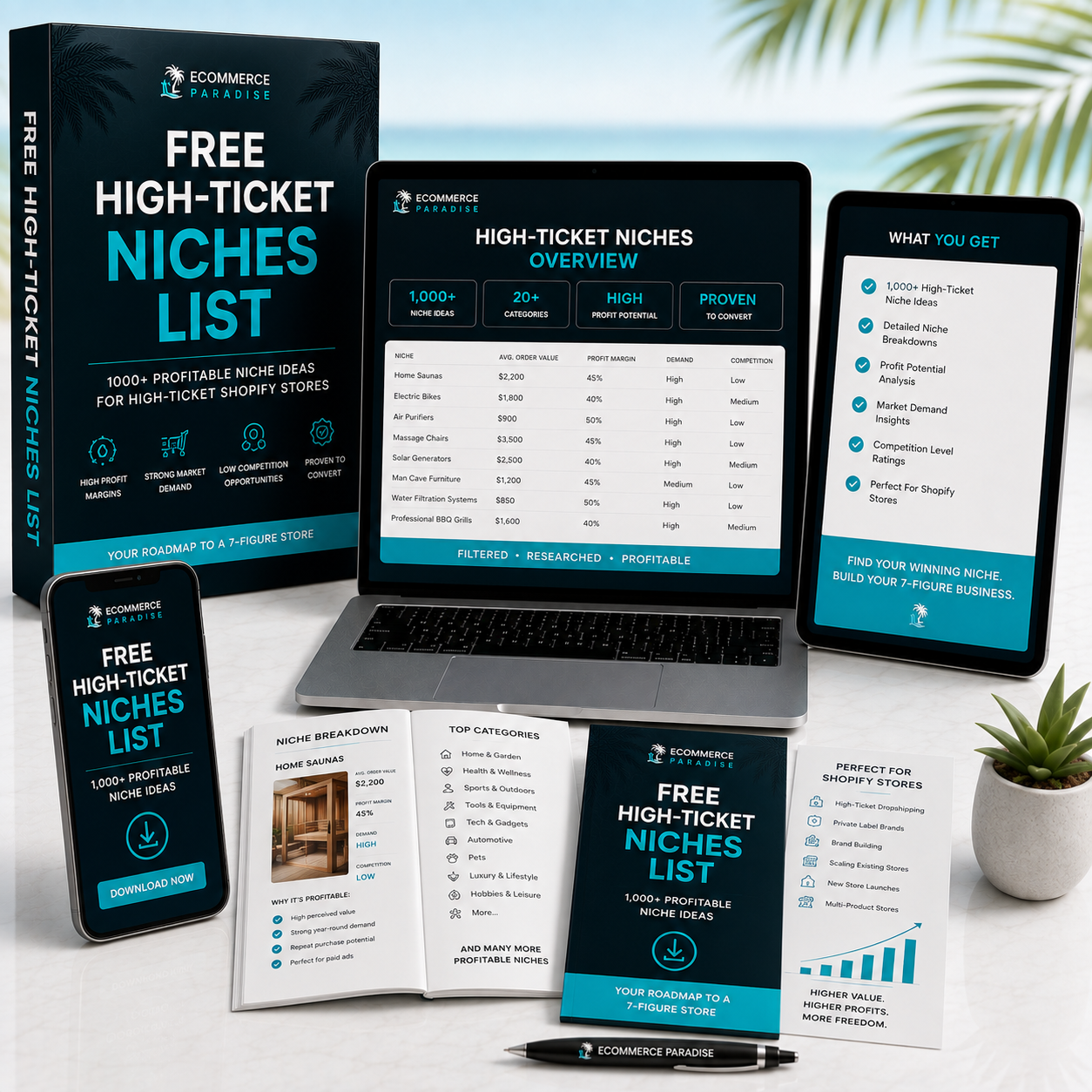
Still deciding what to sell?
Grab the free list of 1,000+ niches that work for high-ticket dropshipping, sorted by category.
Free. Unsubscribe any time.


