

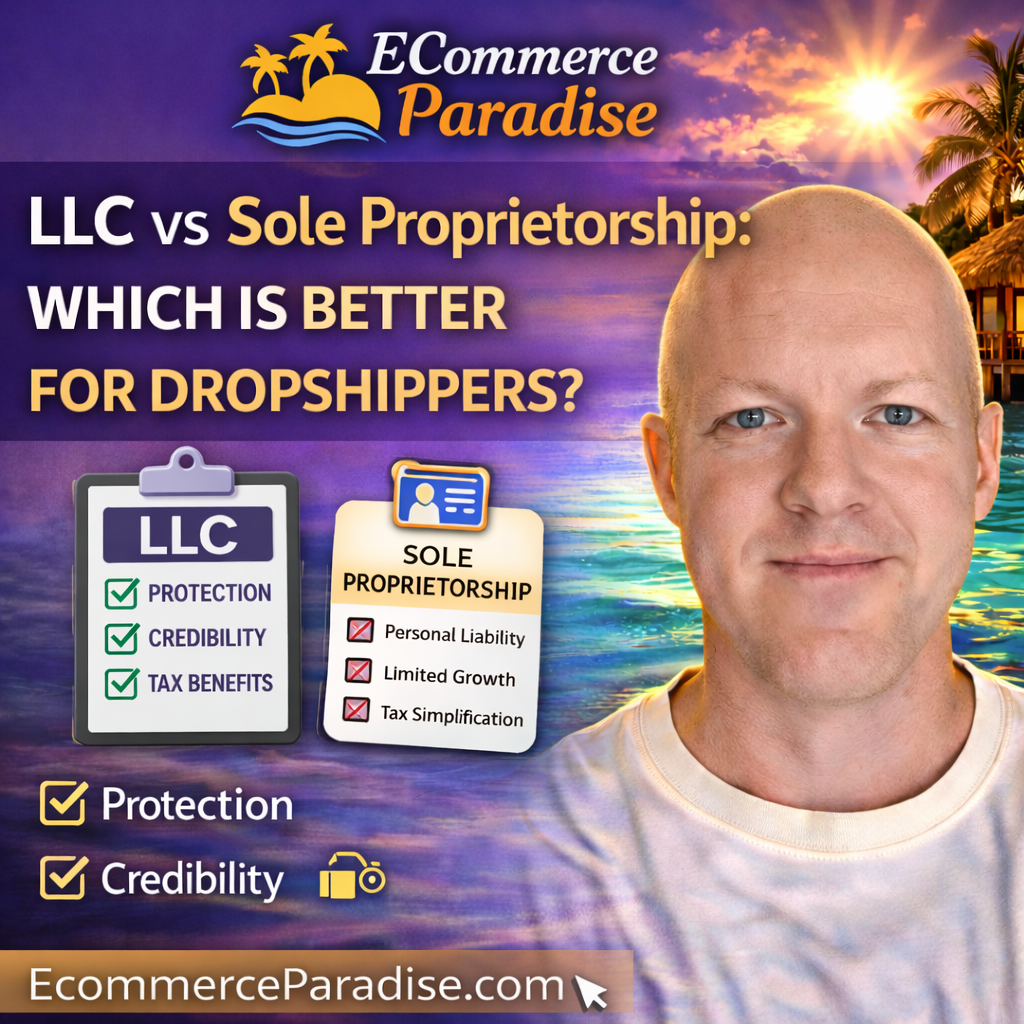

One of the first decisions you’ll make as a new ecommerce entrepreneur is how to structure your business. Most people start out as sole proprietors by default, simply because they didn’t know they had another option. Then they start making money, realize the risks, and start asking the question I hear all the time at E-Commerce Paradise: should I set up an LLC, or is a sole proprietorship fine for now?
The short answer is that an LLC is almost always the better choice for anyone running a real dropshipping business, and I’m going to show you exactly why. I’ve been building location-independent ecommerce businesses since 2013, and I’ve never once seen a serious high-ticket dropshipper wish they had stayed a sole proprietor. The opposite happens constantly. Let’s break it down.
What Is a Sole Proprietorship?
A sole proprietorship is the default business structure for anyone who starts selling without registering a formal business entity. If you open a Shopify store, start taking orders, and haven’t filed any paperwork with your state, you are automatically a sole proprietor. There’s nothing to sign up for and no fees to pay. It’s the simplest business structure that exists.
The simplicity is also its biggest problem. As a sole proprietor, you and your business are legally the same entity. There is no separation between your personal finances and your business finances in the eyes of the law. Everything your business owes, you personally owe. Everything your business gets sued for, you personally get sued for.
According to the U.S. Small Business Administration, sole proprietorships offer no liability protection, which is a critical consideration for anyone running a business that handles customer payments and ships physical products.
What Is an LLC?
An LLC, or Limited Liability Company, is a formal business entity you register with your state. It creates a legal separation between you as an individual and your business. Once your LLC is formed, your business can own assets, enter into contracts, and be held liable for debts separately from you personally.
The “limited liability” part is what matters most. If your business gets sued or can’t pay a supplier, creditors generally can’t come after your personal assets. Your home, personal savings, and personal bank accounts are protected as long as you maintain the separation properly. I cover the full formation process in my guide on business formation for high-ticket dropshipping.
LLC vs Sole Proprietorship: The Key Differences
Liability Protection
This is the biggest difference and the most important one for dropshippers. As a sole proprietor, you have zero liability protection. A customer dispute, a supplier lawsuit, a chargeback that escalates, a damaged product claim — all of that hits you personally. In high-ticket dropshipping where a single order can be worth $2,000 to $15,000, the financial stakes of a single dispute can be significant.
With an LLC, your personal assets are shielded from business liabilities. The lawsuit is against the LLC, not you. This is especially important when you’re selling premium products to customers you’ve never met, through suppliers you may have only worked with for a short time. I wrote specifically about this in my article on why your high-ticket dropshipping business needs an LLC.
Taxation
Sole proprietors report all business income and expenses on Schedule C of their personal tax return. All net profit is subject to self-employment tax (15.3% on the first $160,200 in 2024) on top of income tax. There’s no flexibility here — whatever the business makes flows straight through to your personal return.
An LLC offers the same default pass-through taxation, so you’re not paying more in taxes just by having one. But the LLC also gives you the option to elect S-Corp taxation once your net profit reaches a level where it makes sense, typically around $50,000 or more per year. With an S-Corp election, you pay yourself a reasonable salary and only that salary amount is subject to self-employment tax. The remaining profit distributes to you without self-employment tax, which can save thousands of dollars annually.
A sole proprietor can never make this election. You’re locked into paying self-employment tax on every dollar of profit regardless of how much you make.
Business Banking and Credit
Opening a business bank account as a sole proprietor is possible but less straightforward. Many banks require an LLC or other formal entity for business accounts. And even if you open one as a sole proprietor, there’s no legal requirement to keep finances separate, which leads most sole proprietors to mix personal and business money — a habit that creates accounting nightmares and potentially eliminates any liability protection you thought you had.
With an LLC, you open a dedicated business account in the company’s name and keep everything completely separate. This is one of the first things I cover in my one-on-one coaching program, because clean financials from day one makes everything else easier. Check out my guide on the best business bank accounts for high-ticket dropshipping once your LLC is in place.
Supplier Relationships and Credibility
Premium brands and authorized distributors want to work with legitimate businesses. When you apply to become an authorized reseller for a high-ticket brand, having an LLC, a business bank account, a professional website, and a seller’s permit signals that you’re serious. Sole proprietors often get rejected or ignored by premium suppliers because they don’t look like real businesses.
This matters enormously in high-ticket dropshipping. The ability to get authorized by premium brands is directly tied to how professional your business setup looks. I cover the full supplier approval process in my guide on how to find the best suppliers for high-ticket dropshipping.
Privacy
As a sole proprietor, your personal name is your business name unless you file a DBA. That means your name appears on invoices, supplier agreements, and potentially in any legal proceedings. With an LLC, your business operates under the company name. And if you use a registered agent service like Northwest Registered Agent, your personal address stays off public state records entirely. For digital nomads and home-based business owners, this privacy is genuinely valuable.
Cost and Complexity
This is where the sole proprietorship has its only real advantage: it’s free and requires no paperwork. An LLC costs between $50 and $500 in state filing fees depending on your state, plus optional formation service fees and registered agent costs.
However, this cost difference is trivial in the context of running a real business. Formation services like Bizee offer free LLC formation where you only pay the state fee. In low-cost states like Wyoming, your total first-year cost for a fully set up LLC with a registered agent can be under $250. That’s a one-time expense that buys you ongoing liability protection, better tax flexibility, and professional credibility.
When Does a Sole Proprietorship Actually Make Sense?
I want to be fair here, because there are situations where starting as a sole proprietor is reasonable:
If you’re in pure research mode — meaning you’re exploring a niche, testing product ideas without actually selling, or doing market research — you don’t need an LLC yet because you’re not operating a business. The moment you take your first order, that changes.
If you’re running a very low-revenue side project with minimal customer interaction and zero supplier relationships, the risk profile is lower. But once you’re doing real volume, working with real suppliers, and selling real products to real customers, the sole proprietor structure is genuinely dangerous.
For anyone building a high-ticket dropshipping store, I’ve never seen a situation where staying a sole proprietor was the right call. The upside risk (protecting yourself from a lawsuit or dispute) far outweighs the minor cost of forming an LLC. You can explore what high-ticket niches look like in my high-ticket niches list to understand just how much money moves through these stores.
The Real Cost Comparison Over 3 Years
Let’s run the actual numbers so this is concrete.
Sole Proprietorship (3 years): $0 in formation costs. But zero liability protection, no S-Corp election option, messy financials, and difficulty getting supplier approvals. One customer lawsuit could cost $5,000 to $50,000+ in legal fees and damages.
Wyoming LLC with registered agent (3 years): $100 state filing fee (year 1) + $60 annual report fee (years 2 and 3) + $125/year registered agent = approximately $495 total over 3 years. Full liability protection, S-Corp election option available, clean business banking, professional supplier credibility.
The LLC costs less than $500 over three years and gives you dramatically better protection and flexibility. There’s no version of this math where the sole proprietorship wins for a serious ecommerce business.
How to Make the Switch From Sole Proprietor to LLC
If you’ve already been selling as a sole proprietor and want to switch, the process is straightforward. Form your LLC, get your EIN, open a new business bank account in the LLC’s name, and update your payment processor, supplier accounts, and any business registrations to reflect the new entity. Clean up your books going forward and consult with an accountant to make sure your past income is handled correctly on your tax return.
The best formation services to get this done quickly are:
Bizee (Best Free Option)
Bizee offers free LLC formation where you only pay the state filing fee. Fast, beginner-friendly, and reliable. Read my full Bizee review to see exactly what’s included.
LegalZoom (Best for Legal Support)
LegalZoom is the most well-known formation service in the US and includes access to attorneys for ongoing legal questions. See my LegalZoom review for the full comparison.
Northwest Registered Agent (Best for Privacy)
Northwest Registered Agent uses their own address on your state filings, keeping your personal information completely private. Their formation service is solid and their registered agent service is the best in the business. See my Northwest Registered Agent review for details.
MyCompanyWorks (Best for Speed)
MyCompanyWorks is a fast, reliable mid-range option with great customer support. Check out my MyCompanyWorks review for everything you need to know.
LegalShield (Best for Ongoing Legal Access)
LegalShield gives you a monthly membership with access to attorneys for business and personal legal questions. If you want ongoing legal support beyond just formation, read my LegalShield review to see if it fits your situation.
Frequently Asked Questions
Can I switch from a sole proprietorship to an LLC after I’ve already started selling?
Yes, and you should do it as soon as possible if you haven’t already. Form your LLC, get your EIN, open a new business bank account, and update your accounts. The process typically takes one to two weeks with a formation service. The sooner you make the switch, the cleaner your books and legal structure will be going forward.
Does an LLC pay more taxes than a sole proprietorship?
No. A single-member LLC is taxed identically to a sole proprietorship by default — both use pass-through taxation where income flows to your personal return. The difference is that an LLC gives you the option to elect S-Corp taxation later, which can reduce your self-employment tax burden significantly once your profits grow.
Do I need an LLC if I’m only making a small amount of money?
The level of your income doesn’t change your liability exposure. A customer dispute or supplier issue can happen on your very first sale. The cost of forming an LLC is low enough that there’s no good reason to wait until you’re profitable. I cover this in detail in my guide on the best states to form an LLC.
Can I use a DBA instead of forming an LLC?
A DBA (Doing Business As) lets you operate under a different name, but it does not provide any liability protection. You’re still a sole proprietor with full personal liability. A DBA is a name registration, not a business entity. It’s not a substitute for an LLC.
What state should I form my LLC in if I’m a sole proprietor transitioning to an LLC?
If you live and operate your business in one state, forming in your home state is usually simplest. If you’re running a fully online business with no physical presence tied to one location, Wyoming is an excellent choice: low fees, no state income tax, and strong privacy protections. I break this down fully in my guide on the best states to form an LLC in 2026.
The Verdict: LLC Wins for Dropshippers Every Time
The sole proprietorship vs LLC debate isn’t really a debate for anyone serious about building an ecommerce business. A sole proprietorship leaves you personally exposed every single day you operate. An LLC gives you liability protection, better tax flexibility, improved supplier credibility, cleaner financials, and greater privacy — all for a few hundred dollars in the first year.
If you’re ready to make the switch, start with my best LLC services guide to compare your formation options. Then check out the E-Commerce Paradise Masterclass for the full roadmap on building a legal, scalable high-ticket dropshipping business from the ground up. And join the E-Commerce Paradise community where thousands of entrepreneurs are doing exactly that.
According to SCORE’s business structure guide, the LLC is the most popular structure among small business owners precisely because it delivers meaningful protection without the complexity of a corporation. Build your business the right way from day one and you’ll thank yourself later.

Trevor Fenner is an ecommerce entrepreneur and the founder of Ecommerce Paradise, a platform focused on helping entrepreneurs build and scale profitable high-ticket ecommerce and dropshipping businesses. With over a decade of hands-on experience, Trevor specializes in high-ticket dropshipping strategy, niche and product selection, supplier recruiting and onboarding, Google & Bing Shopping ads, ecommerce SEO, and systems-driven automation and scaling. Through Ecommerce Paradise, he provides free education via in-depth guides like How to Start High-Ticket Dropshipping, advanced training through the High-Ticket Dropshipping Masterclass, and fully done-for-you turnkey ecommerce services for entrepreneurs who want a faster, more hands-off path to growth. Trevor is known for emphasizing sustainable, real-world ecommerce models over hype-driven tactics, helping store owners build scalable, sellable, and location-independent brands.

Still deciding what to sell?
Grab the free list of 1,000+ niches that work for high-ticket dropshipping, sorted by category.
Free. Unsubscribe any time.


