


Affiliate disclosure: some links in this article are affiliate links and I may earn a commission at no cost to you. It does not change what I recommend or what the vendor pages actually say. Every figure below was read on PrintPapa’s own live pages on 15 September 2026, and I have printed the exact configuration that produced each one.
PrintPapa does not print a price in its page copy. Not on the business card category page, not on the banner stand category page, not on any of the six category pages I opened. What you get instead is a configurator that fills in a number once you have picked a size, a stock, a coating, a proof type, a turnaround and a quantity.
That is not evasive, it is how a real trade printer quotes work, and I said as much in my PrintPapa review. But it creates a specific problem for anybody trying to budget. Print pricing is quantity-tiered, and the per-unit price moves enormously with volume. A single headline number tells you almost nothing.
So I went back and did the whole thing properly. I pulled PrintPapa’s sitemap, which lists 500 URLs, then opened 15 product pages, 6 category pages and 6 policy pages and read the figure each one renders on load, along with the exact configuration that produced it. Everything below is that, plus the minimum order quantity and the turnaround options for each product, because those two are the numbers that actually decide whether a print job works for you and almost nobody publishes them together.
I am writing this for somebody running a high-ticket dropshipping store selling $1,000 to $5,000 products, which means the print budget is small, irregular and mostly defensive: cards for a supplier meeting, an insert for the box, dealer-facing paper, one banner for one trade show a year. If that is you, there is one thing on this site that matters more than any price, and it is buried on a page the navigation barely mentions. It is at the bottom of this article.
Get a Number for Your Actual Job, Not Somebody Else’s
Every price in this article is a default configuration. Change the stock, the turnaround or the quantity and it moves. Two minutes in the configurator gets you a figure that is genuinely yours.
The Banner Stand Ladder, Which Is the Clearest Thing on the Site
Trade show graphics are the one category where PrintPapa’s pricing structure is genuinely easy to read, because the quantity is one and the product tiers do the work instead. Four retractable stands, four prices, and each step buys something you can name.
| Stand | Price as loaded | The exact default configuration |
|---|---|---|
| Everyday Retractable, 33 inch | $113.19 | Quantity 1, Light Base Stand + Banner 33×78 inch, 13 oz Smooth Blockout Vinyl Banner, Upload Print Ready PDF Files, 2 Business Days |
| Economy Retractable, 33 inch | $181.43 | Quantity 1, Light Base Stand + Banner 33×78 inch, 7mil Satin Lightblock Scratch Proof Vinyl, Upload Print Ready PDF Files, PDF Proof, 3 Business Days |
| Premium Retractable, 33 inch | $240.06 | Quantity 1, Heavy Base Stand + Banner 33×80 inch, 7mil Satin Lightblock Scratch Proof Vinyl, Upload Print Ready PDF Files, PDF Proof, 3 Business Days |
| Wide Retractable, 47 inch | $281.18 | Quantity 1, Wide Stand + Banner 47×78 inch, 13 oz Smooth Blockout Vinyl Banner, Upload Print Ready PDF Files, PDF Proof, 3 Business Days |
Four rows, and I counted them against the four product pages. Those are the four retractable stands I opened, not every stand PrintPapa sells, because their trade program page also lists a Tension Fabric Stand, a Table Top Banner Stand and three SD Retractable sizes that I did not price.
Now read the steps rather than the numbers. Everyday to Economy is $68.24, and what you are buying is a different vinyl, 7mil satin with a lightblock and scratch proof layer instead of 13 oz smooth blockout, plus a PDF proof step the Everyday default does not include. Economy to Premium is $58.63 and buys a heavy base and two more inches of banner height. Premium to the 47 inch Wide is $41.12 and buys fourteen more inches of width, but note it drops back to the 13 oz vinyl.
Across the three 33 inch stands the spread is $126.87, from $113.19 to $240.06, for the same format. That is the part a first-time exhibitor should sit with before deciding they need the premium one, and you can flip between the four stand pages at PrintPapa in a couple of minutes to see the vinyl and base differences side by side.
I put those figures next to what other vendors charge in my guide to the best trade show displays for first-time exhibitors.
One detail worth catching. The Everyday stand loads with a 2 Business Day turnaround and no proof step. The other three load with 3 Business Days and a PDF proof. So the cheapest stand is also the one that ships soonest on its defaults, which is the opposite of what you would expect and happens because the proof step adds a day of your own decision time.
The Rest of the Price Board
These are the figures the other product pages render on load, each with its quantity and configuration. I have separated them from the banner stands because most of these are quantity-tiered, which means the number below is one point on a curve rather than a price.
| Product | Price as loaded | Quantity | Default configuration |
|---|---|---|---|
| Standard Business Cards 3.5×2 | $14.71 | 100 | Front Side Only (4/0), Card Stock 14Pt. Gloss, no UV coating, no lamination, no spot UV, no rounded corners, Upload Print Ready PDF, 3 Business Days |
| Circle Stickers | $18.97 | 100 | Contour Cut, No Lamination, 3 Mil Gloss Adhesive Vinyl (Air Release), Upload Print Ready PDF Files, PDF Proof, 3 Business Days |
| Short Run Folder 8.75×11.5 | $86.86 | 5 | Outside full colour and inside blank, 1 Pocket (Right Side), Card Stock 110lb Matte, UV Coating on Outside Only, Upload Print Ready PDF, no shrinkwrap, PDF Proof, 5 Business Days |
| Rack Card 4×11 | $177.92 | 250 | Front Side Only (4/0), Card Stock 14Pt. Gloss, no UV coating, no hole drilling, no shrinkwrap, Upload Print Ready PDF, PDF Proof, 5 Business Days |
Four rows, counted. Those are the four product pages of the fifteen I opened that render a completed “Price as Configured” figure in the page source without any interaction. That is an important qualification and the next section explains why.
Do the per-unit arithmetic yourself, because it is illuminating. A hundred business cards at $14.71 is just under fifteen cents a card. Two hundred and fifty rack cards at $177.92 is 71 cents each. Five short run folders at $86.86 is $17.37 each. That last one is the number a store owner should notice: a presentation folder for a dealer meeting costs more than a hundred business cards, and folders are exactly the thing people order without checking.
What PrintPapa Does Not Publish, and the Pages I Opened to Check
Here is the negative finding, stated as narrowly as I can make it, because a negative finding is the most dangerous kind of claim to publish about a company.
PrintPapa publishes no quantity price ladder on any page I opened. There is no “100 cards $X, 500 cards $Y, 1,000 cards $Z” table anywhere I could find. The quantity discount exists, because the business card page’s total of $14.71 for 100 cards is lower than its own listed unit price times a hundred, but the ladder itself is computed in the browser when you change the quantity dropdown, and it does not exist in the page source.
So that I am not asking you to take “I did not find it” as proof, here is what I opened. I pulled the full sitemap, which lists 500 URLs, and grepped every one of them for the strings pric, cost, fee, rate, quantity, discount, bulk, wholesale, volume, payment and billing. Exactly two URLs matched, and both of them are the postage pass-through products covered further down. There is no pricing page on this site.
On top of that I opened six category pages: business cards, banner stands, postcards, labels and stickers, presentation folders and rack cards. Between them they render three dollar figures and all three are coupon caps, not prices. I opened six policy pages: the specials page, the turnaround page, the terms page, the guarantee page, the trade program page and the shipping options endpoint. And I opened fifteen product pages.
That is the list. If a published ladder exists somewhere outside those twenty seven pages and the sitemap grep, I did not find it, and I would rather say that precisely than say it does not exist.
The practical consequence is simple. You cannot budget a print job from this article or any other. You can only budget it from the configurator, which is why every CTA here points you at it rather than at a number.
Minimum Order Quantities and How High They Go
This is the table I most wanted when I first used PrintPapa and could not find anywhere. Every figure is the first and last option in that product’s quantity dropdown.
| Product | Minimum | Maximum | Options in the dropdown |
|---|---|---|---|
| Retractable banner stands, all four | 1 | 100 | 100 |
| Circle Stickers | 1 | 2,500 | 46 |
| Short Run Folder 8.75×11.5 | 5 | 100 | 9 |
| Standard Business Cards 3.5×2 | 50 | 50,000 | 20 |
| Postcard 4×6, print only | 50 | 100,000 | 41 |
| Folded Brochure 8.5×11 | 50 | 100,000 | 41 |
| Rack Card 4×11 | 50 | 25,000 | 31 |
| Rectangle Labels | 50 | 10,000 | 16 |
| Standard 9×12 Presentation Folder | 100 | 5,000 | 11 |
| EDDM Postcard 8×6.5 | 250 | 100,000 | 25 |
| No. 10 Regular Envelope | 500 | 50,000 | 36 |
Eleven rows, counted, covering the twelve product pages that carry a quantity dropdown out of the fifteen I opened. The Direct Mail Postcard 6×4 page takes a free-text quantity instead of a dropdown and loads at 50, and the two postage products have no quantity control at all.
Three things in that table matter for a store.
The low floors are the real story. A minimum of one on a banner stand and one on a sticker means you can order a single test print from PrintPapa before committing to a run. Fifty business cards, fifty postcards and fifty brochures means the same for paper. That is unusually permissive for a trade printer and it is the strongest argument for using PrintPapa when your volumes are small and irregular, which describes almost every high-ticket store I know.
The 500 minimum on envelopes is the outlier that will catch you. If you are setting up a business address for supplier applications, five hundred envelopes is more envelopes than a dropshipping store will use in three years. Buy them once and forget about it, or do not buy them at all.
And the 100 minimum on the standard 9×12 presentation folder versus 5 on the short run folder is the difference between a $17 experiment and a four figure commitment. If you are printing dealer-facing material, start on the short run product.
Print Is Never the Reason a Store Fails
A hundred business cards is $14.71. Nobody has ever lost a high-ticket store over 14Pt gloss versus 16Pt. They lose it on niche, suppliers and the offer. If you would rather have that part built for you, that is what the done-for-you service is.
Turnaround, Which Is Priced Into Every Configuration
Turnaround is a dropdown on every product page, which means it is part of the price, and the options are not the same product to product.
| Product | Default on load | Every option offered |
|---|---|---|
| Standard Business Cards 3.5×2 | 3 Business Days | 3 Business Days, 2 Business Days, Next Business Day, Same Day (Max Qty: 2500) |
| Retractable banner stands | 2 or 3 Business Days by tier | Same Day (Min Qty: 1 Max Qty: 25), Next Business Day, 2 Business Days, 3 Business Days |
| Postcard 4×6 and Folded Brochure | 4 Business Days | 4, 3, 2 Business Days, Next Business Day, Same Day (Max Qty: 1000) |
| Circle Stickers | 3 Business Days | 3, 2 Business Days, Next Business Days, Same Business Day (Max Qty: 1000) |
| Rack Card 4×11 | 5 Business Days | 5, 3, 2 Business Days, Next Business Day, Same Day (Max Qty: 1000) |
| Presentation folders, both sizes | 5 Business Days | 5, 3, 2 Business Days, Next Business Days (with a quantity cap) |
| Rectangle Labels | 5 Business Days | 5, 3, 2 Business Days, Next Business Day |
| Envelopes, EDDM and Direct Mail postcards | 4 Business Days | 4, 3, 2 Business Days, Next Business Day |
Eight rows, counted, covering the products I opened. Same day is available on business cards, stickers, postcards, brochures, rack cards and banner stands, and it is not offered at all on envelopes, EDDM or direct mail.
Now the part that catches people, and PrintPapa is unusually honest about it. Their turnaround page states: “Turnaround time for your print job begins once your order has been placed and print-ready files have been approved by us for printing.” Not when you pay. When they approve your file.
If a proof is in your configuration, it slips again. The same page says: “If you ordered a proof, your turnaround begins when we receive approval for your proof.” Their terms page puts it even more plainly: “Proofing duration is not counted part of the selected turnaround.”
There are cut-offs on top of that. The turnaround page states: “Cut off time for Next Day, 2 Day, 3 Days, 5 Days and above is 2 PM (Pacific Time)”. Same day cuts off at 10 AM Pacific. And weekends are excluded: “Note that our offices are closed Saturdays, Sundays and Holidays. As a result, these days are not considered when calculating production turnaround time.”
Then shipping sits on top: “In addition, production turnaround time does not include shipping or mailing transit time, and you should allow additional business days for delivery based on the shipping or mailing method you selected.”
Put that together on the Economy banner stand, which defaults to a PDF proof and 3 Business Days. Upload Friday at 3 PM Pacific and you are past the cut-off, the weekend does not count, they proof Monday, you approve Monday evening which is past the cut-off again, so production runs Tuesday to Thursday, then ground transit from San Jose. A three business day product lands the following week. That is print being print, not PrintPapa being slow, but you need to know it before the show is nine days away rather than after.
The Coupon Layer, Which Rotates
PrintPapa publishes its codes on a specials page rather than hiding them behind an email popup, and every one carries a hard dollar cap. That cap is the thing that changes the maths on anything expensive, because fifteen percent off a $65 maximum is worth $65 on a $434 order and $65 on a $4,000 order.
When I read the specials page today there were exactly 14 coupon tiles on it. I counted the codes and counted the “Coupon Code” labels in the source and both came to 14. Every one of them carries a published expiry of 30 September 2026.
That is one fewer than the page carried when I wrote the review earlier the same day, and the difference is instructive. The fifteenth was a rotating DealoftheDay on 4 Part Carbonless Forms with a published expiry of 14 September 2026, and it has now dropped off the board. So the board rotates daily and this table is a snapshot, not a list.
| Code | Discount and cap | Applies to |
|---|---|---|
| save15bc26 | 15% off, max $65 | All Business Cards |
| save15ban26 | 15% off, max $65 | Banners and Banner Stands |
| save15pc26 | 15% off, max $65 | All Postcards |
| save15post26 | 15% off, max $65 | Posters |
| save15lsd26 | 15% off, max $65 | All Label, Stickers and Decals |
| save15flb26 | 15% off, max $65 | All Flyer and Brochure |
| save15mail26 | 15% off, max $65 | Direct Mail Marketing |
| save15env26 | 15% off, max $65 | Envelopes |
| save15igc26 | 15% off, max $65 | Invitations and Greeting Cards |
| save15sign26 | 15% off, max $65 | Sign Printing |
| save20book26 | 20% off, max $100 | Book and Booklets |
| 20poffpc0726 | 20% off, max $65 | Political Printing |
| save15apparel26 | 15% off, max $50 | Apparel Printing |
| save10roll | 10% off, max $50 | Roll Labels |
Fourteen rows, and I counted them against the page twice. That is the complete board as it stood today, not a selection, and it is not a claim about every promotion PrintPapa has ever run.
Work the cap, not the percentage. On the $181.43 Economy banner stand, fifteen percent is $27.21, comfortably under the $65 cap, so you get the full fifteen. On a $600 booklet run, twenty percent would be $120 but the cap holds it to $100, so your real discount is 16.7 percent. On a $4,000 trade show order, $65 off is 1.6 percent and effectively nothing. Do that sum before you tell yourself the promotion changed the decision, and check which codes are live at PrintPapa today, because the one I lost between writing two articles proves they move.
Direct Mail, Where the Postage Is Separate
If you are running any kind of mailer, the print is only half the invoice. PrintPapa sells postage as its own line item, and those two products are the only URLs on the entire site with a pricing word in them.
Pay for Postage, 1st Class Postcard Rate loads at $0.68 per piece. Pay for Postage, Flat Rate loads at $1.32 per piece. Neither page has a quantity control, so those are the per-piece figures as rendered.
Their guarantee page also carves direct mail out of the satisfaction guarantee entirely: “For Direct Mail Products and EDDM, PrintPapa is not liable for delays, undeliverable mailers, or damages once the US Postal Service has taken possession of the order.” It adds that “The postage amount is not refundable and is not covered under the 100% Satisfaction guarantee.” If you are going the Every Door Direct Mail route, the USPS Every Door Direct Mail page is where the postal side of that equation is published.
The Thing Actually Worth Knowing, Which Is Not a Price
Everything above is a number. This is the bit that changed how I think about PrintPapa for a dropshipping store, and it is on their trade program page, which the main navigation barely surfaces.
The page is aimed at print brokers, graphic designers, ad agencies and print shops, and it lists its benefits plainly. The first one is: “Trade prices are anywhere 30%-15% lower than regular online retail prices.” The second is: “No coupons to apply – just login and you will see your discounted prices.”
And then the one that matters: “Blind Drop-Shipping Service available. All packages are send in unmarked boxes.”
Think about what that unlocks if you run a high-ticket store where the product ships from your supplier rather than from you. The permanent problem with packaging inserts in this model is that your box is not your box. A printer that will ship unmarked cartons straight to your supplier’s fulfilment desk solves that, and it is the reason inserts are worth designing at all in a dropshipping setup rather than being a nice idea you never execute. I went through the design side of that in my guide to packaging inserts that drive repeat orders.
The same page states that trade orders go through a separate login at printpapatrade.com, that all jobs require payment upfront, and that California customers pay no sales tax with a reseller certificate on file. If you order print regularly enough for that to matter, it is worth reading the trade terms at PrintPapa before you place a retail order.
I have not logged into the trade store, so I have not seen a trade price and I am not going to quote one. The 30 to 15 percent range is their published claim about their own pricing, not a figure I have verified, and prices behind a login are not published prices. Treat it as a reason to apply and check, not as a discount you can bank.
Whether you qualify is a question for them rather than me, and it will depend on your entity and your reseller paperwork, which is one more reason to have business formation for a high-ticket dropshipping business sorted before you need it. This article is general information rather than legal or tax advice, and sales tax and reseller certificate rules vary by state.
What I Would Actually Budget
Here is the realistic annual print spend for a high-ticket store, built from the figures above rather than from a guess.
Credibility paper, roughly $15 to $30. A hundred business cards at $14.71 covers the dealer applications and the two trade meetings you will actually take. A supplier application that arrives on plain paper from a Gmail address gets read differently from one that does not, and the whole approval process is in my step-by-step guide to finding high-ticket dropshipping suppliers. The print side of it is a rounding error and you should stop thinking about it.
Packaging inserts, roughly $180 to $400 a year. Rack cards at $177.92 for 250 is the shape that fits a box insert, and 250 is a sensible first run when you do not yet know whether the supplier will include them. Test with 250 before committing to 2,500.
Dealer-facing material, roughly $90. Five short run folders at $86.86 for the meetings that justify one. Do not touch the 100 minimum standard folder until you know you need a hundred.
One trade show, $113 to $281. One stand, once a year. The Everyday at $113.19 is genuinely fine for a first show and the money you save is better spent on the booth position.
Which totals somewhere around $400 to $800 a year for a store doing real volume, and that is the number worth internalising, because it means print is not a category that needs optimising. It needs deciding once and then ignoring.
The one place I would slow down is a full booth package. PrintPapa’s terms state: “Maximum refund per order or customer is $1000.” And immediately after: “The only remedy for problems with orders over $1000 is reprinting of the order to correct product defects.” On a $181 banner stand that clause is irrelevant. On a four figure booth order three weeks before a show it is the most important sentence on the site, and the sensible move is to split the order so no single order crosses that line.
Two more from the same terms page you should price in mentally. Overruns and underruns: “Your job will be delivered within 3% over or under the quantity ordered”, so order 1,100 if you genuinely need 1,000 in the box. And cancellation: “Depending on the production stage of your order, there may be a 15%-30% charge for the cancellation ($15 minimum)”.
The Verdict on PrintPapa’s Pricing
PrintPapa’s pricing model is honest and inconvenient in exactly equal measure. You cannot comparison shop it from a category page, which is annoying, and the reason you cannot is that they quote the job rather than the category, which is correct.
What they publish well: every configuration is visible before you order, the minimums are genuinely low, the coupon codes are on a public page with caps and expiry dates attached instead of a vague “save today”, and the turnaround page tells you the clock starts at file approval, which most printers bury.
What they do not publish: any quantity ladder, anywhere I could find across 27 pages and a 500 URL sitemap grep. So the honest instruction is the one I keep repeating. Open the product page, put your real specification into it, and read your own number. It takes two minutes and it is the only figure that will be true for your job.
For a store selling four figure products, the whole print category is a few hundred dollars a year and one decision about blind drop-shipping. Get the inserts into the supplier’s boxes and the rest of this is noise.
If you have not settled what you are selling yet, the high-ticket niches list comes a long way before any of this. So does understanding what high-ticket dropshipping actually is.
Everything else I publish lives at Ecommerce Paradise. When you are ready to price a real job, open the PrintPapa configurator and put your own specification into it.
Work Out Whether Print Is Even on Your List
Four hundred to eight hundred dollars a year, decided once. If you are spending more time on this than on supplier approvals or your offer, that is the actual signal. One session usually finds the real constraint faster than another month of guessing.
Frequently Asked Questions
How much do business cards cost at PrintPapa?
The Standard Business Cards 3.5×2 page loads at $14.71 for 100 cards on its default configuration, which is front side only in 4/0, 14Pt gloss stock, no UV coating, no lamination, no spot UV, no rounded corners, upload print ready PDF and a 3 business day turnaround. Change any of those and the number changes. The quantity dropdown runs from 50 to 50,000.
What is PrintPapa’s minimum order?
It varies by product and it is unusually low. Banner stands and circle stickers start at 1, the short run folder starts at 5, business cards, postcards, brochures, rack cards and rectangle labels start at 50, the standard 9×12 presentation folder starts at 100, EDDM postcards at 250 and No. 10 envelopes at 500. Those are the minimums on the twelve product pages I opened that carry a quantity dropdown.
Does PrintPapa publish quantity discounts?
Not as a table you can read. The discount exists, because the business card page’s order total is lower than its unit price times the quantity, but the ladder is calculated in the browser when you change the quantity and it does not appear in the page source. I grepped all 500 sitemap URLs for pricing words and opened 27 pages without finding one.
How much is a retractable banner stand at PrintPapa?
On the defaults each page loads with, the Everyday 33 inch is $113.19, the Economy 33 inch is $181.43, the Premium 33 inch is $240.06 and the Wide 47 inch is $281.18, all at a quantity of one. The Everyday and the Wide use 13 oz smooth blockout vinyl, the Economy and Premium use 7mil satin with a lightblock and scratch proof layer, and the Premium has a heavy base.
When does PrintPapa’s turnaround clock actually start?
At file approval, not at payment. Their turnaround page states that turnaround begins once the order has been placed and print-ready files have been approved by them for printing, and that if you ordered a proof it begins when they receive approval for your proof. The cut-off is 2 PM Pacific for next day and longer turnarounds, 10 AM Pacific for same day, weekends and holidays do not count, and transit time is on top.
Does PrintPapa do blind drop-shipping?
Their trade program page lists “Blind Drop-Shipping Service available. All packages are send in unmarked boxes.” as a trade customer benefit, alongside trade pricing they describe as 30 to 15 percent below regular online retail. Trade prices are only visible after logging in at their separate trade store, so I have not seen one and cannot quote a figure.
Related Articles
- PrintPapa Review 2026: Worth It for an Ecommerce Business?
- Best Trade Show Displays for First-Time Exhibitors in 2026
- How to Design Packaging Inserts That Drive Repeat Orders
- How to Print Shipping Labels Without Overpaying for Supplies
- Is the Trade Show Displays Niche Worth It for High-Ticket Dropshipping in 2026?

Trevor Fenner is an ecommerce entrepreneur and the founder of Ecommerce Paradise, a platform focused on helping entrepreneurs build and scale profitable high-ticket ecommerce and dropshipping businesses. With over a decade of hands-on experience, Trevor specializes in high-ticket dropshipping strategy, niche and product selection, supplier recruiting and onboarding, Google & Bing Shopping ads, ecommerce SEO, and systems-driven automation and scaling. Through Ecommerce Paradise, he provides free education via in-depth guides like How to Start High-Ticket Dropshipping, advanced training through the High-Ticket Dropshipping Masterclass, and fully done-for-you turnkey ecommerce services for entrepreneurs who want a faster, more hands-off path to growth. Trevor is known for emphasizing sustainable, real-world ecommerce models over hype-driven tactics, helping store owners build scalable, sellable, and location-independent brands.
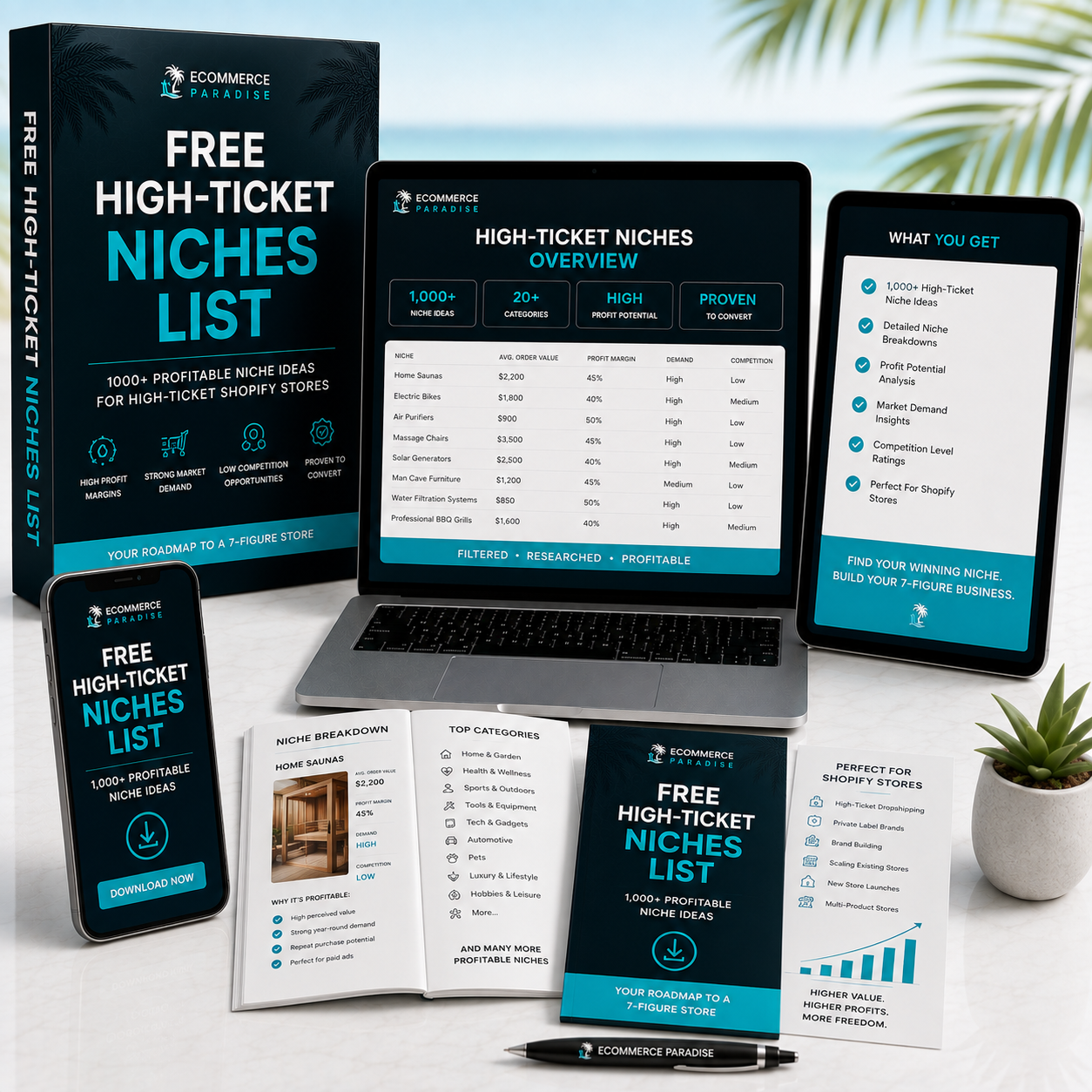
Still deciding what to sell?
Grab the free list of 1,000+ niches that work for high-ticket dropshipping, sorted by category.
Free. Unsubscribe any time.


