

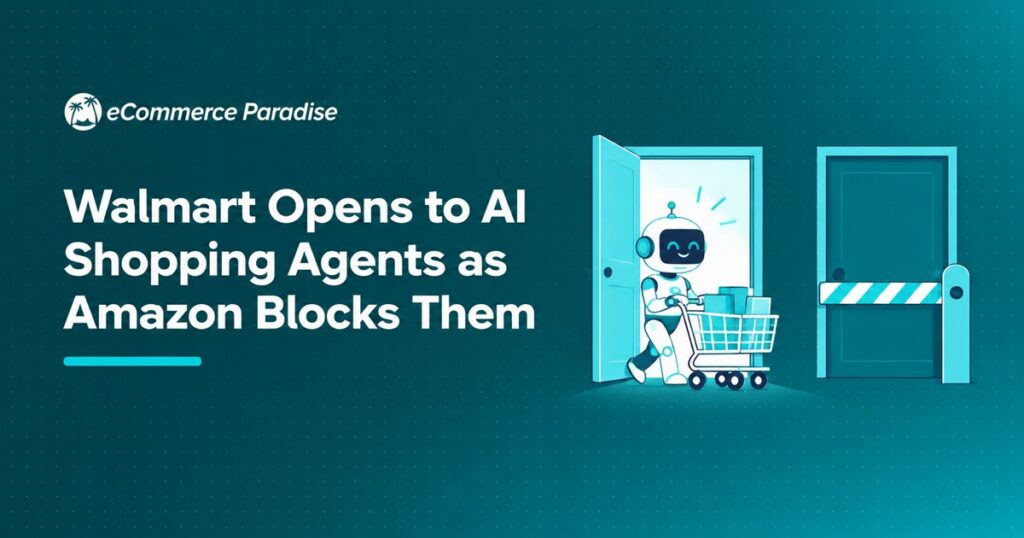
Walmart said Wednesday it will let customers send their own AI agents to shop Walmart and Sam’s Club, while Amazon keeps outside agents blocked.
If you run a high-ticket store on Shopify, this is the first big-retailer rulebook for agent buyers, and it shows what your own checkout will be asked to prove soon. I’ve been tracking agent traffic for Ecommerce Paradise for weeks, and the market has now split into two camps: retailers that publish terms and take the orders, and retailers that block the traffic.
Below: what Walmart actually announced, how Amazon, the banks and Shopify got to their positions, what the split does to a store selling $1,000-plus products, and five moves to make before Black Friday. My earlier breakdown of Shopify opening its catalog to personal AI agents covers the other side of this fight.
Agent platforms and marketplaces will keep asking who is really behind a store. Form your LLC with Northwest, the best LLC formation service for ecommerce owners. Northwest keeps renewal pricing the same as year one and does not push upsells, which is exactly what cheap formation sites that bury you in add-ons do not do. Form your LLC with Northwest →
Walmart Agent Gateway and Agent Profiles: What Launches and When
Walmart announced three tools in a press release on Wednesday, October 21, according to PYMNTS. Agent Profiles launch in November. The Walmart Agent Gateway is in beta now for companies and developers. A set of published terms governs how agents must behave on the site, with no start date given for those terms.
Per TechCrunch, reporter Sarah Perez, the Gateway is a Model Context Protocol server. Approved agents connect through it, search Walmart’s online inventory and buy for the shopper. A customer can have an agent reorder usual brands without handing the agent personal information or purchase history. The system covers Walmart and Sam’s Club, and a Walmart+ membership is not required.
Agent Profiles give each agent its own profile inside the customer’s account, so the agent’s purchases show up separately from the customer’s own. Customers can require approval for every purchase, or let an agent spend up to a limit they set. AFP, in a report carried by the Jamaica Observer, gave $50, $100 and $200 as example limits and said Walmart likened the setup to adding an authorized user to a credit card. A customer can delete a profile at any time.
The terms are the part store owners should read twice. According to PYMNTS, agents may not take actions beyond what the customer intends, may not add or change payment methods, and may access only the information a task needs and the customer allows. TechCrunch adds that non-compliant agents will be blocked and that Walmart’s returns process applies even when an agent does not act as intended.
PYMNTS attributes one statement to “the company” rather than a named executive: shopping with an agent won’t be for everyone, and Walmart’s goal is to be the most trusted option. TechCrunch reports that John Furner, Walmart’s president and CEO, spoke Wednesday at the Masters of Scale Summit in San Francisco about preparing for a world where agents go mainstream. Neither outlet quotes him directly.
Walmart is not starting from zero. TechCrunch says it already works with Meta’s Muse agent and integrates with Gemini and other AI apps, including ChatGPT. Per eMarketer, writing on September 24, Muse’s retail partners include Walmart, Best Buy, Sephora and Wayfair, and the agent passed 2.5 million downloads in about two weeks, citing Sensor Tower data reported by CNN. AFP now puts Muse at more than 10 million downloads, also citing Sensor Tower. Those two figures come from different dates and outlets, so treat the growth rate as directional.
Amazon, Banks and Yelp Block Agents While Shopify Stays Open
Amazon went the other direction. According to Winbuzzer’s account of the Muse episode, users trying to buy through the agent saw a notice by the evening of September 20 that “access by an unauthorized AI agent violated Amazon’s terms.” Amazon said Muse did not identify itself, that Amazon had not agreed to take part, and that the handling of customer credentials raised privacy and security concerns. Amazon had asked Meta to exclude its store, and Meta did not comply before the cutoff. Meta says Muse uses credentials held in secure storage and never sees passwords or payment details.
AFP reports Amazon sued Perplexity in November 2025, alleging its Comet browser agent made covert purchases on the marketplace. AFP also says Amazon has moved to restrict agents from Google and OpenAI while promoting its own tools, Alexa for Shopping and Buy for Me.
The pattern reaches well beyond retail. Per Winbuzzer, JPMorgan restricts outside agents from obtaining banking credentials, a policy a spokeswoman confirmed to CNBC on October 13. Schwab CEO Rick Wurster said the firm blocks unauthorized agents that try to move client money. Yelp permits non-human traffic only through its paid data-licensing program. Zillow lets agents act for consumers, though its anti-scraping defenses sometimes block them. eBay restricts unauthorized agents but does not ban every third-party shopping agent from completing purchases. I covered Citi and BofA joining JPMorgan earlier this week.
Shopify sits on the open side. Winbuzzer reports that its Shop MCP connection lets compatible agents search a catalog of more than one billion products, build carts and check out on Shopify stores. Shoppers use saved addresses and Shop Pay details, must confirm the total and payment method, and the merchant receives the order in the normal Shopify admin. Sierra published a draft Personal Agent Protocol, called Poppy, on October 9. Under the draft, agents identify themselves and customers approve limited access through a temporary session token. I wrote up Shopify’s role in the Poppy protocol announcement at the time.
The counterpoint
Walmart’s side of the Muse story is less tidy than the headline suggests. Per Winbuzzer, Walmart said Muse purchase failures were unintentional and not caused by blocks, and that an interrupted payment check can end a purchase early. So even the welcoming retailer has agents failing at checkout.
Demand is also unproven. PYMNTS cites a PYMNTS Intelligence report finding that merchants expect agentic commerce to become a paid sales channel while many feel unprepared to connect with agents. A study I covered this week found ChatGPT sends 0.62% of Google’s organic traffic. Trust is a drag too: eMarketer cites a March Institute for Public Relations and Leger survey showing 64% of US adults do not trust Facebook much or at all.
What Walmart’s Agent Rules Mean for a High-Ticket Shopify Store
Everything from here down is my read, not reporting.
Walmart just wrote the template. A separate agent profile, a spend limit or per-purchase approval, and permissions the customer can revoke: those three controls are what a safe agent purchase looks like to a large retailer, and other platforms will copy them. Expect payment providers, Shop Pay and card networks to ask for the same shape. Amex has already introduced an intent check for AI agent purchases, so the card side is moving too.
The $50, $100 and $200 example limits matter more than they look. Those are repeat-purchase numbers: paper towels, pet food, a usual brand of coffee. A $1,800 patio set or a $3,400 treadmill blows through any limit a shopper would set, which means a human gets pinged and approves. For a high-ticket store that is mostly good news. A human tap on the final total is the best chargeback defense you will get from an agent order, and it is why my guide to chargeback prevention for high-ticket stores keeps coming back to proof of buyer intent.
Here is hypothetical math, not a forecast. Say your store gets 10,000 sessions a month and 1.5% of them arrive through agents, which is 150 sessions. At a 2% conversion rate and a $1,800 average order, that is 3 orders and $5,400 in revenue. At a 20% gross margin you keep about $1,080 before ads and fees. That is real money for zero ad spend, and it is also small enough that you should not rebuild your store around it.
So set thresholds. If agent sessions are under 1% of your traffic after you measure them, do the cheap checks in the action list below and move on. If they climb past 3%, build an agent-order playbook: tagging, dispute evidence, and a support macro. Nobody has published a benchmark yet, so your own analytics are the only number that counts.
Amazon’s block makes independent stores the open lane. A shopper who tells an agent to find a reclining sofa or a 20-foot trailer has to buy from somewhere that accepts the agent. Per Winbuzzer, Shopify’s Shop MCP route already lets compatible agents check out on stores like yours. I’d treat that as an early-mover window, with one caveat: no source in this story says Walmart’s third-party Marketplace items flow through the Gateway. If you sell on Walmart Marketplace, ask your rep before assuming you get agent traffic.
The real risk is self-inflicted. Stores that bolt on aggressive bot blocking after a scraping scare can lock out the agents they want. Arkose’s study, which I covered as 97.7% of legitimate AI agent sessions lacking verified ID, shows why: identification is thin today, so blunt rules block good and bad traffic alike. The answer is allow-listing identified agents, not leaving the door open or shut.
Buyer-side agents are a different animal from the AI tools you use to run your store, such as Claude, because they spend someone else’s money on your site. I covered the operator side in building a leaner high-ticket business with AI. The buyer side is a trust problem, and trust problems are checkout problems.
If wiring feeds, checkout rules, bot settings and dispute evidence sounds like a second job, that is the exact work my team handles in the turnkey done-for-you service, where we build and run the store so you are not debugging agent traffic at 11 p.m. during BFCM.
Agent buyers are coming whether you built for them or not. Want my team to build and run your high-ticket store with agent-ready checkout from day one? See the turnkey done-for-you service →
Five Agent-Readiness Moves to Make Before Black Friday
Do these five in order. Total time is an afternoon.
- Pull 30 days of referral data and isolate AI sources. Check your analytics for ChatGPT, Meta and Gemini referrers, and remember the ChatGPT tracking bug that hid referrals for a week, so your recent numbers may undercount. Write down the percentage; it decides which threshold above you are in.
- Audit your bot rules. Open robots.txt and your firewall settings and confirm you are not blocking identified agents by accident. The nine AI-agent checks that no Shopify store in 122 passed, which I covered, make a usable checklist. Run a crawl with SEMRush afterward to catch blocked pages.
- Tag agent orders in Shopify with an order tag and a note recording the agent name and the confirmation step. When a dispute lands, that note is your evidence.
- Build a post-purchase flow for buyers who never saw your site. An agent buyer has not read your shipping page, so send delivery windows, assembly details and returns terms by email in Klaviyo. Add a support macro in Gorgias that explains who to contact.
- Stress-test checkout at your top three price points and run it with a saved Shop Pay account. My high-ticket Black Friday checklist covers the rest. If you want a second pair of eyes, book a discovery call.
If you are still choosing what to sell, my high-ticket niches list is the place to start. The guide to what high-ticket dropshipping is covers the model itself.
Frequently Asked Questions
What is the Walmart Agent Gateway?
Per TechCrunch, it is a Model Context Protocol server that lets approved AI agents search Walmart’s online inventory and buy for shoppers. PYMNTS says it is in beta now for companies and developers.
When do Walmart Agent Profiles launch?
November 2026, according to PYMNTS. TechCrunch says “next month” without a specific date.
Can AI agents shop on Amazon?
Outside agents are mostly blocked. Per Winbuzzer, Amazon cut off Meta’s Muse in September and said unauthorized agents violate its terms, and AFP reports it has also moved against agents from Google and OpenAI.
Does this affect my Shopify store?
Yes, mostly as an opportunity. Shopify’s Shop MCP route already lets compatible agents check out on stores, and I covered Shopify’s claim that AI-referred sessions convert 80% better. Treat the claim as Shopify’s own, not an independent benchmark.
Do agents raise or lower chargeback risk?
Nobody has published data. My read is that a human approval step lowers risk and unattended agent buys raise it, so keep records. The single point of failure guide explains why you want a backup processor either way. A multi-currency account like Airwallex is one option.
Should a small high-ticket store block AI agents?
Not blindly. Block unidentified scrapers if you must, but allow agents that identify themselves. Grab my free high-ticket niches list if you are still deciding what to build around.
Where do I start with an agent-ready store from scratch?
Follow everything you need to launch a high-ticket dropshipping business, then add the five moves above.
Want to work through agent-ready checkout with other store owners and me inside the community? Join the Skool community →
Walmart’s November launch is the date to watch, and I’ll cover the first real numbers when anyone publishes them. Subscribe to the YouTube channel for daily breakdowns. More breaking news coming through the day.
Related Articles
If this was useful, these go deeper:
- Meta’s Muse AI Can Now Check Out With Shop Pay
- PayPal Opens Checkout to Meta’s Muse AI Shopping Agent
- The AI Running Your Shop Pay Checkout Had a Security Hole
- Google Universal Cart Is Live: Audit Your Shopify Settings
- How to Optimize Your Ecommerce Store for AI Search Engines

Trevor Fenner is an ecommerce entrepreneur and the founder of Ecommerce Paradise, a platform focused on helping entrepreneurs build and scale profitable high-ticket ecommerce and dropshipping businesses. With over a decade of hands-on experience, Trevor specializes in high-ticket dropshipping strategy, niche and product selection, supplier recruiting and onboarding, Google & Bing Shopping ads, ecommerce SEO, and systems-driven automation and scaling. Through Ecommerce Paradise, he provides free education via in-depth guides like How to Start High-Ticket Dropshipping, advanced training through the High-Ticket Dropshipping Masterclass, and fully done-for-you turnkey ecommerce services for entrepreneurs who want a faster, more hands-off path to growth. Trevor is known for emphasizing sustainable, real-world ecommerce models over hype-driven tactics, helping store owners build scalable, sellable, and location-independent brands.


