


Disclosure first, because it belongs above the first link rather than underneath it. The Expedia link in the next sentence is an affiliate link and it pays me a commission. Expedia is the only monetised link on this page. The Booking.com links here go straight to Booking.com and pay me nothing, and that does not soften the conclusion below, which hands Booking.com the loyalty programme outright and gives it the price protection column too. Read the rest knowing that, and go and read both programmes’ own terms pages yourself rather than taking my word for it.
Expedia and Booking.com are the two travel booking platforms digital nomads and online entrepreneurs compare most often, and the honest answer is that neither one wins across the board. I have booked through both extensively for supplier visits, conferences, and extended stays, and this comparison breaks down exactly where each one pulls ahead.
| Category | Expedia | Booking.com |
|---|---|---|
| Best For | Flight + hotel packages | Apartments, long stays |
| Flight Booking | Yes, extensive | Limited, mostly hotels |
| Price Transparency | Full price shown upfront | Fees sometimes added at checkout |
| Loyalty Program | OneKeyCash, 1% to 3% tiered | Genius, three levels, 10% to 20% on stays |
| Price Guarantee | No price guarantee in the terms. One Key Price Drop Protection is a Gold and Platinum benefit | We Price Match published in its terms; detailed terms not confirmed |
| Long-Stay Inventory | Moderate | Strong, especially Southeast Asia |
Price Transparency: Expedia Wins
Expedia’s standout strength is showing the full price, including taxes, resort fees, and city charges, in the initial search results rather than adding them at checkout. Booking.com’s pricing display varies more by property, and some listings show a lower nightly rate that increases once fees are added during checkout, a pattern that has drawn criticism in independent testing of hotel booking platforms. For entrepreneurs comparing multiple properties quickly, Expedia’s consistency here removes a genuine source of friction that still exists on Booking.com.
This gap matters most when you are comparing several properties back to back, since Booking.com requires clicking into each listing to confirm the true total, while Expedia’s search results are generally reliable at face value. My full Expedia review covers this price transparency advantage in more depth. According to Frommer’s independent 2026 hotel booking site testing, Expedia was one of the few platforms tested that consistently showed the full price including taxes and fees in initial search results, a distinction that carries real weight when you are comparison shopping across a dozen properties in a single afternoon.
One Search Across Flights, Hotels and Packages
Expedia shows taxes and fees upfront and is the only one of these two that bundles a flight with a hotel.
Flight Booking: Expedia Wins
Booking.com added flight search several years ago, but it remains secondary to its core hotel and accommodation business, with narrower airline coverage and fewer filtering options than Expedia’s dedicated flight search. For any trip involving air travel, especially package deals combining a flight with a hotel, Expedia is the more capable platform by a wide margin. Booking.com is not a meaningful competitor in this category and most experienced users do not use it for flights at all.
Hotel and Apartment Inventory: Booking.com Wins
Booking.com‘s inventory depth, particularly for apartments, guesthouses, and extended-stay properties in Southeast Asia, Eastern Europe, and Latin America, consistently exceeds what Expedia surfaces for the same markets. For a digital nomad booking a month-long stay in an apartment with a kitchen and workspace rather than a standard hotel room, Booking.com’s search filters and inventory depth make it the stronger starting point.
Expedia’s hotel inventory is still extensive and perfectly usable for standard hotel stays, but it does not match Booking.com’s specific strength in the apartment and guesthouse category that matters most for longer nomad stays. NerdWallet’s comparison of major booking platforms similarly notes that OTAs with a hotel-first heritage, like Booking.com, tend to carry deeper apartment and alternative-accommodation listings than aggregators built around flight search first, which lines up with what shows up in a side-by-side search for the same Southeast Asian city.
Loyalty Program: Booking.com Wins Clearly
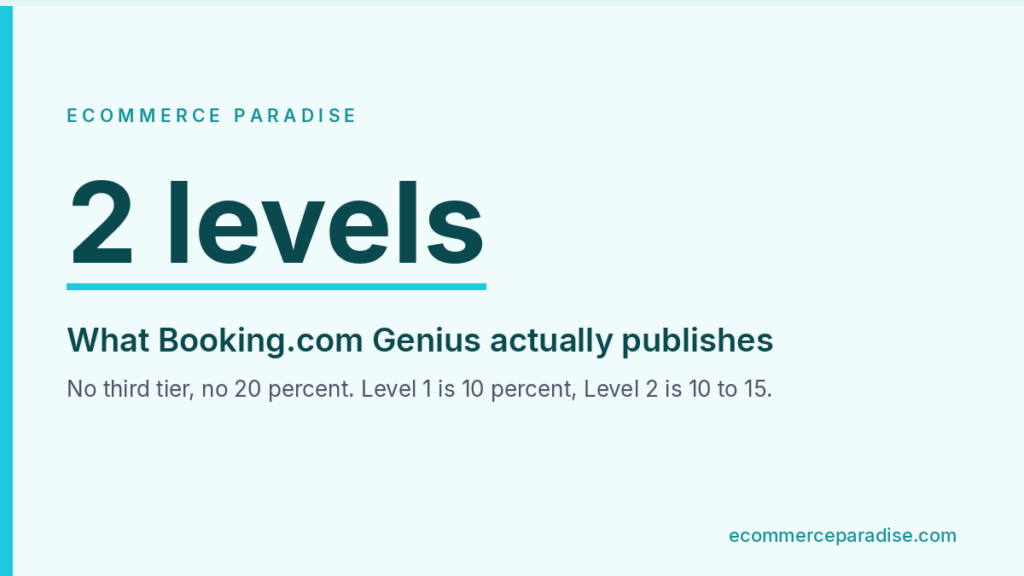
Booking.com’s Genius programme has three published levels, and an earlier version of this page wrongly said it had two. That was my error, and it is worth naming, because I removed a true claim on the grounds that I could not verify it, which is not the same thing as it being false. Booking.com publishes all three levels on its own Genius page. Level 1 activates the moment you sign in to a free account, at 10 percent off stays. Level 2 arrives after 5 bookings in 2 years, at 10 to 15 percent on stays plus free breakfast and free room upgrades on select stays. Level 3 arrives after 15 bookings in 2 years, at 10 to 20 percent on stays plus priority support. All of those discounts are applied, in Booking.com’s words, “to the price before taxes and fees”, and the levels are kept once earned. Note that Level 3 is a range topping out at 20 percent, not a flat 20 percent, and that rental car discounts stop at 10 to 15 percent even at Level 3.
Against that, Expedia’s OneKeyCash pays 1 percent at Blue, 2 percent at Silver and Gold, and 3 percent at Platinum, rising to 3, 4 and 6 percent at VIP Access stays. Those tiers are reached by collecting trip elements, not trips: one per room per completed hotel night, and one per flight ticket flown, with Blue at 0 to 4, Silver at 5 to 14, Gold at 15 to 29 and Platinum at 30 or more in a calendar year. A flight pays no OneKeyCash but still counts as a trip element and moves you up the ladder. My full Expedia pricing breakdown covers the tiers in detail. The comparison is not close for an occasional traveller: Genius Level 1’s 10 percent off the room beats Blue’s 1 percent back immediately, and even Expedia Platinum’s 3 percent does not catch Genius Level 2.
For a frequent traveller the gap does not close either, because the tops of the two ladders are not comparable. Expedia’s Platinum tier asks for 30 trip elements inside one calendar year and pays 3 percent back, while Genius Level 3, Booking.com’s highest published level, asks for 15 bookings across 2 years and takes 10 to 20 percent off the stay before taxes and fees. Booking.com’s top level is both easier to reach and worth several times more, and its discount comes off the invoice in front of you while OneKeyCash accrues as a balance to redeem on a future trip.
Price Guarantee: Booking.com Wins for Anyone Signing Up Now
There is no price guarantee in the current One Key terms, and an earlier version of this page got this wrong twice: first by saying Expedia had discontinued it on 28 July 2026, then by saying it was closed to members who joined on or after 31 October 2025. I have now read the terms document on both the Expedia and Hotels.com domains, and neither the phrase Price Guarantee nor that October 2025 date appears anywhere in either rendering. What Expedia does publish is One Key Price Drop Protection, listed as a benefit of the Gold and Platinum tiers, and the terms also show it can be purchased outright. So protection against a price drop still exists on Expedia, gated at Gold, which is 15 trip elements in a calendar year. Hotels.com does not publish it as a benefit at all. Below Gold, a refundable rate is your only real protection.
Booking.com does publish a price match. Its own terms of service, at section B7, say that if after you have booked your Accommodation with them you find the same Accommodation, with the same conditions, for less on another website, they promise to refund the difference, subject to the We Price Match terms and conditions. I could not read those detailed terms on Booking.com’s own pages, so I am not going to tell you what the claim window is or whether a non-refundable rate qualifies. The publishable position is narrow and it still favours Booking.com: it publishes a price match promise open to every member, while Expedia publishes no price guarantee at all and gates its Price Drop Protection behind the Gold tier.
Bundle and Package Deals: Expedia Wins
Expedia’s ability to bundle a flight and hotel together into a single discounted package has no real equivalent on Booking.com, which does not meaningfully combine flights with accommodation the way Expedia does. An earlier version of this page put that saving at an average of 14 percent and credited the figure to Expedia; I went looking for it on Expedia’s own pages and could not find it, so it is gone. What is published, and what matters more, is that the flight portion of a package earns no OneKeyCash at all, so a bundle that wins on price earns you less than booking the hotel alone would. For a supplier visit or conference trip needing both a flight and a hotel, the bundling is still a genuine advantage that Booking.com’s hotel first model was not built to compete with. Price both ways on your dates and compare the totals including what each earns back.
Gold Is Where the Ladder Starts to Pay
Fifteen hotel nights in a calendar year reaches Gold, where Member Prices hit 20 percent or more and Price Drop Protection applies.
Customer Service: Roughly Even
Both platforms route customer service through a third-party layer rather than the property or airline directly, and both carry documented complaints about response time and refund processing during disrupted trips. Neither platform has a decisive advantage here, and the more relevant factor for either one is booking a refundable rate whenever your plans carry any real uncertainty, since that protects you regardless of which platform’s support team you end up dealing with.
Where the two platforms diverge slightly is in how disputes get resolved when something goes seriously wrong, a canceled property, a denied boarding, a major itinerary disruption. Expedia’s involvement across flights, hotels, and packages means a single disrupted trip can touch multiple providers at once, occasionally leaving you coordinating between Expedia, the airline, and the hotel simultaneously. Booking.com’s narrower focus on accommodation means a disrupted booking usually involves just Booking.com and the property, which is a simpler two-party problem to resolve even if the resolution itself is not necessarily faster.
Cancellation Policies: Roughly Even, With Different Mechanics
Both platforms pass through the cancellation policy set by the individual property or airline rather than enforcing a single universal rule, but the mechanics differ in a way worth understanding before you book. Expedia routes changes and cancellations through its own support layer first, which can add a step compared to canceling directly, and NerdWallet’s review notes Expedia can layer its own service fees on top of a change in some cases. Booking.com’s cancellation process is generally more direct, since most listings clearly display a specific cancellation deadline at the point of booking, and canceling before that deadline through the Booking.com app or site is typically a self-service action without needing to contact support at all.
Where this distinction matters most is on a trip where your plans might change. Booking.com’s clearer self-service cancellation flow is a genuine convenience advantage for entrepreneurs whose supplier visit or conference schedule sometimes shifts on short notice, while Expedia’s bundled packages complicate cancellation further since changing one component of a package typically affects the whole booking rather than allowing an isolated change to just the flight or just the hotel.
Mobile App Experience: Roughly Even
Both mobile apps handle the core job of managing an existing booking, storing confirmation details, and sending push notifications for flight status or booking updates competently. Expedia’s app has an edge for travelers juggling a package booking, since it keeps flight and hotel details unified in a single itinerary view rather than requiring two separate confirmations to track. Booking.com’s app is generally regarded as cleaner and faster specifically for browsing and booking hotels and apartments, which lines up with its broader strength in that category throughout this comparison.
Neither app meaningfully outperforms the other enough to be a deciding factor on its own. For entrepreneurs who book primarily through mobile while traveling, the more relevant question is which platform’s core inventory and pricing already favor your specific trip, since the app experience on both is solid enough not to be the real tiebreaker between them.
Best For Specific Traveler Types
Entrepreneurs doing frequent short supplier visits with a flight involved on nearly every trip get more consistent value from Expedia, given its bundling discount and unified package management across the whole itinerary. Entrepreneurs spending extended stretches of a month or more in a single location, particularly in Southeast Asia or Latin America where Booking.com’s apartment inventory runs deepest, generally get better pricing and property selection from Booking.com instead. Entrepreneurs doing a genuine mix of both trip types across a full year are the ones most likely to end up maintaining active accounts on both platforms rather than settling permanently on a single default.
Which One Should You Actually Use
For a pure hotel or apartment stay, especially a longer one, Booking.com is generally the better starting point given its inventory depth and its published price match promise. For a flight-heavy trip or a genuine flight-and-hotel package, Expedia wins on both capability and bundle savings. Most digital nomads and online entrepreneurs end up using both platforms, defaulting to whichever one fits the specific trip rather than picking one as an exclusive default for every booking.
My broader Expedia alternatives guide covers additional options beyond Booking.com, including direct hotel booking for travelers who already hold loyalty status with a specific chain and want to weigh every reasonable option before committing.
Travel infrastructure is only one piece of running a location-independent business. See how our done-for-you builds handle the rest of it for you →
If you are still earlier in the process and have not settled on a niche or business model yet, my list of proven high-ticket niches is a better starting point before travel platform selection becomes relevant.
My guide to business formation for high-ticket dropshipping covers the legal foundation. My separate guide on finding reliable suppliers rounds it out, since supplier visits are exactly the kind of travel this comparison is meant to help you plan around.
My one-on-one coaching program is a good next step if you want the full sequencing taught directly. My free mini course is a solid no-cost starting point instead.
My full ecommerceparadise.com library covers everything else, from niche selection through supplier vetting and building a compliant business entity around it all.
Sign-Up and Account Setup: Booking.com Wins on Simplicity
Creating a Booking.com account and unlocking the automatic Level 1 Genius discount takes only a couple of minutes, with the 10 percent discount applying immediately to eligible properties on your very first search. Expedia’s OneKey enrollment is similarly quick and also free, but the meaningful earning rate only shows up once you have built enough trip history to reach Silver or Gold tier, so the practical value of signing up is felt much sooner on Booking.com than on Expedia for a brand-new account with no booking history behind it yet.
Neither platform requires a paid membership or subscription of any kind, and both are worth having an account with regardless of which one ends up being your default, since maintaining both costs nothing and keeps the option open to book through whichever platform wins for a given trip.
Running the Real Cost Comparison for a Specific Trip
The category-by-category breakdown above is a useful starting framework, but the only way to actually know which platform wins for a specific trip is running the same dates and destination through both before booking. A hotel-only stay in a market with strong Booking.com apartment inventory will frequently price lower there than on Expedia, while a flight-and-hotel package to the same destination often flips the advantage back to Expedia once the bundle discount is factored in. Treating the category breakdown as a starting point rather than a fixed rule prevents defaulting to the wrong platform out of habit on a trip where the other one would have actually saved more money.
How One Key Shifted This Comparison
One Key moved the loyalty and protection side of this comparison, and I am not dating that move. Expedia Group publishes a launch date for One Key, 17 July 2023, announced as live in the U.S. and rolling out globally starting in 2024, but it publishes no date for when any earlier rate was replaced. I am also not going to tell you what Expedia paid before One Key, because I have not found a published figure for it, and an earlier version of this page asserted a flat 2 percent that I cannot source. What is published is where things stand now: a tiered 1 percent to 3 percent on accommodation, rising to 3, 4 and 6 percent at VIP Access stays for Silver, Gold and Platinum; no OneKeyCash on flights, though a flown ticket still earns a trip element toward your tier; and no price guarantee in the terms at all, with One Key Price Drop Protection available instead as a Gold and Platinum benefit. Against that, Booking.com’s automatic Genius discount and its published price match promise have picked up real ground, while Expedia’s bundling and price transparency advantages are untouched. If you settled on a default before One Key, the loyalty half of that decision is worth revisiting.
It is worth being direct about what did not change in this comparison too. Expedia’s bundling advantage on flight-and-hotel packages was never tied to the OneKey program in the first place, so that specific strength survived the overhaul completely intact. Booking.com’s apartment and long-stay inventory depth similarly has nothing to do with either platform’s loyalty program mechanics. The One Key change shifted the loyalty and protection columns of this comparison specifically, without touching the core inventory and booking-type strengths that were already differentiating these two platforms well before it happened.
Check Both on Your Own Dates
Genius wins on the room discount and Expedia wins on bundles. The only comparison that counts is the one on your dates.
Frequently Asked Questions
Is Expedia or Booking.com better for hotels specifically?
Booking.com generally has deeper hotel and apartment inventory, particularly for longer stays and in Southeast Asia, Eastern Europe, and Latin America. Expedia’s clearest advantage remains full price transparency shown upfront in search results rather than added at checkout.
Does Booking.com have a price guarantee like Expedia used to?
Booking.com publishes a We Price Match promise in its own terms of service, which says that if you find the same accommodation with the same conditions for less on another website after booking, it will refund the difference, subject to the We Price Match terms and conditions. I could not read those detailed terms on Booking.com’s own pages, so I am not quoting a claim window or telling you which rates qualify. Expedia does not publish a price guarantee at all any more. I read the One Key terms on both the Expedia and Hotels.com domains and the phrase Price Guarantee does not appear in either. An earlier version of this answer said the guarantee was closed to members who joined on or after a date in October 2025; that rule is not on either page and I should not have published it. What Expedia does publish is One Key Price Drop Protection, as a Gold and Platinum tier benefit, which the terms show can also be bought outright.
Which loyalty program is worth more, OneKeyCash or Genius?
For occasional travelers, Genius wins clearly since its 10 percent base discount applies automatically with no stay history required at all, versus OneKeyCash’s 1 percent Blue tier rate. At the top of each ladder Genius still wins. Level 3, Booking.com’s highest published level, needs 15 bookings in 2 years for a discount of 10 to 20 percent off the stay before taxes and fees, while Expedia’s Platinum tier needs 30 trip elements in a single calendar year to pay 3 percent back.
Can I book flights on Booking.com the way I can on Expedia?
Technically yes, but Booking.com’s flight search is secondary to its hotel business with narrower airline coverage and fewer filtering options. Expedia remains the meaningfully stronger choice for flights and for any genuine flight-and-hotel package.
Should I just pick one platform and stick with it?
No, that is generally the wrong instinct. Most experienced travelers use both, defaulting to Booking.com for apartment-style long stays and to Expedia for flights and genuine flight-and-hotel packages, checking both before confirming any significant booking regardless of habit.
Did the One Key change make Booking.com the better overall platform?
Not entirely, and it depends heavily on the trip. Booking.com gained real ground specifically on loyalty value and price protection, but Expedia’s bundling and price transparency advantages were unaffected and remain genuinely strong reasons to use it for the right trip type.
Related Articles
Expedia Review 2026: The Full Breakdown
Expedia Pricing 2026: What It Actually Costs
7 Best Expedia Alternatives in 2026
Hotels.com vs Booking.com Compared
Best Travel Booking Platforms for Digital Nomads

Trevor Fenner is an ecommerce entrepreneur and the founder of Ecommerce Paradise, a platform focused on helping entrepreneurs build and scale profitable high-ticket ecommerce and dropshipping businesses. With over a decade of hands-on experience, Trevor specializes in high-ticket dropshipping strategy, niche and product selection, supplier recruiting and onboarding, Google & Bing Shopping ads, ecommerce SEO, and systems-driven automation and scaling. Through Ecommerce Paradise, he provides free education via in-depth guides like How to Start High-Ticket Dropshipping, advanced training through the High-Ticket Dropshipping Masterclass, and fully done-for-you turnkey ecommerce services for entrepreneurs who want a faster, more hands-off path to growth. Trevor is known for emphasizing sustainable, real-world ecommerce models over hype-driven tactics, helping store owners build scalable, sellable, and location-independent brands.

Still deciding what to sell?
Grab the free list of 1,000+ niches that work for high-ticket dropshipping, sorted by category.
Free. Unsubscribe any time.


