

Most brand systems stop at the edge of the screen. The logo has a clear-space rule, the palette has hex and Pantone values, and then a hoodie for a pop-up or a run of branded tees for your team gets ordered from whoever answered the email first. At Ecommerce Paradise I have spent 15 years building ecommerce brands, and branded apparel is a brand asset like any other, which means it deserves the same specifications and the same scrutiny you would give a homepage hero. If you are still deciding what kind of store to build in the first place, my guide to high-ticket dropshipping covers the model, but this piece is about protecting the brand once you have one.
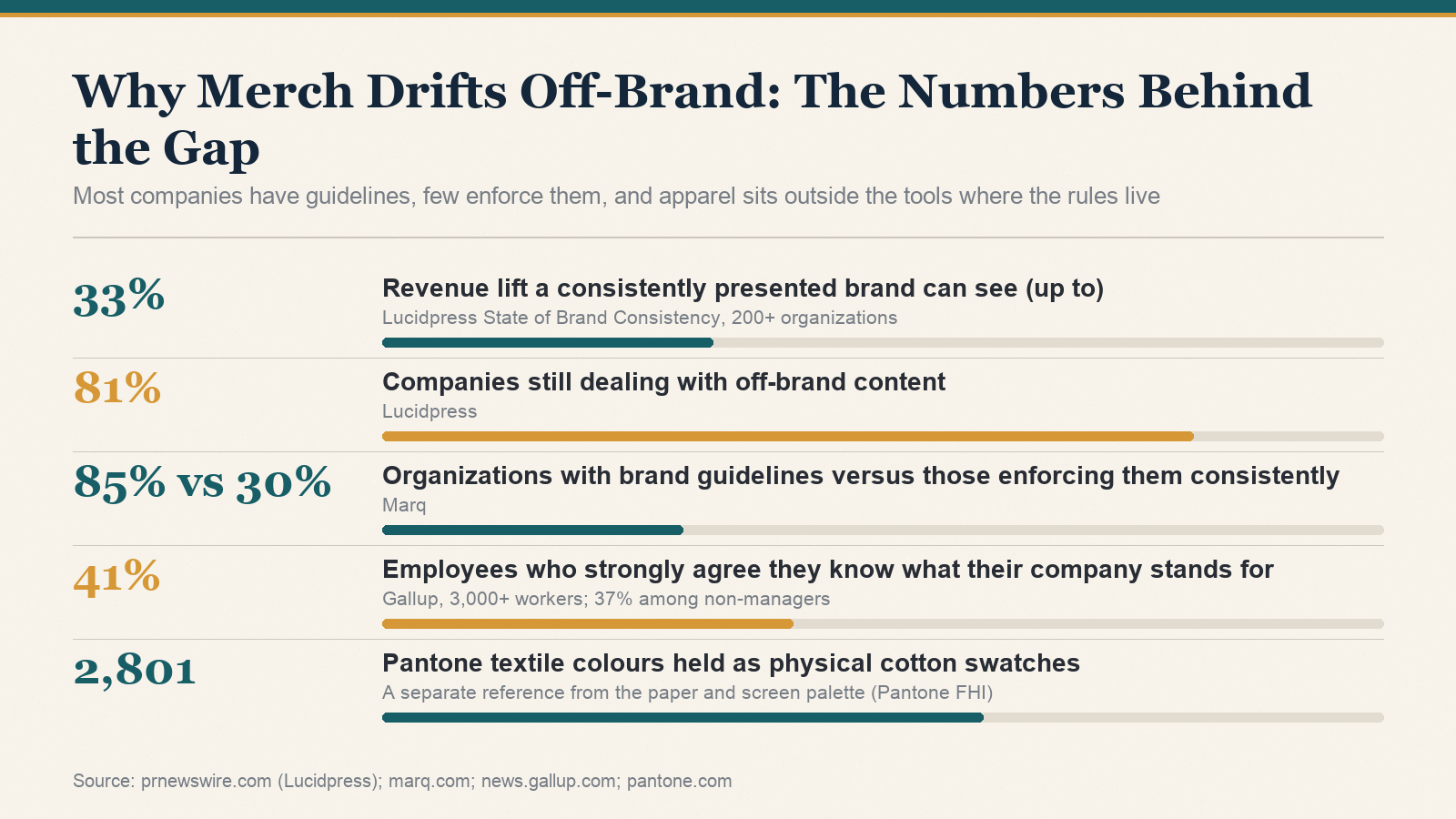
That argument gets easier to make with numbers attached. Lucidpress’s State of Brand Consistency report found that consistent presentation can lift revenue by as much as 33%, while 81% of the companies surveyed still deal with off-brand content (Lucidpress via PR Newswire). Merch is one of the easiest places for that off-brand content to appear because it sits outside the design tools where your rules live. The teams that get this right treat a supplier like R&P Prints branded apparel programs as an extension of the brand system, with proofs signed off the same way a campaign asset would be.

Affiliate disclosure: some links in this article are affiliate links and I may earn a commission at no cost to you. It does not change which tools I recommend or what the research found.
What this means if you put your brand on apparel:
- Branded apparel is a brand touchpoint, and the consistency-to-revenue research applies to a hoodie as much as a landing page.
- Merch drifts off-brand at predictable points: ink and thread conversions, garment colour, scale, low-resolution files and vendors nobody briefed.
- A one-page merch section in your guidelines, plus the proof sign-off you already use for campaign assets, closes most of the gap.
- Your production partner should show a physical proof, a documented colour match and a written tolerance before anything goes to press.
The Five Places Merch Drifts Off-Brand at a Glance
Before the detail, here is the quick map I walk store owners through. Five conversion points sit between the file on a designer’s screen and the garment in a customer’s hands, and each one drifts for its own reason.
| Where it drifts | Why it happens | The fix to write down |
|---|---|---|
| Colour conversion | Screen and paper values do not translate to dye or thread | Pantone, a textile cotton reference, and named thread colours, each with a tolerance |
| Garment colour | The same ink reads differently on white, grey and navy | Approved garment colours per logo version, plus the underbase rule for dark fabric |
| Scale and clear space | Fine strokes fill in or vanish at chest and sleeve sizes | Minimum logo sizes and clear space in millimetres |
| Typography and files | Vendors trace a JPEG and invent letterforms | Vector files with type converted to outlines, from one source |
| Vendors nobody briefed | Anyone can order apparel from any file | One owner, one download location, one approval step |
Why Apparel Deserves the Same Rules as Your Logo
A logo on a chest is seen at closer range and for longer than a logo in a banner ad, because people wear it for a full day and event photos keep it in circulation for years. Gallup found that only 41% of employees strongly agree that they know what their company stands for and what makes its brand different, and the figure drops to 37% among staff who are not managers or executives (Gallup). Those are the people wearing the polo, and apparel that does not match the brand they see on the website teaches them that the rules are optional.
Guidelines alone will not fix this. Marq reports that 85% of organizations have brand guidelines while only 30% enforce them consistently, and respondents in the same research estimated that a consistently maintained brand would be worth a 10 to 20% increase in overall growth (Marq). Enforcement is where merch usually falls through, because nobody assigned it an owner.
For an ecommerce brand the stakes are the same, just pointed at a different audience. The person wearing your branded tee at a trade show, the influencer you shipped a hoodie to, and the customer who got a branded cap in the box are all walking billboards. If the red on the cap is not the red on your product pages, you have quietly taught everyone who sees it that your brand is approximate.
Where Merch Breaks the Brand System
Five conversion points sit between the file on a designer’s screen and the garment in someone’s hands, and each one can drift on its own. Here is what goes wrong at each, and the rule that stops it.
Colour Conversion
Your palette lives as hex, CMYK and Pantone Matching System values built for paper and screens. Textiles use a different reference entirely, because dye behaves differently on fibre than ink does on coated stock. Pantone’s Fashion, Home + Interiors system holds 2,801 colours as physical cotton swatches for exactly this reason (Pantone), and embroidery adds another translation from swatch to a thread manufacturer’s chart.
If your brand colours only live in a founder’s head or a single Canva file, this is the moment they get lost. I keep every store’s palette, including the textile and thread references, in a shared Canva brand kit so the exact values travel with every merch order instead of getting eyeballed by whoever places it.
Garment Colour
The same ink reads differently on white, heather grey and navy, and a brand red printed without an underbase on a dark shirt comes out muddy. Your guidelines already say which logo version goes on light and dark backgrounds, so extend that rule to fabric and name the garment colours the palette is approved to sit on.
Scale and Clear Space
A wordmark that works at 1,200 pixels wide has to survive at 90 millimetres on a left chest and at 30 millimetres on a sleeve. Fine strokes fill in when screen printed and disappear when embroidered, while clear space gets eaten by seams and plackets. Test your mark at the real finished size before you approve it, not at the size it looks good on a monitor.
Typography and Files
Vendors frequently receive a JPEG pulled from a slide deck, then trace it. Tracing changes letterforms and invents kerning that your type designer never approved, which vector files with outlined type would have prevented. If you do not have a clean vector version of your mark yet, commissioning one through a service like 99designs is cheaper than the reprints a traced logo eventually causes. For a quick one-off file cleanup or an outlined export, a freelancer on Fiverr can turn a raster logo into a print-ready vector in a day.
Vendors Nobody Briefed
Regional teams, event staff and even an eager customer-service lead all order apparel, and most of them have never opened the brand portal. An uncontrolled vendor interprets the brand from whatever file they were sent. The fix is ownership: one person holds the merch standards and signs off every order. On a lean ecommerce team that owner is often a virtual assistant, and hiring one through OnlineJobs.ph to manage the brand portal and approvals costs a fraction of one botched print run.
Would rather have a team build the whole brand and store for you, with the assets organized from day one? See how my done-for-you store service works →
How to Write Merch Into Your Guidelines and Approval Workflow
A merch section does not need to be long, and one page covering these points resolves most of the drift described above.
- Colour targets in three forms: Pantone for print, the textile cotton reference for dyed goods, and named thread colours for embroidery, each with an acceptable tolerance.
- Approved garment colours per logo version, with the underbase rule for dark fabric.
- Minimum logo sizes and clear space for print and embroidery, stated in millimetres.
- Required file formats, a single download location, and who approves a physical proof.
Tolerance is the piece most guidelines skip. Colour scientists at X-Rite explain that the naked eye starts to notice a difference at roughly a Delta E of 1, and that a Delta E of 3 or even 5 may be acceptable for a billboard while small assembled parts fail inspection beyond 1 (X-Rite). A fleece sits somewhere between those two, but a tolerance that is not written down defaults to whatever the vendor is comfortable with.
The approval workflow should mirror the one you already run for campaign assets. The brief goes out with the merch page attached, the vendor returns a digital mockup for placement and a physical sample for colour, and the same person who signs off on print collateral signs off here. Keep the whole standard in one place your team can actually reach, whether that is a shared drive folder or the brand kit in your design tool, so nobody has an excuse to work from an old file.
What to Require From a Production Partner
The partner you choose determines how much of this you can enforce. Ask for a physical proof rather than a screen render, since a screen cannot show you thread sheen or ink opacity. Ask how they document a colour match, and ask whether screen printing and embroidery happen under one roof, because a single supplier handling both can keep the same brand red consistent across a printed tee and an embroidered polo.
This is the same vetting discipline you use for product suppliers, and it pays off the same way. My step-by-step guide to finding and vetting suppliers is built around high-ticket products, but the questions transfer cleanly to a merch printer: can they document quality, will they show you proof before they commit, and do they treat your standards as requirements rather than suggestions.
A partner that can answer those questions is already operating like part of your brand system. Merch is the one brand asset people put on their bodies, so hold it to the same standard as the logo it carries.
Want a second set of eyes on your brand system before your next print run? Book a coaching call and we will tighten it up together →
Where Branded Merch Fits in an Ecommerce Brand
For a store owner, merch is rarely the main product, but it is one of the clearest signals of whether a brand is built to last. A consistent cap or tee tells a customer the same thing a clean, fast product page does: this is a real brand, run by people who care about details. That signal matters most in niches where buyers are spending real money, which is exactly why I push people toward my high-ticket niches list before they pick what to sell, because a strong brand on a commodity nobody wants is still a store nobody buys from.
If you decide to sell branded merch as actual products rather than just giveaways, keep the storefront as disciplined as the apparel. Most of my clients run that on Shopify because its theme sections make it easy to keep product imagery, colours and type consistent with the rest of the brand. A clean, conversion-focused theme such as Superstore keeps the storefront on-brand without a custom build, so the shirt and the page it sells on finally match.
The same consistency applies to how your brand shows up in search and on other channels, not just on fabric. I use SEMrush to watch how the brand name appears across listings and competitors, since the goal is one coherent brand everywhere a customer meets it. And before you pour money into any of this, get the legal and financial base right: my business formation checklist covers the entity and trademark groundwork that actually protects the brand you are busy keeping consistent.
Want to learn the whole high-ticket system, brand and store and supply chain together? The Ecommerce Paradise Academy comes with lifetime access and private coaching calls, and it is where I answer questions directly. Join the community →
Frequently Asked Questions
Should Brand Guidelines Specify a Pantone Colour for Apparel?
Yes, but specify it alongside a textile reference, since a Pantone Matching System value built for paper will not translate directly to dyed cotton or thread. Give your vendor both and state the tolerance you will accept.
Who Should Approve Merch Before It Goes Into Production?
The same person or team that approves campaign assets, working from a physical proof. Treating apparel approval as a procurement task rather than a creative one is how off-brand merch gets ordered.
What File Should You Send a Screen Printer or Embroiderer?
A vector file with type converted to outlines, pulled from the brand portal. Sending a JPEG or a screenshot means the vendor has to redraw the mark, and redrawn marks rarely match. If you only have a raster logo, get a proper vector built before you order, not after the first run comes back wrong.
Can I Use the Same Logo File for Screen Printing and Embroidery?
Start from the same vector master, but expect embroidery to need its own setup. Screen printing reproduces fine detail that embroidery cannot, because thread has a minimum stitchable width and small text turns into a lump. A good embroiderer will simplify the mark into a digitized stitch file and match your named thread colours, and you should approve that version separately from the printed one. Keep both files in the same folder as your print master so the next order does not start from scratch.
How Do I Keep Merch On-Brand When Different People Order It?
Give one person the final say and one place to pull files from. Most off-brand merch happens because an event lead or a new hire grabbed whatever logo they could find and emailed a vendor directly. When every order has to go through the same owner, the same file location and the same proof sign-off, the drift stops, even on a small team where that owner is wearing three other hats.
Is Branded Merch Worth It for a Small Ecommerce Store?
Yes, when it is consistent, because a branded cap in the box or on a founder at an event is cheap reach that reinforces the brand customers already saw online. It stops being worth it the moment the colours or logo drift, since off-brand merch quietly signals that the brand is careless, which is the opposite of what a high-ticket buyer wants to see.
Branded apparel is one of the easiest brand assets to get right once you treat it like an asset. Write the one-page merch section, give it an owner, demand a physical proof, and hold your production partner to a written tolerance. Do that and the hoodie, the cap and the homepage finally tell customers the same story. If you want help building the brand and the store underneath it, that is exactly what I do.
New to all of this and want the fundamentals first? Grab my free high-ticket dropshipping mini course →
Related Articles
If you found this useful, these guides go deeper on related topics:
- Smart Ways to Create Stronger Brand Displays for Digital Retail
- Best AI Logo Generators: 7 Compared on Price, Files and Ownership
- How to Build a Fashion Clothing Brand with Dropshipping
- 5 Best Branding and Design Agencies for 2026
- How Branded Challenge Coins Support Better Branding at Events

Trevor Fenner is an ecommerce entrepreneur and world traveler from Seattle, Washington, and the founder of Ecommerce Paradise, a platform focused on helping entrepreneurs build and scale profitable high-ticket ecommerce and dropshipping businesses. With over a decade of hands-on experience, Trevor specializes in high-ticket dropshipping strategy, niche and product selection, supplier recruiting and onboarding, Google & Bing Shopping ads, ecommerce SEO, and systems-driven automation and scaling. Through Ecommerce Paradise, he provides free education via in-depth guides like How to Start High-Ticket Dropshipping, advanced training through the High-Ticket Dropshipping Masterclass, and fully done-for-you turnkey ecommerce services for entrepreneurs who want a faster, more hands-off path to growth. Trevor is known for emphasizing sustainable, real-world ecommerce models over hype-driven tactics, helping store owners build scalable, sellable, and location-independent brands.
He maintains homes in Seattle and Bali, spends most of the year overseas, and usually returns to Seattle for about a month each summer.


