


Most Shopify store owners lose more sales to unanswered questions than they realize. A visitor lands on a product page at 11pm on a Saturday. They have a question about shipping time, compatibility, or a product spec. Your email auto-responder won’t reply until Monday. You have no live agent online. The visitor leaves. In high-ticket ecommerce, where a single conversion might represent $1,000 to $5,000 in revenue, that lost sale is not a rounding error. It is a meaningful hit to your monthly results.
AI chatbots solve this problem by maintaining a responsive, knowledgeable presence on your store 24 hours a day, seven days a week. The best Shopify chatbot apps in 2026 go well beyond scripted FAQ responses. They learn from your product catalog, store policies, and past customer conversations. They answer pre-purchase questions with accuracy. They look up order status in real time. They recover abandoned carts with personalized follow-up. They handle refund and return inquiries. And when a question exceeds their capability, they escalate seamlessly to a human agent rather than leaving the customer without an answer. This is exactly the gap we help close at Ecommerce Paradise.
For ecommerce entrepreneurs running high-ticket dropshipping stores, customers buying $800 electric bikes or $2,000 generators need real assurance before converting. A well-configured chatbot is one of the highest-leverage tools available: it reduces the number of sales that die in silence and compresses the gap between a visitor’s question and a confident purchase decision.
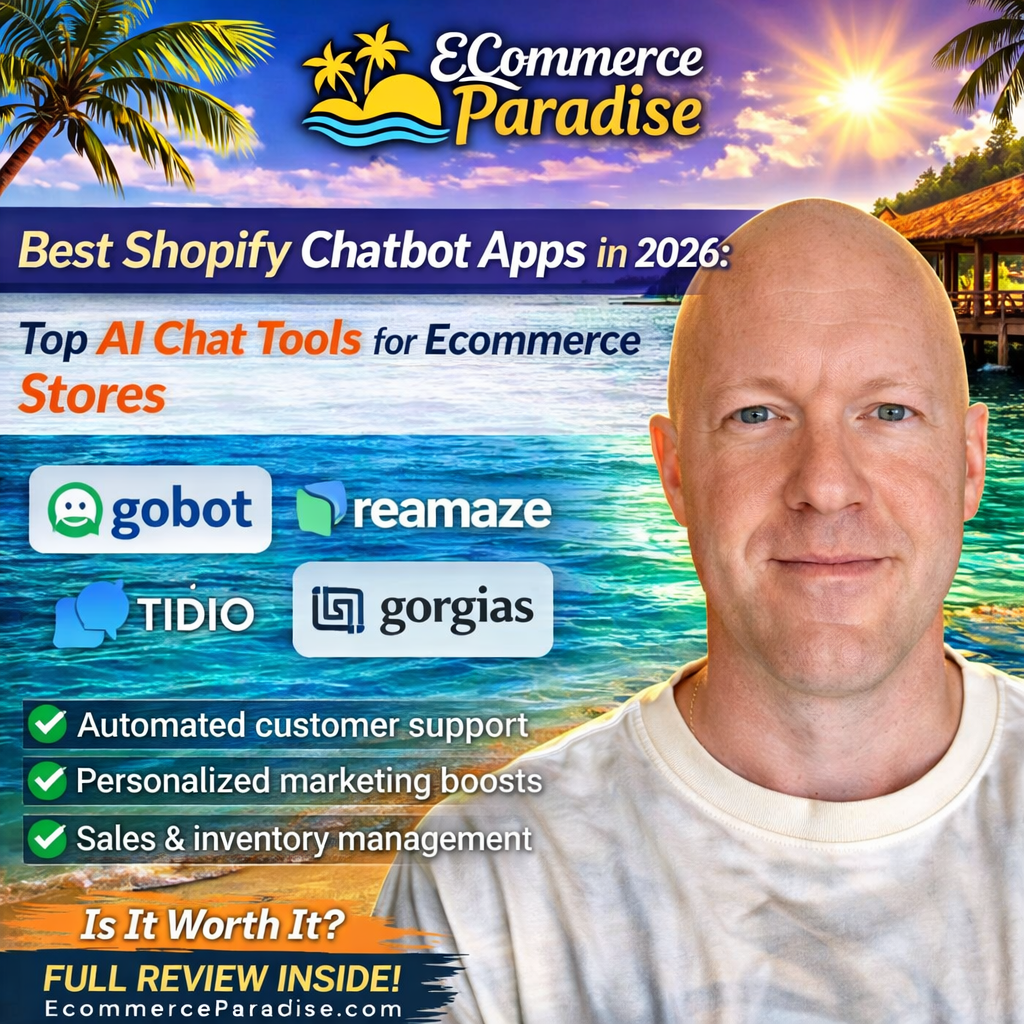
This guide covers ten of the best Shopify chatbot apps in 2026, evaluated on Shopify integration depth, AI accuracy, ease of setup, pricing value, sales and support capability, and fit for different store sizes. Here is a quick look at every app covered:
- Tidio: Best all-in-one chatbot for small to mid-size Shopify stores
- Gorgias: Best full helpdesk with chatbot for high-volume stores
- SmartBot: Best dedicated Shopify AI chatbot with generous free plan
- Re:amaze: Best multichannel support with predictable per-user pricing
- Juphy AI: Best budget-friendly chatbot for catalog-driven product discovery
- VanChat: Best sales-first AI chatbot for conversion optimization
- Richpanel: Best for customer self-service and order management automation
- Yuma AI: Best AI layer for stores already using Gorgias or Zendesk
- Intercom Fin: Best for hybrid SaaS and ecommerce operations
- Gobot: Best for quiz-based product discovery and lead capture
Want your Shopify store’s customer experience built right from day one, chatbot included? Our done-for-you store build → sets up the tools that close 10pm sales gaps before you ever open your doors.
Why Shopify Chatbots Matter More for High-Ticket Stores
The High-Ticket Pre-Purchase Problem
Customers buying a $50 product often purchase without asking questions. Customers buying a $1,500 product almost always have questions before they buy, about shipping timelines, product specifications, compatibility with their existing setup, return policy, and warranty coverage. In high-ticket dropshipping, where customers are making the largest purchases many of them make outside of housing and vehicles, the pre-purchase question gap is the single biggest reason well-trafficked stores underperform on conversion.
A chatbot trained on your full product catalog, shipping policy, return terms, and supplier lead times answers these questions immediately, at any hour, with accuracy. The conversion improvement from closing this gap is often more significant for high-ticket stores than for lower-priced stores where impulse purchases are the norm.
What Shopify Chatbots Actually Do
The best Shopify chatbot apps in 2026 cover four functional areas simultaneously:
Pre-purchase support: Answering product questions, comparing products, explaining shipping timelines, confirming specifications, and overcoming objections before they prevent conversion.
Post-purchase support: Order status lookups, tracking information, shipping delay responses, return initiation, and refund policy explanations, all automatically, without a human agent.
Sales assistance: Product recommendations based on stated preferences, abandoned cart recovery, discount code delivery to hesitant shoppers, and upsell suggestions based on cart contents.
Escalation and handoff: Routing complex or sensitive conversations to a live human agent when the chatbot cannot provide an adequate answer, with full conversation context preserved so the agent does not start from scratch.
What to Look For in a Shopify Chatbot App
Native Shopify Data Integration
The most important capability of a Shopify chatbot is how deeply it connects to your store’s data. A chatbot that reads your product catalog, live inventory, order history, shipping status, and store policies provides dramatically better answers than one that operates off a static FAQ document you uploaded during setup. Look for apps that sync with Shopify in real time, so when a product sells out or a price changes, the chatbot knows immediately.
AI Quality and Training
The gap between rule-based chatbots (scripted flow trees) and AI-powered chatbots (natural language understanding) is significant. Rule-based bots handle exactly the questions they were programmed for and fail on anything else. AI-powered bots handle variations, follow-up questions, and unscripted queries with contextual understanding. For a high-ticket store where customers ask complex, product-specific questions, AI quality determines whether the chatbot helps or frustrates.
Human Escalation Quality
A chatbot that cannot answer a question gracefully and hands off to a human agent cleanly is valuable. One that loops customers in unhelpful automated responses when it is stumped actively damages the customer experience. The escalation pathway (how the bot recognizes its limits, how it transfers context, and how quickly a human agent receives the conversation) is as important as the chatbot’s AI capability.
Pricing Structure Predictability
Some chatbot apps price by ticket volume (Gorgias), some by conversation count (Tidio’s Lyro AI add-on), and some by flat monthly fee. For high-ticket stores with lower transaction volume but higher stakes per conversation, flat-fee pricing is generally more predictable and cost-effective than volume-based billing that can spike unexpectedly during busy periods.
The Best Shopify Chatbot Apps in 2026
1. Tidio: Best All-in-One Chatbot for Small to Mid-Size Shopify Stores
Tidio is the most widely deployed chatbot app among small to mid-size Shopify stores, with over 300,000 businesses using the platform. Its combination of visual chatbot flow builder, Lyro AI agent, live chat inbox, and email integration makes it the most complete entry-level customer communication platform available. The visual flow builder enables non-technical store owners to create custom conversation paths without coding, while Lyro AI handles unscripted questions using natural language processing trained on the store’s product and policy data.
Lyro AI Agent
Lyro is Tidio’s conversational AI agent that automatically resolves repetitive customer questions (order tracking, shipping policy, return procedures, product specifications) without a human agent’s involvement. Lyro can automate up to 67 percent of repetitive conversations according to Tidio’s own data. For high-ticket stores receiving consistent pre-purchase questions about product specs and shipping timelines, Lyro’s automation reduces response time from hours to seconds.
Shopify Integration
Tidio’s dedicated Shopify integration allows chatbot triggers based on what products a customer is browsing, enables product card recommendations inside chatbot messages, and tracks how chatbot conversations affect sales conversion. This data visibility helps store owners understand which chatbot conversations are contributing to revenue and which product pages generate the most questions.
Pricing
Tidio’s base plan starts at $29 per month for live chat and basic chatbot functionality. Lyro AI is a separate add-on starting at $39 per month for 50 conversations, with higher tiers for greater volume. For stores with moderate chat volume, the combined cost is reasonable. For high-volume stores, per-conversation billing can become expensive relative to flat-fee competitors.
Pros:
- Most popular Shopify chatbot, 300K+ businesses, large knowledge base
- Visual flow builder requires no coding knowledge
- Lyro AI automates up to 67% of repetitive conversations
- Product card recommendations inside chat messages
- Free plan available for stores starting out
- Integrates with Instagram, Facebook Messenger, Zapier
Cons:
- Lyro AI is a separate paid add-on on top of base plan
- Per-conversation billing on Lyro can become expensive at high volume
- Lyro and rule-based Flows cannot run simultaneously on the same widget
- More setup required for high-ticket product-specific training
Quick Specs:
- Free Plan: Yes (limited chatbot and live chat)
- Paid Plans: From $29/month; Lyro AI from $39/month add-on
- Shopify Rating: 4.7/5 stars
- Best For: Small to mid-size Shopify stores wanting chatbot + live chat in one platform
2. Gorgias: Best Full Helpdesk with Chatbot for High-Volume Stores
Gorgias is the gold standard full-service ecommerce helpdesk, used by over 16,000 Shopify merchants. It centralizes email, live chat, social media DMs, and SMS into a single dashboard with the deepest native Shopify integration available: agents can view order details, issue refunds, cancel orders, and apply discounts without leaving the Gorgias interface. Its AI Automate feature handles common intents (order tracking, return initiation, shipping policy questions) by pulling live data directly from Shopify to generate accurate, automated responses.
Shopify Integration Depth
Gorgias’s Shopify integration is more comprehensive than any pure chatbot app. Order data, customer purchase history, product details, and discount codes are all accessible within the support interface, enabling agents and AI to provide personalized responses without switching systems. For stores with a meaningful support volume where context matters (knowing a customer’s order history before responding), this integration depth is a meaningful operational advantage.
Pricing Consideration
Gorgias prices by ticket volume, starting at $10 per month for 50 tickets and scaling upward. AI Automate capabilities are an additional cost on top of the base plan. For high-ticket dropshipping stores where support volume is relatively low but each interaction is high-stakes, Gorgias can be cost-effective at lower ticket tiers. Stores with high support volume should model the per-ticket cost carefully before committing.
Pros:
- Deepest native Shopify integration in the category
- Centralizes email, chat, social, and SMS in one dashboard
- AI Automate handles order tracking and returns with live Shopify data
- Intent and sentiment detection for smarter routing
- 16,000+ Shopify merchants, most proven ecommerce helpdesk
- Excellent reporting and team performance analytics
Cons:
- Ticket-volume pricing can become expensive at scale
- AI Automate is an additional cost on top of base plan
- Overkill for solo operators or low-support-volume stores
- Steeper learning curve than dedicated chatbot apps
Quick Specs:
- Starting Price: $10/month (50 tickets); scales by volume
- No Free Plan: Trial only
- Best For: Mid to large Shopify stores with meaningful support volume needing full helpdesk + chatbot
3. SmartBot: Best Dedicated Shopify AI Chatbot with Generous Free Plan
SmartBot is a Shopify-native AI chatbot built specifically for ecommerce stores, learning from your product pages, store policies, and order data to provide 24/7 context-aware support and personalized product recommendations. Its free plan is one of the most generous in the Shopify App Store for a full-featured AI chatbot, making it the strongest starting point for new stores that want AI-powered chat without an immediate monthly commitment.
Catalog-Trained Responses
SmartBot automatically ingests your Shopify product catalog, store pages, and policies during setup, enabling it to answer product-specific questions without manual configuration of every possible question. For high-ticket stores with detailed product specifications across many SKUs, this automatic catalog learning significantly reduces setup time compared to apps that require manual FAQ entry.
Sales Automation
Beyond support, SmartBot includes product recommendation logic that suggests relevant items based on conversation context, cart contents, and customer browsing behavior. For stores with complementary product lines, these in-chat recommendations can increase average order value.
Pros:
- Strong free plan for Shopify stores starting with AI chat
- Automatic catalog and policy learning during setup
- Product recommendations and upsell suggestions inside chat
- Order tracking lookup within chat
- Easy setup, well-reviewed in the Shopify App Store
- Analytics on chatbot performance and conversion impact
Cons:
- Less sophisticated than enterprise helpdesk platforms like Gorgias
- Limited multi-channel capability (primarily on-site chat)
- Human escalation features less polished than dedicated helpdesk tools
- Newer platform with shorter track record than Tidio or Gorgias
Quick Specs:
- Free Plan: Yes
- Paid Plans: Available (check Shopify App Store for current pricing)
- Shopify App Store Rating: 4.6+/5
- Best For: New stores wanting AI chat with no upfront cost
4. Re:amaze: Best Multichannel Support with Predictable Per-User Pricing
Re:amaze is a multichannel customer messaging and helpdesk platform built specifically for ecommerce brands, combining email, live chat, social media messaging, and SMS into a single unified inbox with native Shopify, WooCommerce, and BigCommerce integrations. Its strongest differentiator relative to Gorgias is predictable per-user pricing ($29 to $69 per user per month) rather than ticket-volume pricing, meaning your monthly bill stays flat whether you handle 500 or 5,000 conversations, which suits high-ticket stores with unpredictable support volume patterns.
Shopify Order Lookup in Chat
Re:amaze’s Shopify integration pulls order details, customer history, and product information into the support interface, allowing agents and automated workflows to provide specific, accurate responses to order-related questions. The platform’s smart automation workflows trigger chatbot responses based on customer intent, reducing the volume of questions that require human attention.
Multi-Brand Management
Re:amaze supports managing multiple stores or brands from a single account at no additional per-brand cost, making it practical for ecommerce operators running multiple Shopify stores simultaneously.
Pros:
- Predictable per-user pricing (no ticket-volume billing surprises)
- Unified inbox for email, chat, social, and SMS
- Native Shopify order lookup and customer data in chat
- Multi-brand management from one account
- Chatbot automation included on lower-tier plans
- 14-day free trial
Cons:
- AI capabilities less advanced than purpose-built AI chatbot tools
- Per-user pricing becomes expensive for larger teams
- Help center customization is limited
- Search functionality within the platform is weaker than competitors
Quick Specs:
- Starting Price: $29/user/month
- Free Trial: 14 days
- Best For: Multi-channel stores wanting predictable pricing and Shopify-native order management
5. Juphy AI: Best Budget-Friendly Chatbot for Catalog-Driven Product Discovery
Juphy AI is a simple, affordable Shopify chatbot that syncs directly with your product catalog and FAQ content to handle product discovery questions, recommendations, and basic support. Its one-click setup from the Shopify admin makes it the fastest to deploy of any app on this list, and its flat-rate pricing starting at $19 per month provides cost certainty for stores watching their tool budget carefully.
Product Discovery Focus
Juphy’s strength is catalog-driven product recommendations. Customers can describe what they are looking for conversationally: “I need something for off-road trails under $1,500,” and the chatbot filters your product catalog to surface relevant options. For high-ticket stores with diverse product lines where navigating from the homepage to the right product involves multiple clicks, this conversational discovery reduces friction and increases the likelihood of finding the right product quickly.
Pros:
- One-click setup from Shopify admin
- Affordable flat-rate pricing from $19/month
- Real-time catalog sync for accurate product recommendations
- Instagram DM integration for social commerce
- Multiple language support
- Smart pop-ups to initiate conversations proactively
Cons:
- Less AI sophistication than Tidio’s Lyro or Gorgias’s AI Automate
- Limited reporting and analytics depth
- No full helpdesk functionality
- Best for stores primarily focused on product discovery, not full support automation
Quick Specs:
- Starting Price: $19/month (Starter)
- Plans: $19 / $49 / $99 per month
- Best For: Small stores wanting affordable catalog-driven chatbot
6. VanChat: Best Sales-First AI Chatbot for Conversion Optimization
VanChat is an AI-first shopping assistant built specifically to drive sales rather than manage support. It focuses on buyer intent analysis, reviewing chat history and browsing behavior to proactively suggest products and handle objections before they prevent conversion. Unlike support-focused chatbots that reactively answer questions, VanChat initiates conversations based on customer behavior signals (time on page, scroll depth, cart activity) with personalized outreach timed to maximize conversion impact.
Proactive Sales Engagement
VanChat’s trigger system initiates conversations at strategic moments: when a visitor spends extended time on a product page without adding to cart, when a customer has items in their cart but has not checked out, or when a return visitor lands on a product they viewed before. For high-ticket stores where hesitation is the primary conversion barrier, proactive engagement at the right moment can meaningfully shift outcomes.
Pros:
- Sales-first architecture designed to drive conversions, not just answer questions
- Buyer intent analysis initiates conversations proactively
- Abandoned cart recovery built into the chat workflow
- Strong 5.0 rating on the Shopify App Store
- Free plan available
- 24/7 AI availability with live chat fallback
Cons:
- Less mature helpdesk and support ticket features
- Aggressive proactive messaging can feel intrusive if not carefully configured
- Primarily English-focused
- Less suitable for stores where support volume is the primary concern
Quick Specs:
- Free Plan: Yes
- Paid Plans: Available (check Shopify App Store)
- Shopify Rating: 5.0/5 stars (119 reviews)
- Best For: Conversion-focused stores wanting proactive sales engagement
7. Richpanel: Best for Customer Self-Service and Order Management Automation
Richpanel is a Shopify customer support platform built around the concept of customer self-service, enabling customers to resolve their own common requests (order tracking, return initiation, address changes, cancellations) through a self-service portal without waiting for an agent. For high-ticket dropshipping stores where post-purchase support is a significant time cost (customers anxiously tracking expensive orders, asking about delays, requesting status updates), Richpanel’s self-service model deflects the majority of these requests automatically.
Self-Service Portal
Richpanel’s self-service portal allows customers to log in with their order email, view their order status, initiate returns, update shipping addresses, and access policy information without needing to contact support. This model works particularly well for high-ticket stores where post-purchase anxiety drives high support contact rates: giving customers transparent, real-time access to their order status reduces the volume of “Where is my order?” contacts substantially.
Pros:
- Self-service portal eliminates the majority of “Where is my order?” contacts
- Deep Shopify order and customer data integration
- Reduces agent workload through structured self-service flows
- Multi-channel support (email, chat, social) in one platform
- Good fit for high-ticket stores with high post-purchase contact rates
Cons:
- More focused on support deflection than sales engagement
- Higher starting price than simpler chatbot apps
- Requires meaningful setup to configure self-service flows correctly
- Less suitable for stores whose primary need is pre-purchase sales chat
Quick Specs:
- Pricing: Plans from ~$100/month and up (check current pricing)
- Best For: Stores with high post-purchase support volume wanting self-service automation
8. Yuma AI: Best AI Layer for Stores Already Using Gorgias or Zendesk
Yuma AI is not a standalone chatbot. It is an AI automation layer that plugs into the helpdesk you already use (Gorgias, Zendesk, Kustomer, Re:amaze, Front) and automates ticket resolution within that existing system. For stores that have already invested in configuring Gorgias or Zendesk and do not want to migrate, Yuma provides the AI upgrade without forcing a platform switch.
Retail-Specific Automation
Yuma’s agents are pre-configured for ecommerce workflows: processing refunds, handling exchanges, pausing subscriptions, editing orders, generating return labels, and resolving tracking inquiries, all as complete automated resolutions rather than suggested drafts for an agent to approve. This end-to-end automation capability distinguishes Yuma from AI tools that only draft responses without executing actions.
Pros:
- Works within Gorgias, Zendesk, and other helpdesks without migration
- Pre-built retail workflows for refunds, exchanges, tracking, and order edits
- End-to-end automated resolution, not just draft suggestions
- Performance-based pricing with 30-day free trial
- Integrates with both Shopify and other ecommerce platforms
Cons:
- Requires an existing helpdesk subscription to function
- Adds cost on top of your existing helpdesk
- Best value for stores already at meaningful ticket volume
- Less relevant for stores just starting with customer support tools
Quick Specs:
- Pricing: Performance-based (pay per resolved ticket)
- Free Trial: 30 days
- Best For: Stores already using Gorgias or Zendesk wanting AI automation layer
9. Intercom Fin: Best for Hybrid SaaS and Ecommerce Operations
Intercom’s Fin AI agent is a sophisticated AI support platform built primarily for SaaS companies that has expanded meaningfully into ecommerce through its Shopify integration. For operators running a hybrid business (a Shopify store alongside a digital product, online course, or software subscription), Intercom’s strength across both ecommerce and SaaS workflows makes it a natural fit where dedicated ecommerce-only tools fall short.
Fin AI Quality
Fin AI resolves customer questions using your help center content, past conversation data, and CRM context, handling approximately 50 percent or more of conversations without human intervention. Its contextual awareness across a customer’s full history (purchases, past conversations, subscription status) produces more personalized responses than tools that treat each conversation in isolation.
Pros:
- Excellent AI quality and contextual awareness
- Strong for hybrid SaaS and ecommerce businesses
- Enterprise-grade security (SOC 2, GDPR)
- Integrates with Shopify, Salesforce, HubSpot, and many others
- Proactive messaging alongside reactive support
Cons:
- Expensive, pricing based on resolution volume at scale
- Built primarily for SaaS, Shopify integration is not as native as Gorgias
- Overkill for stores that only need basic chatbot and live chat
- Complex setup requires dedicated time and technical familiarity
Quick Specs:
- Pricing: Custom/quote-based; expensive at volume
- Best For: Hybrid SaaS and ecommerce businesses, enterprise-scale Shopify operations
10. Gobot: Best for Quiz-Based Product Discovery and Lead Capture
Gobot takes a distinct approach to Shopify chatbot engagement: rather than reactive FAQ answering, it leads with interactive shoppable quizzes that guide customers through product discovery based on their stated needs, preferences, and budget. The quiz format generates higher engagement than a standard chat widget for many product categories, collecting customer preferences as structured data alongside email addresses and phone numbers for future marketing.
Quiz-Driven Commerce
For high-ticket product categories, the kind found on our high-ticket niches list, such as electric bikes (commuting vs. off-road vs. cargo), solar generators (watts needed, duration, portability), or mattresses (firmness, sleeping position, budget), the right product depends heavily on the customer’s specific use case. A guided quiz that surfaces the correct product is more effective than either a search bar or a reactive chatbot. Gobot’s quiz engine combined with its product recommendation logic produces a more curated shopping experience for high-consideration categories.
Pros:
- Quiz-based product discovery outperforms passive chat in high-consideration categories
- Collects email and phone during quiz for marketing list building
- Product recommendations based on structured quiz responses
- Abandoned cart recovery and email/SMS retargeting
- Conversion rates of up to 8.5% reported by some merchants
- Integrates with Klaviyo, Omnisend, and major email platforms
Cons:
- Quiz format requires more upfront configuration than a standard chatbot
- Less effective for stores where customers arrive knowing what they want
- Reactive support capability is secondary to sales/discovery focus
- Setup time is higher than one-click apps like SmartBot or Juphy
Quick Specs:
- Pricing: Plans vary (contact for current pricing)
- Best For: High-ticket stores where product selection requires guided discovery
Shopify Chatbot Apps Compared: Feature Breakdown
| App | Free Plan | Starting Paid | Shopify Data | AI Quality | Human Escalation | Best Use Case |
|---|---|---|---|---|---|---|
| Tidio | Yes | $29/mo + Lyro add-on | Yes, Strong | Yes, Lyro AI | Yes | Small-mid stores, chatbot + live chat |
| Gorgias | No (Trial) | $10/mo (50 tickets) | Yes, Deepest | Yes, AI Automate | Yes | High-volume stores, full helpdesk |
| SmartBot | Yes | Paid tiers | Yes, Auto-sync | Yes | Yes | New stores, quick AI chat setup |
| Re:amaze | No (14-day trial) | $29/user/mo | Yes | Yes | Yes | Multi-channel, predictable billing |
| Juphy AI | No | $19/mo | Yes, Catalog | Yes | Yes, Basic | Budget-conscious product discovery |
| VanChat | Yes | Paid tiers | Yes | Yes | Yes | Conversion and sales focus |
| Richpanel | No | ~$100/mo+ | Yes, Strong | Yes | Yes | Post-purchase self-service |
| Yuma AI | No (30-day trial) | Performance | Yes | Yes, Advanced | Yes | Gorgias/Zendesk AI add-on |
| Intercom Fin | No | Custom | Yes | Yes, Excellent | Yes | Hybrid SaaS/ecommerce |
| Gobot | No | Custom | Yes | Yes | Yes | Quiz-based product discovery |
How to Choose the Right Shopify Chatbot App
Use Case Decision Table
| Situation | Recommended App |
|---|---|
| Small store, want chatbot + live chat in one tool | Tidio |
| High support volume, need full helpdesk with AI | Gorgias |
| New store, want free AI chat immediately | SmartBot or VanChat |
| Multi-channel support, predictable monthly bill | Re:amaze |
| Tight budget, need simple product discovery bot | Juphy AI |
| Want chatbot to proactively drive conversions | VanChat |
| High post-purchase contact rate, want self-service | Richpanel |
| Already using Gorgias/Zendesk, want AI on top | Yuma AI |
| Running SaaS + ecommerce hybrid | Intercom Fin |
| High-ticket products requiring guided selection | Gobot |
For High-Ticket Dropshipping Stores Specifically
High-ticket stores have different chatbot priorities than mass-market stores. Consider these specifics:
Pre-purchase question handling. Customers buying $500 to $5,000 items need confidence before buying. Tidio (Lyro), Gorgias (AI Automate), and SmartBot are the strongest tools for this. Train whichever one you pick on full product specs, shipping timelines, warranty terms, and return policy.
After-hours coverage. High-ticket buyers do a lot of their research in the evening, and your chatbot is your only presence outside business hours. Every app on this list provides 24/7 coverage.
Human escalation quality. When a question exceeds the AI’s capability, the handoff must be clean. A fumbled escalation on a $2,000 sale loses the customer. Gorgias, Tidio, and Re:amaze handle this best.
Post-purchase anxiety management. Customers who just spent $1,500 want to know their order is on the way. Self-service order status access reduces support contact rate significantly, and Richpanel, Gorgias, and Re:amaze lead here.
Product discovery for complex catalogs. If your store has many product variants or complementary SKUs, guided discovery reduces the “I’m not sure what to buy” abandonment. Gobot, Juphy AI, and VanChat are built for exactly this.
FAQ: Shopify Chatbot Apps
Q1: Do Shopify chatbots actually improve conversion rates for high-ticket stores?
Yes, particularly for pre-purchase question handling and after-hours coverage. The primary conversion barrier in high-ticket ecommerce is hesitation. A customer who has a question and cannot get an immediate answer leaves and does not always return. A chatbot that answers “Does this electric bike handle hills with a 200-pound rider?” at 10pm on a Sunday closes a gap that previously meant a lost sale. The conversion impact is most measurable when comparing sessions where the chatbot engaged versus sessions where it did not, and for high-ticket stores this difference can be significant given the revenue value per converted session.
Q2: How much does a good Shopify chatbot cost per month?
Entry-level: Free (SmartBot, VanChat free tiers, Tidio free plan) for basic functionality with usage limits. Mid-tier: $19 to $100 per month for full AI chatbot capability (Juphy, Tidio with Lyro, Re:amaze). Full helpdesk: $100 to $300 per month for complete helpdesk + AI automation (Gorgias at meaningful ticket volumes, Richpanel). Enterprise: Custom pricing for Intercom, Yuma AI, and enterprise Gorgias plans. For most high-ticket dropshipping stores operating at modest support volume, a $29 to $79 per month solution covers the core needs without overspending on enterprise infrastructure that is not warranted.
Q3: What should I train my Shopify chatbot on?
The most important training content for a high-ticket dropshipping chatbot is your product catalog (full specs, dimensions, weight limits, compatibility information, and variants), your shipping policy (carrier, estimated delivery times, tracking process, international shipping availability), your return and refund policy (time window, condition requirements, process, and who pays return shipping), your warranty terms (manufacturer warranty coverage, what is and is not covered, how to make a claim), and your most frequently asked questions from past customer emails. Most modern Shopify chatbot apps ingest your store pages and product descriptions automatically. The manual training adds the specific policy and FAQ details that your product pages do not cover.
Q4: Can a Shopify chatbot handle abandoned cart recovery?
Yes. Most quality Shopify chatbot apps include abandoned cart recovery functionality that triggers an automated message when a visitor adds a product to their cart but does not complete checkout. These messages can include discount codes, product information, or a direct link back to the cart. VanChat and Gobot are particularly strong for this functionality. For high-ticket stores where cart abandonment represents thousands of dollars per recovered session, even a modest recovery rate from chatbot-triggered follow-up produces meaningful ROI.
Q5: How does a chatbot fit into a complete high-ticket ecommerce operation?
A well-configured chatbot is one piece of a complete customer experience system for a high-ticket dropshipping store. It handles the top of the funnel (pre-purchase questions that would otherwise block conversion) and the post-purchase layer (order status and return inquiries that would otherwise pile up in your inbox). The High-Ticket Dropshipping Masterclass covers building the complete operational system a chatbot supports, from supplier sourcing to store setup and the full customer journey. That includes getting the business formation piece right before you ever open your doors.
For operators who want the store built and configured from the ground up, including customer service tooling, the done-for-you store service handles the complete buildout. And the EP Patreon Community connects you with other high-ticket operators sharing which chatbot setups are working in their specific niches.
Not sure which chatbot fits your specific niche and price point? Get a second set of eyes with 1-on-1 coaching → before you commit to a monthly tool.
The Bottom Line on Shopify Chatbot Apps
For most high-ticket dropshipping stores on Shopify, Tidio is the best starting point. Its combination of free entry, Lyro AI for automated question handling, visual flow builder for custom scenarios, and direct Shopify integration covers the core pre-purchase and post-purchase chatbot needs without requiring a significant monthly investment before proving the ROI. Start with Tidio’s free or entry-level plan, train it on your full product catalog and policies, and measure conversion impact before committing to a larger platform.
For stores that have grown to meaningful support volume (dozens of tickets per day), Gorgias’s full helpdesk infrastructure with AI automation produces better operational control and team efficiency than a chatbot-only tool. Its ticket-volume pricing requires careful modeling at scale, but its Shopify integration depth is unmatched for stores where support quality and agent efficiency directly affect customer lifetime value.
For stores where the primary gap is guided product discovery for a complex, high-consideration catalog, Gobot’s quiz-driven approach produces engagement and data collection that passive chat widgets cannot replicate. Configure a well-designed quiz once, and it continues qualifying and converting visitors on autopilot.
Whatever app you choose, the configuration investment is what determines the outcome. A chatbot trained well on your specific products, policies, and customer questions performs dramatically better than one deployed with default settings. Spend the time to train it properly, review its conversations weekly in the early stages, and refine responses where it falls short.
If you’re still working out the fundamentals of your store, our free Beginner’s Guide is the place to start before you start comparing chatbot vendors.
Close the 10pm question gap. Convert more of the traffic you already have.
Disclaimer
This article is for informational purposes only. Pricing and app features in this category change frequently. Always verify current details in the Shopify App Store before installing. Ecommerce Paradise uses affiliate links for some providers listed; this does not affect recommendations.
Further Reading
- Shopify Help: Adding a Chat Button to Your Store
- Tidio: How to Set Up Lyro AI for Shopify
- Gorgias: Shopify Integration Guide
Ecommerce Paradise: Lean. Profitable. Freedom-First. 5830 E 2nd St, Ste. 7000 #715 | Casper, WY 82609 | trevor@ecommerceparadise.com | +1 307-429-0021

Trevor Fenner is an ecommerce entrepreneur and the founder of Ecommerce Paradise, a platform focused on helping entrepreneurs build and scale profitable high-ticket ecommerce and dropshipping businesses. With over a decade of hands-on experience, Trevor specializes in high-ticket dropshipping strategy, niche and product selection, supplier recruiting and onboarding, Google & Bing Shopping ads, ecommerce SEO, and systems-driven automation and scaling. Through Ecommerce Paradise, he provides free education via in-depth guides like How to Start High-Ticket Dropshipping, advanced training through the High-Ticket Dropshipping Masterclass, and fully done-for-you turnkey ecommerce services for entrepreneurs who want a faster, more hands-off path to growth. Trevor is known for emphasizing sustainable, real-world ecommerce models over hype-driven tactics, helping store owners build scalable, sellable, and location-independent brands.

Still deciding what to sell?
Grab the free list of 1,000+ niches that work for high-ticket dropshipping, sorted by category.
Free. Unsubscribe any time.


