

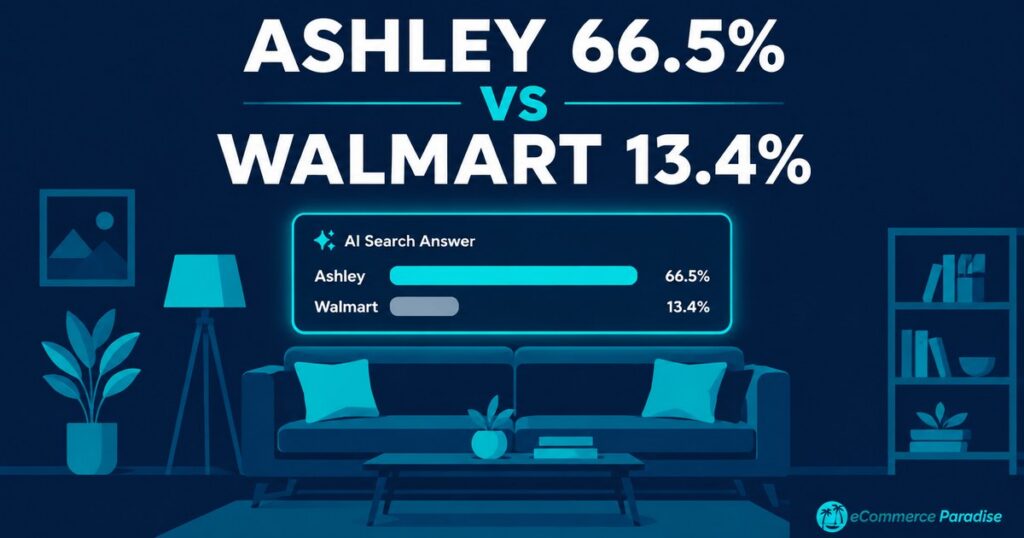
Ashley Furniture showed up in 66.5% of Google AI Overviews furniture holiday answers, against 13.4% for Walmart, according to a new Semrush study.
If you sell high-ticket furniture, patio sets or other big-ticket home goods online, this is the first holiday dataset that shows who AI answers actually name when a shopper asks for deals. The big-box retailers do not own those answers. A category specialist beat Walmart by roughly five to one, and that matters to every Ecommerce Paradise reader who competes on category expertise instead of price.
Below you get the numbers with their baselines, the limits Semrush lists for its own data, and six checks I would run before Black Friday on Nov. 27. Semrush ran an earlier study on how often AI summaries appear, and I covered it in my post on AI Overviews hitting 85% of ecommerce keywords.
Find out which stores AI answers name for your category, then keep tracking it. Semrush ran this study and sells AI visibility tracking, so weigh its advice with that in mind. I also earn a commission if you sign up through my link. Track your AI visibility with Semrush →
Semrush: Ashley Furniture Leads Walmart 66.5% to 13.4%
Semrush published the 28-page mini-study, titled “Peak Season Positioning: Who AI Search Recommends from Black Friday to Christmas,” on Nov. 9, per PPC Land’s Nov. 11 write-up. The data is a September 2026 US snapshot of the Semrush AI Visibility Index across Google AI Overviews, ChatGPT, Gemini and Google AI Mode. PPC Land counts 10,514 answers in total.
Semrush began with 291 holiday shopping topics and kept 269 across 12 aisles after cleanup. It also removed every prompt that named a brand. That means the study measures category discovery, the “best patio furniture deals” type of question, not people who already know who they want to buy from.
Semrush only names a topic leader when a topic has at least 10 AI Overviews prompts. That left 89 topics covering 92% of the AI Overviews prompts. The ChatGPT, Gemini and AI Mode samples hold up to five prompts per topic, which is too thin to name leaders, so every leader below comes from AI Overviews.
Furniture is the headline. Across 239 furniture prompts, Ashley Furniture appeared in 66.5% of answers. Walmart, the best of Amazon, Walmart, Best Buy and Target, appeared in 13.4%. PPC Land calculates that as roughly five times the rate. Across all 89 topics, one of those four big retailers led only 23.6%, about 21 topics, by PPC Land’s math.
| Topic (AI Overviews) | Prompts | Leader and share | Best big-four share |
|---|---|---|---|
| Furniture | 239 | Ashley Furniture 66.5% | Walmart 13.4% |
| Clothing | 139 | Nordstrom 57.6% | Walmart 5.0% |
| Fragrance | 71 | Perfumania 62.0% | Walmart 16.9% |
| Bikes | 75 | Aventon 44.0% | Walmart 12.0% |
| Cameras | 74 | Canon 52.7% | Best Buy 32.4% |
| Phones | 133 | Samsung and T-Mobile 65.4% | Best Buy 61.7% |
The big retailers still win their home turf. Best Buy leads the gaming aisle at 58.1% and phones, computers and tech at 49.6%. Target leads general deals and sales events at 38.4%. Walmart leads toys, kids and baby at 32.3% and home, kitchen and appliances at 26.9%. Home Depot leads tools, auto and garden at 20.7%.
Platform behavior differs sharply. Across all topics, Amazon had the highest mention rate on Gemini at 40.5% and AI Mode at 33.1%, while Walmart led AI Overviews at 20.2% against Amazon’s 16.4%. Mentions are not citations. Gemini named Amazon in 40.5% of answers but cited amazon.com in 0%, and Gemini cites about 2.3 sites per answer against about 5.5 for ChatGPT and AI Mode.
Semrush points to Amazon’s robots.txt file, which blocks Google-Extended while Walmart, Best Buy and Target do not. Semrush calls that “the likely explanation for the Gemini pattern,” per PPC Land, but the study did not test what happens if Amazon lifts the block.
One more number matters for small stores. Reddit was cited in 35.2% of AI Overviews answers but mentioned in only 11.9%, and on Christmas gift prompts it was cited in 53.2%, per the same write-up. AI answers lean on forum threads and video even when they do not name them.
AI Overviews at 88% of Commercial Keywords Set Up This Study
This study sits on top of a year of rising AI search coverage. Semrush found AI Overviews on 88% of tracked commercial keywords in August 2026, up from 45.75% in September 2025, per PPC Land’s context figures. Semrush’s commercial keyword study put ecommerce at 85.11% in August, up from 32.62%.
An earlier Semrush report, covered by PPC Land on June 30, found that only 36 of more than 1,200 brands were visible on all four platforms every month. In the same report, 45% of 481 surveyed marketers said they cannot properly measure AI visibility.
Demand is the other half. Adobe forecast on Sept. 28 that US online holiday spend will hit $275.1 billion, up 6.7%, and that AI-referred traffic to US retail sites will rise 130%. Adobe does not disclose the baseline for that 130%, and it defines the figure as shoppers clicking through a link. Cyber Week alone is forecast at $47.5B, up 7.4%.
Now the counterpoints, because there are several. Wayfair CEO Niraj Shah said on the company’s Q3 call that traffic referred from AI tools more than doubled quarter over quarter but still makes up only about 1% of total traffic, per Digital Commerce 360. Reddit CEO Steve Huffman said on the Q3 call, “The reality is the AI Mode does not drive traffic,” which he framed as a hypothesis, not a measured result, according to PPC Land.
Semrush lists its own limits too. The study measures visibility only, with no sales, traffic or sentiment. It is a single September snapshot taken about two months before Black Friday. Each prompt got one answer, so a brand missing from one answer might appear on the next ask. Semrush also sells the tools it recommends, and personalized results may differ from what the tracker saw.
Traffic from AI is small and growing fast. That is why the visibility numbers matter now even though the click numbers do not yet justify panic. I tracked the earlier click data in my post on ChatGPT versus Google organic traffic.
What Ashley’s AI Lead Means for High-Ticket Store Owners
My read: the useful lesson is not that small stores beat Walmart. Ashley is a manufacturer with its own retail network and a huge content footprint, so it is a brand with depth, not a random reseller. What the data shows is that when a category is deep and specific, AI Overviews reward the source that owns the category language. Furniture is that kind of category.
For a high-ticket dropshipping store, that points at your category and deal pages. A shopper asking an AI for “best outdoor dining set deals” wants prices, dimensions, lead times, freight terms and warranty answers in one place. Walmart’s generic listing rarely holds all of that. A store that publishes it clearly gives the AI something to quote.
Here is hypothetical math to size it. Say your store gets 500 visits a month from deal and category searches, converts 1%, and averages a $3,000 order. That is $15,000 a month. If AI answers on those searches name three competitors and not you, and your clicks drop 30%, you lose $4,500 a month without a ranking change. These numbers are invented to show the mechanism, and your real exposure depends on your queries.
I would set thresholds like this, as a working rule and not a finding. Run ten category prompts, with no brand names, across the four platforms. If you are named in none, AI is not a channel for you yet, so keep your money in Google Shopping and phone follow-up and fix the pages below. If you are named in one to three, build the citation pages and track weekly. If you are named in four or more, protect those pages and stop rewriting them.
Mentions and citations are different prizes, and the study says so. Semrush’s own line is that “winning citations or mentions offers no guarantee of earning the other,” per PPC Land. A store that is named but not cited gets awareness with no click. A store that is cited but not named gets the click from a shopper who never learned your brand. Check both for every prompt.
Off-site presence counts more than most owners think. With Reddit cited in 35.2% of AI Overviews answers, honest participation in forum threads about your category is part of this game. Reddit also launched AI review pages built from user threads, which I covered in Reddit Reviews turns threads into AI review pages. Do not astroturf.
Timing is tight. Google’s November core update, expected to wrap up around Nov. 24, can move rankings at the same moment AI answers shape the shortlist, per my core update store owner plan. Amazon’s Black Friday Week starts Nov. 19, as I wrote in Amazon’s Black Friday Week post, so you are competing with deal pages from every direction.
On the robots.txt question, I would not change anything because of one correlation. Semrush itself does not claim the Amazon block causes the Gemini pattern. What I would do is read your own file and decide on purpose, using my breakdown of the new robots.txt AI opt-out token as the reference.
Furniture sellers carry one more squeeze. Cabinet tariffs are set to double to 50% on Jan. 1 unless deals land, as I covered in my cabinet tariff post, so margins and prices on your pages may change in weeks. Stale prices on a page an AI quotes cost you trust. If you would rather have a team build the category pages and supplier relationships that AI answers can quote, that is the work in my turnkey done-for-you store build.
Not sure which of your pages AI answers would quote this holiday season? Bring your store to a 1-on-1 session and walk through it with me. Get the coaching details →
Six Checks to Run on Your AI Answers Before Black Friday
You do not need a rebuild. You need a clear picture of where you appear today and two or three page fixes before Nov. 27. Here are six steps in the order I would take them.
- Write ten category prompts with no brand names, such as “best outdoor kitchen deals this Black Friday,” and run each in a clean browser on Google AI Overviews, ChatGPT, Gemini and AI Mode. Record who is mentioned and who is cited. A tool such as Semrush can track this on a schedule once you know your prompts.
- Score each prompt twice, once for whether your store is named and once for whether your domain is cited. Semrush found these diverge, so one score hides the problem.
- Rewrite your top three deal or category pages so the answer sits at the top in plain text: exact price, freight cost, lead time, financing and warranty length. Use KWFinder to find the deal phrasing buyers actually type.
- Read the sources AI answers cite for your category. If Reddit threads and YouTube reviews dominate, add honest answers and real product videos to your calendar. Do not post fake reviews.
- Open your robots.txt file and write down which AI crawlers you block and why. Make it a decision, not an accident.
- Capture the visitors you do get. A Klaviyo signup offer for a buying guide on your top five pages is a quick start, and a weekly check in SE Ranking will show whether your page fixes move rankings.
If you are still choosing a category, grab my free high-ticket niches list before you write a single deal page. For supplier options in a category you already picked, my paid supplier directory is the place to start.
Frequently Asked Questions
Does this mean small stores can beat Walmart in AI answers?
Sometimes, in deep categories. Ashley beat Walmart 66.5% to 13.4% in furniture, but Ashley is a large manufacturer with its own content, so treat it as proof that category depth wins, not that size does not matter. My guide on answer engine optimization for AI shopping discovery covers the next layer.
Is the Semrush study reliable?
Treat it as direction. It is a September snapshot with one answer per prompt, thin samples on ChatGPT, Gemini and AI Mode, and no sales data. Semrush sells AI visibility tools, which is why I cross-check with my own prompts.
Will AI answers send me real traffic this holiday season?
Some. Adobe forecasts AI-referred retail traffic up 130%, but Wayfair says AI referrals are still about 1% of its traffic. Plan for a small, fast-growing channel and keep funding Google Shopping for high-ticket products.
Should I unblock AI crawlers in robots.txt?
Decide deliberately. Semrush links Amazon’s Google-Extended block to its Gemini citation gap but did not test it. Weigh that against your reasons for blocking, and keep a record of the choice.
What should my deal page include?
Exact prices, freight terms, lead times, financing and warranty. My high-ticket Black Friday checklist covers the conversion side before you scale ads.
Does my Shopify setup matter for AI answers?
Only for clean pages and structured product data. I covered how ready stores are for AI shopping agents in my AI-agent readiness audit post. A tidy Shopify build makes the page fixes faster.
How do I track my store’s AI visibility over time?
Keep your ten prompts fixed and rerun them weekly, then compare the mentions and citations. I rank the options in my best rank trackers comparison.
Want my team to scale the store you already have before Black Friday traffic peaks? See the scaling service →
I will keep watching how AI answers shift as the holiday data comes in. Subscribe to the YouTube channel for daily breakdowns. More breaking news coming through the day.
Related Articles
If this was useful, these go deeper:
- Semrush: AI Overviews Reach Ecommerce Keywords
- Reddit Reviews Turns Threads Into AI Review Pages
- OpenAI Opens ChatGPT Business Profiles and Free Agents
- Google Search Growth Slows as AI Mode Takes Hold
- How to Scale a High-Ticket Dropshipping Store Without Cutting Prices

Trevor Fenner is an ecommerce entrepreneur and world traveler from Seattle, Washington, and the founder of Ecommerce Paradise, a platform focused on helping entrepreneurs build and scale profitable high-ticket ecommerce and dropshipping businesses. With over a decade of hands-on experience, Trevor specializes in high-ticket dropshipping strategy, niche and product selection, supplier recruiting and onboarding, Google & Bing Shopping ads, ecommerce SEO, and systems-driven automation and scaling. Through Ecommerce Paradise, he provides free education via in-depth guides like How to Start High-Ticket Dropshipping, advanced training through the High-Ticket Dropshipping Masterclass, and fully done-for-you turnkey ecommerce services for entrepreneurs who want a faster, more hands-off path to growth. Trevor is known for emphasizing sustainable, real-world ecommerce models over hype-driven tactics, helping store owners build scalable, sellable, and location-independent brands.
He maintains homes in Seattle and Bali, spends most of the year overseas, and usually returns to Seattle for about a month each summer.


