


If you search for the best rank tracker in 2026, you get lists that crown a different winner every time. That happens because these tools are sold in different ways. Some count keywords per day, some count them per week, some bundle rank tracking into a full SEO suite, and one of the best options is free and has no daily tracking at all.
I run Ecommerce Paradise, and I look at rank tracking as a recurring cost like any other. My stores follow the model in my guide to what high-ticket dropshipping is. A high-ticket store lives on a modest set of commercial keywords, so a drop on one category page can cost real orders. The question is what each tracker costs per keyword, how often it refreshes, and what the number on the screen can and cannot tell you.
I have not benchmarked these tools against each other, and I am not going to pretend I ran an accuracy contest. Everything below comes from each company’s own pricing and help pages, which I read in October 2026, plus three outside sources. Prices and limits change often, so confirm the figure on the signup page before you pay. This is general information about software, not a promise of results.
Disclosure: I may earn a commission if you sign up through my Mangools, Semrush or SE Ranking links, at no extra cost to you. It does not change which tool I say fits which reader, and I tell you where each one falls short.
| Tool | Entry price (October 2026) | Tracked keywords at that tier | Update frequency | Best for |
|---|---|---|---|---|
| SE Ranking | Core: $129 monthly, $103.20 a month on annual billing | 2,000 daily | Daily | Most daily tracking per dollar |
| Mangools SERPWatcher | Basic: $49 monthly, $358.80 a year | 200 | Weekly (daily on Agency) | Small stores on a budget |
| Semrush Position Tracking | SEO: $139 monthly, $117.33 a month on annual billing | 500 daily | Daily | People who want the full SEO suite |
| Ahrefs Rank Tracker | Lite: $129 a month | 750 | Weekly | Big index, 190+ locations |
| AccuRanker | Professional: $249 monthly, $224 a month on annual billing | 2,000 | Daily | Speed and large keyword sets |
| Advanced Web Ranking | Pro: $139 a month | 7,000 keyword units | Weekly default, daily optional | Agencies, flexible scheduling |
| Nightwatch | Starter: 79 euros a month billed yearly | 500 | Daily | Teams that want unlimited seats |
| Google Search Console | Free | Not a tracked list | Reports on actual impressions | The free baseline everyone should use |
Track Up to 2,000 Keywords Every Day Without a Spreadsheet
SE Ranking’s Core plan lists 2,000 daily tracked keywords and 10 projects at $103.20 a month on annual billing, and its 14-day trial says no credit card is needed.
The Short Answer for 2026
If you want the most daily tracking for the money, SE Ranking is where I would start, because its Core plan lists 2,000 keywords checked daily. If you run a small store and only need a few hundred keywords checked weekly, Mangools is the cheapest way in. If you already live in a full SEO suite, Semrush and Ahrefs fold rank tracking into the plan you pay for anyway.
The detail that surprises people is that the headline keyword numbers are not comparable. Ahrefs lists weekly updates on every plan, Semrush and SE Ranking list daily, and Advanced Web Ranking counts a keyword as one weekly check, so tracking daily eats seven times as much of your limit. Compare plans on keywords per refresh cycle, not on the big number on the pricing page.
How I Picked These Eight
I looked at five things: how many keywords each plan tracks, how often they refresh, where and on which devices the tracker can check, what it costs at the entry tier and the mid tier, and how clearly the company explains its limits. I read each vendor’s pricing page and, where one existed, its help article on update frequency. Where a number comes from a single page, I say so.
I did not plant test keywords or compare positions across tools, so I cannot tell you which tracker is the most accurate. Be wary of any list that names an accuracy winner without showing the method. The ranking below is my judgment of fit and cost based on documentation, and your best pick depends on how many keywords you track and how often you need them refreshed.
I also left out local-pack specialists, which are a different category. My post on BrightLocal alternatives covers that side if your store has a physical location.
The 8 Best Rank Trackers in 2026
1. SE Ranking
SE Ranking’s pricing page now shows two self-serve plans. Core is $129 a month, or $103.20 a month on annual billing, and covers 2,000 tracked keywords daily, 10 projects and 1 manager seat. Growth is $279 a month, or $223.20 on annual billing, with 5,000 keywords daily, 30 projects, 3 manager seats and historical data across the project lifetime.
The page says the free trial lasts 14 days, needs no credit card and includes up to 10 projects and 750 tracked keywords per day. Extra keywords are sold as add-ons, from $22.40 on Core and from $32 on Growth. The local and map rank tracker is listed at 1,500 keywords across 3 locations on both plans, which matters if you track by city.
The downsides are plain. The cheapest plan is $103.20 a month even if you only want to watch 150 keywords, and the refund policy says payments are non-refundable except where the service was not delivered as promised. I would pick SE Ranking for daily tracking at volume when you have several hundred to a couple of thousand keywords and want one tool that also audits your site.
2. Mangools SERPWatcher
SERPWatcher is the rank tracker inside the Mangools bundle, which also includes KWFinder, SERPChecker, LinkMiner and SiteProfiler. Mangools’ public plan data lists Basic at $49 a month or $358.80 a year, Premium at $69 a month or $538.80 a year, and Agency at $129 a month or $1,078.80 a year. By my arithmetic that is $29.90, $44.90 and $89.90 a month on annual billing.
The same data lists tracked keywords at 200 on Basic, 700 on Premium and 1,500 on Agency. The Mangools FAQ says each tracking is counted separately, so one keyword on both desktop and mobile uses two of those slots, and the SERPWatcher page says rank updates are weekly, with daily updates on the Agency plan. It also says it supports more than 65,000 locations, from states and counties to cities and DMA regions, with both desktop and mobile results. The Mangools pricing page FAQ says a full refund is available within 48 hours of payment, which does not apply to two consecutive subscriptions. I could not find a paid trial on the pages I read, only a free account and that refund window.
Two cautions. Weekly updates mean a sudden drop can sit unseen for days unless you are on Agency, and I saw different Mangools price figures in other places while researching, so treat the plans page as the final word. If you want a cheap tracker plus keyword research in one subscription, I would try Mangools and KWFinder first. My post on KWFinder alternatives shows who else competes with that bundle.
3. Semrush Position Tracking
Semrush sells Position Tracking inside its SEO plans, and the current ladder is SEO at $139 a month, Starter at $199, Pro+ at $299 and Advanced at $549 on monthly billing. On annual billing the pricing page shows $117.33, $165.17, $248.17 and $455.67 a month. Tracked keywords are 500 daily on SEO and Starter, 1,500 on Pro+ and 5,000 on Advanced, with 5, 5, 15 and 40 websites.
Semrush’s help page says information in Position Tracking is generally updated daily within 24 to 48 hours, and that daily data is kept for 60 days before it switches to weekly points kept for 140 weeks. The pricing page lists multi-location and device tracking at Pro+ and share of voice at Advanced. Extra users start at $45 a month, and the pricing page says you can try Semrush free for seven days. Its pricing FAQ says a small charge is placed on your card to check it is valid and then refunded, with no billing until the trial ends.
Semrush’s refund policy page gives a 7-day money-back window for initial annual subscriptions and add-ons, and says refunds are not available on month-to-month plans. The cost per tracked keyword is the highest on this list, because you are paying for the whole suite. That is fine if you also use keyword research, site audits and backlink tools. I would pick Semrush for rank tracking inside a full SEO suite when the rest of the platform earns its keep.
Not Ready to Spend $100 a Month on Rank Tracking?
Mangools lists 200 tracked keywords with weekly updates on Basic at $29.90 a month on annual billing, and SERPWatcher comes bundled with KWFinder and the other Mangools tools.
4. Ahrefs Rank Tracker
Ahrefs Rank Tracker is part of its main platform, so you buy a plan, not a tracker. The pricing page lists Lite at $129 a month with 750 tracked keywords and 5 projects, Standard at $249 with 2,000 and 20 projects, Advanced at $449 with 5,000 and 50 projects, and Enterprise at $1,499 with 10,000 or more on an annual commitment. It says annual billing saves up to 17 percent, and the help center says the default update frequency is weekly on all plans.
The tracker page lists 190 or more locations, from country down to ZIP code, both mobile and desktop tracking, 19 SERP features including AI Overviews, and comparison against up to 10 competitors. Ahrefs’ pricing FAQ says it never runs discounts, and its refund policy says it does not issue refunds in general, though monthly subscribers can request one if they have not used the service. The only free access is Ahrefs Free, which gives limited Site Explorer and Site Audit access for sites you own.
Weekly refreshes and no trial are the tradeoffs. If you are weighing the whole platform, my Ahrefs pricing breakdown covers the credit meter and the seat costs. It is a strong pick when you want one big data set for research and tracking, and weekly is fast enough for you.
5. AccuRanker
AccuRanker is a dedicated rank tracker built around speed. Its pricing page lists Professional with keyword options of 2,000, 3,000 and 5,000, and Expert with options from 10,000 to 25,000. The page data shows Professional at $249 a month for 2,000 keywords, $369 for 3,000 and $609 for 5,000, with the displayed $224 being the annual-billing rate for 2,000. Expert starts at $849 monthly, or $764 on annual billing, and the page says annual payment gets a 10 percent discount.
The features page says rankings, SERP features and CTRs update daily, and the page also mentions refreshing a single keyword on demand and updating an entire domain every two hours, which I read as a limit on how often you can force a full refresh, so ask to confirm. Professional includes keyword research, search intent, tagging, advanced filtering and Search Console and Analytics connections, while Expert adds dynamic tagging, AI CTR, AI Search Volume and an unlimited read API. The pricing page pushes a demo request, but a help article says the free trial lasts 14 days and needs no credit card, and AccuRanker’s terms say prepaid fees are non-refundable, so confirm the current trial before you buy.
It costs more per keyword than SE Ranking at the entry tier and it does not bundle backlink or content tools. I would put it on a shortlist for an agency or a large catalogue where fast refreshes and clean tagging matter more than a bundled suite.
6. Advanced Web Ranking
Advanced Web Ranking, or AWR, prices by keyword units. Pro is $139 a month for 7,000 keywords, Agency is $279 for 14,500 with 1-hour on-demand updates, and Enterprise is $699 for 35,500, with a larger tier at $980. The page says paying annually saves 10 percent, all plans carry a 30-day money-back guarantee, and Pro includes unlimited projects and users.
Its FAQ defines a keyword as one weekly query for one search engine and one device at a depth of 50 results. Daily updates use seven times as many units, and each extra location or device multiplies the count. By my arithmetic, Pro’s 7,000 units cover about 1,000 keywords checked daily, or 7,000 checked weekly.
The tool lists 4,000 or more search engines, plus YouTube, Amazon, Bing, Yahoo, Naver and Baidu, with local and mobile rankings. The site offers a free trial, but the pricing page does not state its length, only that your data is kept for another 14 days after the trial ends, so confirm the length at signup. It suits agencies and consultants who need flexible schedules and many projects, and it is a lot of tool for a single store.
7. Nightwatch
Nightwatch prices in euros and by keywords tracked, not by seats. The Starter plan is 79 euros a month billed yearly (948 euros a year) for 500 keywords tracked daily, Professional is 159 euros for 2,500, and Agency is 399 euros for 7,500, with Enterprise at 20,000 or more. The page says every plan has unlimited seats and the full toolkit, including keyword research, site audit and AI prompt tracking.
It lists Google, YouTube, Bing, Yahoo, DuckDuckGo and Google Maps as tracked engines, real-time on-demand checks, and 3-year SERP history. The trial is 14 days, but two lines on the page conflict: the pricing section says no credit card is required, while an FAQ says that if you do not cancel within 14 days it will bill you monthly. Confirm that at signup.
I could not see a monthly-billing price in the version of the page I read, only the yearly-billed figures. It fits a team where adding colleagues is the cost problem, since the page says there are no per-seat fees.
8. Google Search Console
Search Console is not a rank tracker in the usual sense, but it is the one data source that comes straight from Google. The Performance report shows clicks, impressions, click-through rate and average position, and the default view covers the past three months. It is free, and it reports positions for queries where your site actually appeared.
It will not tell you where a competitor ranks, and it will not track a keyword you have not yet appeared for. Google’s help page says the position shown is the topmost position your property held in results, averaged across all queries. That makes it a good sanity check on a paid tracker and a poor day-to-day alarm.
If you only want to know which pages are slipping, start here before you pay for anything. My list of free SEO apps for small Shopify stores shows what else costs nothing.
How Keyword Limits Are Counted
The number on the pricing page does not mean the same thing across tools. A tracker that refreshes weekly can offer many more keywords for the same price than one that refreshes daily, because it makes a seventh as many requests. Mangools and Ahrefs refresh weekly on most plans, Semrush, SE Ranking, AccuRanker and Nightwatch list daily, and AWR lets you choose.
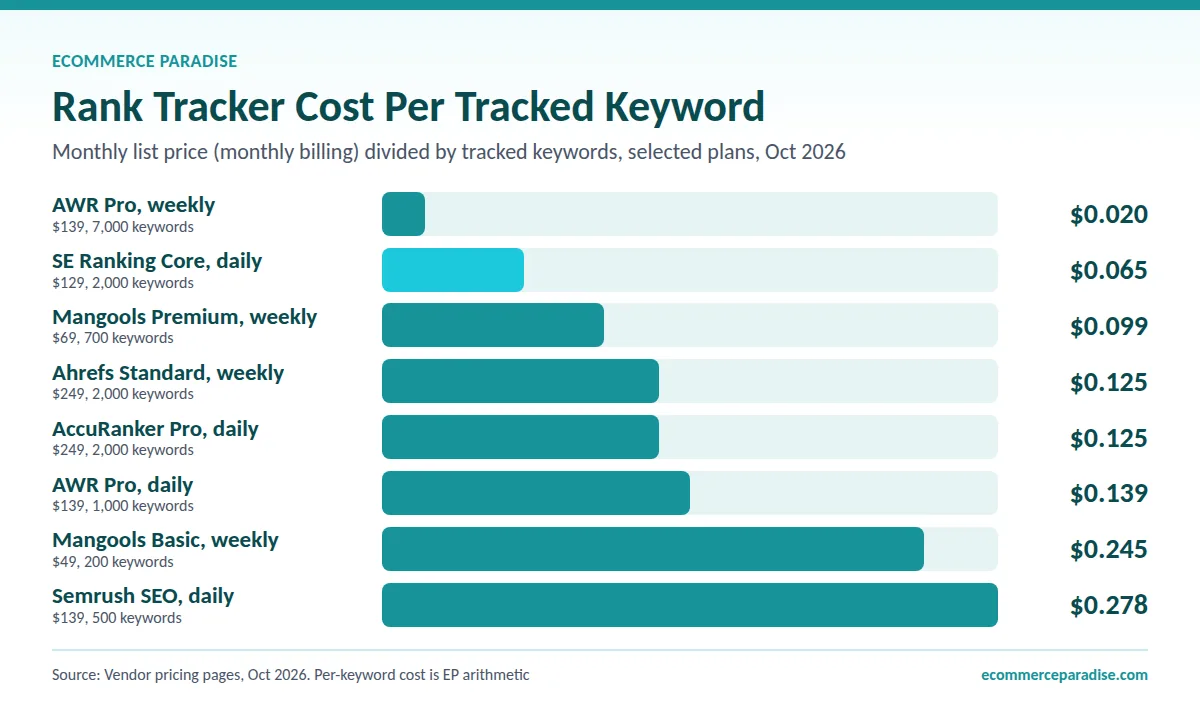
The table below is my own arithmetic from list prices, and it divides the monthly price by the tracked keywords. It ignores everything else in the plan, so Semrush and Ahrefs look expensive here partly because they bundle research tools. Use it to see the shape, not to crown a winner.
| Plan | Monthly price | Tracked keywords | Refresh | Price per keyword per month |
|---|---|---|---|---|
| Mangools Basic | $49 | 200 | Weekly | $0.245 |
| Mangools Premium | $69 | 700 | Weekly | $0.099 |
| SE Ranking Core | $129 | 2,000 | Daily | $0.065 |
| Semrush SEO | $139 | 500 | Daily | $0.278 |
| Ahrefs Standard | $249 | 2,000 | Weekly | $0.125 |
| AccuRanker Professional | $249 | 2,000 | Daily | $0.125 |
| AWR Pro (weekly) | $139 | 7,000 | Weekly | $0.020 |
| AWR Pro (daily) | $139 | 1,000 | Daily | $0.139 |
Read it carefully. SE Ranking Core is the lowest daily figure here at about 6.5 cents, while AWR looks cheapest only if you accept weekly checks. Mangools Basic looks pricey per keyword but the lowest total bill, which is the number that matters if you track 150 keywords.
What a Rank Tracker Can and Cannot Tell You
A rank tracker reports where a page appeared for a query from a specific location and device at a specific time. That is not the same as what a customer saw. Semrush’s own help page says Position Tracking shows unbiased results while Google shows personalized ones, shaped by location, search history, browsing history and language, and that even different zip codes in one city can see different results.
Timing matters too. Semrush notes that results can change many times in a day, and its tracker updates every 24 to 48 hours, so a manual search a few minutes later can disagree. Incognito mode does not fix this either, according to the same page.
Search Console has its own quirks. Search Engine Journal reported Google’s John Mueller saying that average position is based on actual search results shown to users and not a theoretical number, but it can still differ from what you see because of personalization and geo-targeting. Use trackers to spot trends across many keywords, and do not argue with them over one number on one day.
The Google Change That Shook Rank Data
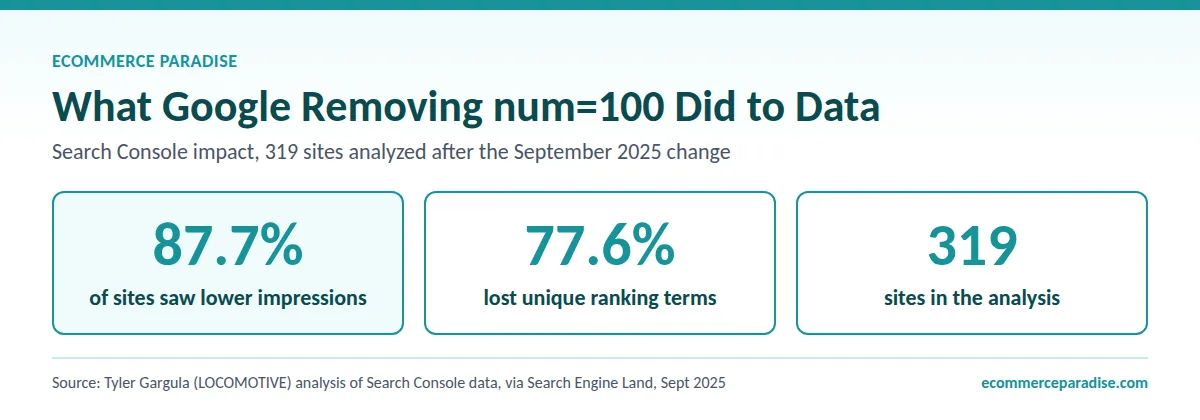
In mid-September 2025, Google removed the num=100 parameter that let tools request 100 results in a single query. Search Engine Land reported analysis of 319 sites finding that 87.7 percent of sites saw lower impressions and 77.6 percent lost unique ranking terms in Search Console. It also said Semrush and AccuRanker acknowledged disruptions and were working on fixes.
Ahrefs published its own timeline, saying the change had an industry-wide impact, that top 100 tracking first returned for Enterprise customers on October 8, 2025, and that by November 14, 2025 it was requesting the top 100 results for all keywords in Rank Tracker again. Search Engine Land noted that rank trackers using that parameter may have inflated Search Console impressions for years. I could not confirm how every vendor on this list handled it, so ask any vendor how deep its tracking goes.
The practical lesson is that a rank chart is only as stable as the way it gathers data. If your graph shows a cliff on one date across every keyword, check for a method change before you rewrite a page.
Do You Need a Paid Tracker or Is Search Console Enough?
If you are tracking fewer than 50 keywords and mostly care about your own site, Search Console may be enough. It shows what you rank for, how many impressions you get and which pages are slipping, all for free. A paid tracker earns its price when you need competitor positions, daily alerts, locations other than your own, or reports for a client.
My routine suggestion is to use both. Use Search Console to find where you almost rank, and use a tracker to watch the 20 to 200 keywords that actually pay your bills. A store that sells expensive products does not need 5,000 tracked keywords on day one.
If your tool budget is tight, my post on SEO Chrome extensions shows cheap ways to check a result by hand. Whatever you buy, put the subscription under your company, which is easier once you have followed my business formation guide for high-ticket dropshipping.
What to Track for a High-Ticket Store
Start with the categories on your own site, because they are what you are trying to rank. If you are still picking a market, my list of high-ticket niches gives you categories to research before you load a single keyword. Add the head term for each category, the brand and model names you sell, and a handful of buying-guide phrases.
Brand and model keywords come straight from your suppliers’ catalogs. Once you have approved suppliers from my guide on finding suppliers for high-ticket products, pull their top model names and track those, because shoppers who type a model number are often further along in the buying process. Track on mobile as well as desktop if your analytics show mobile traffic.
Group keywords with tags or projects so you can see a category move as a whole. Several of these tools support tagging, and it is the feature that keeps a 300-keyword list readable.
Picking by Store Size
These scenarios are my own arithmetic from list prices, and they assume the prices above hold. For a new store with about 150 keywords, Mangools Basic at $49 monthly ($29.90 on annual billing) covers it with 50 keywords to spare. SE Ranking would cost $129 monthly for the same 150, so you pay for headroom you do not use.
For a store with about 500 keywords and a need for daily data, SE Ranking Core at $129 gives 2,000 daily, while Semrush SEO at $139 gives exactly 500 daily and costs more. If weekly is fine, Mangools Premium at $69 covers 700, which is a little over half of the SE Ranking price.
For an agency with several clients and tagged keyword sets, the monthly price per keyword stops being the main number. AWR’s unlimited users and 1-hour updates, Nightwatch’s unlimited seats, AccuRanker’s tagging and Semrush’s Pro+ multi-location tracking each solve a different reporting problem.
Switching Trackers Without Losing History
Export your keyword list and any historical data before you cancel, because most of these tools do not offer a direct migration path to each other. SE Ranking’s pricing page says free migration comes with an annual subscription and that you can import projects and ranking history using built-in options, so ask which platforms it can import from.
Overlap the old and new tools for a month if you can, and compare the same 20 keywords by location and device. Small differences are normal for the reasons above, so look for a consistent gap and not a perfect match. Keep a spreadsheet of your top 50 keywords and positions as a backup.
Check the refund terms before you commit to annual billing, since they range from 48 hours at Mangools, 7 days on Semrush annual plans and 30 days at AWR to very limited or no refunds at SE Ranking, Ahrefs and AccuRanker.
Which One Should You Pick?
| If you are | Pick | Why |
|---|---|---|
| A store tracking a few hundred keywords on a budget | Mangools SERPWatcher | Lowest total bill, bundled keyword research |
| Tracking 500 to 2,000 keywords daily | SE Ranking | 2,000 daily on Core, 14-day trial |
| Using a full SEO suite already | Semrush | Position Tracking inside the same plan |
| Wanting one big data set for research and tracking | Ahrefs | 190+ locations, 19 SERP features |
| Managing large keyword sets | AccuRanker | Daily updates and fast refresh |
| An agency needing flexible scheduling | Advanced Web Ranking | Unlimited users, 30-day money-back |
| A team that hates per-seat fees | Nightwatch | Unlimited seats on every plan |
| On a zero budget | Google Search Console | Free first-party data |
My Verdict: The Best Rank Trackers in 2026
For most store owners reading this, I would pick between SE Ranking and Mangools. SE Ranking wins when you need daily checks on hundreds or thousands of keywords, because its Core plan lists 2,000 daily for $129 monthly. Mangools wins when you need a few hundred weekly checks and a small bill, with keyword research thrown in.
If you already pay for a full suite, use the tracker inside Semrush or Ahrefs and skip the extra subscription. Pick AccuRanker, Advanced Web Ranking or Nightwatch when you have an agency-style need they solve better. Whatever you choose, run the free trial with your real keywords and do not trust one day’s number.
Ready to Put Rank Tracking Inside a Full SEO Suite?
Semrush’s SEO plan lists 500 daily tracked keywords and 5 websites at $117.33 a month on annual billing, and the pricing page offers a 7-day free trial.
Frequently Asked Questions
What is the best rank tracker in 2026?
It depends on how many keywords you track and how often. SE Ranking lists the most daily tracked keywords for the money, and Mangools is the cheapest way to track a few hundred weekly. I have not run an accuracy test, so I do not name a winner on precision.
Is there a free rank tracker that works?
Google Search Console is free and reports your actual average position, but it is not a tracked keyword list and shows no competitors. Mangools also offers a free account, but its limits are small, so check what it allows before relying on it. For a store with a real budget, free tools are a start, not a system.
How often should a rank tracker update?
For most stores I think weekly is enough, because most pages do not move much from one day to the next. Daily is worth paying for if you run promotions, test titles or manage client campaigns where a quick drop needs a fast response. Check how the tool counts keywords, since daily tracking can use seven times the allowance.
Why does my rank tracker show a different position than Google?
Google personalizes results by location, history and language, and trackers report an unbiased snapshot from a set location and device. Timing differences add to it. Compare trends over weeks, not one search against one chart.
Which rank tracker should I try first?
Try one with a free trial and test it with your real keywords. SE Ranking lists a 14-day trial with no card, Semrush lists 7 days and checks your card, while Ahrefs lists no trial, so confirm the terms on each signup page.
Want Your Store Built So You Can Focus on Rankings and Sales?
My team builds the store and lines up suppliers, so the setup work is already handled. Prefer to learn it yourself? Ask about coaching. You can also start with my free mini course.
Related Articles
If you found this useful, these guides go deeper on related topics:
- KWFinder vs Semrush 2026: Focused SEO Suite vs All-In-One Marketing Platform
- Semrush vs Ahrefs in 2026: Comprehensive Marketing Intelligence Platform vs Industry-Leading Backlink-Focused SEO Tool, Which Wins for Your Business?
- 10 Best KWFinder Alternatives in 2026: SEO Platforms Compared for Ecommerce Operators
- Ubersuggest Alternatives in 2026: The 8 Best SEO Tools and When Each One Beats Ubersuggest
- Best SEO Tools for Ecommerce Agencies Managing Multiple Client Sites in 2026

Trevor Fenner is an ecommerce entrepreneur and the founder of Ecommerce Paradise, a platform focused on helping entrepreneurs build and scale profitable high-ticket ecommerce and dropshipping businesses. With over a decade of hands-on experience, Trevor specializes in high-ticket dropshipping strategy, niche and product selection, supplier recruiting and onboarding, Google & Bing Shopping ads, ecommerce SEO, and systems-driven automation and scaling. Through Ecommerce Paradise, he provides free education via in-depth guides like How to Start High-Ticket Dropshipping, advanced training through the High-Ticket Dropshipping Masterclass, and fully done-for-you turnkey ecommerce services for entrepreneurs who want a faster, more hands-off path to growth. Trevor is known for emphasizing sustainable, real-world ecommerce models over hype-driven tactics, helping store owners build scalable, sellable, and location-independent brands.

Still deciding what to sell?
Grab the free list of 1,000+ niches that work for high-ticket dropshipping, sorted by category.
Free. Unsubscribe any time.


