



Hey guys, Trevor here with E-Commerce Paradise. I get emails almost every week asking me to look at some dropship supplier or directory that showed up in a Google search, and Barpel is one that keeps coming up, especially from folks who are just starting to research suppliers for a housewares, small appliance, or gift niche store. So I dug into barpel.com, ran it through the same checklist I use when I’m vetting any potential supplier for my own stores or my clients’ stores, and I’m giving you the honest breakdown below.
Quick context before we get into it: I usually push people toward supplier vetting the way I lay out in my guide on how to find the best suppliers, because most people skip real vetting and just go with whatever shows up first in search results. Barpel is worth a look, but it’s also a good example of why that vetting process matters. Let’s get into it.
See If Barpel’s Catalog Fits Your Store
Housewares, small appliances, and giftware dropship access with no monthly software fee tacked on top.
What Is Barpel
Barpel is a wholesale dropship distributor that’s been kicking around the online retail world for a long time, way longer than most of the “modern” supplier directories you’ll see recommended in 2026. It’s not a slick SaaS platform with a dashboard full of AI product recommendations. It’s a straightforward distributor of housewares, small kitchen appliances, giftware, and general merchandise that ships direct to your customer once you place an order on their behalf.
If you’ve spent any time in the old-school dropship and comparison-shopping circles from the PriceGrabber and Shopping.com era, the Barpel name might already ring a bell. That’s the world this company comes out of: a wholesale distributor that built its business feeding product data to comparison shopping engines and small online retailers before Shopify apps and one-click supplier integrations were the norm. It’s stuck around, but the online footprint is thin. There’s no active Trustpilot page, no BBB profile I could pull up, and no meaningful Reddit or dropship forum threads discussing recent experiences with them. That’s not a dealbreaker by itself, but it’s something you should know going in.
Worth keeping in mind: US retail ecommerce sales have kept climbing every year according to the Census Bureau’s own quarterly e-commerce report, and that growth is exactly why so many old wholesale distributors like Barpel quietly added a dropship option in the first place. They didn’t rebuild their whole business around ecommerce. They just opened a side door for it.
The categories Barpel covers (small appliances, kitchenware, home decor, giftware) sit on the lower end of the price spectrum compared to what I usually push people toward. If you’ve read my list of high-ticket niches, you already know I’m partial to categories where the average order value is $500 or more. Barpel’s product mix skews toward items that sell for $20 to $150, which changes the entire math on how you’d need to run a store built around it.
Core Features
Here’s what actually matters when you’re evaluating a distributor like this: what they sell, how the ordering process works, what it takes to get an account, and how they handle shipping. Let’s break each one down.
Product Categories
Barpel’s catalog leans heavily into housewares and small kitchen appliances: coffee makers, blenders, cookware sets, storage containers, and similar items you’d find in a big box store’s housewares aisle. Layered on top of that is a giftware and general merchandise selection, seasonal decor, novelty items, and household goods that round out the catalog. It’s a broad but shallow mix rather than a deep specialty in any one vertical.
That breadth can be useful if you’re running a general home goods store and want a single account to cover multiple product lines. It’s less useful if you’re trying to build a tightly focused niche store the way I always recommend, since a scattershot catalog makes it harder to position your store as the go-to expert in one specific thing.
Dropship Program and Ordering
The dropship model here is the classic setup: you get access to a product feed or order portal, you place individual orders as your customers buy, and Barpel ships direct to the end customer under your store’s branding (or close to it, depending on their packing slip policy at the time you sign up). There’s no bulk inventory purchase required on your end, which is the entire point of dropshipping in the first place.
What I couldn’t verify with confidence, and what I’d tell you to confirm directly before committing any real time, is the exact per-order dropship fee structure and whether pricing has changed recently. Distributors like this typically charge a per-order handling fee on top of wholesale cost, somewhere in the range you’d expect from a small to mid-size distributor (often a flat few dollars per order, sometimes a percentage), but I don’t have current, verified numbers I’m comfortable publishing as fact. Get that in writing from them before you build a store around their catalog.
Account Setup and Requirements
Like most legitimate wholesale distributors, Barpel expects you to come to the table as an actual business, not a hobbyist. That typically means having a resale certificate or sales tax ID ready, and in most cases an LLC or other formal business entity behind your store. If you haven’t handled that part yet, go read my guide on business formation before you apply anywhere, because getting rejected by a supplier over paperwork is a completely avoidable setback.
Approval isn’t instant with distributors like this the way it is with some of the app-based dropship tools. Expect a manual review process on their end, which is normal for this style of company but can feel slow if you’re used to signing up for a Shopify app and getting product access in five minutes.
Shipping and Fulfillment
Ship times and carrier options for a distributor of this size and age tend to be reasonable but not lightning fast, and this is exactly where you need to protect yourself. Under the FTC’s mail and telephone order rules, you’re on the hook to ship (or have your supplier ship) within the time you promised the customer, so get Barpel’s actual average processing and transit times in writing and build your site’s shipping copy around the real number, not a guess. You can read the full rule on the FTC’s mail, internet, and telephone order merchandise page if you want the details.
Skip the Guesswork on Supplier Vetting
Get the exact fee structure and ship times from Barpel before you build a single product page around their catalog.
What Real Users Say
I’ll be straight with you here: independent, verifiable reviews of Barpel are hard to come by. I checked Trustpilot, the Better Business Bureau, Reddit, and the usual dropshipping forums (Warrior Forum, r/dropship, r/ecommerce) and came up with essentially nothing recent. No pile of one-star horror stories, but also no wave of five-star praise. Just quiet.
That’s a very different situation than what you’ll find on a supplier like Doba or Salehoo, where thousands of reviews and years of forum threads give you a real signal one way or the other. With Barpel, the absence of a public track record means you’re doing more of the vetting work yourself. It’s not proof the company is bad. Plenty of legit, older B2B distributors never built a consumer-facing review presence because their whole business runs on repeat wholesale accounts, not retail reputation management. But it does mean you should treat this section of the review as “proceed carefully and verify everything yourself” rather than “here’s what the crowd says.”
My honest take: if a supplier has almost no public footprint in 2026, after nearly two decades of dropshipping being a mainstream business model, that tells you something about how actively they’re marketing to new dropshippers versus just quietly servicing existing wholesale accounts. Keep that in mind as you read the rest of this review.
If you want a second opinion beyond what I’m telling you here, broader supplier roundups like BigCommerce’s list of dropshipping companies are worth skimming too, mostly so you can see how rarely Barpel gets mentioned compared to the bigger, more actively marketed suppliers. That absence is itself useful data when you’re deciding how much weight to put on any one distributor.
Barpel Pricing in 2026
Barpel doesn’t publish a clean, public pricing page the way a lot of the modern dropship software tools do, so what I’m giving you here is the general shape of how distributors like this typically structure cost, not confirmed exact figures. Verify every number directly with them before you commit.
| Cost Item | General Range to Expect |
|---|---|
| Account setup / application | Typically free to low-cost for approved resellers with a valid resale certificate |
| Wholesale product cost | Standard wholesale pricing on housewares, appliances, and giftware, well below retail |
| Per-order dropship fee | A flat handling fee per drop-shipped order is common with this type of distributor; confirm the current amount directly |
| Minimum order requirements | May apply to bulk/wholesale orders, less commonly enforced on individual dropship orders |
Compare that to a directory tool like SaleHoo, which charges a low annual fee for access to a curated list of thousands of suppliers plus market research tools. Or Worldwide Brands, which charges a one-time lifetime fee for its certified supplier directory instead of a recurring charge. Those are directory access fees, not per-supplier dropship fees, so they’re not directly apples to apples with what a single distributor like Barpel would charge you, but it’s useful context when you’re deciding how to spend your sourcing budget.
Pros and Cons
| Pros | Cons |
|---|---|
| Long-standing distributor, not a fly-by-night operation | Almost no independent reviews or public track record to verify against |
| Real wholesale relationship, not a middleman reselling someone else’s feed | Product mix skews low to mid ticket, doesn’t fit the high-ticket model well |
| Broad category coverage under one account (housewares, small appliances, giftware) | No published pricing page, so you have to apply just to get real numbers |
| No monthly software subscription cost the way modern dropship apps charge | Dated web presence, and manual approval process instead of instant app-style access |
| Legitimate business account requirements (resale certificate) keep out casual tire-kickers | Broad, shallow catalog makes tight niche positioning harder |
Who Should (and Shouldn’t) Use Barpel
Barpel makes the most sense for someone who already has a home goods, kitchenware, or general gift store and wants another wholesale source to round out the catalog, especially if you’re comfortable doing your own vetting and don’t need a slick dashboard to feel confident about a supplier. If you’ve got an existing resale certificate and business entity in place and you’re specifically hunting for housewares and small appliance SKUs, it’s worth applying and seeing what their actual terms look like.
It’s a much tougher fit if you’re building a business around what I teach here on E-Commerce Paradise. My whole model is high-ticket dropshipping: fewer sales, bigger order values, better margins per transaction, and less customer service headache per dollar earned. Barpel’s catalog just doesn’t live in that world. You’re not going to find $2,000 patio furniture sets or commercial-grade equipment in a housewares and giftware catalog. If high-ticket is your goal, this isn’t your supplier.
It’s also not a great fit for a total beginner who wants hand-holding. There’s no onboarding wizard, no chat support bubble walking you through setup, and no community forum to lean on when you have questions. If that kind of support matters to you while you’re learning the ropes, a directory tool with an active community will serve you better than a bare-bones wholesale account will.
Alternatives
Before you commit to Barpel, it’s worth putting it side by side with the bigger, better-documented players in the supplier directory space.
Doba is a subscription-based dropship aggregator that pulls together tens of thousands of products from hundreds of suppliers into one dashboard, with built-in order automation and marketplace integrations. You’ll pay a recurring monthly fee, but you get a lot more visibility into inventory levels and supplier performance than you’ll get from a single distributor like Barpel.
SaleHoo is more of a research and directory tool than a supplier itself. For a low annual fee you get access to a vetted list of thousands of wholesale and dropship suppliers plus a market research lab and an active community forum, which is exactly the kind of support system Barpel doesn’t offer.
Worldwide Brands takes a different approach with a one-time lifetime membership fee instead of a recurring charge, giving you access to a directory of certified wholesale and dropship suppliers across a huge range of categories. If you want to check it out directly, I’ve got my link to Worldwide Brands here.
None of these three are perfect either, and I’ve said plenty of critical things about all of them in other reviews on this site. But they all share one advantage Barpel doesn’t: a large enough user base that you can find real feedback before you commit. For a broader roundup of how suppliers get vetted across the industry, Shopify’s own guide to dropshipping suppliers is a decent second opinion to cross-reference against what I’m telling you here.
My Verdict
Here’s where I land on Barpel. It’s a real, legitimate wholesale distributor with actual products and an actual dropship program, not a scam and not vaporware. That much I’m confident saying. What I can’t tell you with full confidence is exactly what you’ll pay per order, how fast they actually ship in 2026, or what their customer service is like when something goes wrong, because there just isn’t enough public information out there to verify any of that, and their own site doesn’t spell it out clearly either.
For high-ticket dropshippers specifically, which is who reads this site, Barpel is a weak fit on product mix alone. Housewares and small appliances in the $20 to $150 range mean you’d need a much higher sales volume to hit the same revenue you could get from a handful of high-ticket orders a month. That’s more customer service tickets, more returns to process, and thinner margins per sale, which is the exact opposite of what I teach people to build.
If you’re outside the high-ticket world and specifically need a housewares or giftware source, Barpel might still earn a spot in your supplier rotation once you’ve confirmed their terms directly. Just don’t treat it as your only source, and don’t sign anything or build your store copy around promises you haven’t gotten in writing.
My rating: 5.4/10. Legitimate but dated, thin on transparency, and a poor match for the high-ticket model this site is built around.
Ready to See If Barpel Fits Your Store?
Apply directly, get their real fee structure in writing, and decide with actual numbers instead of guesses.
Frequently Asked Questions
Is Barpel a legitimate dropship supplier?
Yes, based on everything I could verify, Barpel is a real wholesale distributor with an actual dropship program, not a scam site. What’s thin is the public review history, not evidence of it being fraudulent.
What products does Barpel sell?
Mainly housewares, small kitchen appliances, giftware, and general home merchandise. It’s a broad, low to mid-ticket catalog rather than a niche specialty in one category.
Do I need an LLC or resale certificate to open a Barpel account?
Distributors like this typically expect you to apply as a registered business with a resale certificate or sales tax ID, so get your business entity and tax paperwork sorted before you apply.
Is Barpel good for high-ticket dropshipping?
Not really. The catalog skews toward lower price points than what high-ticket dropshipping is built around, so you’d need much higher order volume to hit comparable revenue.
What’s a better alternative to Barpel for beginners?
SaleHoo or Worldwide Brands tend to be better starting points for beginners because they come with active communities, research tools, and a large enough user base that you can actually find reviews before committing.
If you’re still sorting out your supplier strategy after reading this, that’s completely normal, this is one of the parts of starting a store that trips people up the most. Go back through my guide on finding the best suppliers if you haven’t already, and make sure whatever niche you land on is actually one worth building around. My high-ticket niches list is free and it’s the same list I use with my own clients.
And if you’d rather skip the trial and error entirely, that’s exactly what my services exist for. My done-for-you service handles the store build, supplier vetting, and launch from start to finish, so you’re not the one spending weeks emailing distributors trying to get a straight answer on fees. If you just want a second set of eyes on the decisions you’re already making, whether that’s Barpel or something else entirely, book a session through my coaching program and we’ll map it out together. Thanks for reading, and I’ll catch you in the next one.

Trevor Fenner is an ecommerce entrepreneur and the founder of Ecommerce Paradise, a platform focused on helping entrepreneurs build and scale profitable high-ticket ecommerce and dropshipping businesses. With over a decade of hands-on experience, Trevor specializes in high-ticket dropshipping strategy, niche and product selection, supplier recruiting and onboarding, Google & Bing Shopping ads, ecommerce SEO, and systems-driven automation and scaling. Through Ecommerce Paradise, he provides free education via in-depth guides like How to Start High-Ticket Dropshipping, advanced training through the High-Ticket Dropshipping Masterclass, and fully done-for-you turnkey ecommerce services for entrepreneurs who want a faster, more hands-off path to growth. Trevor is known for emphasizing sustainable, real-world ecommerce models over hype-driven tactics, helping store owners build scalable, sellable, and location-independent brands.
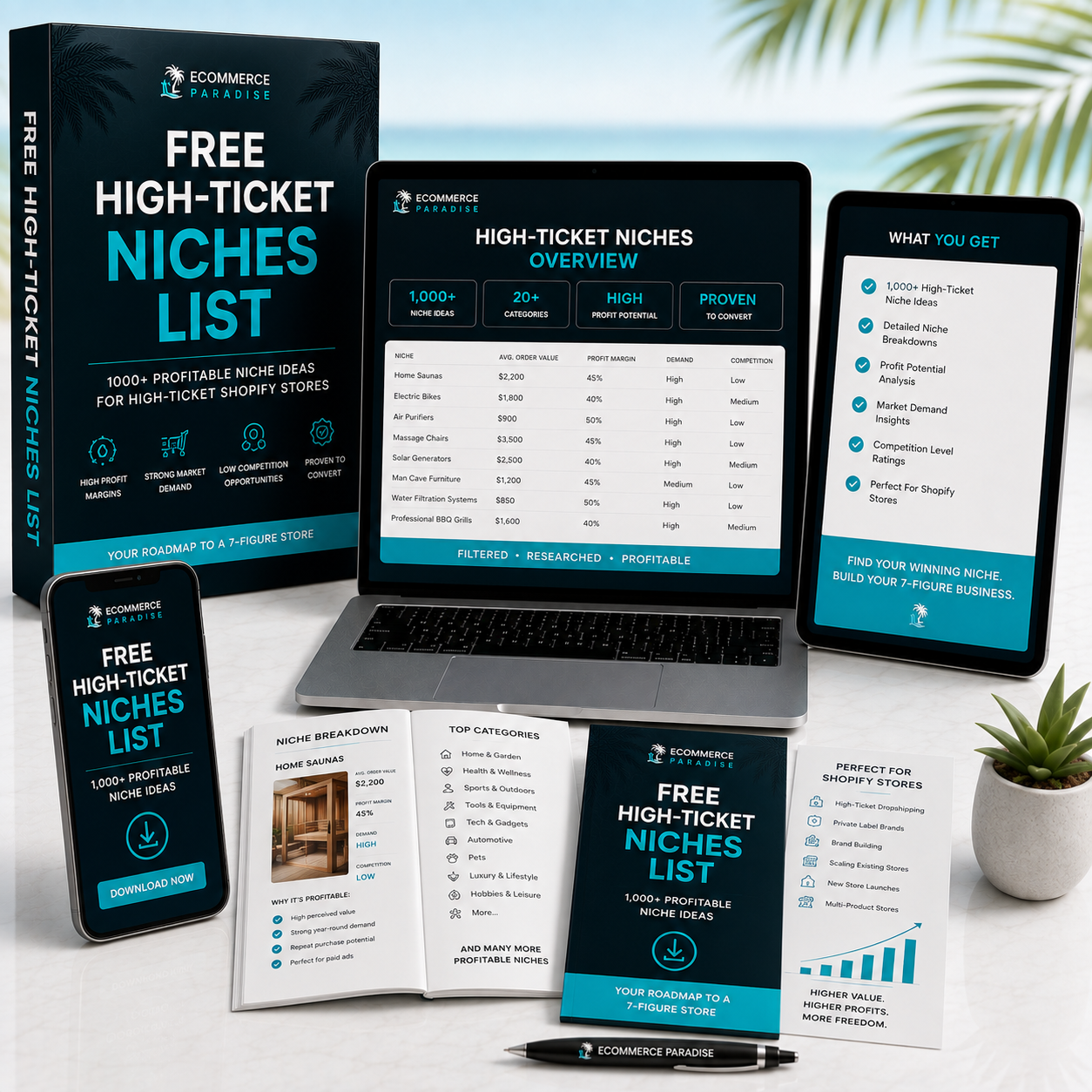
Still deciding what to sell?
Grab the free list of 1,000+ niches that work for high-ticket dropshipping, sorted by category.
Free. Unsubscribe any time.


