

Stop Doing Everything Yourself and Start Building a Business That Runs Without You
Outsourcing is one of the most powerful leverage tools available to entrepreneurs, small business owners, and growing companies. When you stop trading your time for tasks that someone else can handle faster, better, or more affordably, you free yourself to focus on the high-value work that actually moves your business forward. The challenge is finding the right platform to connect with trustworthy, skilled remote workers who can take real ownership of the work you hand them.
This guide covers the best outsourcing websites available in 2026, reviewing each platform’s talent pool, pricing model, vetting standards, and ideal use cases. Whether you need a virtual assistant to manage your inbox, a developer to build your next product, a customer service team to handle your growing order volume, or a specialist to run your paid advertising, the right outsourcing platform is here. Our top overall pick is OnlineJobs.ph. Read on to find out why it leads the list for online business owners and ecommerce entrepreneurs.
Why Outsourcing Is a Business Strategy, Not Just a Cost
Many entrepreneurs resist outsourcing because it feels like an expense rather than an investment. This is one of the most expensive misconceptions in small business ownership. Every hour you spend on tasks below your highest-value contribution is an hour not spent on strategy, sales, product development, or the work that drives revenue. If your time is worth $100 per hour and you spend three hours per day on tasks a skilled virtual assistant could handle for $8–15 per hour, the true cost of not outsourcing compounds every single day.
The most successful online business operators understand that their job is to build systems and teams, not to personally execute every function. Outsourcing is how you scale without multiplying your own working hours. It’s how you achieve consistent output across time zones, cover customer service around the clock, and maintain content production, ad management, and order processing simultaneously, without burning out.
The key factors to evaluate when choosing an outsourcing platform include:
- Talent quality and vetting: whether the platform screens workers before listing them or accepts anyone who signs up
- Pricing model: flat subscription, per-project fees, commission on wages, or hourly markup
- Niche specialization: whether the platform serves your specific industry or use case
- Relationship model: project-based transactional work versus long-term ongoing employment
- Payment protection: how funds are held, released, and disputed if work doesn’t meet expectations
- Geographic focus: where the talent pool is concentrated and what that means for language, culture, and working hours
How Outsourcing Transforms Ecommerce Businesses
For ecommerce entrepreneurs and high-ticket dropshipping store owners, outsourcing isn’t optional at scale. It’s essential. The operational demands of running a profitable online store grow faster than any solo operator can keep up with. Customer inquiries need timely responses around the clock. Product listings need to be created, optimized, and updated continuously. Supplier relationships need active management. Paid advertising campaigns need daily monitoring and adjustment. Content needs to be produced on a consistent schedule to drive organic traffic.
The moment you try to handle all of this yourself, you hit a ceiling. The entrepreneurs who break through that ceiling are the ones who identify which tasks can be systematized and delegated, then find the right people to own those systems. Outsourcing platforms are the marketplace where that transformation happens.
At Ecommerce Paradise, we teach this systems-and-team approach as a core component of building a sustainable, scalable dropshipping business. Our free course at ecommerceparadise.com/freecourse covers the foundational strategies for building a business designed to scale, including how to structure your team and delegate effectively from day one. If you are still deciding whether this business model fits you, our guide to what high-ticket dropshipping is breaks down how the model actually works.
The 15+ Best Outsourcing Websites for 2026
1. OnlineJobs.ph: Our Top Pick
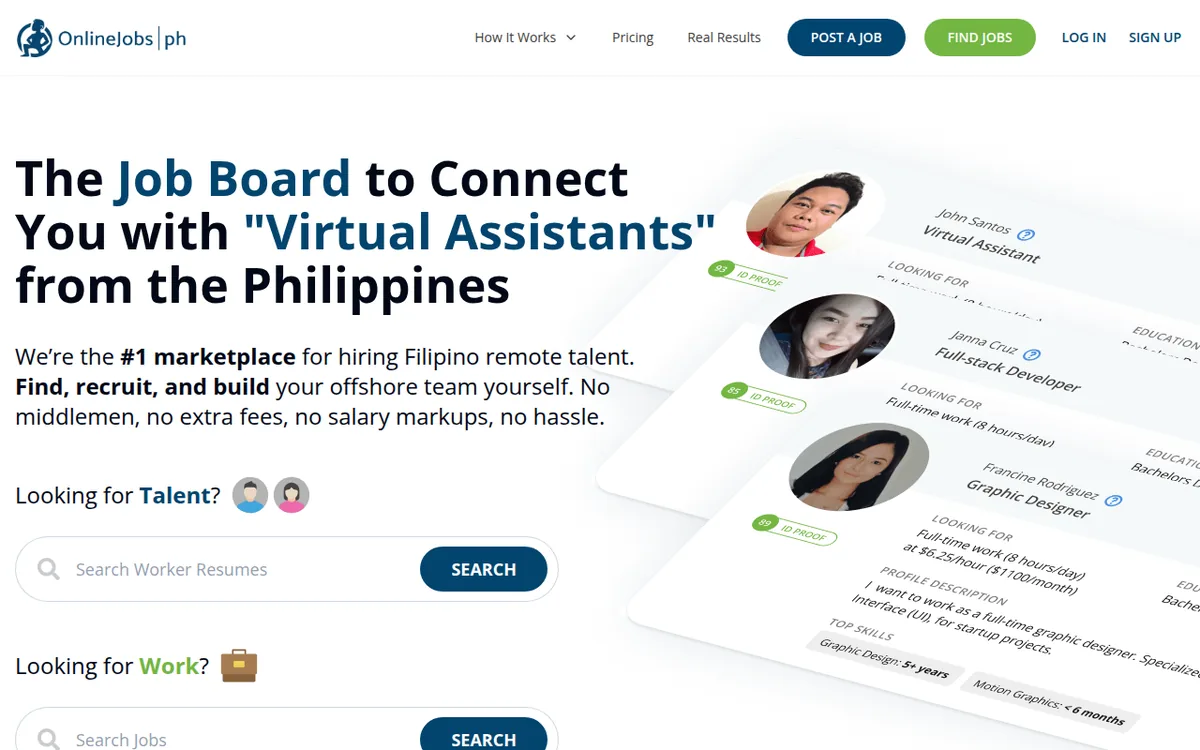
OnlineJobs.ph is our top overall recommendation for outsourcing, and the platform we point ecommerce entrepreneurs and online business owners toward first. It’s not a traditional freelance marketplace. It’s a dedicated job board for Filipino remote workers, giving you direct access to one of the most talented, English-proficient, and hardworking remote talent pools in the world. If you’re serious about building a real remote team rather than cobbling together a rotating cast of one-off freelancers, OnlineJobs.ph is where that team starts.
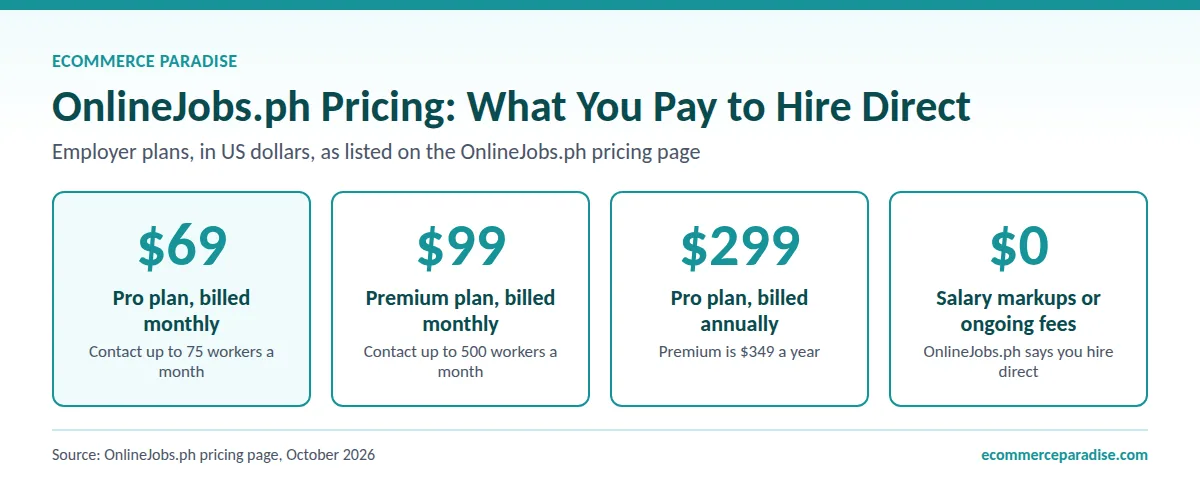
What makes OnlineJobs.ph exceptional is the economic model it enables. You pay a flat monthly subscription (the Pro plan is $69/month, or $299 billed annually, and Premium is $99/month, as of October 2026) to post jobs, browse worker profiles, and communicate with candidates. There are no commissions on wages, no per-hire fees, and no platform cuts taken from ongoing payments. Once you find the right person, you hire and pay them directly. A skilled Filipino virtual assistant, content writer, social media manager, customer service rep, SEO specialist, or graphic designer commonly asks for roughly $350 to $1,200 per month for full-time work at beginner to intermediate level, and senior experts ask for more. That range comes from the virtual assistant figures in OnlineJobs.ph’s own salary guide, so treat other roles as a rough guide. Either way, it’s a fraction of what equivalent talent costs in Western markets, without any platform taking a percentage on top.
Filipino professionals have built a global reputation for dedication, reliability, and strong English communication. Many are specifically looking for stable, long-term employment with a single employer rather than managing multiple clients simultaneously. This means hires made through OnlineJobs.ph tend to become genuinely invested team members: people who learn your systems, develop institutional knowledge, and grow with your business over months and years. That continuity is invaluable compared to the churn of project-based outsourcing.
The OnlineJobs.ph homepage says you can search a database of more than 5,000,000 Filipino profiles, across virtually every online business category. You can search by skill, experience, availability, and desired salary, browse full resumes, review portfolios, and communicate with candidates before making any commitment. For ecommerce businesses managing customer service queues, product catalog updates, content calendars, supplier communications, and order coordination, OnlineJobs.ph is the most cost-effective way to build the team that makes all of it possible.
Pros:
- No commission on wages ever: flat monthly subscription with zero ongoing platform fees
- Massive pool of English-proficient Filipino talent across every online business category
- Enables long-term employment relationships that build genuine team loyalty and institutional knowledge
- Exceptional value: skilled full-time workers available at rates far below Western equivalents
- Browse resumes, portfolios, and communicate with candidates before any hiring commitment
- Best platform for ecommerce entrepreneurs building a scalable remote operations team
Cons:
- Talent pool is exclusively Filipino: not ideal if you need specialists in other geographic markets
- Monthly subscription cost applies even during periods when you’re not actively hiring
- No built-in payment processing or escrow: wage payments are arranged directly
- Less suitable for one-off projects where speed and no relationship commitment are priorities
- Requires more hands-on hiring management than platforms that pre-match candidates for you
Start hiring on OnlineJobs.ph today and build the remote team your ecommerce business needs to scale.
2. FreeUp: Our Runner-Up Pick
FreeUp takes a fundamentally different approach from open outsourcing marketplaces by pre-vetting every freelancer before they join the network. FreeUp says it only lets in the top 1% of applicants through a rigorous screening process that evaluates technical skills, English proficiency, attitude, and reliability. The result is a curated marketplace where you can hire with significantly more confidence than platforms that accept anyone who creates a profile.
For business owners who need help quickly without spending days evaluating proposals from wildly varying candidates, FreeUp‘s matching speed is a major advantage. Describe what you need, and FreeUp says it will pair you with a qualified candidate within 24 hours. The platform has a particular strength in ecommerce, with many specialists experienced in Shopify, Amazon seller operations, product listing optimization, PPC campaign management, and customer service, exactly the roles most online business owners need to fill first.
FreeUp’s no-turnover guarantee means that if a freelancer quits, the platform works to replace them right away and covers applicable replacement costs. This significantly reduces the risk of the hiring process, which is one of the biggest anxieties entrepreneurs face when outsourcing for the first time. The platform covers categories including virtual assistance, content writing, graphic design, web development, digital marketing, bookkeeping, and ecommerce operations.
Pros:
- Only the top 1% of applicants get in, per FreeUp, so every freelancer has cleared meaningful quality vetting
- Fast candidate introductions: FreeUp says within 24 hours of submitting your hiring request
- Strong ecommerce specialization with experienced Shopify, Amazon, and online business operators
- Replacement guarantee reduces first-hire risk significantly
- No proposal sifting: FreeUp curates matches based on your specific requirements
- Freelancers are paid fairly, creating better quality incentives than race-to-bottom platforms
Cons:
- Smaller talent pool than open platforms due to selective vetting
- Rates are higher than unvetted freelancers on open marketplaces
- Platform markup on hourly rates adds cost compared to direct hiring through OnlineJobs.ph
- Less suitable for highly niche technical roles with fewer available vetted specialists
- Less browsing flexibility: you describe needs and receive introductions rather than self-selecting
Hire vetted freelancers through FreeUp and get matched with ecommerce-experienced talent within 24 hours.
3. Upwork
Upwork is the world’s largest general outsourcing and freelance marketplace, connecting businesses with independent professionals across virtually every category imaginable: software development, data science, content writing, graphic design, video production, accounting, legal services, customer support, marketing, and hundreds more. For businesses that need a broad range of talent on demand without long-term commitments, Upwork’s scale is unmatched.
Freelancers pay Upwork a service fee that ranges from 0% to 15% per contract, and that fee is fixed once the contract begins (per Upwork’s fee page, as of October 2026). The old 20%, 10%, 5% sliding scale is gone. Upwork’s built-in time tracking, milestone payments, escrow system, and dispute resolution provide a secure environment for both sides of the transaction.
The scale of Upwork’s talent pool is its primary advantage for outsourcers: you can find specialists in virtually any domain, review verified work histories and client feedback, and start projects quickly. The challenge is filtering through significant volume, as competition among freelancers means you’ll receive proposals ranging from highly skilled specialists to low-cost generalists, requiring careful evaluation.
Pros:
- Largest talent pool of any outsourcing platform: virtually every skill category represented
- Robust payment protection through escrow, milestone payments, and dispute resolution
- Verified work history and client reviews provide meaningful vetting signals
- Freelancer service fee is fixed when a contract starts, so the terms stay predictable
- Fixed-price and hourly contract options suit different outsourcing needs
- Well-established platform with strong legal and financial protections
Cons:
- High volume of proposals requires significant time investment to evaluate
- Freelancers pay a service fee of up to 15% per contract, which can show up in what they charge you
- Quality varies widely: expert specialists and low-effort bidders submit to the same jobs
- Connects system costs tokens for proposal submissions
- Algorithm favors established profiles, making it harder to find emerging talent
- Some clients report difficulty reaching consistent, high-quality contractors
Browse talent on Upwork and post your first job today to start receiving proposals.
4. Fiverr Business
Fiverr and its Fiverr Business tier have evolved from the original $5 gig model into a legitimate outsourcing platform for businesses of all sizes. The platform’s Gig-based model, where service providers create standardized packages clients can purchase directly, makes it exceptionally fast for specific, well-defined outsourcing tasks. Need a logo, a product description, a voiceover, a social media graphic, or a 1,000-word blog post? You can find, review, purchase, and receive it within 24–48 hours without any back-and-forth negotiation.
Fiverr Business adds team management features, a curated catalog of vetted professionals called Fiverr Pro, and consolidated billing that suits companies managing multiple outsourced functions simultaneously. For ecommerce businesses that need quick turnaround on design assets, content, video editing, or SEO tasks, Fiverr’s speed and simplicity are genuine advantages. Fiverr says it charges a flat 20% commission on every sale a freelancer makes, tips included, and buyers pay a separate service fee on top.
Pros:
- Fastest platform for well-defined, deliverable-based outsourcing tasks
- Fiverr Pro tier provides access to vetted, higher-quality professionals
- No proposal process needed: browse packages, review samples, purchase and receive work
- Enormous category breadth covering virtually every creative and digital service
- Strong SEO means Fiverr sellers rank well externally, driving platform credibility
- Fiverr Business adds team management and consolidated billing for growing companies
Cons:
- Flat 20% commission with no reduction for long-term relationships
- Package-based model is less suited to complex, custom, or ongoing projects
- Quality varies significantly between sellers at similar price points
- Race-to-bottom pricing pressure in saturated categories affects average quality
- Less suitable for building long-term outsourcing relationships than staffing-focused platforms
- Dispute resolution can be slow and seller-favorable in some cases
Explore Fiverr Business to find pre-packaged services you can purchase and receive within 24–48 hours.
5. 99designs
99designs is the leading outsourcing platform specifically for graphic design, and one of our most recommended platforms for any business that needs professional creative work done. Whether you need a logo, brand identity, packaging design, website design, social media graphics, merchandise design, or book cover, 99designs connects you with a global community of professional designers through two distinct models.

The contest model invites multiple designers to submit concepts based on your brief, giving you a diverse range of creative directions to evaluate before selecting a winner and paying. This is particularly valuable when you’re not sure exactly what direction you want to take and benefit from seeing multiple interpretations. The direct hire model lets you browse designer portfolios and hire a specific designer for your project, creating a more collaborative, relationship-based engagement. 99designs Pro provides access to the platform’s most experienced and highest-rated designers for premium projects.
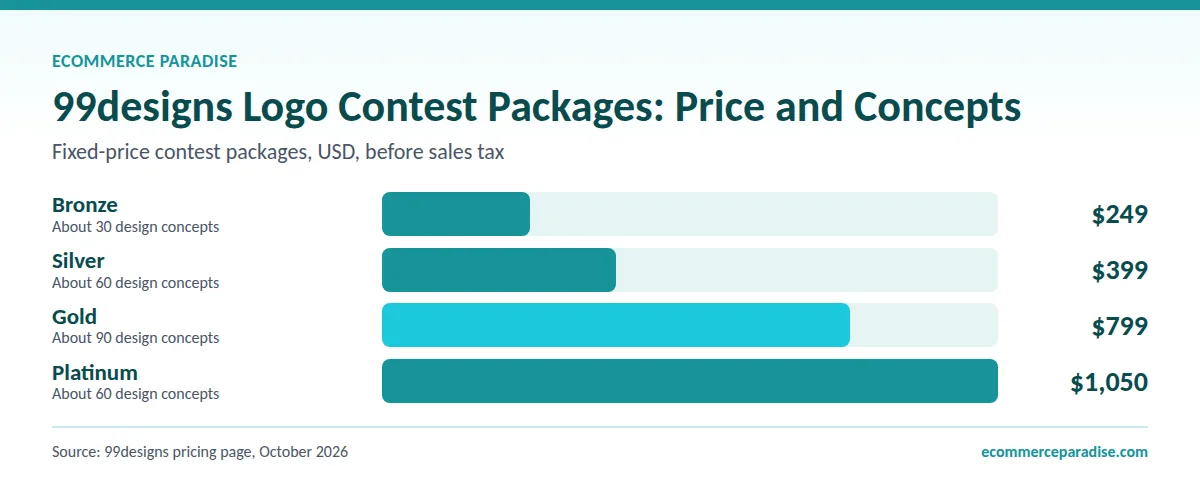
For ecommerce brands that understand design quality directly affects conversion rates, trust perception, and long-term brand equity, 99designs’ design-exclusive focus means every provider on the platform is there specifically because design is their craft, not a secondary skill offered alongside dozens of other services.
Pros:
- Design-specific platform attracts clients and designers who take creative work seriously
- Contest model provides multiple creative concepts before you commit to a direction
- 99designs Pro tier gives access to the most experienced, highest-rated designers
- Strong portfolio showcase tools make designer quality assessment straightforward
- Well-known brand with significant marketing reach drives consistent designer quality
- Good payment protection on both contest and direct hire models
Cons:
- Contest model involves speculative unpaid work for designers who don’t win
- Platform is exclusively for design: no other skill categories
- 99designs takes a meaningful percentage of designer earnings
- Contest participation requires significant time investment in concept development
- Global competition keeps some rates under pressure in commodity design categories
- Building a relationship with a specific designer requires moving to direct hire model
Launch a design contest or hire directly on 99designs to get professional creative work done fast.
6. Toptal
Toptal is the elite end of the outsourcing spectrum, claiming to accept only the top 3% of applicants through a multi-stage screening process that includes language assessment, technical evaluation, live skills testing, and a paid trial period with a real client. For businesses that need senior-level talent (software architects, financial modelers, UX leads, product managers) without the overhead of executive recruitment, Toptal provides access to pre-vetted professionals at the top of their fields.
Toptal handles matching rather than running an open marketplace, meaning you describe your needs and Toptal surfaces the most appropriate candidates from their network. This is efficient for time-pressed business owners who can’t afford to spend days evaluating proposals. The client base includes Fortune 500 companies, fast-growing startups, and well-funded scale-ups that need trusted expertise quickly. Rates reflect the elite positioning: Toptal is among the most expensive outsourcing options, but for senior technical and strategic roles the quality assurance justifies the premium.
Pros:
- Rigorous vetting accepts only top 3% of applicants: quality assurance is exceptional
- No proposal process: Toptal handles matching based on your requirements
- Rates reflect real senior expertise, not inflated junior rates
- Engagements tend to be long-term, reducing repeated hiring friction
- Strong legal protections and IP agreements built into the engagement process
- Well-suited to enterprise and growth-stage companies with demanding technical needs
Cons:
- Among the most expensive outsourcing options available
- Primarily serves software development, design, finance, and product management
- Less suitable for operational or administrative outsourcing needs
- Platform controls matching: less agency for clients in candidate selection
- Not accessible for small businesses or solo entrepreneurs with limited budgets
- Acceptance process means availability of specific specialists isn’t guaranteed
Apply to work with Toptal clients or hire from their elite vetted network for your most demanding technical needs.
7. PeoplePerHour
PeoplePerHour is a UK-based outsourcing platform with strong European reach and growing global coverage. The platform combines a proposal-based job posting model with a Hourlies feature, fixed-price service packages that function similarly to Fiverr Gigs, giving businesses flexibility in how they engage talent. Categories include web development, digital marketing, content writing, graphic design, SEO, and business support services.
PeoplePerHour’s AI-powered matching system surfaces relevant freelancers to clients based on project requirements, reducing the noise of irrelevant proposals. This selective matching tends to improve the signal-to-noise ratio compared to pure open-bidding platforms. Fees range from 3.5–20% depending on the freelancer’s earnings history on the platform, with long-term relationships becoming more cost-efficient over time.
Pros:
- AI matching reduces irrelevant proposal volume and surfaces more qualified candidates
- Hourlies feature enables fast purchasing for well-defined tasks
- Strong UK and European talent base with professional expectations
- Sliding fee structure incentivizes ongoing outsourcing relationships
- Good category coverage for marketing, development, and creative work
Cons:
- Smaller client and talent base than Upwork: fewer job postings overall
- Less name recognition outside of the UK and Europe limits talent pool depth in some regions
- Interface and mobile experience lag behind modern competitors
- Payment processing can be slower than other platforms
- Less suitable for highly technical or niche outsourcing requirements
Post your project on PeoplePerHour and receive matched proposals from qualified freelancers.
8. Guru
Guru is a general outsourcing marketplace with a workroom-based collaboration system that makes managing ongoing outsourcing relationships particularly straightforward. The platform covers programming, design, writing, administrative support, sales, marketing, legal, and engineering categories. Guru’s free membership allows unlimited bid submissions, distinguishing it from platforms that gate proposal volume behind paid subscriptions.
At 5–9% commission depending on membership tier, Guru offers one of the lowest fee structures among established outsourcing platforms. The SafePay escrow system protects payments, and the workroom environment provides a clear, organized space for deliverables, milestones, messages, and file sharing across ongoing engagements.
Pros:
- 5–9% fee is among the lowest of any major outsourcing platform
- Unlimited proposals on free membership with no per-bid cost
- Workroom system makes long-term outsourcing relationship management clean and organized
- SafePay escrow provides solid payment protection
- Good for businesses seeking ongoing retainer-style outsourcing arrangements
Cons:
- Smaller talent pool and fewer job postings than Upwork or Fiverr
- Less brand recognition means fewer clients know to look for talent here
- Platform has invested less in UX modernization than newer competitors
- Verification and trust signals less robust than curated platforms
- Competition for available postings can be high relative to job volume
Find long-term outsourcing talent on Guru with one of the lowest fee structures in the industry.
9. Outsourcing providers: Specialized BPO Firms
Beyond marketplace platforms, many businesses, particularly those outsourcing customer service, data processing, or back-office operations at scale, work directly with Business Process Outsourcing (BPO) firms. Companies like TaskUs, TTEC, and Teleperformance provide managed teams of trained agents handling specific business functions on an ongoing basis.
BPO relationships differ from freelance platforms in that you’re hiring a managed service rather than individual workers. The BPO firm handles recruitment, training, supervision, and quality control. This model suits businesses that need large-scale, consistent operations, like a customer service team handling thousands of tickets per month, rather than individual specialists. Costs are higher than direct hiring through platforms like OnlineJobs.ph but lower than building equivalent teams in-house in high-cost markets.
Pros:
- Managed service model eliminates direct hiring, training, and supervision burden
- Well-suited to high-volume, process-driven functions like customer service and data entry
- Quality control and management are the BPO firm’s responsibility
- Easier to scale up or down than managing individual remote hires
- Enterprise-grade security, compliance, and SLA agreements available
Cons:
- Significantly higher cost than direct talent platforms like OnlineJobs.ph
- Less control over individual workers and team culture
- Minimum volume requirements exclude small businesses from many BPO relationships
- Less flexibility for specialized, knowledge-intensive outsourcing needs
- Long-term contracts common, reducing agility if needs change
Explore BPO options like TaskUs if you need managed, high-volume operational outsourcing at scale.
10. Contra
Contra is a growing independent platform distinguished by its 0% commission model: freelancers keep 100% of what they earn, and the platform generates revenue through premium features and client-side subscriptions rather than transaction cuts. For businesses, this means the talent you’re paying is actually receiving what you pay, creating better incentives for quality and retention.
Contra focuses on independent professionals across design, development, marketing, writing, and operations. The platform skews toward more experienced, self-directed professionals who’ve moved away from commission-heavy platforms. The client base is growing, and the talent present tends to have higher professional expectations around project quality and communication.
Pros:
- Zero commission means freelancers receive full pay, creating better work quality incentives
- Modern platform aesthetic attracts experienced, professional-grade talent
- No proposal token or bid limit friction for either side
- Growing community of high-caliber independent professionals
- Client-friendly browsing experience with strong portfolio presentation
Cons:
- Smaller total talent base than established platforms
- Fewer job opportunities for freelancers means less browsing depth for clients
- Payment protection and dispute resolution less battle-tested than legacy platforms
- Fewer niche specializations available compared to Upwork’s breadth
- Still building the track record and community that older platforms have developed over years
Create your free profile or post a job on Contra and connect with independent professionals who keep 100% of what they earn.
11. Remote.com
Remote addresses one of the most significant challenges businesses face when outsourcing internationally: legal compliance, payroll, and employer-of-record (EOR) requirements. Remote serves as the legal employer for your international hires, handling local payroll processing, tax compliance, benefits administration, and employment contract management in over 170 countries. This makes it possible to hire full-time remote employees in foreign countries without establishing a legal entity in each jurisdiction.
For businesses that want to convert successful freelance relationships into formal employment arrangements, with all the loyalty, commitment, and stability that comes with that, Remote.com provides the infrastructure to do it compliantly. It’s particularly valuable for companies that have found excellent talent through platforms like OnlineJobs.ph and want to offer formal employment terms.
Pros:
- Handles international payroll, tax, benefits, and legal compliance in 170+ countries
- Enables formal employment of international workers without establishing local entities
- Converts freelance relationships into stable, compliant employment arrangements
- Reduces legal risk of international hiring significantly
- Supports benefits, equity, and perks administration for global teams
Cons:
- Meaningful monthly cost per employee: intended for committed ongoing hires, not project work
- Overkill for small businesses still in early outsourcing experimentation
- Primarily a compliance and payroll tool, not a talent discovery platform
- Requires you to find talent through other means before using Remote for employment
- Less suitable for project-based or short-term outsourcing needs
Learn more about Remote.com if you’re ready to convert freelance relationships into compliant international employment.
12. Fiverr Pro
Fiverr Pro deserves separate mention from the standard Fiverr marketplace. Pro is Fiverr’s hand-vetted tier featuring freelancers who’ve been reviewed and approved by Fiverr’s team based on portfolio quality, professional experience, and service reliability. Pro sellers work across categories including brand design, video production, copywriting, web development, business consulting, and digital marketing, and they command significantly higher rates than standard Gig sellers.
For businesses that need Fiverr’s speed and simplicity but require a quality threshold that the general marketplace doesn’t reliably deliver, Fiverr Pro is the middle path between open platforms and fully curated services like Toptal or FreeUp.
Pros:
- Hand-vetted talent provides meaningful quality assurance above standard Fiverr
- Faster engagement than Toptal or FreeUp while maintaining higher standards than the open marketplace
- Package-based model maintains Fiverr’s speed advantage for well-defined projects
- Good for premium one-off outsourcing without committing to long-term relationships
- Strong category coverage across creative, technical, and business services
Cons:
- Still subject to Fiverr’s 20% flat commission structure
- Vetting is less rigorous than Toptal or FreeUp acceptance processes
- Package model less suited to complex, evolving, or ongoing project work
- Pro tier availability varies significantly by category
- Rates at Pro level can approach or exceed equivalent talent on other curated platforms
Browse Fiverr Pro sellers to find hand-vetted professionals across design, development, marketing, and more.
13. Belay
Belay is a premium US-based virtual assistant and remote staffing service that places pre-vetted American contractors with clients as VAs, bookkeepers, and social media managers. Unlike open platforms where you browse and self-select, Belay handles matching entirely: you describe your needs, and Belay assigns a contractor from their network of pre-screened professionals.
Belay’s positioning is premium on both sides: clients pay more than on general platforms, and contractors earn more than they would on Upwork or equivalent marketplaces. For executives, business owners, and teams that need high-trust, high-communication virtual support and are specifically looking for US-based professionals comfortable working in American business culture, Belay delivers a managed, concierge-level experience.
Pros:
- US-based contractors with professional communication and cultural alignment
- Belay handles all matching: no time spent evaluating candidates
- Pre-vetted talent with consistent quality standards
- Strong for executive-level VA support requiring high trust and discretion
- Long-term relationship model provides stability and institutional knowledge
Cons:
- US-based only: significantly higher rates than offshore outsourcing options
- Limited to VA, bookkeeping, and social media management categories
- Less autonomy in contractor selection than open browsing platforms
- Belay’s margin means total cost is high relative to quality of work delivered
- Not suitable for technical, creative, or specialized professional outsourcing needs
Connect with a Belay specialist for concierge-level US-based virtual assistant matching.
14. Virtual Staff Finder
Virtual Staff Finder is a done-for-you recruiting service for businesses looking to hire Filipino virtual assistants without the hands-on work of posting jobs and evaluating candidates themselves. You describe the role you need filled, and Virtual Staff Finder’s team recruits, screens, and shortlists three candidates for you to interview and select from. The service charges a one-time placement fee rather than ongoing commissions.
For business owners who want access to Filipino talent, similar to what OnlineJobs.ph provides, but prefer to have someone else handle the recruitment legwork, Virtual Staff Finder is a practical bridge between full DIY hiring and full-service staffing agency pricing.
Pros:
- Done-for-you recruitment saves significant time compared to DIY hiring through job boards
- Access to high-quality Filipino VA talent similar to OnlineJobs.ph
- One-time placement fee with no ongoing commissions on wages
- Three curated candidates to interview gives choice without overwhelming volume
- Good for business owners who want outsourcing without the hiring process
Cons:
- One-time placement fee can be $500+ depending on role
- No ongoing platform support once placement is made
- Smaller candidate pool than browsing OnlineJobs.ph directly
- Less suitable for businesses that need to hire frequently or across multiple roles simultaneously
Use Virtual Staff Finder to have Filipino VA candidates recruited and shortlisted for you without the hiring legwork.
- Limited to VA and administrative roles: not a broad outsourcing solution
15. Hubstaff Talent
Hubstaff Talent is a completely free directory where businesses can browse remote worker profiles and contact talent directly, with no fees for either side. Freelancers and contractors create profiles across categories including development, design, writing, marketing, and support, and clients browse and reach out without any platform intermediary.
Because there are no commissions, no escrow, and no payment processing, Hubstaff Talent functions as a discovery layer rather than a managed marketplace. All financial arrangements happen directly between business and contractor. It works best as a supplementary discovery channel for established businesses that have their own onboarding and payment systems and want additional talent pipeline without adding platform fees.
Pros:
- Completely free for both businesses and talent: zero commissions or subscription fees
- Good supplementary discovery channel alongside primary platforms
- No bid limits, token systems, or proposal friction
- Direct communication from the first contact creates warmer hiring conversations
- Works alongside Hubstaff’s time tracking and payroll tools if already using the ecosystem
Cons:
- No payment protection, escrow, or dispute resolution built in
- Much smaller talent base than major platforms: limited job volume
- No vetting or quality assurance: profiles are self-reported
- Less name recognition means fewer professionals actively maintain profiles here
- Not viable as a primary outsourcing platform for businesses with frequent hiring needs
Browse remote worker profiles on Hubstaff Talent for free: no commissions, no fees, ever.
16. Bark.com
Bark.com operates as a lead generation platform rather than a traditional outsourcing marketplace. Businesses post service requests and Bark notifies matching professionals, who then purchase credits to respond to those leads. The platform covers a wide range of categories including photography, marketing, accounting, legal, cleaning, tutoring, and many more, making it particularly useful for outsourcing needs that fall outside the digital services categories dominant on other platforms.
Because Bark charges professionals for lead access rather than taking a commission on completed work, there are no platform fees on earnings. Won business belongs entirely to the professional and client. For businesses outsourcing local services or non-digital functions, Bark’s broad category coverage fills gaps that freelance platforms focused on remote digital work don’t address.
Pros:
- No commission on completed work: pay only for lead access on the professional side
- Very broad category coverage including non-digital and local services
- Good for outsourcing needs underserved by remote-focused platforms
- Active intent signals from leads indicate genuine hiring interest
- Useful complement to remote platforms for local or in-person outsourcing needs
Cons:
- Pay-per-lead model means spending money even when leads don’t convert
- Lead quality varies: some are early in consideration rather than ready to hire
- Less suited to ongoing remote outsourcing relationships
- Less name recognition than major platforms reduces professional profile quality
- Not designed for specialized knowledge work or senior professional engagements
Post your service request on Bark.com to receive responses from matched professionals across hundreds of categories.
17. SolidGigs
SolidGigs takes a different approach from every other platform on this list. It’s a curated job alert service rather than a marketplace. SolidGigs monitors dozens of job boards, company career pages, and freelance platforms and delivers the top 1% of outsourcing opportunities to subscribers daily. For businesses, this isn’t a direct hiring tool, but for the freelancers and contractors you’re trying to attract, understanding that SolidGigs exists helps explain why well-qualified professionals may find your posted opportunities even when you post beyond the major platforms.
For solo entrepreneurs and small teams actively building their own freelance or contractor income alongside their primary business, SolidGigs is a practical tool for discovering quality work without spending hours across multiple platforms, a flat $21/month with no commissions on earned income.
Pros:
- Curated job selection saves hours of searching across multiple platforms
- No commission on work won: keep 100% of all earnings
- Flat monthly subscription is predictable and recoverable with a single quality engagement
- Useful supplement to primary platform strategy for active freelancers
- Includes business development resources and templates
Cons:
- Not a hiring platform for businesses: relevant only for the freelancer/contractor perspective
- Requires existing proposal skills and external portfolio to convert discovered opportunities
- Monthly subscription cost applies regardless of how many jobs are won
- Less useful in niches where SolidGigs’ curation doesn’t cover well
- No community or support ecosystem comparable to full marketplace platforms
Try SolidGigs to receive the top 1% of curated freelance opportunities delivered daily: no commissions on work you win.
Complete Guide to Outsourcing Successfully
What to Outsource First
One of the most common questions entrepreneurs ask when starting to outsource is where to begin. The answer depends on your business, but a useful framework is to start with tasks that are time-consuming, well-defined, and repeatable, not your highest-value strategic work. Customer service responses, data entry, social media scheduling, product listing creation, order tracking follow-ups, and basic content formatting are all examples of work that can be systematized into clear standard operating procedures and handed off reliably.
The goal of your first outsourcing hire is twofold: to free up a meaningful block of your own time, and to develop your ability to manage remote workers effectively. Both skills compound over time. The more clearly you can document processes and communicate expectations, the better every subsequent outsourcing relationship will be. Think of your first hire as the beginning of your remote team capability, not just a task execution solution.
Writing Job Descriptions That Attract Quality Candidates
The quality of candidates you attract is directly proportional to the clarity and specificity of your job posting. A vague posting like “looking for a virtual assistant to help with various tasks” will attract a flood of generalist applicants with no specific expertise relevant to your needs. A specific posting like “looking for a Shopify-experienced VA to manage customer service tickets, process refunds, update product descriptions, and coordinate with suppliers 20 hours per week” attracts candidates who can immediately assess whether they’re a good fit and demonstrate relevant experience.
Your job description should clearly state the specific tasks involved, the expected time commitment and schedule, the tools or platforms they’ll need to work in, the communication cadence you expect, and how performance will be evaluated. Salary or rate ranges reduce wasted time for both sides. Including a small test in the application, like answering a specific question buried in the job description, filters out candidates who apply without actually reading your posting.
Managing Remote Workers Effectively
Outsourcing only works as well as your management systems allow. Remote workers, no matter how talented, need clear expectations, regular communication, and structured accountability to deliver consistent results. Before your first hire starts, document the processes they’ll own in enough detail that someone unfamiliar with your business could follow them. Standard operating procedures don’t need to be elaborate. A clear step-by-step outline with screenshots or a Loom video walkthrough is often sufficient.
Establish regular check-ins at a cadence that fits the role: daily async updates via a project management tool like Asana or Trello, weekly video calls to review performance and address questions, and monthly reviews to assess whether the relationship is working and where it can improve. Over-communication in the early weeks of a new outsourcing relationship prevents the misaligned expectations that cause most early failures.
The most important management principle for remote outsourcing is measuring outcomes rather than activity. Define what success looks like in concrete, measurable terms for each role: number of tickets resolved per day, articles published per week, ads managed with target ROAS achieved. Then hold your remote workers accountable to those metrics rather than hours worked or tasks checked off.
Frequently Asked Questions About Outsourcing Websites
What is the best outsourcing website for small businesses?
For small businesses and ecommerce entrepreneurs, OnlineJobs.ph is our top recommendation. The flat subscription model with no ongoing commissions makes it the most cost-effective way to build a team, and the quality of Filipino remote workers available through the platform is genuinely excellent across virtually every online business function. For businesses that want a faster, more managed hiring experience without the hands-on search process, FreeUp’s curated matching and ecommerce specialization make it the best runner-up.
How much does it cost to outsource through these platforms?
Costs vary significantly by platform and talent type. OnlineJobs.ph charges a flat subscription (Pro is $69/month and Premium is $99/month as of October 2026) to access the talent pool, with full-time Filipino VAs commonly asking for roughly $350–$1,200/month at beginner to intermediate level, per OnlineJobs.ph’s own salary guide. FreeUp lists rates from about $5 to $75+ per hour depending on experience tier (as of October 2026), while Upwork freelancers set their own rates, typically $10–$100+ depending on the skill level and category. Toptal and Belay represent the premium end where senior talent costs $100–$250+ per hour. Design outsourcing through 99designs ranges from a few hundred dollars for contest-based logo work to several thousand for brand identity projects.
Is outsourcing safe? How do I make sure I get what I pay for?
Safety depends largely on the platform you use and whether you follow the platform’s payment protocols. Established platforms like Upwork, FreeUp, and Fiverr use escrow and milestone systems that hold funds until work is delivered and approved, providing meaningful protection. Direct hiring platforms like OnlineJobs.ph require you to arrange your own payment methods. Common approaches include PayPal, Wise, or direct bank transfers to Filipino workers. The best protection in any outsourcing relationship is starting with a small paid test project before committing to a larger engagement, and always having a clear written agreement on deliverables and timelines.
What’s the difference between outsourcing and hiring a freelancer?
The terms are often used interchangeably, but there’s a meaningful distinction in practice. Freelancers typically work on discrete projects for multiple clients simultaneously, while outsourced roles tend to be ongoing, operational, and integrated into your business systems. A freelance graphic designer who creates a logo for you is a freelancer; a Filipino VA who manages your customer service inbox 30 hours per week as part of your team is an outsourced hire. Platforms like OnlineJobs.ph and FreeUp are oriented toward the outsourced hire model, while Fiverr and 99designs are more suited to the freelance project model.
Can I outsource my entire ecommerce operation?
Yes, and many successful ecommerce entrepreneurs do exactly this. The typical progression is to outsource customer service first, then product listing and catalog management, then content production and SEO, and finally paid advertising management. Each function requires finding the right talent, building the right systems, and developing your own ability to manage and measure remote performance. Some entrepreneurs, particularly those running high-ticket dropshipping stores, eventually operate businesses where they focus exclusively on supplier relationships, strategy, and growth while their outsourced team handles all day-to-day operations. Our masterclass at ecommerceparadise.com/masterclass covers this operational model in detail.
How do I know if someone I hire through an outsourcing platform is reliable?
Platform reviews and verified work history are the strongest signals available on marketplace platforms. On Upwork, look for job success scores above 90%, verified employment history, and long-term client relationships rather than many short-term engagements. On OnlineJobs.ph, look for completed ID verification, detailed work history, and positive references from previous employers. In interviews, evaluate communication quality, response speed, and whether the candidate asks clarifying questions. All are strong indicators of how they’ll behave once hired. Starting every new outsourcing relationship with a paid test task before committing to a full engagement is the most reliable filter of all.
The niche you choose for your ecommerce business has a direct effect on how much outsourcing you will need and what it will cost. Our high-ticket niches list breaks down the categories with the best margins and the most room for a lean, outsourced team. Once you have a niche locked in, our guide to finding the best suppliers walks through how to vet manufacturers before you start delegating supplier communication to a virtual assistant.
Before you bring on contractors or employees, it is worth getting the legal and financial foundation in place. Our business formation checklist covers the LLC, banking, and contractor-payment steps most new store owners overlook until it costs them.
Build Your Outsourced Team and Scale Your Business
The entrepreneurs who grow the fastest are rarely the ones who work the most hours. They’re the ones who build the best systems and find the best people to run them. Outsourcing is the mechanism that converts your business from a job you’ve created for yourself into an enterprise that generates value beyond your personal output.
Whether you’re just beginning to delegate your first tasks or you’re building a fully remote operational team to run a growing ecommerce business, the platforms in this guide give you access to exceptional talent at every budget level and commitment depth. Start with OnlineJobs.ph or FreeUp to build your core team, use Upwork or Fiverr for specialized project work, and turn to 99designs when your brand and design needs require professional creative execution.
If you’re building the ecommerce business that you want to eventually run with an outsourced team, Ecommerce Paradise has everything you need to get started on the right foundation. Our free course at ecommerceparadise.com/freecourse covers the fundamentals. Our masterclass at ecommerceparadise.com/masterclass provides the advanced strategy for scaling to consistent monthly revenue through high-ticket dropshipping.
Ecommerce Paradise Resources
If you’re building an ecommerce business alongside your outsourcing strategy, these resources will help you create sustainable revenue:
Free Course: Start Here Learn the fundamentals of high-ticket dropshipping and building a profitable ecommerce business from scratch.
Masterclass: Advanced Training Advanced strategies for sourcing premium suppliers, building high-converting stores, and scaling to six and seven figures.
Done-For-You Store Build Let our team build your high-ticket dropshipping store for you, fully optimized and ready to generate revenue.
Coaching Book a 1-on-1 call for personalized guidance on your high-ticket dropshipping business.
Scaling Services Expert growth services including Google Shopping ad management, catalog optimization, and supplier recruiting for established stores.
Supplier Directory Curated database of verified high-ticket dropshipping suppliers across dozens of profitable niches.
YouTube Channel Free video training on ecommerce strategy, supplier sourcing, and business scaling.

Trevor Fenner is an ecommerce entrepreneur and the founder of Ecommerce Paradise, a platform focused on helping entrepreneurs build and scale profitable high-ticket ecommerce and dropshipping businesses. With over a decade of hands-on experience, Trevor specializes in high-ticket dropshipping strategy, niche and product selection, supplier recruiting and onboarding, Google & Bing Shopping ads, ecommerce SEO, and systems-driven automation and scaling. Through Ecommerce Paradise, he provides free education via in-depth guides like How to Start High-Ticket Dropshipping, advanced training through the High-Ticket Dropshipping Masterclass, and fully done-for-you turnkey ecommerce services for entrepreneurs who want a faster, more hands-off path to growth. Trevor is known for emphasizing sustainable, real-world ecommerce models over hype-driven tactics, helping store owners build scalable, sellable, and location-independent brands.


