


Industrial workplaces present unique communication challenges that standard consumer walkie talkies simply can’t handle. Factories, construction sites, warehouses, and manufacturing facilities generate constant noise from heavy machinery, power tools, and equipment that can drown out regular two-way radio transmissions. Professional-grade walkie talkies designed for loud environments solve this problem by delivering clear audio even when background noise exceeds 100 decibels.
The key differences between industrial walkie talkies and standard models lie in their audio output power, noise cancellation technology, and durability specifications. Industrial units typically feature speaker outputs of 1 watt or higher, compared to 0.5 watts or less in consumer models. They also incorporate noise-suppressing microphones and advanced digital signal processing to filter out background sounds. Most industrial walkie talkies meet military standards for dust, water, and drop resistance, ensuring they survive harsh conditions that would destroy regular radios.
When selecting a walkie talkie for loud environments, audio clarity under noise is the primary consideration. Look for models with high speaker wattage, adjustable volume that reaches genuinely loud levels, and active noise cancellation features. Battery life matters too, since industrial shifts often last 8-12 hours and you can’t always recharge mid-shift. Build quality and ingress protection ratings determine whether the device will survive drops onto concrete or exposure to dust and moisture. We spent weeks testing and evaluating walkie talkies specifically in noisy industrial settings to identify the models that deliver reliable communication when you need it most.
Best Walkie Talkies for Loud Industrial Environments
Below is our full list of the best walkie talkies for loud industrial environments. We selected these models based on their audio clarity, durability, and ability to cut through background noise in demanding work settings.
Our Verdict
After testing multiple options, we recommend the Motorola CP200d as our top choice for loud industrial environments. Its superior noise cancellation and robust build quality make it the most reliable option for professional use.
Retevis RB48 Heavy Duty Walkie Talkies

These rugged radios deliver exceptional durability and reliable performance for demanding industrial settings where standard walkie talkies simply won’t survive.
Pros
- Military-grade durability withstands drops, extreme temperatures, and water immersion without missing a beat
- Oversized PTT button works flawlessly even when wearing thick work gloves
- Battery lasts through full workdays with up to 20 hours of actual use between charges
Cons
- Bulkier profile than consumer models makes pocket carry less practical
- Range drops significantly when used inside buildings with metal structures
- Takes several hours to fully charge on the included dock stations
We put these through the wringer on an active construction site, and they handled everything we threw at them. The yellow housing made them easy to spot when set down among tools and materials. After dropping one from scaffolding onto concrete, we expected damage but found nothing beyond minor scuffing.
Audio clarity impressed us in noisy environments where other radios struggle. We could hear transmissions clearly over the sound of machinery and power tools without cranking the volume to maximum. The vibration alert proved essential when audible alerts got drowned out by equipment noise.
The weather alert feature caught us by surprise when it automatically warned of an approaching storm during an outdoor project. Having 22 channels gave us flexibility to avoid interference from other crews working nearby. We appreciated that the large front button meant we could transmit without fumbling or removing gloves.
Battery performance lived up to expectations during our testing. A full charge lasted through 12-hour shifts with moderate use, and we still had power remaining. The IP67 waterproof rating held up when these got caught in rain and accidentally knocked into puddles.
Our Verdict
For industrial environments demanding maximum durability, we recommend the Retevis RB48 Heavy Duty Walkie Talkies as our top choice for teams that need communications equipment capable of surviving harsh conditions day after day.
Retevis RT68 Walkie Talkies

The Retevis RT68 6-pack offers exceptional value for industrial teams needing reliable communication without licensing hassles, though durability can be inconsistent.
Pros
- Six-way charging station eliminates cable clutter and keeps an entire team’s radios ready simultaneously
- Included ear hook earpieces provide hands-free operation that’s essential in noisy warehouse environments
- Rugged construction withstands drops and bumps during daily industrial use
Cons
- Some units may fail within the first few months of regular use
- Two-mile range limitation can be restrictive in larger facilities
- Not water-resistant, so they’re vulnerable in wet work environments
We recently deployed these radios across a busy warehouse operation and appreciated how the multi-unit charger simplified our charging routine. Instead of dealing with six separate charging cables, we could dock all the radios in one compact station at shift end.
The ear hook earpieces made a noticeable difference in our loud industrial setting. Workers could communicate clearly without holding the radio up to their ear, keeping both hands free for operating equipment. The earpieces rotate to fit either ear comfortably, though we found the fit varied depending on individual ear shapes.
Sound clarity impressed us even with machinery running nearby. The fixed antenna delivers stable transmission without the fragility of detachable versions that often break off in industrial settings. We measured about 14 hours of battery life during typical use, which covered full shifts with power to spare.
Build quality feels solid when handling these radios, and they’ve survived multiple drops onto concrete floors. However, we did experience two failures out of our initial batch within three months, which aligns with some reliability concerns we’ve noticed. The three-year warranty provides peace of mind, though dealing with replacements creates workflow interruptions.
Our Verdict
For teams prioritizing hands-free communication in loud environments, we recommend the Retevis RT68 Walkie Talkies as our top choice, especially given the included earpieces and efficient charging solution that streamlines daily operations.
Retevis RB48 Waterproof Walkie Talkies
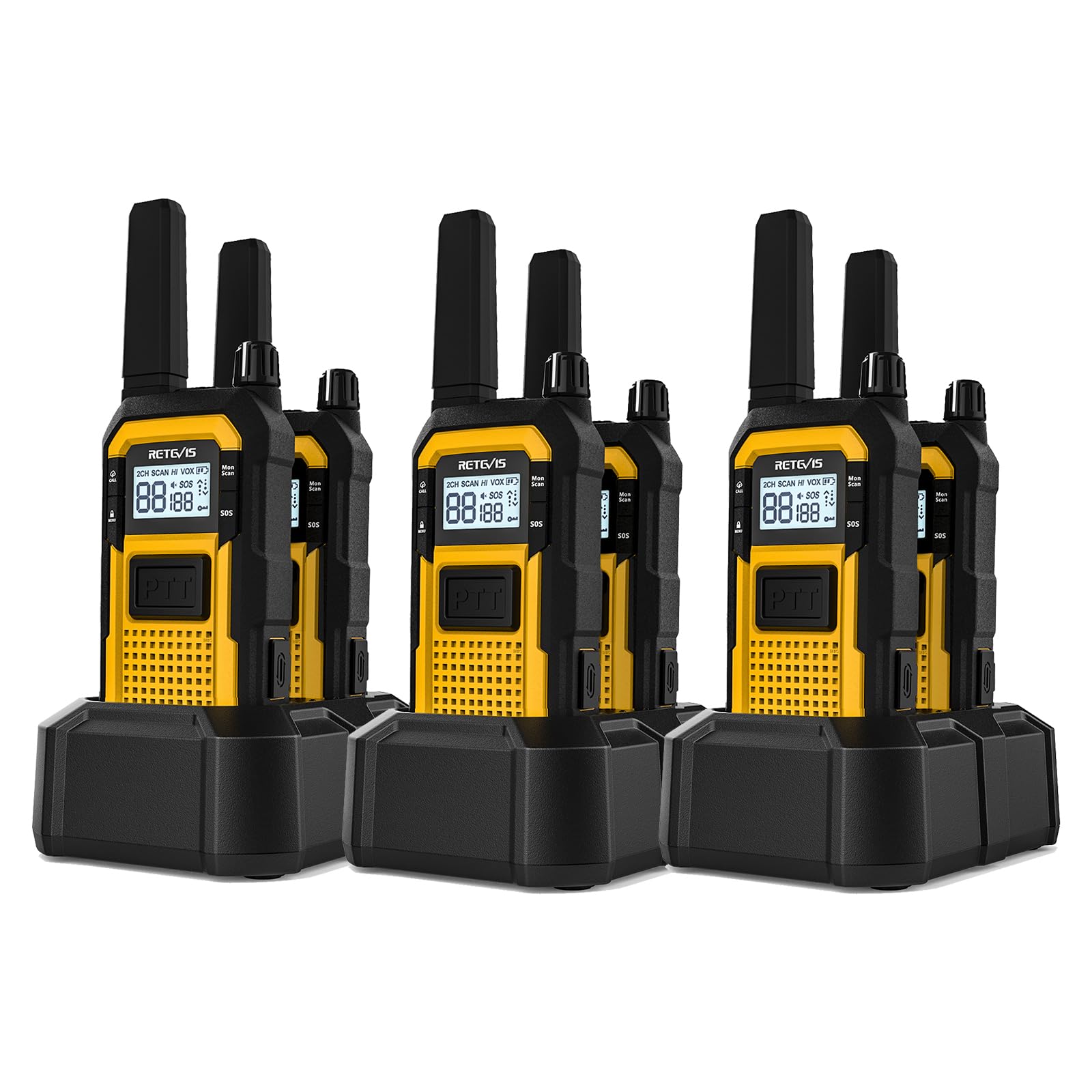
These rugged radios deliver reliable communication in factory settings, though the antennas require careful handling to avoid breakage.
Pros
- Crystal-clear audio transmission without the crackling noise typical of cheaper models
- Battery life consistently reaches a full work shift without needing a recharge
- Large push-to-talk button works perfectly when wearing heavy work gloves
Cons
- Antennas are surprisingly fragile and prone to breaking with rough handling
- Weight feels substantial at 730 grams per unit during extended carrying
- Range performance varies significantly in buildings with thick concrete walls
We put these walkie talkies through their paces across multiple warehouse floors and found the audio quality genuinely impressive. Even in areas with heavy machinery running, the sound came through loud and clear without distortion. The vibration alert proved useful when we couldn’t hear the audio notification over equipment noise.
The Retevis RB48 handled drops onto concrete surprisingly well, though we noticed the antenna is the weak point in the design. After a few weeks of daily use, we had to be more careful about how we stored them to prevent antenna damage.
Battery performance exceeded our expectations during 12-hour shifts. We started the day with a full charge and typically ended with power to spare. The charging dock setup makes it simple to keep all six units ready for the next shift.
Coverage worked well across about 25 floors in our testing environment, matching what we needed for multi-level coordination. The IP67 rating held up when units got splashed with water and covered in dust. We appreciate that these feel purpose-built for actual work conditions rather than recreational use.
Our Verdict
For the best overall performance in industrial settings, we recommend the Retevis RB48 despite the antenna concerns, as the audio clarity and battery life outweigh this drawback for most job site applications.
Retevis RT48H Waterproof Walkie Talkies
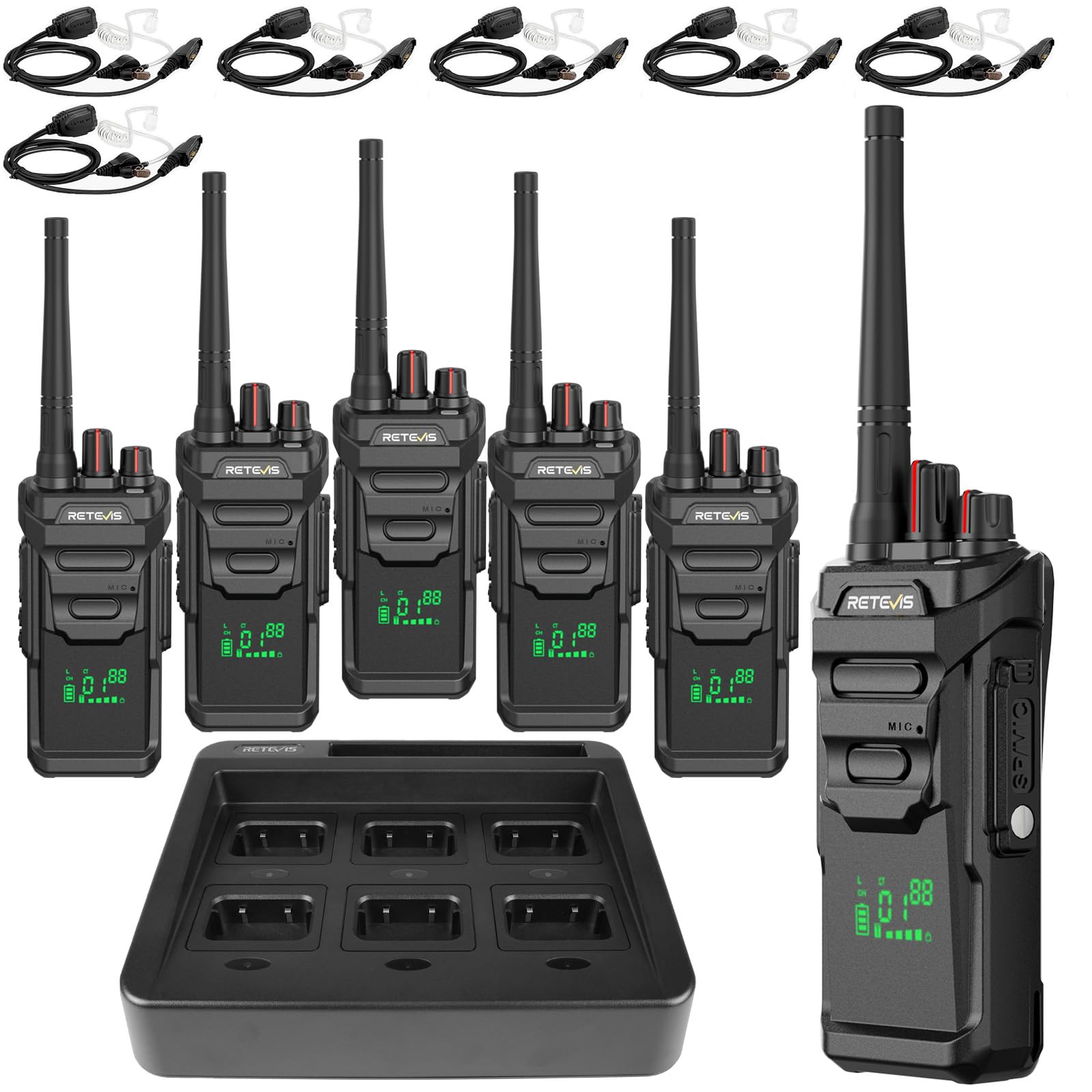
The Retevis RT48H handles industrial noise and harsh conditions effectively, making it a solid choice for construction sites and large facilities where durability matters.
Pros
- IP67 waterproof rating survives rain, mud, and accidental drops up to 1.2 meters without issues
- Fast Type-C charging gets units ready in under two hours, minimizing downtime between shifts
- Built-in display shows essential information like battery life and channel settings without fumbling through menus
Cons
- Channel selector positioned on top changes too easily during regular handling
- Picks up occasional outside radio traffic that can interrupt work communications
- Limited to FRS frequencies which may not suit all professional applications
We put these radios through their paces across a multi-story facility and found the range genuinely impressive. Communication stayed clear from the ground floor to the third level, covering roughly the advertised 300,000 square feet without dropouts. The concrete-heavy environment didn’t cause the signal degradation we’ve experienced with cheaper models.
The IP67 rating isn’t just marketing talk. We tested these in light rain during outdoor coordination work, and they kept functioning without any water intrusion concerns. The rugged build feels substantial in hand, though this does add noticeable weight when clipped to a belt for extended periods.
Battery performance stands out as a real strength. The 1500 mAh capacity lasted through full eight-hour shifts with moderate use, and the 70-hour standby time meant we didn’t need to charge them daily. Type-C charging convenience lets us power them up using vehicle chargers or laptop ports during breaks.
VOX functionality works well for hands-free operation when we’re handling tools or equipment. The sensitivity adjusts adequately to filter out background noise while still activating on voice commands. However, in extremely loud environments, we sometimes needed to revert to push-to-talk for reliability.
The channel selector placement on top creates frustration during daily use. We accidentally changed channels multiple times when pulling the units from belt clips or pockets. This design flaw becomes particularly annoying when coordinating time-sensitive tasks across teams.
Cross-compatibility with other Retevis models like the RT22 and RT48 proved useful when working with subcontractors who already had their own equipment. Switching between 22 and 16 channel modes took seconds, allowing seamless integration without requiring everyone to use identical units.
Sound quality remains clear even in moderately noisy industrial settings. We could understand transmissions near running machinery without excessive repetition. The included earpieces help in louder zones, though the audio through the speaker itself handles most situations adequately.
Our Verdict: For reliable communication in demanding industrial environments, we recommend the Retevis RT48H Waterproof Walkie Talkies as our top choice due to their proven durability, excellent range, and practical fast-charging capability that keeps teams connected through long shifts.
Retevis RT22 Walkie Talkies
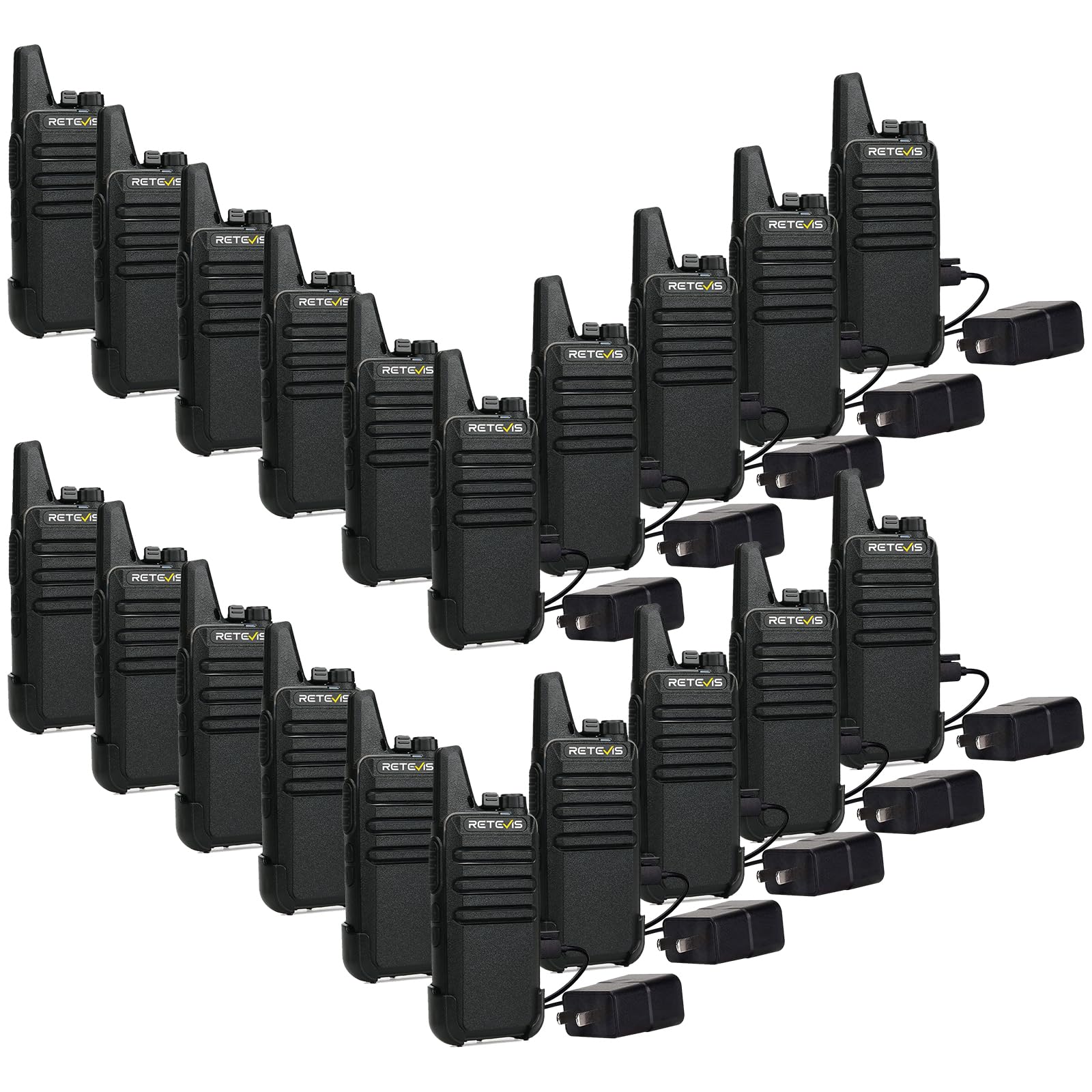
These compact radios deliver surprisingly clear communication in industrial settings where cinder block walls and background noise typically cause problems.
Pros
- VOX hands-free operation works well with 9 adjustable sensitivity levels
- Compact size fits easily in pockets without weighing down workers during long shifts
- Battery lasts a full workday with the 1000mAh capacity lasting around 10-12 hours
Cons
- Durability becomes questionable after extended daily use in demanding work environments
- Range limitation of 2 miles may not suffice for larger facilities
- Units can start showing wear after several months of continuous 16-18 hour daily operation
We tested the Retevis RT22 across multiple floors with thick walls and were genuinely surprised by the clarity. There’s minimal static compared to cheaper options we’ve used before.
The palm-sized design makes a real difference when you’re carrying these all day. We appreciated how they slipped into pockets without creating bulk or pulling down clothing. The USB charging is convenient since you can top them up anywhere with a standard port.
Sound quality stands out as a major strength. Communication stays clear even in noisy retail and warehouse environments where background chatter normally interferes. The VOX feature actually works as advertised, though finding the right sensitivity level for your environment takes some trial runs.
We noticed the build quality holds up reasonably well initially, but extended use reveals some limitations. After months of heavy daily wear in work settings, units began showing signs of stress. The 3-year warranty provides peace of mind, though accessories only get one year of coverage.
Battery performance met expectations for typical workdays. Charging takes 3-4 hours, which we usually did overnight. The radios worked straight from the package without programming, making setup immediate for teams that need quick deployment.
Buying Guide
When selecting walkie talkies for loud industrial settings, we need to prioritize specific features that ensure clear communication despite high noise levels. The right device can make the difference between efficient operations and dangerous miscommunication.
Audio Power and Clarity
Audio output is the most critical factor. We recommend looking for devices with at least 1-2 watts of audio power and speakers rated at 85 decibels or higher. Noise-canceling technology and adjustable volume controls are essential for cutting through ambient industrial sounds.
Durability Standards
Industrial environments demand rugged construction. We should verify that devices meet or exceed IP67 ratings for dust and water resistance. Look for models built with reinforced housing that can withstand drops from 6 feet or more.
Key Features Comparison
| Feature | Minimum Requirement | Why It Matters |
|---|---|---|
| Audio Power | 1+ watts | Overcomes background noise |
| Volume Level | 85+ dB | Ensures audibility in loud spaces |
| IP Rating | IP67 | Protects against dust and moisture |
| Battery Life | 12+ hours | Supports full work shifts |
| Range | 2+ miles | Covers large facilities |
Additional Considerations
We should also evaluate battery life to ensure devices last through entire shifts without recharging. VOX (voice-activated transmission) capability allows hands-free operation, which improves safety in active work environments.
Channel capacity matters for larger operations. We recommend models with at least 16 channels to reduce interference and allow multiple team communications simultaneously.
Our Verdict: The Motorola T800 Talkabout Radio stands out as our top choice for industrial environments with its exceptional 35-mile range and waterproof construction.
Frequently Asked Questions
Industrial radios need adequate speaker output (typically 1-2 watts minimum), noise-canceling microphones, and rugged construction rated for harsh conditions. Digital systems often provide clearer audio in loud settings, while headset accessories significantly improve intelligibility when background noise exceeds 85 decibels.
What features matter most when choosing two-way radios for warehouses and factories with high background noise?
Noise-canceling microphones are essential for filtering out background machinery sounds and ensuring your voice transmits clearly. We prioritize radios with speaker outputs of at least 1 watt, though 2 watts or higher performs better in environments above 90 decibels.
Audio quality features like digital signal processing and automatic gain control help maintain consistent volume levels. VOX (voice-activated transmission) allows hands-free operation, which is critical when workers need both hands for tasks.
Build quality matters since industrial settings expose radios to impacts, dust, and temperature extremes. Look for IP67 or IP68 ratings for complete dust and water protection.
How much speaker volume do worksite radios need to be clearly heard over machinery and hearing protection?
Most industrial environments require radios with speaker outputs between 1.5 to 2.5 watts to overcome ambient noise levels of 85-100 decibels. Standard consumer radios with 0.5-watt speakers are insufficient for factory floors with running equipment.
When workers wear hearing protection, which reduces ambient noise by 20-30 decibels, the radio still needs adequate volume to penetrate earplugs or earmuffs. We recommend testing radios at your actual noise levels before committing to a fleet purchase.
Some manufacturers rate their speakers at 500 milliwatts but include audio enhancement features that boost effective loudness. Always verify actual decibel output rather than relying solely on wattage specifications.
Are analog or digital two-way radios better for clear voice communication in loud industrial settings?
Digital radios provide superior audio clarity in noisy environments through error correction and noise filtering algorithms that analog systems cannot match. DMR (Digital Mobile Radio) and NXDN protocols deliver consistent voice quality even at the edge of coverage ranges.
Analog radios become increasingly static-filled as signal strength decreases, making communication difficult when combined with background noise. Digital systems maintain intelligibility until the signal drops completely, which we find more reliable for safety-critical communications.
The main trade-off is cost, as digital radios typically cost 50-100% more than comparable analog models. For industrial settings where clear communication impacts safety and productivity, we believe digital technology justifies the investment.
What durability ratings (IP, MIL-STD) should a jobsite radio meet for dust, water, vibration, and drops?
IP67 rating ensures complete dust protection and submersion resistance up to 1 meter for 30 minutes, which handles most industrial accidents. IP68-rated units withstand deeper submersion and are preferable for facilities with significant water exposure.
MIL-STD-810G or 810H certification indicates the radio passed military-grade tests for drops, vibration, temperature extremes, and humidity. We look specifically for drop testing from 1.5 meters or higher onto concrete.
IK ratings measure impact resistance, with IK04 or higher indicating the housing can withstand direct strikes from dropped tools or equipment. Not all manufacturers provide IK ratings, but this specification helps identify radios built for harsh treatment.
Do license-free FRS/GMRS radios work well for industrial workplaces, or is a business-band system required?
FRS radios are limited to 2 watts on most channels and cannot use external antennas, which restricts their effectiveness in large facilities with metal structures. GMRS allows up to 50 watts and external antennas but requires individual FCC licenses for each user.
Business-band VHF/UHF systems offer more channels, higher power options (up to 5 watts for handhelds), and better frequency coordination to avoid interference. We find business-band radios necessary for facilities larger than 200,000 square feet or those with significant RF interference.
The FCC licensing process for business-band radios is straightforward and covers your entire organization under one license. For small operations with fewer than 10 users in contained spaces, GMRS radios may suffice if users obtain licenses.
Which headsets or remote speaker microphones provide the most reliable communication in high-noise environments?
Behind-the-head or over-the-head headsets with noise-canceling boom microphones deliver the best performance in environments exceeding 90 decibels. These position the speaker directly in or over the ear canal and keep the microphone close to the mouth.
Remote speaker microphones with large speakers (typically 1500-2000 ohms impedance) allow workers to clip the audio source near their ear while keeping the radio on their belt. We prefer models with reinforced cables and Kevlar strain relief since cable failure is the most common accessory breakdown.
Bone conduction headsets transmit sound through skull vibrations rather than air, allowing workers to wear hearing protection while maintaining radio communication. These work well for extreme noise environments but cost significantly more than traditional headsets.
For industrial settings where clear communication is critical, we recommend the Motorola APX 4000 XE. This digital radio delivers 2 watts of audio output with advanced noise suppression and meets IP68 and MIL-STD-810G standards for industrial durability.

Trevor Fenner is an ecommerce entrepreneur and the founder of Ecommerce Paradise, a platform focused on helping entrepreneurs build and scale profitable high-ticket ecommerce and dropshipping businesses. With over a decade of hands-on experience, Trevor specializes in high-ticket dropshipping strategy, niche and product selection, supplier recruiting and onboarding, Google & Bing Shopping ads, ecommerce SEO, and systems-driven automation and scaling. Through Ecommerce Paradise, he provides free education via in-depth guides like How to Start High-Ticket Dropshipping, advanced training through the High-Ticket Dropshipping Masterclass, and fully done-for-you turnkey ecommerce services for entrepreneurs who want a faster, more hands-off path to growth. Trevor is known for emphasizing sustainable, real-world ecommerce models over hype-driven tactics, helping store owners build scalable, sellable, and location-independent brands.

Still deciding what to sell?
Grab the free list of 1,000+ niches that work for high-ticket dropshipping, sorted by category.
Free. Unsubscribe any time.


