


Affiliate disclosure: some links in this article are affiliate links and I may earn a commission at no cost to you. It does not change what I recommend or what the vendor pages actually say. Every figure below was read on Content Development Pros’ own live pages on 15 September 2026, and the page that publishes each one is linked next to it.
I published a full review of Content Development Pros earlier today, and the thing that kept nagging at me afterwards was that the review only looked at two of their pricing pages. So I went back and pulled their sitemap, which lists 179 URLs, downloaded every one of them, and grepped the lot for dollar signs. Eighty six pages came back with a price on them.
That changes the answer. Because once you read more than one page, you find that Content Development Pros does not have a price for a 1,000 word post. It has three, on three different pages of its own website, and they are $31.90, $35.00 and $40.00 depending on which door you walk in through.
That is not me catching them out. It is a company that sells nine or ten different named products which all happen to be prose, priced separately, on separate landing pages, the way a print shop prices a postcard differently from a rack card. But if you are an ecommerce entrepreneur about to buy content for a store selling $3,000 units, the practical consequence is real: the page you land on from Google decides what you pay, and nothing on any of those pages tells you a cheaper page exists.
So this article is the price board they do not publish in one place. Every package, every retainer tier, every term discount, with the URL that carries it. I have counted the rows in every table against the live page. Where their own arithmetic does not add up, I say so rather than quietly fixing it, because you are going to see the same number on their site and I would rather you knew.
Buy the Cheapest Version of the Same Job
A 1,000 word post is $31.90 on the blog page, $35.00 on the article page and $40.00 on the listicle page. Same company, same week. Knowing that before you order is worth more than any coupon.
The Blog Post Price Board
This is the board most people find, because it is what the navigation calls blog writing. Everything in this section is on their blog writing service page.
| Package | Listed price | Stated turnaround |
|---|---|---|
| 1 Custom Blog Post, 300 words | $11.95 | Within 2 Business Days |
| 1 Custom Blog Post, 500 words | $17.44 | Within 2 Business Days |
| 1 Custom Blog Post, 1000 words | $31.90 | Within 2 Business Days |
| 10 Custom Blog Posts, 300 words each | $105 | Within 3 Business Days |
| 10 Custom Blog Posts, 500 words each | $175 | Within 3 Business Days |
| 10 Custom Blog Posts, 1000 words each | $350 | Within 3 Business Days |
| 1 AI Content Package, 300 words | $2.5 | Delivered within 72 hours per 10K words |
| 10 AI Content Package, 300 words | $25 | Delivered within 72 hours per 10K words |
Eight rows, and I counted them against the live page. You can check that board is still showing these eight packages in about thirty seconds, which is worth doing because package boards move. That is the Standard Packages block on that URL. It is not everything that page sells, because the same page also carries a long form tier and three monthly retainers, both of which are further down this article.
A footnote under the block is worth reading before you treat any of this as fixed. It says: “The packages quoted on this page are for standard projects.” The same note adds that complexity, industry and quality “may necessitate custom pricing.” Read every figure in this article as a floor.
The Article Price Board, Which Is Not the Same Board
Their article writing service page sells what looks like the identical product under a different noun, at different prices and different turnarounds.
| Package | Listed price | Stated turnaround |
|---|---|---|
| 1 Custom Article, 300 Words | $10.50 | Within 2 Business Days |
| 1 Custom Article, 500 Words | $17.50 | Within 2 Business Days |
| 1 Custom Article, 1000 Words | $35.00 | Within 7 Business Days |
| 10 Custom Articles, 300 Words | $105.00 | Within 2 Business Days |
| 10 Custom Articles, 500 Words | $175.00 | Within 2 Business Days |
| 10 Custom Articles, 1000 Words | $350.00 | Within 7 Business Days |
| 1 AI Content Package, 300 words | $2.5 | Delivered within 72 hours per 10K words |
| 10 AI Content Package, 300 words | $25 | Delivered within 72 hours per 10K words |
Eight rows again, counted. Now compare them line by line, because the differences are not random.
At 300 words the article is cheaper, $10.50 against $11.95. At 500 words the blog post is cheaper, $17.44 against $17.50, by six cents. At 1,000 words the blog post is cheaper by $3.10, and this is the important one, the blog post ships in 2 business days while the article ships in 7. The ten packs converge at exactly the same three figures, $105, $175 and $350, but the ten pack of 300 word blog posts takes 3 business days and the ten pack of 300 word articles takes 2.
So on the same site, in the same week, a thousand words of prose is either $31.90 in two days or $35.00 in seven days, and which one you get depends on whether you clicked the word blog or the word article.
And a Third Price on a Third Page
Their listicle writing service page sells a numbered list, which is still a blog post, on its own board: $20 for 500 words, $32 for 800 words and $40 for 1,000 words, each stated at Within 2 Business Days. The ten packs are $200, $320 and $400, each at Within 5 Business Days.
So a 1,000 word piece is $31.90, $35.00 or $40.00. The listicle is 25 percent more expensive than the blog post for the same word count and the same stated two day turnaround. If you were going to brief a listicle anyway, brief it as a blog post and put the numbered structure in the brief. That single sentence is worth $8.10 a post to you, and nothing on their listicle page mentions that the blog page exists.
What a Power Blog Costs Depends Which Page You Read
This is where it gets genuinely confusing, and it is the part that matters most if you are buying long form, because long form is the only shape of content worth buying for a high-ticket store.
Three pages sell a product called a power blog, at three different word counts and three different prices.
| Page | What it calls a power blog | Price for four a month |
|---|---|---|
| Blog writing service | 2500 words | $220.32/MO, Within 2 Business Days |
| Power blog service | 2000+ Words on the monthly tier, 1,400 Words on the standard packages | $260 struck through to $199 |
| Blog management services | 1,500 words | Not sold separately, bundled into the retainers below |
Three rows, three pages, and four different word counts between them: 1,400, 1,500, 2,000 plus, and 2,500. I counted those four against the live pages before writing the number.
The monthly ladder on the power blog page reads 1 POWER POST/MO at $65 struck through to $60, 2 POWER POSTS/MO at $130 struck to $110, and 4 POWER POSTS/MO at $260 struck to $199, all labelled 2000+ Words. The blog writing page ladder reads 1 Power Posts/MO at $78.75, 2 at $116.64 and 4 at $220.32, all labelled 2500 words.
Four long posts a month is therefore $199 or $220.32, a gap of $21.32, and the cheaper one is on the page dedicated to the product. Before you subscribe through either, open both power blog boards at Content Development Pros and see which word count each one is showing today. I have no way of knowing whether the 2,500 word version is genuinely longer or whether one of these pages is simply stale, and I am not going to guess. What I can tell you is to put the word count you actually want into the brief in writing, because the brief is what the revision policy gets measured against.
The standard, non-monthly packages on the power blog page are a separate thing again: 1 POWER POST at $65 for 1,400 Words in 2 business days, 3 POWER POSTS at $195 for 1,400 words each in 5 business days, and 5 POWER POSTS at $325 for 1,400 words each in 10 business days. That is a flat $65 a post with no bulk discount at all, only a longer queue.
The Monthly Blog Retainers, and the Arithmetic Nobody Shows You
Three monthly packages, each displaying a current price next to a higher struck-through figure. I am publishing both figures, because a sale price quoted alone is not a price.
| Package | Current price | Struck-through | Blog content included |
|---|---|---|---|
| Basic Blogging | $350 | $400 | 1 power blog (1,500 words) and 1 skyscraper blog (2,500 words) per month |
| Advanced Blogging | $650 | $800 | 2 power blogs (1,500 words each) and 2 skyscraper blogs (2,500 words each) |
| Enterprise Blogging | $1,600 | $2,400 | 6 power blogs (1,500 words each) and 6 skyscraper blogs (2,500 words each) |
Three rows, counted against the page. The word counts in that last column are the useful part, and they are not on the blog writing page at all. They are only on the blog management services page, where they are printed under each bullet instead of hidden behind a tooltip. That is the single most valuable thing I found in the whole sitemap.
Now do the sum, because it is the sum that tells you what you are buying. Basic Blogging at $350 a month is 1,500 plus 2,500, so 4,000 words of blog content, plus 2 social posts. Four thousand words for $350 is 8.75 cents a word. The same company will sell you four 1,000 word posts off its own price board for $127.60, which is 3.2 cents a word.
So roughly $222 a month of that $350 is the management layer: keyword research, a blog calendar, royalty free images, publishing, link building and monthly reports. All three tiers list those. Advanced and Enterprise add a dedicated project manager and weekly reports instead of monthly.
Whether $222 a month is a fair price for somebody else running your calendar is a real question with a real answer, and the answer depends entirely on whether you would otherwise not publish at all. What it is not is a content discount. Buying the retainer costs you nearly three times per word what buying the posts costs.
The SEO Retainers, All Sixteen Cells of Them
Their SEO services page puts four tiers behind a term switcher with four settings, so there are sixteen published prices on that one page. Here they all are.
| Tier | Monthly | Quarterly, Save 10% | Biannual, Save 15% | Annual, Save 20% |
|---|---|---|---|---|
| Starter | $399/Mo | $1,077.30 from $1,197 | $2,034.90 from $2,394 | $3,830.40 from $4,788 |
| Growth | $699/Mo | $1,887.30 from $2,097 | $3564.9 from $4,194 | $6,710.40 from $8388 |
| Pro | $899/Mo | $2,427.30 from $2,697 | $4,584.90 from $5,394 | $8,630.40 from $10788 |
| Enterprise | $1099/Mo | $2,967.30 from $3,297 | $5,604.90 from $6,594 | $10,550.40 from $13188 |
Four tiers times four terms, and I checked every cell against the switcher. Their arithmetic here is clean, which is worth saying because it is not clean everywhere else on the site. Starter monthly is $399, times twelve is $4,788, and twenty percent off $4,788 is $3,830.40. Every one of the sixteen cells checks out the same way.
If an SEO retainer is what you came for, the term switcher on their SEO page is where the real decision sits, because the annual commitment costs you twenty percent less per month and twelve months of lock-in. Starter is the tier a store owner would look at, and its monthly deliverable is published in full: one article posted on a niche specific website, two blog posts posted on your website, one press release every month, ten links, three directory submissions, three social bookmarking submissions, three business profile creations and listings, and eight Facebook posts, eight tweets and eight Instagram posts.
The ten links line is the one I would interrogate before paying anybody $399 a month. Link building is the part of an SEO retainer where quality varies most and is hardest to check from outside, and directory submissions and social bookmarking are the 2012 end of that spectrum. Ask what the links actually are and where they land before the first invoice.
The Content Marketing Retainers, and a Number That Does Not Add Up
The content marketing page runs a separate three tier ladder with its own term switcher.
| Tier | Monthly | 6-month term, Save 15% | 1-year term, Save 30% |
|---|---|---|---|
| Standard | $349/Mo | $297/Mo, $1782 total | $244/Mo, $2928 total |
| Advanced | $999/Mo | $849/Mo, $5094 total | $699/Mo, $8388 total |
| Enterprise | $2499/Mo | $2124/Mo, $12744 total | $1749/Mo, $20988 total |
Nine cells, counted. Two things on that page are broken and you should know about both before you read a number off it.
First, the struck-through price on the annual Advanced tile reads $99, not $999. The same tile on the six month view reads $999 correctly, and $699 is exactly thirty percent off $999, so $99 is a typo on their page rather than an offer. Do not convince yourself you found a $99 plan.
Second, every total on that page is labelled “for a 1-year term”, including the six month tiles. Standard on the six month term shows $297 a month and a total of $1782, and $297 times six is $1,782, so that total is a six month total wearing a one year label. Check the term you are signing, not the caption under the number.
Standard at $349 a month buys one blog post, one paid press release, one guest blog and ten social media posts, plus keyword research, a content plan, a content calendar, royalty free images, content distribution and weekly reports. That is one post a month. For a store selling four figure products, one post a month is not a content strategy, it is a subscription.
The Retainer Is Not the Cheap Part of This Decision
Basic Blogging is 4,000 words for $350, which is 8.75 cents a word. The same words bought singly are 3.2 cents. If what you actually want is the whole machine built rather than a calendar rented, that is a different purchase and it should be made on purpose.
What an Ecommerce Store Actually Buys From Them
Blog posts are the headline product and the least interesting one for a store. Here is the rest of the menu, restricted to the things somebody running a high-ticket store would plausibly order.
Product Descriptions, Where the Spread Is Widest
Their product description writing page publishes exactly one number: “Starting from only $1 /Product Description”. There is no package block on it. That is a floor, not a price, and it is the least useful figure on the entire site.
Their Amazon product description page, by contrast, publishes a real board: 1 product description at 300 words for $27 within 2 days, 5 for $135 within 5 days, and 10 for $270 within 1 week. Three rows, counted, and no bulk discount at all, it is a flat $27 each.
So a product description is somewhere between $1 and $27 depending on which page you read and what a description turns out to mean. For a store where one SKU is a $3,400 unit, $27 for 300 words is not the expensive part. The expensive part is that 300 words written by somebody who has never seen the freight class, the lead time or the warranty terms will not answer the three questions that actually stop the sale. I go through what those questions are in my guide to finding and vetting high-ticket suppliers, because the answers come out of the supplier relationship, not out of a brief.
Web Copy and Content Pages
The web copy page lists 1 Page at $39.80 within 2 business days and 5 Pages at $199.00 within 7 business days. Five singles would be $199.00 as well, so the five pack buys you nothing but a longer queue. Their own FAQ on that page says: “While most web copy writing services charge you over $100 for a single web page, we often deliver the same service at half the price.”
The general content writing page publishes “Starting from only $12.95/Page” and no package block, which makes it another floor rather than a price.
Press Releases
Their press release page lists three packages, all at 500 words and all Within 2 Business Days: a Single Press Release at $49.95, a 2 Options Press Release at $79.95 which is “2 different versions written by 2 different writers”, and Press Release and Distribution at $79.95 with basic online distribution. Three rows, counted.
That page also carries a rights sentence the rest of the site does not: “As ghostwriters, we transfer all rights to you upon delivery.” That is a clearer statement than the comparison chart I picked apart in the review, though it is still marketing copy on a landing page rather than a signed assignment. Get the assignment in writing, signed from the entity that owns the store, which is one more reason to settle business formation for a high-ticket dropshipping business before you start buying assets. This article is general information and not legal advice, and copyright and contractor rules vary by state and by country.
The Store Build
Their ecommerce web design page publishes six tiers across three named groups, plus a bundle.
| Group | Tier | Price | What the page says you get |
|---|---|---|---|
| Basic | Standard | $399 | 3 main pages, 5 product pages, templated design, no content, complete in 5 business days |
| Basic | Custom Design | $699 | 3 main pages, 5 product pages, custom design, content included, complete in 10 business days |
| Intermediate | Template Design | $1,199 | 4 main pages, up to 25 product pages, no content, theme based design, complete in 3 weeks |
| Intermediate | Professional | $1,999 | 4 main pages, up to 50 product pages, original content, custom design, complete in 3 weeks |
| Advanced | Template Design | $3,499 | 12 main pages, up to 50 product pages, admin and user dashboards, original content, complete in 4-5 weeks |
| Advanced | Enterprise | $4,499 | 12 main pages, up to 50 product pages, dashboards, original content, 5 final draft revisions, complete in 4-5 weeks |
Six rows, counted against the page. Lower down, the same page offers a separate bundle “For only $2,099” that it also calls Enterprise, including a custom logo, the Intermediate eCommerce Website, custom design, custom content, a Facebook banner and an Instagram banner. So the word Enterprise appears on that page attached to both $2,099 and $4,499. If you are quoting them back at themselves, quote the tier description, not the tier name.
Five product pages on the $399 tier is the line that decides whether any of this is for you. A high-ticket store typically carries dozens to hundreds of SKUs, so the $399 and $699 tiers are a landing page with a checkout, not a store. Before you spend anything here, be honest about whether you have picked what you are selling, because the high-ticket niches list comes before any build decision.
The Per-Word League Table
Strip the product names off and the whole site collapses into one number: cents per word. Here is every human-written option I found, sorted cheapest first, with the page that publishes it.
| What you buy | Published price | Cents per word | Page |
|---|---|---|---|
| 4 power posts a month, 2500 words each | $220.32/MO | 2.2 | Blog writing |
| 4 power posts a month, 2000+ words each | $199/MO, from $260 | 2.5 at 2,000 words | Power blog |
| 1 blog post, 1000 words | $31.90 | 3.2 | Blog writing |
| 10 blog posts, 1000 words each | $350 | 3.5 | Blog writing |
| 1 article, 1000 words | $35.00 | 3.5 | Article writing |
| 1 listicle, 1000 words | $40.00 | 4.0 | Listicle |
| 1 micro blog post, 300 words | $13.5 | 4.5 | Micro blog |
| Basic Blogging retainer, 4,000 words | $350/MO, from $400 | 8.75 | Blog management |
| 1 Amazon product description, 300 words | $27 | 9.0 | Amazon descriptions |
| 1 press release, 500 words | $49.95 | 10.0 | Press releases |
Ten rows, counted, and that is ten of the options I found rather than every priced item on the site. I left the AI tier out of the table deliberately, because comparing 300 AI-assisted words at $2.5 to human writing on a cents-per-word basis is how people talk themselves into publishing a hundred thin pages a month.
Two things jump out of that table. The cheapest per-word rate on the entire site is the long form monthly tier, which is also the only format worth buying for a store that sells considered purchases. And the most expensive per-word rate is the retainer, which is the one the site pushes hardest.
The micro blog page is the outlier worth naming. It sells 1 micro blog post at $4.50 for 100 words, $9.00 for 200 words and $13.5 for 300 words, ten packs at $45, $90 and $135, and monthly tiers of 4 posts at $54 struck to $48.60, 12 posts at $162 struck to $145.80, and 30 posts at $405 struck to $364.50. Thirty 300 word posts a month for $364.50 is 4.05 cents a word and it is the exact shape of purchase Google’s spam policies documentation describes when it says: “Scaled content abuse is when many pages are generated for the primary purpose of manipulating search rankings and not helping users.” Nothing about buying thirty short posts makes that true automatically. Buying thirty short posts because they were cheap, with no brief behind them, does.
What I Would Actually Buy, and What I Would Not
If I were running a store selling $1,000 to $5,000 units and I had decided to buy from this company, here is the order I would place.
I would buy the long form monthly tier and nothing else. Four posts a month at 2,000 words plus, at $199 or $220.32 depending on which page you subscribe through, is the only line on the whole price board where the format matches what a high-ticket buyer needs, which is depth. A 300 word post cannot answer whether the freight carrier will bring the unit inside the house. A 2,000 word one can.
I would not buy the blog management retainer. Not because it is bad, but because the $222 a month you are paying above the raw content cost buys calendar management and link building, and at the stage most store owners are at, neither of those is the constraint. The constraint is that nobody has written down what makes your store different from the four others selling the same brand.
I would not buy product descriptions at any price until the store has been through a full quarter of real customer questions. Then I would buy them, from a brief built out of those questions, and I would pay the $27 rather than the $1 because the $1 page does not tell you what a dollar buys.
And I would spend the first order on a test rather than a project. Buy one 1,000 word post at $31.90 against a genuinely specific brief containing a fact that contradicts what every other article on the topic says. Then read what comes back and see whether the writer led with that contradiction, buried it, or ignored it. That is a thirty two dollar test that tells you more than the entire case studies page, and it is the same test I recommend for every writing vendor including the ones I link to. If you want the full picture of how they handle revisions, turnaround and the AI tier, that is all in my Content Development Pros review.
The honest summary of the pricing itself is this. Content Development Pros publishes more of its prices than almost anybody in this category, and I would rather have a messy public price board than a Request A Quote button, which is what most agencies give you. But the board is spread across at least ten pages, it contradicts itself on two products, and it contains at least one arithmetic error. Open more than one page before you order. That is the whole lesson, and it applies to every vendor on Ecommerce Paradise, not just this one.
Decide What to Buy Before You Decide Who to Buy It From
There are ten priced products on this board and only one of them fits a store selling four figure units. Picking the wrong one costs more than picking the wrong vendor. I work that decision through with store owners one session at a time.
Frequently Asked Questions
How much is a 1,000 word post from Content Development Pros?
It depends which of their pages you order from. The blog writing service page lists $31.90 within 2 business days. The article writing service page lists $35.00 within 7 business days. The listicle service page lists $40.00 within 2 business days. All three were live on 15 September 2026.
What is the cheapest content they sell per word?
Of the human-written options I priced, the long form monthly tiers are cheapest per word. Four power posts a month is $220.32 at 2,500 words each on the blog writing page, which is 2.2 cents a word, or $199 from a struck-through $260 at 2,000 plus words on the power blog page. The AI-assisted packages are cheaper still at $2.5 for 300 words, but their 30-day crawl guarantee excludes AI-assisted content.
Does Content Development Pros publish its SEO prices?
Yes, all sixteen of them. Four tiers, Starter at $399, Growth at $699, Pro at $899 and Enterprise at $1099 a month, each with quarterly, biannual and annual prices behind a switcher at 10, 15 and 20 percent off respectively. Every cell checks out arithmetically against the monthly figure.
Is the monthly blog retainer cheaper than buying posts?
No. Basic Blogging is $350 a month for 4,000 words of blog content, which is 8.75 cents a word. The same company sells 1,000 word posts at $31.90, so four of them is $127.60 or 3.2 cents a word. The difference is the management layer, not a content discount.
How much does a product description cost?
Their product description page says “Starting from only $1 /Product Description” and publishes no packages. Their Amazon product description page publishes a real board at $27 for one 300 word description, $135 for five and $270 for ten, with no bulk discount.
Do these prices include revisions?
Every human-written package card I read lists Unlimited Revisions among its inclusions, and their FAQ narrows that to revisions that do not contradict your original brief, with a possible small payment where a revision is drastically different from the original instructions. The brief is what the policy is measured against, so the brief is where your effort belongs.
Related Articles
- Content Development Pros Review 2026: Worth It for an Ecommerce Business?
- Boosta Review 2026: Worth It for an Ecommerce Business?
- How to Outsource Ecommerce Blog Content Without Losing Your Voice
- How to Create an SEO Content Strategy for Your Ecommerce Store
- Best VA Platforms for Small Business in 2026

Trevor Fenner is an ecommerce entrepreneur and the founder of Ecommerce Paradise, a platform focused on helping entrepreneurs build and scale profitable high-ticket ecommerce and dropshipping businesses. With over a decade of hands-on experience, Trevor specializes in high-ticket dropshipping strategy, niche and product selection, supplier recruiting and onboarding, Google & Bing Shopping ads, ecommerce SEO, and systems-driven automation and scaling. Through Ecommerce Paradise, he provides free education via in-depth guides like How to Start High-Ticket Dropshipping, advanced training through the High-Ticket Dropshipping Masterclass, and fully done-for-you turnkey ecommerce services for entrepreneurs who want a faster, more hands-off path to growth. Trevor is known for emphasizing sustainable, real-world ecommerce models over hype-driven tactics, helping store owners build scalable, sellable, and location-independent brands.
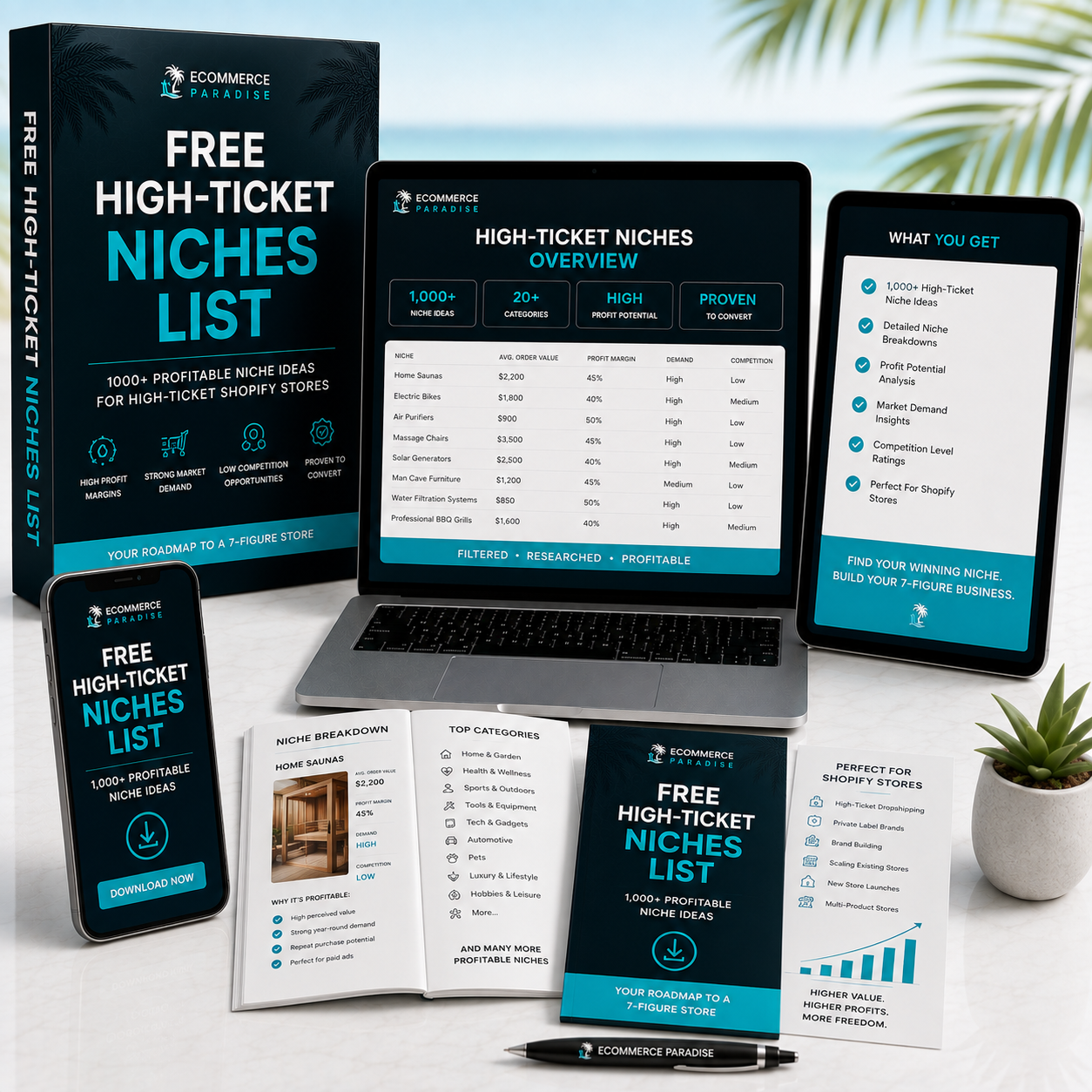
Still deciding what to sell?
Grab the free list of 1,000+ niches that work for high-ticket dropshipping, sorted by category.
Free. Unsubscribe any time.


