



This post exists because two things on this site disagree with each other, and I would rather fix that in public than leave a store owner to guess which of our pages to believe.
One of our guides says you can solve the two factor problem abroad with a VoIP line plus an authenticator app. Two others say banks and payment processors routinely reject VoIP numbers. Both cannot be simply true, and the popular version of the second claim, the one you will find repeated on every forum, is wrong in a specific and checkable way. So before I rank anything, I am going to sort out what is actually published and what is folklore.
The question in this post is narrow on purpose. Not which plan is cheapest, and not which carrier is friendliest to somebody living abroad. Just this: what kind of US number actually receives a bank or payment processor verification code? That is a question about number class and about each sender’s delivery policy, and it has a different answer from the pricing question.
Disclosure, before the first paid link. The Tello links here are affiliate links and this site is paid when somebody signs up, up to ten dollars a signup. Google Fi and Quo are also monetised on this site, so neither of those is a neutral recommendation either, and Quo in particular matters below because Quo is a VoIP product and VoIP is the thing under examination. Mint Mobile, US Mobile, Ultra Mobile, NumberBarn, Tracfone and Google Voice pay this site nothing. I am telling you which of my links pay me before I tell you what to do, because on this topic the temptation to shade the answer toward the paid product is obvious and I would rather you could see it.
The Claim Everyone Repeats, And Where It Came From
The claim is that SMS two factor codes do not get delivered to VoIP numbers, as a rule, because banks are not allowed to send them there. I have read that sentence dozens of times. It has three parts and two of them do not survive checking.
No US carrier publishes such a rule. I went looking for one. There is no carrier policy document that says verification codes cannot be delivered to a number classified as VoIP.
No US regulator publishes such a rule either. The Federal Communications Commission proceedings that people gesture at when they say “it is regulated” are about something else entirely. FCC 22-72, 23-21 and 23-107 concern illegal and scam text messaging and caller identification authentication. They are about blocking bad senders and proving a caller is who they claim to be. None of them regulates whether a one time passcode may be delivered to a number by its class. That is a different subject and the FCC has not ruled on it in the way the folklore implies.
The part that is real is a standards document, and it has been superseded. This is the crux, and it is the single most useful thing in this post.
The source everybody is actually citing, usually at third hand without knowing it, is NIST Special Publication 800-63B revision 3. That edition did prohibit VoIP for out of band authentication, in these words.
“Methods that do not prove possession of a specific device, such as voice-over-IP (VOIP) or email, SHALL NOT be used for out-of-band authentication.”
That is a real quote from a real document, and for years it was the backbone of every “VoIP cannot receive 2FA” post on the internet. But that revision has been superseded. The current edition, NIST SP 800-63B-4, published in July 2025, no longer prohibits VoIP for out of band authentication. Its only mention of VoIP is permissive. The prohibition on email survived. The prohibition on VoIP did not.
And there is a second layer people miss even when they get the first one right. NIST is the National Institute of Standards and Technology. Its digital identity guidelines set requirements for federal agency identity systems. They are not banking regulation. A commercial bank is not bound by SP 800-63B and never was. Plenty of banks read it and took guidance from it, which is exactly how a federal agency guideline turned into internet folklore about what banks are permitted to do, but “NIST says so” was never the same thing as “the bank is not allowed to”.
So What Is Actually True
Here is the honest finding, and I want to state it in a way that does not overshoot in either direction, because both overshoots are common and both are damaging.
“SMS verification codes never reach VoIP numbers” is real as observed behaviour and false as a rule.
It is real as behaviour because people genuinely do fail to receive codes on VoIP and wireline numbers, repeatedly, from named companies, and that failure is documented by the vendors themselves. It is false as a rule because there is no rule. What is happening is sender-side filtering: individual companies deciding, as a fraud control policy, not to send verification messages to certain number classes. That decision belongs to the sender, it varies company by company, it changes without notice, and nobody publishes a master list.
Which means two practical things. First, you cannot reason from “my number is VoIP” to “codes will not arrive”, because it depends entirely on who is sending. Second, and more importantly for a business, you cannot reason from “codes arrived last month” to “codes will arrive next month”, because the sender can change its policy and will not tell you.
That is a less satisfying answer than the folklore. It is also the only one I can defend, and it has a clear operational consequence that I will get to.
A Real Wireless Line Is The Conservative Choice
Tello publishes, in its own words, that one time passwords and bank verification texts reach you abroad once Wi-Fi calling is active, and plans run $5 to $25 per month. Two caveats I will keep repeating: the line must be activated inside the United States first, and the cheapest tier has no data, so a code arriving as a picture message will not reach it.
The Best Evidence In The Category, And Exactly What It Does Not Say
The strongest published evidence that number class gets filtered comes from NumberBarn, and NumberBarn publishes it about its own product, which is unusually honest for a vendor. NumberBarn numbers are classified as wireline, meaning landline, rather than mobile, and NumberBarn says what that breaks.
“Because NumberBarn phone numbers are classified as wireline (landline) numbers, support for these messages depends entirely on the company sending them.”
“NumberBarn cannot guarantee that a third party company will send verification messages, authentication codes, or short code texts to a wireline number.”
Then it names them, which is the part nobody else does. The real list runs longer than the extract below, and Bank of America and Schwab appear on its working side, so do not read this as banks failing and everything else passing. Confirmed working: Amazon, Apple ID, DoorDash, Facebook, Instagram, Google Duo, GrubHub, Mailchimp, Signal and TikTok. Confirmed not working: Chase Bank, Wells Fargo, Capital One, American Express, PayPal and Zelle, plus LinkedIn, X and ChatGPT.
Look at that failing list as a store owner. Chase, Wells Fargo, Capital One, American Express, PayPal, Zelle. That is the banking and payments layer of most American online businesses. NumberBarn adds that some companies specifically require a wireless mobile number for account creation, security verification, fraud alerts and password resets, and its own list of suggested workarounds includes getting a separate wireless mobile number, which is a vendor telling you its product is the wrong tool for this job.
Now the boundary, and I am going to be pedantic about it because getting this wrong would be worse than not writing the post.
That list describes NumberBarn’s own wireline numbers and nothing else. It is not a list of banks that reject Tello. It is not a list of banks that reject Mint, Ultra Mobile, US Mobile, Google Fi or any wireless carrier. It is not a general statement about VoIP either, because wireline and VoIP are different classifications. If you take away only one sentence from this section, take this one: nobody has published evidence that Chase refuses to text a Tello line, and I am not going to imply it by putting the two facts next to each other and letting you draw the line.
What the list genuinely proves is the mechanism. Named, identifiable companies do filter by number class, that filtering is a policy choice of theirs rather than a technical impossibility, and a vendor can tell you which ones fail for its own numbers if it chooses to. That is the evidence base. It is narrower than the folklore and considerably more useful. Our breakdown of Tello alternatives by job applies the same boundary to the parking and forwarding products.
Google Says It Too, About Its Own Free Product
The second vendor who publishes the problem about itself is Google, in the Google Voice documentation. Google says you can get text messages from anywhere in the world. In the same document, Google says this.
“Some websites, such as banks or subscription services, won’t send text messages to Google Voice numbers.”
And adds that in those instances you may need to use your mobile carrier number.
Two things are worth noticing about how Google worded that. Google does not name a single bank, so I cannot either. And Google does not frame it as a VoIP classification problem, it frames it as “some websites will not send to Google Voice numbers”. That is a statement about senders choosing not to deliver to a particular service, not a statement about a technical class of number. I am not going to extend Google’s wording past what Google wrote, because the temptation to turn “some websites” into “all banks” is exactly how this topic got confused in the first place.
For the record, Basic Google Voice is $0 for personal use on a personal Gmail account. Voice Starter standalone is $10 per month and Standard is $20, with Workspace add on tiers at $10, $20 and $30 per user per month that require paid Workspace. Google also reclaims numbers for inactivity, with a 45 day window to recover after the reclaim date, and the inactivity period that triggers a reclaim is not published, so you cannot plan around it.
Where That Leaves VoIP, Including The One That Pays Us
Quo is a VoIP service and it is monetised on this site. So when our own earlier guide recommended a VoIP line plus an authenticator app as the answer to the two factor problem abroad, that recommendation pointed at a paid link, and I am not going to quietly leave it standing without comment.
Here is the fair version. A VoIP business line is a genuinely good product for the job it is designed for: a number that rings you anywhere, that a team can share, that forwards on rules, that does not care where your body is. For taking supplier calls, for putting a professional number on a dealer application, for not handing out your personal mobile, VoIP is a reasonable choice, and our guide to business phone plans for small operations covers that use case properly.
The authenticator app half of that advice is also good, and better than it sounds. Where a bank or platform offers an authenticator app or a hardware key instead of SMS, taking it removes the entire problem from your life, because no message needs to be delivered to any number at all. That is the single highest value move in this post and it costs nothing.
What was wrong was the framing, which implied the combination solves the problem generally. It does not, for a plain reason: you do not get to choose the delivery method, the sender does. If your bank only does SMS, an authenticator app is not available to you for that account, and then everything depends on whether that specific sender will text your specific number class. Some will. Some will not. You will find out at the worst possible moment.
So the honest position on VoIP is neither “it never works” nor “it solves everything”. It is: it is a good business line, it is a poor single point of failure for account access, and the risk is not a regulation, it is a sender you do not control.
What Actually Receives A Code, Ranked
| Number type | Example | Published evidence about code delivery | Use it for account access? |
|---|---|---|---|
| Wireless carrier line, US | Tello, Mint Mobile, Ultra Mobile, US Mobile, Google Fi | No vendor in this class publishes a list of senders that fail. Tello publishes that bank one time passwords arrive abroad over Wi-Fi calling | Yes, this is the conservative choice |
| Wireless line, cheapest tier with no data | Tello at $5 per month | Plain SMS yes. Tello publishes that a message with a link or file becomes an MMS, that MMS needs data, and that MMS does not work over Wi-Fi | Only with a data tier underneath it |
| VoIP business line | Quo | No rule published against it by any carrier or regulator. No vendor named list either way. Depends entirely on the sender | Good business line, poor sole route to account access |
| Free VoIP from a platform | Google Voice | Google publishes that some websites, such as banks or subscription services, will not text Google Voice numbers | No, the vendor has told you not to |
| Wireline parking or forwarding | NumberBarn | Named failing list including Chase, Wells Fargo, Capital One, American Express, PayPal and Zelle, about its own wireline numbers | No, and NumberBarn says so itself |
The ranking is not a surprise once you strip out the folklore. A real US wireless line is the conservative answer, not because a rule forbids the alternatives, but because it is the number class with no published evidence of sender filtering against it, and because senders that filter are filtering for wireline and platform numbers rather than mobile ones.
Among the wireless options, Tello is the only one that publishes a statement about this exact situation.
“Once Wi-Fi Calling is active, you can receive One-Time Passwords (OTPs) and verification texts from your bank even if you are outside the US.”
That appears on two separate Tello pages, and two factor authentication code reception is separately listed as an included plan feature. Mint’s comparable statement is that receiving text messages while travelling is free of charge and that replying requires a Minternational Pass. Neither statement is a guarantee about any particular bank, because no carrier can make one. What Tello has done is put its name to the use case in writing, which is more than the others have done, and our full Tello review goes through what else that page commits to.
Buy The Tier With Data, Not The Famous One
Tello’s build your own configurator prices 2 GB with 300 minutes and unlimited text at $8 per month, and the Starter plan adds unlimited talk to that same 2 GB for $10. The $5 no data tier holds a number perfectly well but cannot receive a picture message, and a verification text containing a link is a picture message. Activation must happen inside the United States.
The Trap On The Cheapest Plan, Which Is Not About VoIP At All
Everything above is about number class. This is a different failure mode and it catches people who did everything else right, because it is about data rather than classification.
Tello’s own no data configurator page carries this warning, and it is Tello’s wording, not mine.
“Are you sure you don’t need Data? Remember that Data is required to send or receive an MMS. Any text message that includes a file (like a picture, video, emoji, or a website link) turns into an MMS and requires Data.”
Read that last clause slowly. A website link turns a text into an MMS. Plenty of verification and account security messages contain links. So on a no data plan, that message needs data the plan does not have.
Then Tello publishes a second thing, separately, about Wi-Fi calling: while standard texts work over Wi-Fi, picture messages do not. Put the two together and you get the actual consequence. The $5 plan is fine for holding a number and fine for plain text codes. A code that arrives as an MMS has no data to arrive on, and over a Wi-Fi calling setup abroad it does not arrive at all. This is the reason I will not recommend the famous $5 tier as the number your store’s account access depends on, and it is the sort of thing that only turns up when you read a vendor’s own configurator warnings instead of its marketing page. The arithmetic on paying the extra few dollars is in our breakdown of Tello’s price ladder.
One more boundary while we are here. Tello’s My Tello app is not a fallback for this. Tello publishes that you cannot receive calls or send and receive texts through the app. The app manages the account, it is not a second inbox.
What I Would Actually Do About Account Access
The conclusion of all this is not a product, it is an operating practice. If the delivery decision belongs to senders you do not control and can change silently, then no single number is a safe design.
Take the authenticator app or hardware key wherever it is offered. Every account you move off SMS is an account that cannot be broken by a filtering policy change, a lapsed plan or a hotel network that blocks Wi-Fi calling traffic. This is free and it is the highest leverage thing on the list.
Hold a real US wireless line for the accounts that only do SMS, and buy a tier with data on it. Keep it on an active plan rather than prepaid credit, because on Tello a plan lapse gives a 12 day grace period before the number expires with a reminder email a week earlier, whereas Pay As You Go credit with no plan expires three months after purchase and then the service is disconnected and the number is deleted permanently. Tello says plainly that it cannot bring back a number once it has expired.
Do not consolidate. If every bank, processor and platform points at the same single number, that number is a single point of failure for your whole business. Spread the critical accounts across two independent routes where the platform allows it.
Test before you need it. Trigger a real verification code on each critical account from where you actually live, not from an airport lounge on your way out. A code that arrived in Los Angeles proves nothing about the same code arriving over house Wi-Fi in another hemisphere, and Tello itself warns that some public, office and hotel networks block Wi-Fi calling traffic, which it says is outside its control.
And keep the geography question separate from the number question. Whether a login gets flagged because of where your traffic exits is a different problem with different fixes, and we handled it in our guide to running a store without tripping account security locks, which is also the post whose VoIP framing this page corrects. If what you need is a local number for local services in the country you live in, rather than a US number for US services, that is the mirror image of this problem and our review of Airhub as a local destination number covers it.
Set It Up While You Are Still In The Country
A Tello line cannot be activated from abroad, an eSIM cannot be activated from abroad, and a port in has to be done from inside the United States. Plans run $5 to $25 per month. If you are already overseas with no US line, this is a next trip home job, and Tello’s Terms also say services must be used within the US, which it has not reconciled with its own abroad marketing.
Two Things I Am Not Claiming
I am not claiming that any specific bank rejects any specific carrier. The only named list in existence is NumberBarn’s, it is about NumberBarn’s own wireline numbers, and extending it to a wireless carrier would be inventing evidence.
And I am not claiming VoIP works fine for bank codes. I am claiming there is no published rule against it, that the NIST prohibition people cite comes from a superseded edition, and that the real risk is sender-side policy you cannot see or control. Those are different statements from “it works”, and the operational advice, which is to keep a wireless line for SMS only accounts and move everything else to an authenticator app, is the same either way.
If you want the plan level comparison rather than the number class question, our ranking of plans for keeping a US number while living abroad sorts the same vendors by published cost and published limits.
Two head to head comparisons sit underneath that ranking. The first is our Tello versus Google Fi verdict. The second is our Tello versus Mint Mobile comparison.
Where This Sits In The Business
None of this matters unless there is real money moving through the accounts you are protecting, which is why I would rather you started with our list of high ticket niches worth building in than with a phone plan comparison.
The reason account access is existential in this model rather than annoying is order size. Our explainer on what high ticket dropshipping actually is covers why a single locked processor account can cost more than a year of phone bills.
Supplier relationships are the other half of it, and they begin with a verification step performed by a human being on a telephone. Our step by step guide to finding high ticket suppliers shows where in that process the call arrives.
Before any of it, the entity. Our walkthrough of business formation for high ticket dropshipping explains what to file and why the state matters. For what a supplier reviewer actually checks about the number on your application, our guide to getting a business phone number suppliers will accept is the authority and I am not going to duplicate it here.
My own stack is unexciting on purpose. The storefront runs on Shopify and has since the start. The company filing went through Bizee because it was fast and cheap.
Liability cover only becomes urgent the day a supplier asks for a certificate, and mine is with Hiscox for exactly that reason. Keeping the banking side alive from abroad is its own discipline, covered in our guide to keeping a US bank account open while living outside the country.
If assembling the whole apparatus yourself is not how you want to spend the year, we build and launch it through our done for you high ticket store build service.
Frequently Asked Questions
Is it true that banks cannot send SMS codes to VoIP numbers?
No. No US carrier and no US regulator publishes a rule to that effect. The NIST prohibition people cite, which said methods that do not prove possession of a specific device such as voice over IP or email must not be used for out of band authentication, came from an edition that has been superseded. The current NIST SP 800-63B-4 from July 2025 does not prohibit VoIP, though it still prohibits email, and NIST guidelines bind federal agency identity systems rather than commercial banks.
Then why do so many people say codes never arrive on VoIP?
Because it frequently happens. The cause is sender-side filtering, meaning individual companies choosing as a fraud control not to deliver verification messages to certain number classes. That is a policy decision by each sender rather than a rule, which is why it varies by company, changes without notice, and cannot be predicted from your number alone.
Which banks are confirmed not to deliver codes?
The only published named list comes from NumberBarn, about NumberBarn’s own wireline numbers, and it names Chase Bank, Wells Fargo, Capital One, American Express, PayPal and Zelle as not working, plus LinkedIn, X and ChatGPT. That list is not a statement about Tello, Mint, Ultra Mobile, US Mobile, Google Fi or any wireless carrier, and it should not be read as one.
What is the safest number type for verification codes?
A real US wireless carrier line, because it is the number class with no published evidence of sender filtering against it. Tello is the only carrier in this comparison that publishes a statement about bank one time passwords arriving while you are outside the United States, over Wi-Fi calling.
Will the $5 Tello plan receive my codes?
Plain text codes, yes. Codes that arrive as a picture message, no. Tello’s own configurator says any text including a file or a website link becomes an MMS and that MMS requires data, and Tello separately publishes that picture messages do not work over Wi-Fi. Buy a tier with data if account access depends on it.
Is Google Voice usable for bank verification?
Google itself says some websites, such as banks or subscription services, will not send text messages to Google Voice numbers, and that in those instances you may need your mobile carrier number. Google does not name which ones. For a business account I would not rely on it, and Google also reclaims numbers for inactivity with a 45 day recovery window and an unpublished inactivity threshold.
Should I use an authenticator app instead?
Wherever the platform offers one, yes, and it is the best advice in this post. An authenticator app or hardware key removes the delivery problem entirely because nothing has to reach a phone number. The catch is that you do not choose, the sender does, so you will still need a working number for accounts that only do SMS.
Does a VPN or my exit location affect whether codes arrive?
That is a separate problem. Whether a login gets flagged for the location it comes from has nothing to do with whether a text message is delivered to your number class, and the two get conflated constantly. We cover the geography side separately in our guide to running a store without tripping account security locks.
Related Articles
Tello alternatives sorted by what you need the number to do
The real sequence for keeping a US phone number while living abroad
Getting a business phone number that suppliers will accept
Running an ecommerce business without tripping account security locks
Business phone plans for small operations, compared

Trevor Fenner is an ecommerce entrepreneur and the founder of Ecommerce Paradise, a platform focused on helping entrepreneurs build and scale profitable high-ticket ecommerce and dropshipping businesses. With over a decade of hands-on experience, Trevor specializes in high-ticket dropshipping strategy, niche and product selection, supplier recruiting and onboarding, Google & Bing Shopping ads, ecommerce SEO, and systems-driven automation and scaling. Through Ecommerce Paradise, he provides free education via in-depth guides like How to Start High-Ticket Dropshipping, advanced training through the High-Ticket Dropshipping Masterclass, and fully done-for-you turnkey ecommerce services for entrepreneurs who want a faster, more hands-off path to growth. Trevor is known for emphasizing sustainable, real-world ecommerce models over hype-driven tactics, helping store owners build scalable, sellable, and location-independent brands.
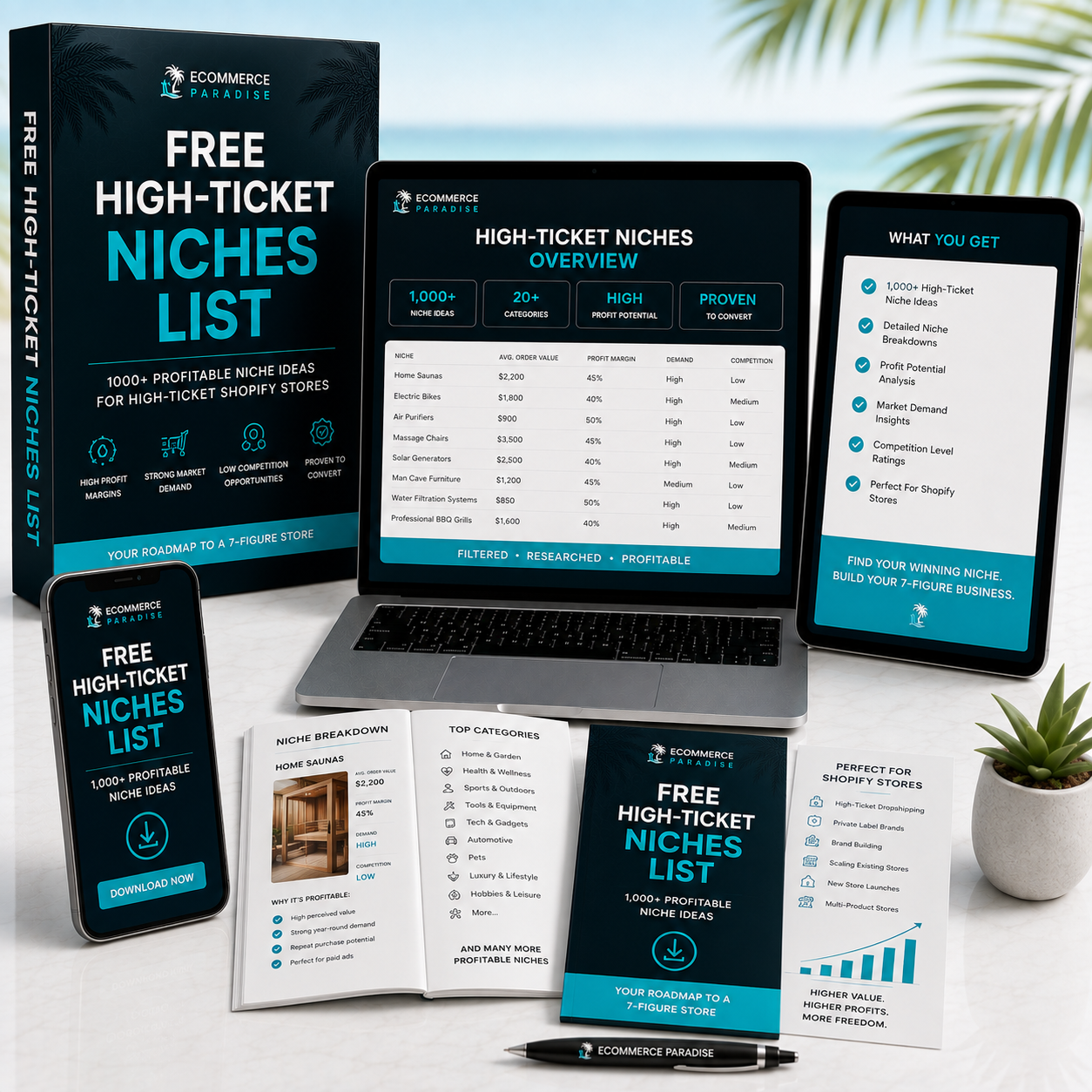
Still deciding what to sell?
Grab the free list of 1,000+ niches that work for high-ticket dropshipping, sorted by category.
Free. Unsubscribe any time.


