



Nearly every alternatives post is organised by logo, which is useless. You do not want to know which company is best in the abstract. You want to know which one does the specific thing you need, and the specific things people need from a US phone number while living outside the US are wildly different from each other. Holding a dormant number costs three dollars a month. Guaranteeing that your payment processor’s verification code lands on it costs more and comes with fewer promises.
So this is sorted by job. Find the sentence that matches what you actually need, read that section, and skip the rest. I run a store from Bali, so this is my own problem, and I have been careful to report what each vendor publishes rather than what I assume.
Disclosure, before the first paid link. The Tello links here are affiliate links and we get paid when somebody signs up, up to ten dollars a signup. Google Fi and Quo are also monetised on this site, so those two are not neutral either. Mint Mobile, US Mobile, Ultra Mobile, NumberBarn, Tracfone and Google Voice pay us absolutely nothing. Two of the options I am about to recommend are cheaper than the one that pays us, and I am going to say so in plain language, because a list that only recommends its own advertisers is not a list, it is a media buy.
The Whole Field On One Screen
| Service | Cheapest published price | Best at | Pays this site |
|---|---|---|---|
| Ultra Mobile PayGo | $3/mo | Cheapest real wireless line that holds a number | No |
| NumberBarn Park | $2.99/mo | Parking a number you need no codes on | No |
| Tello | $5/mo | Cheap line with published OTP delivery abroad | Yes |
| Mint Mobile | $15/mo on the 12 month 6 GB plan | Fewest written limits on living abroad | No |
| Google Voice Basic | $0 | Free, if you accept that some banks will not text it | No |
| Google Fi | $20/mo Flexible plus $10 per GB | Heavy multi-country data use | Yes |
| US Mobile | From $10/mo shared data, 1 line, 2 GB | Domestic use, and the worst fit for living abroad | No |
| Quo | Pricing on their site | A VoIP business line, a different product class | Yes |
| Tracfone | Not retrievable from its own pages | Nothing I can recommend on published evidence | No |
Job One: I Only Need To Hold The Number
This is the majority case. The number exists so that it stays yours, so an old contact can still reach you, and so a plain text code arrives occasionally. You are not making calls on it and you are not using its data.
The cheapest real wireless answer is Ultra Mobile’s PayGo plan, and I am going to quote it because it undercuts the option that pays us.
“Talk, text and data for $3/mo. PayGo gives you 100 minutes of talk, 100 texts and 100MB 5G / 4G LTE Data for only $3 per month.”
Three dollars. Overages run three cents a minute, one cent a text and three cents per megabyte. That is genuinely cheaper than Tello’s five dollar tier and it includes a small data allowance that Tello’s five dollar tier does not. Ultra Mobile pays this site nothing, and it is still the correct answer to the question as asked.
Now the limitation, which Ultra publishes and which matters enormously for our reader. Ultra says voice, SMS and MMS roaming is paid for through your PayGo Wallet balance, and then adds this: the PayGo Plan does not come with Data Roaming. On top of that, Ultra’s PayGo page does not mention Wi-Fi calling at all. Ultra’s regular monthly plans do list free Wi-Fi calling, but the three dollar plan’s own page is silent on it. For somebody sitting on hotel Wi-Fi in Southeast Asia hoping a bank code will arrive, that silence is the whole ballgame, and I am not going to fill it in on Ultra’s behalf.
Ultra’s paid monthly plans, for completeness, run talk and text with 500MB at thirteen dollars, 4 GB at nineteen, 8 GB at twenty four, 24 GB at thirty nine and unlimited at forty nine. Those all list free Wi-Fi calling and unlimited talk and text to 90+ international destinations. I am deliberately not publishing Ultra’s multi-month bundle totals, because they rendered inconsistently when I checked them and I could not verify a single reliable figure.
The other sub-three-dollar option is a completely different product. NumberBarn does number parking at $2.99 per month per number, with forwarding at $6.99, a business line at $9.99 and an unlimited tier at $19.99. Port away is free. Porting a number in costs five dollars per number, waived if you take the Park annual plan. Callers to a parked number hear a customisable thirty second message.
Parking is the cheapest way to keep a number you own without keeping a phone service. It is also completely unsuitable for job two below, and NumberBarn is refreshingly honest about why. There is also a documentation contradiction worth knowing: NumberBarn’s pricing page shows Park including SMS forward to email, while its number parking page says text messaging is a one dollar per month add-on that is not included in parking. Both statements are live, so confirm which applies before you rely on it.
Tello sits above both at five dollars a month for 300 minutes, unlimited text and no data, and its pitch against them is documentation rather than price. Tello publishes an explicit statement about bank codes arriving abroad, which neither Ultra’s PayGo page nor NumberBarn’s parking product does. Whether that is worth two dollars a month over Ultra is your call, and our breakdown of Tello’s price ladder walks through where the real value sits.
Two Dollars More Than The Cheapest, For Published Answers
Ultra Mobile PayGo holds a line for $3 per month and Tello’s cheapest build is $5, so Tello is not the cheapest here. What Tello publishes and Ultra’s PayGo page does not is Wi-Fi calling abroad and bank one time password delivery. Tello’s $5 tier still has no data, so picture messages will not arrive on it.
Job Two: Bank And Processor Codes Have To Actually Arrive
This is the job that breaks businesses. If Shopify will not release a payout change, or your bank locks you out, or PayPal wants to confirm it is you, the number has to receive the message. And this is where the cheap parking options fall apart in a way that is documented rather than theoretical.
NumberBarn publishes the single best piece of evidence in this entire category, and it publishes it about its own product, which takes some integrity. NumberBarn’s numbers are classified as wireline, not mobile, and NumberBarn names what that breaks.
“Because NumberBarn phone numbers are classified as wireline (landline) numbers, support for these messages depends entirely on the company sending them.”
“NumberBarn cannot guarantee that a third party company will send verification messages, authentication codes, or short code texts to a wireline number.”
Then it gives a list, longer than the extract below. Bank of America and Schwab sit on its working side, so this is not a clean split between banks and everyone else. Confirmed working: Amazon, Apple ID, DoorDash, Facebook, Instagram, Google Duo, GrubHub, Mailchimp, Signal and TikTok. Confirmed not working: Chase Bank, Wells Fargo, Capital One, American Express, PayPal and Zelle, plus LinkedIn, X and ChatGPT.
Read that failing list again with an ecommerce brain on. Chase, Wells Fargo, Capital One, Amex, PayPal and Zelle. That is the payments and banking layer of most American online businesses. NumberBarn also notes that some companies specifically require a wireless mobile number for account creation, security verification, fraud alerts and password resets, and its own suggested workaround list includes getting a separate wireless mobile number.
Now the precision that matters, because it is easy to misread and I have seen other sites misread it. That list is about NumberBarn’s own wireline numbers. It is not a list of banks that reject Tello, and it is not a list of banks that reject any carrier. Nobody should read it as saying Chase will not text a Tello line. What it demonstrates is that a wireline number class gets filtered by named senders, and that the filtering is a sender-side policy decision rather than a technical impossibility.
So for job two the answer is a real wireless line, and the cheap ones are Ultra Mobile PayGo at three dollars, Tello from five, and Mint from fifteen. Of those, Tello is the only one that publishes a direct statement about the use case.
“Once Wi-Fi Calling is active, you can receive One-Time Passwords (OTPs) and verification texts from your bank even if you are outside the US.”
That sentence appears on two separate Tello pages, and two factor authentication code reception is separately listed as an included plan feature. Mint’s equivalent, which is also useful, is that receiving SMS text messages while travelling is free of charge and that replying requires a Minternational Pass.
There is one trap on Tello’s own cheapest tier that I will not let you walk into. Tello’s configurator warns that data is required to send or receive an MMS, and that any text message including a file such as a picture, video, emoji or a website link turns into an MMS. A verification text containing a link is therefore an MMS, and on the no-data plan it has no data to arrive on. Worse, Tello publishes separately that while standard texts work over Wi-Fi, picture messages do not, so MMS does not arrive over a Wi-Fi calling setup abroad at all. Buy a tier with data, and keep a second route into anything critical. We go further into this in our guide to the best US number for SMS verification codes.
The VoIP Rule Everyone Cites, Which Is Not A Rule
You have read somewhere that verification codes never reach VoIP numbers. It gets repeated as though it were regulation. It is not, and getting this right changes which options are on your table.
No US carrier and no US regulator publishes a rule that two factor codes cannot be delivered to VoIP numbers. The Federal Communications Commission proceedings people wave at concern illegal and scam texting and caller identity authentication, not deliverability by number class.
The document that did prohibit it was NIST Special Publication 800-63B revision 3, which said methods that do not prove possession of a specific device, such as voice over IP or email, shall not be used for out of band authentication. That is the sentence quoted in a thousand blog posts. That revision has been superseded, and NIST’s own notice on it says so. The current edition, NIST SP 800-63B-4 from July 2025, no longer prohibits VoIP for out of band authentication and its only mention of VoIP is permissive. It still bans email. And NIST writes standards for federal agency identity systems in any case, not binding rules for commercial banks.
So what is actually true? Sender-side filtering is real, documented and company specific. NumberBarn’s named list is one proof. Google’s own statement about Google Voice is another. The claim “SMS two factor does not work to VoIP numbers” is accurate as observed behaviour with particular senders and false as a general rule. That distinction is worth having because it means the right question is never “is this VoIP” but “does the specific company I need a code from deliver to this specific number”.
A Real Wireless Line Is The Conservative Answer
Tello plans run $5 to $25 per month, and $10 buys 2 GB with unlimited talk and text. Tello publishes that bank one time passwords arrive abroad over Wi-Fi calling. It also states the line must be activated and used inside the US first, so this only works if you set it up before you go.
Job Three: It Has To Still Work In Three Years
If you live abroad permanently rather than travelling, the thing that kills you is not price. It is a clause. So here is what each vendor has written down about extended international use, ranked from most permissive to least.
| Service | Published limit on extended use abroad |
|---|---|
| Mint Mobile | None published. No day threshold, no suspension timeline, no return-to-US requirement |
| Tello | No day limit published, but terms say all services must be used within the US |
| Google Fi | Warning at around 50 days, then international data suspended 30 days later. Calls and texts continue |
| US Mobile | Reserves the right to restrict roaming after more than 90 consecutive days of international use with no domestic usage |
Mint publishing nothing is the most permissive position in the set, and it is worth saying without hedging: Mint Mobile is genuinely competitive for this job, and it pays us nothing. Its cheapest steady state plan is the twelve month 6 GB option at fifteen dollars intro and fifteen dollars on renewal, with no step-up. Every other Mint plan does step up on renewal, from thirty dollars for twelve month unlimited to forty for three month unlimited, so read those in pairs. Our full Tello and Mint Mobile head to head lays out the whole grid.
US Mobile is the worst option here and it says so itself. Its international service terms state that the plan is designed to support short-term trips outside the country and is not intended for extended or permanent use outside the United States, then reserve the right to limit roaming, suspend the plan feature or remove it entirely after more than 90 consecutive days of international use with no domestic usage. That ninety day figure is legitimately US Mobile’s, and it is routinely and wrongly attributed to Google Fi, including in one post on this site that we have now corrected, as explained in our Tello and Google Fi comparison.
On price, US Mobile’s cheapest verified option is shared data from ten dollars a month for one line with 2 GB and unlimited talk and text. Unlimited Starter works out at $16.58 a month on an annual commitment, at one hundred and ninety nine dollars for year one renewing at two hundred and seventy. Unlimited Flex is $17.50 a month. Unlimited Premium is $24.92 a month annually, at two hundred and ninety nine for year one renewing at three hundred and ninety. One note on honesty: US Mobile’s own page metadata claims plans from only five dollars a month, and no such plan appears on any of its plan pages, so I am not publishing that number.
Tello’s position on this job is genuinely mixed and I will not smooth it. It publishes no day limit and no requirement to periodically reconnect to the US network, which is good. Its number loss mechanics are tied to plan or credit lapse rather than geography, which is also good. But its terms of service say all Tello services must be used within the US and all orders must have a valid US address for tax purposes, while its marketing runs a landing page titled “Keep Your US Phone Number While Abroad”. Whether that clause is about tax nexus or about usage is ambiguous as written and I am not going to resolve it. Email support, describe your situation plainly, and keep the written reply. Our full Tello review deals with that contradiction at length.
Job Four: I Want It Free
Basic Google Voice costs zero dollars for personal use on a personal Gmail account, with no paid Workspace requirement. The paid tiers are Voice Starter standalone at ten dollars a month and Standard at twenty, plus Workspace add-ons at ten, twenty and thirty dollars per user per month which do require paid Workspace.
Google is also unusually candid about the limitation, and the candour is the reason I will still list it.
“You can get text messages from anywhere in the world.”
“Some websites, such as banks or subscription services, won’t send text messages to Google Voice numbers.”
“In those instances, you may need to use your mobile carrier number.”
So a free number that receives texts worldwide, with Google itself telling you that banks may not be among the senders. Note that Google does not name which banks and does not frame this as a VoIP classification issue, and I am not going to extend the claim past Google’s own wording.
There is one more risk to flag. Google Voice numbers can be reclaimed for inactivity, and there is a forty five day window to recover a number after its reclaim date. The inactivity period that triggers the reclaim is not published anywhere I could find, so if you are using a free Google Voice number as a long term anchor for anything, use it regularly and do not rely on a month count nobody has published.
My honest read: Google Voice is an excellent free second number for the things on NumberBarn’s working list, and a bad primary anchor for a business whose bank and processor access depends on it.
Job Five: A Number Suppliers Will Accept On A Dealer Application
This is a different purchase and it deserves a different answer. A supplier’s compliance reviewer looking at your dealer application is not thinking about monthly cost. They are thinking about whether the business looks real, whether the number is answered, and whether it presents as a business line rather than a mobile you might or might not pick up. There is also usually a human who dials it.
We have that written up properly elsewhere and I am not going to duplicate it here, so read our guide to getting a business phone number suppliers will accept before you buy anything for this job.
If a VoIP business line is what you are after, Quo is the option we carry on this site, and it is monetised, which I said at the top and am repeating here. It solves presentation and routing, not number class filtering, so read the section above on what actually receives codes before you assume a VoIP line covers both jobs. For the general question of VoIP against a carrier line for business use, our roundup of business phone plans for small businesses is the right starting point.
The One I Cannot Price: Tracfone
Tracfone belongs on this list and I cannot give you a cheapest plan price, because Tracfone cannot either. All four of its plan pages serve unresolved template placeholders where the prices should be. What is readable is Tracfone Freedom unlimited at forty five dollars a month with auto-refill, with a regular rate referenced at fifty, plus an anniversary promotion at thirty five after discount or thirty with auto-refill, and a bring your own phone six month Freedom plan at one hundred and thirty five dollars, which works out at $22.50 a month.
On Wi-Fi calling, Tracfone says to connect to Wi-Fi to enable unlimited calls and texts without using data across all plans, and does not say whether that works outside the US. International calling is limited to Canada and Mexico.
I am going to be blunt, because the reader here is making a multi-year decision. A carrier that cannot render its own prices is not a carrier I would hang account access on while living eight thousand miles from its support desk. That is a disqualification on published evidence, not a judgement about their network.
Which One I Would Actually Buy
Disclosure one more time, because this is the paragraph where it counts. Tello and Google Fi and Quo pay this site. Ultra Mobile, NumberBarn, Mint Mobile, US Mobile, Google Voice and Tracfone pay us nothing. Two of my picks below are unpaid options.
If the only job is holding a number with no code delivery requirement, park it. NumberBarn at $2.99 a month is the cheapest honest answer, and it tells you in writing what will not work.
If you want the cheapest real wireless line and you can live with an undocumented Wi-Fi calling story, Ultra Mobile PayGo at three dollars a month is the cheapest thing on this page and it beats Tello on price. It pays us nothing.
If codes from banks and processors are the point, buy a real wireless line with data on it. Tello Starter at ten dollars a month for 2 GB and unlimited talk is my pick, because Tello is the only vendor in the set that publishes a plain statement about bank one time passwords arriving abroad. Buy the tier with data, not the five dollar one, and clarify the terms of service question with support in writing.
If you are staying abroad for years and want the fewest written tripwires, take Mint’s twelve month 6 GB plan at fifteen dollars intro and fifteen on renewal. It is the most permissive published position in the category and it earns us nothing.
If you want a free second number for services on the working side of the ledger, Google Voice Basic at zero dollars is the answer, with Google’s own bank caveat firmly in mind.
And whichever you choose, the sequencing matters more than the brand. Tello, Mint and US Mobile all require activation and first use inside the US, so this is a before-you-leave job. Our walkthrough on keeping a US phone number while living abroad covers the order of operations. Our ranking of the best plans for keeping a US phone number abroad then grades every option on that activation requirement specifically.
Set It Up While You Are Still In The Country
Tello runs $5 to $25 per month with unlimited text on every plan, and publishes that one time passwords arrive abroad over Wi-Fi calling. It also states its service cannot be initially activated outside the US, and Ultra Mobile PayGo is cheaper at $3 per month, so compare both before you commit.
Running The Business Behind The Phone Number
A number is only worth paying for if something valuable is on the other end of it, which is why I point people at our list of high ticket niches worth building in before they shop for phone plans.
If the model is new to you, the unit economics are the part that changes everything about how you operate. Our explainer on what high ticket dropshipping actually is covers why one approved supplier outweighs a thousand small orders.
Supplier acquisition is exactly where a working US number stops being a convenience. Our step by step guide to finding high ticket suppliers shows how many steps in that process end with somebody dialling you.
The entity comes first, because dealer applications ask for one and real suppliers verify it. Our walkthrough of business formation for high ticket dropshipping explains what to file and why the state matters.
My stack is intentionally unexciting. The storefront runs on Shopify and always has. The company filing went through Bizee because it is cheap and quick.
Liability cover is the thing nobody plans for until a supplier requests a certificate, and mine is with Hiscox for precisely that reason.
If assembling all of this yourself sounds like the wrong use of your year, we build and launch the whole thing through our done for you high ticket store build service.
Frequently Asked Questions
What is the cheapest US phone number I can keep while living abroad?
NumberBarn parks a number for $2.99 a month, which is the cheapest of anything here, but parking is not a phone service and NumberBarn publishes a named list of companies that will not text its wireline numbers. Ultra Mobile PayGo is the cheapest real wireless line at three dollars a month. Tello is five.
Which banks reject these numbers?
Be careful with this question. NumberBarn publishes that Chase Bank, Wells Fargo, Capital One, American Express, PayPal and Zelle do not deliver verification texts to its numbers, and that is specifically about NumberBarn’s own wireline numbers. It is not a statement about Tello, Mint, Ultra or any wireless carrier, and nobody should read it that way.
Is it true that verification codes never go to VoIP numbers?
No. No carrier and no regulator publishes such a rule. The NIST prohibition people cite came from an edition that has been withdrawn, and the current July 2025 edition does not ban VoIP for out of band authentication. What is real is sender-side filtering by individual companies, which is why NumberBarn’s named list and Google’s own admission about Google Voice are the useful evidence.
Is Ultra Mobile PayGo actually cheaper than Tello?
Yes. Three dollars a month against five, and PayGo includes 100 minutes, 100 texts and 100MB of data. The catch Ultra publishes is that the PayGo Plan does not come with Data Roaming, and Ultra’s PayGo page does not mention Wi-Fi calling at all, which is the feature a reader abroad depends on most.
Can I use Google Voice as my only US number?
I would not, for a business. Google says you can get text messages from anywhere in the world, and in the same document says some websites such as banks or subscription services will not send text messages to Google Voice numbers. Numbers can also be reclaimed for inactivity, with a forty five day recovery window, and the inactivity period that triggers reclaim is not published.
Why is US Mobile the worst option for living abroad?
Because it tells you so. Its terms say the plan is designed for short-term travel and is not intended for extended or permanent use outside the United States, and it reserves the right to restrict roaming after more than 90 consecutive days of international use with no domestic usage. That is the clearest disqualifier in the set.
Why will you not quote a Tracfone price?
Because Tracfone does not publish one I could read. All four plan pages serve unresolved template placeholders where the prices belong. I can tell you Tracfone Freedom unlimited shows at forty five dollars a month with auto-refill, but I cannot tell you what its cheapest plan costs, and I will not estimate it.
Related Articles
Tello Review 2026: the cheap US line that keeps a number alive abroad
The best US number for SMS verification codes in 2026
Best plans for keeping a US phone number while living abroad
Airhub reviewed as a local destination number, the mirror of a US line
Running an ecommerce business without tripping account lockouts

Trevor Fenner is an ecommerce entrepreneur and the founder of Ecommerce Paradise, a platform focused on helping entrepreneurs build and scale profitable high-ticket ecommerce and dropshipping businesses. With over a decade of hands-on experience, Trevor specializes in high-ticket dropshipping strategy, niche and product selection, supplier recruiting and onboarding, Google & Bing Shopping ads, ecommerce SEO, and systems-driven automation and scaling. Through Ecommerce Paradise, he provides free education via in-depth guides like How to Start High-Ticket Dropshipping, advanced training through the High-Ticket Dropshipping Masterclass, and fully done-for-you turnkey ecommerce services for entrepreneurs who want a faster, more hands-off path to growth. Trevor is known for emphasizing sustainable, real-world ecommerce models over hype-driven tactics, helping store owners build scalable, sellable, and location-independent brands.
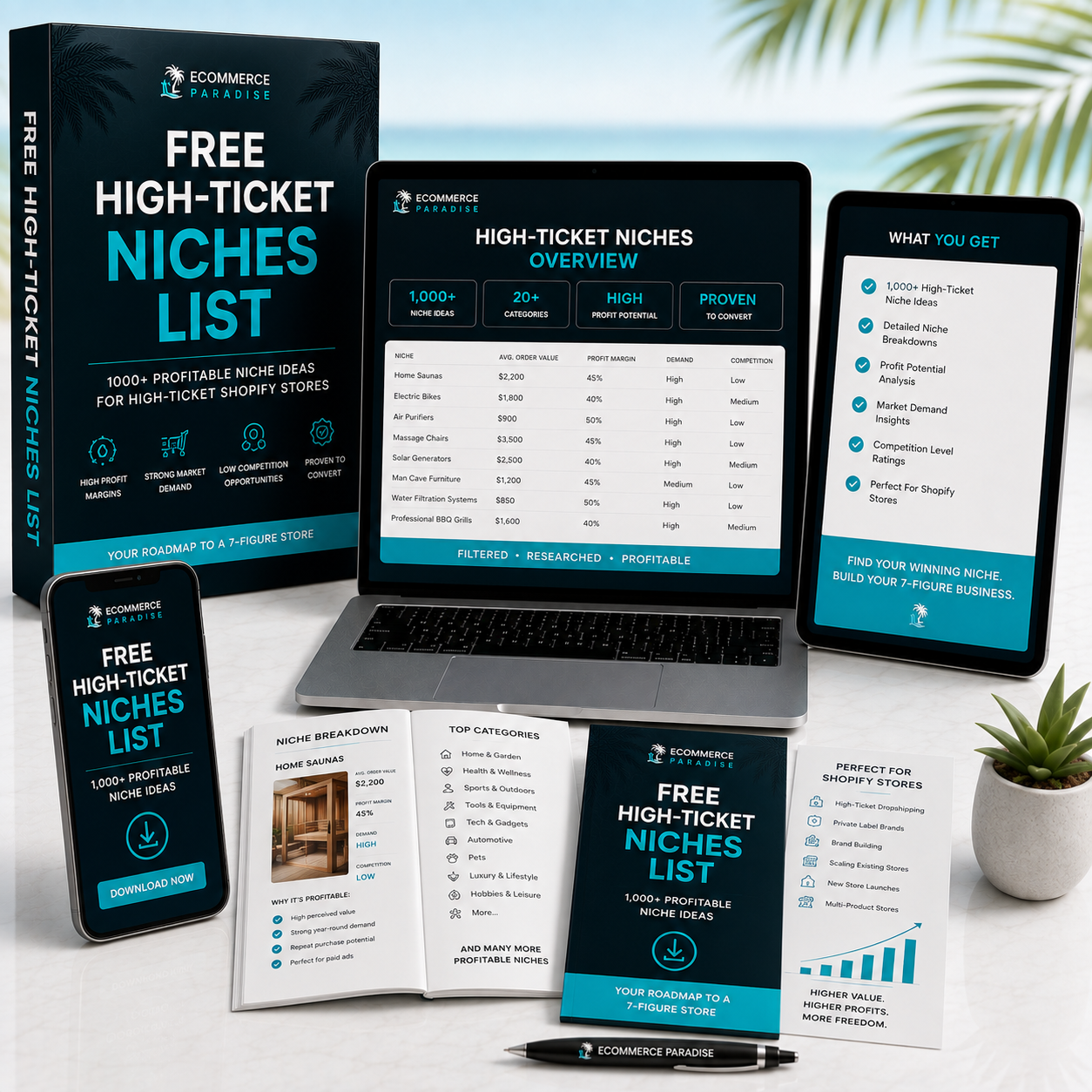
Still deciding what to sell?
Grab the free list of 1,000+ niches that work for high-ticket dropshipping, sorted by category.
Free. Unsubscribe any time.


