


Quick answer: Hire an ecommerce agency when your store is live, sales are steady, and one specific job (ads, search, site work, testing) has outgrown you. Pick a specialist for that job, keep every account in your own name, and treat the first 90 days as a paid trial. If you have no store or no proven product yet, an agency has nothing to improve, and your money does more good elsewhere.
Should you hire an ecommerce agency? For most store owners the useful answer is “not yet, and not for everything.” The agency world is built to sell you a retainer, so the decision usually gets framed as which agency, when the real question is whether you need one at all.
I have spent 15+ years in ecommerce, and at Ecommerce Paradise I see store owners reach the same moment again and again: the store is live, one job has grown bigger than they can do well alone, and they start taking sales calls. If you are still choosing the business model itself, start with my explainer on what high-ticket dropshipping is, because no agency can rescue a store with weak margins.
This guide gives you the decision first, then the types of agencies, what they charge in 2026, how to read the “best agency” lists, the red flags, how to vet one, what belongs in the contract, and the cheaper alternatives. Every price comes from a page I opened in October 2026 and is named with its source, but most of those pages are published by agencies that sell the service, so treat each number as a ballpark and get written quotes.
I do not recommend any specific agency in this guide, because I have not audited any. I also sell done-for-you store builds and private coaching at Ecommerce Paradise, so I have a stake in one section below, and I say so there. This is general information, not legal or financial advice, and I am not a lawyer, so have one read any contract that carries real money.
What’s in This Guide
- What an ecommerce agency actually does
- Do you need one? Match your situation to the right help
- Diagnose the problem before you shop
- The main types of ecommerce agencies
- How to read “best ecommerce agency” lists
- What ecommerce agencies charge in 2026
- Is an agency worth it at your size?
- Red flags before you sign
- How to vet an agency in five steps
- Contracts, account ownership and access
- How to run a 90-day trial
- Freelancers and marketplaces: the middle option
- When the real need is a virtual assistant
- When a done-for-you build beats an agency
- How I would decide
- Frequently asked questions
What an Ecommerce Agency Actually Does (and What It Does Not)
An ecommerce agency is a company that runs part of your store’s growth for a fee. That can mean buying your ads, building or redesigning your site, ranking your pages in search, writing product content, running your email, or testing your checkout. The word covers everything from a two-person shop to a firm with hundreds of staff, so the label tells you almost nothing about quality.
It helps to separate it from its neighbors. A freelancer is one person on a defined job, usually cheaper and with no backup if they disappear. A consultant advises while you or your team do the work. An in-house hire is an employee who learns your business over years. A done-for-you build is a one-time project that launches a store rather than an ongoing service.
What an agency does not do is fix a store that has nothing to sell. It cannot create demand for a product nobody wants, and it cannot make a thin margin fatter. It can only get more out of an offer that already works, which is why the first question is always about your store, not about the agency.
Do You Need One? Match Your Situation to the Right Help
Most of the wasted agency money I see comes from hiring the right kind of help at the wrong stage. Here is how I match a situation to the kind of help that usually fits it, with no prices, because the stage matters more than the fee.
| Where you are | What usually fits | Why |
|---|---|---|
| No store yet, or no sales yet | Learn the model, then build it yourself or buy a one-time build | Agencies need an existing store and data to improve |
| Live store, few sales, unclear what works | A consultant or coach for a second opinion, plus fixing the basics | The problem is usually the offer, supplier terms or trust, not marketing volume |
| Live store with one clear weak spot (product pages, feed, tracking) | A freelancer or specialist on a defined project | A fixed scope is cheaper and easier to judge than a retainer |
| Steady sales and one channel is the bottleneck (ads or search) | A specialist agency for that channel, with a 90-day test | You have data to improve and a clear job to hand off |
| Steady sales, several channels, a thin team | A full-service agency, with reporting split by channel | The coordination is worth paying for, if you can still see what each channel earns |
| Order handling, support and admin are eating your week | A virtual assistant or an operations hire | This is an operations problem, and agencies do not solve it |
| Replatforming or a full redesign | A development agency on a fixed-scope project | It is project work with a start and an end |
Signs you are ready
You are ready when your store has steady sales you can measure, you know your margin per order, and you can name the one job you want off your plate. You also have enough time to manage the relationship, because no agency runs well without a client who answers questions and reads reports.
A budget cushion matters too. If a retainer would take cash you need for inventory, ad spend or payroll, wait.
Signs you are not
You are not ready if you have no sales history, no clear niche, or no supplier terms you trust. You are also not ready if you cannot say what success looks like in numbers, because then nobody, including you, can tell whether the agency is working. In that case, my high-ticket niches list is a better first step than a sales call.
Diagnose the Problem Before You Shop
A traffic problem, a conversion problem, a margin problem and an operations problem all look the same on a revenue chart: sales are lower than you want. An agency can help with the first two. It cannot help with the last two, and paying one to try is the most common way owners burn a quarter.
Traffic: not enough of the right people
If few people reach your store, the fix is ads, search, email or content, and that is where ad and SEO agencies earn their fees. Check your own numbers first: where visitors come from, which pages they land on, and what a visitor is worth. Without that baseline you cannot judge any result later.
Conversion: people arrive and leave
If visitors arrive but few buy, the fix is on the site: product pages, trust, shipping clarity, checkout. The Baymard Institute’s page on documented cart abandonment rates puts the average at 70.22% across 50 studies, last updated in September 2025. In its breakdown of reasons, with shoppers who were just browsing set aside, the largest is extra costs such as shipping, tax and fees, at 40%. The figures add up to more than 100%, so shoppers seem to give more than one reason.
That is a pricing and policy decision, and no tester can fix it for you. A conversion specialist who asks about your shipping and margins before running a single test is worth more than one who starts with button colors.
Margin: you sell, but the math does not work
If orders come in but the profit does not, no agency fee will help, because it adds cost on top of a thin margin. The fix is better supplier terms, better pricing or a better product. My guide to finding suppliers for high-ticket dropshipping covers the dealer side, and it is worth more than any retainer if this is your problem.
Operations: you are the bottleneck
If you are answering every email, entering every order and chasing every shipment, you need process and help, usually a person, not a marketing agency. I come back to this in the virtual assistant section below.
The Main Types of Ecommerce Agencies
Agencies tend to specialize in a few services: ads, search, development, conversion work, email and creative. Knowing which one you need stops you paying a generalist to do a specialist’s job.
Full-service agencies
A full-service agency bundles strategy, paid ads, email, search and sometimes site work under one contract and one account manager. The appeal is a single point of contact. The risk is that you pay for a team of generalists, and when sales move you cannot tell which channel caused it.
If you go this route, ask for reporting split by channel from day one. Otherwise you are buying a black box.
Paid media and Google Shopping agencies
These agencies manage paid traffic: Google Shopping, Search, Performance Max, and sometimes Meta and Microsoft ads. Google Shopping is a common early paid channel for high-ticket stores, because the shopper is already searching for the product. I wrote up how to vet one in my guide to Google Shopping ad agencies.
Your ad spend is separate from their fee, which matters more than it sounds. Search Engine Journal’s pricing column suggests that if your ad budget is under $2,500 a month, you should consider managing ads in-house or with automation tools, because agency fees can eat too much of the budget.
SEO agencies
SEO agencies work on search rankings through technical fixes, category and product page optimization, content and links. It is slow work, and Google’s own hiring guidance says no one can guarantee a number one ranking. For names to begin a shortlist, my roundup of ecommerce SEO agencies is a starting point, not a verdict.
If you sell to businesses with long buying cycles, the criteria change, and I cover them in my guide to choosing a B2B ecommerce SEO agency. And if you are weighing whether to do the work yourself, read DIY SEO vs hiring an SEO agency before you sign anything.
Store development and migration agencies
Development agencies build, redesign, migrate and customize your store, and some also sell monthly retainers for fixes and apps. This is project work, and the quote depends heavily on scope, so fix the scope in writing before you agree to anything. If you need a developer on an ongoing basis rather than a project team, my guide to hiring developers for long-term product development covers that model.
If you have no store yet, you probably do not need a development agency to start. A platform template and a weekend of setup gets a first version live for far less, and you can always rebuild once you have sales.
Conversion rate optimization agencies and consultants
Conversion rate optimization is the work of turning more of your existing visitors into buyers, through research, testing and fixes to product pages and checkout. It needs enough traffic to test on, so a store with a few hundred visitors a month has little to optimize with. My guide on how to select a CRO consultant goes through what to ask.
Email and retention agencies
These agencies build and run your email and text flows: welcome series, abandoned cart, post-purchase and win-back. For many stores this is the cheapest revenue to add, because it works on people who already know you. Ask to see flow performance from other stores in your price range, and keep ownership of your email platform account and your subscriber list.
Creative and content agencies
Performance creative agencies produce the ad images, video and landing pages that your media buyer then tests. In my view, creative is often what separates an ad account that scales from one that stalls. I compared a group of them in my post on performance creative agencies for ecommerce brands.
Marketplace agencies
If you sell on Amazon or other marketplaces, a marketplace agency handles listings, advertising and account health. It is a different skill set from running a store of your own, so do not assume a store agency can do it. I cover what that work involves in the Related Articles at the end.
How to Read “Best Ecommerce Agency” Lists
If you search for an agency, the first results are mostly lists and directories. They are a useful way to find names, but it is worth knowing how they are made, because the ranking is rarely what it looks like. Here is what I saw on pages I opened in October 2026.
One “best ecommerce agencies in 2026” roundup was published by an agency and ranked that same agency number one, with no ranking method explained. A large directory page disclosed that sponsored listings pay for placement above organic positions, and that its default sort is “Sponsored.” Another directory showed “Featured Agency” badges, ads and membership tiers on its listings, without saying how placement is decided.
That does not mean the agencies on those pages are bad. It means a position on the page tells you little about quality, so use these lists to collect names and nothing more. The same goes for the roundups on this site: they are starting points, and you still need to vet whoever you pick.
A better source of signal is a short list built from referrals, from owners in your niche, and from agencies that can show you results for a store like yours. I come back to that in the vetting steps.
What Ecommerce Agencies Charge in 2026
This is the one place in the guide with prices. Agencies charge in a few different ways, and the model matters as much as the number.
How agencies charge
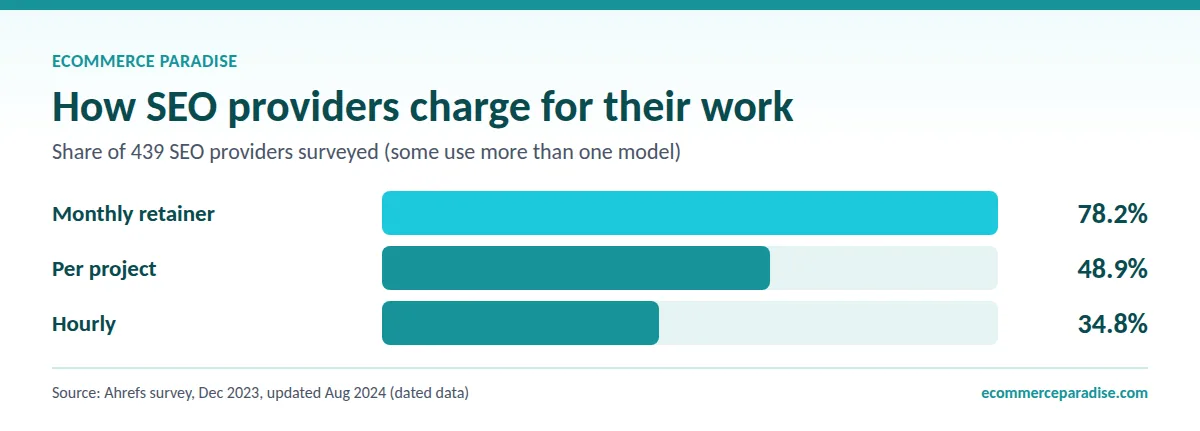
A monthly retainer is the most common. Ahrefs’ survey of 439 SEO providers, published in December 2023 with an August 2024 update (so the data is dated), found that 78.2% charge monthly retainers, 48.9% charge per project and 34.8% charge hourly, with some offering more than one.
Percent-of-spend pricing is common in paid ads, a flat project fee is typical for builds, and performance-based pricing charges per lead or sale. Search Engine Journal’s column on PPC management costs notes that with performance-based deals the agency keeps control of the account, which is a problem if you later want to take it over. It also calls the traditional models the safer choice if transparency and long-term flexibility matter to you.
Ranges as published
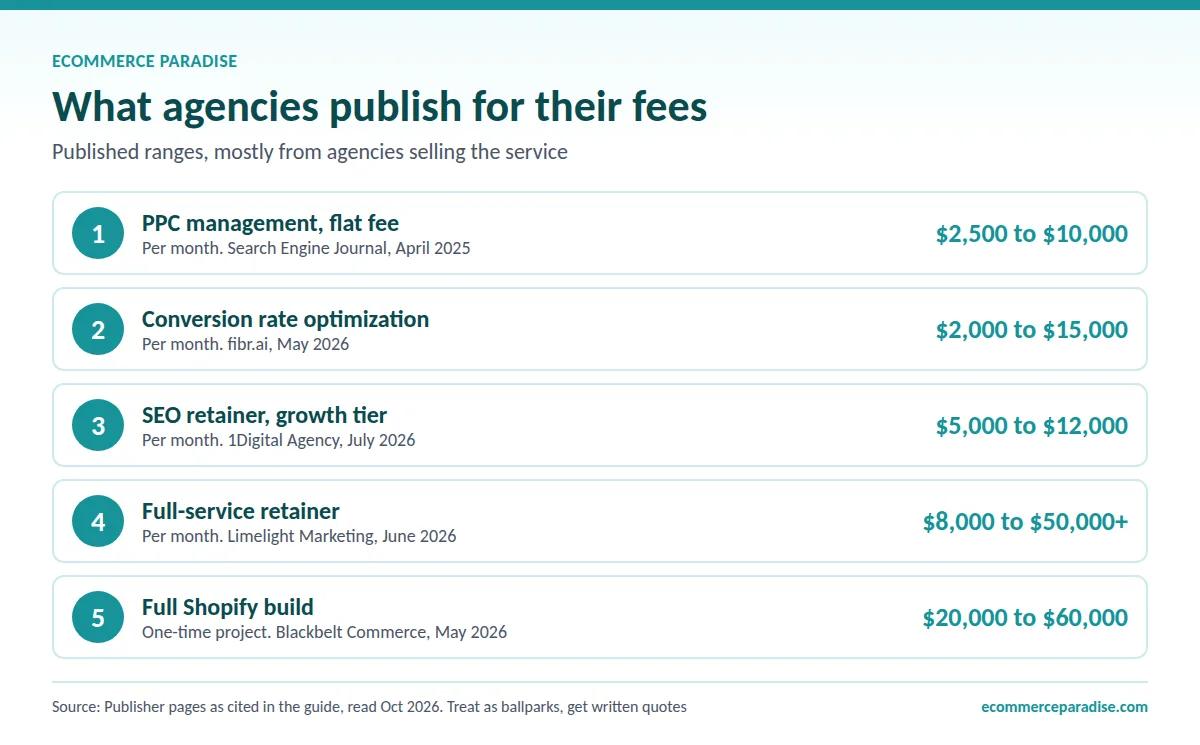
These are the figures I found, each with the publisher and date. Most come from agencies selling the service, so read them as a market picture, not a quote.
| Service | Range as published | Publisher and date |
|---|---|---|
| SEO retainer | $2,500 to $5,000 foundational, $5,000 to $12,000 growth, $12,000 to $25,000+ enterprise; hourly $100 to $300+ | 1Digital Agency, published July 2026, modified August 2026 |
| SEO, survey averages | Agencies $3,209 a month, freelancers $1,348 a month | Ahrefs, published December 2023, updated August 2024 |
| PPC management, flat | $2,500 to $10,000 a month | Search Engine Journal, April 2025 |
| PPC management, percent plus flat | 5% to 15% of spend plus $500 to $2,500 a month | Search Engine Journal, April 2025 |
| PPC management, percent of spend | 10% to 20% (and 10% to 30% in another section of the same page) | Limelight Marketing, updated June 2026 |
| Shopify project work | Full build $20,000 to $60,000; custom theme $12,000 to $45,000; Plus implementation $25,000 to $100,000 | Blackbelt Commerce, May 2026 |
| Website build or redesign | Template-based Shopify site $15,000 to $40,000; redesign or build $50,000 to $250,000+ | Limelight Marketing, updated June 2026 |
| Conversion rate optimization | $2,000 to $15,000 a month, or $5,000 to $50,000 per project; hourly $100 to $300 | fibr.ai, May 2026 |
| Full-service retainer | $8,000 to $50,000+ a month (the same page also gives $10,000 as the floor) | Limelight Marketing, updated June 2026 |
Why the numbers disagree
Do not expect these sources to line up, because they do not. Limelight puts a website redesign or build at $50,000 to $250,000+ and a basic Shopify template build at $15,000 to $40,000. Blackbelt Commerce lists a full Shopify build at $20,000 to $60,000 in the article above, which is a very different band for a similar job.
The sources contradict themselves too. Limelight gives the full-service floor as both $8,000 and $10,000 on the same page, and its PPC fee as 10% to 20% in most places and 10% to 30% in one. Hourly rates run from about $100 to $300+ across the pages I read, and Limelight puts freelancers at $50 to $200 an hour.
My takeaway is simple. Use these ranges to spot a quote that sits far outside the market, then rely on written quotes from at least three vendors for your actual scope.
What the fee does not cover
The retainer is rarely the whole bill. Ask whether the quote excludes ad spend, creative production, software and tool subscriptions, development hours beyond a cap, and onboarding or setup fees. Ask too whether reporting is included or sold separately.
A quote that looks cheap often leaves these out. Compare proposals line by line, not by the headline number.
Is an Agency Worth It at Your Size?
Here is some arithmetic of my own, not a benchmark. Say a retainer costs $4,000 a month and your gross margin on sales is 25%. The agency has to bring in about $16,000 of additional sales a month ($4,000 divided by 0.25) just to cover its own fee, before returns, ad spend or your time.
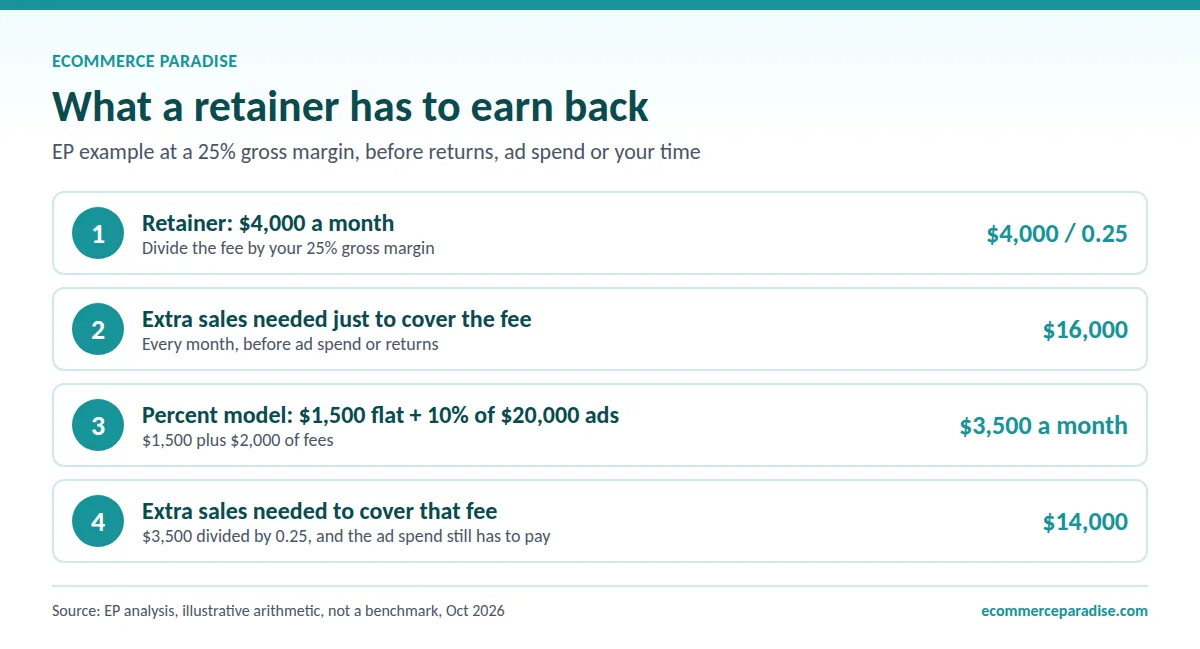
Now add a percentage model. Suppose the agency charges a $1,500 flat fee plus 10% of a $20,000 monthly ad budget, which is $1,500 plus $2,000, or $3,500 a month. On a 25% margin that is $14,000 of extra monthly sales to break even on the fee alone, and the $20,000 of ad spend still has to earn its own way.
That bar is reasonable for a store with steady revenue and unused demand. It is a hard one for a store that has not yet proven its offer. If you are not there yet, spend the money on the basics: a niche you believe in, supplier terms that leave room for profit, and a store that converts.
If the goal is to learn the channel rather than hand it off, there is a cheaper route, and the next block is for that reader.
Not Ready for an Agency? Learn How the Model Works First
My free mini course is eight video lessons on suppliers, niche choice, the legal setup, platform choice and running the business day to day. The page says it is 100% free with no sign-up required, so you can judge the basics yourself before you pay anyone to run them.
Red Flags Before You Sign
Google’s Search Central page on hiring an SEO is the best checklist I know, and most of it applies to any agency. Its red flags include ranking guarantees, claims of a special relationship with Google, unsolicited emails about your rankings, and companies that are secretive or will not explain what they plan to do. It also says you should never have to link to an SEO, and to avoid anyone who pushes link popularity schemes or submitting your site to thousands of search engines.
The same page advises granting an auditor only read access to Search Console, not write access, and says an SEO with FTP access to your site should explain every change. You can read the full list in Google’s guidance on hiring an SEO. It also says plainly that you are ultimately responsible for the actions of any companies you hire.
The Federal Trade Commission says something similar about advertising. On its page FTC’s Endorsement Guides: What People Are Asking, it states that your company is ultimately responsible for what others do on your behalf, and that delegating promotion to an outside company does not relieve you of responsibility.
That matters most for reviews. The FTC’s rule on fake reviews and testimonials went into effect on October 21, 2024, and its questions and answers on the rule say a business can be liable for purchased reviews it knew or should have known were false. The same page says ad agencies and reputation management companies are not immune from liability either. So an agency that offers to buy, trade or “seed” reviews for you is handing you a legal problem.
Add a few red flags of my own, which come from judgment rather than a study:
- They will not show you reports from a client in a similar niche or price range.
- They quote a price before asking about your margins, your suppliers or your goals.
- They push an annual contract on the first call, or a discount that expires tonight.
- They run your ads inside their own account and will not hand over the history.
- They report revenue or “return on ad spend” but never profit.
- The person who sells you the work is not the person who will do it, and nobody will tell you who is.
If an answer to any of these is vague, treat that as an answer. An agency that is confident in its work can explain it in plain words.
Disclosure: I may earn a commission if you sign up through my Semrush, Upwork or OnlineJobs.ph links below, at no extra cost to you. I link each only where it fits the point being made, and I name other alternatives in plain text.
How to Vet an Agency in Five Steps
Vetting does not have to be complicated. This is the order I would work in.
Step 1: Write down the job and the number
Before you talk to anyone, write one sentence: what job you want done and how you will know it worked. “Raise profit from Google Shopping by 15% in 90 days” is a brief an agency can answer. “Grow the business” is not.
Pull your own baseline at the same time: sales, profit after product cost and ad spend, traffic by source and conversion rate. You will need it for step five.
Step 2: Run your own audit, especially for SEO
If you are considering an SEO agency, check whether the problems they pitch are real before you pay them to fix them. A Semrush Site Audit crawls your store, ranks the issues it finds by severity and shows a single overall health metric, so you can see what an audit report should look like and whether the problems an agency pitches actually exist. Semrush’s features page offers a seven-day free trial at the time of writing, so confirm the current terms before you sign up.
Step 3: Build a short list from people, not rankings
Ask other owners in your niche who they use and what they would do differently. Look for agencies that work with stores of your size and price range, and be wary of one that lists enterprise logos but has no small clients. Three candidates is plenty.
Step 4: Ask the same questions of each
A good call feels like an interview where you do most of the listening. These are the questions I would ask, roughly in this order:
- Who will actually work on my account, and how many other accounts do they handle?
- Which clients in my niche or price range can I speak to?
- What results do you expect and by when? (Google suggests asking an SEO exactly this.)
- How do you measure success, and will you report profit or only revenue?
- Will my ad accounts, analytics and store stay in my name?
- What is not included in the fee: ad spend, creative, tools, development hours?
- What does onboarding cost, and how long before work shows up?
- How do I leave, and what do I get when I do?
- Will you tell me every change you make to my site, and why?
- What do you need from me each week?
Step 5: Start with a paid test
Ask each finalist for a small paid starting project: an audit, a feed cleanup, a month of managed ads at a capped budget. The way someone handles a small job tells you more than their sales deck, and it caps what you lose if the fit is wrong. An agency that refuses any trial and wants twelve months on day one has told you something.
Contracts, Account Ownership and Access
A lot of avoidable trouble in agency relationships comes from what the contract never said. Again, I am not a lawyer, and you should have one review anything large. Here is what I would want spelled out.
What the contract should cover
Scope comes first: the deliverables, the channels, the number of reports and calls, and what counts as extra work. Then the term and the exit: the length of the initial commitment, the notice period, whether it auto-renews, and what happens to your data and accounts on termination.
On length, there is no standard. Limelight’s cost article says retainer commitments typically run 6 to 12 months in several places and describes 12+ month partnerships in another. I would push for a short initial term, such as three months, with a clear notice period, rather than a long lock-in.
Next is ownership. Your ad accounts, analytics properties, domain, store logins, creative files and customer data should stay yours. Then fees: whether ad spend is billed to you directly or passed through, the percentage or flat fee, and any minimums. Finally, check confidentiality and who is liable if something goes wrong.
Sign as your business, not as yourself. If you have not set up the entity yet, my business formation guide walks through the LLC, EIN and bank account order.
Keep every account in your name
This is the single most useful protection, and it costs nothing. For Google Ads, the setup you want is your own account with the agency linked in as a manager. Google’s help page on manager accounts says a manager cannot change a client account’s sign-in information, and that anyone with administrative access to a client account can end the relationship at any time by unlinking the manager.
The same page says a manager can be given ownership of a client account, so check the Managers section of your own account to see who is listed as the owner. If an agency insists on holding your ad account, getting your campaign history out when you leave may be difficult.
For analytics, Google Analytics roles let you control what each person can do. The Administrator role can manage users, the Editor role has full control of settings at the property level but cannot manage users, and the Viewer role can see settings and data. Keep Administrator for yourself and give the agency the lowest role that lets them do the job.
Do the same for your store. Shopify’s help center describes collaborator accounts, which let an agency log in with permissions you choose, require your approval for each request, and cannot be given ownership of the store. Use that kind of access instead of sharing your password, and remove it when the work ends.
How to Run a 90-Day Trial and Judge the Results
Treat the first three months as a trial even if the contract says twelve. Agree on the numbers before you start: a baseline for sales, profit after product cost and ad spend, and the main metric for the channel. For ads that might be profit per order rather than return on ad spend, because return on ad spend ignores your margin.
Ask for a short written plan in the first two weeks, a monthly report in plain language, and a call each month covering what changed and why. Keep your own analytics access so you can check the numbers yourself. If you cannot reconcile their report with your store’s sales, ask until you can.
Give the work a fair test length. Paid ads can show signals within weeks, while SEO takes longer, and Google’s page does not give a fixed timeline for it. It only says to ask the SEO what results to expect and in what timeframe. If SEO is part of the deal, run a site audit again at month three and see whether the flagged issues were actually fixed.
At the end of 90 days, ask three questions. Is profit up, flat or down against the baseline? Do I understand what they did and why? Would I sign again at today’s price? If the answer to the third is no, leave on your notice terms and keep your accounts.
Freelancers and Marketplaces: The Middle Option
Between doing it yourself and hiring an agency sits the freelancer. For a defined job like a product page rewrite, a store fix, an ad creative set or a technical SEO audit, a freelancer is often the cheaper and faster choice. The trade is that you are the project manager, and you carry the risk if the person disappears.
On Upwork, you post a job, review proposals and interview people, and you can look at a freelancer’s profile, work history and ratings before you pay anyone. It suits technical work and defined projects, because a small paid job doubles as the trial from step five. As I read Upwork’s client pricing page, the Basic plan charges clients a 5% marketplace fee (3% for eligible US clients paying from a checking account), plus a contract fee of $0.99 to $14.99. One FAQ entry on that page gives a different Basic fee of 7.99%, so confirm the number on your own screen.
Other marketplaces work on the same idea. Fiverr sells packaged gigs at a visible price and adds a buyer service fee at checkout, so read the final total before you pay. FreeUp is another freelancer marketplace, though I could not open its pricing page to check its terms, so read them before you commit. For a logo or ad design, a contest site such as 99designs can be a cheaper test than a retainer.
I compare several of these platforms in my guide to Upwork alternatives. A freelancer does not replace a strategist, but a small paid project is the cheapest way to learn whether you need a bigger team.
When the Real Need Is a Virtual Assistant
Many owners who start shopping for an agency are actually drowning in operations: customer emails, order entry, supplier follow-ups, listing updates. No marketing agency fixes that, and a retainer for ads will not give you your week back. A part-time assistant often will.
For ongoing admin, customer service or order handling, OnlineJobs.ph lets you hire a Filipino virtual assistant directly. Its pricing page, as I read it, lists a free tier that lets you post jobs but not contact workers, paid plans from $69 a month or $299 a year, and a note that it adds no salary markups, with the worker’s pay agreed between you and them. It also advertises a money-back guarantee, whose conditions sit on a separate page I did not review.
In every case you recruit, train and manage the person yourself, so write a simple process document first and start with a short paid trial task. My guide on hiring and onboarding a VA for ecommerce customer service walks through that setup.
When a Done-For-You Build Beats an Agency
An agency makes sense when you have a working store and need more of something. A done-for-you build makes more sense when you do not yet have a store, a supplier base or ad accounts, because agencies need data to work with and a store with no sales gives them little.
Here is the conflict of interest: I run the done-for-you service at Ecommerce Paradise, so weigh my view accordingly. As I read the done-for-you store build page in October 2026, every package covers niche research, business formation guidance, a custom Shopify store, recruiting of US high-ticket suppliers (10, 15 or 30 depending on the package), product upload, email flows, Search Console setup, Google and Bing Shopping ads and three months of bi-weekly coaching. It is sold as a one-time fee tiered by supplier count, and the page shows sale pricing that changes, so I am not quoting a price here.
The fair comparison is that a build is a one-time project that leaves you with a store you own instead of a monthly invoice, but it is not the whole bill. The page says ad spend, LLC filing fees and third-party software are not included, and it estimates software at roughly $100 a month at launch and about $250 a month once the store is live. It also says plainly that it makes no promise about revenue or profit.
The page gives different timelines in different places, from about two months to launch up to several months for the largest package, so I am not quoting one. Ask for the build and ad-launch schedule in writing, exactly as you would with any agency. If you would rather compare the field first, I did that in my post on the best done-for-you dropshipping stores.
A build does not replace ongoing growth work. Once your store is live and selling, an agency, a freelancer or private coaching is the better fit for what comes next.
How I Would Decide
If you have no store, skip the agency. Learn the model, pick a niche with room for margin, and either build it yourself or have a store built for you. Agencies come later, when there is something to grow.
If you have a live store with a clear weak spot, hire a freelancer or a specialist for that one job, with a written scope and a small paid start. If you have steady revenue and several channels to run, a retainer starts to make sense, and the contract, account ownership and 90-day test matter more than the logo on the proposal.
Whichever you pick, own your accounts, measure profit rather than activity, and get three written quotes. Use the ranges above to catch a quote that is far off the market. The limit of this guide is that most published prices come from the people selling the service, and your results depend on your product and your margins.
Holding a Proposal You Are Not Sure About? Get a Second Opinion First
Private coaching is 1-on-1 on Google Meet, on any high-ticket ecommerce topic you choose, at a flat $97 an hour with no minimum at the time of writing. Bring the proposal, the contract or the latest report and we go through it. The page makes no income or results guarantees, and neither do I.
Frequently Asked Questions
How much does an ecommerce agency cost in 2026?
The published ranges I read run from about $2,500 a month for a single channel to $50,000 or more a month for full service, with Shopify builds quoted from roughly $15,000 to over $250,000 depending on the source. Those sources disagree with each other and most are published by agencies selling the service. Get written quotes from at least three vendors, ask what is excluded, and confirm all prices before you sign.
What is the difference between an ecommerce agency and a freelancer?
An agency gives you a team, a process and backup at a higher price, and a freelancer gives you one person at a lower price with more management on your side. For a single defined task I would start with a freelancer and judge the work before paying for anything larger. For ongoing admin or support, a virtual assistant is usually the better fit than either.
Should I pay an agency a percentage of ad spend or a flat fee?
Both exist, and each has tradeoffs. Search Engine Journal reports flat management fees of $2,500 to $10,000 a month and 5% to 15% of spend plus a flat fee, and says to be careful with performance deals where the agency keeps control of the account. My own concern with a pure percentage fee is that the agency earns more when you spend more, whether or not you profit, so I would ask for a flat fee tied to clear profit targets and keep the ad account in my name.
How long should an agency contract be?
There is no standard, and the one agency cost article I read that mentions it says retainers typically run 6 to 12 months. I would ask for a short initial term, a clear notice period, and the right to leave with your accounts and data intact. Google’s SEO guidance also suggests asking what results to expect and in what timeframe, and I would write that answer into the agreement.
How do I know if my agency is working?
Compare profit, not activity, against the baseline you set before the contract started, and check their report against your own store and analytics data. You should understand what they changed and why, and you should be able to leave without losing your accounts. If after 90 days you cannot say whether profit moved because the reporting is unclear, that is itself a reason to renegotiate or move on.
Starting From Zero? Get the Store Built Before You Hire Anyone to Grow It
The done-for-you page lists a custom Shopify build, US supplier recruiting, email flows, Google and Bing Shopping ads and three months of coaching. Ad spend and software are not included, the page does not guarantee revenue, and package pricing changes, so check the current page.
Related Articles
If you found this useful, these guides go deeper on related topics:
- How Much Does Ecommerce SEO Cost: The Complete Pricing Breakdown
- What Does an Amazon Growth Agency Do? Complete Guide for Sellers
- Best Freelance Marketplace in 2026: Top Platforms for Hiring and Getting Hired
- How to Outsource Ecommerce Blog Content Without Losing Your Voice (2026)
- 3PL Fulfillment in the USA: When to Outsource, What It Costs, and How to Choose

Trevor Fenner is an ecommerce entrepreneur and the founder of Ecommerce Paradise, a platform focused on helping entrepreneurs build and scale profitable high-ticket ecommerce and dropshipping businesses. With over a decade of hands-on experience, Trevor specializes in high-ticket dropshipping strategy, niche and product selection, supplier recruiting and onboarding, Google & Bing Shopping ads, ecommerce SEO, and systems-driven automation and scaling. Through Ecommerce Paradise, he provides free education via in-depth guides like How to Start High-Ticket Dropshipping, advanced training through the High-Ticket Dropshipping Masterclass, and fully done-for-you turnkey ecommerce services for entrepreneurs who want a faster, more hands-off path to growth. Trevor is known for emphasizing sustainable, real-world ecommerce models over hype-driven tactics, helping store owners build scalable, sellable, and location-independent brands.

Still deciding what to sell?
Grab the free list of 1,000+ niches that work for high-ticket dropshipping, sorted by category.
Free. Unsubscribe any time.


