


If you sell on Etsy, you already know the platform doesn’t tell you much. You get a sales number and a handful of stats buried in Shop Manager, and that’s about it. No real competitor data, no keyword volume, no idea why your listing sits on page four while someone selling nearly the same product sits on page one. That’s the gap tools like EtsyHunt try to fill, and it’s a big reason Etsy sellers end up spending money on research software before they’ve even figured out if their niche is any good.
I run Ecommerce Paradise, where I teach people how to build and scale online stores, and a chunk of my audience either sells on Etsy directly or uses it as a testing ground before launching a bigger store. If you’re at that stage, getting your business structure right matters just as much as picking good keywords, so it’s worth reading my guide on forming a real business entity once you’re past the hobby phase.
This review covers what EtsyHunt actually does, what it costs in 2026, what real users say about it (the good and the genuinely concerning), and whether it’s worth your money compared to the other Etsy research tools out there. I’m not going to sugarcoat the parts that worry me. Let’s get into it.
Stop Guessing Which Etsy Products Will Actually Sell
EtsyHunt scans millions of active listings and surfaces real sales data, trending categories, and keyword volume so you can pick products with proof behind them instead of a hunch.
What Is EtsyHunt
EtsyHunt, sometimes branded EHunt, is a product and keyword research platform built specifically for Etsy sellers. It pulls data on millions of active Etsy listings and turns it into something you can actually use: sales estimates, search volume for keywords, trending product charts, and competitor breakdowns.
It launched as a fairly bare-bones product research tool and has expanded into a full suite that now includes an AI writing assistant (EtsyGPT), image editing tools, and even a data set for Amazon Handmade, which is a nice touch if you’re selling the same handmade or print-on-demand products across both platforms.
The core pitch is simple: instead of guessing what to make or which keywords to target, you look at what’s already selling and reverse-engineer a strategy from there. That’s the same basic approach I teach for niche selection in my niches list, just applied to Etsy’s marketplace instead of a standalone Shopify store. The logic holds either way: sell something people are already proven to want, don’t invent demand from scratch.
EtsyHunt is free to start, which is a big part of why it’s picked up so much traction with newer sellers who don’t want to commit money before they know if Etsy is even going to work for them.
Core Features
EtsyHunt packs a lot into one dashboard. Here’s what actually matters if you’re deciding whether to use it.
Product Research and Trend Tracking
The Product Database lets you search millions of Etsy listings and filter by category, price range, and review count, then see estimated sales and performance metrics for each one. The Product Chart shows bestselling and rising products by category and timeframe, which is genuinely useful for spotting a trend before it peaks instead of after everyone else has already jumped on it.
There’s also an Inactive Products tool that flags listings competitors let go stale, basically showing you demand gaps you can step into. I like this feature specifically because it’s the kind of research most sellers never bother doing manually. It would take hours to spot the same pattern by hand.
Keyword and SEO Tools
This is the section most sellers come for. EtsyHunt gives you search volume estimates, competition scores, and engagement data for Etsy keywords, plus a listing analysis tool that scores your existing tags, titles, and descriptions against what’s ranking. If you’ve never done real keyword research for Etsy, this is the part of the platform that pays for itself fastest, because most sellers are still picking tags based on vibes rather than the actual title and tag guidance Etsy itself publishes for sellers.
Shop and Competitor Analysis
You can pull up a competing shop and see their product mix, pricing, and estimated performance side by side with your own. This matters more than people think. On my own stores, the single biggest unlock has always been figuring out exactly what a competitor is doing differently, not guessing at it.
EtsyGPT and Image Tools
EtsyGPT is EtsyHunt’s built-in AI writing assistant for generating titles and descriptions. It’s fine as a starting draft generator, but I wouldn’t publish its output word for word. Etsy buyers respond to specific, human detail (materials, dimensions, the story behind a handmade piece), and AI copy tends to read generic unless you go back and edit it hard. The image tools, background removal and AI background replacement, are a nicer surprise. They save real time if you’re not paying for Photoshop or a VA to clean up product photos.
Chrome Extension
The free Chrome extension overlays sales and keyword data directly onto Etsy search results and listing pages, so you’re not tabbing back and forth to the dashboard. Multiple reviewers single this out as the best part of the whole product, and after testing it, I get why. It’s the fastest way to do quick research while you’re just browsing Etsy normally.
Skip the Guesswork on Another Software Subscription
EtsyHunt’s free plan gives you 10 daily product searches and 5 daily EtsyGPT uses, no card required, so you can test the actual data before you commit a dollar.
What Real Users Say
This is where I want to be really direct with you, because the reviews for EtsyHunt are more mixed than the marketing copy on the site suggests.
On Capterra, EtsyHunt sits at 4.3 out of 5 across 8 reviews. Users praise it for improving their search visibility and call it comprehensive and user-friendly, but the same reviewers mention a disorganized, information-heavy dashboard and note that the higher pricing tiers feel expensive for what you get. That tracks with what I saw testing it myself. The dashboard throws a lot at you at once, and it takes a session or two before it clicks.
On G2, the rating is a clean 5.0 out of 5, but that’s based on only 2 reviews, so treat it as a small sample rather than a verdict. Both reviewers liked the trend discovery and bulk keyword tools, and one called out the Chrome extension specifically for being “easy to use and see results fast.”
Here’s the part I won’t gloss over. EtsyHunt’s Trustpilot page shows a 3.6 out of 5 average from a small number of reviews, and most of the negative ones are about billing, not the product itself. Multiple reviewers describe getting charged after they thought they’d canceled, one specifically said the cancellation button under their profile didn’t work, and a couple mentioned slow or unresponsive email support. One reviewer also reported the tool returning zero stats on searches at times, which points to reliability hiccups on top of the billing complaints.
To be fair, this is a tiny sample size, four total reviews at the time I’m writing this, so I’m not going to tell you it’s a pattern across thousands of users. But it’s enough of a signal that I’d tell anyone signing up for a paid plan to do it with a credit card you’re watching closely, and to screenshot your cancellation confirmation the day you cancel. That’s just good practice with any subscription tool, but it matters more here given what’s actually being reported.
EtsyHunt Pricing in 2026
EtsyHunt runs a freemium model with four tiers as of this review:
Free Forever gives you 10 daily product searches, 10 daily keyword searches, and 5 daily EtsyGPT uses. It’s a real free tier, not a seven-day trial dressed up as free, and it’s enough to get a feel for the platform before you spend anything.
Basic runs around $3.99 to $9.99 a month depending on which promotional pricing is live when you sign up, and unlocks unlimited product searches plus 100 daily keyword searches and 1,000 favorites. For a solo seller just getting serious about SEO, this is the tier that makes sense.
Pro costs $19.99 a month and bumps you to 200 daily keyword searches, 2,000 Product Chart entries, and access to the Amazon Handmade research data. This is the tier for someone running a shop that’s already generating consistent revenue and wants deeper competitive intelligence.
Team is $59.99 a month for 5 seats and shared daily search allowances, aimed at agencies or sellers managing multiple shops with a small team.
Compared to eRank and EverBee, which I’ll get into in the alternatives section, EtsyHunt’s entry-level paid tier is genuinely cheap. That’s the strongest part of its pricing story. Where it gets less competitive is at the Pro and Team levels, where reviewers on Capterra specifically flagged the cost relative to the feature set.
Pros and Cons
| Pros | Cons |
|---|---|
| Genuinely usable free plan with real daily search limits, not a locked demo | Multiple Trustpilot reviews report billing issues and a cancellation button that didn’t work for them |
| Cheapest entry-level paid tier among the major Etsy research tools | Dashboard feels cluttered and information-heavy, especially in the first few sessions |
| Chrome extension is fast, well-reviewed, and puts data right on the Etsy page you’re already looking at | Some reports of search results returning zero stats, suggesting occasional data reliability gaps |
| Amazon Handmade data is a rare feature most competitors don’t offer | Pro and Team tiers get expensive fast relative to what you’re actually using day to day |
| EtsyGPT and image tools add real utility beyond pure research | AI-generated titles and descriptions still need a human edit pass before publishing |
Who Should (and Shouldn’t) Use EtsyHunt
If you’re a brand-new Etsy seller trying to figure out whether a niche has legs before you invest in inventory or a print-on-demand supplier relationship, EtsyHunt’s free tier is a low-risk way to start. It’s also a solid fit if you’re print-on-demand specifically, since the Amazon Handmade crossover data and bulk keyword tools save real time across two platforms at once.
It’s also worth using if you’re already thinking past Etsy toward a standalone store. Etsy is a fine place to validate demand cheaply, and once you know something sells, that’s exactly the moment to look at sourcing it properly through vetted suppliers instead of staying dependent on whatever you can find on a marketplace.
Where I’d pump the brakes is if you’re already running a high-volume shop with tight margins and you’re specifically worried about billing reliability. Given what’s showing up in the Trustpilot reviews, I’d want a seller in that position to either start on the free tier and prove it out first, or go with a competitor that has a longer, cleaner review track record before committing to an annual plan. If you’re the kind of seller who wants zero subscription drama, that risk alone might be worth paying a couple dollars more a month for eRank or EverBee instead.
Alternatives
EtsyHunt isn’t the only game in town, and depending on what you value most, one of these might fit you better.
eRank is the longest-standing name in Etsy SEO tools and has a much larger, more established review history than EtsyHunt. It leans harder into keyword and listing optimization than product discovery, so if SEO is your main pain point, it’s worth a direct comparison. I cover the full breakdown in my eRank review.
EverBee has built a strong reputation for its profit calculator and sales estimate accuracy, and it’s the tool several unhappy EtsyHunt reviewers said they switched to. I go deep on pricing and features in my EverBee review if you want the side-by-side.
A few other names worth knowing. Marmalead was one of the earliest dedicated Etsy SEO tools and still has a loyal following for keyword grading. Alura bundles product research with marketing tools like email and social scheduling instead of sticking to pure research.
Sale Samurai offers a similar research and keyword feature set at a competitive price point. I’m writing dedicated reviews on all three, so keep an eye out if you want the full detail on any of them specifically.
My Verdict
7.2/10.
EtsyHunt’s actual research capability is solid. The Product Database, trend charts, and keyword tools give you real, usable data, and the free tier is genuinely useful rather than a bait-and-switch demo. The Chrome extension alone makes it worth trying if you’ve never used a research tool before.
What keeps me from rating it higher is straightforward: a handful of Trustpilot reviews describing billing problems and a cancellation flow that reportedly didn’t work is not something I can wave away, even with a small sample size. When money and subscription cancellation is the specific complaint, that’s the kind of thing that erodes trust fast, and it should factor into your decision if you’re choosing between EtsyHunt and a competitor with a cleaner track record.
If you stick to the free plan or the cheap Basic tier and keep an eye on your card statement, EtsyHunt is a legitimately good value for the research it delivers. If you’re about to commit to an annual Pro or Team plan, I’d read through the recent Trustpilot reviews yourself first and go in with eyes open.
Ready to See What’s Actually Selling on Etsy?
Start on EtsyHunt’s free plan, run your own product and keyword searches, and decide for yourself before you ever enter a card number.
Frequently Asked Questions
Is EtsyHunt actually free to use?
Yes. The Free Forever plan gives you 10 daily product searches, 10 daily keyword searches, and 5 daily EtsyGPT uses with no credit card required. It’s limited, but it’s a real free tier, not just a trial.
Is EtsyHunt safe, given the Trustpilot complaints about billing?
The tool itself works as described, but a handful of Trustpilot reviews report billing continuing after cancellation and a cancellation button that didn’t function for them. I’d start on the free plan, and if you upgrade, screenshot your cancellation confirmation and watch your card statement for a cycle or two.
How does EtsyHunt compare to eRank and EverBee?
EtsyHunt is cheaper at the entry level and leans harder into product and trend discovery, while eRank has the longest track record for keyword optimization and EverBee is known for its profit calculator accuracy. Check my eRank and EverBee reviews for the full breakdown against this one.
Does EtsyHunt work for print-on-demand sellers?
Yes, and it’s actually one of its stronger use cases. The trend charts and Amazon Handmade data help print-on-demand sellers spot rising design categories before they’re saturated on either platform.
Do I still need to know Etsy SEO basics if I use EtsyHunt?
Yes. EtsyHunt gives you the data, but you still need to understand how Etsy’s algorithm weighs titles, tags, and buyer behavior. Etsy’s own seller handbook guide on brainstorming keywords is a good place to start before you lean on any third-party tool.
Etsy is a good place to test an idea cheap, but it’s not the ceiling. Once you’ve proven a product sells, the same research instincts EtsyHunt teaches you, watching what’s trending, reading real demand instead of guessing, are exactly what I teach for building out a full high-ticket dropshipping business with real margins instead of competing on a crowded marketplace.
If you’d rather skip the trial and error and have someone build that next step for you, my team offers a done-for-you store build that takes you from validated idea to a live, ready-to-market store. And if you want to keep more control but still want someone in your corner while you scale, my 1-on-1 coaching is built for exactly that. Either way, tools like EtsyHunt are a starting point, not the whole plan. What you do with the data is what actually moves the needle.

Trevor Fenner is an ecommerce entrepreneur and the founder of Ecommerce Paradise, a platform focused on helping entrepreneurs build and scale profitable high-ticket ecommerce and dropshipping businesses. With over a decade of hands-on experience, Trevor specializes in high-ticket dropshipping strategy, niche and product selection, supplier recruiting and onboarding, Google & Bing Shopping ads, ecommerce SEO, and systems-driven automation and scaling. Through Ecommerce Paradise, he provides free education via in-depth guides like How to Start High-Ticket Dropshipping, advanced training through the High-Ticket Dropshipping Masterclass, and fully done-for-you turnkey ecommerce services for entrepreneurs who want a faster, more hands-off path to growth. Trevor is known for emphasizing sustainable, real-world ecommerce models over hype-driven tactics, helping store owners build scalable, sellable, and location-independent brands.
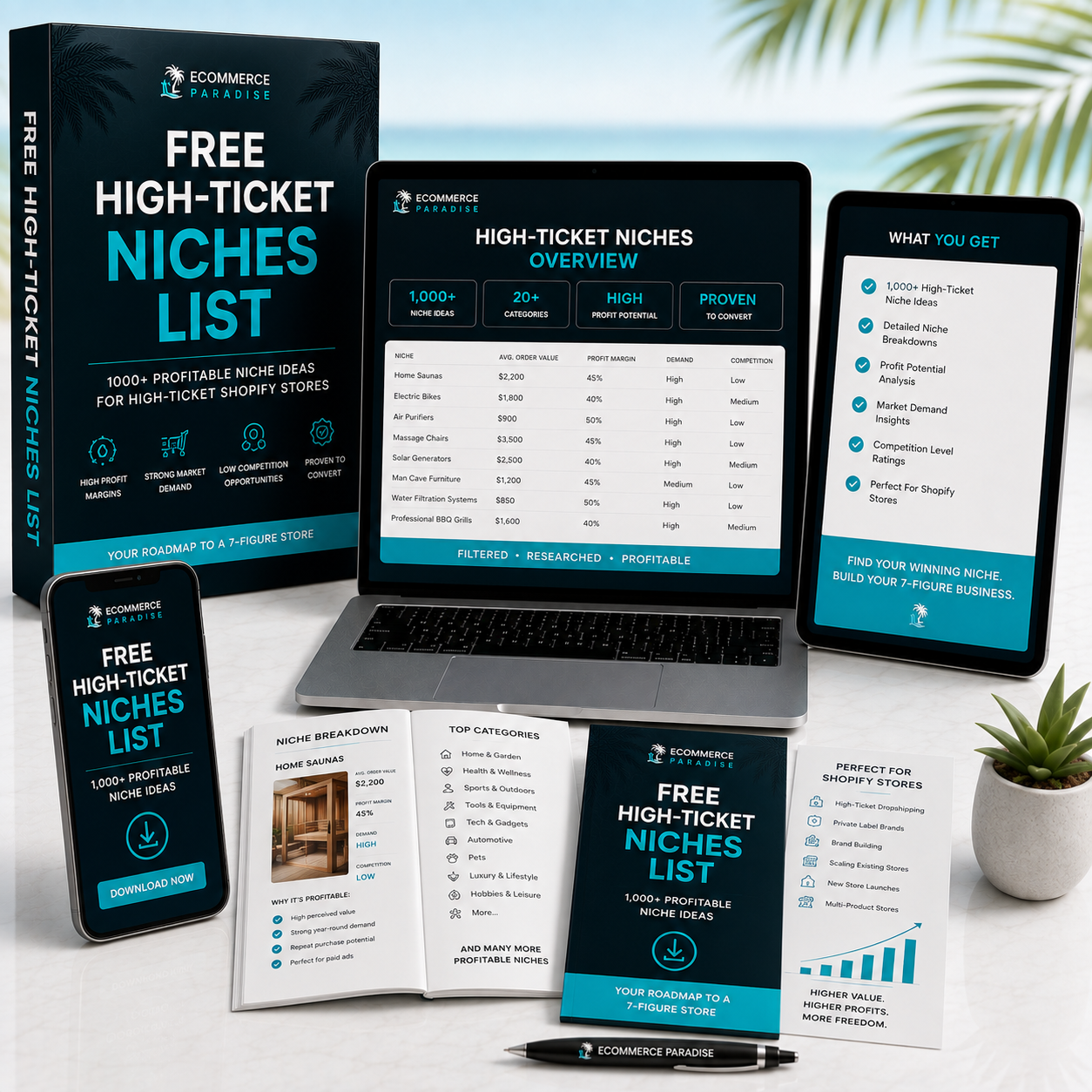
Still deciding what to sell?
Grab the free list of 1,000+ niches that work for high-ticket dropshipping, sorted by category.
Free. Unsubscribe any time.


