

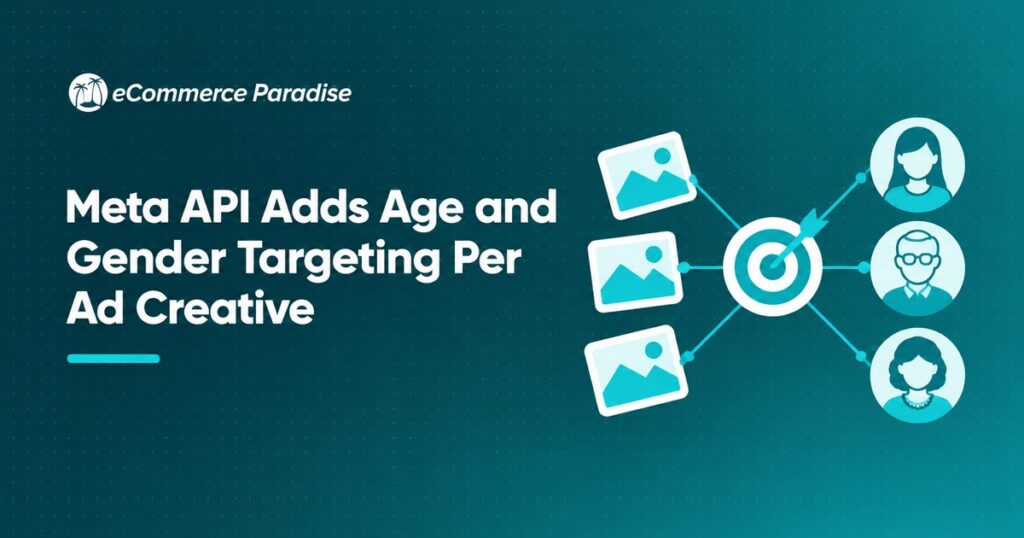
Meta launched a setting on Oct. 19 that lets advertisers give each image or video in one ad set its own age range and gender, per its developer blog.
If you run Meta ads for a high-ticket store, this is the first official way to put a different audience behind each piece of creative without splitting your ad sets. Today it sits in Meta’s Marketing API for partners, not in an Ads Manager dropdown, and it carries restrictions that rule out the Advantage+ audience setup most stores run. This is the Ecommerce Paradise read on what it changes for a store owner selling $2,000 to $10,000 products.
Below: what Meta shipped and what it left unanswered, how it fits a two-year pattern of Meta narrowing the targeting you control, what I’d test first, and a five-step audit to run before Black Friday spend ramps. If you are new to the model, start with my guide to high-ticket dropshipping first.
Your ad account, processor and supplier agreements should sit under a business entity, so form your LLC with Northwest, the best LLC formation service for ecommerce owners. Northwest holds the renewal price at the year-one number with no upsell ladder, which is where cheap formation sites make their money back. Form your LLC with Northwest →
Meta Creative Audience Pairing: What Launched on Oct. 19
Meta published a post on its Meta for Developers blog on Oct. 19, written by Graham Mahon, announcing a feature called “Choose an audience for each ad creative,” according to PPC Land. In the Marketing API the feature is named creative audience pairing. Advertisers can assign an age range and a gender to each image or video inside a single ad set, instead of one audience for the whole set.
Marketing API partners can test it starting Oct. 19, per PPC Land. The article gives no general rollout date. Meta’s stated use is to let advertisers pick the age range and gender each piece of media is “best suited for.”
The mechanics are specific. An ad set opts in with a creative_audience_pairing flag inside targeting_automation, and setting it to 1 turns the feature on. Each creative’s audience lives in a creative_audience_pairing_persona object. For single-asset ads the persona sits on the ad. For multi-asset ads it goes on each asset inside media_sourcing_spec, and any ad-level persona is ignored. Turning the flag on without a persona does nothing.
A persona has three fields. The age_min value must be 18 or older and cannot sit below the ad set’s minimum. The age_max value goes up to 65. The genders field takes up to two values, 1 for male and 2 for female. Omitted fields default to the ad set’s values when you create the ad and keep their current values when you update it.
The restrictions matter more than the fields. The ad set’s minimum age must be between 18 and 25, and its maximum must be 65. The ad set must target all genders, which means single-gender ad sets are not allowed. Meta’s design treats the ad set as a broad container and the personas as narrower segments inside it.
The feature cannot run alongside Advantage+ audience or alongside age and gender suggestions, per PPC Land. Conflicting requests return Graph API error code 100. The change touches eight endpoints, covering reads and writes on ad sets, ads and ad creatives, and the reference examples use Graph API v26.0.
Meta’s post contains no performance data, no test results and no rollout figures, according to PPC Land. The article lists what remains unanswered: whether personas restrict delivery or only signal preferences to Meta’s delivery system, whether the feature will appear in Ads Manager, which markets, objectives and placements qualify, whether reporting breakdowns exist, whether special ad categories can use it, and whether an age_max of 65 includes users older than 65. I found no published advertiser reaction to this specific feature as of Oct. 20.
Meta’s Targeting Controls Keep Shrinking Since January 2025
This feature arrives after two years of Meta taking targeting levers away and handing back narrower ones. On Jan. 21, 2025, Meta announced it was removing detailed targeting exclusions. Meta cited an advertiser test in which the median cost per conversion was 22.6% lower when exclusions were not used. Developers had until April 21, 2025 to finish code changes, and existing campaigns kept running until someone updated the ad set.
Value rules came next. Meta’s bid-adjustment tool lets advertisers raise or lower bids by age, gender, location, operating system and placement, according to Social Media Today, which reported the expansion on Aug. 4, 2025. Meta’s own example raised bids 60% for men aged 25 to 44 and cut them 20% for women in the same range. Meta also warns that “you may see more conversions from your preferred audiences, but your overall cost per result may increase.”
Practitioners split on whether that trade is worth it. A Jan. 6, 2026 PPC Land analysis by Luis Rijo reported that Pleurat Breznica of ProfitMetrics.io opposes value rules in most accounts because they can inflate cost per result without improving profit. Jon Loomer expects a higher cost per conversion but higher-value conversions in return. The same piece says each rule set holds up to 10 rules, with bid adjustments ranging from a 1,000% increase to a 90% decrease.
Loomer’s March 24, 2026 guide to Meta ads targeting describes where the line sits now. Gender cannot be a control by default. It can be a suggestion, or a strict restriction only with Advantage+ turned off, and Loomer advises against restricting by gender. The minimum-age control runs from 18 to 25. His fix when Meta overspends on cheap, low-quality results in one demographic is value rules, not removing the group.
The last six weeks added more. I covered Meta’s past-buyer exclusion and AI ad agent, where Meta warned that cost per acquisition would likely rise and in-platform ROAS would fall once past buyers were excluded. On Oct. 14 I covered Meta’s claim that its GEM model lifted conversions 18.9%, a figure published without a baseline. In July I covered the change that made retargeting audiences bigger, and in August Meta removed the ad placement kill switch.
The counterpoint is Loomer’s standing advice to stay hands-off, treat suggestions as optional and avoid age and gender restrictions. There is also advertiser skepticism toward Meta’s automation. PPC Land’s earlier analysis cited one incrementality test in which Advantage+ produced 17% of the conversions Meta’s attribution reported, set against Meta’s claim of a 22% return on ad spend uplift from Advantage+ creative features. Neither side has data on creative audience pairing yet.
What Per-Creative Age Targeting Means for High-Ticket Stores
My read is that Meta is returning a narrow slice of control and packaging it at the creative level so its delivery system stays in charge. The persona is probably a signal to delivery, not a wall. Meta has not said which, and the answer decides whether this feature is worth your time.
Take a hypothetical store spending $200 a day on Meta prospecting. If 30% of that spend, $60 a day or about $1,800 a month, lands on people outside the age band that ever buys a $3,000 product, that is $1,800 a month of waste before a single bad lead is counted. A per-creative persona is Meta’s first official tool aimed at that leak. The number is illustrative, so pull your own age breakdown before you believe it.
Two scenarios, with a threshold for each. If the persona behaves like a hard limit, a creative written for buyers aged 55 to 65 stays inside that band, and your cost per qualified lead should fall. If it behaves like a hint, expect leakage. My test: after about $1,500 of spend on a persona creative, check the age breakdown at the ad level. If fewer than 80% of impressions land inside the band you set, treat the persona as a suggestion and stop paying for the complexity.
The age ceiling is the part I would watch hardest. Personas stop at 65, and PPC Land lists as unanswered whether 65 includes older users. I teach high-ticket stores to aim at older buyers with money, patience and a card, and categories like mobility, outdoor, furniture and powersports lean that way. If 65 means exactly 65, a creative aimed at the oldest slice of your buyers cannot be pinned there, and I would not assume otherwise until a test shows it.
Gender is the other trap. The ad set has to stay open to all genders, so you cannot build a women-only or men-only ad set with this tool. You can write one creative that speaks to a wife researching a purchase and another that speaks to a husband signing the order, then let each persona narrow its own slice. Use it for message fit, not exclusion. Loomer’s warning about gender restrictions applies even when Meta packages the control differently.
The Advantage+ conflict forces a real trade. High-ticket accounts often see a handful of purchases a week, which leaves Meta’s learning data thin, and Advantage+ audience is the setting that helps Meta find buyers from thin data. I would not convert a working ad set. I would run persona tests as a separate ad set with its own budget cap, no more than 20% of your Meta spend, and keep the control ad set untouched.
Meta is a support channel for most high-ticket stores, not the engine. Google Shopping still does the heavy lifting, which is why my Black Friday Google Ads setup comes before any Meta test. Meta earns its spend through retargeting and discovery, and my breakdown of the best ad platforms for high-ticket dropshipping shows where each one fits. A $3,000 sale also rarely closes in a single session, so creative has to carry a message across weeks, which I cover in marketing high-ticket products with long sales cycles.
Timing matters because demand is rising. The National Retail Federation forecast on Oct. 15 that November and December retail sales will grow 4.2% to $1.013 trillion, up from $972 billion in 2025, which itself rose 3.1%. NRF Chief Economist Mark Mathews said in the release that “consumers remain the bright spot in the economy.” Black Friday is Nov. 27, 38 days from today, and a test that needs two weeks of clean data has to start soon or wait until January.
Cost is the risk I would price in. Meta warned that cost per result may rise when you steer toward preferred audiences, and the past-buyer exclusion warning went the same direction. Judge persona tests on profit per order, not on in-platform ROAS, because Meta’s reported numbers shift whenever its matching or attribution changes. The honest case against all of this is that the accounts winning on Meta today mostly let the algorithm run broad, and one more knob may not beat that.
If running tests like this on top of customer service, supplier orders and ad operations is where you stall, that is the work my team takes on inside the turnkey done-for-you service.
Want to work through your Meta creative tests with other store owners and me before Black Friday? Join the Skool community →
Meta Ads Audit to Run Before Black Friday Spend Ramps
Five steps, in order. None of them needs API access, and all of them help whether Meta’s new setting works or not.
- Open Ads Manager and list every ad set that uses Advantage+ audience or age and gender suggestions. Those cannot take per-creative personas, per PPC Land. Then export the last 30 days broken down by age and gender, with spend and purchases or qualified leads in each bracket.
- Write one creative brief per age bracket that actually buys. Draft variants with Claude, build the image and video cuts in Canva, and see my guide to UGC-style ads without filming anything for the no-camera route.
- Hand the cutting work to a virtual assistant from OnlineJobs.ph, and name every file with its intended audience, for example F-55-65-recliner-v2. Clean names are what let you read results later, whichever way Meta’s delivery behaves.
- Judge creatives on profit, not ROAS. Connect your books to Finaloop so margin per order is visible, and check what competitors run on Google Shopping with Semrush before you decide how much Meta budget a product deserves.
- Capture the age bracket on every phone lead and quote request. Route leads into HubSpot with an age-bracket field, following my lead routing guide for high-ticket stores, and send the follow-up sequence through Omnisend. For a stronger Black Friday plan, my 2026 game plan covers the offer side.
If you would rather have a second set of eyes on the account before you commit budget, book a discovery call and we’ll go through the numbers together.
Frequently Asked Questions
Can I use per-creative audiences in Ads Manager today?
Not according to current reports. Marketing API partners can test it from Oct. 19, and PPC Land lists whether it will appear in Ads Manager as unanswered. Ask your agency or ad tool vendor whether they have access, and keep your Shopify store’s tracking clean in the meantime.
Does it let me target only women or only men?
No. The ad set must target all genders, and single-gender ad sets are not allowed. The persona narrows a creative inside that open ad set, per PPC Land.
Will it work with Advantage+ audience?
No. Meta’s reference says creative audience pairing cannot be combined with Advantage+ audience or with age and gender suggestions, and conflicting requests return Graph API error code 100.
Does the 65 age cap cut off my older buyers?
Unknown. Personas go up to age_max 65, and whether that includes users older than 65 is an open question. Test it before building a campaign around the oldest slice of your buyers.
Should I drop value rules now?
No. Value rules adjust bids and creative audience pairing assigns audiences to creatives, so they do different jobs. Meta warns that cost per result may rise with value rules, so judge both on profit. My high-ticket niches list and the free niches download help if the real problem is a low-margin category.
How much should I spend testing this?
My suggestion: no more than 20% of your Meta budget, in a separate ad set, for about two weeks, with a control ad set left alone. If you are still learning the basics of paid traffic, start with the free mini course.
Want my team to build and run your high-ticket store while you decide where Meta fits? See the turnkey done-for-you service →
I’ll update this when Meta says whether personas limit delivery or only nudge it. Subscribe to the YouTube channel for daily breakdowns. More breaking news coming through the day.
Related Articles
If this was useful, these go deeper:
- Meta’s Muse AI Now Plugs Into Your Shopify and Stripe
- Meta Bans TikTok Ads: What Store Owners Must Do Now
- How to Scale a High-Ticket Dropshipping Store Without Cutting Prices
- Ecommerce Agency: How to Choose One in 2026
- Vibe vs Facebook Ads 2026: How to Use Both for Ecommerce

Trevor Fenner is an ecommerce entrepreneur and the founder of Ecommerce Paradise, a platform focused on helping entrepreneurs build and scale profitable high-ticket ecommerce and dropshipping businesses. With over a decade of hands-on experience, Trevor specializes in high-ticket dropshipping strategy, niche and product selection, supplier recruiting and onboarding, Google & Bing Shopping ads, ecommerce SEO, and systems-driven automation and scaling. Through Ecommerce Paradise, he provides free education via in-depth guides like How to Start High-Ticket Dropshipping, advanced training through the High-Ticket Dropshipping Masterclass, and fully done-for-you turnkey ecommerce services for entrepreneurs who want a faster, more hands-off path to growth. Trevor is known for emphasizing sustainable, real-world ecommerce models over hype-driven tactics, helping store owners build scalable, sellable, and location-independent brands.


