

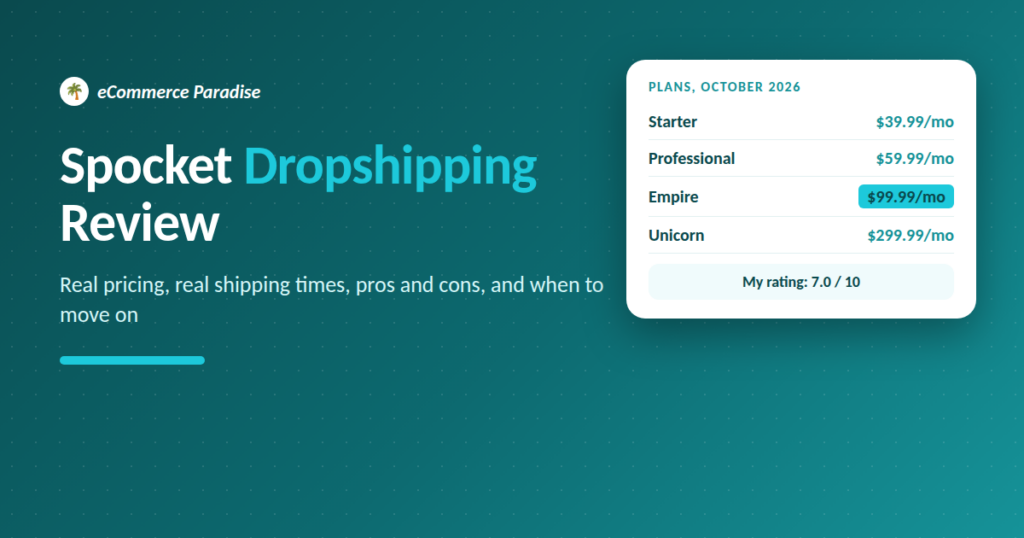
Quick answer: Spocket is a good fit if you sell mid-priced general products to US or EU customers and want suppliers closer to your buyers than AliExpress. I rate it 7.0 out of 10 for that job. Plans run from $39.99 to $299.99 a month as of October 2026, real delivery is closer to 5 to 12 business days than the 2 to 5 you will see in older reviews, and billing complaints are common enough that you should set a cancellation reminder. For high-ticket dropshipping it is the wrong tool, and I rate that fit 3 out of 10.
If you searched for Spocket dropshipping, you probably want three answers: what it costs, how fast it really ships, and whether the products leave you any profit. This review gives you all three, and it replaces an older version of this page that quoted numbers I could no longer confirm.
I have been building online stores for over fifteen years, and through Ecommerce Paradise I teach the higher-priced version of this model. My guide to what high-ticket dropshipping is explains how it differs. That background shapes how I judge Spocket: it is a supplier marketplace for cheaper products, and I will tell you where that helps you and where it holds you back.
Everything here is current as of October 2026. When a number comes from Spocket’s own pages or another source, I name it. When it is my own arithmetic or opinion, I say so. This review contains affiliate links, which I explain in the disclosure near the end.
Start here: get my free high-ticket niches list. The product category you pick sets your margins more than any app does, so look at the options before you pay for a supplier subscription. Get the Free Niches List →
Prefer to watch? Here is my video on whether to start with low-ticket or high-ticket dropshipping.
What’s in This Review
- Quick summary
- Quick verdict
- What Spocket is and what I could verify
- Spocket pricing in October 2026
- Core features
- Shipping: what to promise your customers
- What users say, and the billing issue
- Pros and cons
- The margin problem: mid-priced vs high-ticket
- Spocket alternatives compared
- Who Spocket is for, and who should skip it
- When to move up to high-ticket
- Final rating and verdict
- Frequently asked questions
Quick Summary
| Question | Answer |
|---|---|
| Best for | Shopify or WooCommerce sellers of mid-priced general products (apparel, beauty, home goods, accessories, pet items) who sell mostly to US and EU customers |
| My rating | 7.0 / 10 for mid-priced stores, 3 / 10 for high-ticket stores |
| Pricing | Starter $39.99, Professional $59.99, Empire $99.99, Unicorn $299.99 per month. Annual rates: $24, $57 and $79 per month for the top three. Starter has no annual option. All as of October 2026 |
| Free trial | 7 days, per Spocket’s pricing page and FAQ (a trust badge on the page says 14 days, so confirm at signup) |
| Biggest strength | Suppliers weighted toward the US and EU, so parcels do not start in China |
| Biggest drawback | Thin margins on cheaper products, a 25-product cap on Starter, and repeated billing complaints in public reviews |
| Best alternatives | DSers (free Basic plan), AutoDS (automation), Zendrop, Syncee, SaleHoo or direct dealer accounts for high-ticket products |
How I put this review together: for this update I read Spocket’s pricing page and homepage, its Trustpilot and Shopify App Store listings, and several independent reviews and tests. I did not place a new paid order through Spocket for this update, so where I give shipping times I attribute them to the people who measured them.
Quick Verdict
Spocket does one thing well: it lets you list products from suppliers that are often based in the US or Europe, so your customers wait days instead of weeks. If shipping speed is the thing that has been hurting your reviews and chargebacks, that matters. A store selling $30 to $80 items to US buyers can reasonably start here.
It does not fix thin margins, and it does not remove the work of running a store. Mid-priced products from a marketplace are visible to every other Spocket seller, so you compete on price and ads. If you want to sell larger-ticket products where one order pays real money, you need dealer accounts with brands, which Spocket does not offer.
Get Products Closer to Your Customers Without Building a Supplier Network
Spocket lists suppliers in the US, EU and other regions, offers 0% transaction fees on every plan, and starts with a 7-day trial, so you can test a few products before you commit to a plan.
What Spocket Is and What I Could Verify
Spocket is a Montreal-based dropshipping marketplace that launched in 2017. You connect your store, browse products from supplier listings, import the ones you want, and Spocket passes each order to the supplier, who ships to your customer. It works with Shopify, WooCommerce, BigCommerce, Wix, Squarespace, Ecwid and others, and its homepage also lists eBay and Amazon.
The earlier version of this review repeated several marketing figures. When I checked them again for this update, some did not hold up, so here is a plain comparison.
| Claim you will see | What I found in October 2026 |
|---|---|
| “4.8/5 Trustpilot” | Spocket’s Trustpilot page shows 4.2 out of 5 from 10,664 reviews, with 88% five-star and 8% one-star |
| “2 to 5 day delivery” | Spocket’s homepage gives no delivery time. Independent reviewers report about 4 to 7 business days of US transit plus supplier processing time |
| “50,000+ suppliers” | The homepage says 500,000+ sellers use Spocket and shows a 100M+ catalog figure. Its Shopify listing says 7+ million US and EU products. I could not confirm a supplier count |
| “80% US and EU suppliers” | The homepage says “80% of our US & EU suppliers”, which is worded ambiguously, so treat the figure as marketing |
| Shopify App Store rating | The Spocket Shopify listing shows 3.6 from 624 reviews, with 77% five-star and 14% one-star |
That does not mean Spocket is bad. It means the headline numbers in many reviews are stale or generous, and a mixed 3.6 to 4.2 rating across two review sites is a better guide than a perfect score. I use those figures in my rating below.
Spocket Pricing in October 2026
I read Spocket’s pricing page in October 2026. It lists four paid plans, and the cheapest one is the least useful. Confirm the current price on the page before you pay, because the page contains a few inconsistencies that I note below.
| Plan | Monthly | Annual (per month) | Annual total | Unique products | Premium products |
|---|---|---|---|---|---|
| Starter | $39.99 | Not shown | Not shown | 25 | Not stated |
| Professional | $59.99 | $24 | $288 | 250 | 25 |
| Empire | $99.99 | $57 | $684 | 10,000 | 10,000 |
| Unicorn | $299.99 | $79 | $948 | 25,000 | 25,000 |
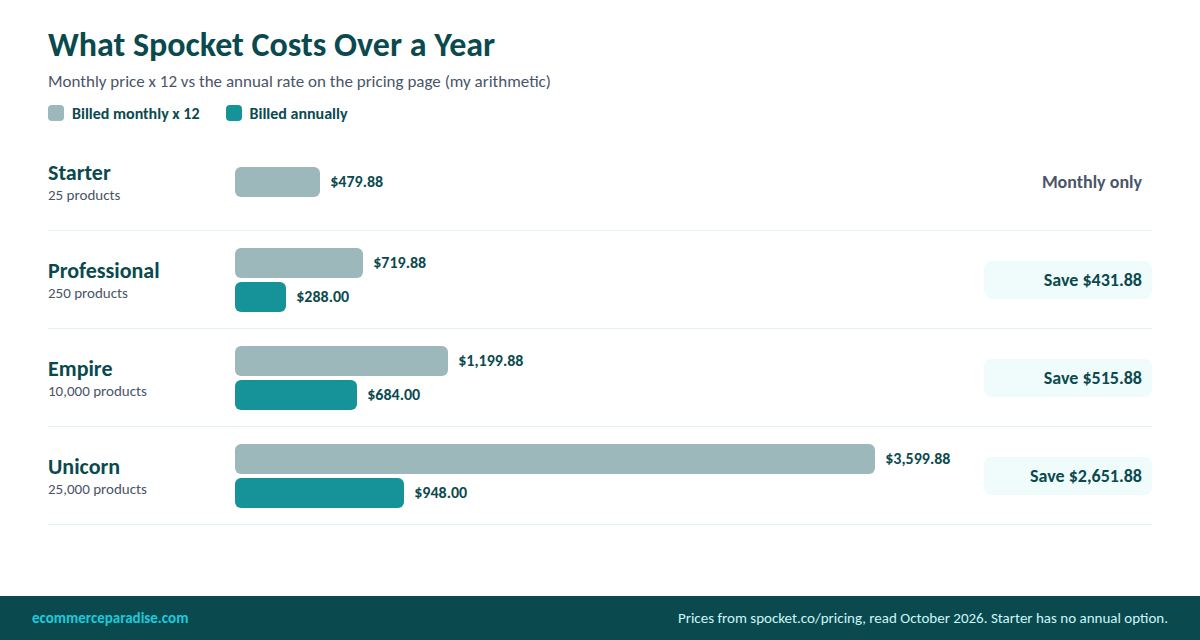
The annual totals are my arithmetic (the monthly annual rate times 12), since the page shows monthly rates only. Every plan card shows a 0% transaction fee and a 7-day trial.
What the annual math says
Annual billing is where the value is. On Professional, twelve monthly payments come to $719.88 and the annual rate is $288, a gap of $431.88. On Empire it is $1,199.88 against $684, a gap of $515.88. Spocket’s own cards say “Save $432” and “Save $516”, which matches.
The Unicorn card says “Save $2563”, but $3,599.88 minus $948 is $2,651.88, so that figure does not match the listed prices. The page toggle also says “FREE 8 months off”, and the cards do not show eight months of savings at every tier, so I would trust the dollar figures I calculated over the toggle wording.
Things the pricing page does not make obvious
- One subscription per store. The plan cards say a separate subscription is required for each store to access all features and VIP support. Two stores on Starter would cost $79.98 a month (my arithmetic).
- Starter is a test plan. Twenty-five unique products is too few for a store that has to survive ad testing, and premium products are not listed for Starter.
- The feature lists changed. An earlier version of this review said branded invoicing started at Professional and eBay and Amazon dropshipping were Empire features. The pricing page now shows branded invoice, eBay and Amazon dropshipping and bulk checkout on every card, Starter included, while the Shopify listing still describes branded invoicing under Pro. Check what your own plan includes before you rely on it.
- The trial is 7 days. The FAQ and cards say 7 days, but one badge on the page says 14 days. Treat 7 days as the number and do not assume extra time.
Software is only part of your monthly cost. Shopify’s Basic plan is $39 a month, or $29 a month billed annually, as of October 2026, and you can start a Shopify trial to see the admin first. Shopify Basic at $39 plus Spocket Professional at $59.99 comes to $98.99 a month, or $1,187.88 a year (my arithmetic), before a domain, samples or ads. My guide to the best Shopify apps for dropshipping prices the rest of the stack.
Core Features
Supplier network weighted toward the US and EU
This is the reason to use Spocket. Instead of overseas marketplaces, you browse listings from suppliers in the US, EU, UK, Canada, Australia and other regions, according to the Shopify listing. The practical benefit is shorter transit, easier returns and fewer surprise customs fees for your buyers.
One-click import and order syncing
You import a product with its images, description and variants, then set your own price. Orders flow to the supplier through the app, and tracking goes back to your store. Imported descriptions are written for every seller, so rewrite them, or you will have the same page as your competitors.
Branded invoicing and supplier chat
Branded invoicing puts your store name on the packing slip so the customer does not see Spocket. Supplier chat lets you ask about stock, packaging or delays directly. Both help if you are building a recognizable store, though a branded slip does not change what is inside the box.
AliScraper and AI store builder
AliScraper imports AliExpress products into Spocket for items missing from the native catalog, with AliExpress shipping times. Spocket’s homepage also advertises an AI store builder. I would use AliScraper sparingly, because it brings back the slow shipping you came to Spocket to avoid.
Inventory sync and samples
Spocket updates stock and pricing from the supplier, which protects you from selling what no longer exists. Reviewers also report that you can order a sample before listing, and I would always do that. Ask any supplier you rely on whether they pack on weekends and what happens when an item sells out after payment.
Skip the Complexity of Vetting Every Supplier Yourself
Browse US and EU supplier listings, order a sample before you list, and use supplier chat to ask about stock and processing time, all inside one dashboard.
Shipping: What to Promise Your Customers
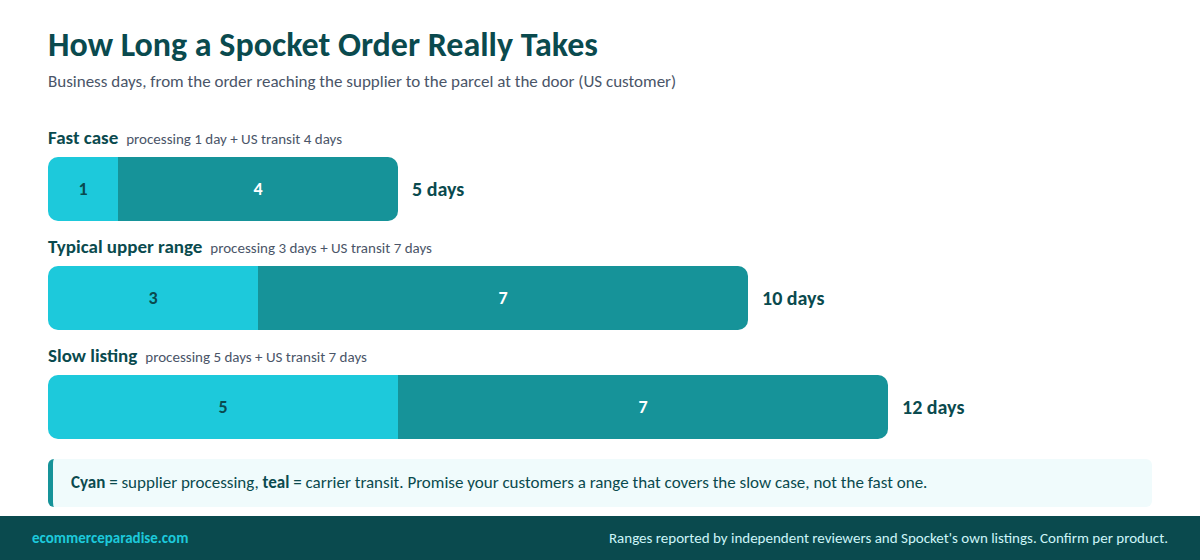
Older Spocket reviews, including the earlier version of mine, say US delivery takes 2 to 5 days. Spocket’s own homepage does not claim that, and independent writers report longer. One reviewer who studied the app writes that most suppliers need 1 to 3 business days to process an order and that US transit typically takes 4 to 7 business days. One hands-on test I read saw a listing with 3 to 5 business days of processing.
Add those together and a realistic US door-to-door range is about 5 to 12 business days, shown below. These ranges come from reviewers, not from my own test order, so check each product page.
That is still much faster than the 7 to 60 days one reviewer estimates for AliExpress orders. It is not Amazon-fast, and it varies by product because every supplier processes orders differently. If you order several items from different suppliers, they ship as separate parcels with separate tracking.
Why the number you promise is a legal matter
The FTC’s business guide to its Mail, Internet, or Telephone Order Merchandise Rule says the person soliciting the order, not the one fulfilling it, is the seller. It also says you need a reasonable basis for any shipping time you state, and if you state none, a reasonable basis for believing you can ship within 30 days. Read the FTC order merchandise rule guide and write your delivery times from what you measure on a sample order.
Imports from outside the US and EU
Some Spocket suppliers and all AliScraper items ship from overseas. For years, parcels worth $800 or less entered the US duty-free under de minimis, and a presidential order suspended that exemption effective August 29, 2025, according to CBS News. Rules keep moving, as my news post on the CBP bond proposal for low-value imports shows. Ask suppliers in writing whether the price you see includes duties.
What Users Say, and the Billing Issue
Public reviews split into two groups. Many sellers praise the interface and the US and EU focus. A steady stream of others describe being billed after a trial or after they thought they had cancelled.
On Trustpilot, the common complaints I saw in the most recent reviews were charges after cancelling or after a free trial, refund requests denied under a no-refund policy, trouble removing saved card details, and slow, template-style support replies. Some sellers also called the catalog limited and the prices high compared with other sourcing options. These are patterns in public reviews, and I cannot tell you how often they happen across all users.
How I would protect myself
- Put a calendar reminder on day 5 of the trial, not day 7.
- Cancel inside your Spocket account, then screenshot the confirmation page.
- Check your card statement the following month.
- If you are billed after cancelling, contact support first and your card issuer if it is not resolved.
Spocket’s FAQ says you can cancel at any time without penalties, so keep your proof in case a dispute follows. Paying with a card you can dispute, not a debit card tied to your rent account, is a sensible habit with any subscription.
Pros and Cons
Pros
- Supplier network weighted toward the US and EU, with shorter transit than overseas marketplaces
- 0% transaction fee listed on every plan
- Annual billing cuts Professional to $24 a month and Empire to $57 a month
- Works with Shopify, WooCommerce, BigCommerce, Wix and more
- Branded invoicing and supplier chat for a more professional customer experience
- Sample orders and automatic stock sync reduce quality and overselling risk
- 7-day trial before the first full charge
Cons
- Mid-priced products leave thin margins once ads, fees and refunds are counted
- Starter is capped at 25 unique products, and the monthly rates on higher plans are expensive
- Public billing and cancellation complaints on Trustpilot, and a 3.6 Shopify App Store rating
- Delivery is slower than marketing suggests: about 5 to 12 business days, by the reviewers I read
- One subscription is required per store
- Other sellers can import the same products, so you compete on price and ads
- Not built for high-ticket products or dealer accounts
The Margin Problem: Mid-Priced vs High-Ticket
This is the part most Spocket reviews skip, and it is why I rate high-ticket fit at 3 out of 10. Card processing has a fixed piece, 30 cents with Shopify’s 2.9% plus 30 cents Basic rate, that does not shrink on a small order. Here is the same $5,000 profit goal on a $59 order and a $2,000 order. Every number is my assumption for illustration.
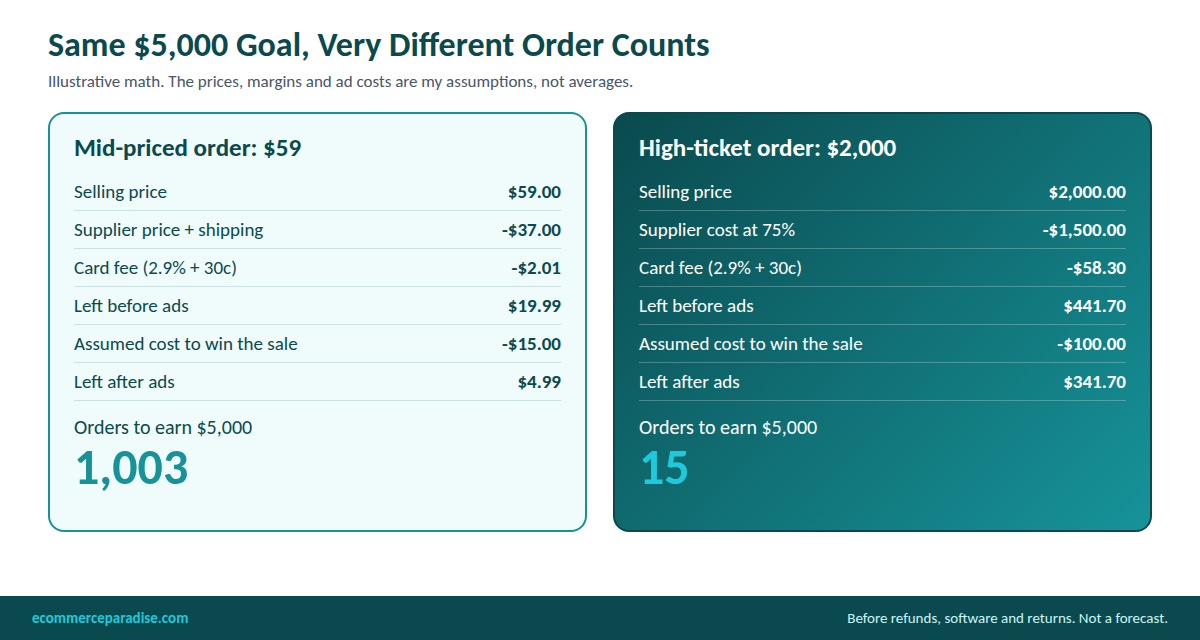
On the $59 order, I assume $30 for the product and $7 for supplier shipping. The card fee is $2.01, which leaves $19.99 before ads. If winning that sale costs $15 in advertising, you keep $4.99, and a $5,000 profit takes 1,003 orders. A 5% refund allowance, $2.95, would take your break-even ad cost down to $17.04.
On the $2,000 order, I assume the supplier takes 75%, so the card fee of $58.30 leaves $441.70 before ads. Pay $100 to win that sale and you keep $341.70, so $5,000 takes 15 orders. That is the case for the higher-ticket version of this business, with different downsides: dealer approval, freight shipping and longer buyer research.
The subscription matters too. At $24 a month on Professional annual billing, Spocket costs about $0.24 an order at 100 orders a month (my arithmetic). That is small against a $441.70 margin and noticeable against $4.99. If you want to improve a thin margin, my post on how to raise dropshipping profit margins without raising prices covers bundling and order value.
Many suppliers also enforce minimum advertised price, so learn what MAP pricing in dropshipping means before you undercut anyone. My high-ticket niches list shows the categories where one order pays properly.
Spocket Alternatives Compared
If Spocket’s price, catalog or billing reputation puts you off, here is how the main options compare. I read each pricing page in October 2026 except where noted. Plans change, so confirm before you buy.
| Option | Entry price (October 2026) | Where its products come from | Best for |
|---|---|---|---|
| Spocket | $39.99/mo Starter, 7-day trial | Vetted marketplace, US and EU weighted | Fast-shipping mid-priced stores |
| DSers | Basic free (3,000 products), Advanced $19.90, Pro $49.90 | AliExpress and similar | Cheapest automation, slower shipping |
| AutoDS | $26.90/mo Import 200 plan, 3-day trial (Shopify listing) | Many marketplaces plus its own tools | Automation across many suppliers |
| Zendrop | Free plan with limited access, Pro $49, Plus $79 per month | Its own catalog with US products | Branded fulfillment and coaching tools |
| Syncee | Free plan, Basic $39.99 with 100 products | Multi-region supplier marketplace | Mixed suppliers on one tool |
| CJdropshipping | I could not confirm a subscription fee from its homepage | Mostly China, with sourcing and 3PL services | Product sourcing and private label |
| Direct dealer accounts | No platform fee, but you apply to each brand | US brands, authorized dealer terms | High-ticket stores |
Zendrop’s page listed the Plus tier ($79) as the “Most Popular” plan and Pro at $49, so read the plan names carefully.
For head-to-head detail, read my Spocket vs DSers comparison. My longer list of seven Spocket alternatives goes further.
My ranking of the best dropshipping suppliers for building a real business covers wholesalers too.
If you want a directory of established US suppliers instead of an app marketplace, the Ecommerce Paradise supplier directory lists them by niche. My guide to how to find suppliers for high-ticket products explains how dealer applications work.
Want help picking a supplier model and getting approved by brands? One-on-one help with your niche and dealer applications can save weeks of trial and error. Ask About Coaching →
Who Spocket Is For, and Who Should Skip It
Spocket fits you if
- You sell mostly to US or EU customers and shipping speed is your main complaint
- Your products sell for roughly $30 to $100, and you can win a sale for a few dollars of ads
- You run a Shopify or WooCommerce store and want a simple import-and-order workflow
- You are willing to commit to annual billing once you have tested a few products
Skip Spocket if
- You want to sell furniture, fitness gear, e-bikes, power equipment or other four-figure products, which are not sold through marketplace apps
- You compete on the lowest price in a crowded category
- You need a free plan to learn on (DSers has one)
- You need to run more than one store without paying for each
When to Move Up to High-Ticket
If you already run a Spocket store, you do not have to start over to sell higher-priced items. The business entity, the Shopify account and your ad-testing skills carry across. What changes is the supplier relationship: you move from marketplace catalogs to approved dealer accounts with established US brands, and you need a registered business to be taken seriously. My business formation guide for high-ticket dropshipping walks through that order of operations.
My guide to how to start dropshipping covers the basics if you want to compare both versions. Here is where I point readers once they have finished this review.
| Where you are | Go here |
|---|---|
| Still choosing a niche | Free niches list |
| Want to learn it yourself, free | Free mini course or the beginner guide |
| Want the full training | High-Ticket Dropshipping Masterclass |
| Want help while you build | Coaching |
| Want a store built for you | Done-for-you build |
| Already selling and want to scale | Store management and ad management |
Prefer to learn the whole high-ticket model yourself? The High-Ticket Dropshipping Masterclass has 18 modules, over 20 hours of training and 10 bonuses, and you choose how to join on the sales page. See the Masterclass →
Final Rating and Verdict
These scores are my own judgment after reading the sources above, not a lab test. The overall score averages the first six rows, because it describes Spocket at its own job. High-ticket relevance is scored separately.
| Category | Score |
|---|---|
| US and EU supplier fit and shipping speed | 8.0 / 10 |
| Product vetting and quality control | 7.5 / 10 |
| Pricing value (annual billing) | 6.5 / 10 |
| Margin potential on mid-priced products | 6.0 / 10 |
| Ease of use and integrations | 8.5 / 10 |
| Billing, cancellation and support reputation | 5.5 / 10 |
| Overall (average of the six) | 7.0 / 10 |
| High-ticket dropshipping relevance (not in the average) | 3.0 / 10 |
The earlier version of this review scored Spocket 8.2. I lowered it because the Trustpilot rating is 4.2 rather than 4.8, the Shopify App Store rating is 3.6, the billing complaints are frequent in public reviews, and real delivery times run longer than the old marketing numbers.
My advice: use the 7-day trial, import a few products from suppliers you have messaged, place a sample order and measure the delivery yourself. If it works for your category, move to annual billing on Professional. If you find your margin is too thin to cover ads, that is the signal to look at the higher-ticket model.
Ready to Test Fast-Shipping Suppliers on Your Own Store?
Start the 7-day trial, order one sample, and measure the delivery time yourself. Set a day-5 reminder so you decide before the first charge.
Disclosure: I may earn a commission if you sign up through my Spocket, Shopify, DSers, AutoDS, Zendrop, Syncee or CJdropshipping links in this review, at no extra cost to you. It does not change what I wrote about their prices or downsides.
Frequently Asked Questions
How much does Spocket cost?
As of October 2026, Spocket lists Starter at $39.99 a month, Professional at $59.99, Empire at $99.99 and Unicorn at $299.99, all billed monthly. Annual billing brings Professional to $24 a month, Empire to $57 and Unicorn to $79, and Starter has no annual option. Every plan shows a 0% transaction fee and a 7-day trial.
Is Spocket legit?
Yes, it is a real, long-running marketplace. Its Trustpilot rating is 4.2 out of 5 from 10,664 reviews, and its Shopify listing shows 3.6 from 624 reviews. The recurring complaints are about charges after cancelling and refund refusals, so cancel carefully and keep proof.
How long does Spocket shipping take?
Spocket’s homepage gives no delivery time. Independent reviewers report 1 to 3 business days of supplier processing and about 4 to 7 business days of US transit, so I would plan on 5 to 12 business days door to door and test each supplier with a sample order.
Is Spocket good for high-ticket dropshipping?
No. Its catalog is built around mid-priced general products. High-ticket dropshipping means applying for dealer accounts with US brands in categories like furniture, fitness equipment and e-bikes, and those brands are not listed on a marketplace app. I explain the model in my guide to high-ticket niches.
Can you make money with Spocket?
It is possible, but it is not a given. Spocket gives you suppliers and automation, not customers, so profit depends on your product margin and what it costs you to win a sale. With a $19.99 margin before ads, a $15 ad cost leaves $4.99 per order, and that math is why many stores struggle.
What is a better alternative to Spocket?
It depends on what you need. DSers has a free Basic plan, AutoDS is stronger on automation, and Zendrop and Syncee offer free plans with limits. For higher-priced products, direct dealer accounts replace the marketplace model entirely.
Want a Working High-Ticket Store Instead of a Marketplace Catalog?
My team builds a high-ticket dropshipping store and lines up suppliers, so you start with a working store and spend your time learning the business. Prefer to learn it yourself? Ask about coaching instead.
Related Articles
If you found this useful, these guides go deeper on related topics:
- Spocket Alternatives: 7 Dropshipping Platforms Compared for 2026
- Spocket Pricing in 2026: A Complete Guide to All Plans, Features, and What You’ll Actually Pay
- Is Spocket Good for Dropshipping in 2026?
- Spocket vs Zendrop in 2026: Curated Quality vs Catalog Depth
- AutoDS Review 2026
Trevor Fenner
Email: trevor@ecommerceparadise.com
Phone: (307) 429-0021
5830 E 2nd St, Ste. 7000 #715, Casper, WY 82609
About | Contact | Resources

Trevor Fenner is an ecommerce entrepreneur and the founder of Ecommerce Paradise, a platform focused on helping entrepreneurs build and scale profitable high-ticket ecommerce and dropshipping businesses. With over a decade of hands-on experience, Trevor specializes in high-ticket dropshipping strategy, niche and product selection, supplier recruiting and onboarding, Google & Bing Shopping ads, ecommerce SEO, and systems-driven automation and scaling. Through Ecommerce Paradise, he provides free education via in-depth guides like How to Start High-Ticket Dropshipping, advanced training through the High-Ticket Dropshipping Masterclass, and fully done-for-you turnkey ecommerce services for entrepreneurs who want a faster, more hands-off path to growth. Trevor is known for emphasizing sustainable, real-world ecommerce models over hype-driven tactics, helping store owners build scalable, sellable, and location-independent brands.


