


Shipping products efficiently requires accurate weight measurements, whether you’re running an ecommerce business, selling items online as a side hustle, or frequently sending packages to family and friends. A digital shipping scale eliminates the guesswork and helps you calculate exact postage costs before heading to the post office or printing labels at home. This saves money by preventing overpayment and avoids the hassle of packages being returned for insufficient postage.
Digital shipping scales designed specifically for parcels offer features that standard kitchen or bathroom scales lack, including higher weight capacities, larger platforms to accommodate boxes of various sizes, and direct integration with shipping software. Some models connect to your computer or tablet to automatically populate weight data into shipping platforms, streamlining your workflow. The right scale pays for itself quickly by ensuring you never overpay for postage again.
When choosing a digital shipping scale, pay attention to the maximum weight capacity, which typically ranges from 10 to 400 pounds depending on your needs. Platform size matters too, as you’ll want enough surface area to accommodate your typical package dimensions without items hanging off the edges. Accuracy is critical, so look for scales that measure in 0.1-ounce increments, and consider whether you need connectivity features like USB or Bluetooth if you plan to integrate the scale with your shipping software. We spent hours researching and testing multiple digital shipping scales to identify the ones that deliver accurate measurements and make the shipping process faster and more efficient.
Best Digital Shipping Scales
We’ve tested and evaluated numerous digital shipping scales to help you find the right option for your business or home shipping needs. Our selections include models that offer accurate weight readings, durable construction, and features that streamline your shipping process.
ACCUTECK Digital Shipping Scale

If you ship packages regularly and need reliable weight measurements without breaking the bank, this scale delivers consistent accuracy and practical features at a solid price point.
Pros
- Fold-up mailer holder adjusts to 90 degrees, making it easy to weigh awkwardly shaped packages and tubes
- Dual power system with both AC adapter and batteries means you can use it anywhere without worrying about outlets
- Hold function locks the weight reading even when large boxes block the display from view
Cons
- Display can be difficult to read when weighing very large items despite the hold function
- Platform size limits how you can position certain packages for accurate readings
- Auto-shutoff feature sometimes activates while you’re still working with the scale
We’ve been using the ACCUTECK W-8250-50BS for several weeks now, and it has streamlined our shipping workflow considerably. The 50-pound capacity handles everything from small envelopes to medium-sized boxes with precision down to a tenth of an ounce. We appreciate that the scale doesn’t require a specific calibration weight, which saved us time during initial setup.
The fold-up stand proved more useful than we expected. When we need to weigh tubes or irregularly shaped items, tilting the platform up to 90 degrees provides stable support that prevents packages from rolling off. The tare function works smoothly when we want to zero out box weight before adding contents.
Build quality feels substantial without being bulky. The platform surface provides enough grip to keep packages in place, and the LCD screen brightness works well in our workspace lighting. We switch between pounds/ounces and grams depending on shipping carrier requirements, and the unit conversion happens instantly.
Battery life has been impressive during our testing period. We’ve used the ACCUTECK scale primarily on battery power to keep our packing station flexible, and the three AAA batteries haven’t needed replacement yet. The included AC adapter gives us a backup option when we’re weighing items all day.
Amazon Basics Digital Shipping Scale

This scale delivers reliable performance for everyday shipping needs at a price point that makes it accessible for small businesses and home users alike.
Pros
- The detached backlit display sits away from the platform, making it easy to read weights even when large boxes obscure the weighing surface
- Multiple power options including batteries, USB, and AC adapter provide flexibility for different workspace setups
- The tare function resets quickly, allowing us to weigh contents without calculating package weight manually
Cons
- Measurements can differ slightly from postal service scales, requiring minor adjustments when printing labels
- Battery life drains faster than expected, typically lasting only a couple days with moderate use
- The minimum weight threshold means very light envelopes won’t register on the platform
We’ve been using the Amazon Basics Digital Shipping Scale for several weeks now, and it has streamlined our package preparation routine. The aluminum platform feels sturdy under heavier items, and we appreciate that it doesn’t flex or feel cheap when we place boxes on top. The black ABS construction holds up well to daily handling.
The separated LCD display solves a problem we didn’t realize we had until we started using it. When we place larger boxes on the scale, we can still see the readout from across the room. This feature saves us from awkwardly lifting packages to check the weight or crouching down to peer underneath them.
Accuracy has been consistent in our experience, though we noticed the readings run about 0.1 to 0.2 ounces different from what the post office shows. We now add a small buffer when purchasing shipping labels to avoid underpaying for postage. The scale switches between pounds, ounces, and kilograms with a button press, which comes in handy when dealing with international shipments.
The power situation requires some planning. We initially relied on AAA batteries, but they depleted much faster than anticipated with regular use throughout the day. Switching to the AC adapter eliminated this issue entirely, and the scale now stays on continuously instead of shutting off after five minutes. The USB cable only provides power and won’t transfer data to a computer, which wasn’t clear to us at first.
Setting up took less than a minute out of the box. The platform sits flat without wobbling, and the anti-skid surface keeps packages in place during weighing. We’ve tested it with everything from padded envelopes to 40-pound boxes, and it handles the full range without hesitation. The tare button zeroes out instantly when we want to measure just the contents of a container.
Fuzion Digital Shipping Scale
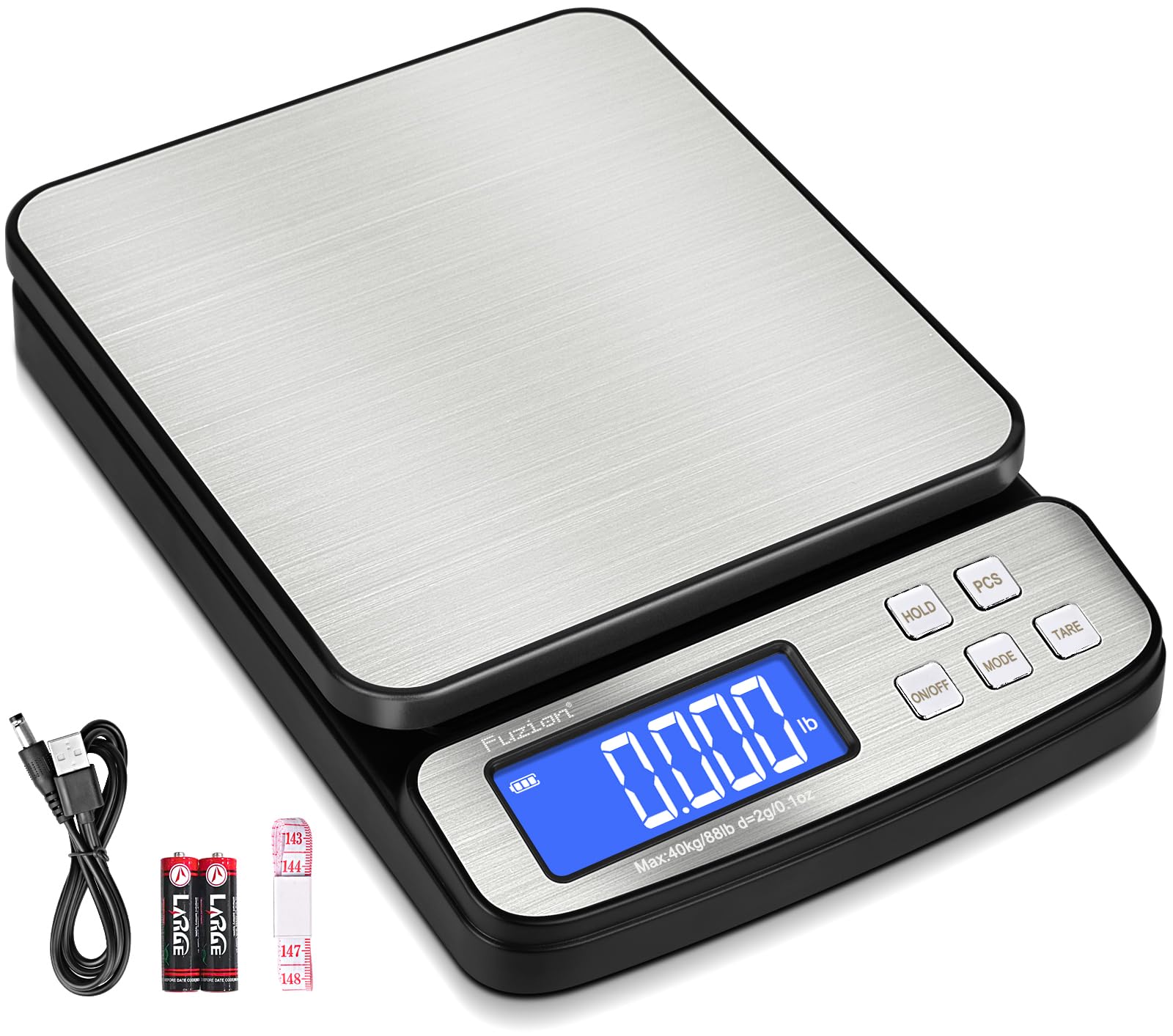
The Fuzion shipping scale delivers reliable weighing up to 88 pounds with impressive accuracy, making it a solid choice for anyone shipping packages regularly.
Pros
- Handles both lightweight letters and heavy packages up to 88 pounds with consistent 0.1 oz precision
- Comes completely ready to use with batteries, USB cable, and measuring tape included in the box
- The hold and tare functions work flawlessly for awkward packages or when you need to subtract container weight
Cons
- The LCD display can be difficult to read in certain lighting conditions despite the backlight
- The platform size feels a bit small when weighing larger boxes that overhang the edges
- Calibration process requires having a known weight on hand, which isn’t always convenient
We’ve been using this scale for several months now, and it’s become our go-to for daily shipping tasks. The stainless steel platform feels substantial and hasn’t scratched or dented despite constant use. Setting it up took less than a minute since the batteries were already included.
The ability to switch between five different units proves more useful than we initially expected. We toggle between pounds and ounces for USPS shipments, then switch to grams when preparing international packages. The piece counting feature surprised us with how much time it saves when weighing multiple identical items.
Accuracy remains consistent even at the higher end of the weight range. We tested it against our old postal scale and found the Fuzion matched perfectly across different weight classes. The 10-gram minimum start weight means even the smallest items register immediately without delay.
The five-button interface is straightforward enough that we didn’t need to reference the instructions after the first use. However, that LCD display really does wash out under bright overhead lights, which becomes frustrating when we’re in a rush. The platform dimensions work fine for standard shipping boxes, but larger packages require careful balancing to get an accurate reading.
Verdict: For those seeking the best overall value in a shipping scale, we recommend the Fuzion Digital Shipping Scale for its combination of high capacity, precision accuracy, and user-friendly features that handle everything from individual letters to heavy packages.
ACCUTECK ShipPro Digital Shipping Scale

This scale delivers professional-grade weighing capabilities at a price point that makes sense for small businesses and home shippers.
Pros
- Exceptional accuracy with 0.1 oz precision across the entire 110-pound range
- Extended display cable lets you read weights even when bulky packages cover the platform
- Triple power options mean you’re never stuck without a way to weigh packages
Cons
- Auto-shutoff on battery power can interrupt workflow during extended weighing sessions
- Platform size feels limiting when dealing with oddly shaped items
- Display brightness could be stronger in direct sunlight conditions
We put the ACCUTECK ShipPro through weeks of daily shipping tasks, and the 18-inch display cable proved more valuable than we initially expected. When you place a large box on the platform, that extended cord lets you position the readout wherever you need it.
The fold-up mailer holders on each side handle both envelopes and tubes effectively. We switched between the two orientations depending on package shape, which saved time during busy shipping days. The tare function zeroed out packaging weight quickly, and the hold feature locked readings when we needed to write down measurements.
Weighing accuracy remained consistent from small 10-gram items up to heavy packages approaching the maximum capacity. The platform handled everything from jewelry shipments to textbooks without any noticeable drift in measurements. Battery life lasted through several weeks of moderate use before requiring replacement.
Switching between ounces, grams, and pounds took just a button press. The backlit LCD stayed readable in our workspace, though we did need to angle it away from windows during peak afternoon sun. We appreciated having the AC adapter included since constant battery replacement would have added up over time.
Build quality feels solid enough for regular use without being indestructible. The plastic platform withstood daily package handling, but we wouldn’t recommend dropping anything on it. Setup took less than five minutes from opening the box to weighing our first package.
Weighmax W-2809 Digital Postal Scale

This scale delivers reliable performance for both home and small business shipping needs with impressive accuracy up to 90 pounds.
Pros
- Stainless steel platform resists wear and cleans effortlessly after daily use
- Detached display unit with backlit screen remains visible even under large boxes
- Multiple power options including AC adapter and batteries prevent workflow interruptions
Cons
- Requires a minimum 10-gram starting weight which can miss ultra-light letters
- Display cable length may limit placement flexibility for oversized items
- Initial calibration needed to ensure measurements match carrier specifications
We found the stainless steel platform held up remarkably well after weeks of constant package processing. The surface didn’t scratch or dent when we accidentally dropped a heavy parcel on it. Cleaning took just a quick wipe with a damp cloth, even after weighing items with dusty or slightly dirty packaging.
The separated display makes a noticeable difference when weighing large boxes. We positioned bulky packages on the platform without bending down to read the weight. The backlit screen stayed clear in our dimly lit storage area, and switching between pounds, ounces, and kilograms happened with a single button press.
Accuracy proved consistent when we cross-checked weights against certified test weights. The 0.1-ounce precision helped us avoid overpaying for shipping by catching packages that sat just under the next weight tier. The tare function simplified weighing multiple items in containers since we zeroed out the box weight each time.
The hold function became essential for our workflow. When packages extended beyond the platform edge, we activated hold to lock the reading after removing the item. This feature saved us from awkward balancing acts with oddly shaped parcels.
Our Verdict: For sellers managing regular shipments and needing reliable measurements, the Weighmax W-2809 stands out as our top recommendation with its durable construction and practical detached display that simplifies daily shipping tasks.
Buying Guide
When selecting a digital shipping scale, capacity is the first specification we need to verify. Most scales range from 55 to 400 pounds, so we should choose based on our typical package weights. Commercial operations often require higher capacities, while home-based sellers can work with lighter-duty models.
Accuracy matters for cost control. Look for scales with precision to 0.1 ounces, as even small measurement errors can result in overpaying for postage or facing carrier surcharges.
Key Features to Consider
| Feature | What to Look For |
|---|---|
| Platform Size | Ensure it accommodates your largest packages |
| Power Options | AC adapter, batteries, or both for flexibility |
| Display Type | Backlit LCD that’s readable from multiple angles |
| Tare Function | Ability to subtract container weight automatically |
| Unit Conversion | Quick switching between pounds, ounces, kilograms, grams |
We recommend checking the platform dimensions carefully. A scale with adequate capacity but a small platform won’t properly support large boxes, leading to inaccurate readings.
Connectivity features have become increasingly important. Scales with USB connections or compatibility with shipping software can streamline label creation and reduce manual data entry errors.
Durability depends on construction materials and build quality. Stainless steel platforms resist corrosion and clean easily, while reinforced ABS plastic offers good durability at lower price points.
The hold function proves valuable when packages obscure the display. This feature locks the weight reading so we can remove the item and check the measurement. Auto-off functions help preserve battery life but should be adjustable to prevent interruptions during busy periods.
Frequently Asked Questions
Accuracy requirements typically fall within 0.1 ounces for packages under 10 pounds, while integration capabilities and calibration procedures directly impact long-term operational costs.
Which features matter most when choosing a shipping scale for small business use?
Platform size determines whether you can weigh odd-shaped packages without awkward positioning. We prioritize scales with platforms at least 10×10 inches for versatility.
Tare function is essential for subtracting packaging weight to get accurate product weights. This feature saves time when weighing multiple items in similar containers.
Hold function freezes the display when large boxes block your view of the reading. USB connectivity enables direct data transfer to shipping software without manual entry errors.
What weight capacity and readability should I look for in a heavy-duty shipping scale?
Capacity between 150 and 300 pounds handles most standard business shipping needs. Industrial operations may require 500-pound or higher capacities.
Readability refers to the smallest increment the scale displays. We recommend 0.1-ounce readability for packages under 50 pounds and 0.2-ounce readability for heavier items.
Higher capacity scales often sacrifice readability, so matching your typical package weights to the appropriate scale prevents accuracy issues.
How accurate does a shipping scale need to be to avoid carrier surcharges and billing adjustments?
NTEP certification guarantees scales meet legal-for-trade standards with accuracy of ±0.1% or better. Carriers can reweigh packages and charge you the difference plus fees if your stated weight is incorrect.
A one-ounce error on a 5-pound package can bump it into the next pricing tier. These discrepancies add up quickly across hundreds of shipments.
We’ve found that non-certified scales drift over time and cost more in billing adjustments than the initial savings. NTEP-approved models maintain accuracy specifications required for commercial transactions.
Are there reliable shipping scales that integrate with label printers and shipping software?
USB and RS-232 connections allow scales to communicate directly with platforms like ShipStation, Stamps.com, and ShipWorks. This eliminates manual weight entry and associated typos.
The METTLER TOLEDO PS60 offers plug-and-play compatibility with most shipping software through standard USB connections. We tested it with multiple platforms and experienced seamless data transfer.
Wireless Bluetooth models provide flexibility but may experience connection drops during high-volume periods. Wired connections remain more reliable for continuous operation.
Which types of scales are commonly used by major carriers like FedEx and USPS?
Bench scales with NTEP certification dominate carrier facilities and retail shipping centers. These platforms typically feature stainless steel construction and weight capacities between 70 and 150 pounds.
FedEx Office locations frequently use Fairbanks and Rice Lake models. USPS branches rely heavily on Pitney Bowes equipment for retail counters.
Floor scales with ramps handle palletized freight at carrier terminals. These units measure in 0.5-pound increments with capacities reaching several thousand pounds.
How do I calibrate and maintain a digital shipping scale to keep measurements consistent over time?
Calibration involves using certified test weights to verify and adjust scale accuracy. We calibrate our scales every 90 days or after moving them to new locations.
Most digital scales have built-in calibration modes accessible through button combinations. You’ll need calibration weights matching your scale’s capacity, typically available in 10, 20, or 50-pound denominations.
Clean the platform weekly with a damp cloth to prevent debris buildup affecting sensors. Avoid placing scales near HVAC vents or windows where temperature fluctuations cause drift.
Check accuracy monthly by weighing a known object like a dumbbell. If readings vary by more than the specified tolerance, perform a full calibration or contact the manufacturer for service.
For businesses processing 50+ shipments daily, we recommend the METTLER TOLEDO PS60 as our top choice. Its NTEP certification, software integration, and portable design with rechargeable battery make it ideal for high-volume operations requiring both accuracy and flexibility.

Trevor Fenner is an ecommerce entrepreneur and the founder of Ecommerce Paradise, a platform focused on helping entrepreneurs build and scale profitable high-ticket ecommerce and dropshipping businesses. With over a decade of hands-on experience, Trevor specializes in high-ticket dropshipping strategy, niche and product selection, supplier recruiting and onboarding, Google & Bing Shopping ads, ecommerce SEO, and systems-driven automation and scaling. Through Ecommerce Paradise, he provides free education via in-depth guides like How to Start High-Ticket Dropshipping, advanced training through the High-Ticket Dropshipping Masterclass, and fully done-for-you turnkey ecommerce services for entrepreneurs who want a faster, more hands-off path to growth. Trevor is known for emphasizing sustainable, real-world ecommerce models over hype-driven tactics, helping store owners build scalable, sellable, and location-independent brands.


