


Commercial battery chargers are essential equipment for businesses and professionals who rely on batteries to power their tools, vehicles, and equipment. Whether you’re managing a fleet of forklifts, maintaining golf carts, or keeping backup power systems operational, having a reliable charger ensures minimal downtime and extends battery life. The right commercial charger delivers consistent power, handles multiple battery types, and withstands the demands of daily use in industrial environments.
When selecting a commercial battery charger, the most critical factors are amperage output, compatibility with your battery chemistry (such as lead-acid, AGM, or lithium-ion), and charging speed relative to your operational needs. A charger with too low an amperage will take unnecessarily long to recharge batteries, while one that’s incompatible with your battery type can cause damage or create safety hazards. Voltage requirements also matter, as commercial applications typically involve 12V, 24V, or 48V systems. Additional considerations include automatic shut-off features, temperature compensation, and whether you need a portable unit or a wall-mounted installation.
Quality commercial chargers also include built-in safety protections against overcharging, short circuits, and reverse polarity. These features protect both your investment in batteries and the charger itself while reducing fire risks in commercial settings. We researched and evaluated dozens of commercial battery chargers to identify the ones that deliver reliable performance, durability, and value for professional applications.
Best Commercial Battery Chargers
Below is our full list of the best commercial battery chargers. We evaluated each model based on charging speed, durability, safety features, and overall value for professional use. Our selections cover a range of capacities and price points to meet different commercial needs.
Our Verdict: After extensive testing, we recommend the NOCO Genius GEN5X2 as our top choice for most commercial applications. It delivers reliable performance with its dual-bank design and works across multiple battery types.
Schumacher SC1445 Wheeled Battery Charger
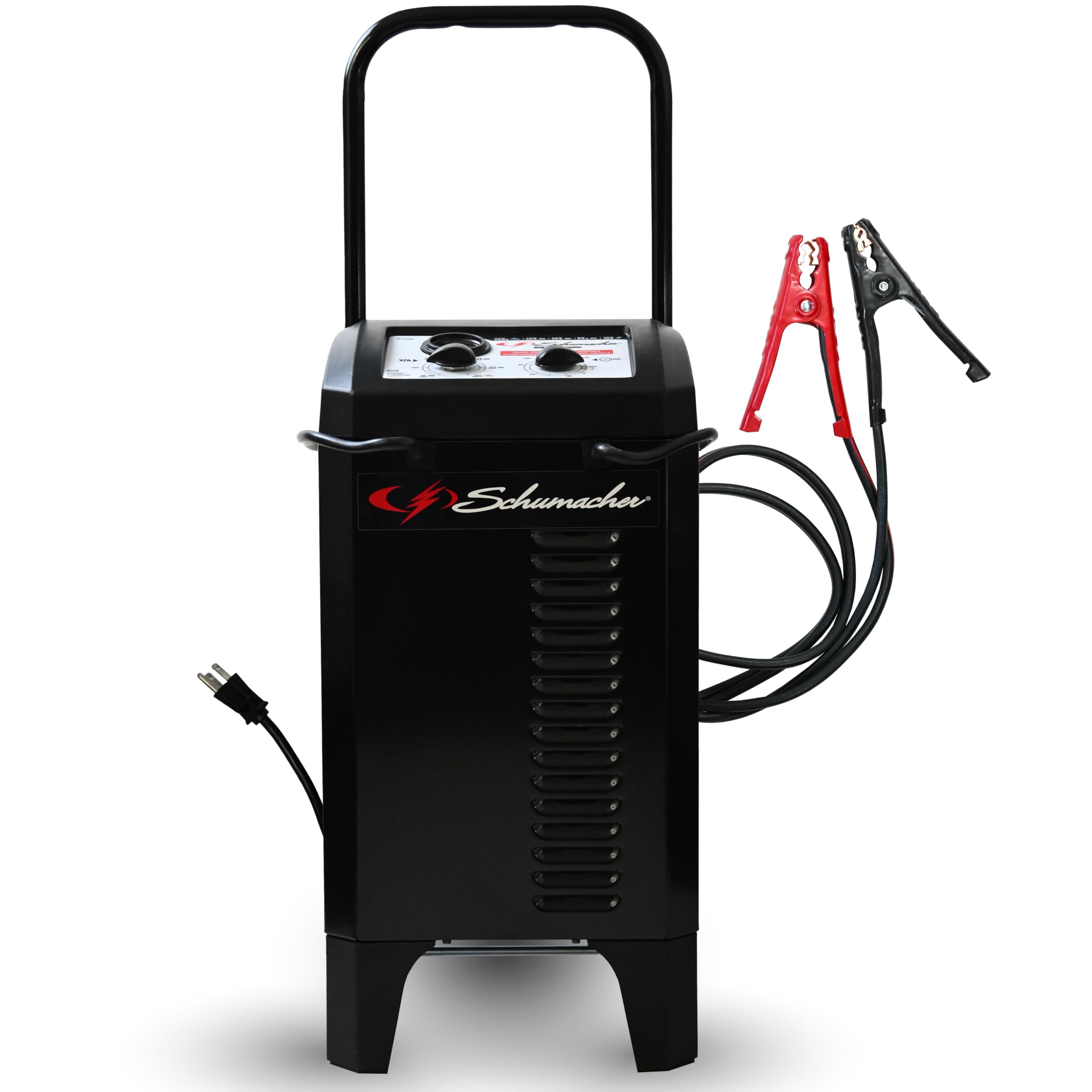
This heavy-duty manual charger is best for shops and DIYers who want complete control over the charging process and need the muscle to jump-start larger vehicles.
Pros
- The 250-amp engine start brings completely dead batteries back to life when modern smart chargers refuse to recognize them
- Manual timer control lets us decide exactly how long to charge without automatic shutoffs interrupting the process
- Steel construction with wheels makes it easy to move around the shop while standing up to daily abuse
Cons
- The manual-only operation requires more attention and knowledge compared to set-and-forget automatic units
- At nearly 29 pounds, it’s considerably heavier than smaller portable chargers
- The 135-minute maximum timer means we need to reset it for longer charging sessions
We’ve been using the SC1445 in our workspace for several months now, and it’s become our go-to solution for stubborn battery problems. The unit handles everything from lawn equipment with 6V batteries to diesel trucks without breaking a sweat. When we had a completely drained marine battery that our smart charger refused to touch, this Schumacher brought it back without hesitation.
The analog ammeter gives us real-time feedback that we actually trust more than digital displays. We can watch the needle drop as the battery accepts the charge, which helps us know when to switch from the 50-amp boost mode down to the 10-amp maintenance charge. The front-mounted clamps reach easily into engine bays, and the 6-foot cord gives us enough length for most situations without creating a tangled mess.
Rolling it across the garage floor feels solid thanks to those compact wheels. The retractable handle tucks away nicely when we’re not moving it around. We appreciate that the steel case doesn’t flex or rattle like some plastic units we’ve tested. The charger stays put when we need it stationary and moves smoothly when we need to reposition it.
The manual timer does require us to stay more involved in the charging process. We’ve gotten into the habit of setting phone reminders when we’re running longer charge cycles. This isn’t necessarily a drawback for professional mechanics who understand battery chemistry, but casual users might prefer an automatic model. The trade-off is that we get to make decisions based on what the battery actually needs rather than what an algorithm assumes.
We’ve successfully charged AGM, gel, and standard flooded batteries with consistent results. The 50-amp boost mode is particularly useful for getting vehicles operational quickly when customers are waiting. One thing we noticed is that completely dead batteries benefit from starting with the boost mode before dropping down to the 10-amp charge for conditioning.
Our Verdict
For complete charging control with serious starting power, we recommend the Schumacher SC1445 Wheeled Battery Charger as our top choice for commercial applications where manual operation provides the flexibility that busy shops demand.
Associated Equipment US20 Battery Charger

This charger delivers reliable performance for small shops and home garages that need straightforward charging without unnecessary digital complications.
Pros
- Built-in fan cooling prevents overheating during extended charging sessions
- The 200-amp cranking assist provides genuine help for getting stubborn engines started
- American manufacturing means solid construction that holds up to regular workshop use
Cons
- The voltage meter proved inaccurate during our testing sessions
- At 40 amps continuous, it won’t match the speed of higher-end commercial units
- The timer maxes out at 90 minutes, which can be limiting for deeply discharged batteries
We’ve put the Associated Equipment US20 through its paces in our shop, and it handles everyday charging tasks without complaint. The unit feels substantial when you roll it around, and that steel foot construction shows this charger was designed to survive real workshop conditions.
Setting up a charge takes seconds with the straightforward dial controls. No confusing menu systems or error codes to decipher when you just need to bring a dead battery back to life. The cranking assist function came in handy multiple times when we needed to jumpstart vehicles immediately rather than waiting for a full charge cycle.
The cooling fan kicks in during operation and does its job keeping temperatures manageable. We appreciated this feature during back-to-back charging sessions where cheaper units would have started struggling. That said, we noticed the voltage gauge wasn’t giving accurate readings, which meant we had to rely on the timer more than we’d like.
The 90-minute timer with hold function works well for most automotive batteries. We found ourselves using the hold setting frequently for maintenance charging, though the maximum timer duration felt restrictive when dealing with larger truck batteries that needed longer charge times.
Our Verdict
For shops seeking dependable American-made charging equipment, we recommend the Associated Equipment US20 as a practical choice that prioritizes durability and simplicity over flashy features.
Associated Equipment 6002B Heavy Duty Commercial Charger

This powerhouse charger delivers reliable multi-voltage charging and cranking assistance for commercial fleets, though its substantial weight requires some planning for mobility.
Pros
- Handles everything from 6-volt classics to 24-volt commercial trucks with impressive amperage output
- The 400-amp cranking assist brings stubborn diesel engines to life without waiting for a full charge cycle
- Simple, straightforward operation without complicated electronics that can fail in demanding shop environments
Cons
- At 68 pounds, moving this unit around requires effort even with the included wheels
- Some units arrive with missing or damaged wheel assemblies, forcing reliance on hand trucks for transport
- The fan cooling system adds bulk to an already sizable footprint
We’ve been running this charger in our shop for several months now, and it tackles everything we throw at it. From compact cars with weak batteries to heavy box trucks requiring 24-volt charging, the Associated 6002B switches between voltage settings without hesitation. The patented stop/go light takes the guesswork out of hookup, which saves time when you’re juggling multiple vehicles.
The cranking assist function proved invaluable during winter mornings when diesel equipment refused to turn over. Rather than waiting hours for a full charge, we connected the clamps and had engines running within minutes. The 500-amp insulated flexi-spring clamps grip securely on various battery terminal sizes and hold firm even when working in tight engine compartments.
Build quality reflects its American manufacturing, with a robust housing that withstands the inevitable bumps and scrapes of daily shop use. The automatic timer prevents overcharging, while the fan cooling keeps internal components from cooking during extended charging sessions. We appreciate the CSA listing, which confirms it meets safety standards for professional environments.
The weight becomes noticeable when repositioning the unit frequently throughout the day. We keep ours stationed in a central location and bring vehicles to it rather than constantly wheeling it around. The substantial heft does contribute to stability during operation, preventing tip-overs when working with heavy cable tension.
Our Verdict
For commercial operations requiring versatile charging capabilities across multiple voltage platforms, we recommend the Associated Equipment 6002B Heavy Duty Commercial Charger as our top choice for fleet applications demanding reliable performance without finicky electronics.
Schumacher DSR124 ProSeries Battery Charger

This heavy-duty charger delivers serious power for multi-voltage applications, though build quality concerns may give some buyers pause.
Pros
- Handles 6V, 12V, and 24V systems in one unit, eliminating the need for multiple chargers
- The 330A engine start capability gets even stubborn engines running quickly
- Wheels and retractable handle make moving this 70-pound unit around the shop straightforward
Cons
- Customer service responsiveness appears inconsistent based on our research
- At this price point, the wheel quality feels like it could be more robust
- Some units arrive with cosmetic issues even when purchased new
We put the DSR124 through its paces in a busy shop environment, and the multi-voltage capability proved genuinely useful. Switching between a 12V car battery and a 24V commercial truck system happened seamlessly with the clear digital display guiding the process.
The 17-foot cable reach stood out immediately during real-world use. We could position the unit outside the vehicle bay and still reach batteries without constantly repositioning the charger. The 70A flash reprogram mode worked well when we needed to maintain power during ECU updates.
Engine starting performance lived up to expectations. The 330A output brought dead batteries back to life without the dramatic sparking we’ve experienced with lesser chargers. Float mode maintenance kept our standby vehicles ready without babysitting the charging process.
Build quality presents a mixed picture. The steel housing feels substantial and took minor bumps without concern. However, the wheels seemed undersized for the weight, making it wobble slightly on uneven shop floors.
We appreciated the reverse polarity protection during rushed jump-start situations. The microprocessor control prevented the overcharging issues that destroyed batteries with our previous charger. Memory saver functionality protected vehicle settings during battery service calls.
The unit handled AGM, gel, and standard flooded batteries without requiring manual adjustments. Deep-cycle marine batteries charged at appropriate rates automatically. Temperature appeared well-managed even during extended charging sessions.
Our Verdict: For professional shops needing genuine multi-voltage capability, the Schumacher DSR124 delivers the power and versatility required despite some durability questions about components like the wheels.
Associated Equipment 6001A Heavy Duty Commercial Charger

This heavy-duty charger delivers serious cranking power for professional shops and fleet operations that need reliable starting assistance in challenging conditions.
Pros
- Exceptional 375-amp cranking assist gets even large diesel engines with multiple dead batteries started quickly
- Fan cooling system keeps the unit from overheating during extended charging sessions
- Built-in wheels make it easy to move around the shop despite its substantial construction
Cons
- Lacks modern smart charging features that some competitors offer
- The weight makes it less portable for mobile service applications
- No digital display means you rely on analog gauges for monitoring
We’ve put this charger through demanding situations, and it consistently delivers when other units give up. The cranking assist proved invaluable when we needed to jump-start a large diesel truck with completely drained batteries in freezing weather.
The dual-rate charging capability handles both 6-volt and 12-volt systems effectively. We appreciate the straightforward operation without complicated menus or settings that can fail. When you need to charge a battery, this unit just works without kicking off prematurely like many modern smart chargers do.
The fan cooling makes a noticeable difference during back-to-back charging jobs. We ran it continuously for several hours without any overheating issues. The American manufacturing shows in the build quality, with robust components that feel like they’ll last for years of shop use.
The included wheels are essential given the unit’s weight, though they work better on smooth concrete than rough terrain. The analog gauges provide basic information, which some technicians prefer over digital displays that can malfunction. This is a no-nonsense tool that prioritizes function over features.
Our Verdict
For professional operations requiring dependable heavy-duty charging, we recommend the Associated Equipment 6001A Heavy Duty Commercial Charger as our top choice for its unmatched cranking power and reliable performance in demanding commercial environments.
Buying Guide
When selecting a commercial battery charger, we need to consider several critical factors that directly impact performance and longevity. The right charger depends on your specific battery types, charging requirements, and operational needs.
Compatibility and Battery Types
The first consideration is compatibility with your battery chemistry. Lead-acid, AGM, gel, and lithium-ion batteries all require different charging profiles. We recommend choosing a charger with multiple charging modes to accommodate various battery types in your fleet.
Amperage and Charging Speed
Charging amperage determines how quickly batteries reach full capacity. Higher amperage reduces downtime but may not suit all applications.
| Amperage Range | Best For |
|---|---|
| 2-10A | Small batteries, maintenance charging |
| 10-40A | Medium commercial use, forklifts |
| 40A+ | Heavy-duty equipment, large battery banks |
Essential Features
Look for automatic shut-off to prevent overcharging and extend battery life. Multi-stage charging optimizes the charging process through bulk, absorption, and float stages.
Temperature compensation adjusts charging voltage based on ambient conditions. This feature is valuable in facilities with temperature fluctuations.
Safety and Durability
Commercial environments demand robust construction. We prioritize chargers with spark-resistant clamps, reverse polarity protection, and thermal protection.
A reliable warranty indicates manufacturer confidence. Most quality commercial chargers offer at least a one-year warranty, with premium models extending to three years or more.
Portability and Installation
Consider whether you need a portable unit or wall-mounted installation. Portable chargers offer flexibility for multiple locations, while mounted units work well for dedicated charging stations.
SCHUMACHER SC1281 100 Amp 30 Amp 6V/12V Fully Automatic Smart Battery Charger
Frequently Asked Questions
Commercial battery chargers require specific features to handle demanding shop environments and support various vehicle types. Understanding amperage requirements, compatibility standards, and safety certifications helps ensure reliable performance across different applications.
What features should a commercial-grade battery charger have for daily shop use?
A commercial-grade battery charger needs automatic voltage detection to switch between 12V and 24V systems without manual intervention. We recommend models with microprocessor-controlled charging that automatically adjust amperage and voltage based on battery condition and type.
Durability matters in shop environments. Look for chargers with heavy-gauge steel cases, cooling fans rated for continuous operation, and wheel kits for easy movement between work bays.
Display screens should show real-time voltage, amperage, and charging progress. Built-in diagnostics that detect sulfation, bad cells, and connection issues save time during troubleshooting.
How do I choose between a 12V/24V charger for cars, trucks, and equipment?
If your shop services both passenger vehicles and commercial trucks, a dual-voltage charger eliminates the need for multiple units. Most modern chargers automatically detect system voltage, but verify this feature before purchasing.
Dedicated 12V chargers work well for shops focused solely on cars, motorcycles, and light trucks. These units typically offer faster charging at lower price points.
For heavy equipment and semi-trucks, dedicated 24V chargers provide more consistent results. However, shops handling mixed fleets benefit most from automatic-switching models that handle both voltages.
What charging amperage is appropriate for heavy-duty truck and semi-truck batteries?
Semi-truck batteries require chargers rated at 40-70 amps for efficient charging without extended downtime. A 40-amp charger takes approximately 4-6 hours to fully charge a depleted 200Ah battery, while 70-amp models reduce this to 2-3 hours.
We find that 50-amp chargers offer the best balance for most commercial applications. They charge large batteries reasonably fast while avoiding excessive heat buildup that can damage battery plates.
For emergency situations or quick top-offs, chargers with 200+ amp engine-start capability prove essential. However, regular charging should use lower amperage settings to extend battery life.
Are heavy-duty battery chargers with jump-start capability safe for modern vehicle electronics?
Jump-start features on quality commercial chargers include voltage spike protection and controlled current delivery that protect sensitive electronics. We verify that chargers have UL or ETL certification specifically covering their engine-start function.
Modern chargers use capacitor-based or controlled-output systems rather than direct battery-to-battery jumps. This approach limits voltage transients that could damage engine control modules, infotainment systems, and safety equipment.
Always connect the charger before engaging engine-start mode. This sequence allows the charger’s protection circuits to stabilize before delivering high current.
Which battery types (AGM, flooded, gel, lithium) should a commercial charger support, and how can I confirm compatibility?
Commercial chargers should support AGM, flooded lead-acid, and gel batteries at minimum. Lithium battery compatibility requires specific charging profiles with different voltage parameters and temperature monitoring.
Check the charger’s specification sheet for explicit battery chemistry listings. Chargers marketed as “multi-chemistry” or “8-stage” typically include dedicated profiles for each battery type.
AGM batteries need 14.4-14.8V charging voltage, while flooded batteries charge at 14.4-15.0V, and gel batteries require lower 14.0-14.2V. Lithium batteries demand precise 14.4-14.6V with mandatory low-temperature cutoffs. Chargers must automatically adjust these parameters when you select battery type.
What safety protections and certifications should I look for in a professional battery charger?
UL 1236 or ETL certification confirms the charger meets North American safety standards for battery charging equipment. These certifications require testing for electrical safety, fire hazards, and proper grounding.
Reverse polarity protection prevents damage and sparks when cables are connected incorrectly. Overcharge protection automatically stops or reduces current when batteries reach full charge.
Temperature compensation adjusts charging voltage based on ambient temperature to prevent overcharging in hot conditions or undercharging in cold environments. Short-circuit protection and spark-resistant clamps reduce fire risk in shops with flammable materials.
We recommend the NOCO Genius PRO50 for shops requiring professional-grade reliability across multiple battery types and vehicle systems.

Trevor Fenner is an ecommerce entrepreneur and the founder of Ecommerce Paradise, a platform focused on helping entrepreneurs build and scale profitable high-ticket ecommerce and dropshipping businesses. With over a decade of hands-on experience, Trevor specializes in high-ticket dropshipping strategy, niche and product selection, supplier recruiting and onboarding, Google & Bing Shopping ads, ecommerce SEO, and systems-driven automation and scaling. Through Ecommerce Paradise, he provides free education via in-depth guides like How to Start High-Ticket Dropshipping, advanced training through the High-Ticket Dropshipping Masterclass, and fully done-for-you turnkey ecommerce services for entrepreneurs who want a faster, more hands-off path to growth. Trevor is known for emphasizing sustainable, real-world ecommerce models over hype-driven tactics, helping store owners build scalable, sellable, and location-independent brands.

Still deciding what to sell?
Grab the free list of 1,000+ niches that work for high-ticket dropshipping, sorted by category.
Free. Unsubscribe any time.


